
Spain Self-Monitoring Blood Glucose Devices Market Size and Share
Market Overview
| Study Period | 2021 - 2032 |
|---|---|
| Forecast Data Period | 2027 - 2032 |
| Historical Data Period | 2021 - 2025 |
| Base Year Market Size (2026) | USD 330.22 Million |
| Market Size (2027) | USD 352.41 Million |
| Market Size (2032) | USD 487.85 Million |
| Growth Rate (2027 - 2032) | 6.72 % |
Major Players *Disclaimer: Major Players sorted in no particular order Image © Mordor Intelligence. Reuse requires attribution under CC BY 4.0. | |
Spain Self-Monitoring Blood Glucose Devices Market Analysis by Mordor Intelligence
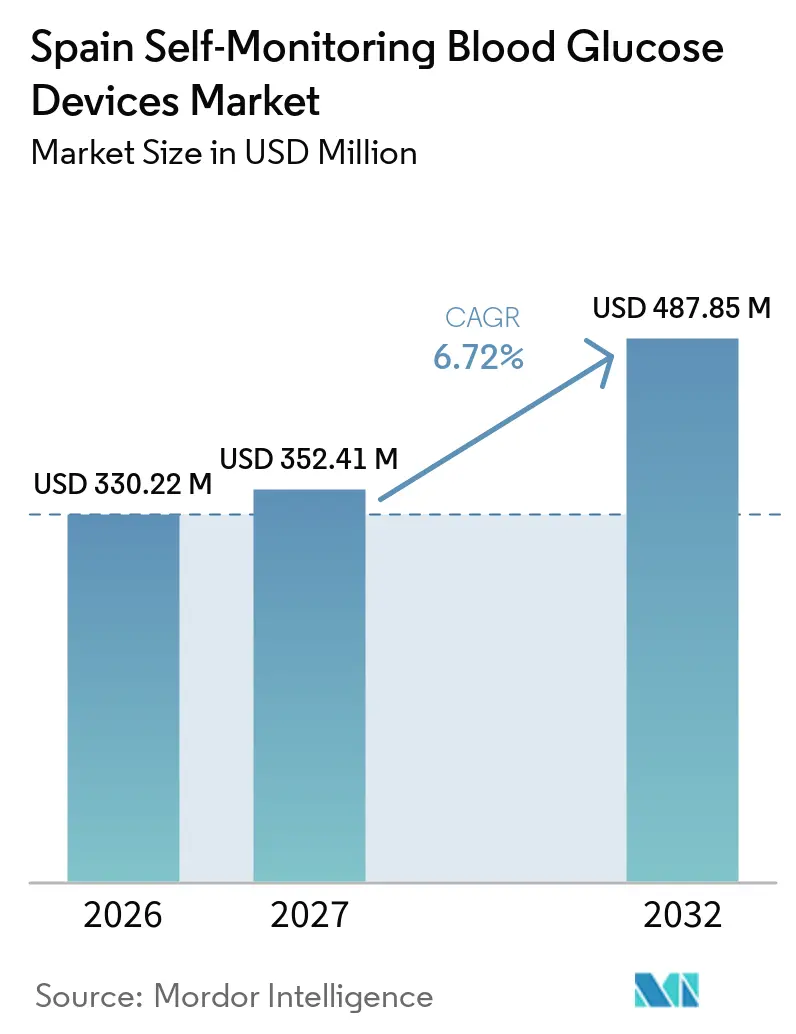
The Spain Self-Monitoring Blood Glucose Devices Market size is expected to grow from USD 330.22 million in 2026 to USD 352.41 million in 2027 and is forecast to reach USD 487.85 million by 2032 at 6.72% CAGR over 2027-2032.
Diabetes was quickly recognized as a risk factor for bad results during the COVID-19 pandemic. This risk was influenced by several variables frequently present in diabetes mellitus, such as advanced age, a proinflammatory and hypercoagulable condition, hyperglycemia, and underlying comorbidities (hypertension, cardiovascular disease, chronic kidney disease, and obesity). That's why managing or delaying cases of diabetes became more important. The use of telemedicine or self-monitoring blood glucose helped improve glycemic control during the COVID-19 pandemic.
Blood glucose monitoring increases patients' awareness of glucose values, which supports healthy lifestyle choices. Blood glucose monitoring values help provide feedback and guidance on making health behavior changes when needed. Continued elevation in blood glucose levels in diabetes patients can contribute to progressive complications such as renal, nerve, and ocular damage. Appropriate and timely monitoring of blood glucose allows the successful management of out-of-range blood glucose levels, minimizing diabetic-related health complications.
Innovative technologies, such as digital health apps that display and summarize individual blood glucose measurements and incorporate additional relevant data such as insulin doses, meals, and physical activity, can further support self-management while decreasing disease burden and benefiting overall diabetes care. Integration of blood glucose monitoring with insulin calculators, automated insulin titration software, and remote coaching are further developments that provide patients with poorly controlled diabetes with the additional support needed to improve critical outcomes, thereby enhancing market prospects in the years to come.
Note: Market numbers in this report are based on Mordor Intelligence's proprietary estimation framework, which combines nine months of actuals with Q4 projections for base year 2026.
Spain Self-Monitoring Blood Glucose Devices Market Trends and Insights
Rising Diabetes Prevalence in Spain
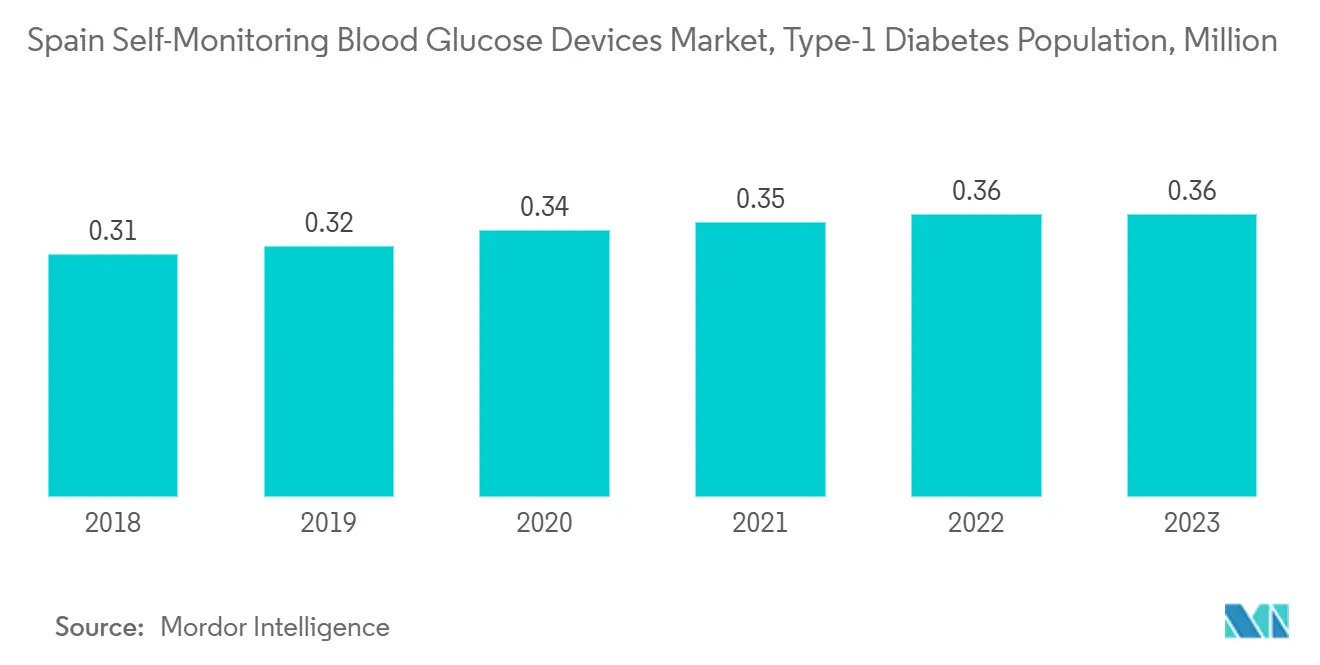
In Spain, the diabetes population is expected to increase by more than 2.5% over the forecast period.
According to the IDF report, diabetes prevalence in Spain reached 14.8%, or one in seven adults, the second highest rate in Europe. In addition, diabetes-related health expenditures in Spain reached 15.5 billion USD. Almost 30.3% of people living with diabetes in Spain were undiagnosed. When diabetes is undetected or inadequately treated, it can cause serious and life-threatening complications, such as heart attack, stroke, kidney failure, blindness, and lower-limb amputation. These result in reduced quality of life and higher healthcare costs.
According to the Sociedad Española de Diabetes (SED), diabetes education has become an urgent healthcare priority rather than simply a necessary component of treatment. The rising prevalence of diabetes and ongoing advances in disease monitoring and management have increased the need for comprehensive patient education and equitable access to innovative diabetes care resources. The SED highlights the progress in diabetes management driven by technological innovation. For instance, Spain has approved reimbursement for flash glucose monitoring systems for people with type 2 diabetes receiving basal-bolus insulin therapy.
Self-monitoring of blood glucose plays a central role in enabling people with diabetes to manage their condition effectively. Blood glucose measurements allow patients and healthcare professionals to modify dietary habits, lifestyle practices, insulin treatment, and medication regimens to maintain glucose levels within the target range. Modern glucometers use highly sensitive test strips and sensors to deliver accurate readings that closely align with laboratory results. The growing focus on early diabetes detection, improved self-care, and better glycemic control supports demand in the Spain self-monitoring blood glucose devices market. In addition, expanded reimbursement coverage and the adoption of advanced glucose monitoring technologies are expected to strengthen market growth during the forecast period.
Therefore, the studied market is anticipated to witness growth over the analysis period due to rising prevalence and the aforementioned factors.
The Test Strips Segment holds the highest market share in the current year
The test strip segment recorded a market share of about 76.9% in the current year.
Blood glucose test strips are compact, single-use components that support blood glucose monitoring. When a user applies a blood sample to the strip, glucose in the blood reacts with glucose oxidase, producing gluconic acid. The glucose meter then sends an electrical current through the strip. Electrical terminals on the strip allow the meter to measure the current, which varies according to the amount of gluconic acid generated. Using this variation, the blood glucose meter applies an algorithm to calculate the user's blood glucose level.
Test strips are expected to account for stronger market share growth than glucose meters due to their higher frequency of use. While a glucometer is generally purchased once and can last from six months to three years, test strips are required for every test and must be discarded after a single use. As a result, test strips create recurring expenditure throughout the lifespan of the glucose meter.
In the Spain Self-Monitoring Blood Glucose Devices Market, the recurring need for test strips is expected to support their continued demand. The increasing focus on regular blood glucose monitoring among individuals with diabetes is also likely to contribute to test strip consumption.
Diabetes care requires the tracking and monitoring of many different test results and processes while simultaneously controlling risks to prevent complications. People with diabetes face complex medical regimens and often encounter numerous health professionals responsible for elements of the management of the disease and the prevention of its complications. Recent studies show that the implementation of electronic health records is not sufficient to improve the quality of diabetes care. The use of a diabetes registry for managing diabetes and preventing its complications by tracking clinical outcomes is widely recommended.
The aforementioned factors are expected to drive the market over the forecast period.
Competitive Landscape
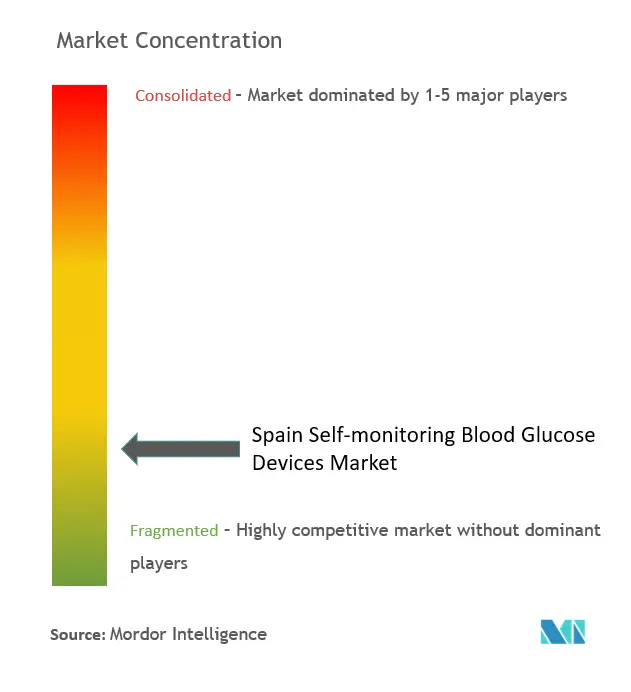
The Spanish self-monitoring blood glucose device market is moderately fragmented, with few significant and other generic players. Manufacturers like Abbott, LifeScan, Ascensia, etc. occupy a major share.
Spain Self-Monitoring Blood Glucose Devices Industry Leaders
-
Roche Diabetes Care
-
Abbott Diabetes Care
-
Ascensia Diabetes Care
-
LifeScan
-
Sinocare
- *Disclaimer: Major Players sorted in no particular order
Recent Industry Developments
- January 2023: LifeScan announced that the peer-reviewed Journal of Diabetes Science and Technology published Improved Glycemic Control Using a Bluetooth-Connected Blood Glucose Meter and a Mobile Diabetes App: Real-World Evidence from Over 144,000 People with Diabetes, detailing results from a retrospective analysis of real-world data from over 144,000 people with diabetes-one of the largest combined blood glucose meter and mobile diabetes app datasets ever published.
- January 2022: Roche announced the launch of the Cobas Pulse system in selected countries accepting the CE Mark. The Cobas Pulse system marks Roche Diagnostics' newest generation of connected point-of-care solutions for professional blood glucose management. The Cobas Pulse system combines the form factor of a high-performance blood glucose meter with simple usability and expanded digital capabilities like those of a smartphone.
Spain Self-Monitoring Blood Glucose Devices Market Report Scope
Self-monitoring of blood glucose is an approach used by diabetic patients to measure their blood sugar level themselves using a glucometer, test strips, and lancets. Based on the readings, patients can adjust or check the effect of their treatment. The Spanish self-monitoring blood glucose device market is segmented by components. The report offers the value (in USD) and volume (in units) for the above segments.
| Glucometer Devices |
| Test Strips |
| Lancets |
| Component | Glucometer Devices |
| Test Strips | |
| Lancets |
Key Questions Answered in the Report
How big is the Spain Self-Monitoring Blood Glucose Devices Market?
The Spain Self-Monitoring Blood Glucose Devices Market size is expected to reach USD 352.41 million in 2027 and grow at a CAGR of 6.72% to reach USD 487.85 million by 2032.
What is the current Spain Self-Monitoring Blood Glucose Devices Market size?
In 2026, the Spain Self-Monitoring Blood Glucose Devices Market size is expected to reach USD 330.22 million.
Who are the key players in Spain Self-Monitoring Blood Glucose Devices Market?
Roche Diabetes Care, Abbott Diabetes Care, Ascensia Diabetes Care, LifeScan and Sinocare are the major companies operating in the Spain Self-Monitoring Blood Glucose Devices Market.
What years does this Spain Self-Monitoring Blood Glucose Devices Market cover, and what was the market size in 2025?
In 2025, the Spain Self-Monitoring Blood Glucose Devices Market size was estimated at USD 309.43 million. The report covers the Spain Self-Monitoring Blood Glucose Devices Market historical market size for years: 2021, 2022, 2023, 2024, and 2025. The report also forecasts the Spain Self-Monitoring Blood Glucose Devices Market size for years: 2027, 2028, 2029, 2030, 2031, and 2032.