Market Overview
| Study Period | 2020 - 2031 |
|---|---|
| Forecast Data Period | 2026 - 2031 |
| Base Year Market Size (2025) | USD 2.91 Billion |
| Market Size (2026) | USD 3.44 Billion |
| Market Size (2031) | USD 7.95 Billion |
| Growth Rate (2026 - 2031) | 18.23% CAGR |
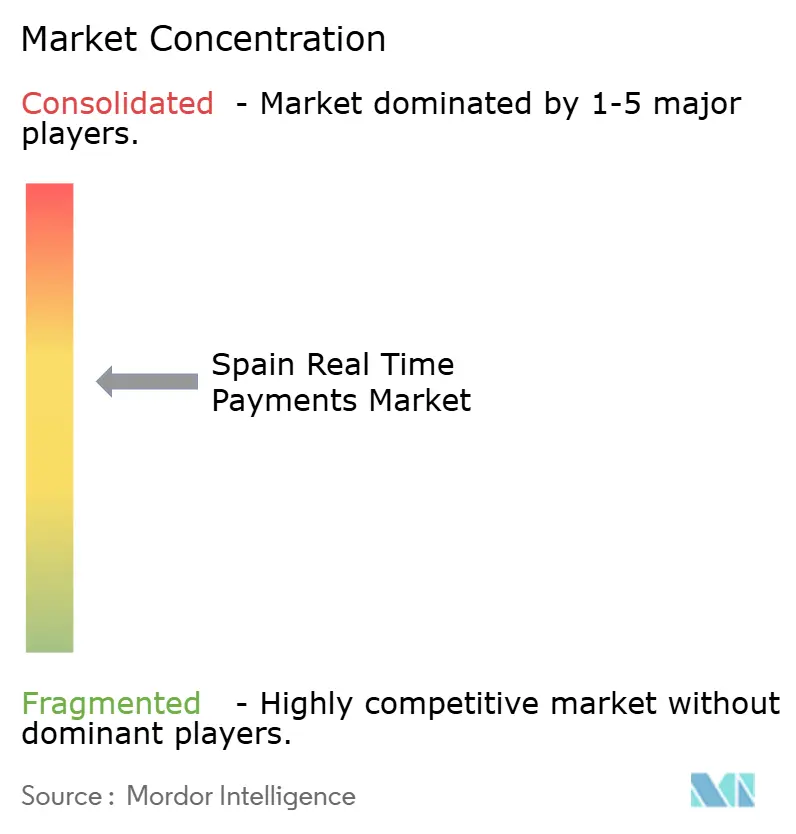
| Market Concentration | Medium |
Major Players *Disclaimer: Major Players sorted in no particular order Image © Mordor Intelligence. Reuse requires attribution under CC BY 4.0. | |
Spain Real Time Payments Market Analysis by Mordor Intelligence
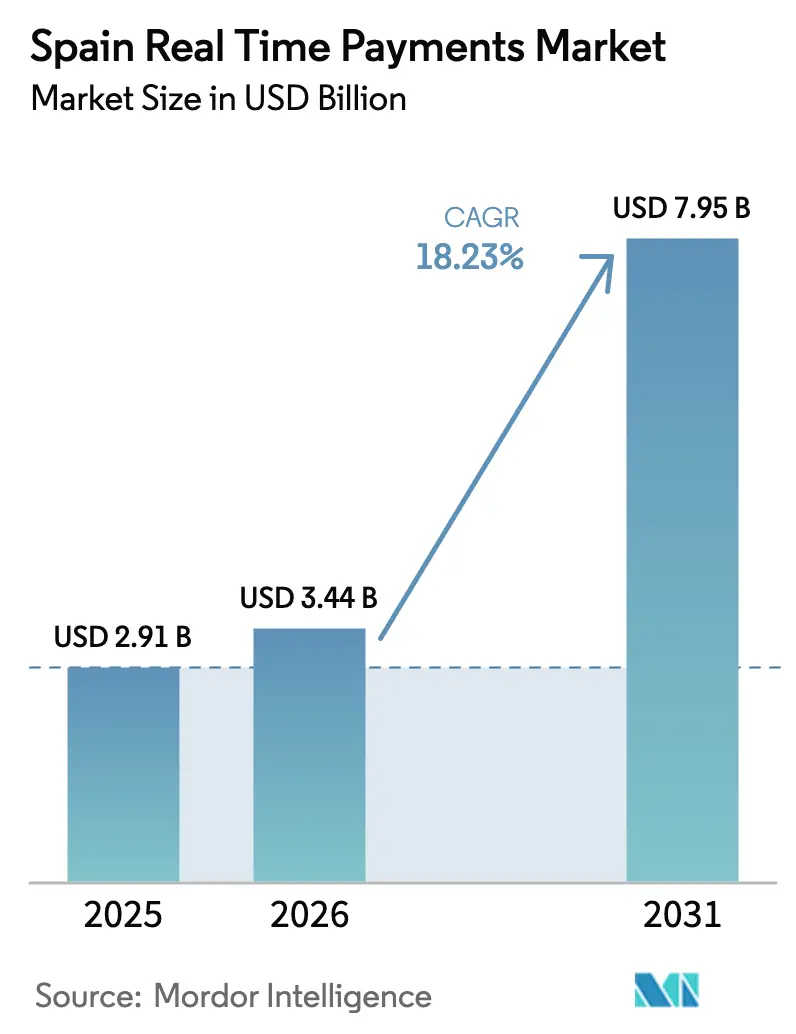
The Spain real time payments market size is expected to grow from USD 2.91 billion in 2025 to USD 3.44 billion in 2026 and is forecast to reach USD 7.95 billion by 2031 at 18.23% CAGR over 2026-2031. Rapid scale-up reflects Spain’s 53% instant-transfer penetration-well above the 15% European average. Mandated SEPA Instant Transfer rules effective January 2025, fee caps that equalize instant and regular credit transfers, and early ISO-20022 migration create strong compliance pressures that favor instant rails. [1]European Commission, “Regulation (EU) 2023/xxxx on Instant Payments,” ec.europa.eu Merchant demand for account-to-account (A2A) checkout, 5G-enabled mobile ubiquity, and rising fintech-bank partnerships further reinforce growth. Cloud modernization among mid-tier banks, coupled with domestic–cross-border initiatives such as EuroPA, widens addressable volumes and intensifies competition. However, fraud-as-a-service and fragmented legacy cores moderate momentum and shape risk-adjusted investment priorities.
Key Report Takeaways
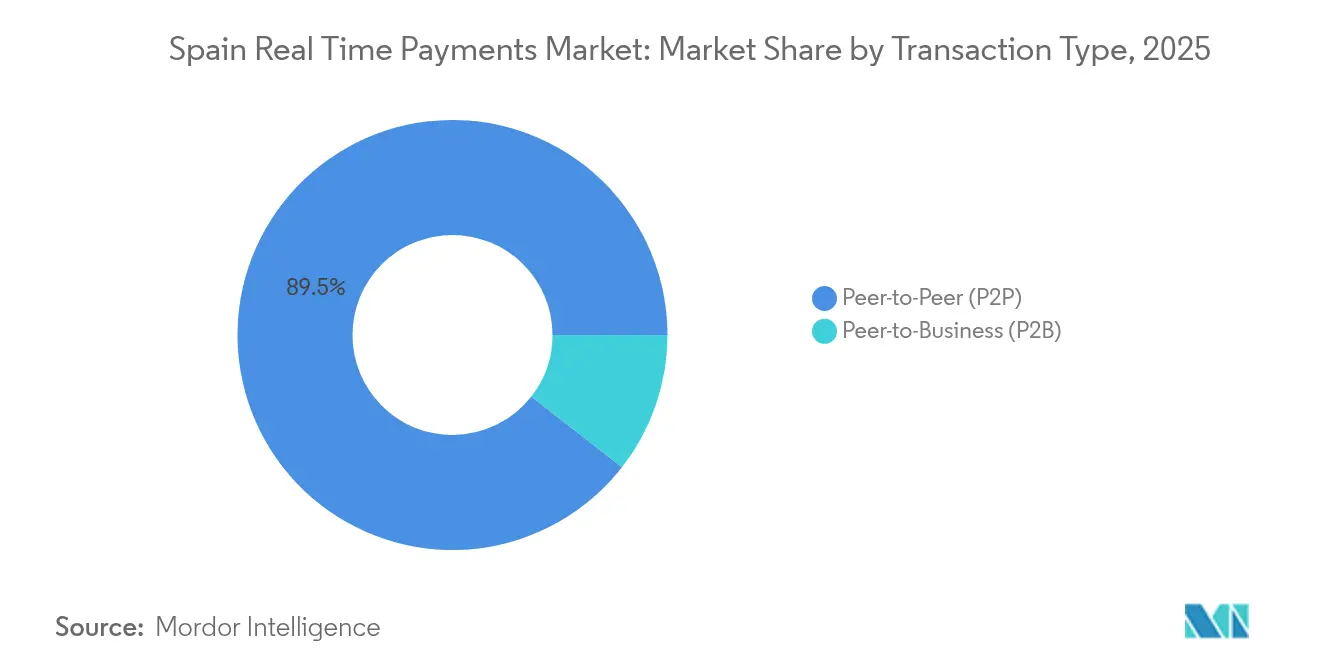
- By transaction type, peer-to-peer transfers led with 89.45% revenue share in 2025, while peer-to-business transactions are forecast to expand at a 18.87% CAGR through 2031.
- By component, platforms held 67.25% of 2025 revenue; services record the highest projected CAGR at 19.98% through 2031.
- By deployment model, cloud captured 54.70% of 2025 revenue and is rising at a 18.96% CAGR to 2031.
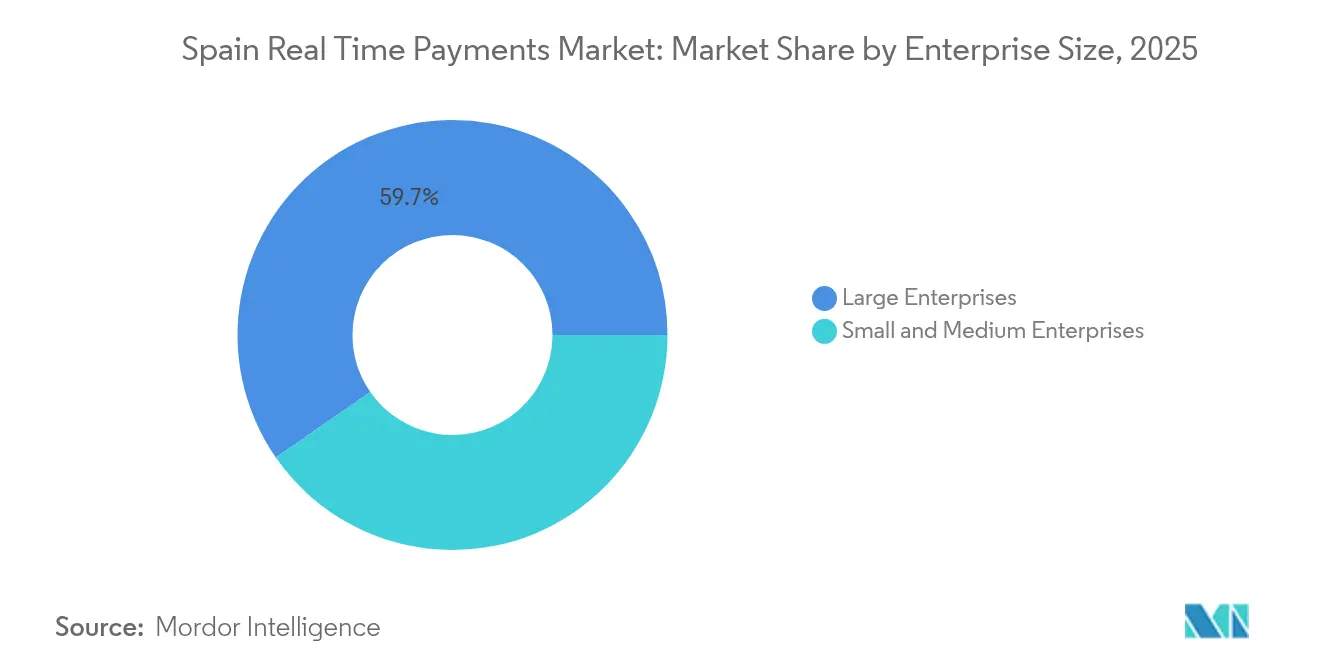
- By enterprise size, large enterprises commanded 59.65% market value in 2025, whereas SMEs show the fastest growth at a 19.74% CAGR.
- By end-user industry, retail and e-commerce accounted for 35.62% share in 2025; government and public sector is advancing at a 20.95% CAGR through 2031.
Note: Market size and forecast figures in this report are generated using Mordor Intelligence’s proprietary estimation framework, updated with the latest available data and insights as of 2026.
Spain Real Time Payments Market Trends and Insights
Drivers Impact Analysis*
| Driver | (~) % Impact on CAGR Forecast | Geographic Relevance | Impact Timeline |
|---|---|---|---|
| Increasing Smartphone Penetration Coupled with 5G Roll-out | +3.2% | National, with early gains in Madrid, Barcelona, Valencia | Medium term (2-4 years) |
| Shift of Spanish Merchants to Account-to-Account Checkout at POS | +4.1% | National, concentrated in retail hubs | Short term (≤ 2 years) |
| Mandatory SEPA Instant Transfer Regulation Drives the Market | +5.8% | EU-wide, Spain early adopter | Short term (≤ 2 years) |
| ISO-20022 Migration Unlocking Data-Rich RTP Use-Cases | +2.9% | Global, Spain leading implementation | Long term (≥ 4 years) |
| Rise of FinTech–Bank Partnerships for Instant Salary and Gig-Worker Payouts | +2.4% | National, urban centers leading | Medium term (2-4 years) |
| Source: Mordor Intelligence | |||
Increasing Smartphone Penetration Coupled with 5G Roll-out
Telefonica reached 90% 5G coverage across 1,500 municipalities by early 2025, delivering speeds up to 1,600 Mbps that enable ultra-low-latency payment processing. High smartphone usage dovetails with Bizum Pay’s NFC launch, positioning mobile-first adoption even as 66% of face-to-face payments remained cash in 2024. [2]Stripe, “2024 Spain Payments Report,” stripe.com Together, network upgrades and app innovation foster rapid retail acceptance and pave the way for wider Spain real time payments market adoption. Spain’s leadership in 5G Standalone, alongside Germany and Austria, cements the infrastructure base for future use cases.
Shift of Spanish Merchants to Account-to-Account Checkout at POS
Redsys processed EUR 505 billion (USD 545.4 billion) through 1.5 million POS terminals in 2024, illustrating immediate A2A integration potential. Amazon’s Bizum integration and 50,000+ merchants accepting the service—up 19% year-on-year—signal tipping-point dynamics. Contactless cards already comprise 67% of transactions, easing behavioral transition to instant A2A. Banco Santander’s zero-fee POS offer for new merchants removes cost friction. These developments accelerate Spain real time payments market penetration in retail environments.
Mandatory SEPA Instant Transfer Regulation Drives the Market
The EU regulation that took effect 9 January 2025 mandates sub-10-second euro transfers and fee parity with regular credits. [3]European Commission, “Regulation (EU) 2023/xxxx on Instant Payments,” ec.europa.eu CaixaBank scrapped instant-transfer fees for all clients from January 2025, highlighting compliance-driven competitive moves. Reporting deadlines were deferred to April 2026, yet infrastructure investments surged as banks raced to meet messaging and timestamp standards. Spain’s 53% instant-transfer share enables local institutions to leverage regulations for cross-border service advantage.
ISO-20022 Migration Unlocking Data-Rich RTP Use-Cases
Structured data enhances automated reconciliation and regulatory reporting, supporting e-invoicing mandates for firms over EUR 8 million (USD 8.64 million) turnover. CaixaBank’s EUR 5 billion (USD 5.4 billion) “Cosmos” plan funds compliance and analytics, underlining strategic importance. Rich messaging also supports EuroPA’s multi-country user journeys, aligning Spain real time payments market capabilities with future cross-border expectations. [4]European Payments Council, “ISO-20022 Migration Guide,” europeanpaymentscouncil.eu
Restraints Impact Analysis*
| Restraint | (~) % Impact on CAGR Forecast | Geographic Relevance | Impact Timeline |
|---|---|---|---|
| High Fraud-as-a-Service Targeting RTP Channels | -2.8% | National, urban areas most affected | Short term (≤ 2 years) |
| Fragmented Legacy Core Banking Systems among Mid-Tier Spanish Banks | -1.9% | National, regional banks concentrated | Medium term (2-4 years) |
| Processing Fee Caps Pressuring PSP Margins | -1.6% | National, affecting all PSPs | Short term (≤ 2 years) |
| Delayed Merchant On-Boarding due to KYC Bottlenecks | -1.2% | National, SME sector most impacted | Medium term (2-4 years) |
| Source: Mordor Intelligence | |||
High Fraud-as-a-Service Targeting RTP Channels
Eight in ten Spaniards reported scam attempts in 2024, and 7% lost at least EUR 5,000 (USD 5,400) via RTP fraud. Real-time irrevocability compresses fraud-detection windows, urging banks to adopt hybrid ML models and graph analytics. The threat heightens demand for secure services within the Spain real time payments market, where 63% of users ask for stronger bank protection.
Fragmented Legacy Core Banking Systems among Mid-Tier Spanish Banks
While major lenders fund multi-billion-euro digital programs, smaller regionals struggle to meet 10-second processing mandates, slowing overall Spain real time payments market rollout. Cloud-based managed services increasingly bridge capability gaps, yet integration and compliance costs weigh on budgets.
*Our forecasts treat driver/restraint impacts as directional, not additive. The impact forecasts reflect baseline growth, mix effects, and variable interactions.
Segment Analysis
By Transaction Type: P2P Dominance Faces B2B Disruption
Peer-to-peer transfers controlled 89.45% of 2025 revenue, reflecting Bizum’s 1 billion annual transactions. However, the peer-to-business sub-segment is forecast to expand at 18.87% CAGR as merchants roll out instant A2A checkout. This shift diversifies Spain real time payments market size by broadening use cases into retail and services. Cross-border P2P via EuroPA links 50 million users in Spain, Italy, and Portugal, deepening network effects.
Strong consumer familiarity underpins resilient P2P volume; yet merchant uptake of A2A doubles Bizum online purchases to 30 million in 2024, valued at EUR 1.65 billion (USD 1.782 billion). As SMEs digitize at speed, P2B convenience and lower interchange begin eroding card dominance, reinforcing growth prospects across the Spain real time payments market.


By Component: Services Growth Outpaces Platform Investments
Platforms still represent 67.25% of 2025 spending, but services forecast a 19.98% CAGR through 2031 as banks prioritize fraud analytics and compliance assistance. Outsourced monitoring helps mid-tier banks achieve ISO-20022 readiness and manage 24/7 settlement obligations. Resultant operational expenditure elevates services share within Spain real time payments market size forecasts.
European Banking Authority deadline extensions for harmonized reporting now spur consultancy demand to retrofit systems. AI-driven fraud solutions, exemplified by CaixaBank’s Cosmos rollout, differentiate providers as fraud threats intensify. The component mix signals a shift from initial platform build-out toward value-added service layers.
By Deployment Mode: Cloud Migration Accelerates Modernization
Cloud holds 54.70% revenue and grows 18.96% CAGR, reflecting cost and scalability benefits for instant rails. Mid-tier institutions leverage cloud to bypass CapEx for core upgrades required by SEPA rules, driving Spain real time payments market share gains for cloud vendors. On-premise maintains 45.30% share among major banks prioritizing in-house security controls.
Fintech entrants such as Silbo Money use cloud-native design to scale across WhatsApp’s 35 million Spanish users swiftly. Telefonica’s extensive 5G coverage ensures connectivity resilience, reinforcing cloud adoption for latency-sensitive payment workloads.
By Enterprise Size: SME Digitalization Drives Fastest Growth
Large corporates currently generate 59.65% of market value thanks to complex treasury needs. Nevertheless, SMEs are forecast to grow 19.74% CAGR as fee caps, freemium pricing, and cloud platforms lower entry barriers. Mandatory e-invoicing for firms exceeding EUR 8 million turnover accelerates digital uptake, anchoring demand for ISO-20022-ready solutions within the Spain real time payments market.
SME adoption challenges—skills shortages and integration costs—are easing via SaaS packages and fintech partnerships. CaixaBank’s zero-fee instant transfers likewise help level cost structures for small firms.
By End-User Industry: Government Sector Leads Digital Transformation
Retail and e-commerce posted 35.62% share in 2025; yet government and public sector is set for a 20.95% CAGR through 2031. The April 2025 launch of the MiDNI digital ID app integrates payments into citizen services. Public-procurement e-invoicing volume exceeds 12 million annually, fostering instant settlement demand.
Energy and telecom utilities deploy RTP to streamline billing, as shown by Iberdrola España enabling card payments at 3,200 charging stations (40% of its network). BFSI remains a core adopter owing to regulatory imperatives, whereas healthcare is poised to follow as digital health payments mature.
Geography Analysis
Spain real time payments market leadership stems from 53% instant-transfer penetration, enabled by Bizum’s user base and nationwide 5G coverage. Redsys processes USD 545.4 billion equivalent annually across 1.5 million POS devices, illustrating ready merchant infrastructure. Telefonica’s 90% 5G footprint across 1,500 municipalities underpins ubiquitous mobile RTP usage.
European integration deepens reach: the EuroPA link connects 186 institutions and 50 million users in Spain, Italy, and Portugal, enabling phone-number-based instant transfers and positioning Spain as a regional hub. Banco Santander’s One-Leg-Out scheme further extends instant capability to non-EU destinations. Harmonized SEPA fee caps remove cost friction across borders, enhancing Spain real time payments market competitiveness.
Spain’s banks also carry significant Latin American footprints, offering optionality for future corridor expansion. With 93% of consumers comfortable sending RTP domestically and 90% receiving, Spain serves as a reference model for markets transitioning from card-centric systems.
Regulatory Landscape
Spain real time payments operate under EU and national payments frameworks, with Banco de Espana supervising payment systems and Iberpay operating the SNCE retail clearing infrastructure that supports SEPA Instant Credit Transfer (SCT Inst) processing. At the national level, Royal Decree-Law 19/2018 (PSD2 transposition) underpins payment service regulation and PSP authorization requirements for providers active in instant transfers.
The EU Instant Payments Regulation (Regulation (EU) 2024/886) raises compliance requirements for euro-area PSPs by requiring that providers offering ordinary euro credit transfers also offer instant credit transfers, with charges not exceeding those for standard credit transfers. In parallel, the European Payments Council updated the SCT Inst rulebook (2025 version 1.1), effective 5 October 2025, tightening scheme requirements including execution-time and messaging/formatting practices. In Spain, these updates flow into PSP implementation roadmaps and interoperability testing.
Value Chain Analysis
The Spain real time payments value chain starts with end users (consumers, SMEs, enterprises, and public entities) initiating instant credit transfers via bank and fintech front ends, proxy layers (notably Bizum), and merchant acceptance stacks. Requests move through PSPs and processors, including bank gateways and acquirer/processor platforms such as Redsys for acceptance enablement, then into clearing and settlement, where Iberpay operates the SNCE for retail payments while interfacing with SEPA instant rails and central bank infrastructure.
Settlement and liquidity management depend on Eurosystem services and local participation conditions, including TARGET-Banco de Espana participation frameworks updated effective 15 June 2026. Compliance and risk controls span the chain, covering SCA/PSD2 obligations, fraud monitoring, AML/KYC onboarding, and ISO 20022 data readiness that supports reconciliation and reporting. Additional capability layers are forming around interoperability and future money, including Banco de Espana participation in the ECB digital euro pilot (announced July 2026), which includes Spanish PSP entities and signals incremental integration work for wallets, acceptance, and settlement workflows alongside existing instant payment rails.
Competitive Landscape
Collaboration defines domestic dominance: Bizum aggregates 29 million users across >30 banks, processing 1 billion transfers yearly and securing nearly 90% share of instant P2P traffic. International card schemes and fintechs contest merchant space, but regulatory fee parity erodes structural advantages.
Disruptors leverage alternative channels. Silbo Money integrates payments into WhatsApp, courting 35 million Spanish users with zero-fee messaging-based transfers. Revolut’s rollout of 50 ATM-kiosks aims to capitalize on Spain’s 60% cash POS share and upsell digital accounts. Domestic processor Iberpay and clearing house Iberpay monitor scheme interoperability and support EuroPA expansion, fortifying the Spain real time payments market.
Strategic investments highlight competitive positioning. CaixaBank’s USD 5.4 billion Cosmos program focuses on AI fraud controls and API enablement to sustain differentiation under commoditized fee structures. Banco Santander targets A2A merchant solutions to defend acquiring revenue as interchange pressure rises. Fragmentation remains moderate: top five entities—Bizum, Iberpay, Redsys, CaixaBank, and Santander—control close to 60% of transactional volume.
Spain Real Time Payments Industry Leaders
ACI Worldwide Inc.
FIS Global
Paypal Holdings Inc.
Fiserv Inc.
Matercard Inc.
- *Disclaimer: Major Players sorted in no particular order

Market Opportunities and Future Outlook
A key white-space area is expanding instant account-to-account payments from P2P into everyday commerce at physical points of sale and in e-commerce checkout. Bizum moving into in-store payments in May 2026 using an NFC/contactless approach, initially with CaixaBank, Sabadell, and Bankinter, creates an acceptance-led pathway for instant settlement. It also leverages established consumer familiarity, while giving processors, acquirers, and POS software providers opportunities to add SCT Inst routing, reconciliation, and dispute-handling tooling.
Cross-border interoperability is another near-term opportunity anchored in active European programs rather than standalone domestic scale. The February 2026 Memorandum of Understanding involving Bizum, Bancomat, SIBS-MB WAY, Vipps MobilePay, and EPI sets a concrete track toward pan-European interoperability, increasing the value of ISO 20022-ready messaging, directory/proxy services, and scheme governance capabilities for Spanish PSPs. Separately, the European Commission Digital Decade roadmap for Spain (2026 country reporting) and rising online commerce volumes (CNMC reporting for 2025) support demand for better digital onboarding, fraud controls, and automated reconciliation services that monetize around instant rails even under fee-parity constraints.
Recent Industry Developments
- July 2026: Banco de Espana announced its participation in the ECB digital euro pilot, which includes two Spanish PSP entities, a consortium (Abanca, Ibercaja, Unicaja, Cecabank, Bizum, and Deloitte) and the payment institution Uinku (Sipay). This expands the Spanish payments ecosystem workbench beyond SCT Inst into programmable settlement and wallet acceptance experiments, influencing vendor priorities across core payments platforms, fraud controls, and merchant acceptance integration.
- June 2026: Banco de Espana implemented updates to the TARGET-Banco de Espana system participation conditions effective June 15, 2026, including changes affecting liquidity transfers linked to TIPS accounts and commission structures. The update tightens operational requirements for participants and supports more automated liquidity management, which is material for banks and PSPs scaling 24/7 instant payments.
- May 2026: Bizum activated NFC contactless payments at physical merchant terminals in Spain (May 18, 2026), routing transactions as SEPA Instant Credit Transfers via Iberpay, with CaixaBank, Sabadell, and Bankinter participating at launch. The move extends Bizum from P2P into point-of-sale commerce and increases competitive pressure on traditional card-based acceptance by offering instant settlement on account-to-account rails.


Research Methodology Framework and Report Scope
Market Definition and Coverage
This market covers the revenues generated from enabling and processing real-time (instant) payment transfers in Spain, where funds are cleared and confirmed to the recipient within seconds, across common consumer and business use cases.
Scope exclusions: We exclude standard batch credit transfers, card payment acquiring, and cash handling services that are not executed as instant payments.
Segmentation Overview
- By Transaction Type
- Peer-to-Peer (P2P)
- Peer-to-Business (P2B)
- By Component
- Platform / Solution
- Services
- By Deployment Mode
- Cloud
- On-Premise
- By Enterprise Size
- Large Enterprises
- Small and Medium Enterprises
- By End-User Industry
- Retail and E-Commerce
- BFSI
- Utilities and Telecom
- Healthcare
- Government and Public Sector
- Other End-user Industries
Data Sources, Market Sizing, and Validation
Desk Research
Desk research helped us anchor the model on what is observable in Spain, including how quickly instant transfer availability expanded and how regulatory requirements are shaping adoption. We referenced public sources such as Banco de Espana publications, European Central Bank payments statistics, the European Payments Council updates on SEPA Instant, and European Commission materials tied to the Instant Payments Regulation, to frame adoption signals and timing. We also used ISO 20022 message standards and scheme documentation to keep terminology aligned, and then supported the build with issuer and processor materials such as annual reports, investor presentations, and industry association releases.
To pressure test the direction of volumes and commercialization, we selectively used paid subscriptions that track company financials and intelligence, plus news and financials, and we cross checked major product launches through reputed press coverage. The sources listed here are illustrative only, and many other public documents and datasets were reviewed to collect data points, validate assumptions, and clarify gaps.
Primary Interviews and Surveys
Primary work focused on confirming how real-time payments are being monetized in Spain, and where revenues sit across enabling software, implementation work, and ongoing service fees. We spoke with a mix of banks and payment service participants, plus technology and operations leaders, and commercial owners who could validate adoption pace, pricing direction, and how SEPA Instant readiness is reflected in buyer budgets.
Distribution of primary research fieldwork respondents
| Company type | Respondent position | Region |
|---|---|---|
| Top tier: 28% | CXOs: 15% | |
| Mid tier: 53% | Functional/Unit leaders: 41% | |
| Smaller Players: 19% | Managers: 44% |
Market-Sizing & Forecasting
We started with a top-down build that reconstructs the Spain demand pool from instant payment rail readiness and usage, and then converts that pool into revenue using practical pricing and service mix assumptions. In the model, the main inputs include instant transfer penetration across bank customers, the share of transactions shifting from standard credit transfers, adoption in merchant and bill-payment flows, implementation cycle length, and the typical split between one-time integration work and recurring platform or managed-service fees.
Once the first totals were created, they were corroborated with selective bottom-up approximations, such as sampled supplier revenue bands, channel checks on typical contract sizes, and volume times average fee logic for use cases where pricing is more standardized. Forecasting was done using scenario-based projections supported by primary feedback, where variables like regulatory milestones, ISO 20022 migration progress, fraud-control investment intensity, and mobile-first usage trends were varied within realistic ranges. Where company disclosures did not split real-time payments cleanly, revenue was allocated using validated activity mix and product positioning, and then reviewed again during expert callbacks.
Data Validation & Update Cycle
We validated outputs by comparing the modeled trajectory against independent signals, including publicly discussed SEPA Instant rollout timing, banking digital adoption indicators, and observable shifts in instant transfer usage. Large variances were flagged, checked for unit or currency timing issues, and then corrected only after re-checking the supporting assumptions with desk sources and interview notes. Before sign-off, the model and key assumptions go through a second analyst review so that avoidable errors and overfitting are reduced.
Reports are refreshed annually, and interim updates are triggered when material events occur, such as major regulatory enforcement dates, sudden pricing shifts, or notable platform migrations. Right before delivery, an analyst completes a fresh pass to ensure the latest public information and any newly validated primary inputs are reflected.
Mordor Intelligence's Spain Real Time Payments Market Size Versus Other Published Estimates
Published market sizes for Spain real-time payments can look far apart, even when the topic name appears the same, because firms count different revenue streams and apply different timing and pricing assumptions. In our checks, the largest swings usually come from what is treated as a payments value measure versus a market revenue measure, and whether the estimate is updated after new regulation deadlines.
Transaction value totals for instant transfers sit outside Mordor Intelligence's scope, which keeps the market size tied to monetized platform, solution, and service revenues rather than to the full payment-flow amount. Differences also appear when a publisher includes wider digital payments tools (like gateways or card-linked commerce), uses aggressive adoption curves for P2B instant payments, or relies on older FX averages and does not revisit assumptions after SEPA Instant rule changes.
Benchmark comparison
| Source | Market Size | Gaps in Research Methodology |
|---|---|---|
| Mordor Intelligence | USD 2.91 B (2025) | |
| Trade Portal A | USD 448.16 B (2025) | This figure appears to reflect the value of payment flows processed via real-time rails, not revenues earned from enabling and servicing instant payments, which inflates the total versus a revenue-based market model. |
| Industry Tracker B | USD 682.51 B (2025) | The scope is broader, blending cards and overall payments value in Spain, so real-time payments are not isolated as a distinct revenue pool and the number tracks total spend more than industry revenues. |
The spread in the table is mainly explained by scope, since flow value and broad payments totals can be hundreds of billions, while a revenue-focused view stays much smaller and easier to reconcile with budgets and provider income. By keeping the model anchored to adoption, service mix, and pricing signals that can be rechecked each year, we provide a practical estimate that buyers can trace back to clear, repeatable inputs.


Key Questions Answered in the Report
What is the current value of the Spain real time payments market?
It is valued at USD 3.44 billion in 2026 and is projected to reach USD 7.95 billion by 2031.
Why did instant transfers surge in Spain ahead of other EU nations?
Early compliance with SEPA Instant rules, fee parity mandates, and collaborative schemes such as Bizum drove 53% instant-transfer penetration compared with the 15% EU average.
Which segment grows fastest within the Spain real time payments market?
Peer-to-business transactions are forecast to expand at a 18.87% CAGR through 2031 as merchants adopt account-to-account checkout solutions.
How are Spanish banks addressing rising fraud in real-time payments?
Institutions invest in hybrid machine-learning and graph-based analytics; CaixaBank’s Cosmos plan dedicates significant funds to AI-driven fraud prevention.
What role does cloud deployment play?
Cloud holds 54.70% revenue share and supports 18.96% CAGR, allowing mid-tier banks to modernize quickly and comply with 10-second settlement rules without heavy CapEx.
Page last updated on: