
Market Overview
| Study Period | 2020 - 2031 |
|---|---|
| Forecast Data Period | 2026 - 2031 |
| Historical Data Period | 2020 - 2024 |
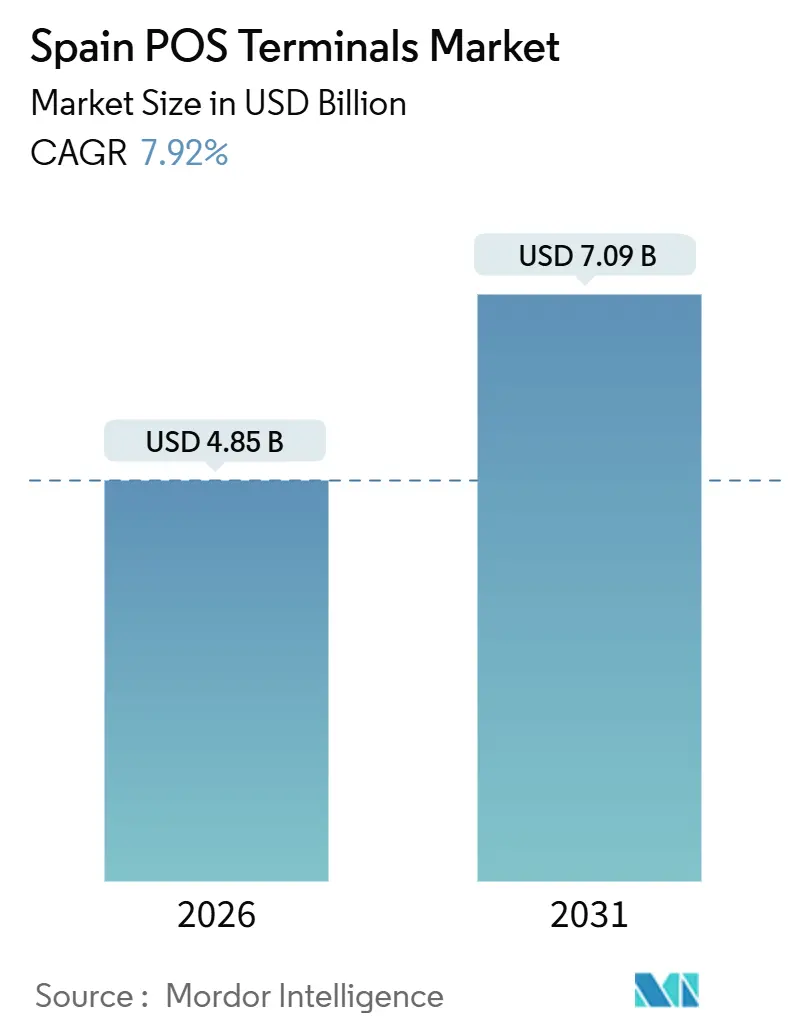
| Market Size (2026) | USD 4.85 Billion |
| Market Size (2031) | USD 7.09 Billion |
| Growth Rate (2026 - 2031) | 7.92 % |
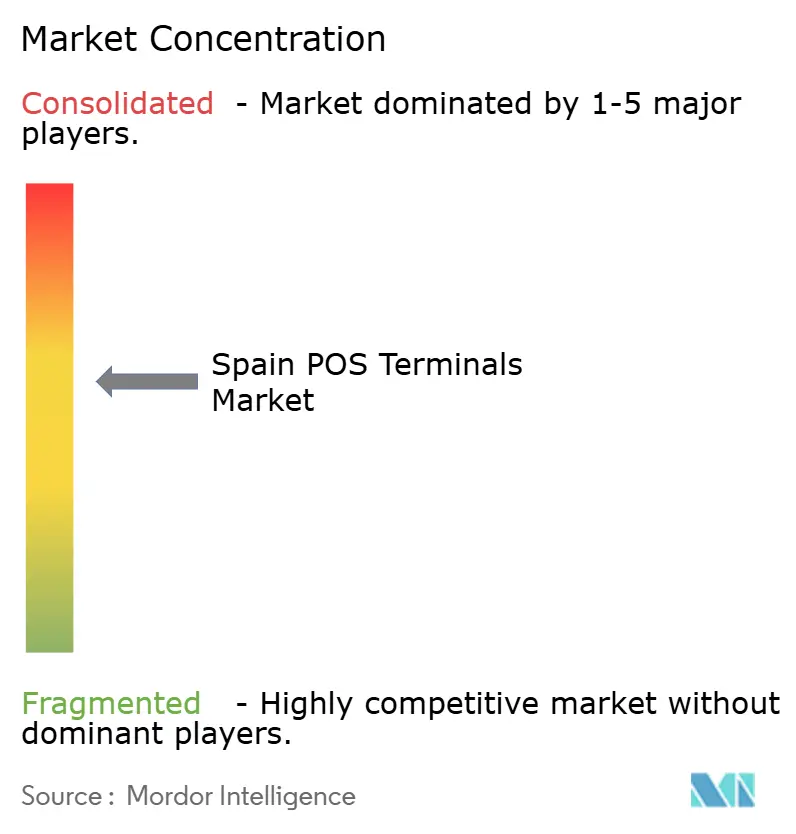
| Market Concentration | Medium |
Major Players *Disclaimer: Major Players sorted in no particular order Image © Mordor Intelligence. Reuse requires attribution under CC BY 4.0. | |
Spain POS Terminals Market Analysis by Mordor Intelligence
The Spain POS terminals market size stood at USD 4.85 billion in 2026 and is projected to reach USD 7.09 billion by 2031, reflecting a 7.92% CAGR over the period. The trajectory is shaped by stricter cash-use limits, vibrant tourism flows, and near-universal contactless readiness among issuers and merchants. Regulatory mandates obligate even micro-businesses to digitize takings, while Bizum wallet integration and SoftPOS solutions are lowering entry costs for small hospitality and service operators. High smartphone penetration is nurturing mobile-originated tap-to-pay habits, and terminal refresh cycles are accelerating as retailers seek cloud analytics and omnichannel orchestration to compete with e-commerce giants. Meanwhile, interchange-fee caps are compressing margins for acquirers, nudging the ecosystem toward software-led recurring-revenue models rather than hardware subsidies.
Key Report Takeaways
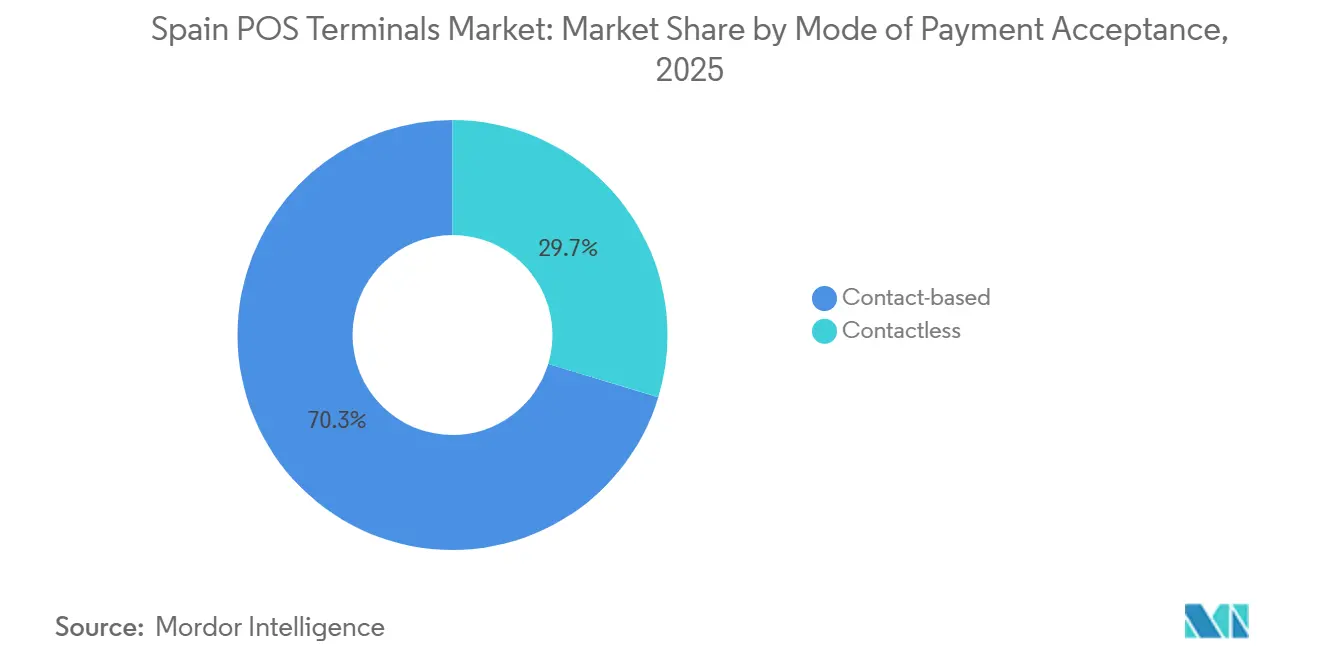
- By mode of payment acceptance, contactless methods captured 70.32% of transaction value in 2025; contactless payments are advancing at an 8.13% CAGR through 2031.
- By POS type, mobile and portable units held 46.58% of the Spain POS terminals market share in 2025, while mobile solutions are forecast to expand at an 8.67% CAGR between 2026-2031.
- By component, hardware commanded 62.14% of the Spain POS terminals market size in 2025, yet software is scaling at an 8.78% CAGR through 2031.
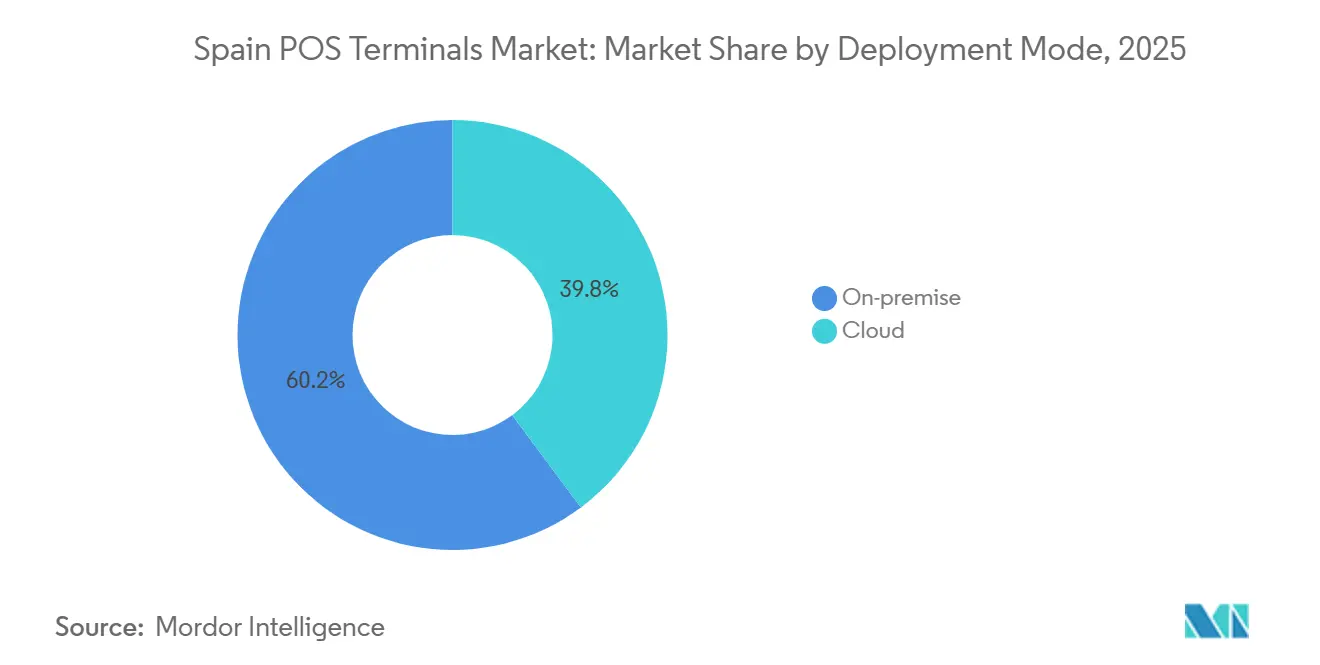
- By deployment mode, cloud platforms accounted for 39.81% revenue in 2025 and are growing at an 8.48% CAGR to 2031.
- By end-user industry, retail led with 35.28% revenue share in 2025; healthcare is the fastest-growing vertical, registering an 8.92% CAGR to 2031.
Note: Market size and forecast figures in this report are generated using Mordor Intelligence’s proprietary estimation framework, updated with the latest available data and insights as of January 2026.
Spain POS Terminals Market Trends and Insights
Drivers Impact Analysis*
| Driver | (~) % Impact on CAGR Forecast | Geographic Relevance | Impact Timeline |
|---|---|---|---|
| Surge in Contactless Card Issuance Driven by Spanish Banks | +2.1% | National, with concentration in Madrid, Barcelona, Valencia, Seville | Short term (≤ 2 years) |
| Government Cash-Transaction Limits and Fiscal Digitalization Law | +1.8% | National, particularly affecting micro-merchants in Andalusia, Castile and León, Galicia | Medium term (2-4 years) |
| Tourist Spending Rebound Boosting POS Volumes in Coastal Regions | +1.5% | Coastal tourism zones: Balearic Islands, Canary Islands, Costa del Sol, Costa Brava | Short term (≤ 2 years) |
| SME Adoption of Integrated Cloud POS for Omnichannel Commerce | +1.2% | National, early gains in urban centers Madrid, Barcelona, Bilbao | Medium term (2-4 years) |
| Instant Payments Integration via Bizum and SoftPOS Enablement | +1.0% | National, with higher penetration in digitally mature regions Catalonia, Madrid, Basque Country | Medium term (2-4 years) |
| Digital Euro Readiness Accelerating Early Terminal Upgrades | +0.6% | National, pilot programs concentrated in Madrid and Barcelona | Long term (≥ 4 years) |
| Source: Mordor Intelligence | |||
Surge in Contactless Card Issuance Driven by Spanish Banks
Spanish issuers are saturating the market with NFC-enabled plastics and wallets, evidenced by CaixaBank’s 100.7 million mobile and contactless transactions in June 2025, up 34.4% year-on-year.[1]CaixaBank, “CaixaBank Processes 100.7 Million Mobile and Contactless Transactions in June 2025,” CAIXABANK.COM Banco de España counted 5.562 billion card operations in the first half of 2024, 93.7% of which were contactless. Across the euro area, 92% of terminals accepted contactless by late 2024. Mastercard research shows 50.4% of Spanish tap-to-pay transactions now originate from phones rather than cards. Acquirers are therefore bundling NFC readers with loyalty and analytics apps, positioning the Spain POS terminals market as a springboard for data-driven engagement rather than a simple payments endpoint.
Government Cash-Transaction Limits and Fiscal Digitalization Law
Law 11/2021 capped cash dealings at EUR 1,000, while Royal Decree 253/2025 imposes monthly card-payment reporting from January 2026.[2]Boletín Oficial del Estado, “Royal Decree 253/2025 on Fiscal Reporting Requirements,” BOE.ES Merchants in hospitality, automotive repair, and construction materials can no longer rely on opaque cash records without risking penalties. Upcoming B2B e-invoicing mandates under Law 18/2022 and EU VAT-in-the-Digital-Age reforms further propagate electronic rails. Consequently, SMEs - about 3.4 million firms - are fast-tracking Spain POS terminals market deployments to ensure compliance, spurring demand for cloud suites that auto-generate fiscal receipts and transmit them to tax platforms in real time.
Tourist Spending Rebound Boosting POS Volumes in Coastal Regions
International visitors spent EUR 76 billion between January-July 2025, 7.2% more than a year earlier. The Balearic Islands installed 1,652 validators and 611 dual EMV desks in partnership with Redsys and Banco Santander. Barcelona’s TMB fitted 1,070 buses with EMV readers, exceeding 500,000 transactions in early rollout. Such infrastructure slashes payment friction for tourists and fuels seasonal transaction spikes, reinforcing the Spain POS terminals market’s reliance on travel and leisure corridors.
SME Adoption of Integrated Cloud POS for Omnichannel Commerce
Spain ranks 11th on the EU Digital Economy and Society Index, yet only 60% of SMEs hold basic digital skills. The Digital Kit subsidy, worth EUR 2,000-12,000 per applicant, is nudging merchants toward cloud-based suites. BBVA’s Virtual POS, free for a year under the voucher, supports Bizum, Apple Pay, and Google Pay, lowering the barrier for micro-merchants. Stripe noted 4.2 million active terminals in early 2023, up 9.7% on-year, with contactless volumes jumping 18% in H1 2024. Cloud dashboards also optimize inventory across online and brick-and-mortar channels, critical during tourist peaks, anchoring future growth of the Spain POS terminals market.
Restraints Impact Analysis*
| Restraint | (~) % Impact on CAGR Forecast | Geographic Relevance | Impact Timeline |
|---|---|---|---|
| Interchange-Fee Caps Squeezing Acquirer Margins and Subsidies | -1.4% | National, with heightened pressure on acquirers serving low-ticket merchants in hospitality and retail | Medium term (2-4 years) |
| Fragmented SME Digital Literacy Hindering Advanced POS Uptake | -1.0% | National, concentrated in rural areas and among older merchant demographics in Castile-La Mancha, Extremadura, Aragon | Medium term (2-4 years) |
| GDPR-Related Compliance Costs for Cloud POS Vendors | -0.5% | National, affecting cloud-based SaaS providers and multi-country acquirers | Short term (≤ 2 years) |
| Dependence on Imported Chipsets Amid Geopolitical Supply Risks | -0.4% | National, with exposure to Asia-Pacific semiconductor supply chains | Long term (≥ 4 years) |
| Source: Mordor Intelligence | |||
Interchange-Fee Caps Squeezing Acquirer Margins and Subsidies
EU Regulation 2015/751 cut debit and credit interchange to 0.2% and 0.3% respectively, enacted locally via Royal Decree 150/2020.[3]European Commission, “EU Regulation 2015/751 on Interchange Fees,” EC.EUROPA.EU The reduced economics have curtailed free-terminal campaigns, pushing acquisition costs onto merchants. Low-ticket venues such as quick-service restaurants struggle to absorb higher rental fees, slowing Spain POS terminals market penetration in some rural pockets. Smaller acquirers lacking scale are withdrawing from unprofitable niches or consolidating, although SoftPOS is abating the hardware burden by enabling bring-your-own-device acceptance.
Fragmented SME Digital Literacy Hindering Advanced POS Uptake
Despite financial incentives, older proprietors in Castile-La Mancha, Extremadura, and Aragon often avoid cloud dashboards, fearing hidden costs and complexity. Limited local tech support aggravates hesitation, leaving merchants on legacy keypad devices that offer only payment capture. Vendors are responding with simplified user interfaces and on-site training, yet adoption of analytics, loyalty, and real-time inventory tools remains patchy, tempering near-term gains for the Spain POS terminals market.
*Our forecasts treat driver/restraint impacts as directional, not additive. The impact forecasts reflect baseline growth, mix effects, and variable interactions.
Segment Analysis
By Mode of Payment Acceptance: Contactless Expands as the Default Choice
Contactless channels represented 70.32% of value in 2025, while they are growing at an 8.13% CAGR, gradually displacing chip-and-PIN. Contact-based terminals still serve high-value or offline-risk environments, but Banco de España indicates 93.7% of card operations were tap-to-pay by late 2024, underscoring consumer preference. The Spain POS terminals market size for contactless flows is widening as PSD2 low-value exemptions maintain frictionless taps and Bizum wallet integration offers domestic instant-payment alternatives.
Bizum’s addition to BBVA’s POS fleet in March 2025 merges wallet transfers with card workflows, cutting costs for small tickets. Ingenico and BBVA SoftPOS apps convert Android phones into terminals, boosting penetration in gig-economy services. The Spain POS terminals industry therefore sees dual-interface devices becoming minimum specs, ensuring continued but shrinking relevance for contact-based acceptance.


By POS Type: Mobility Redefines Checkout
Fixed lanes retained 53.42% share in 2025, yet portable systems rose 8.67% annually as eateries adopted tableside payments and festivals favored pop-up stalls. Barcelona’s TMB bus network and Balearic transport validators exemplify how transit deployments lean on mobile readers. Madrid Metro’s EUR 5.9 million upgrade across 302 stations further illustrates the capital intensity of fixed infrastructure.
SoftPOS is blurring lines between hardware categories. Ingenico estimated 350,000 Android-based devices live in Spain by January 2023, forecasting smartphones could handle 25% of acceptance within a few years. BBVA’s NFC app needs only Android 11, enabling same-day onboarding. High-volume grocery chains still rely on tethered scanners and cash drawers, but flexible mobility is redefining the customer journey across the Spain POS terminals market.
By Component: Software Leads Value Creation
Hardware comprised 62.14% revenue in 2025, yet software is expanding 8.78% annually as merchants demand real-time dashboards and omnichannel orchestration. Redsys processed 19.7 billion transactions worth EUR 505 billion in 2024, highlighting the service layer’s scale. Worldline’s exit from terminal manufacturing in 2022 and Adyen’s Android launches in 2025 both illustrate a pivot toward software ecosystems.
Digital Kit vouchers accelerate adoption, with BBVA offering a fee-free year for its virtual suite. PCI DSS and PSD2 rules necessitate continual firmware patches, locking merchants into subscription contracts and enlarging the Spain POS terminals market size for SaaS.
By Deployment Mode: Cloud Gains Momentum
On-premise solutions still hold 60.19% share, but cloud platforms are growing 8.48% yearly as SMEs appreciate subscription pricing. GDPR responsibilities cost vendors up to EUR 1.3 million, yet multi-tenant architecture amortizes these outlays. Stripe observed 18% growth in contactless usage in H1 2024, tied to the rise of cloud-connected models.
CaixaBank and BBVA’s 2025 Request-to-Pay trial via Iberpay proved cloud orchestration can support real-time invoices outside card rails. As 5G and satellite connectivity mature, offline justifications for local databases will erode, accelerating cloud penetration in the Spain POS terminals market.
By End-User Industry: Healthcare Surges Ahead
Retail controlled 35.28% share in 2025, but healthcare is pacing at an 8.92% CAGR thanks to Redsys Salud integrations with insurers like Adeslas SegurCaixa and Sanitas. Secure e-prescription terminals supplied by the National Mint also propel uptake. Hospitality thrives on revived tourism spend, hitting EUR 76 billion in the first seven months of 2025. Transportation investments, such as Madrid Metro’s rollout, extend acceptance to turnstiles.
Automotive repair, professional services, and government counters are adopting devices to comply with Law 11/2021 limits. The forthcoming national transport pass will widen scope further, reinforcing sector diversity within the Spain POS terminals market.
Geography Analysis
Spain’s POS penetration varies sharply by region. Coastal hotspots Balearic Islands, Canary Islands, Costa del Sol, and Costa Brava record seasonal peaks tied to international arrivals that rose 7.2% year-on-year in mid-2025. Transport upgrades, such as 1,652 validators in the Balearics and 1,070 EMV-enabled buses in Barcelona, have normalized tap-to-pay for visitors. Madrid Metro’s EUR 5.9 million project anchors acceptance in the capital.
Inland rural zones lag due to limited digital literacy among SMEs, although Digital Kit grants ease financial hurdles. Catalonia, Madrid, and the Basque Country lead Bizum and SoftPOS usage, reflecting higher smartphone adoption. CaixaBank’s contactless volumes skew toward its base in Catalonia and the Balearics, echoing tourism patterns. Redsys’ nationwide reach across 1.5 million merchants bridges gaps, while the planned 2026 national transport pass will harmonize acceptance across provinces, narrowing disparities in the Spain POS terminals market.
Coastal tourism zones, the Balearic and Canary Islands, Costa del Sol, and Costa Brava, generate seasonal transaction spikes, while Madrid, Barcelona, Valencia, and Seville anchor year-round volumes. Municipal upgrades such as 1,652 transit validators in the Balearics, 1,070 EMV-enabled buses in Barcelona, and a EUR 5.9 million contactless rollout across Madrid Metro underscore public investment in cashless mobility. Rural provinces lag because SME digital skills remain patchy, although Digital Kit grants of up to EUR 12,000 are nudging adoption. Bizum’s 28.8 million users and CaixaBank’s 100.7 million contactless transactions in June 2025 highlight higher wallet and SoftPOS penetration in Catalonia, Madrid, and the Basque Country. A planned 2026 national transport pass is expected to harmonize acceptance, narrowing the regional divide in the Spain POS terminals market.
Regulatory Landscape
Spain's POS terminal ecosystem operates within a payments framework supervised by the Banco de Espana under the payment services transposition package (Real Decreto-ley 19/2018 and Real Decreto 736/2019), alongside PSD2-aligned security and conduct rules that shape terminal certification, authentication, and incident handling across issuers and acquirers. For merchants, Law 11/2021 tightened cash-use limits, and Royal Decree 253/2025 introduced monthly reporting requirements for card payments starting January 2026, which reinforces demand for POS software that can capture, reconcile, and export compliant records.
The infrastructure layer is anchored by recognized payment systems and schemes, including the SNCE retail clearing system managed by Iberpay and card-clearing arrangements, which influence how acquirers integrate authorization, clearing, dispute flows, and instant payments. A notable regulatory milestone occurred on July 8, 2026, when the European Commission opened an infringement procedure against Spain regarding the transposition of EU passporting notification rules for payment institutions, increasing compliance focus for cross-border providers and their onboarding processes in Spain.
Value Chain Analysis
The Spain POS terminals value chain begins with device and platform vendors (traditional countertop terminals, Android POS, and SoftPOS apps) and their technical service providers that handle installation, maintenance, repairs, and lifecycle management. These technical providers can sit outside the payment institution authorization perimeter when they do not handle client funds. Upstream components and certification (secure elements, NFC modules, EMV and PCI-aligned firmware, and device management software) then feed into acquirers and payment institutions that bundle terminals with merchant acquiring, settlement, and value-added services such as invoicing, loyalty, and analytics.
Downstream, transactions route through card schemes and domestic rails into national clearing and settlement systems, with SNCE (Iberpay) supporting retail clearing and complementary infrastructures supporting card and large-value settlement flows. A growing operational node is compliance reporting: from 2026, businesses and professionals receiving payments through card and mobile payment systems face monthly informational reporting to the Spanish Tax Agency, which increases the role of POS middleware, cloud back offices, and acquirer reporting stacks across the overall chain.
Competitive Landscape
Worldline and Ingenico jointly held roughly 37% of global terminal shipments in 2025. Worldline’s 2022 divestiture of the Ingenico hardware arm to Apollo, plus 2025 sales of MeTS and PaymentIQ, signal a strategic shift toward acquiring and value-added services. Redsys dominates domestic processing, handling EUR 505 billion in 2024 and operating Spain’s PSD2 hub for 80 banks.
Adyen’s S1E4 Pro and S1F4 Pro terminals, launched in November 2025, emphasize Android ecosystems with app marketplaces. SoftPOS is emerging as white space; Ingenico forecasts smartphones could capture 25% of acceptance in a few years, and BBVA’s Android-based solution underscores bank-led momentum. SumUp, Square, and MONEI court micro-merchants with transparent pricing, unsettling incumbents reliant on bundled contracts.
NCR leverages Verifone, Equinox, and Ingenico readers to anchor its restaurant suite. PAX Technology has shipped more than 80 million devices globally and promotes the MAXSTORE management layer, deepening its foothold in the Spain POS terminals market. Margin compression from interchange caps is steering acquirers toward software subscriptions rather than hardware subsidies, reshaping competitive playbooks.
Spain POS Terminals Industry Leaders
NCR Corporation
Worldline SA
PayPal Holdings, Inc. (Zettle)
VeriFone, Inc.
NEC Ibérica, S.L.
- *Disclaimer: Major Players sorted in no particular order

Market Opportunities and Future Outlook
Regulatory reporting expands the need for software-led POS bundles that automate audit trails and monthly submissions across card and mobile payments. Tax rules effective February 2026 require monthly electronic reporting for digital payment systems, including mobile phone number-based systems such as Bizum, removing the prior EUR 3,000 threshold. This creates room for vendors and acquirers to embed compliant data capture, reconciliation, and export into cloud POS and SoftPOS experiences for micro-merchants.
Operational resilience and third-party risk management are also becoming buying criteria for cloud-connected POS stacks. The EU Digital Operational Resilience Act (DORA) raises governance and ICT vendor oversight for financial entities and critical third-party providers, which favors POS platforms with stronger device management, monitoring, and incident response capabilities. At the same time, local method convergence is visible at the terminal level, including Bizum wallet acceptance being added to POS fleets, such as Bizum integration on BBVA terminals in March 2025. That trend supports opportunities for omnichannel orchestration layers that unify cards, wallets, and instant payments at the physical checkout.
Recent Industry Developments
- May 2026: The integration of BizumPay into Worldline SA's omnichannel platform enables merchants to accept Bizum at physical POS across Spain. This strengthens omnichannel payment capabilities and supports local market adoption of Bizum in physical retail.
- January 2026: Verifone expands the Victa device portfolio and ecosystem partnerships to serve as a platform for global commerce. The expanded device lineup broadens Verifone's reach in Spain's POS terminals through a wider hardware offering and partner network.
- November 2025: Adyen globally launches S1E4 Pro and S1F4 Pro terminals with third-party app support. The launch positions Adyen as a software-enabled hardware player and shapes competition in Spain's terminal market.


Research Methodology Framework and Report Scope
Market Definition and Coverage
This market is counted as the value generated in Spain from POS terminal setups that enable in-store and on-premise payments, including the core device, the supporting POS software layer, and related implementation and support services tied to that setup.
Scope exclusions: It excludes pure e-commerce checkout tools and standalone payment processing revenue that is not directly linked to a POS terminal deployment.
Segmentation Overview
- By Mode of Payment Acceptance
- Contact-based
- Contactless
- By POS Type
- Fixed Point-of-Sale Systems
- Mobile / Portable Point-of-Sale Systems
- By Component
- Hardware
- Software
- Services
- By Deployment Mode
- Cloud-based
- On-Premise
- By End-User Industry
- Retail
- Hospitality
- Healthcare
- Transportation and Logistics
- Other End-User Industries
Data Sources, Market Sizing, and Validation
Desk Research
Desk work starts with building a clean picture of how many merchant locations exist, how fast digital payments are growing, and what type of acceptance technology is being pushed in Spain. We mainly rely on public statistics and official papers such as Banco de Espana payment statistics, the Bank for International Settlements (BIS) payment indicators, Eurostat retail and enterprise structure data, and European Central Bank materials on cards and contactless usage.
To translate those signals into POS demand, we also review association and scheme level publications such as the European Payments Council, plus Spanish government digitalization programs that influence SME upgrades. Company filings, investor presentations, and credible business press are used to cross-check rollout timelines, product mix shifts, and channel patterns. We then use paid subscriptions for company financials and news only when local disclosure is thin. The sources listed here are illustrative rather than exhaustive, and additional references are also used to collect data, validate assumptions, and clarify open questions during the analysis.
Primary Interviews and Surveys
Primary interviews and structured surveys are used to test what the desk inputs miss, especially typical replacement cycles, attach rates for software and services, and how adoption differs between retail, hospitality, and other merchant groups. We speak with a mix of ecosystem participants, including acquirer and payment service teams, POS resellers and integrators, and merchant operators. The insights are then used to confirm realistic pricing and shipment to install conversion logic.
Distribution of primary research fieldwork respondents
| Company type | Respondent position |
|---|---|
| Top tier: 36% | CXOs: 15% |
| Mid tier: 49% | Functional/Unit leaders: 25% |
| Smaller Players: 15% | Managers: 60% |
Market-Sizing & Forecasting
Sizing begins with a top-down rebuild of the Spain demand pool, where merchant outlet counts and card payment intensity are converted into an install base need. That view is then translated into annual replacements and new adds. We cross-check the outcome through selective bottom-up work, such as sampled average selling price (ASP) by terminal type, channel checks on shipment ranges, and a light roll-up of supplier and reseller revenue signals to spot overstatement or missing pockets.
Inputs that matter in this market include contactless share of card payments, tourism-driven transaction seasonality, typical terminal refresh cycles, the split between fixed and mobile or portable units, and the attach rate of cloud-based POS software and services to new deployments. Where direct data is missing, we use calibrated ratios from interviews, for example average terminals per outlet by merchant type, and then test the sensitivity so totals do not hinge on one assumption.
For forecasting, scenario analysis is used with a short list of drivers that experts generally agree on, including retail and hospitality activity trends, card and wallet usage growth, and the pace of SoftPOS substitution in smaller merchants. The final path is kept realistic by applying gradual ASP changes rather than a single-step price jump, followed by checks against merchant affordability and willingness to upgrade.
Data Validation & Update Cycle
Outputs are validated through multiple passes, starting with variance checks across years, segments, and implied unit economics, and then moving to consistency checks against independent signals such as card usage growth and merchant density. When a number looks off, we re-open the driver inputs, re-check the math, and re-contact selected experts to confirm whether a shift is real or just a modeling artifact.
Before sign-off, another analyst reviews the assumptions, and then the model is compared against alternate calculations so the result can be repeated using the same steps. The report is refreshed annually, and interim updates are made when material events change adoption or pricing, followed by a final pre-delivery pass so clients receive the latest view.
Mordor Intelligence's Spain Pos Terminals Market Sizing Compared With Other Published Estimates
Published market values for Spain POS terminals often do not match because each publisher counts a different basket of revenues and uses different timing for pricing and replacement cycles. The spread usually shows up when some studies bundle software and service revenue into one number, or when they only count devices and ignore recurring subscriptions.
Standalone payment acquiring fees sit outside Mordor Intelligence's scope for this title, which is one reason our market value differs from estimates that merge POS deployments with payment processing economics. Other gaps come from using a single national ASP for all terminal types, applying aggressive adoption curves for micro-merchants without field checks, or mixing installed base value with annual sales value, which can inflate comparisons when not clearly separated.
Benchmark comparison
| Source | Market Size | Gaps in Research Methodology |
|---|---|---|
| Mordor Intelligence | USD 4.85 B (2026) | |
| Global Consultancy A | USD 6.37 B (2026) | Often rolls payment acquiring and broader merchant service revenue into the POS number, which expands the value pool beyond terminal-linked hardware, software, and deployment services. |
| Industry Analyst B | USD 2.50 B (2026) | Typically focuses on hardware shipments only and applies a narrow average price, which can miss software subscriptions, integration, and support services that are commonly bundled in Spain. |
The table shows that the main variation comes from what gets counted as POS related revenue and how pricing is built up across fixed and mobile formats. By keeping the value tied to observable deployment and replacement drivers, and then validating key ratios with interviews, we arrive at an estimate that can be traced back to repeatable steps.


Key Questions Answered in the Report
What is the forecast value of the Spain POS terminals market by 2031?
The market is expected to reach USD 7.09 billion, expanding at a 7.92% CAGR.
Which payment method is growing fastest at Spanish points of sale?
Contactless transactions, covering 70.32% of value in 2025, are advancing at an 8.13% CAGR through 2031.
Why are cloud POS platforms gaining popularity in Spain?
Cloud models offer subscription pricing, remote updates, and real-time analytics, aligning with Digital Kit subsidies that cut upfront costs for SMEs.
Which end-user sector shows the highest growth potential?
Healthcare is projected to grow at an 8.92% CAGR thanks to insurer integrations and e-prescription workflows.
How are interchange-fee caps affecting acquirers?
Caps at 0.2% for debit and 0.3% for credit are compressing margins, prompting a shift away from hardware subsidies toward software-driven revenue.
What role does Bizum play at the physical point of sale?
Bizum wallet acceptance on BBVA and other terminals enables instant payments, offering merchants a low-cost domestic alternative to card networks.
Page last updated on:


 Your data is secure and never sold or shared.


