
Market Overview
| Study Period | 2020 - 2031 |
|---|---|
| Forecast Data Period | 2026 - 2031 |
| Historical Data Period | 2020 - 2024 |
| Market Size (2026) | USD 2.96 Billion |
| Market Size (2031) | USD 3.67 Billion |
| Growth Rate (2026 - 2031) | 4.43 % |
| Market Concentration | Medium |
Major Players *Disclaimer: Major Players sorted in no particular order Image © Mordor Intelligence. Reuse requires attribution under CC BY 4.0. | |

Spain Over-the-counter (OTC) Drugs Market Analysis by Mordor Intelligence
The Spain Over-the-counter Drugs Market size is estimated at USD 2.96 billion in 2026, and is expected to reach USD 3.67 billion by 2031, at a CAGR of 4.43% during the forecast period (2026-2031).
Continued reimbursement cuts, faster Rx-to-OTC switches, and an aging population that self-medicates for minor ailments are widening the customer base while easing pressure on primary-care clinics.[1] Tablet formats still dominate volume but consumer willingness to pay more for gummies, sprays, and other convenient delivery systems is lifting average selling prices. The European Medicines Agency’s 2024 reclassification of pantoprazole and cetirizine expanded the number of non-prescription molecules on Spanish shelves, encouraging manufacturers to introduce dose-flexible packs priced below reimbursed prescription equivalents. Urban millennials fuel double-digit online growth while coastal tourism triggers seasonal spikes in analgesics, sunscreens, and rehydration salts.[2] Multinationals leverage global brand equity whereas Spanish incumbents rely on direct distribution to protect shelf space and margins.
Key Report Takeaways
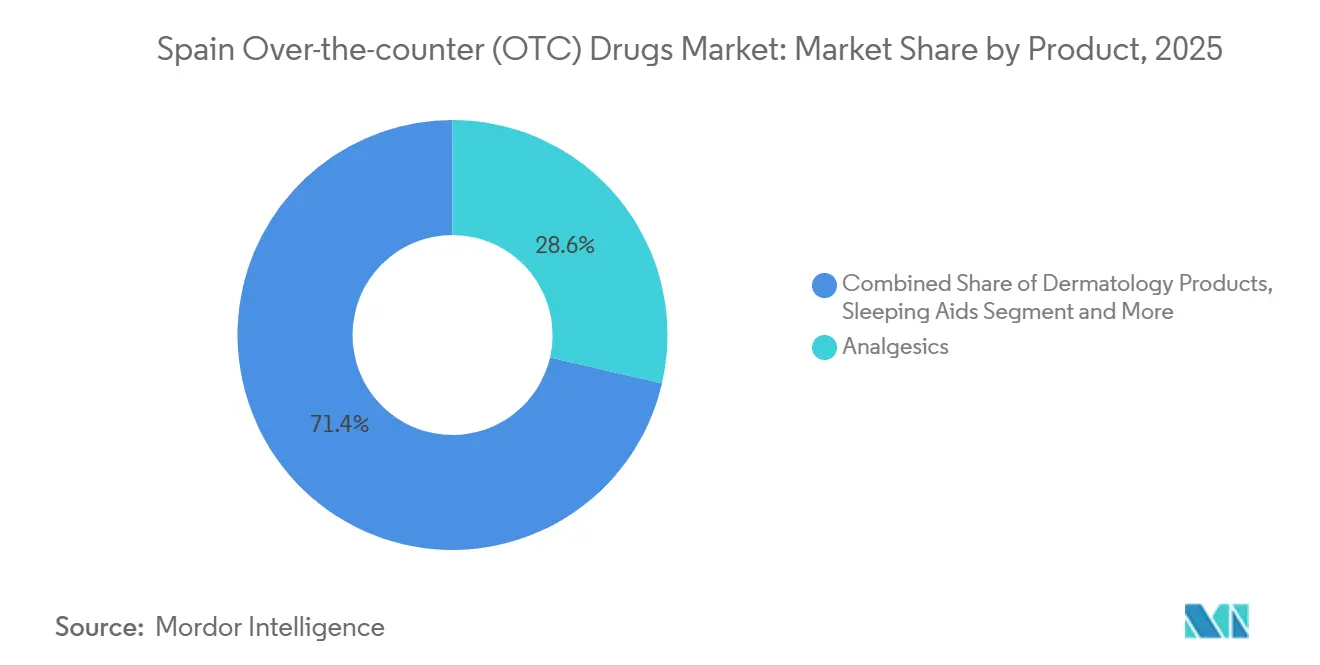
- By product category, analgesics led with 28.62% of Spain over the counter (otc) drugs market share in 2025; sleep aids are forecast to expand at a 7.36% CAGR through 2031.
- By dosage form, tablets and capsules accounted for 41.57% of the Spain over the counter (otc) drugs market size in 2025, while gummies, sprays, and drops are projected to grow at 7.55% CAGR to 2031.
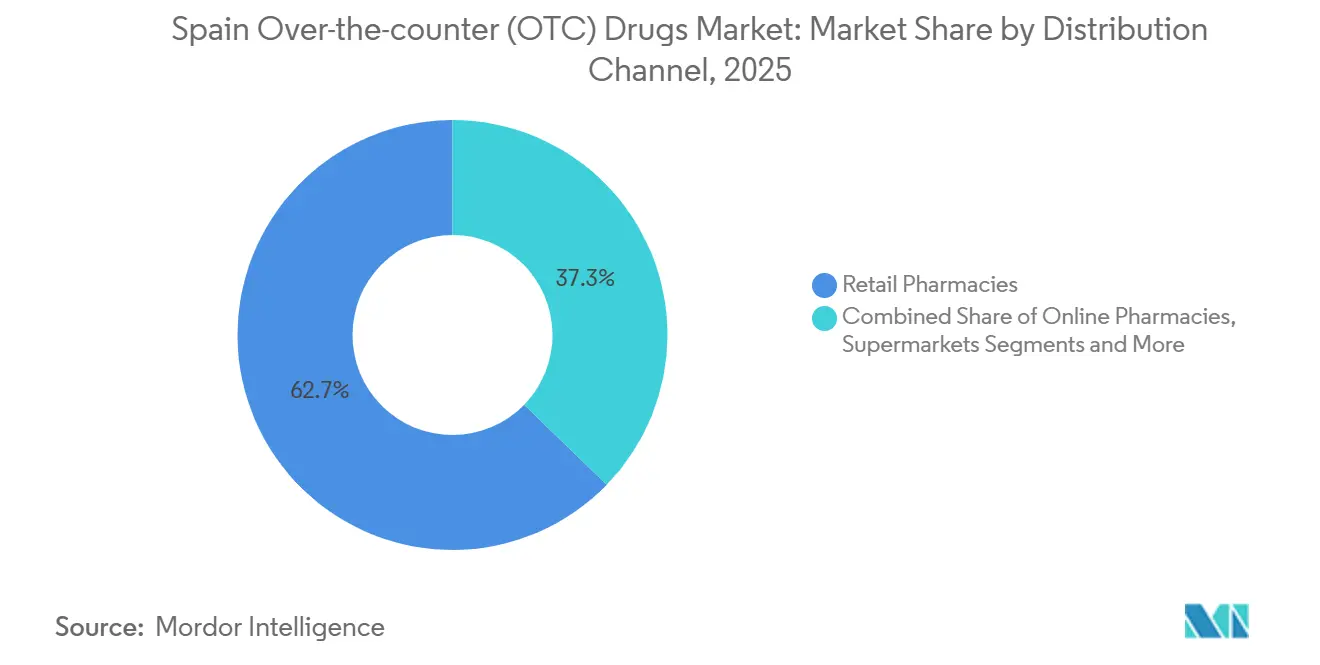
- By distribution channel, retail pharmacies captured 62.73% revenue in 2025, whereas online pharmacies record the highest projected 8.62% CAGR through 2031.
- By consumer demographic, adults held 57.92% of consumption in 2025, yet the geriatric cohort is advancing at an 8.01% CAGR through 2031.
Note: Market size and forecast figures in this report are generated using Mordor Intelligence’s proprietary estimation framework, updated with the latest available data and insights as of January 2026.
Spain Over-the-counter (OTC) Drugs Market Trends and Insights
Drivers Impact Analysis*
| Driver | (~) % Impact on CAGR Forecast | Geographic Relevance | Impact Timeline |
|---|---|---|---|
| Rx-to-OTC switches accelerating post-EU reclassification | +0.9% | National, early uptake in Catalonia and Madrid | Medium term (2–4 years) |
| Growing preference for self-care among aging population | +1.2% | National, concentrated in Galicia, Asturias, Castile and León | Long term (≥4 years) |
| Expansion of e-pharmacy and click-and-collect models | +0.8% | National, led by Madrid, Barcelona, Valencia | Short term (≤2 years) |
| High tourism inflow boosting point-of-sale volumes | +0.6% | Balearic Islands, Canary Islands, Costa del Sol, Costa Brava | Short term (≤2 years) |
| Regional reimbursement cuts driving OTC uptake | +0.7% | National, most pronounced in Andalusia, Valencian Community, Murcia | Medium term (2–4 years) |
| Emerging CBD-based OTC remedies | +0.3% | National, pilot adoption in Catalonia and Basque Country | Long term (≥4 years) |
| Source: Mordor Intelligence | |||
Rx-to-OTC Switches Accelerating Post-EU Reclassification
The European regulator downgraded pantoprazole 20 mg and cetirizine 10 mg in 2024, and AEMPS mirrored the decision within three months, allowing pharmacies nationwide to dispense both molecules without prescriptions. Manufacturers quickly introduced lower-dose packs priced 20–30% below prescription equivalents, helping price-sensitive patients who previously delayed treatment. Cinfa’s 14-tablet pantoprazole pack at EUR 6.50 (USD 7.10) undercut a leading multinational rival by EUR 3.00. General-practitioner visits for minor gastric complaints fell 8% in 2025, freeing capacity for chronic-disease management. The policy therefore expands access, lowers out-of-pocket costs, and reduces strain on the public health system, jointly lifting the Spain over the counter (otc) drugs market.
Growing Preference for Self-Care Among Aging Population
Spain counted 9.8 million residents aged 65 and above in 2025, equal to 20.8% of all citizens, and demographic forecasts suggest the share will reach 25% by 2030. Retirees favor familiar brands, consult pharmacists about drug–drug interactions, and self-fund vitamins and minerals excluded from public reimbursement, sustaining steady demand for analgesics, laxatives, and vitamin D. Faes Farma’s Fisiogen cognitive-health line grew sales 18% in 2025 on the back of targeted newspaper ads and pharmacy loyalty programs. WHO guidelines published in 2024 encourage older adults to manage minor ailments themselves, reinforcing the strategic pivot toward geriatric-focused portfolios. As these consumers purchase repeatedly for chronic conditions, they underpin the Spain over the counter (otc) drugs market’s long-run volume growth.
Expansion of E-Pharmacy and Click-and-Collect Models
An amended Royal Decree in 2024 permits licensed pharmacies to sell non-prescription medicines online once they register with AEMPS and display the EU common logo. Online channels captured 8.2% of OTC revenue in 2025, up from 5.1% two years prior, with click-and-collect accounting for 60% of digital orders. PromoFarma reported 1.2 million active users and an average basket value of EUR 35 (USD 38) in 2025. Digital ads face fewer creative constraints than prescription categories, so brands deploy price-comparison engines and targeted coupons to acquire new customers. The convenience premium appeals most to 18–40-year-olds in urban centers, cementing the Spain over the counter (otc) drugs market’s fastest-growing channel.
High Tourism Inflow Boosting Point-of-Sale Volumes
Spain welcomed 85 million visitors in 2024, restoring arrivals to above pre-pandemic levels and injecting EUR 110 billion (USD 120 billion) into the economy.[3] Coastal pharmacies report that tourists contribute up to 20% of July-August OTC turnover, predominantly on premium-priced analgesics, sunscreens, and rehydration salts. These sales lift per-unit margins because international travelers prefer branded products they recognize from home markets. Pharmacies stock multilingual packaging and hire English-speaking staff to minimize misuse risk. Nonetheless, the seasonality forces outlets in Ibiza and Málaga to build inventories six months early, tying up working capital yet providing an important revenue cushion for the Spain over the counter (otc) drugs market.
Restraints Impact Analysis*
| Restraint | (~) % Impact on CAGR Forecast | Geographic Relevance | Impact Timeline |
|---|---|---|---|
| Risk of misdiagnosis and delayed professional care | –0.4% | National, higher incidence in rural areas | Medium term (2–4 years) |
| Rising substance-abuse flags for codeine combinations | –0.3% | National, concentrated in Madrid, Barcelona, Seville | Short term (≤2 years) |
| Stringent Spanish advertising code CAP 2024 | –0.2% | National | Short term (≤2 years) |
| Price-containment pacts with regional health authorities | –0.3% | Catalonia, Basque Country, Navarra | Medium term (2–4 years) |
| Source: Mordor Intelligence | |||
Risk of Misdiagnosis and Delayed Professional Care
Ready OTC access can mask serious conditions and postpone specialist consultations. A 2024 study tracking 1,200 self-medicating heartburn patients found that 9% later received diagnoses of Barrett’s esophagus or early gastric cancer after delaying endoscopy eight months on average. Chronic headache sufferers who rely on analgesics risk overlooking hypertension or intracranial lesions. Although AEMPS mandates on-pack warnings to seek medical advice if symptoms persist beyond 10 days, compliance audits in 2025 showed that 30% of consumers ignore the guidance. Some chains deploy digital triage tools that flag red-flag symptoms, yet adoption outside large cities remains limited. The resulting disease-progression costs temper the positive trajectory of the Spain over the counter (otc) drugs market.
Rising Substance-Abuse Flags for Codeine Combinations
Emergency-room visits linked to codeine overdose rose 12% year on year to 4,800 in 2024, with adolescents and young adults representing 40% of incidents. AEMPS introduced sales-log requirements and single-pack limits in mid-2025 to curb misuse, yet stakeholders fear a shift to illicit channels. The EMA’s pharmacovigilance committee is reviewing codeine safety, and a move to prescription-only status would erase about EUR 25 million (USD 27 million) from OTC shelves. While public-health benefits are clear, revenue contraction and tighter pharmacist workload may restrain near-term growth in the Spain over the counter (otc) drugs market.
*Our forecasts treat driver/restraint impacts as directional, not additive. The impact forecasts reflect baseline growth, mix effects, and variable interactions.
Segment Analysis
By Product: Sleep Aids Outpace Traditional Categories
Analgesics generated 28.62% of revenue in 2025, but sleep aids are forecast to record a 7.36% CAGR to 2031, the quickest of any category. The Spain over the counter (otc) drugs market size for sleep aids is expected to expand as digital-device exposure prolongs wakefulness among urban professionals. Melatonin gummies and valerian capsules resonate with consumers seeking drug-free solutions, and EFSA’s 2024 approval of a health claim stating that 1 mg melatonin reduces sleep-onset latency legitimizes marketing. Spanish players launched affordable gummy lines priced below EUR 10 per monthly supply, while multinationals promote premium herbal blends with sustained-release technology.
Growing consumer interest in preventive health also lifts vitamins, minerals, and supplements, while dermatology products benefit from high UV exposure in coastal regions. Cough, cold, and flu remedies remain a seasonal staple, reinforced by lingering COVID-19 circulation. Gastrointestinal products serve both aging residents managing chronic reflux and tourists adjusting to new cuisines. Weight-control and ophthalmic segments retain niche status because advertising rules restrict bold efficacy claims, yet they round out pharmacy assortments, ensuring comprehensive choice within the Spain over the counter (otc) drugs market.

By Dosage Form: Gummies and Sprays Gain Traction
Tablets and capsules still accounted for 41.57% of value in 2025, but novel forms are eroding share. Gummies, sprays, and drops are projected to climb 7.55% CAGR, thanks to palatability, perceived naturalness, and on-the-go convenience. Consumers accept a 30–40% price premium per dose, which lifts category profitability. For example, Bayer’s vitamin C oral spray targets commuters who want quick immune support without water.
Liquids and syrups remain critical in pediatrics, yet sachets and chewables are winning over parents who prefer spill-proof administration. Topical creams and transdermal patches see steady demand for dermatology and localized pain relief. Powders and granules hold a niche for rehydration salts and fiber supplements. The dosage-form shift reflects broader expectations that OTC remedies integrate seamlessly into daily routines, reinforcing growth prospects for the Spain over the counter (otc) drugs market.
By Distribution Channel: Online Pharmacies Surge
Retail pharmacies commanded 62.73% of sales in 2025 due to Spain’s dense network of 22,000 outlets and the advisory role of pharmacists. However, online players are forecast to post an 8.62% CAGR, the steepest among channels, supported by the 2024 clarification of e-pharmacy rules. The Spain over the counter (otc) drugs market size for online sales climbs as urban millennials prioritize price transparency and 24-hour delivery. Click-and-collect mitigates cold-chain risks and allows face-to-face counseling at pickup.
Supermarkets and hypermarkets remain barred from carrying pharmacist-supervised medicines, limiting their share to vitamins and first-aid supplies. Drug-parapharmacy chains broaden assortments with cosmetics and wellness items, capturing convenience shoppers. Secondary channels such as vending machines and gas stations fill emergency needs but contribute minimal volume. As digital literacy spreads across age groups, hybrid omnichannel models will shape the Spain over the counter (otc) drugs market.
By Consumer Demographic: Geriatric Segment Accelerates
Adults aged 19–59 represented 57.92% of volume in 2025, yet the geriatric cohort is set to grow at 8.01% CAGR through 2031. This acceleration stems from Spain’s median age of 45 years and a forecast leap to 25% seniors by 2030. Seniors buy OTC products to manage arthritis pain, constipation, and osteoporosis, and they purchase vitamins that public insurance does not cover. The Spain over the counter (otc) drugs market size for geriatric consumers benefits from multibrand loyalty programs that bundle blood-pressure checks and medication reviews.
Faes Farma distributes cognitive-health sachets via senior centers, generating strong word-of-mouth endorsements. Younger adults experiment with novel flavors and delivery forms, driving gummies and effervescent tablets. Pediatrics lags due to Spain’s low birth rate of 7.9 per 1,000 in 2024, prompting brands to reposition children’s products for family use. Altogether, demographic nuances guide portfolio decisions across the Spain over the counter (otc) drugs market.
Geography Analysis
Spain’s internal diversity creates regional demand clusters that shape strategy. Catalonia and Madrid, representing 30% of the population, accounted for an outsized share of value in 2025, buoyed by higher disposable incomes, dense pharmacy networks, and robust e-commerce penetration. Barcelona alone hosted 800 pharmacies for 1.6 million residents, ensuring five-minute walk-in access for most citizens. Online purchases reached 12% of Catalonia’s OTC volume, twice the national average, even though price-ceiling agreements trim branded margins. The Spain over the counter (otc) drugs market captures incremental volume here through premium-format launches and digital loyalty schemes.
Andalusia, the most populous community, displays a dual profile. Coastal provinces such as Málaga and Cádiz experience summer demand spikes 40% above average due to tourist inflows, while inland areas favor low-priced generics. Andalusia’s 2024 formulary cuts shifted EUR 60 million (USD 65 million) of products to out-of-pocket purchases, buoying local OTC sales despite lower per-capita incomes. The Valencian Community and Galicia follow national patterns but skew toward geriatric consumption because their median ages exceed the Spanish average.
Island regions punch above their demographic weight. The Balearic Islands sold an estimated EUR 40 million (USD 43 million) in OTC products to 14 million visitors in 2024, focusing on sunburn relief and anti-diarrheal tablets. Pharmacies stock multilingual leaflets and employ seasonal staff fluent in English and German. The Basque Country and Navarra exhibit the highest per-capita OTC spending at EUR 68 (USD 74) in 2025, propelled by higher incomes and proactive health cultures. Although price-containment pacts cap yearly increases, consumers continue to trade up to sustained-release and effervescent formats, supporting value growth within the Spain over the counter (otc) drugs market.
Regulatory Landscape
Spain does not operate with a separate legal category for OTC medicines. Instead, products are marketed as non-prescription medicinal products under the general medicines framework (Real Decreto Legislativo 1/2015), with marketing authorization and ongoing safety oversight coordinated nationally by AEMPS and, where applicable, via EMA procedures. This approach keeps quality, pharmacovigilance, and labeling requirements for non-prescription products aligned with prescription medicines, which affects time-to-market and lifecycle change control for brands pursuing Rx-to-OTC switches.
Distribution and promotion rules also influence access and go-to-market execution. Online sales of non-prescription medicines are permitted only through authorized brick-and-mortar pharmacies under Royal Decree 870/2013, with the EU common logo used as the consumer-facing authenticity signal. Consumer advertising is generally limited to non-prescription medicines that are not publicly financed, while prescription-only advertising to the public is prohibited. As a result, brands have to budget for Spain-specific advertising compliance, including CAP 2024 in-market practice.
Value Chain Analysis
The Spain OTC drugs value chain runs from API and excipient sourcing through finished-dose manufacturing, including differentiated formats such as gummies, sprays, and drops, to marketing authorization holders and a tightly regulated distribution tier. Full-line wholesalers dominate pharmaceutical wholesale distribution in Spain (about 98.7% of the wholesale market), supplying the nationwide community-pharmacy network and handling both forward distribution and reverse logistics, which supports consistent service levels across urban and rural areas.
Downstream, community pharmacies dispense medicines and also handle online sales, so manufacturers compete heavily on pharmacy-facing execution, including trade terms, education, inventory availability, and omnichannel support such as click-and-collect. Supply continuity has become a more explicit operating requirement, with AEMPS publishing its 2025-2030 Plan for Guarantees of Human Medicine Supply to strengthen early shortage detection and coordination with marketing authorization holders. Industry bodies such as ANEFP also shape commercialization through self-care category advocacy and advertising self-regulation (Sello anefp), influencing how brands structure claims, media, and point-of-sale activation.
Competitive Landscape
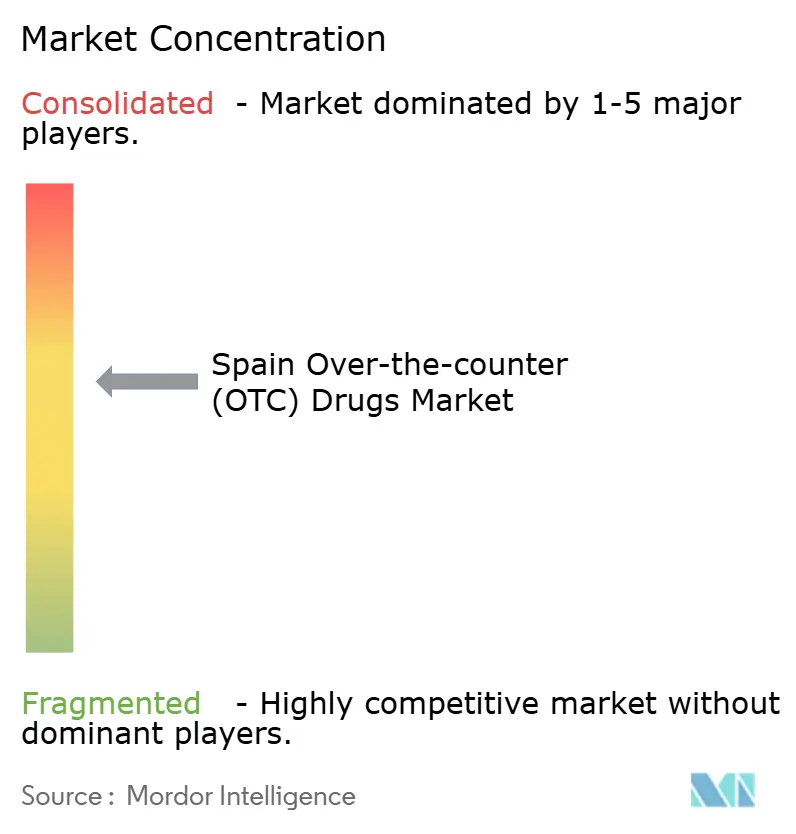
The top five multinationals, GSK, Bayer, Sanofi, Reckitt Benckiser, and Johnson & Johnson - held roughly half of revenue in 2025, while Spanish incumbents Cinfa, Almirall, Faes Farma, and Esteve together captured another 25%. The remaining 25% is fragmented among regional brands and private-label suppliers, giving the Spain over the counter (otc) drugs market a moderately concentrated structure. Multinationals rely on global R&D pipelines and marketing clout to sustain premium prices for legacy brands such as Nurofen, Voltaren, and Doliprane.
Domestic players counter with vertical integration. Cinfa manufactures in Navarra and delivers directly to 22,000 pharmacies, slashing logistics costs and enabling rapid replenishment during flu season. Faes Farma exploits niche categories such as cognitive health and women’s wellness, where branded clinical data differentiates from generics. Almirall filed a European patent in 2024 for a transdermal patch combining CBD and lidocaine, signaling intent to pioneer cannabinoid-based analgesia once regulatory barriers fall.
Strategic patterns include portfolio premiumization - shifting customers from generic ibuprofen to fast-acting gel capsules - and omnichannel rollout, with direct-to-consumer sites that bypass pharmacy margins. Perrigo and STADA grow by supplying pharmacy private-labels, siphoning price-sensitive buyers. Only 15% of outlets used AI inventory tools in 2025, leaving efficiency gains on the table. Mergers remain rare as family-owned pharmacies retain ownership restrictions, but supply-side collaborations to co-manufacture gummies and sprays illustrate incremental consolidation within the Spain over the counter (otc) drugs market.
Spain Over-the-counter (OTC) Drugs Industry Leaders
-
Sanofi SA
-
GlaxoSmithKline PLC
-
Bayer
-
Reckitt Benckiser Group PLC
-
P&G Health
- *Disclaimer: Major Players sorted in no particular order
Market Opportunities and Future Outlook
Pharmacy-anchored digital commerce is a key whitespace area. Regulation permits e-sales of non-prescription medicines only via authorized pharmacies (Royal Decree 870/2013), which pushes brands to win through pharmacy-led marketplaces, click-and-collect, and compliant digital acquisition rather than non-pharmacy retail. This design favors manufacturers and platforms that build pharmacist counseling into the customer journey alongside rapid fulfilment and clear product assortment.
Additional policy and infrastructure programs create new levers for self-care portfolios. Spain launched the National Health Data Space (ENDS) in January 2026 with a EUR 70 million investment to promote secure data sharing for research and innovation, which supports more data-informed symptom education and pharmacovigilance-aligned consumer engagement around non-prescription categories. On the supply side, Profarma 2025-2026 (launched July 2025) and the national pharmaceutical industry strategy (2024-2028) focus incentives on industrial competitiveness, R&D, and manufacturing resilience. These programs can support investments that improve continuity and reduce stock-out risk for high-velocity OTC lines during seasonal peaks, including tourism and winter respiratory demand.
Recent Industry Developments
- June 2026: Cooper Consumer Health acquired Ferrer's consumer healthcare business in Spain, adding established brands such as Gelocatil along with Repavar and Novalac to its local portfolio. The transaction strengthens Cooper's scale in Spain's pharmacy-led OTC channel and increases competitive intensity in high-turnover categories like analgesics, where brand presence and shelf execution are critical.
- December 2025: Cooper Consumer Health reported the Spain-wide launch of Nicotinell nicotine-replacement therapy through its multi-country omnichannel platform. The rollout broadened access across pharmacy and digital touchpoints, reinforcing the importance of coordinated cross-channel activation for self-care categories in Spain.
- November 2024: The European Medicines Agency reclassified pantoprazole 20 mg and cetirizine 10 mg as suitable for non-prescription use, expanding the pool of OTC-eligible molecules available to national regulators. This shift supported faster Rx-to-OTC switching activity in Spain and encouraged manufacturers to introduce dose-flexible packs positioned below reimbursed prescription equivalents.
Research Methodology Framework and Report Scope
Market Definition and Coverage
This market covers the value of non-prescription medicines that consumers can buy in Spain without a doctor's prescription, across common self-care needs and typical retail and online routes.
Scope exclusions: Prescription-only medicines and hospital-only pharmacy sales are excluded from this sizing.
Segmentation Overview
- By Product
- Cough, Cold & Flu Products
- Analgesics
- Dermatology Products
- Gastrointestinal Products
- Vitamin, Mineral & Supplements (VMS)
- Weight-loss/Dietary Products
- Ophthalmic Products
- Sleep Aids
- Other Product Types
- By Dosage Form
- Tablets & Capsules
- Liquids & Syrups
- Topicals (Creams/Ointments/Patches)
- Powders & Granules
- Others (Sprays, Drops, Gummies)
- By Distribution Channel
- Retail Pharmacies
- Online Pharmacies
- Supermarkets/Hypermarkets
- Drug-Parapharmacy Chains
- Other Channels (Gas stations, Vending)
- By Consumer Demographic
- Adults (19–59 yrs)
- Geriatric (≥60 yrs)
- Pediatric (0–18 yrs)
Data Sources, Market Sizing, and Validation
Desk Research
Desk research is used to set the base context for Spain's self-medication demand, channel structure, and category mix before modeling starts. We rely on public sources such as national health and medicines agencies, national statistics releases, EU health and trade publications, and OECD health indicators to understand spend patterns and consumer access.
To keep inputs grounded, we also review company annual reports, investor presentations, and audited filings for listed retailers and manufacturers. Reputable press coverage is reviewed for market signals like pricing actions and channel shifts. For specific checks, paid subscriptions are used for company financials and intelligence, and for patent databases when product-switch and innovation activity needs clarification. The desk sources mentioned are illustrative, and many other references were used for data capture, validation, and follow-up clarification.
Primary Interviews and Surveys
Primary work is used to pressure-test what desk sources cannot show clearly, especially category boundaries, channel margins, and how promotions and pack sizes move average selling prices over time. We speak with pharmacy and parapharmacy channel stakeholders, distributors, and category specialists, and then we re-check key assumptions with practitioners familiar with Spanish consumer health behavior so the final model matches on-the-ground realities.
Distribution of primary research fieldwork respondents
| Company type | Respondent position |
|---|---|
| Top tier: 29% | CXOs: 19% |
| Mid tier: 52% | Functional/Unit leaders: 35% |
| Smaller Players: 19% | Managers: 46% |
Market-Sizing & Forecasting
Sizing starts with a top-down build where Spain's consumer health spending signals and category shares are used to reconstruct the OTC value pool, and then it is split across the main therapeutic and channel buckets. To keep the totals realistic, we corroborate the outputs with selective bottom-up approximations, such as sampled retail price points by pack format multiplied by estimated unit movement for high-rotation products, followed by supplier and channel checks.
Key inputs (illustrative) include the share of retail pharmacy versus supermarkets and online, the mix of high-volume categories like analgesics and cough-cold-flu, dosage-form patterns that influence price per treatment, the portion of adults versus pediatric demand in seasonal categories, and observed price inflation by pack size and formulation changes. Where a bottom-up proxy is incomplete, gaps are handled using channel-weighted averages and conservatively adjusted ranges, which are then reviewed in follow-up calls.
For forecasting, scenario analysis is used so growth can be flexed based on a few practical drivers, including consumer self-care adoption, respiratory season severity, OTC switch intensity, and the pace of online pharmacy penetration. The final forward view is kept consistent with what primary respondents consider achievable under a base case, and then stress-tested under slower and faster demand scenarios.
Data Validation & Update Cycle
Outputs are checked through triangulation across category splits, channel totals, and implied pricing so the model does not drift away from observable market behavior. Variance checks are run across historical years, and any sharp jumps are traced back to a specific driver such as price changes, channel reclassification, or an unusual seasonal peak before sign-off.
A second analyst review is completed for formulas, assumptions, and unit consistency, and re-contact is triggered when an estimate falls outside the interview-informed range. Reports are refreshed annually, and interim updates are made when material events occur. Before delivery, an analyst performs a final pass so clients receive the latest updated view.
Mordor Intelligence's Spain Over the Counter Otc Drugs Market Size Compared Against Other Published Estimates
It is common to see different market sizes for Spain OTC drugs because publishers do not always count the same sales routes, product boundaries, and base years. Differences also show up when one model leans more on retail price assumptions, while another leans more on manufacturer revenue, which can move the final number a lot.
In this study, the spread is mainly explained by what gets counted as OTC in Spain and how channels are treated, especially supermarket and drug-parapharmacy chain sales versus pharmacy-only views, followed by how average selling price is updated for pack-size shifts and promotion intensity. Another driver is the refresh cadence, where a newer model can capture recent pricing and mix changes that older base years may miss, and this is reflected in the 2026 current-year estimate used by Mordor Intelligence.
Benchmark comparison
| Source | Market Size | Gaps in Research Methodology |
|---|---|---|
| Mordor Intelligence | USD 2.96 B (2026) | |
| Industry Publisher A | USD 1.40 B (2025) | Uses an earlier base year and a tighter channel lens in its public summary, which can understate value when supermarket and parapharmacy chain sales are more fully captured in the channel mix. |
| Research House B | USD 4.13 B (2022) | Anchors the market at a 2022 base and appears to apply broader value capture and growth assumptions, which can inflate totals if pricing progression and category boundaries are not re-checked with current channel realities. |
The comparison shows that most of the gap comes from year selection, channel coverage, and how pricing is carried forward across changing pack formats. By keeping the scope tied to clearly defined OTC categories and validating channel splits and price movement with primary checks, the sizing stays traceable to repeatable steps and practical market signals, which helps decision-makers work with a stable number over time.
Key Questions Answered in the Report
How large is the Spain over the counter (otc) drugs market in 2026?
It was valued at USD 2.96 billion in 2026 and is on track to reach USD 3.67 billion by 2031.
Which product category is expanding the fastest?
Sleep aids lead with a projected 7.36% CAGR through 2031, driven by melatonin gummies and herbal blends.
What channel is gaining share most quickly?
Online pharmacies, supported by click-and-collect and 24-hour delivery, are forecast to post an 8.62% CAGR.
Why are Rx-to-OTC switches important for growth?
Reclassification of molecules such as pantoprazole immediately broadens self-medication options and reduces GP visits.
How do regional price caps affect manufacturers?
Caps squeeze margins in Catalonia, the Basque Country, and Navarra, prompting firms to favor premium formats outside control.
What is the main demographic driver?
Spain’s aging population - set to reach 25% seniors by 2030 - is boosting demand for analgesics, vitamins, and laxatives.