Market Overview
| Study Period | 2020 - 2031 |
|---|---|
| Forecast Data Period | 2026 - 2031 |
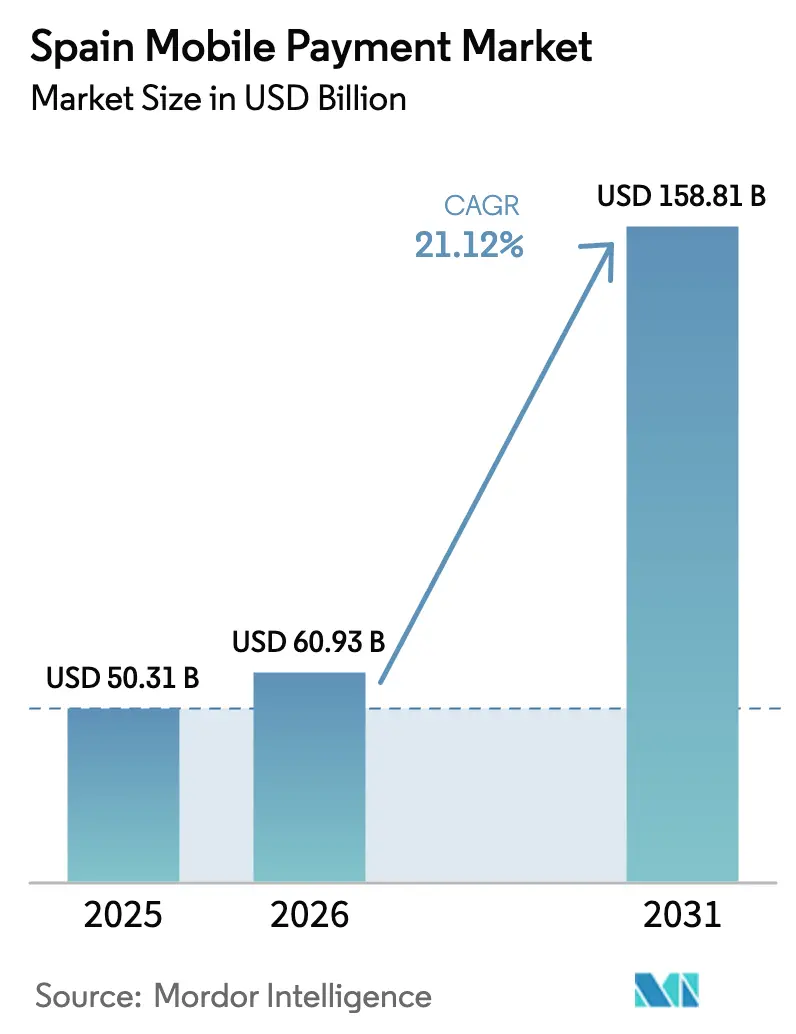
| Base Year Market Size (2025) | USD 50.31 Billion |
| Market Size (2026) | USD 60.93 Billion |
| Market Size (2031) | USD 158.81 Billion |
| Growth Rate (2026 - 2031) | 21.12% CAGR |
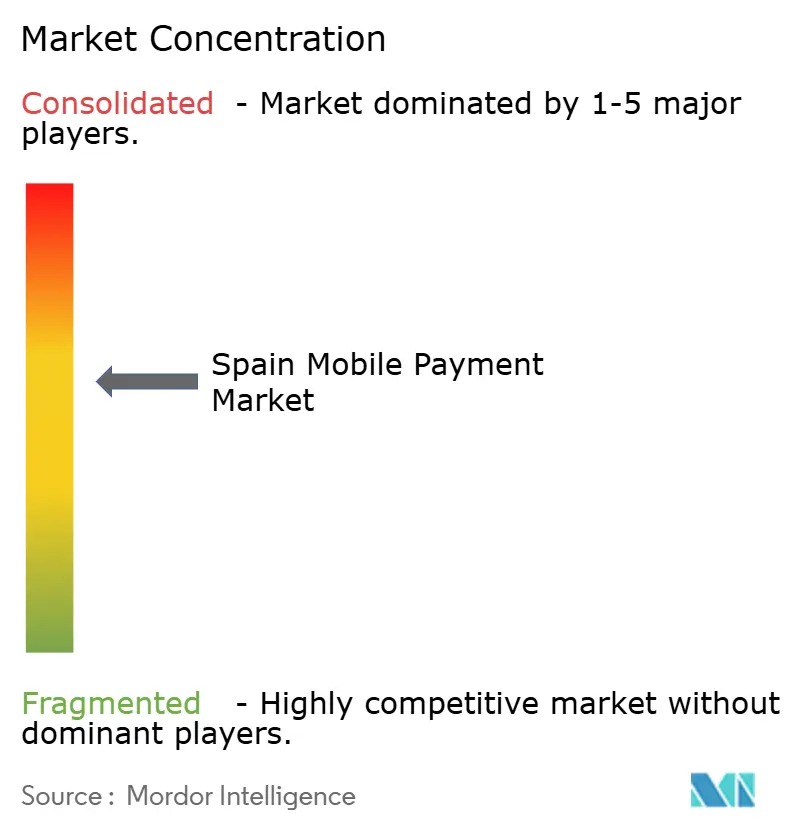
| Market Concentration | Medium |
Major Players *Disclaimer: Major Players sorted in no particular order Image © Mordor Intelligence. Reuse requires attribution under CC BY 4.0. | |
Spain Mobile Payment Market Analysis by Mordor Intelligence
The Spain mobile payment market size is expected to grow from USD 50.31 billion in 2025 to USD 60.93 billion in 2026 and is forecast to reach USD 158.81 billion by 2031 at 21.12% CAGR over 2026-2031. The sharp growth rests on three pillars: a 43% instant-payment penetration rate that far outstrips the EU average, Iberpay’s rails that settled EUR 2.8 trillion (USD 3.08 trillion) in 2024, and Bizum’s 1.093 billion transactions that underline consumer trust in real-time account-to-account (A2A) transfers.[1]Iberpay, “Informe Anual 2024,” iberpay.com Policy tailwinds add momentum—EU instant-payment mandates now cap settlement at 10 seconds, and the European Central Bank’s (ECB) digital-euro sandbox is enrolling Spanish banks for pilot use cases. At the same time, 92.3% 5G coverage and 95.2% fiber connectivity give the ecosystem the network reliability it needs for dense transaction volumes.[2]International Trade Administration, “Spain – Digital Economy,” trade.gov Cybersecurity investments by large incumbents are mitigating fraud-loss concerns, while near-field-communication (NFC) innovation—ranging from Tap-to-Pay smartphones to wearable rings—continues to widen consumer appeal.
Key Report Takeaways
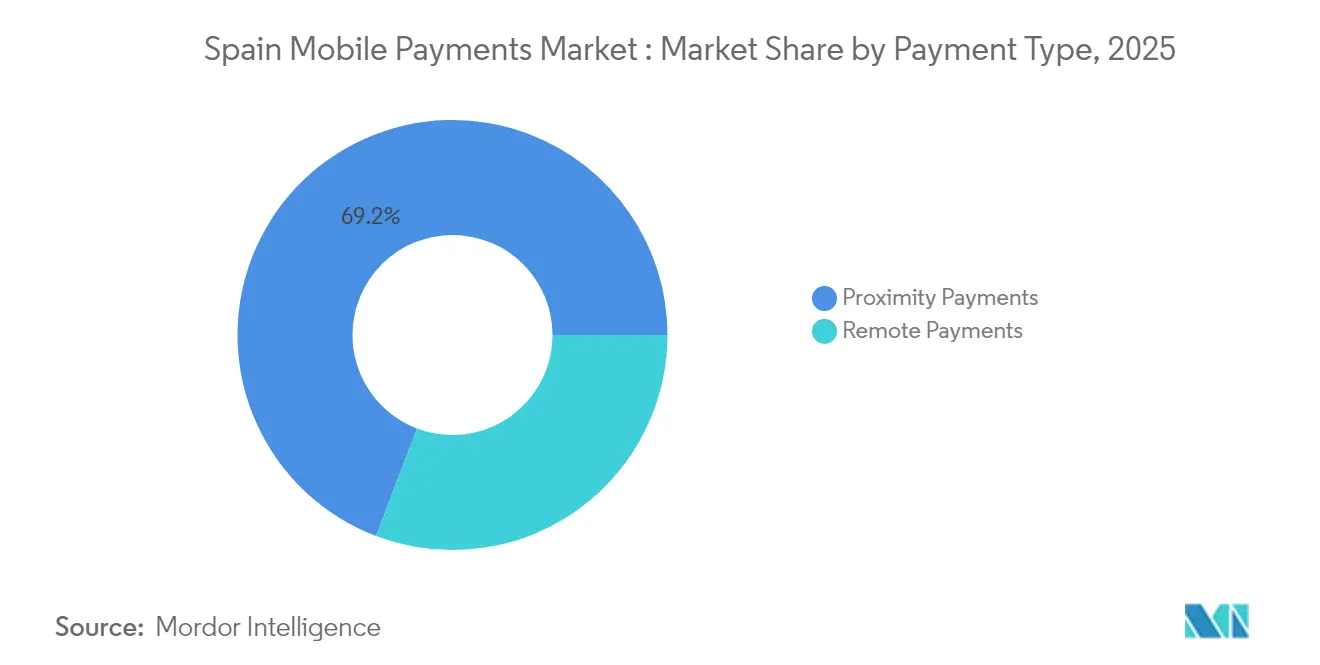
- By payment type, proximity payments led with 69.22% revenue share in 2025, whereas remote payments are forecast to expand at a 22.96% CAGR through 2031.
- By transaction type, in-store point-of-sale captured 45.34% of the Spain mobile payment market share in 2025; person-to-merchant (P2M) checkout solutions are set to rise at a 23.85% CAGR.
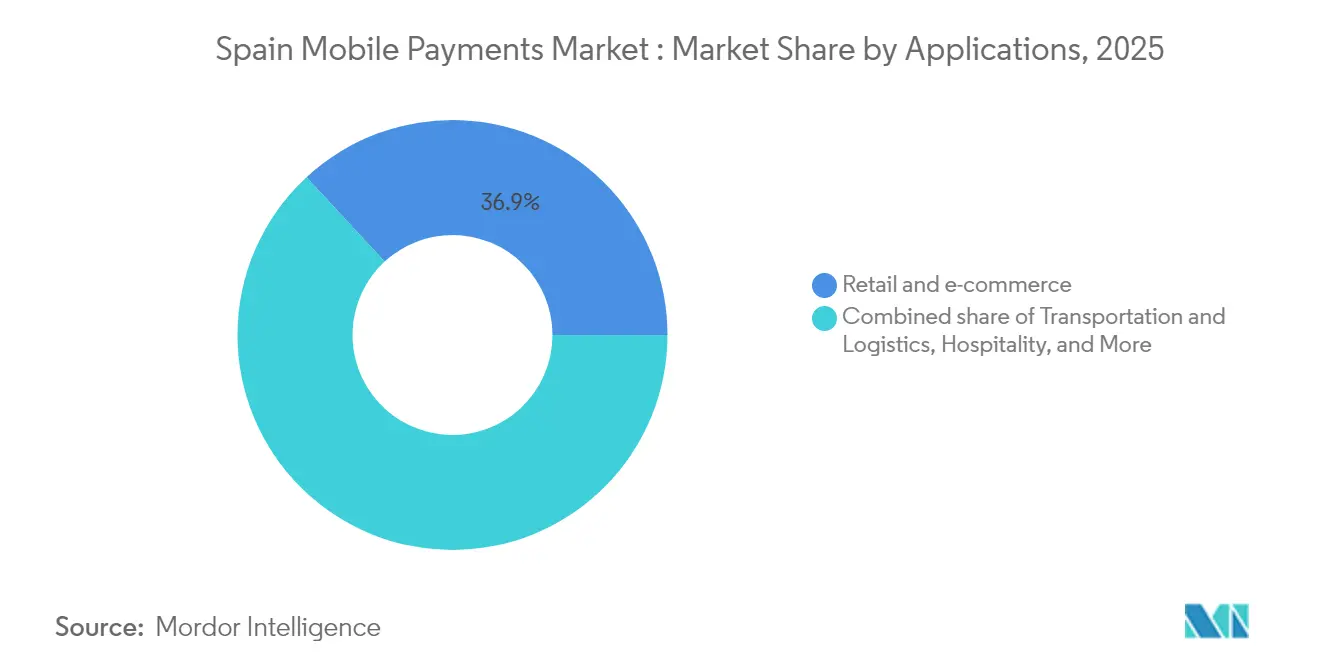
- By application, retail and e-commerce accounted for 36.88% of the Spain mobile payment market size in 2025; the government and public-sector segment is advancing at a 25.02% CAGR.
- By end-user, personal usage remained dominant at 65.12%, while the business segment is projected to log a 22.14% CAGR through 2031.
Note: Market size and forecast figures in this report are generated using Mordor Intelligence’s proprietary estimation framework, updated with the latest available data and insights as of 2026.
Spain Mobile Payment Market Trends and Insights
Drivers Impact Analysis*
| Driver | (~) % Impact on CAGR Forecast | Geographic Relevance | Impact Timeline |
|---|---|---|---|
| Rising smartphone & 4G/5G penetration | +4.2% | National, with urban concentration in Madrid, Barcelona, Valencia | Short term (≤ 2 years) |
| Bizum & open-banking rails scaling instant A2A payments | +6.8% | National, with spillover to Portugal, Italy, Andorra | Medium term (2-4 years) |
| Shift to contact-free payments drives the market | +3.9% | National, accelerated in hospitality and retail sectors | Short term (≤ 2 years) |
| Digital-Euro pilots to fast-track wallet interoperability | +2.1% | EU-wide, with Spain as early adopter market | Long term (≥ 4 years) |
| Mandatory-cash-acceptance law spurring POS upgrades | +1.8% | National, concentrated in retail and hospitality | Medium term (2-4 years) |
| Iberpay cross-border instant rails opening B2C payout use-cases | +2.9% | Cross-border focus: Spain-Portugal-Italy corridor | Medium term (2-4 years) |
| Source: Mordor Intelligence | |||
Rising smartphone & 4G/5G penetration
Spain has achieved 92.3% 5G coverage and 95.2% fiber-to-the-premises reach, creating low-latency conditions that favor on-device authentication and sub-second settlement. Government funding via the España Digital 2026 plan directs 26% of NextGenerationEU capital toward connectivity, ensuring rural provinces close the digital gap. Consumer response is immediate: mobile-payment usage jumped to 50% of Spaniards in 2023 from 29.7% in 2022, a shift echoed in rising NFC-ring pilots that anonymize credentials at the point of tap. Network robustness also supports the Digital Beta Wallet, a state-backed app that layers age-verification on top of payment credentials, foreshadowing integrated identity-plus-payment wallets.[3]Government of Spain, “Digital Beta Wallet,” digital.gob.es
Bizum & open-banking rails scaling instant A2A payments
Bizum demonstrates how a bank-consortium model can out-innovate fintech disruptors. Its 17% annual volume jump in 2024 brought total operations to 1.093 billion, while online purchases soared to EUR 3.107 billion (USD 3.42 billion).[4]Bizum, “Bizum alcanza los 1.100 millones de operaciones en 2024,” elespanol.com PSD2 open-banking APIs let third-party providers plug directly into 186 domestic and foreign institutions, trimming card-network fees and enabling immediate settlement. The 2025 EuroPA launch extends Bizum to Portugal, Italy, and Andorra, giving merchants a cross-border customer base of 50 million without additional integration. Merchant uptake shows 56% growth to 82,000 retail points, cementing Bizum as Spain’s de-facto A2A standard.
Shift to contact-free payments drives the market
Hospitality venues report that 66% of patrons now prefer mobile settlement, and 82% of tourists demand contactless options during peak season. Bars and nightlife spending climbed at a 15.6% CAGR in 2024, a trend fueled by Tap-to-Pay rollouts that remove the need for PIN pads. The Madrid Virtual Transport Card processed 588,500 trips in pilot phase, validating consumer readiness for hardware-less NFC services. QR and Pay-by-Link workflows offer a bridge between physical and online retail, while AI-vision checkout kiosks reduce transaction time and labor cost in supermarkets.
Digital-euro pilots to fast-track wallet interoperability
The ECB’s 70-participant innovation platform is stress-testing programmable money features—conditional disbursement, offline transfer, and privacy tiers—with Spanish banks in the first cohort. Academic modeling suggests 32.29% of Spanish depositors could shift up to 5.57% of household balances into digital euros, altering bank funding mixes but opening new transaction rails. Because the CBDC is by design mobile-first, existing wallet providers must upgrade to pan-EU interoperability standards sooner, catalyzing back-end harmonization. Spain’s instant-payment proficiency offers a blueprint for the ECB on fraud mitigation and real-time reconciliation, accelerating continental rollout.
Restraints Impact Analysis*
| Restraint | (~) % Impact on CAGR Forecast | Geographic Relevance | Impact Timeline |
|---|---|---|---|
| Fraud & data-security concerns | -2.8% | National, with higher impact in urban areas | Short term (≤ 2 years) |
| Legacy card-fee economics slowing merchant adoption | -1.9% | National, concentrated in SME segment | Medium term (2-4 years) |
| Ageing cash-oriented population & legal right-to-cash | -1.4% | Rural areas and elderly demographics | Long term (≥ 4 years) |
| Single aggregator (Redsys) bottlenecks open-API quality | -1.1% | National payment processing infrastructure | Medium term (2-4 years) |
| Source: Mordor Intelligence | |||
Fraud & data-security concerns
Spain logged over 96,000 cybersecurity incidents in 2024, a 15% rise that hit financial services disproportionately. High-profile leaks such as the Air Europa breach keep risk perception elevated. The ECB’s fraud-prevention taskforce now recommends real-time data-sharing and biometric authentication, compelling providers to add cost-intensive defenses. SMEs are especially exposed; 22,000 cyber incidents in 2023 hit freelancers and micro-firms, with one-third related to online fraud. This threat matrix slows onboarding for merchants that lack the budget for multilayer defense.
Legacy card-fee economics slowing merchant adoption
Spain’s anti-fraud law caps professional cash payments at EUR 1,000 (USD 1142.04), nudging merchants toward electronic acceptance, yet interchange fees remain stubbornly high for small retailers. Redsys processes the lion’s share of card traffic, and its single-hub status means API enhancements move at a pace set by one vendor, creating a bottleneck. Consumer research shows 67% of Spaniards rank security above speed, so merchants must fund premium fraud filters to win trust—another cost hurdle. Although the EU’s instant-payment regulation bans extra fees for 10-second transfers, its staging timeline allows entrenched fee structures to persist for several quarters, delaying ROI on mobile-payment upgrades.
*Our forecasts treat driver/restraint impacts as directional, not additive. The impact forecasts reflect baseline growth, mix effects, and variable interactions.
Segment Analysis
By Payment Type: Proximity Growth Faces Remote Surge
Proximity transactions held 69.22% of the Spain mobile payment market in 2025, an edge built on ubiquitous NFC-capable terminals and consumer familiarity at grocery checkouts. Remote payments, however, are accelerating at a 22.96% CAGR, buoyed by Bizum’s online-checkout plugin, which doubled e-commerce volumes to EUR 3.107 billion (USD 3.42 billion) in 2024. Madrid’s Virtual Transport Card illustrates how proximity modes keep innovating, recording 588,500 test rides without physical passes.
Remote-payment momentum stems from cross-border interoperability: Bizum’s EuroPA link will let 50 million users send instant transfers beyond Spain. Parallel innovations in Pay-by-Link and QR codes blur the boundary between remote and in-person transactions, enabling merchants to reconcile both flows in one ledger. While proximity volumes dominate, remote payments rewrite the unit-economics calculus by slashing interchange, putting card networks under margin pressure. This dual-track dynamic ensures both modes expand but at varied trajectories, shaping gateway and processor roadmaps through 2031.


By Transaction Type: POS Resilience Meets P2M Innovation
In-store POS still commands 45.34% of the Spain mobile payment market in 2025, thanks to retailer investment in contactless terminals and integrated loyalty apps. Person-to-merchant (P2M) checkouts, however, top the growth chart at a 23.85% CAGR. Bizum’s merchant base rose 56% to 82,000 locations, demonstrating that A2A rails can undercut card fees for micro-ticket sales. Peer-to-peer flows remain a stable pillar: Bizum captured 95% of domestic P2P volume with 1.093 billion transfers in 2024.
AI-vision checkout and Tap-to-Phone services are reshaping queue management by converting consumer handsets into POS devices, a boon for pop-up retail. Cross-border P2M capabilities from the EuroPA launch unlock Italian and Portuguese shoppers for Spanish e-tailers at domestic fee rates, redefining addressable revenue pools. Meanwhile, POS-network providers must invest in real-time fraud scoring to keep pace with instant-settlement expectations, prompting consolidation among independent service operators.
By Application: Retail Leadership Meets Government Acceleration
Retail and e-commerce represented 36.88% of the Spain mobile payment market size in 2025, translating into superior checkout-conversion rates and basket-value lifts for omni-channel merchants. Government and public-sector wallets are on a steeper 25.02% CAGR slope, propelled by EUR 1.6 billion (USD 1.76 billion) in subsidies earmarked for digital ticketing in 2025. Madrid’s account-based ticketing system—and its upcoming expansion to iOS and monthly passes—validates the scale potential of civic applications.
Hospitality ranks next in wallet adoption as tourists demand touch-free interactions; nightly bar spend rose at 15.6% CAGR, a cash-replacement storyline embraced by city tourism boards. Health-care and education remain nascent but will benefit from the Digital-Spain 2026 blueprint, which funds biometric ID integration for hospital check-ins and school meal plans. The Digital Beta Wallet’s age-verification feature showcases cross-domain utility, weaving payments and digital identity into a single UX.
By End-User: Personal Dominance Anchors Business Upside
Personal accounts contributed 65.12% of the Spain mobile payment market in 2025, underpinned by epayment literacy and 72% European wallet penetration. Business end-users, however, post a 22.14% CAGR, accelerated by regulatory ceilings on cash transactions and the tax office’s e-invoice mandate for SMEs. The BBVA-Sabadell merger adds EUR 5 billion (USD 5.5 billion) in annual lending headroom that can be channeled into working-capital lines tied to integrated payment suites.
SMEs flock to Pay-by-Link and Tap-to-Pay because they eliminate hardware capex and shorten settlement cycles vis-à-vis card rails. Bizum enabled 1 million charitable donations worth EUR 49.2 million in 2024, illustrating product versatility beyond P2P. As digital-euro integration looms, corporates are requesting wallet solutions that can toggle between commercial bank money and CBDC, spurring treasury-software updates.
Geography Analysis
Spain outperforms the broader EU on real-time adoption, processing 43% of all domestic transactions as instant settlements in 2025. Iberpay links 99% of the country’s financial institutions and cleared 3.185 billion payments last year, cementing a national backbone for user-friendly A2A experiences. Urban centers multiply the effect: Madrid’s Virtual Transport Card pilot recorded 588,500 trips, while Barcelona and Valencia gear up for similar NFC wallets, signaling network effects across large metro areas.
Regional disparities persist. Rural provinces, home to an ageing demographic, still rely heavily on cash despite the EUR 1,000 threshold on professional cash usage. Digital-Spain 2026 dedicates fiber and 5G subsidies to these zones, aiming to push coverage beyond today’s 92.3% level. Island territories such as the Balearics are early testers of QR-code fare collection for ferries, illustrating how tourism corridors experiment with lightweight solutions.
Cross-border momentum elevates Spain to gateway status for southern Europe. Bizum’s 2025 extension to Portugal, Italy, and Andorra enables the first multi-country instant-payment corridor at scale. Spanish banks are pilot nodes in the ECB’s digital-euro sandbox, adding to the country’s reputational edge in payments R&D. This geographic synergy pulls inbound fintech investment and positions Spanish processors to license out their fraud-analytics IP across the eurozone
Regulatory Landscape
Spain’s mobile payments operate under EU and national payments rules transposed via Real Decreto-ley 19/2018 (PSD2). Banco de Espana oversees payment systems and providers and supervises key domestic infrastructures referenced in this market, including Iberpay’s SNCE rails and scheme and processing entities such as Bizum and Redsys. EU instant-payments requirements that entered force in June 2025, including a 10-second settlement baseline and fee parity constraints for instant transfers, are directly relevant for bank-led mobile payment journeys in Spain, where account-to-account (A2A) use cases are scaling.
Supervision has shifted from authorization toward operational resilience and crypto-adjacent payment activity. Banco de Espana’s 2025-2026 risk-based supervision plan emphasizes digital operational resilience aligned with DORA expectations, raising compliance requirements around ICT risk management for payment services. In March 2026, Banco de Espana said that crypto-asset service providers offering payment services with electronic money tokens must hold PSD2 authorization, with a March 2, 2026 cut-off for existing providers to have applied. This reinforces a clearer perimeter between regulated payment institutions and unlicensed crypto payment offers.
Value Chain Analysis
The value chain starts with funding and account access at banks and e-money institutions, then moves through scheme and processing layers that route and authorize transactions. Iberpay provides core interbank clearing for instant credit transfers, enabling real-time A2A payments that underpin Bizum. For card and hybrid wallet flows, processors and switches such as Redsys connect financial entities, merchants, and acceptance devices, and Redsys underpins parts of the domestic ecosystem that support Bizum-linked checkout experiences.
On the acceptance side, acquirers and merchant service providers package terminals, softPOS, risk tools, and settlement into merchant contracts, with bank-owned platforms holding a large share of distribution. Comercia Global Payments (CaixaBank and Global Payments) is a major POS manager in Spain (30.5% share cited in Banco de Espana supervision reporting), while Santander’s Getnet operates as a scaled acquiring platform within the group. Gateway and orchestration providers, including firms such as Sipay, integrate methods such as Bizum, Apple Pay, and Google Pay for merchants, and device and OS ecosystem players (Apple and Google) supply wallet front ends and secure elements. Recent bank-led feature rollouts, including Tap to Pay on iPhone and Apple Pay installment options, show how banks and global wallet platforms collaborate to reduce hardware dependency and embed credit at checkout.
Competitive Landscape
Traditional banks anchor the ecosystem by controlling core settlement rails, yet fintech challengers spur rapid product cycles. The Spain mobile payment market therefore displays a “co-opetition” model: Bizum’s banking consortium shares APIs across rival institutions, generating network effects that single-player apps struggle to match. Strategic emphasis has shifted to embedded payments—CaixaBank’s 70.5% digital-client ratio enables in-app micro-loans that settle via mobile wallets in seconds.
The approved BBVA-Sabadell merger changes the leaderboard by creating Spain’s second-largest lender, consolidating product budgets for AI-fraud suites and multi-rail wallets. CaixaBank and Santander counterbalance through partnerships: Santander’s stablecoin pilot under MiCA aims to offer corporate treasurers on-chain settlement, while CaixaBank co-develops Request-to-Pay flows with BBVA for B2B invoices.
Technology suppliers occupy a crucial tier. Redsys remains the dominant processor, but open-banking aggregators such as PPRO and Paycomet differentiate via merchant-specific analytics. Patent filings—2,111 in 2023—show a tilt toward automated tolling and IoT micro-payments, reinforcing Spain’s reputation for applied payments engineering. As regulatory compliance costs rise—MiCA for crypto and instant-payment mandates for banks—scale economics increasingly favor incumbents, implying further consolidation in processing and gateway niches.
Spain Mobile Payment Industry Leaders
PayPal Holdings, Inc.
Apple Inc.
Google LLC
CaixaBank S.A.
Banco Bilbao Vizcaya Argentaria S.A.
- *Disclaimer: Major Players sorted in no particular order

Market Opportunities and Future Outlook
A clear whitespace exists in-store A2A at scale, where instant-payment penetration and Iberpay rails enable card-like experiences without card-network economics. Bizum’s plan to expand into NFC in-store payments in 2026, including the Bizum Pay wallet, broadens the acceptance footprint by targeting existing contactless terminals. It also complements the EuroPA interoperability path that already links Spain to Portugal, Italy, and Andorra for A2A transfers. For merchants, this supports payment orchestration and reconciliation tools that treat Bizum and card wallets as peer rails across proximity and remote journeys.
Another opportunity sits at the intersection of identity, compliance, and payments as public-sector digitization accelerates. Spain’s Digital Beta Wallet concept (age verification layered with credentials) and the ECB digital-euro experimentation that includes Spanish banks both push providers toward interoperable wallet standards and stronger authentication. Players that can package DORA-aligned operational controls, biometric or risk-based authentication, and multi-rail acceptance (cards, Bizum, instant transfers, and future CBDC-linked flows) have a practical entry point. This is especially relevant given that mobile payments’ share of Spanish transactions increased from 4% to 7% between 2022 and 2025, alongside continued signals from banks and processors that mobile-led in-person payments are gaining ground.
Recent Industry Developments
- July 2026: Bizum (Spain) launches standalone Bizum Pay digital wallet for NFC-based payments at POS. The move expands NFC A2A payments and strengthens domestic payment rails, widening merchant adoption and competition with card networks.
- May 2026: Bizum (Spain) rolls out NFC-based in-store account-to-account payments at physical terminals. The expansion of SEPA Instant Payments at point-of-sale accelerates merchant uptake of A2A transfers and intensifies competition with card schemes.
- June 2025: CaixaBank launches Tap to Pay on iPhone for business customers (contactless acceptance). The adoption of digital wallet acceptance via iPhone reinforces CaixaBank leadership in mobile payments and drives merchant acceptance tooling integration.


Research Methodology Framework and Report Scope
Market Definition and Coverage
For this report, we define Spain mobile payment as the value of payments initiated on a mobile device and completed through proximity or remote payment flows in Spain, covering both consumer and business use cases.
Scope exclusions: we exclude card or bank transfers that are not initiated through a mobile payment experience, and we also exclude hardware-only revenues such as POS terminals and phones.
Segmentation Overview
- By Payment Type
- Proximity Payments
- Remote Payments
- By Transaction Type
- Peer-to-Peer (P2P)
- In-store Point-of-Sale (POS)
- Person-to-Merchant (P2M/Checkout)
- Other Transaction Types
- By Application
- Retail and eCommerce
- Transportation and Logistics
- Hospitality and Food-Service
- Government and Public Sector
- Other Applications (Education, Healthcare)
- By End-user
- Personal
- Business
Data Sources, Market Sizing, and Validation
Desk Research
Desk research was used to set the market frame and to anchor model inputs to public payment and digital adoption signals for Spain. We relied on official and open sources such as Banco de Espana and ECB payment statistics, National Statistics Institute (INE) indicators on population and digital access, and European Commission updates on payments regulation and consumer protection that can affect adoption.
To translate signals into a usable sizing model, we also reviewed publications from the Bank for International Settlements (BIS) on payments and settlement and OECD digital economy indicators, followed by checks against annual reports, investor presentations, and Spanish and EU financial press. In parallel, we used paid subscriptions for company financials and intelligence, patent databases, and news and financials to validate product direction and to avoid missing key market shifts. These desk sources are illustrative only, and additional references were used during data collection, validation, and clarification.
Primary Interviews and Surveys
Primary work was used to confirm how stakeholders define and operate "mobile payment" in day-to-day transactions, and then to test assumptions around transaction mix and pricing logic. We spoke with stakeholders across issuers, acquirers, payment service providers, merchants, and ecosystem experts, and we validated differences between large cities and smaller towns because acceptance and consumer habits can vary.
Inputs refined through these discussions included typical use cases by channel (in-store versus remote), the contribution of P2P transfers to overall value, and how checkout flows change by merchant size and vertical.
Distribution of primary research fieldwork respondents
| Company type | Respondent position | Region |
|---|---|---|
| Top tier: 37% | CXOs: 13% | |
| Mid tier: 47% | Functional/Unit leaders: 35% | |
| Smaller Players: 16% | Managers: 52% |
Market-Sizing & Forecasting
Our sizing uses a combination of top-down and bottom-up approaches. First, we reconstruct a realistic pool of mobile-initiated transactions in Spain using payment statistics and digital commerce signals, then filter that pool into proximity and remote payment flows. The resulting total is subsequently stress-tested using selective bottom-up approximations, such as sampled transaction value by use case and channel checks, followed by spot roll-ups from publicly available company disclosures where they are reported consistently.
Key inputs shaping the model include smartphone and mobile internet penetration, the share of consumers using contactless and wallet-based payments, the split between P2P, in-store POS, and P2M checkout activity, and the growth of online retail and app-based services that drive remote payments. We also tracked acceptance signals such as contactless-enabled merchant coverage and the pace of digital onboarding, which helps explain why growth can accelerate in some years compared with others.
For forecasting, we used scenario analysis because adoption and usage are influenced by several moving factors that can change at different speeds, including regulation, merchant acceptance, and shifts in consumer habits. Assumptions were adjusted using expert consensus on expected wallet usage, checkout conversion behavior, and likely changes between P2P and merchant payments, then applied to the base-year structure. Where bottom-up checks had gaps, for example incomplete disclosure for specific payment flows, we used conservative ranges and widened them only when multiple interviews pointed to the same direction.
Data Validation & Update Cycle
Validation was handled through triangulation across independent signals, so the model outputs were compared with payment statistics trends, consumer adoption indicators, and observable shifts in merchant acceptance. When a value was inconsistent with the direction of key drivers, we re-checked the underlying assumption, reviewed the math steps, and re-contacted sources if the variance remained unexplained.
Before sign-off, the work goes through a multi-step analyst review that checks for year-to-year jumps, unit consistency, and clean currency treatment. Reports are refreshed annually, and interim updates are added when material events occur, including major regulatory changes or meaningful shifts in payment behavior. Right before delivery, a final pass is completed so clients receive the latest updated view available at that time.
Mordor Intelligence's Spain Mobile Payment Market Size Compared With Other Published Estimates
Published market sizes for Spain mobile payment can appear far apart because the category can be counted in different ways, even when the titles sound similar. The biggest drivers are usually what gets counted as "mobile," whether P2P value is included, and how the model treats remote checkout versus broader digital payments.
Some estimates expand scope to include most digital payments that touch a phone at any point, which can bring in general card-not-present volumes that are not truly mobile initiated. Those broader totals are outside what Mordor Intelligence counts, since only mobile-initiated proximity and remote payment value in Spain are included, and the P2P, in-store POS, and P2M checkout mix is rechecked through primary validation and consistent USD conversion timing.
Benchmark comparison
| Source | Market Size | Gaps in Research Methodology |
|---|---|---|
| Mordor Intelligence | USD 50.31 B (2025) | |
| Industry Association A | USD 44.90 B (2025) | Often uses conservative adoption and usage rates for mobile wallets, and may undercount remote P2M checkout value when transactions are routed through mixed web and app flows. |
| Global Consultancy B | USD 57.80 B (2025) | Can include broader digital commerce payments where a mobile device is only one touchpoint, and may apply higher assumed transaction-value growth without rechecking P2P and in-store splits. |
The spread in the table is mostly explained by scope and how mobile initiation is tested, followed by how fast average transaction value is assumed to grow. By tying the total to observable channel splits and repeatable checks, we keep the output traceable to clear inputs that can be reviewed and updated each year.


Key Questions Answered in the Report
What is the current Spain mobile payment market value?
The market stands at USD 60.93 billion in 2026 and is forecast to reach USD 158.81 billion by 2031 at a 21.12% CAGR.
How fast are remote payments growing versus proximity payments?
Remote payments are projected to expand at a 22.96% CAGR, whereas proximity payments remain the volume leader with 69.22% share.
Which segment holds the largest Spain mobile payment market size?
Retail and e-commerce lead with 36.88% share, reflecting strong card-to-wallet migration and omnichannel adoption.
What is driving government adoption of mobile payments?
EUR 1.6 billion (USD 1.76 billion) in transport subsidies and the Digital Beta Wallet initiative are fueling 25.02% CAGR growth in public-sector applications.
How will the digital euro affect local providers?
Spanish banks in the ECB sandbox get early exposure to wallet interoperability standards, but they must adapt to potential deposit flight into CBDC holdings.
What are the top cybersecurity challenges?
A 15% year-on-year rise in cyber incidents—96,000 cases in 2024—reinforces the need for biometric authentication and AI-driven fraud analytics across all payment apps.
Page last updated on: