
Spain Mining Equipment Market Size and Share
Market Overview
| Study Period | 2019 - 2031 |
|---|---|
| Forecast Data Period | 2026 - 2031 |
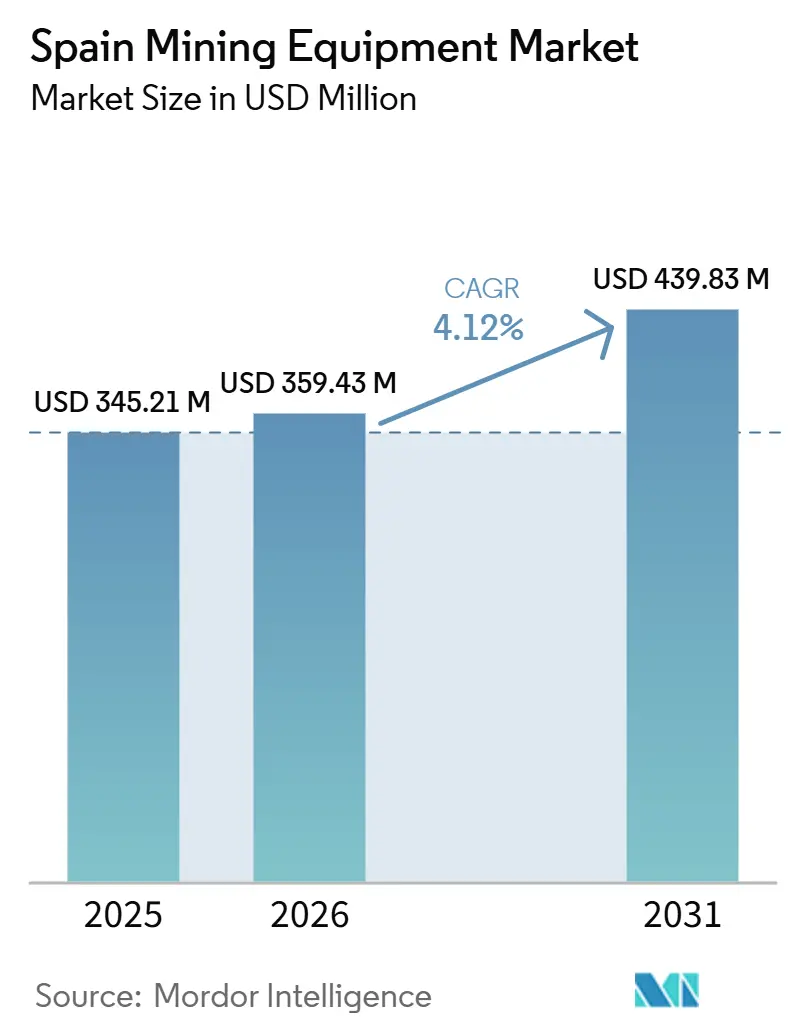
| Base Year Market Size (2025) | USD 345.21 Million |
| Market Size (2026) | USD 359.43 Million |
| Market Size (2031) | USD 439.83 Million |
| Growth Rate (2026 - 2031) | 4.12 % |
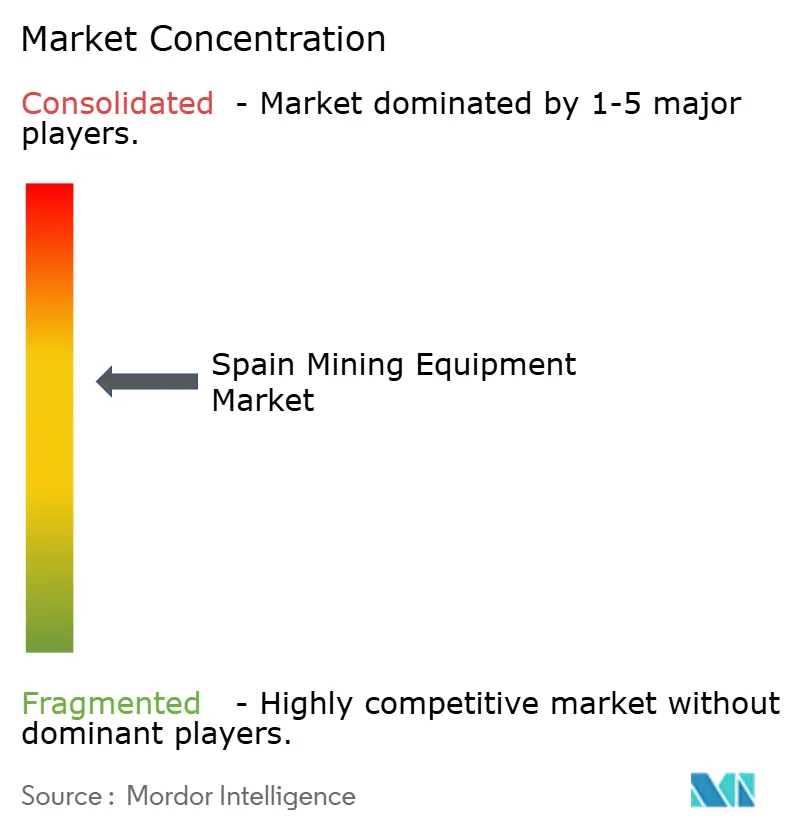
| Market Concentration | Medium |
Major Players *Disclaimer: Major Players sorted in no particular order Image © Mordor Intelligence. Reuse requires attribution under CC BY 4.0. | |
Spain Mining Equipment Market Analysis by Mordor Intelligence
The Spain mining equipment market size was valued at USD 345.21 million in 2025 and is estimated to grow from USD 359.43 million in 2026 to reach USD 439.83 million by 2031, at a CAGR of 4.12% during the forecast period (2026-2031). Spain's mining equipment market is experiencing a revival, driven by the reopening of previously inactive mines, a significant public exploration initiative, and the selection of multiple projects under the EU Critical Raw Materials Act. While surface fleets continue to dominate, there is a noticeable shift towards automation, battery-electric drivetrains, and sensor-based ore sorting. This transformation is particularly evident in new lithium and polymetallic projects developing in Extremadura, Galicia, and Andalusia. Financing methods are also evolving, with a focus on outcome-based service contracts that ensure high uptime levels. This approach not only transfers performance risks to OEMs but also accelerates equipment replacement cycles. However, the market faces challenges such as lengthy permitting processes, water scarcity, and increasing component lead times, which are limiting immediate unit sales. In this environment, aftermarket density, local parts availability, and open-architecture telematics have become critical competitive advantages.
Key Report Takeaways
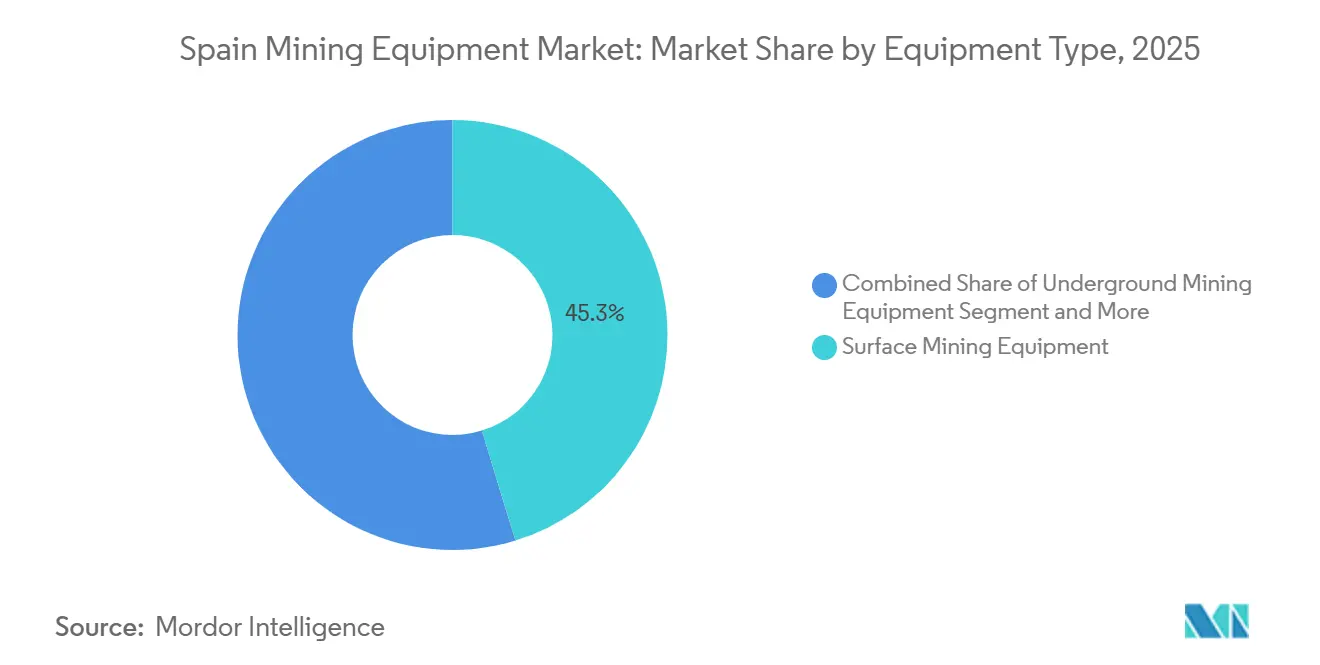
- By equipment type, surface mining equipment led with 45.27% of the Spain mining equipment market share in 2025; loaders and haul trucks are forecast to expand at a 7.46% CAGR between 2026 and 2031.
- By automation level, manual fleets accounted for 68.28% of the Spain mining equipment market in 2025, and fully autonomous systems are projected to grow at an 8.43% CAGR through 2031
- By powertrain, internal-combustion units made up 76.58% of 2025 revenue; battery-electric vehicles are set to record an 8.78% CAGR during 2026-2031.
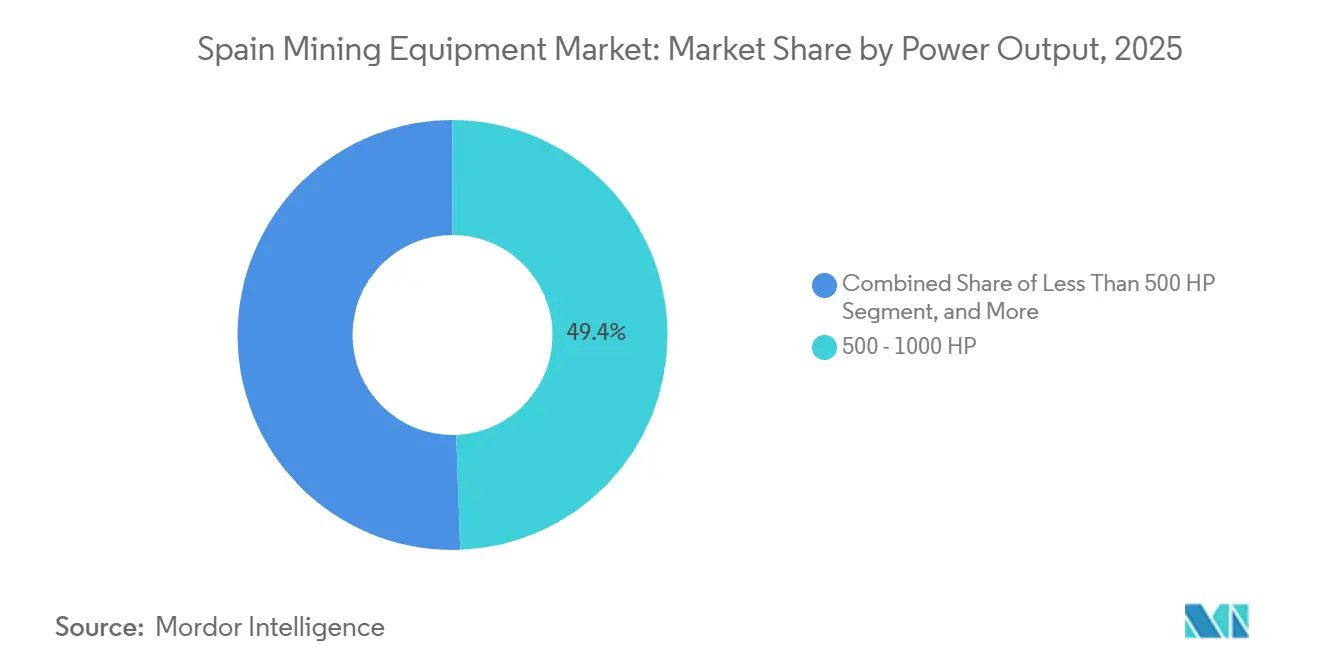
- By power output, the 500-1,000 HP bracket captured 49.42% of the Spain mining equipment market size in 2025; equipment above 1,000 HP is expected to advance at a 6.37% CAGR through 2031.
- By application, metal mining generated 46.75% of value in 2025, whereas mineral mining is anticipated to post a 6.43% CAGR over the forecast horizon.
Note: Market size and forecast figures in this report are generated using Mordor Intelligence’s proprietary estimation framework, updated with the latest available data and insights as of January 2026.
Spain Mining Equipment Market Trends and Insights
Drivers Impact Analysis*
| Driver | (~) % Impact on CAGR Forecast | Geographic Relevance | Impact Timeline |
|---|---|---|---|
| EU Raw Materials Push | +1.8% | National, Andalusia, Extremadura, Galicia | Medium term (2-4 years) |
| Metals Boom | +1.5% | Extremadura, Castilla y León, Galicia | Long term (≥ 4 years) |
| Automation Demand | +1.2% | Major mining regions nationwide | Medium term (2-4 years) |
| Performance-Based Maintenance | +0.9% | Large mines nationwide | Medium term (2-4 years) |
| Low-Emission Incentives | +0.8% | National (MOVES III) | Short term (≤ 2 years) |
| Micro-Mine Robotics | +0.6% | EU-wide with Spanish sites | Long term (≥ 4 years) |
| Source: Mordor Intelligence | |||
EU Critical Raw Materials Push Revives Domestic Mining Investments
Spain’s elevation to strategic supplier status inside the EU has ignited spending on surface drills, haulage fleets, and on-site processing plants. Seven Spanish projects are now named “Strategic” under the Critical Raw Materials Act, a designation that cuts permitting lead times and channels EU capital toward equipment-intensive developments. Campo de Montiel and El Moto headline the pipeline, each demanding high-capacity excavators, 100-t trucks, and modular concentrators capable of rapid redeployment across adjacent deposits. Ministries have embedded geological mapping funds into the national budget, guiding investors to lithium-rich pegmatites and tungsten skarns that previously lay idle. The resulting alignment between EU autonomy targets and domestic economic policy has restored industry credibility, boosting lender appetite and compressing financing spreads for high-specification equipment acquisitions[1]“Critical Raw Materials Act – Strategic Projects List”, European Commission, ec.europa.eu.
Renewables-Led Metals Boom (Lithium, Copper, Tin) Expanding Equipment Demand
Rooftop-solar installs, grid-scale batteries, and offshore wind arrays lock in multi-decade demand for copper and lithium, funneling investment toward Spain’s Iberian Pyrite Belt and Valdeflores Valley. Contractors mobilize high-reach electric shovels and Tier 4-compliant loaders to strip saprolite horizons above lithium pegmatites without breaching local particulate matter limits. New concentrators integrate dry-stack tailings and ore-sorting modules, significantly curbing water use—a decisive procurement attribute in drought-prone Andalusia. International Energy Agency scenarios projecting a tenfold spike in lithium by 2050 underpin forward contracts for advanced reels of medium-voltage cable and on-board inverter cabinets, stimulating the Spain mining equipment market[2]“Global Critical Minerals Outlook 2024”, International Energy Agency, iea.org.
Surge in Automation and Remote-Operation Demand to Improve Safety / Productivity
Sandfire's MATSA hub recently achieved a significant milestone by implementing fully autonomous drilling operations. This was accomplished by integrating Epiroc's Simba rigs operating on ABC Total with Sandvik's DD422i jumbos equipped with AutoMine technology [3]“MATSA Automation Milestone 2025,”, Sandfire Resources, sandfire.com.au. This combination enables continuous advancement during blast-clear windows. Additionally, RCT's ControlMaster system now directs both Caterpillar and Sandvik loaders along predetermined haul routes. This innovation allows a single surface operator to manage multiple units simultaneously. These advancements address the ongoing decline in Spain's mining workforce and aim to mitigate the shortage of technicians skilled in autonomy. Furthermore, public-private collaborations, including the X MINE initiative and the Horizon Europe-backed PERSEPHONE consortium, are testing intelligent explosives-loading systems and compact, autonomous drills. Their goal is to fast-track these technologies to advanced readiness levels. Consequently, fleet purchasers are increasingly opting for OEM-agnostic platforms, a shift aimed at avoiding vendor lock-in. This trend is significantly altering procurement strategies within Spain's mining equipment sector.
Government Incentives for Low-Emission Powertrains in Heavy Mobile Machinery
The PERTE VEC program is allocating significant funding to battery-electric and hybrid heavy equipment over a defined period. Epiroc introduced its SmartROC D65 BE drill as part of its product advancements. Caterpillar launched the diesel-only, DEF-free Cat 6015 shovel, which delivers improved fuel economy compared to earlier models. Komatsu presented its HM460-6 at a major industry event, a model compliant with EU Stage V standards, without EGR, and designed for extended service intervals, catering to quarry and mid-size open-pit operators. Although battery-electric adoption is growing steadily, it faces competition from advanced diesel technologies that avoid payload penalties, reflecting a dual-track progression in Spain's mining equipment market.
Restraints Impact Analysis*
| Restraint | (~) % Impact on CAGR Forecast | Geographic Relevance | Impact Timeline |
|---|---|---|---|
| Permitting And Opposition | -1.1% | Andalusia, Extremadura | Medium term (2-4 years) |
| Cap-Ex Inflation And Supply Chain | -0.9% | Global with regional exposure | Short term (≤ 2 years) |
| Skilled-Tech Shortage | -0.8% | Automated sites nationwide | Medium term (2-4 years) |
| Water Stress Limits | -0.7% | Andalusia, Extremadura | Long term (≥ 4 years) |
| Source: Mordor Intelligence | |||
Lengthy Permitting and Strong Local Environmental Opposition
Complex multi-tier authorizations and vocal activist groups delay project timelines, extending supplier lead-times and elevating inventory-carry costs. The Boliden spill legacy still shapes public sentiment, driving rigorous baseline studies and multi-agency reviews. Municipal councils wield discretionary powers that can override national approvals, prompting miners to run protracted community-engagement campaigns before equipment orders gain board sign-off. Suppliers respond by staging long-lead components—such as mill shells and shovel car-bodies—in European hubs to compress delivery once permits clear. Even with recent Critical Raw Materials Act fast-track provisions, procedural appeals remain frequent, tempering immediate upside for the Spain mining equipment market.
Water-Stress Restrictions on Andalusian and Extremaduran Mine Expansions
Reservoir levels in the Andévalo system have declined significantly, and agriculture has priority over industrial users. Emerita Resources’ request for a substantial water allocation stirred protests, illustrating how scarce water can derail even permitted projects. Lithium Iberia’s flotation-heavy flow sheet now faces mandatory zero-discharge stipulations, while TOMRA’s dry XRT sorters, already installed at Barruecopardo, are gaining traction as a low-water alternative. Equipment suppliers able to bundle sensor-based pre-concentration with dry conveying gain a resilience edge in the Spain mining equipment market.
*Our forecasts treat driver/restraint impacts as directional, not additive. The impact forecasts reflect baseline growth, mix effects, and variable interactions.
Segment Analysis
By Equipment Type: Surface Dominance Aligns with Open-Pit Strategy
Surface units retained 45.27% of 2025 revenue, yet loaders and haul trucks are on track for a 7.46% CAGR to 2031 as lithium pits in Cáceres and polymetallic cut-backs in Huelva scale up. As deposits shift from open-pit to deeper levels, the demand for ventilation, narrow-vein loaders, and paste-fill rigs has surged, leading to a growing share for underground fleets. Nationwide, several TOMRA machines have already enabled Barruecopardo to boost its feed to gravity circuits by a significant percentage, thanks to sensor-based sorters. Epiroc’s HB 4100, sold in Gran Canaria, underscores the stability of drills and breakers, benefiting from cross-ordering trends in quarrying.
Equipment design is increasingly favoring integrated fleets. For instance, the Cat 6015 shovel is now optimized to work in tandem with Cat 773-777 trucks, ensuring efficient cycle times. Meanwhile, Komatsu’s HM460-6, equipped with traction control and hydro-pneumatic suspension, effectively mitigates tire spin on Spain’s softer overburden. In the Spanish mining equipment market, open telematics systems such as MineStar, Smart Quarry, and Micromine Pitram have outpaced standalone horsepower solutions, underscoring the growing emphasis on interoperability as a key purchasing criterion.


By Automation Level: Gradual Shift from Manual to Autonomous
Manual units still accounted for 68.28% of 2025 turnover, but autonomy is expanding at an 8.43% CAGR, driven by labor scarcity and successful pilots at MATSA. Transitional technologies like semi-autonomous tramming and teleremote mucking are reducing operator exposure while still valuing legacy iron. The X MINERGY explosives-loading prototype is progressing toward field validation, heralding a wider embrace of teleoperated surface equipment. Infrastructure investment plays a pivotal role: MATSA's comprehensive fiber WiFi network bolsters its interoperability strategy, a model now being adopted by other operators in the Iberian Pyrite Belt within Spain's mining equipment market.
By Powertrain Type: ICE Leads as Battery-Electric Accelerates
ICE platforms accounted for 76.58% of sales in 2025, but battery-electric rigs will post the fastest CAGR of 8.78% as PERTE VEC subsidies roll out.
Emissions-free tunneling is demonstrated by the SmartROC D65 BE drill, while Liebherr’s trolley-assist concept offers a glimpse into future haulage models. At the same time, Caterpillar’s shovel without DEF requirements and Komatsu’s fuel-efficient engine highlight a concurrent evolution in diesel technology, catering to operators cautious about charging logistics. With industrial power demand increasing in Andalusia, numerous mine owners are integrating fleet electrification with on-site solar, signaling a hybrid energy trajectory for Spain's mining equipment market.
By Power Output: Mid-Range Rules but High-Power Grows on Scale
Equipment rated 500-1,000 HP secured 49.42% of 2025 revenue, reflecting Spain’s prevalence of medium-tonnage loaders and articulated trucks. Ultra-class machines above 1,000 HP are poised for 6.37% CAGR as Masa Valverde and Aznalcóllar come on stream, elongating haul roads and raising throughput targets.
Below-500 HP service units see modest growth as automation emphasizes productivity per operator rather than fleet count. OEMs now differentiate through torque curves, swing-energy recovery, and site-specific engine mapping, embedding software value in the Spain mining equipment market.
By Application: Metal Mining Captures Critical-Mineral Upside
Metal mining delivered 46.75% of 2025 income, fueled by a record 51,139 t of copper from Riotinto and sustained output at Cobre Las Cruces. Mineral mining, led by lithium, tungsten, and tin, will expand 6.43% annually as Valdeflores, Cañaveral, and San Juan reach the commercial phase.
Secondary metals recycling, notably Atlantic Copper’s CirCular e-scrap plant, introduces heterogeneous feed that calls for agile crushing and sorting configurations. Consequently, OEMs offering mineral-specific attachments and dry-processing equipment gain traction in the Spain mining equipment market.
Geography Analysis
Andalusia anchors most of Spain’s metal output and posted major turnover in 2025, underwriting the most significant regional slice of equipment orders. Cobre Las Cruces’ planned underground expansion for high-capacity conveyors, battery-electric loaders, and deep-well dewatering pumps. Junta-mandated water quotas press operators to adopt dry-stack filters and electric dust-suppression sprayers, opening niches for vendors specializing in low-water circuits.
Extremadura follows lithium, tungsten, and rare-earth metals. El Moto tungsten targets most of Europe’s supply, ordering high-pressure grinders and gravity spirals from European OEMs. Regional SMEs leverage EU Just Transition funds to co-finance modern fleets, expanding the Spanish mining equipment market footprint.
Northern provinces, Galicia, Asturias, and Castilla y Leon, offer skilled labor and port proximity for equipment imports. Epiroc’s Boomer rigs reduced drilling rounds by 40 minutes at El Valle-Boinás, highlighting the productivity upside when advanced automation meets competent crews. Ports of Vigo and Gijón expedite inbound heavy-lift modules, shortening project ramp-up times compared with Mediterranean gateways.
Competitive Landscape
Global majors dominate strategic contracts yet rely on Spanish dealers for localized service. Epiroc’s services arm generates most of its global revenue via outcome-based agreements that guarantee uptime, a model rapidly replicating in Spain. Komatsu invests in a Granada-based component-rebuild center to shorten turnaround time.
Differentiation pivots on electrification, digital twins, and water-smart technology. ABB and Hitachi Construction Machinery co-develop 220-t battery dump trucks with pantograph-assisted fast-charge, clinching pre-orders from Andalusian copper mines. Niche robotics startups arising from EU research grants widen innovation bandwidth, but consolidation is likely once prototypes are commercialized, shaping the future structure of the Spain mining equipment market.
Spain Mining Equipment Industry Leaders
Caterpillar Inc.
Komatsu Ltd.
Liebherr-Group
Sandvik AB
Epiroc AB
- *Disclaimer: Major Players sorted in no particular order

Recent Industry Developments
- February 2026: Caterpillar has launched an enhanced version of its Cat 6015 shovel. The new Cat® 6015 hydraulic mining shovel, designed for versatile and efficient operation across various tasks, features significant enhancements. These upgrades boost machine uptime, improve operating efficiency, and enhance durability and serviceability, resulting in higher annual output. Additionally, this flexible shovel design ensures a low cost-per-ton operation.
- March 2025: The European Commission approved seven Spanish mining projects under the Critical Raw Materials Act, unlocking streamlined permits for equipment mobilization.


Spain Mining Equipment Market Report Scope
The Spain mining equipment market report is segmented by equipment type (surface mining equipment, underground mining equipment, mineral processing equipment, drills & breakers, crushing, pulverizing & screening equipment, loaders, and mining trucks), automation level (manual equipment, semi-autonomous equipment, and fully autonomous equipment), powertrain type (internal combustion engine vehicles, battery-electric vehicles, and hybrid vehicles), power output (below 500 HP, 500-1,000 HP, and above 1,000 HP), and application (metal mining, mineral mining, and coal mining). The market forecasts are provided in terms of value (USD).
| Surface Mining Equipment |
| Underground Mining Equipment |
| Mineral Processing Equipment |
| Drills & Breakers |
| Crushing, Pulverizing & Screening |
| Loaders & Haul Trucks |
| Manual Equipment |
| Semi-Autonomous Equipment |
| Fully Autonomous Equipment |
| Internal-Combustion Engine Vehicles |
| Battery-Electric Vehicles |
| Hybrid Vehicles |
| Less than 500 HP |
| 500 - 1,000 HP |
| Above 1,000 HP |
| Metal Mining |
| Mineral Mining |
| Coal Mining |
| By Equipment Type | Surface Mining Equipment |
| Underground Mining Equipment | |
| Mineral Processing Equipment | |
| Drills & Breakers | |
| Crushing, Pulverizing & Screening | |
| Loaders & Haul Trucks | |
| By Automation Level | Manual Equipment |
| Semi-Autonomous Equipment | |
| Fully Autonomous Equipment | |
| By Powertrain Type | Internal-Combustion Engine Vehicles |
| Battery-Electric Vehicles | |
| Hybrid Vehicles | |
| By Power Output | Less than 500 HP |
| 500 - 1,000 HP | |
| Above 1,000 HP | |
| By Application | Metal Mining |
| Mineral Mining | |
| Coal Mining |


Key Questions Answered in the Report
What is the latest valuation and projected CAGR for Spain’s mining equipment space?
The sector was valued at USD 345.21 million in 2025 and is projected to expand to USD 439.83 million by 2031 at a 4.12% CAGR.
Which equipment categories show the quickest growth through 2031?
Loaders and haul trucks are the standout, advancing at a 7.46% CAGR on the back of new lithium and polymetallic pits in Extremadura, Galicia, and Andalusia.
How far has automation progressed in Spanish mining operations?
Benchmark sites like Sandfire's MATSA complex have seen a 20% penetration of fully autonomous drilling and loading systems, with autonomous fleets expanding at a robust 8.43% CAGR.
Which equipment type holds the top revenue share in Spain’s mining sector?
Surface mining systems lead with 45.27% of the Spain mining equipment revenue in 2025.
How are performance-based maintenance contracts affecting procurement cycles?
Guaranteed uptime clauses shorten replacement intervals and shift risk to OEMs, accelerating new-equipment purchases.
Page last updated on:


 Your data is secure and never sold or shared.


