
Market Overview
| Study Period | 2020 - 2031 |
|---|---|
| Forecast Data Period | 2026 - 2031 |
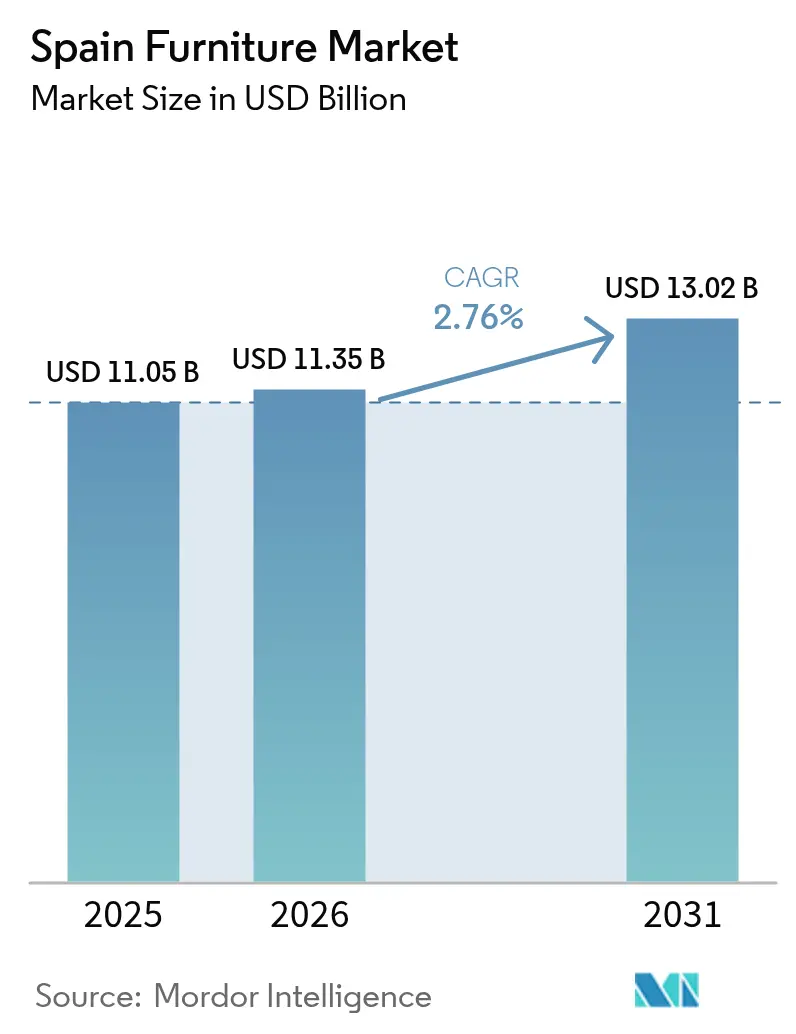
| Base Year Market Size (2025) | USD 11.05 Billion |
| Market Size (2026) | USD 11.35 Billion |
| Market Size (2031) | USD 13.02 Billion |
| Growth Rate (2026 - 2031) | 2.76 % |
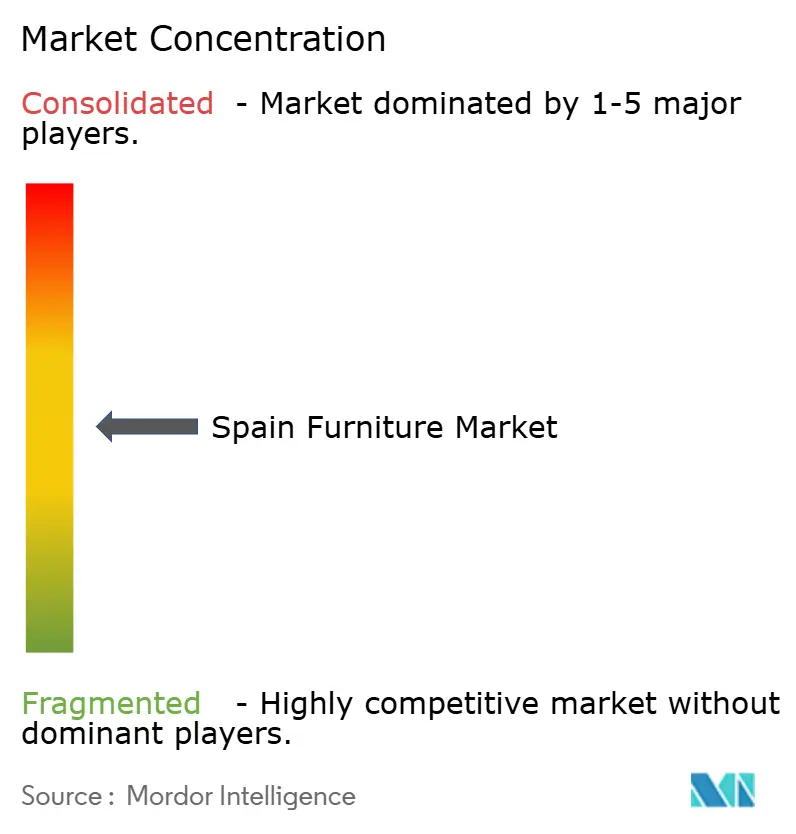
| Market Concentration | Medium |
Major Players *Disclaimer: Major Players sorted in no particular order Image © Mordor Intelligence. Reuse requires attribution under CC BY 4.0. | |
Spain Furniture Market Analysis by Mordor Intelligence
The Spain Furniture market size was valued at USD 11.05 billion in 2025 and estimated to grow from USD 11.35 billion in 2026 to reach USD 13.02 billion by 2031, at a CAGR of 2.76% during the forecast period (2026-2031). Momentum stems from a rebound in residential renovations, a sharp resurgence in tourism-led hospitality refurbishments, and rising acceptance of omnichannel shopping models that blend in-store engagement with e-commerce convenience. Demand is also supported by EU-funded energy-efficiency retrofits that incentivize home upgrades, while value-oriented Scandinavian-design chains enlarge their Spanish footprints to capture price-sensitive consumers. Meanwhile, urban downsizing and sustainability preferences steer households toward modular, recycled, and circular-economy offerings, prompting manufacturers to recalibrate material choices and packaging formats. Supply-side conditions remain mixed: input-cost swings in wood, metal, and logistics squeeze margins for small workshops, yet scale-driven retailers negotiate global contracts that buffer volatility and sustain competitive pricing[1].
Key Report Takeaways
- By application, Home Furniture led with 72.45% of the Spain Furniture market share in 2025; Hospitality Furniture is forecast to advance at a 3.96% CAGR to 2031.
- By material, wood held 60.20% of the Spain Furniture market share in 2025, while plastics and polymers are projected to expand at the fastest 4.37% CAGR through 2031.
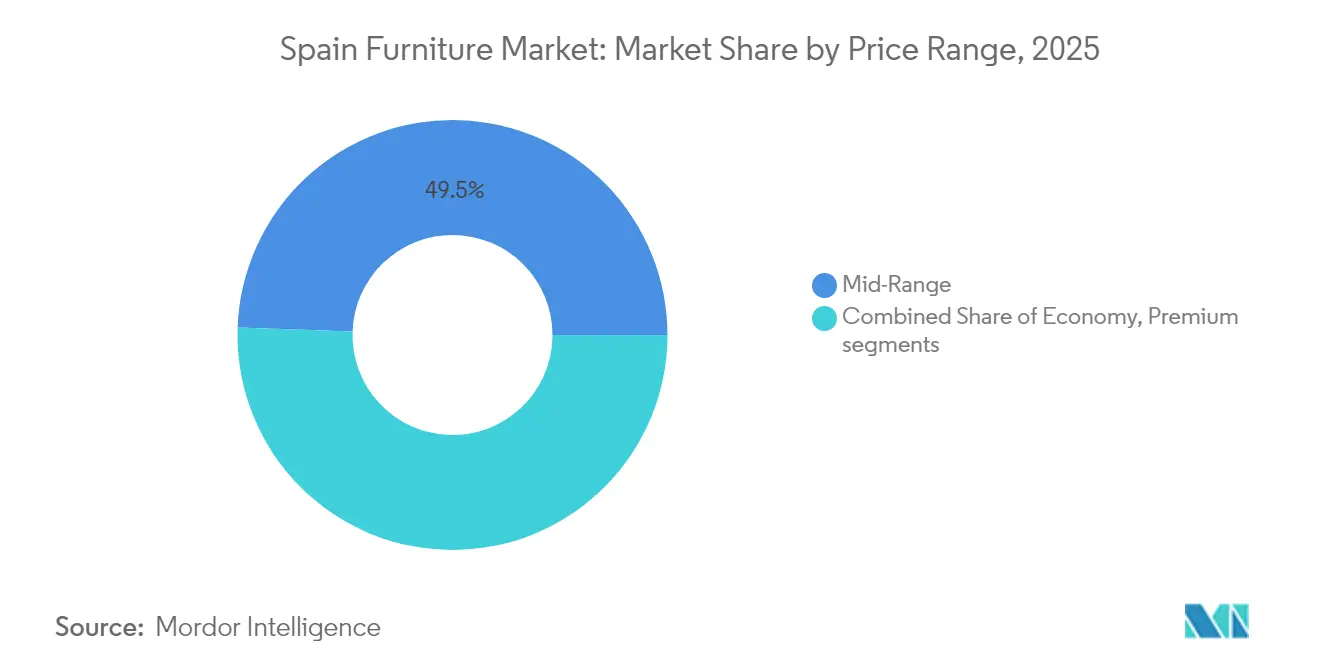
- By price range, the mid-range tier accounted for 49.45% of the Spain Furniture market size in 2025, yet the premium tier is poised to rise at a 4.18% CAGR between 2026-2031.
- By distribution channel, B2C/Retail controlled 80.05% of the Spain Furniture market share in 2025; online-enabled omnichannel formats are on track for a 4.09% CAGR over the forecast horizon.
- By region, Catalonia captured 21.90% of the Spanish furniture market share in 2025, whereas the Balearic and Canary Islands are set to record the swiftest 3.96% CAGR thanks to tourism-driven hospitality refurbishments.
Note: Market size and forecast figures in this report are generated using Mordor Intelligence’s proprietary estimation framework, updated with the latest available data and insights as of 2026.
Spain Furniture Market Trends and Insights
Drivers Impact Analysis*
| Driver | (~) % Impact on CAGR Forecast | Geographic Relevance | Impact Timeline |
|---|---|---|---|
| Residential construction rebound & renovation boom | +0.8% | Nationwide focus on Madrid, Catalonia, Valencia | Medium term (2-4 years) |
| Tourism-led hospitality refurbishment cycle | +0.6% | Balearic & Canary Islands, Andalusia coasts, Madrid | Short term (≤ 2 years) |
| Omnichannel & e-commerce penetration surge | +0.5% | Large urban areas nationwide | Medium term (2-4 years) |
| Value-oriented Scandinavian-design retail expansion | +0.4% | National, led by IKEA and JYSK store rollouts | Short term (≤ 2 years) |
| EU-funded energy-efficiency retrofits | +0.3% | Older housing stock in northern Spain, Catalonia, and urban centers | Medium term (2–4 years) |
| Second-hand & circular-economy trade-in platforms | +0.2% | Urban and suburban areas with high renter populations (e.g., Barcelona, Madrid) | Short term (≤ 2 years) |
| Source: Mordor Intelligence | |||
Residential Construction Rebound & Renovation Boom
Building permits exceeded 127,000 units in 2024, outpacing sector capacity and signalling strong refurbishment pipelines that will translate into furniture purchases through 2027. Spain logged 1.85 million scheduled home renovations for 2025 after years of under-building, redirecting demand from new housing to interior upgrades. Construction costs climbed 4.20% in 2024, making retrofits more cost-effective than new builds and spurring appetite for modular cabinets, wardrobes, and space-saving seating. The Spain Furniture market benefits because renovations prompt whole-room refurnishing rather than piecemeal replacement. EU Recovery funds earmarked for energy-efficient retrofits further enlarge budgets for quality furnishings that complement thermal upgrades. Manufacturers with rapid-fit, customizable lines are best positioned to monetize the renovation wave.
Tourism-Led Hospitality Refurbishment Cycle
International arrivals rebounded to 93.8 million in 2024, restoring the cash flow hotels need for property upgrades[2]. Tourism services generated a 4.20% of GDP surplus, enabling chains such as RIU and Radisson to accelerate multi-million-euro refurbishments that soak up contract-grade furniture. Islands heavy on short-term rentals, Balearic and Canary, present concentrated demand where replacement cycles run every 3-4 years, far quicker than residential averages. Suppliers secure higher margins on hospitality orders because buyers prioritize durability and uniform aesthetics. Logistic advantages arise when manufacturers cluster deliveries to tourism zones, trimming transport costs. The Spain Furniture market therefore, captures elevated per-unit spending in coastal hospitality corridors.
Omnichannel & E-Commerce Penetration Surge
Spanish consumers increasingly research online before visiting showrooms, pushing retailers to synchronize inventory visibility, AR planning tools, and click-and-collect services. Online furniture sales growth outpaces total retail as shoppers grow comfortable with virtual room simulators that mitigate the tactile barrier. IKEA’s potential Vitoria-Gasteiz outlet and JYSK’s 30-store 2025 rollout both hinge on seamless app-to-store experiences that lift conversion rates. Smaller chains adopt marketplace integrations to tap digital traffic without heavy tech investment. As checkout journeys shift online, data analytics empower retailers to personalize promotions and manage stock, fostering repeat purchases that sustain the Spain Furniture market.
Value-Oriented Scandinavian-Design Retail Expansion
Nordic retailers resonate with Spanish households that prefer minimalist, space-efficient designs suited to shrinking average household size, projected at 2.32 persons by 2039[3]. Flat-pack formats compress shipping volumes, enabling low-cost home delivery nationwide and reinforcing competitive pricing. IKEA’s 24% market leadership showcases the formula: standardized SKUs, global procurement, and strong sustainability narratives. JYSK targets a 300-store scale to narrow the gap, intensifying price competition yet expanding consumer choice. Domestic manufacturers respond by blending Spanish craftsmanship with Nordic aesthetics to defend their share. The result is wider design diversity that keeps the Spain Furniture market vibrant.
Restraints Impact Analysis*
| Restraint | (~) % Impact on CAGR Forecast | Geographic Relevance | Impact Timeline |
|---|---|---|---|
| Input-cost volatility in wood & logistics | −0.4% | Valencia manufacturing cluster is heavily exposed | Short term (≤ 2 years) |
| Import-price pressure on fragmented local makers | −0.3% | Traditional production hubs nationwide | Medium term (2-4 years) |
| Demographic drag from aging & low household formation | −0.2% | Rural interior provinces | Long term (≥ 4 years) |
| Tightened fire-safety & eco-design compliance costs | −0.2% | Nationwide, driven by EU regulations | Medium term (2-4 years) |
| Source: Mordor Intelligence | |||
Input-Cost Volatility in Wood & Logistics
Raw material price inflation poses significant margin pressure on Spanish furniture manufacturers, with wood prices experiencing potential increases up to 30% by year-end 2025 according to European manufacturing surveys, while steel could rise 25% and plastics at least 20%. Although pine timber prices have fallen EUR 4-10 (USD 4.28–10.70) per tonne since March 2023, the underlying volatility creates planning difficulties for manufacturers who must balance inventory costs against supply security. Logistics costs compound these pressures, with land prices for logistics facilities rising 1.70% in 2024 and rental rates increasing 3.70%, directly impacting furniture distribution networks that rely on large-format warehousing. The combination of material and logistics inflation disproportionately affects smaller, fragmented Spanish manufacturers who lack the purchasing power and vertical integration of multinational competitors.
Demographic Drag from Ageing & Low Household Formation
Spain's demographic transition presents a structural headwind for furniture demand, with the population aged 65+ reaching 20.40% in December 2024 and the old-age dependency ratio hitting a record high of 30.80%[4]. While total households are projected to grow from 19.3 million in 2024 to 23 million by 2039, the increase is driven primarily by single-person households rising to 33.50% of the total, indicating smaller average household sizes and reduced per-household furniture consumption. The aging population tends to reduce furniture replacement frequency as older consumers prioritize durability over style updates and downsize living spaces rather than expand them. Rural and interior regions face particularly acute demographic challenges as younger populations migrate to urban centers for employment, leaving behind aging communities with limited furniture purchasing power.
*Our forecasts treat driver/restraint impacts as directional, not additive. The impact forecasts reflect baseline growth, mix effects, and variable interactions.
Segment Analysis
By Application: Residential Scale and Hospitality Upside
Home Furniture dominated the Spain Furniture market with a 72.45% revenue stake in 2025, reflecting Spanish households’ deep cultural investment in living-space aesthetics. That leadership is forecast to expand at only 3.38% CAGR as replacement cycles lengthen, but it still anchors overall growth because renovation spending converts into whole-room re-furnishing orders. Sofas, dining sets, and modular storage remain staples, although urban apartments spur demand for collapsible tables and wall-mounted shelving. Hospitality Furniture trails in absolute size yet races ahead at a projected 3.96% CAGR, as hotel groups, short-term rentals, and boutique hostels refresh interiors to meet global guest expectations. Spain's Furniture market size for hospitality is expected to edge up each year as the Canary and Balearic Islands upgrade aging room inventories. Suppliers seeking stability hedge by serving both residential and contract pipelines, smoothing seasonal tourism swings.
The applications portfolio is diversifying into office, educational, and healthcare categories as hybrid work, school modernization, and hospital expansions progress. Office purchases skew toward ergonomic chairs and height-adjustable desks that accommodate flexible working styles, although volumes remain small compared to household needs. Educational furniture captures public-sector tenders focused on collaborative classroom layouts, while healthcare demand centers on antimicrobial surfaces and mobility aids. Even within niche segments, Spain Furniture market share gains accrue to brands offering rapid customization, strict certification, and clear sustainability credentials.


By Material: Wooden Heritage Meets Polymer Innovation
Wood retained a 60.20% share in 2025, underpinned by Valencia’s centuries-old carpentry cluster and consumer affinity for natural finishes. Spain Furniture market size for wooden pieces is expected to inch forward, but relinquish a few points as recycled plastics gain acceptance. Polymer furniture, growing at a brisk 4.37% CAGR, benefits from lower cost, weather resistance, and design flexibility, making it popular for outdoor terraces and budget apartments. Manufacturers like Actiu showcase chairs moulded from recycled fruit crates, reinforcing circular-economy storytelling.
Metal retains a niche in office frames and hospitality fixtures where durability trumps weight concerns. Composite panels and engineered woods widen in cabinetry, blending resource efficiency with strength. EU eco-design directives accelerate the pivot toward FSC-certified timber and traceable recycled content, reshaping supply chains. Compliance introduces documentation costs but also differentiates brands that validate sustainable sourcing. Consequently, Spain's Furniture market share is likely to tilt toward material innovators capable of meeting strict environmental benchmarks without eroding affordability.
By Price Range: Mid-Range Core and Premium Lift
Mid-range products captured 49.45% of 2025 revenue as households balance style aspirations with tight discretionary budgets. Value-oriented Scandinavian chains anchor this tier via standardized SKUs, flat-pack logistics, and self-assembly instructions that compress the total cost of ownership. Even so, the premium tier is on course for a 4.18% CAGR because affluent buyers in Madrid, Barcelona, and coastal resorts elevate spending on artisan craftsmanship, FSC woods, and bespoke upholstery. Spain Furniture market size for premium lines remains modest but yields higher margins, enticing domestic brands like Andreu World to double down on design awards and export channels.
At the other end, economy products cater to student rentals and secondary residences; however, rising freight and raw-material costs strain margins, prompting some discounters to rationalize SKUs or adopt lighter flat-pack designs. Price polarization intensifies middle-class consumers gravitate to promotional bundles, while high-net-worth households seek experiential retail experiences with interior-design consultations. The segmentation underscores divergent paths within the Spain Furniture market, compelling companies to specialize rather than straddle all price points.
By Distribution Channel: Omnichannel Supremacy
B2C/Retail accounted for 80.05% of the 2025 value as Spanish shoppers still prefer tactile inspections before large-ticket purchases. Nonetheless, web traffic guides showroom visits, so retailers synchronize real-time stock data and flexible payment tools to close sales. Spain's Furniture market share for online-only transactions is small but growing inside omnichannel ecosystems, pushed by mobile-first millennials who appreciate AR room planners and doorstep delivery. B2B/Project channels, while smaller, spike when hotel refurbishments or office fit-outs bundle bulk orders with tight timelines.
Home-center chains reinvent store layouts into experience hubs where curated vignettes encourage add-on sales. Meanwhile, pure-play e-tailers such as Sklum leverage rapid dropship partnerships to expand catalogues without inventory risk, enticing impulsive purchases. Last-mile logistics is a battleground: same-day delivery in Madrid and Barcelona sets customer expectations that ripple nationwide. Firms mastering reverse logistics for returns and trade-ins will unlock repeat business and reinforce the Spain Furniture market.
Geography Analysis
Catalonia generated 21.90% of 2025 sales, buoyed by Barcelona’s design culture, export-ready workshops in Girona and Tarragona, and robust household incomes. Its diversified manufacturing ecosystem balances residential demand with contract export orders to France and Italy, fortifying resilience. Madrid ranks second, leveraging the nation’s highest GDP per capita of EUR 42,198 (USD 45,152) and dense populations of new apartment dwellers seeking turnkey furnishings. Valencian Community benefits from entrenched production know-how but contends with cost inflation that tests competitiveness.
The Balearic and Canary Islands headline growth at 3.96% CAGR, where hotel refurbishments and short-term rentals renew interiors every few years, pushing high-value, quick-turnaround contracts. Logistic premiums are offset by pricing power as island operators prioritize supplier reliability. Andalusia contributes sizeable volume via its large population and coastal tourism assets, even though average ticket sizes trail northern regions. Remaining autonomous communities round out national coverage, with demand patterns tied closely to local economic conditions and aging dynamics. Combined, these geographic strands weave a balanced Spain Furniture market with both mature cores and high-growth fringes.
Regulatory Landscape
Spain does not apply a furniture-specific, sector-wide safety law; instead, products sold to consumers fall under horizontal rules such as the General Product Safety framework (including Real Decreto 1801/2003) and general consumer labeling requirements under Real Decreto 1468/1988. Labeling in Spanish typically covers composition, essential characteristics, installation/use/maintenance instructions, and warnings where foreseeable risks exist, while market surveillance is carried out by consumer authorities at the level of Spain's autonomous communities.
Sustainability and circularity requirements are tightening through EU policy. The European Union adopted the Ecodesign for Sustainable Products framework in June 2024 and subsequently set out a 2025-2030 working plan (December 2024) that includes furniture for delegated acts by 2028, moving compliance toward durability, reparability, and circularity requirements. On the trade side, furniture imports follow the EU TARIC system, with typical import processes also applying Spain's 21% VAT, shaping landed cost dynamics for imported finished goods and components.
Value Chain Analysis
Spain's furniture value chain runs from raw materials and components (timber and wood panels, metal frames, plastics/polymers, upholstery fabrics, fittings, and packaging) through design and manufacturing, then into wholesale and retail distribution and after-sales services (delivery, installation, and returns). Production is fragmented, with many SMEs alongside larger brands, and is concentrated in established hubs such as the Valencian Community and Catalonia, while Murcia (notably Yecla) maintains a strong specialization in upholstery, supporting both residential and contract products.
Downstream, demand is served through B2C retail (specialty furniture stores, big-box formats, and omnichannel e-commerce) and B2B/project channels linked to hotels and other fit-outs. Export flows are a key extension of the chain: Spain's furniture exports reached about EUR 3.146 billion in 2025 (up 5% versus 2024), with France and Portugal among the main destinations, reinforcing the importance of trade associations and technical centers (e.g., ANIEME and AIDIMME) that support compliance, testing, and internationalization. Logistics and warehousing capacity, especially for bulky products and fast replenishment, has become an operational differentiator as retailers push nationwide delivery and click-and-collect models.
Competitive Landscape
The Spain furniture market shows moderate concentration, with the top five players controlling a significant share. IKEA Ibérica leads by combining standardized Scandinavian designs, global sourcing advantages, and an efficient click-and-collect system that simplifies bulky-item logistics. JYSK is rapidly expanding, with plans for over 30 new stores in 2025, using aggressive real estate strategies and localized marketing that emphasizes its Danish roots. Conforama España, now owned by XXXLutz, competes through deep discounts and fast product rotation, benefiting from pan-European purchasing power to manage cost pressures. These major players rely on scale and strategic positioning to maintain their competitive edge.
Mid-tier domestic brands like Sklum and Kave Home focus on e-commerce niches, appealing to millennial renters with trend-driven, Instagram-ready designs. Operating asset-light models, they minimize inventory risks by using rapid dropshipping logistics, but must invest heavily in digital marketing to sustain customer traffic. Meanwhile, premium manufacturers such as Andreu World and Actiu differentiate through sustainability, offering FSC-certified products, recycled materials, and award-winning ergonomic designs. Their client base includes corporate buyers and international distributors, reinforcing their strong export orientation. This tiered structure highlights the diversity of market approaches depending on target demographics and channel strategies.
Strategic developments emphasize the sector’s ongoing evolution. Actiu’s 2025 debut of the Fluit chair—made from recycled fruit crates—illustrates innovation rooted in sustainability. Andreu World leverages ISO-certified production to attract eco-conscious designers abroad, strengthening its global appeal. IKEA’s plans to expand into locations like Vitoria-Gasteiz reflect continued commitment to physical retail, even as online shopping grows. These moves show how sustainability, omnichannel presence, and operational scale are becoming key drivers of long-term success in Spain’s furniture market.
Spain Furniture Industry Leaders
-
IKEA Ibérica
-
Conforama España
-
JYSK Spain
-
El Corte Inglés (Home & Decor)
-
Sklum
- *Disclaimer: Major Players sorted in no particular order
Market Opportunities and Future Outlook
Regulatory pull toward circularity creates whitespace for repairable, traceable, and recycled-content furniture lines as the EU Ecodesign for Sustainable Products Regulation (June 2024) and follow-on work plan (December 2024) progress toward furniture-specific delegated acts by 2028. Companies that can document materials and design for disassembly have clearer pathways into both retail narratives and project specifications, especially where buyers are already prioritizing durability and uniform aesthetics in hospitality refurbishments.
On the demand side, recent market evidence points to spend and production resilience that supports premiumization and omnichannel upgrades: AIDIMME reported Spain's furniture manufacturing production value at EUR 4.779 billion in 2025 (up 3.4% year-on-year) and exports at EUR 2.887 billion (up 4.6%), while reported average household expenditure on furniture and home decoration reached EUR 741 in 2025 (up 14% versus 2024). This combination reinforces opportunities in modular and multifunctional formats for smaller urban homes, and in digital selling tools (room planning, inventory visibility, and click-and-collect) that convert online research into store and delivery execution, particularly for retailers expanding physical networks and logistics capacity.
Recent Industry Developments
- July 2026: JYSK announced a EUR 60 million investment plan to open 120 new stores across Spain and Portugal over four years. The rollout underscores the continued push for higher store density and more convenient access points beyond major metros, increasing competitive pressure in the mid-range segment.
- May 2026: JYSK strengthened its Spanish supply chain footprint with support from a new 300,000 sqm logistics hub in Almenara, Castellon. Expanded warehousing and replenishment capacity helps improve availability for bulky categories and supports faster omnichannel delivery and click-and-collect operations.
- December 2024: The European Commission adopted the Ecodesign for Sustainable Products Working Plan 2025-2030, earmarking furniture for delegated acts by 2028. This step accelerates preparation for durability, reparability, and circularity requirements, influencing product design, material selection, and documentation across Spain's furniture supply chain.
Research Methodology Framework and Report Scope
Market Definition and Coverage
For this methodology, the Spain furniture market is defined as the value of furniture sold for residential, office, and hospitality use within Spain, across physical retail and online channels, measured in USD at current prices.
Scope exclusions: This sizing excludes home decor and soft furnishings that are not classified as furniture, along with installation-only services that are billed separately.
Segmentation Overview
- By Application
- Home Furniture
- Chairs
- Tables (side, coffee, dressing, etc.)
- Beds
- Wardrobe
- Sofas
- Dining Tables/Sets
- Kitchen Cabinets
- Other Home Furniture
- Office Furniture
- Chairs
- Tables
- Storage Cabinets
- Desks
- Sofas & Soft Seating
- Other Office Furniture
- Hospitality Furniture
- Educational Furniture
- Healthcare Furniture
- Other Applications
- Home Furniture
- By Material
- Wood
- Metal
- Plastic & Polymer
- Other Materials
- By Price Range
- Economy
- Mid-Range
- Premium
- By Distribution Channel
- B2C/Retail
- Home Centers
- Specialty Furniture Stores
- Online
- Other Retail Channels
- B2B/Project
- B2C/Retail
- By Region
- Catalonia
- Andalusia
- Community of Madrid
- Valencian Community
- Balearic & Canary Islands
- Remaining Autonomous Communitie
Data Sources, Market Sizing, and Validation
Desk Research
Desk work starts by framing the demand pool and its main signals in Spain, then building a consistent time series for spending, construction, and trade. We use public sources such as Spain's National Statistics Institute (INE), Eurostat, and the Bank of Spain to anchor household consumption, housing activity, and inflation context that can shift furniture demand.
To sanity-check the supply side, we also review non-paywalled sources such as UN Comtrade, Spanish customs and trade releases, and industry bodies including the European Furniture Industries Confederation and Spanish retail or manufacturing associations where available. These are combined with company filings, investor presentations, and credible press to map channel shifts (including online) and typical price positioning by category. For company financials, patent activity, and shipment-level trade patterns, we reference selected paid databases only to speed up validation, not to replace the public facts. The desk source list above is illustrative, and we reviewed many other public documents to collect data points, cross-check totals, and clarify items that were not straightforward to classify.
Primary Interviews and Surveys
Primary work focuses on confirming what is actually selling in Spain, how pricing is moving, and which channels are gaining share. We speak with a mix of retailers, distributors, manufacturers, and commercial buyers, so gaps from desk research can be filled, and then assumptions on volumes and price bands can be aligned to current market reality.
Distribution of primary research fieldwork respondents
| Company type | Respondent position |
|---|---|
| Top tier: 28% | CXOs: 12% |
| Mid tier: 58% | Functional/Unit leaders: 37% |
| Smaller Players: 14% | Managers: 51% |
Market-Sizing & Forecasting
The core model is built using a top-down approach where national consumption signals, housing and renovation activity, and furniture trade flows are used to reconstruct the annual value sold in Spain, which is then split across major buying uses and channels. To keep totals realistic, we use selective bottom-up approximations as cross-checks, such as sampled category price bands multiplied by estimated unit movement from channel checks, followed by a reasonableness test against supplier and retailer revenue exposure.
Inputs that most often move market value, and are tracked as part of the model, include residential completions and permits, renovation activity indicators, household final consumption and inflation, import dependency by furniture type, and online penetration for furniture purchases. Because pricing tends to shift with raw material pressure and retail promotions, average selling price progression is handled through observed inflation and interview-based adjustments rather than assuming a flat uplift.
For forecasting, scenario analysis is used because demand can swing with consumer confidence and housing trends, and then a simple multivariate regression is applied to translate the most stable drivers into yearly growth rates. Where bottom-up checks are incomplete, such as in fragmented specialty stores, the gap is handled by applying channel share estimates validated in interviews, and then the implied totals are compared back to macro and trade signals before finalizing.
Data Validation & Update Cycle
Validation is done by comparing model outputs against independent signals such as household spending direction, building activity, and import and export movements, then checking whether the implied price and mix shifts look reasonable. If an outlier appears, we review the assumptions behind it, and we trigger follow-up calls when the variance cannot be explained by seasonality, one-off promotions, or a known policy change.
Before sign-off, the work passes through a multi-step analyst review where calculations, conversions, and split logic are rechecked, and sensitivity ranges are tested for the main drivers. Reports are refreshed annually, and interim updates are made when material events occur that can change demand, pricing, or trade patterns. Right before delivery, we complete a final pass so clients receive the latest updated view available at that time.
Mordor Intelligence's Spain Furniture Market Size Compared With Other Published Estimates
Published market values for Spain furniture often do not match because the scope and the pricing basis are not set the same way, even when the titles look similar. Differences usually come from what is counted as furniture, whether the estimate uses retail value or factory gate value, and how online sales and imports are treated.
In this study, the biggest gap drivers are whether hospitality and office demand are included alongside home purchases, how VAT and retail markups are handled in the value, and whether cross-border e-commerce deliveries into Spain are captured as domestic consumption. The spread is also affected by how price inflation is carried forward across wood, metal, and plastic lines and how often assumptions are refreshed after major demand shifts. For that reason, the scope is kept tied to in-country sales value with annual assumption resets applied by Mordor Intelligence.
Benchmark comparison
| Source | Market Size | Gaps in Research Methodology |
|---|---|---|
| Mordor Intelligence | USD 11.35 B (2026) | |
| Industry Association A | USD 10.60 B (2026) | This figure is typically closer to manufacturing and domestic shipments, which can undercount imported furniture sold through Spanish retail and online channels, and it may also exclude some office and hospitality replacement demand. |
| Trade Journal B | USD 12.10 B (2026) | This estimate can run higher when it uses retail spending proxies that fold in adjacent home furnishings and includes VAT and broader home improvement baskets, which inflates value versus a furniture-only view. |
Across the three values, the table mainly reflects how different studies draw the line between furniture-only sales and wider home-related spend, and how they treat imports and retail pricing layers. By keeping the steps traceable to consumption, housing, and trade signals, the final market number stays easier to reproduce and simpler to explain when assumptions change.
Key Questions Answered in the Report
How big is the Spain Furniture market in 2026?
It is valued at USD 11.35 billion, with a projected 2.76% CAGR to 2031.
Which application category sells the most units?
Home Furniture accounts for roughly 72.45% of 2025 revenue due to ongoing residential renovations and replacement purchases.
Which region is growing fastest for furniture sales?
The Balearic and Canary Islands are projected to grow at a 3.96% CAGR because of tourism-driven hotel and rental refurbishments.
What material segment is gaining share quickest?
Plastics and polymers are expanding at a 4.37% CAGR thanks to affordability, lightweight properties, and recycled content innovations.
How is e-commerce influencing furniture retail in Spain?
Online research now precedes most store visits, driving omnichannel models that link virtual showrooms with click-and-collect or home delivery services.
What sustainability rules will impact Spanish furniture makers?
The EU Ecodesign for Sustainable Products framework will introduce recyclability and recycled-content mandates for furniture by 2028, raising compliance requirements.