
Market Overview
| Study Period | 2020 - 2031 |
|---|---|
| Forecast Data Period | 2026 - 2031 |
| Base Year Market Size (2025) | USD 38.18 Billion |
| Market Size (2026) | USD 40.08 Billion |
| Market Size (2031) | USD 51.11 Billion |
| Growth Rate (2026 - 2031) | 4.98 % |
| Market Concentration | Medium |
Major Players *Disclaimer: Major Players sorted in no particular order Image © Mordor Intelligence. Reuse requires attribution under CC BY 4.0. | |
Spain Facility Management Market Analysis by Mordor Intelligence
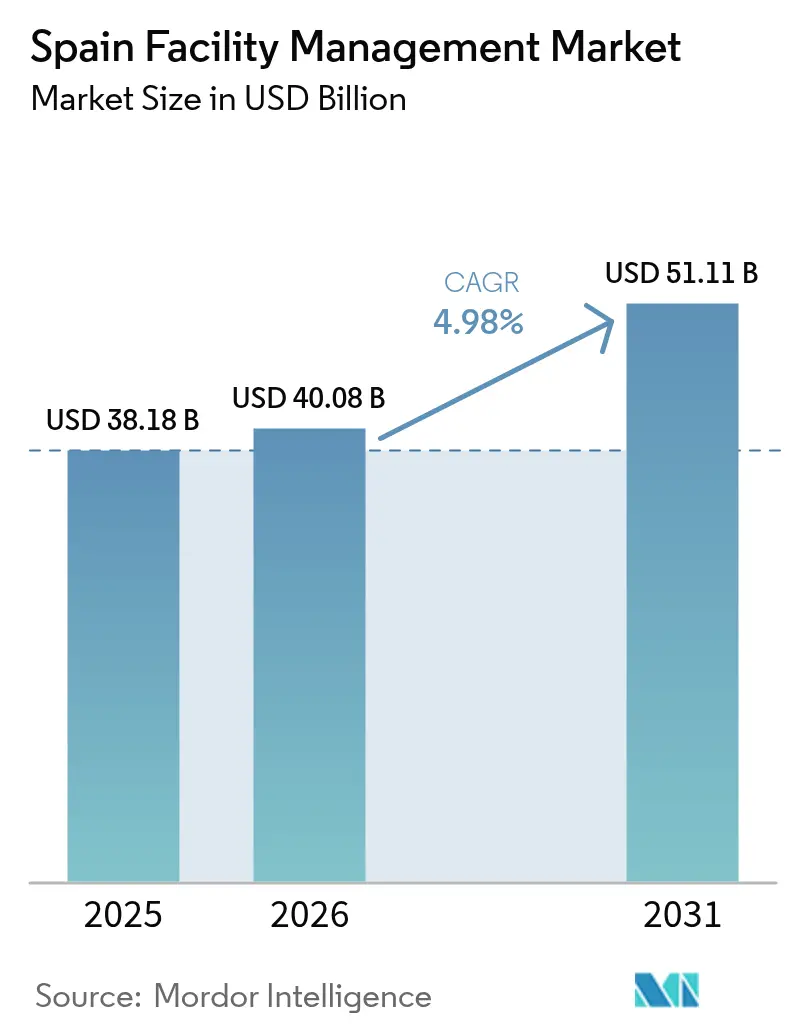
The Spain facility management market size is expected to grow from USD 38.18 billion in 2025 to USD 40.08 billion in 2026 and is forecast to reach USD 51.11 billion by 2031 at 4.98% CAGR over 2026-2031. Robust NextGenerationEU allocations, growing smart-building adoption and higher outsourcing penetration underpin this trajectory. Hard services dominate today because Spain’s aging building stock requires HVAC, MEP and fire-safety upgrades to meet European energy directives. Soft services are gaining momentum as hybrid work models elevate employee-experience priorities, while electricity-price volatility strengthens the business case for specialist energy-efficiency solutions. A steady pipeline of public-private partnership infrastructure projects and data-center construction deepens long-term demand, yet rising labor costs and short-term energy-price swings tighten provider margins. Competitive intensity remains moderate but consolidation pressure is rising as scale, technology capability and ESG credentials become decisive for major contract awards.
Key Report Takeaways
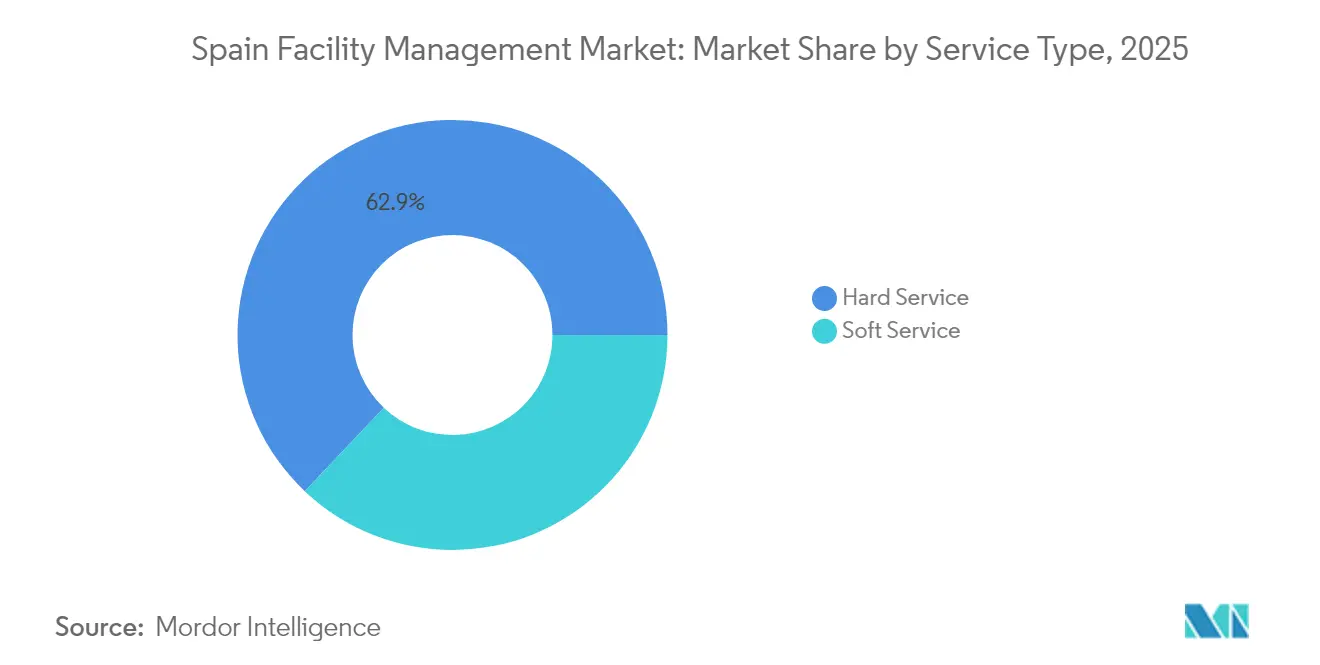
- By service type, hard services led with a 62.94% share of Spain facility management market size in 2025, whereas soft services are projected to post the fastest 5.08% CAGR through 2031.
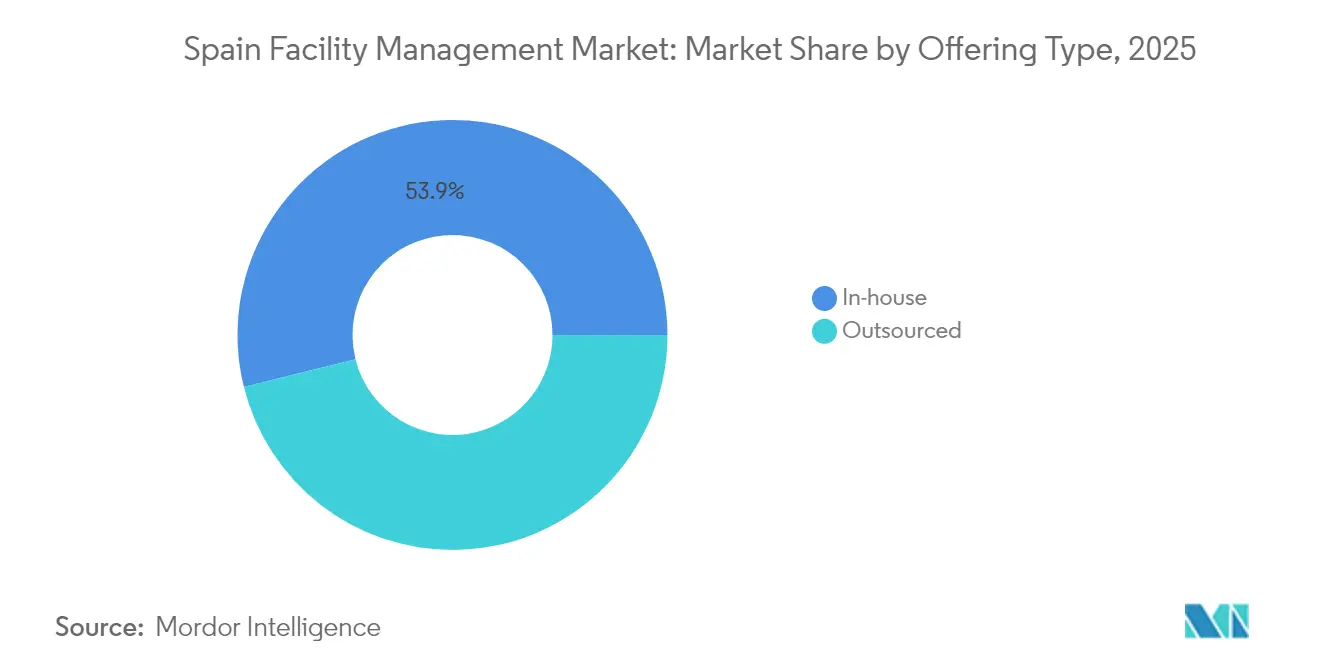
- By offering type, in-house operations accounted for 53.89% of Spain facility management market share in 2025; the outsourced model is forecast to grow at a 5.21% CAGR to 2031.
- By end-user industry, the commercial segment held 41.11% revenue share in 2025 and is set to expand at a 5.3% CAGR through 2031.
Note: Market size and forecast figures in this report are generated using Mordor Intelligence’s proprietary estimation framework, updated with the latest available data and insights as of 2026.
Spain Facility Management Market Trends and Insights
Drivers Impact Analysis*
| Driver | (~) % Impact on CAGR Forecast | Geographic Relevance | Impact Timeline |
|---|---|---|---|
| Shift toward integrated FM contracts among large enterprises | +1.2% | Madrid, Barcelona, Valencia and other national hubs | Medium term (2-4 years) |
| Hospitality and tourism rebound | +0.8% | Coastal regions, Balearic Islands, Canary Islands, major cities | Short term (≤ 2 years) |
| E-commerce logistics and data-center expansion | +1.0% | Madrid, Barcelona, Valencia, Zaragoza corridors | Medium term (2-4 years) |
| PPP social-infrastructure projects | +0.7% | Andalusia, Catalonia, Madrid and nationwide | Long term (≥ 4 years) |
| NextGenerationEU retrofit funding | +1.1% | Northern regions with older stock and nationwide | Medium term (2-4 years) |
| Flexible-workspace micro-contracts | +0.5% | Madrid, Barcelona, Valencia, Bilbao urban centers | Short term (≤ 2 years) |
| Source: Mordor Intelligence | |||
Shift toward integrated facility management (IFM) contracts among large enterprises
Spanish corporations are consolidating multiple vendors into single-source IFM agreements to gain real-time building analytics, unified service levels and ESG compliance assurance. A notable case is Hotelatelier, which achieved an 88% guest-satisfaction index after switching to an integrated model that merges HVAC optimization with front-of-house service orchestration. [1] The move is strongest in multi-site office portfolios, but hospital and data-center operators are also beginning to bundle technical and soft scopes to improve uptime and simplify governance. Greater contract size and duration improve provider revenue visibility, yet require advanced digital-platform and change-management capability to meet stringent key-performance indicators.
Hospitality and tourism rebound
Spain welcomed a sharp rise in international arrivals in 2024 and early 2025, restoring room-occupancy levels in the Balearic and Canary Islands as well as the Costa del Sol. Hotels outsource cleaning, security and concierge functions to withstand seasonal labor swings and focus on guest experience technologies such as automated check-in, which reached 60% adoption at Kora Living properties. Sustainability targets linked to NextGenerationEU retrofits further widen the service scope to include energy benchmarking and waste-reduction programs. Outsourcing peaks during peak travel months, reinforcing the need for agile contract structures and performance-based pricing mechanisms.
E-commerce logistics and data-center expansion
Spain’s logistics corridors and metropolitan campuses host a growing fleet of automated warehouses and hyperscale data centers, spurred by EUR 300 billion (USD 320 billion) regional pipeline investments from contractors such as ACS, Acciona and Ferrovial. [2] Facilities demand 24/7 HVAC, critical-power monitoring and ISO-trained technical personnel, creating premium revenue pools for hard-service specialists. Predictive maintenance, IoT-enabled asset registers and remote-command centers shift delivery from reactive repair to uptime assurance, raising average contract values. The trend clusters around Madrid’s Getafe-Illescas axis, Barcelona’s El Prat hub and Valencia’s Sagunto logistics district.
PPP social-infrastructure projects
Municipalities increasingly package lifecycle facility management into twenty-to-thirty-year PPP concessions covering hospitals, schools and municipal arenas. The Madrid 12 de Octubre Hospital expansion illustrates the model, embedding long-term MEP maintenance targets alongside construction milestones. [3] Providers gain stable recurring cash flows but also assume stringent penalty clauses tied to availability and energy-performance metrics. EU-funded climate-adaptation programs amplify the opportunity set in Andalusia and Catalonia, where aging public buildings require deep retrofits and structured performance guarantees.
Restraints Impact Analysis*
| Restraint | (~) % Impact on CAGR Forecast | Geographic Relevance | Impact Timeline |
|---|---|---|---|
| Rising labor costs under new collective-bargaining agreements | -0.9% | Catalonia, Basque Country, Madrid and nationwide | Short term (≤ 2 years) |
| Volatile energy prices | -0.7% | Industrial regions and nationwide | Short term (≤ 2 years) |
| Legacy building stock with poor documentation | -0.4% | Historic city centers nationwide | Long term (≥ 4 years) |
| Chronic late payment in public sector | -0.3% | Regional-government contracts nationwide | Medium term (2-4 years) |
| Source: Mordor Intelligence | |||
Rising labor costs under new collective-bargaining agreements
The V Agreement for Employment and Collective Bargaining mandates wage increases of 4% for 2025, lifting the largest cost element in Spain facility management market contracts. Providers whose revenue mix tilts toward soft services face the greatest exposure because automation options are limited, while regional wage differentials intensify margin pressure in Catalonia and the Basque Country. Companies respond by accelerating robotics in cleaning, renegotiating service-level scopes and bundling services to dilute overhead.
Volatile energy prices
Electricity tariffs are projected to rise 13% in 2025 after higher system charges and grid-reinforcement levies under Real Decreto-ley 7/2025. Hard-service contracts covering HVAC, boiler maintenance and street lighting suffer immediate cost swings, especially when price-escalation clauses are absent. Providers mitigate exposure through energy-performance contracts, on-site solar deployment and digital sub-metering that identifies waste for rapid corrective action.
*Our forecasts treat driver/restraint impacts as directional, not additive. The impact forecasts reflect baseline growth, mix effects, and variable interactions.
Segment Analysis
By Service Type: Hard Services Drive Market Foundation
Hard services commanded 62.94% of Spain facility management market size in 2025, mirroring the imperative to modernize decades-old HVAC, electrical and fire-safety installations. Asset-management subcontracts dominate as owners deploy predictive analytics to counter unplanned downtime. A chemical plant in Murcia cut energy use by almost 50% over ten years after pairing energy-management and maintenance-management systems. Technical-service providers secure multiyear agreements that couple capital-expenditure planning with day-to-day operations and maintenance tasks, improving revenue stability.
Soft services are forecast to outpace at 5.08% CAGR, fueled by hybrid workplaces and hospitality recovery. Security and office-support functions gain complexity as occupancy fluctuates weekly, prompting demand for access-control integrations and desk-booking analytics. Cleaning contracts face cost headwinds from wage inflation but also benefit from sensor-driven scheduling that aligns labor hours with real-time footfall. Catering rebounds on return-to-office trends and tourism demand, although menu-cost pressure from food inflation necessitates dynamic pricing models.

By Offering Type: Outsourcing Gains Momentum
In-house delivery still controls 53.89% of Spain facility management market share in 2025, anchored in sectors with sensitive data or patient-care requirements. Large banks and hospital groups keep strategic oversight while subcontracting specialized hard-services tasks that demand certifications. Cost creep, talent shortages and digitization gaps are prompting board-level reviews of legacy in-house models.
The outsourced model is expanding at a 5.21% CAGR as CFOs prioritize variable-cost structures. Single-service contracts remain an entry point, yet bundled and integrated FM formats are scaling quickly because they cut procurement cycles and harmonize key-performance metrics. Providers with national coverage and robust vendor-management systems win multi-region mandates, illustrating a shift from price-based tenders to capability-based selection.
By End-user Industry: Commercial Sector Leads Growth
Commercial real estate captured 41.11% of market revenue in 2025 and is on track for a 5.3% CAGR through 2031. Hybrid office adoption drives space re-stacking, sensor-based energy management and tenant-experience apps that slot seamlessly into hard- and soft-service offerings. Data-center ramps in Madrid and Barcelona boost demand for Tier III and Tier IV facility-operations expertise signed under uptime-linked SLAs.
The hospitality segment is rebounding on tourism tailwinds, pushing demand for housekeeping automation, touchless guest services and LEED-aligned energy retrofits that lower operating expenses. Institutional and public-infrastructure clients provide predictable long-term revenue via PPP frameworks, while healthcare facilities maintain premium pricing due to stringent compliance and critical-care uptime standards. Industrial plants target predictive-maintenance roadmaps and compressed-air optimization to cushion energy volatility.
Geography Analysis
Spain facility management market value clusters around Madrid, Barcelona and Valencia, which together generated nearly 59% of 2025 contract spend. Madrid hosts multinational headquarters, ministries and a growing colocation-data-center footprint, generating steady integrated FM pipelines. Barcelona couples port logistics and life-science clusters with tourism-driven soft-service peaks, while Valencia’s Mediterranean logistics hub sparks warehouse-maintenance and security contracts.
Northern regions such as the Basque Country and Catalonia are accelerating facility upgrades using NextGenerationEU grants for energy-efficient retrofits, bolstering hard-service volumes. The Balearic and Canary Islands exhibit seasonal demand spikes tied to tourism cycles, favoring flexible workforce models and short-notice micro-contracts. Andalusia’s broad economic base, including agriculture processing and solar farms, sustains year-round technical-service needs and PPP hospital concessions.
Secondary cities including Zaragoza, Seville and Bilbao are emerging growth nodes as logistics investment, urban-renewal schemes and renewable-energy projects expand. Smart-city programs foster demand for IoT-enabled street-lighting, waste-management and mobility-hub maintenance, thereby widening the addressable opportunity beyond core metros. Providers with national branch networks and unified digital platforms are best positioned to capitalize on the geographic dispersion of opportunity.
Regulatory Landscape
Spain facility management (FM) delivery is shaped by building connectivity, energy-efficiency, and digital-services enforcement requirements that increasingly flow into FM scopes for commercial, public, and critical facilities. Royal Decree 346/2011 governs Common Telecommunications Infrastructure (ICT) in buildings, requiring a technical ICT project in new builds and defined procedures for deployment and registration. In practice, this brings FM providers into ongoing maintenance, testing, and documentation of in-building networks alongside traditional MEP and safety work.
In parallel, Ley 11/2022 (General Telecommunications Act) requires urban planning to integrate telecom infrastructure and reinforces operator access to public and linear infrastructure, increasing coordination needs for FM teams managing multi-tenant and municipal sites. On the digital side, CNMC has been designated as the coordinator for digital services under the EU Digital Services framework, expanding supervision and sanctioning capability for covered services. Meanwhile, proposed security and resilience rules for electronic communications networks and services elevate expectations for data-center-type assets treated as essential infrastructure, reinforcing security, access control, and continuity requirements in technical FM contracts.
Value Chain Analysis
Spain facility management value creation starts with asset owners (commercial landlords, corporates, public bodies, and infrastructure operators) defining service outcomes and compliance needs, then proceeds through procurement (single-service, bundled, or IFM tenders), delivery, and performance governance. Public-sector contracting remains a major channel, evidenced by recent Madrid and regional maintenance awards and framework tenders that bundle electrical systems, security, and building-technology upkeep. This pushes providers to coordinate specialist subcontractors and certify work to client-defined service levels.
Upstream inputs include labor (technical and soft services), consumables, spare parts, and increasingly building-technology stacks (BMS, sensors, networking, and cybersecurity tooling) that enable monitoring and predictive maintenance. Import dependence in advanced digital hardware used across connected buildings, including telecom and network components, adds lead-time and availability risk, shifting differentiation toward system integration, commissioning, and aftermarket support. Downstream, providers deliver on-site operations plus remote monitoring and reporting, with data capture (asset registers, energy dashboards, and compliance documentation) becoming a core handoff to clients. This is especially relevant as automation and control requirements tighten for large non-residential HVAC installations by 2027 under the EPBD mandate.
Competitive Landscape
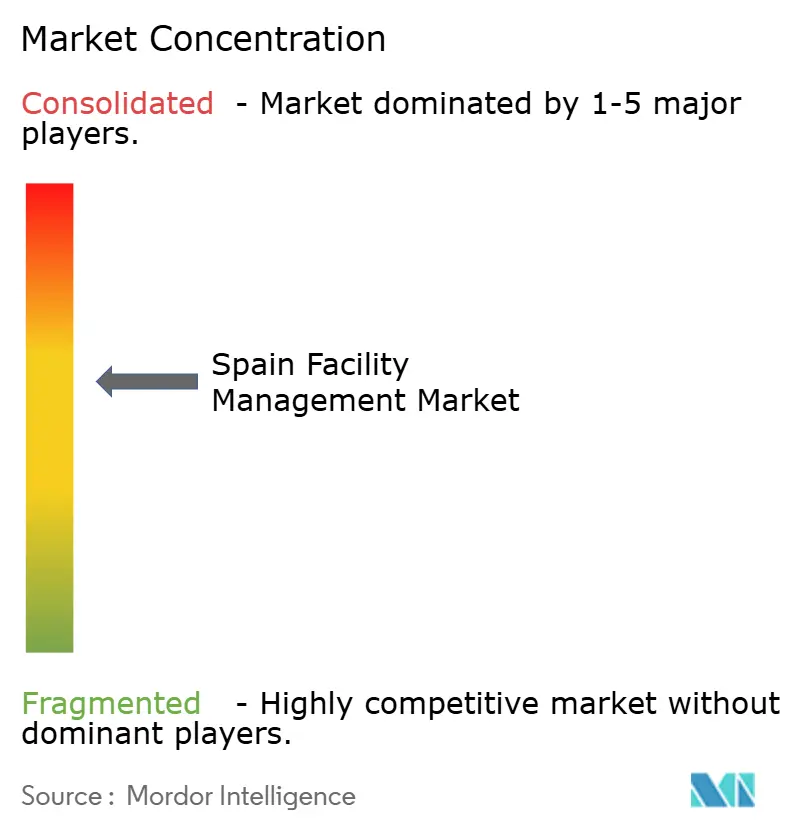
Spain facility management market remains moderately fragmented, with no single provider exceeding a double-digit share. Global firms such as ISS leverage data-driven platforms and cross-border procurement to win multi-site contracts, reporting USD 12.1 billion global revenue in 2024. Local champions like ILUNION post USD 1.22 billion revenue and differentiate through inclusive-employment models and regional intimacy. Construction conglomerates continue to divest service arms; ACS’s planned sale of Clece, valued at up to USD 961 million, underscores capital-allocation shifts toward core infrastructure concessions.
Technology is the frontline of competition. IoT retrofits across 370 Spanish buildings showcase how remote-monitoring dashboards and digital twins cut energy bills and fault-diagnosis time. Providers able to integrate building-management systems with ESG reporting are favored by multinational clients bound by EU taxonomy disclosure. Scale procurement, standardized workflows and cybersecurity safeguards further separate leaders from regional independents.
Consolidation is expected to intensify as private-equity funds target predictable cash flows and cross-sell synergies. Service breadth, contract-portfolio diversity and balance-sheet resilience will therefore decide winners in the next investment cycle. Providers lacking digital capability or multi-region reach risk marginalization to subcontract status within integrated FM ecosystems.
Spain Facility Management Industry Leaders
-
Licuas SA
-
CBRE
-
Sacyr Facilites
-
The Mail Company
-
LD Facility
- *Disclaimer: Major Players sorted in no particular order
Market Opportunities and Future Outlook
Mandated building automation upgrades create a compliance-driven opening for FM providers that can combine hard services with digital delivery. The EPBD requirement for building automation and control systems in non-residential buildings with large HVAC systems by 2027 moves BMS retrofits, sensorization, and continuous commissioning from optional improvement to programmatic work. Providers that can bundle MEP maintenance with controls, metering, and lifecycle documentation are better positioned to capture this shift.
Evidence of the move toward data-centric FM is visible in public housing digitization and platform refresh cycles in building controls. EMVS Madrid rolled out the SCAMIA predictive maintenance system across 14 public housing developments as a EUR 4.5 million initiative using digital twins, IoT sensors, and machine-learning, validating a route for providers to win multi-site contracts anchored in uptime, condition-based maintenance, and measurable asset performance. On the technology supply side, upgrades such as Johnson Controls Metasys 15.0 (released in May 2026) support higher device density and resilience for large portfolios, widening the scope for FM teams to operate and secure multi-server BMS environments. In parallel, telecom infrastructure strategies tied to the MasMovil-Orange combination and broader asset-light moves keep critical sites, fiber assets, and data-center-type environments in focus, reinforcing demand for specialized hard FM around power, cooling, and physical security where SLA-based delivery and auditability are central.
Recent Industry Developments
- July 2026: Licuas S.A. began providing road maintenance services covering 18 districts in the municipality of Murcia following a contract award. The win broadens Licuas presence in municipal operations work where service continuity, fleet management, and rapid-response maintenance capabilities are decisive in renewals.
- July 2025: PAI Partners pursued the acquisition of Avanta and Aspy to form a larger labor-risk-prevention platform. The move highlights increasing investor appetite for scale in compliance-adjacent services that interface with FM contracts through occupational safety, audits, and multi-site risk management needs.
- February 2024: Spain continued operationalizing its national digital policy agenda (Digital Spain 2025 program framework), reinforcing public-sector digitization priorities that feed into smart-building and connected-infrastructure requirements in public estates. This supports wider adoption of sensor-based monitoring, standardized reporting, and technology-enabled service models in FM procurement.
Research Methodology Framework and Report Scope
Market Definition and Coverage
For this study, the Spain facility management market is defined as the value of services used to operate, maintain, and support buildings and sites across Spain, covering both hard and soft facility services delivered through in-house teams or outsourced partners.
Scope exclusions: Pure one-off construction work and standalone equipment sales (without an ongoing facility service contract) are excluded from this market sizing.
Segmentation Overview
- By Service Type
- Hard Services
- Asset Management
- MEP and HVAC Services
- Fire Systems and Safety
- Other Hard FM Services
- Soft Services
- Office Support and Security
- Cleaning Services
- Catering Services
- Other Soft FM Services
- Hard Services
- By Offering Type
- In-house
- Outsourced
- Single FM
- Bundled FM
- Integrated FM
- By End-user Industry
- Commercial (IT and Telecom, Retail and Warehouses, etc.)
- Hospitality (Hotels, Eateries, Large-scale Restaurants)
- Institutional and Public Infrastructure (Govt, Education, Transportation)
- Healthcare (Public and Private Facilities)
- Industrial and Process (Manufacturing, Energy, Mining)
- Other End-user Industries (Multi-housing, Entertainment, Sports and Leisure)
Data Sources, Market Sizing, and Validation
Desk Research
Desk research was used to anchor the model to Spain-specific building activity and service-demand signals before assumptions were tested in the field. We referenced public sources such as Spain's National Statistics Institute (INE) for macro and employment series, Eurostat for construction and services indicators, and European Commission material on energy efficiency and renovation programs that influence maintenance intensity.
To keep service mix realistic, we also used sources such as Spain's public procurement portal and EU procurement disclosures to observe outsourced FM tender patterns, along with technical publications and peer reviewed articles on HVAC, energy performance, and building upkeep cycles. Company annual reports, investor decks, and reputable business press were reviewed to understand contracting preferences and pricing commentary, and selective paid database subscriptions were used for company financials, news and financials, patents, and tender tracking when it helped validate revenue exposure. This list is illustrative only, and other public sources were used for data collection, cross-checks, and clarification during the work.
Primary Interviews and Surveys
Primary work focused on interviews and structured surveys with a mix of facility service providers, subcontractors, and large end users that manage multi-site portfolios, supported by discussions with industry advisors and procurement professionals. We used these conversations to confirm outsourcing penetration, typical contract structures (single, bundled, and integrated), and to pressure-test service-level pricing, renewal cycles, and regional demand differences across Spain's main economic hubs.
Distribution of primary research fieldwork respondents
| Company type | Respondent position |
|---|---|
| Top tier: 36% | CXOs: 15% |
| Mid tier: 42% | Functional/Unit leaders: 42% |
| Smaller Players: 22% | Managers: 43% |
Market-Sizing & Forecasting
Sizing was built using a top-down and bottom-up logic, where the top-down approach starts from Spain's serviced building and infrastructure demand pool and then applies penetration and spend intensity assumptions by service type. In practice, we linked demand to observable drivers such as commercial floor space additions, aging building stock that raises planned maintenance, outsourcing share by facility type, energy efficiency upgrades that increase technical services, and wage inflation that shifts service pricing.
Once totals were formed, they were corroborated using selective bottom-up approximations, such as sampled contract values, provider revenue splits by FM lines, and a simple check of average annual spend per site for common facility categories. Where coverage gaps appear in bottom-up checks (for example, small local contractors with limited disclosures), assumptions were adjusted using field feedback on subcontracting share and typical markups so the final totals stay realistic.
For forecasting, we relied on scenario analysis supported by a light multivariate regression, where the key variables were facility stock growth, outsourcing penetration trends, technical maintenance intensity (especially MEP and HVAC), and labor cost progression. Forecast paths were then aligned to what interviewees expected for contract renewals, budget tightening, and energy compliance spending, before the final curve was signed off.
Data Validation & Update Cycle
Validation was done through multiple cross-checks so the final market value is not driven by one assumption. We compared model outputs against independent signals such as employment in building services, public tender volumes for FM style contracts, and disclosed revenue mix statements from service providers, and then investigated any large variances.
Before sign-off, an analyst review step checks for outliers by service line and by end-user exposure, and respondents are re-contacted when a key input moves outside the expected range. Reports are refreshed annually, and interim updates are made when material events occur, such as policy shifts, large contract changes, or sudden labor cost moves. Right before delivery, a final review pass is completed so clients receive the latest updated view.
Mordor Intelligence's Spain Facility Management Market Size Measured Against Other Published Estimates
Published market sizes for facility management in Spain often differ because the counted services are not always the same, and because some estimates mix facility services with adjacent building-service categories. Differences also show up when one publisher reports only outsourced spend while another includes in-house delivery value.
The main gap comes from whether in-house FM labor and multi-service contracts are counted as part of the market, where Mordor Intelligence includes both in-house and outsourced models and then separates single, bundled, and integrated delivery through consistent spend-intensity inputs. Another driver is how hard services (like MEP and HVAC upkeep) are treated relative to one-time project work, plus how wage inflation and contract indexation are rolled into pricing over the forecast years.
Benchmark comparison
| Source | Market Size | Gaps in Research Methodology |
|---|---|---|
| Mordor Intelligence | USD 38.18 B (2025) | |
| Industry Database A | USD 25.00 B (2024) | Often centers on outsourced FM and integrated contracts reported by larger suppliers, which can undercount in-house delivery and smaller local subcontracting that still represents real service consumption. |
| Sector Note B | USD 11.20 B (2024) | Typically reflects technical maintenance for buildings and installations and may exclude soft FM lines like cleaning and catering, and it can be reported in EUR with timing differences that change the USD-converted value. |
Seen together, the spread is largely explained by scope, especially which service lines and delivery modes are included, and by how pricing is updated year to year. Our approach keeps the total traceable to a clear demand pool, a defined set of service inclusions, and repeatable checks against observable Spain-specific signals.
Key Questions Answered in the Report
What is the current size of the Spain facility management market?
The market was valued at USD 40.08 billion in 2026 and is projected to reach USD 51.11 billion by 2031 at a 4.98% CAGR.
Which service type holds the largest share?
Hard services led with a 62.94% share in 2025, reflecting significant demand for HVAC, MEP and fire-safety upgrades.
Why is outsourcing gaining traction in Spain facility management market contracts?
Organisations seek variable-cost structures, advanced technology and multi-service coordination, driving outsourced models at a 5.21% CAGR through 2031.
Which end-user segment is the fastest growing?
The commercial sector is expanding at a 5.3% CAGR owing to hybrid-workspace optimisation and data-center growth.
How do energy-price fluctuations affect FM providers?
A forecast 13% electricity-price rise in 2025 compresses margins on energy-intensive contracts, prompting efficiency retrofits and energy-performance clauses.
What is the competitive outlook for the market?
Moderate fragmentation persists, but digital capability and scale are poised to trigger consolidation as providers vie for integrated IFM contracts.