
Market Overview
| Study Period | 2020 - 2031 |
|---|---|
| Forecast Data Period | 2026 - 2031 |
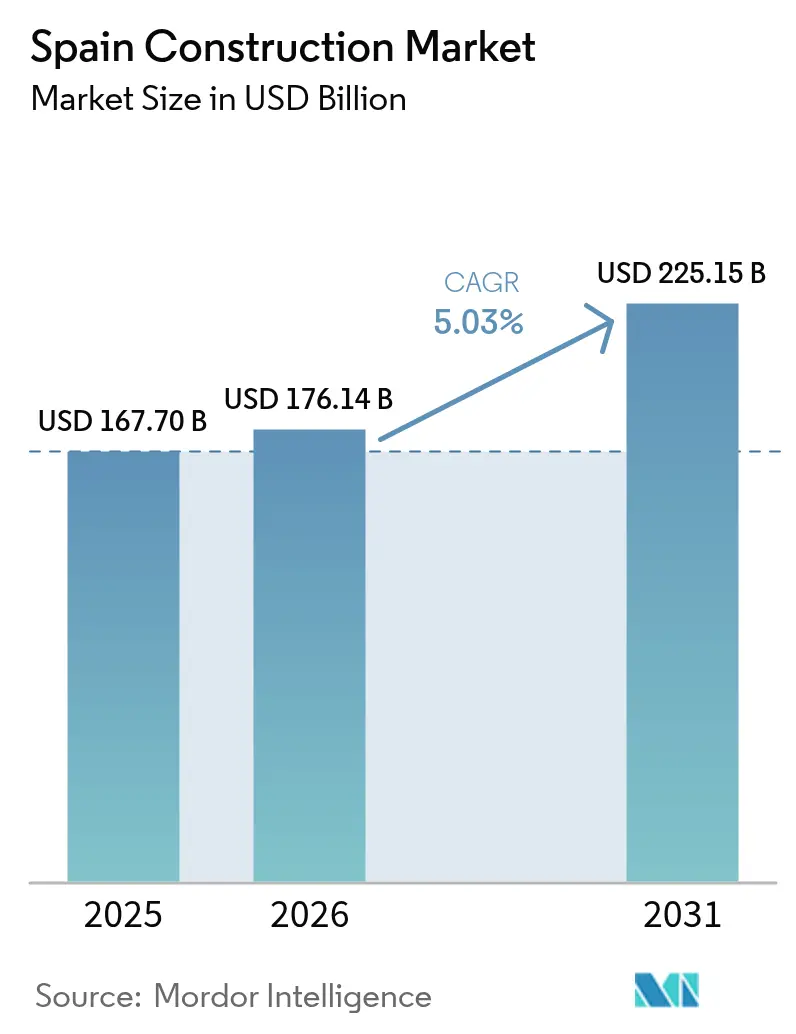
| Base Year Market Size (2025) | USD 167.70 Billion |
| Market Size (2026) | USD 176.14 Billion |
| Market Size (2031) | USD 225.15 Billion |
| Growth Rate (2026 - 2031) | 5.03 % |
| Market Concentration | Medium |
Major Players *Disclaimer: Major Players sorted in no particular order Image © Mordor Intelligence. Reuse requires attribution under CC BY 4.0. | |
Spain Construction Market Analysis by Mordor Intelligence
The Spain construction market size is expected to grow from USD 167.70 billion in 2025 to USD 176.14 billion in 2026 and is forecast to reach USD 225.15 billion by 2031 at 5.03% CAGR over 2026-2031. This expansion is propelled by Spain’s access to USD 154 billion in NextGenerationEU resources, of which roughly 70% flows directly into construction-related programs spanning infrastructure, renewable energy, and building rehabilitation. Residential activity keeps demand resilient, while unprecedented public-sector spending anchors infrastructure outlays and crowds in private capital. Growing adoption of modern construction methods, extensive digitalization mandates, and the 2030 FIFA World Cup infrastructure program further widen the opportunity set. Nevertheless, labor scarcity and commodity-price volatility continue to weigh on margins, compelling firms to accelerate automation, off-site manufacturing, and strategic procurement actions.
Key Report Takeaways
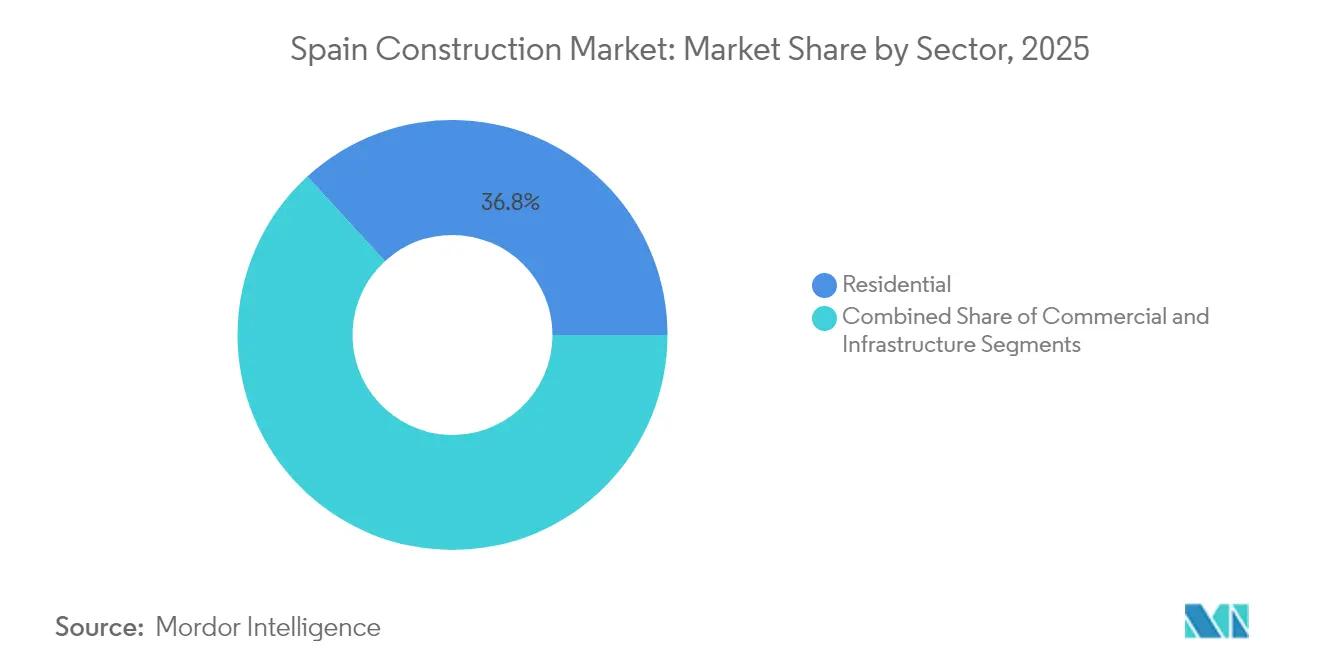
- By sector, residential construction led with 36.80% of Spain's construction market share in 2025, whereas infrastructure is forecast to expand at a 6.78% CAGR through 2031.
- By construction type, new construction accounted for 67.05% of the Spain construction market size in 2025; renovation is projected to grow at a 5.55% CAGR through 2031.
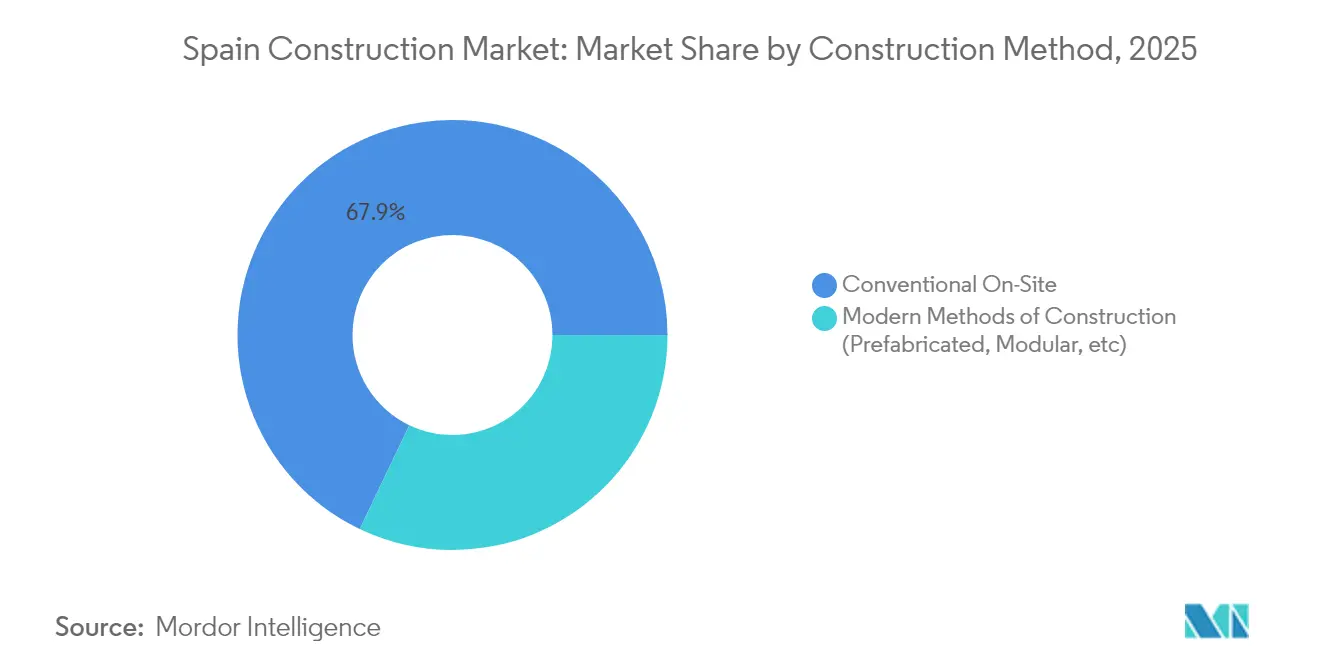
- By construction method, conventional on-site techniques held 67.90% share of the Spain construction market in 2025; modern methods are growing at 11.10% CAGR.
- By investment source, public expenditure accounted for 64.10% of the Spain construction market size in 2025, and private funding is rising at an 8.74% CAGR to 2031.
- By geography, Madrid captured a 23.30% share of the Spain construction market in 2025, while Andalusia is advancing at a 5.12% CAGR to 2031.
Note: Market size and forecast figures in this report are generated using Mordor Intelligence’s proprietary estimation framework, updated with the latest available data and insights as of 2026.
Spain Construction Market Trends and Insights
Drivers Impact Analysis*
| Driver | (~) % Impact on CAGR Forecast | Geographic Relevance | Impact Timeline |
|---|---|---|---|
| EU-funded infrastructure modernization | +1.2% | Nationwide, Andalusia, Catalonia, Madrid, Valencia | Long term (≥ 4 years) |
| Renewable-energy build-out | +1.0% | Castile-La Mancha, Extremadura, Aragon | Long term (≥ 4 years) |
| Housing-demand recovery via favorable mortgage rates | +0.8% | National: early momentum in Madrid, Valencia, Barcelona | Medium term (2-4 years) |
| Tourism-led commercial real-estate rebound | +0.6% | Coastal zones, Madrid, Barcelona | Medium term (2-4 years) |
| Modular/industrialized construction in public tenders | +0.4% | Catalonia, Madrid, the Basque Country | Long term (≥ 4 years) |
| Water-scarcity adaptation projects | +0.3% | Mediterranean coast, Andalusia, Valencia | Medium term (2-4 years) |
| Source: Mordor Intelligence | |||
EU-Funded Infrastructure Modernization
Spain secured USD 76.5 billion in grants, receiving an “excellent” rating from the European Commission for its recovery plan. Flagship rail schemes include the USD 919.6 million ADIF network renewal and the USD 3.3 billion Mediterranean Corridor upgrade, which converts single to double track and electrifies critical links. Complementary Connecting Europe Facility funding of USD 265.1 million supports 22 multimodal projects across eight regions. These works generate local employment, stimulate steel and concrete demand, and re-position Spain as a continental logistics hub.
Renewable-Energy Build-Out
National targets call for 62 GW of fresh renewable capacity by 2030, fuelling wide-ranging construction. The USD 770 million Teruel onshore wind contract for 125 GE Vernova turbines will deliver 760 MW and exemplifies portfolio scale-up. Iberdrola’s USD 550 million smart-grid expansion, part-financed by EU funds, is projected to support 10,000 annual jobs. Energy-storage investments such as the Valdecañas pumped-storage upgrade (USD 118.8 million) raise grid resilience and secure stable EPC pipelines[1]European Commission, “Spain’s BIM Public Procurement Plan,” ec.europa.eu.
Housing-Demand Recovery Via Favorable Mortgage Rates
Spanish developers benefit from a window of low mortgage costs that coincides with a housing shortage in major metro areas. Building permits totaled 107,934 in 2023 against 297,000 new household formations, underscoring supply gaps. Net-zero social-housing pilots, such as the 54-unit complex in Inca, Mallorca, highlight policy focus on affordability and sustainability. Foreign buyers continue to absorb prime units, providing liquidity even as domestic volumes fluctuate. As financing conditions gradually tighten, the pipeline front-loading observed in 2025 is expected to moderate, yet elevated demographic pressure maintains baseline demand.
Tourism-Led Commercial Real-Estate Rebound
Co-hosting the 2030 FIFA World Cup will unlock USD 1.57 billion in stadium and urban upgrades, generating an estimated USD 5.5 billion in economic value and 82,000 jobs. High-profile projects include the USD 1.9 billion Santiago Bernabéu redevelopment and the USD 1 billion Camp Nou overhaul, both integrating mixed-use retail components. Hotel pipelines expand, illustrated by Dalata’s 243-room Clayton Hotel Madrid, designed for LEED Gold certification and scheduled for 2029 completion.
Restraints Impact Analysis*
| Restraint | (~) % Impact on CAGR Forecast | Geographic Relevance | Impact Timeline |
|---|---|---|---|
| High labor cost & skilled-worker shortages | –0.9% | Madrid, Catalonia, Basque Country | Short term (≤ 2 years) |
| Volatile cement & steel prices | –0.6% | National | Short term (≤ 2 years) |
| Stringent biodiversity impact assessments | –0.3% | Protected coasts, mountain zones | Medium term (2-4 years) |
| Rising climate-risk insurance premiums | –0.2% | Mediterranean coast, flood areas | Long term (≥ 4 years) |
| Source: Mordor Intelligence | |||
High Labor Cost & Skilled-Worker Shortages
Only 9.2% of Spain’s construction workforce is under 29, down from 25.2% in 2008, constraining execution capacity for EU-funded projects. Vocational-training enrolment declined 45.6% over 15 years, widening gaps just as renewables and digitalization require specialized talent. The sector lobby pushes for expanded dual-training programs under the Fundación Laboral de la Construcción, while recruiting abroad delivers incremental relief. Tight labor markets in Madrid and Catalonia drive wage escalation that jeopardizes bid competitiveness and strains fixed-price contracts.
Volatile Cement & Steel Prices
Cement producer-price indices hit 138.8 in 2024, and steel rose 11.2% year-on-year, eroding contractor margins. Price-revision clauses in public contracts remain rigid, forcing bidders either to absorb cost spikes or withdraw. Budget overruns deter smaller firms, reducing tender competition and delaying Recovery Plan milestones. Transport surcharges in island territories further inflate delivered prices, damaging regional project viability.
*Our forecasts treat driver/restraint impacts as directional, not additive. The impact forecasts reflect baseline growth, mix effects, and variable interactions.
Segment Analysis
By Sector: Infrastructure Momentum Challenges Residential Leadership
Residential construction held 36.80% of the Spain construction market share in 2025, sustained by unmet urban housing demand and a brisk foreign-buyer segment. Infrastructure, the fastest-growing component, is forecast to post a 6.78% CAGR through 2031 as Recovery-Plan disbursements front-load transport and energy upgrades. Metro Madrid line extensions, Mediterranean Corridor rail doubling, and Iberdrola grid expansions collectively shift contractor backlogs toward heavy civil works. Meanwhile, the 2030 FIFA World Cup injects marquee stadium and urban-mobility projects that further tilt growth toward infrastructure.
Despite the infrastructure’s surge, residential pipelines remain robust in Madrid, Barcelona, and Valencia, where land scarcity and policy incentives favor vertical development. Energy-efficient building codes catalyze demand for heat-pump installations and high-performance envelopes, spurring specialized subcontractors. Commercial real estate capitalizes on revived tourism flows, while industrial space rides the wave of near-shoring and e-commerce logistics, showcasing the sector’s diversified growth engines.


By Construction Type: Renovation Gains Momentum Through EU Energy Programs
New construction dominated with a 67.05% slice of the Spain construction market size in 2025, powered by green-field rail, highway, and utility megaprojects. Renovation, however, is expanding at a 5.55% CAGR on the back of USD 3.8 billion in EU subsidies targeting 510,000 residential retrofit actions by 2026. Grants covering up to 80% of eligible costs and mandating 30% energy-use cuts amplify homeowner uptake. Catalonia leads with more than 300 subsidized schemes, while 597 public buildings across 499 municipalities secure separate retrofit funding.
The renovation surge addresses Spain’s aging stock, with two-thirds of buildings older than 40 years. BIM-based energy audits and digital building permits streamline approval and encourage bundling of works, reducing unit costs. Contractors pivot to façade insulation, solar-ready roofing, and accessibility upgrades, creating niche opportunities for SME specialists. As utility bills climb, payback periods shrink, supporting a sustained retrofit wave beyond the grant window.
By Construction Method: Digital Technologies Accelerate Modern Methods Adoption
Conventional on-site approaches retained 67.90% market share in 2025, yet modern methods boast an 11.10% CAGR, spurred by labor shortages and BIM-mandate compliance. Public-sector clients now stipulate BIM deliverables on contracts exceeding USD 13.7 million, nudging supply chains to embrace digital twins and factory-precision modules. Projects like MOD4SMART cut the schedule by a quarter, evidencing measurable productivity gains.
Prefabricated volumetric units gain traction in social housing and education facilities, lowering waste by up to 45% and improving worker safety. Robotics, 3D concrete printing, and on-site drones support quality control and progress monitoring. Early adopters leverage these capabilities to differentiate in competitive bid evaluations that assign points for technology and sustainability, signaling structural change in how Spain builds.
By Investment Source: Private Sector Acceleration Complements Public Leadership
Public funds contributed 64.10% of Spain's construction market value in 2025, reflecting robust fiscal stimulus and EU grant inflows. Private capital, the fastest-rising pool at an 8.74% CAGR to 2031, intensifies in renewables and commercial real estate. Iberdrola’s USD 2.2 billion co-investment with Norges Bank for 2.6 GW of green capacity illustrates growing institutional appetite. Meanwhile, a USD 2.75 billion European Investment Fund guarantee program channels liquidity to more than 6,000 construction-linked SMEs.
Public-private partnerships (PPPs) gain renewed appeal as fiscal rules tighten after 2026. Concession models blending recovery-plan grants with user-fee revenue underpin upcoming highway and desalination assets. As private investors demand ESG-aligned opportunities, Spain’s decarbonization roadmap offers a deep pipeline of bankable projects across transport electrification, grid expansion, and energy-positive buildings.
Geography Analysis
Madrid captured 23.30% of the Spain construction market in 2025, underpinned by flagship rail, airport-access, and stadium undertakings that reinforce its role as an economic hub. The USD 1.9 billion Bernabéu refurbishment and the Clayton Hotel’s LEED-targeted design attract global contractors and green-finance providers. Strong public-investment flows and corporate headquarters presence keep office-fit-out demand intact, while high-rise residential towers proliferate along new metro axes.
Catalonia combines industrial prowess with pressing climate-adaptation needs. USD 126.5 million worth of desalination upgrades protect manufacturing output, and USD 115 million in retrofit grants kick-start deep-renovation clusters. Barcelona’s Camp Nou expansion re-energizes the commercial pipeline, while logistics developers capitalize on cross-border e-commerce traffic to France.
Andalusia is the fastest-growing region at a 5.12% CAGR through 2031, leveraging superior solar irradiation and coastal tourism assets. Large-scale PV parks in Cádiz and wind arrays in Almería dovetail with expanded cruise-port capacity, creating multi-disciplinary contract opportunities. EU Cohesion funding upgrades secondary roads and freight terminals, narrowing the region’s historical infrastructure gap and unlocking private-sector co-investments. Elsewhere, Valencia benefits from Mediterranean Corridor rail works, Galicia enhances maritime infrastructure, and Aragón cements its status as a renewables manufacturing hub, illustrating the varied regional contributions to national growth.
Regulatory Landscape
Spain’s construction activity is shaped by national building requirements under the Codigo Tecnico de la Edificacion (CTE), which continues to be updated to incorporate tighter energy-efficiency and sustainability provisions. In parallel to the building rules, the Ministerio de Transportes y Movilidad Sostenible sets technical frameworks for transport infrastructure through road and rail technical standards, including the updated rail project and construction instruction (IFI 2025 series). Project owners and contractors use these instructions for design, materials, and execution controls.
On housing delivery and affordability, the Government approved the Plan Estatal de Vivienda 2026-2030 in April 2026 with a EUR 7 billion budget, setting the direction for public and protected housing delivery (including new-build/acquisition and renovation lines). Industrialization is also being positioned as a policy-backed execution pathway through the PERTE for Housing Industrialization (EUR 1.3 billion), linking modernization, labor conditions, and productivity to funding and eligibility, and reinforcing demand for industrialized systems and compliant digital deliverables in public tenders.
Value Chain Analysis
Spain’s construction value chain runs from land development and project origination (public administrations, ADIF and other public owners, and private developers) to design and engineering, general contracting, and specialist subcontracting. Specialist scopes typically include MEP, civil works, envelopes, and refurbishment trades. Materials and equipment supply relies on cement, aggregates, steel, and building products, while logistics and on-site handling affect delivered cost, particularly in island territories. For 2024, structural sector statistics reported EUR 205.204 billion turnover and EUR 66.024 billion gross added value, underscoring the scale of upstream procurement and downstream installation activity.
Bottlenecks concentrate on skilled labor availability and on administrative tendering and permitting complexity, both of which raise the value of standardized design, procurement bundling, and factory-led production. Policy-led industrialization is pushing earlier coordination across the chain: the PERTE for Housing Industrialisation targets an average of 15,000 industrialized homes annually, encouraging contractors, component manufacturers, and logistics providers to align on timelines. Additional higher-specification construction demand is also visible in 2026, including Ferrovial’s announced EUR 1 billion data center campus in Alcobendas (Madrid), and Dragados Offshore starting work at the Algeciras yard on TenneT’s LanWin2 offshore converter platform, both of which increase the need for electrical integration and long-lead equipment coordination.
Competitive Landscape
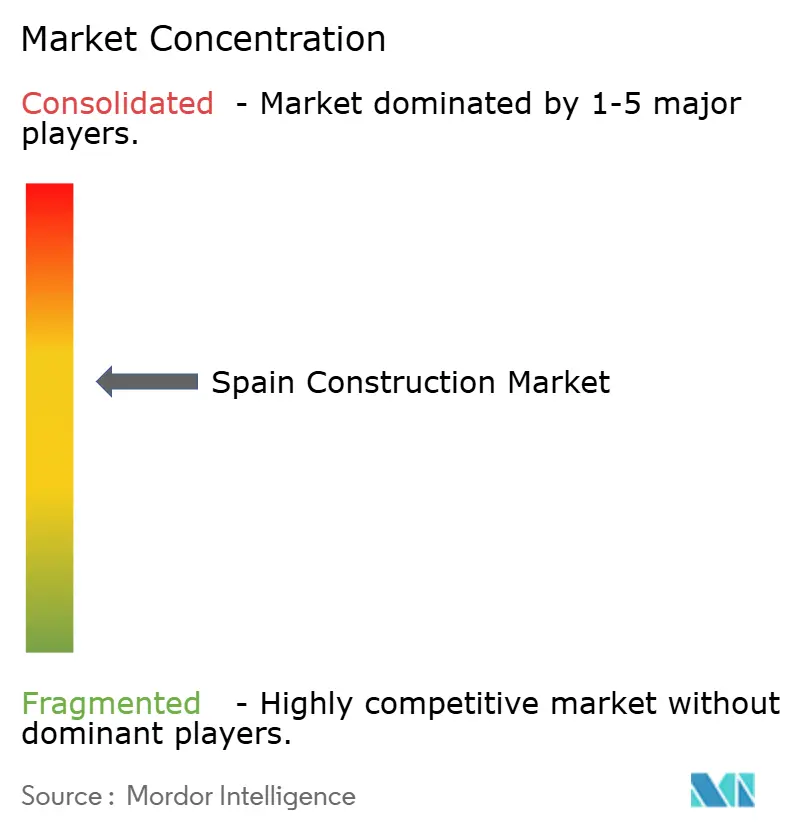
Spain’s construction market features a moderately concentrated set of diversified champions. ACS, Acciona, Dragados, and Ferrovial leverage extensive international backlogs to hedge domestic cyclicality, while retaining deep local supply-chain relationships. The ACS merger of Flatiron and Dragados USA, creating a USD 6.4 billion civil-engineering giant, underscores the pursuit of geographic scale and cross-border synergies. Ferrovial’s U.S. mobility concessions provide stable cash flows that fund domestic bids, whereas Acciona’s early-stage modular housing subsidiary seeks to capture green-building opportunities[3]European Investment Bank, “Grid Expansion Loan to Iberdrola,” eib.org.
Technology adoption shapes competitive differentiation. Firms that embed BIM, IoT-based asset monitoring, and AI-driven scheduling win bonus points in quality-weighted tenders. Acciona deploys digital twins on desalination projects to optimize energy use, while Ferrovial trials autonomous equipment on highway upgrades. As public clients push for life-cycle cost visibility, contractors with integrated design-build-operate platforms capture expanding O&M revenues.
Strategic partnerships proliferate. Iberdrola teams with civil contractors for co-located PV and storage projects, offering bundled EPC packages. Spanish mid-tier builders co-invest with pension funds on student-housing and data-center assets, diversifying away from low-margin residential blocks. Foreign entrants eye modular and off-site niches, but stringent local labor-union requirements and language barriers underscore the value of entrenched domestic incumbents.
Spain Construction Industry Leaders
ACS, Actividades de Construcción y Servicios, S.A.
Dragados S.A.
Acciona Construcción S.A.
Ferrovial Construcción S.A.
FCC Construcción S.A.
- *Disclaimer: Major Players sorted in no particular order

Market Opportunities and Future Outlook
Public programs are creating clear whitespace across affordable/public housing delivery, deep renovation, and transport connectivity. In April 2026, the Government approved the EUR 7 billion State Housing Plan 2026-2030, with budget shares defined for new public housing construction/acquisition and for renovation, supporting a continuing pipeline across new build, rehabilitation, and public procurement frameworks. In parallel, industrialized delivery is being funded through the EUR 1.3 billion PERTE for Housing Industrialization, which creates room for modular/off-site manufacturers, façade and envelope specialists, and contractors that can connect factory production with site execution.
Transport and logistics investment continues to concentrate demand in rail and strategic corridors. The Ministerio de Transportes y Movilidad Sostenible cited more than EUR 2.9 billion executed on Mediterranean Corridor works since January 2024, covering construction, station improvements, and port access. That activity sustains opportunities for major civil contractors as well as specialist suppliers in rail systems, electrification interfaces, and port connectivity works. Separately, updated BIM thresholds applying from January 1, 2026 are tightening public procurement requirements, supporting an adoption-driven market for digital engineering, coordination, and compliance services. On the private side, diversification into digital infrastructure is also becoming more concrete, with Ferrovial’s 2026 data center campus announcement in Madrid indicating an expanding pool of high-specification projects that rely on strong MEP capability, energy efficiency execution, and schedule certainty.
Recent Industry Developments
- July 2026: Ferrovial announced a EUR 1 billion investment to develop a data center campus in Alcobendas (Madrid), with an initial phase sized at 60 MW. The move expands the company’s exposure to digital infrastructure construction and increases demand for high-spec MEP delivery, power connection coordination, and program management capabilities in Spain.
- March 2025: The European Investment Bank and Iberdrola signed a USD 118.8 million loan to support the Valdecanas pumped-storage expansion, adding 313 MW of pumping capacity. The financing supports a visible energy and utilities construction pipeline and reinforces bank-supported capex for grid resilience assets.
- December 2024: The European Investment Bank approved USD 385 million in financing for ADIF’s rail renewal program, part of a broader USD 919.6 million investment. This supports continued rail upgrade works that drive demand for civil engineering, track renewals, and associated station and access improvements.


Research Methodology Framework and Report Scope
Market Definition and Coverage
For this study, the Spain construction market is defined as the value of construction activity delivered within Spain, covering new build and renovation work across buildings and civil works, measured in current prices.
Scope exclusions: This scope excludes construction activity executed outside Spain even if it is delivered by Spain headquartered groups.
Segmentation Overview
- By Sector
- Residential
- Apartments/Condominiums
- Villas/Landed Houses
- Commercial
- Office
- Retail
- Industrial and Logistics
- Others
- Infrastructure
- Transportation Infrastructure (Roadways, Railways, Airways, others)
- Energy & Utilities
- Others
- Residential
- By Construction Type
- New Construction
- Renovation
- By Construction Method
- Conventional On-Site
- Modern Methods of Construction (Prefabricated, Modular, etc)
- By Investment Source
- Public
- Private
- By Geography
- Andalusia
- Catalonia
- Madrid
- Valencia
- Rest of Spain
Data Sources, Market Sizing, and Validation
Desk Research
Desk research was used to set clear market boundaries and build a fact base before assumptions were added. We leaned on public statistics to anchor construction activity levels and direction, and then cross-checked the story with industry publications and financial disclosures.
Core references included official releases and datasets such as Spain's National Statistics Institute for structural business statistics on construction turnover, Eurostat construction production indices, OECD macro series for investment cycles, and European Commission materials linked to recovery funding and infrastructure priorities. These were supplemented with company annual reports, investor presentations, tender notices, and reputable business press for project pipelines and timing. When needed, paid subscriptions were used only for company financials and patent lookups to confirm technology adoption signals. The sources listed are illustrative, and other public documents were also reviewed to support data collection, validation, and clarification.
Primary Interviews and Surveys
Primary work was used to check what public data cannot easily capture in Spain, such as renovation intensity, how typical contract sizes change over time, and how public programs translate into awarded work. We spoke with a mix of contractors, subcontractors, consultants, and project owners across Spain to confirm demand drivers, pricing behavior, and realistic execution timelines.
Distribution of primary research fieldwork respondents
| Company type | Respondent position |
|---|---|
| Top tier: 36% | CXOs: 12% |
| Mid tier: 45% | Functional/Unit leaders: 33% |
| Smaller Players: 19% | Managers: 55% |
Market-Sizing & Forecasting
The main model uses a top-down approach where national construction activity is reconstructed from sector level output and investment signals, then split into workable demand pools. In practice, we map the totals into new construction and renovation, and then reconcile them with sector realities in residential, commercial, industrial, transport infrastructure, and energy related works.
To keep the numbers practical, we used market fingerprints that can be explained and rechecked, such as construction turnover and value added series, permits and housing starts direction, public infrastructure budget flow, renovation share discussions from the field, and cost inflation proxies that affect contract values. Selective bottom-up checks were then applied, including sampled project value by project counts in priority corridors, and supplier and channel checks on typical pricing and volume movement, so totals could be adjusted when early outputs looked stretched. Where bottom-up visibility was incomplete for smaller local subcontracting and informal scopes, the gap was handled through calibrated factors validated in interviews.
For forecasting, scenario analysis was used because Spain's construction outlook is sensitive to public funding timing, tender conversion, and labor and materials constraints. Assumptions for project awards, execution lags, and price progression were updated with primary feedback, and then rolled into year by year market values in current USD.
Data Validation & Update Cycle
Validation was done in steps so any major mismatch could be caught early. We compared the model outputs against independent signals such as construction sector turnover, construction value added movement, and visible public works and energy project activity, and then investigated variances that fell outside expected ranges.
Outliers were reviewed by a second analyst, followed by a focused recheck of the specific inputs that caused the swing, such as renovation mix, public versus private split, or price growth assumptions. Reports are refreshed annually, and interim updates are triggered when material events occur, such as large policy changes, major budget revisions, or sharp cost shifts. Before delivery, a fresh pass is completed so clients receive an updated view aligned to the latest available indicators.
Mordor Intelligence's Spain Construction Market Size Measured Against Other Published Estimates
Published numbers for Spain's construction market often do not match, and the differences usually come from what gets counted and how prices are treated across years. Variations in base year selection, treatment of renovation versus new build, and how public programs are translated into executed work can all move the final value.
Some published figures lean closer to enterprise turnover style reporting, and some extend the definition to include Spain based companies doing large volumes of work outside Spain. In Mordor Intelligence, the market is counted only when construction activity is delivered within Spain and is allocated across residential, commercial, industrial, transport infrastructure, and energy and utilities, which reduces double counting from overseas revenues and non-executed pipeline values.
Benchmark comparison
| Source | Market Size | Gaps in Research Methodology |
|---|---|---|
| Mordor Intelligence | USD 167.70 B (2025) | |
| Global Publisher A | USD 180.80 B (2025) | Often reflects a broader accounting of construction value where adjacent activities and looser execution timing can be captured earlier, and this can lift the base year compared with an executed-work view. |
| Official Statistics B | USD 222.00 B (2024) | Uses company turnover reported for construction sector enterprises, which can differ from delivered construction work value because it reflects business reporting structures, subcontracting pass-through, and local accounting treatment. |
The spread in the table is mainly explained by scope and measurement style, not by a simple math error. When the market is tied to delivered activity inside Spain and checked against multiple public indicators plus field feedback, the final value becomes easier to track, update, and defend year to year using repeatable steps and clear assumptions.


Key Questions Answered in the Report
What is the projected value of the Spain construction market in 2031?
The market is forecast to reach USD 225.15 billion by 2031, up from USD 176.14 billion in 2026.
Which segment is expected to grow fastest through 2031?
Infrastructure is set to expand at a 6.78% CAGR, outpacing residential and commercial works.
How large is the public spending share in Spanish construction?
Public funds represented 64.10% of total value in 2025, reflecting hefty EU-backed programs.
Which region shows the highest growth momentum?
Andalusia leads with a 5.12% CAGR owing to renewables and tourism-centered projects.
What role do modern construction methods play?
Modern methods are growing at 11.10% CAGR as BIM mandates and labor shortages accelerate prefab adoption.
How are material-price spikes affecting contractors?
Cement and steel volatility compress margins and deter bidding, prompting demand for better price-revision clauses.
Page last updated on:


 Your data is secure and never sold or shared.


