
Market Overview
| Study Period | 2021 - 2031 |
|---|---|
| Forecast Data Period | 2026 - 2031 |
| Base Year Market Size (2025) | USD 8.78 Billion |
| Market Size (2026) | USD 9.71 Billion |
| Market Size (2031) | USD 16.02 Billion |
| Growth Rate (2026 - 2031) | 10.53 % |
| Market Concentration | Medium |
Major Players *Disclaimer: Major Players sorted in no particular order Image © Mordor Intelligence. Reuse requires attribution under CC BY 4.0. | |
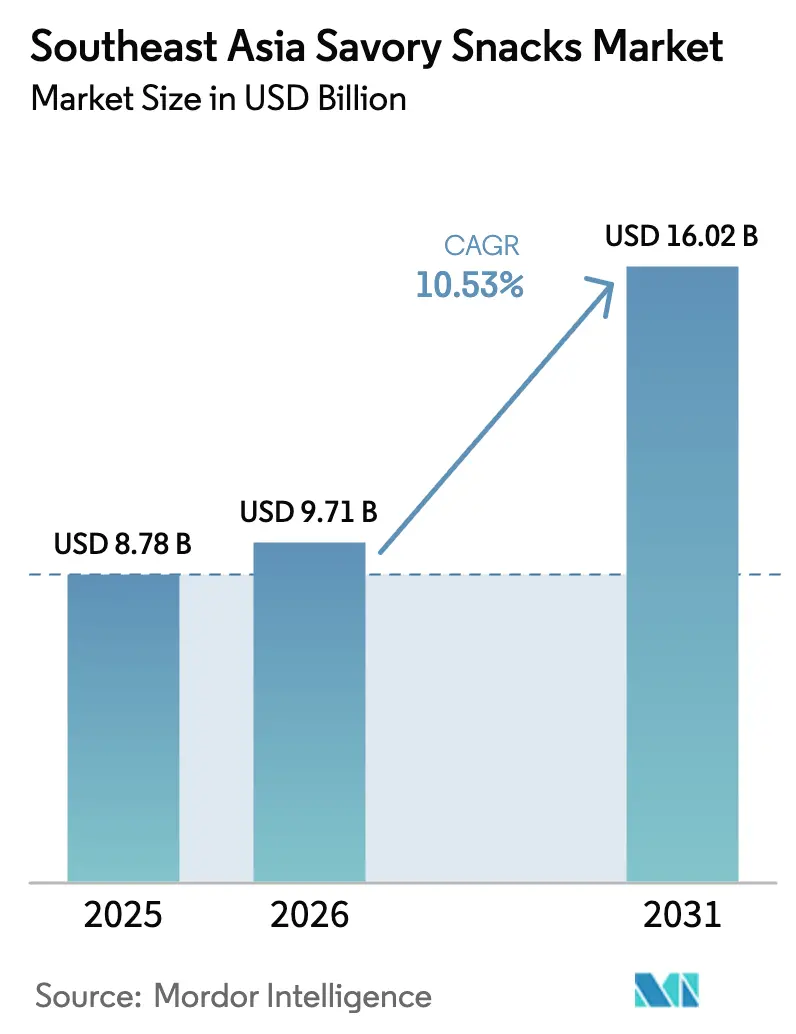
Southeast Asia Savory Snacks Market Analysis by Mordor Intelligence
The Southeast Asia Savory Snacks Market size is projected to increase from USD 8.78 billion in 2025 to USD 9.71 billion in 2026 and reach USD 16.02 billion by 2031, growing at a CAGR of 10.53% from 2026 to 2031. Strong population growth, rapid urbanization, and rising disposable incomes are accelerating the adoption of convenient snacks as meal replacements, especially among time-pressed city dwellers. Ongoing “snackification” is spawning an array of premium, functional, and flavor-forward innovations that appeal to Gen Z and millennials, while competitive pricing keeps core volumes resilient among value-oriented households. Digital commerce is opening low-barrier routes to consumers in dense urban corridors, giving digital-native brands and multinationals equal opportunity to capture incremental occasions. At the same time, manufacturers are confronting price pressures from volatile palm-oil and potato costs and preparing for stricter sodium- and sugar-reduction rules that are gathering momentum across the region.
Key Report Takeaways
- By product type, chips and crisp-based snacks led with 38.13% of the Southeast Asia savory snacks market share in 2025, while fruit and vegetable snacks are forecast to post a 12.50% CAGR through 2031.
- By flavor profile, classic/salted led with 52.07% of the Southeast Asia savory snacks market share in 2025, while flavored are forecast to post a 10.81% CAGR through 2031.
- By distribution channel, supermarkets/hypermarkets commanded 42.94% of the Southeast Asia savory snacks market size in 2025; online retail is projected to rise at an 11.45% CAGR between 2026 and 2031.
- By geography, Indonesia retained 34.11% revenue share of the Southeast Asia savory snacks market in 2025; Vietnam is projected to be the fastest-growing country at 14.32% CAGR during 2026-2031.
Note: Market size and forecast figures in this report are generated using Mordor Intelligence’s proprietary estimation framework, updated with the latest available data and insights as of January 2026.
Market Trends and Insights
Drivers Impact Analysis of Southeast Asia Savory Snacks Market*
| Driver | (~) % Impact on CAGR Forecast | Geographic Relevance | Impact Timeline |
|---|---|---|---|
| Rapid urbanisation and growth of modern retail in Indonesia, Vietnam and Philippines | +2.6% | Indonesia, Vietnam, Philippines | Medium term (2-4 years) |
| Health-oriented reformulation (reduced sodium/oil) led by Thailand and Singapore | +2.1% | Thailand, Singapore, with spillover to Malaysia | Medium term (2-4 years) |
| Local-cuisine flavour innovation (sambal, tom-yum, durian) engaging Gen-Z | +1.6% | Thailand, Indonesia, Malaysia, Singapore | Short term (≤ 2 years) |
| Domestic extruder capacity expansions lowering price points in Indonesia and Vietnam | +1.9% | Indonesia, Vietnam | Medium term (2-4 years) |
| E-commerce and quick-commerce fulfilment boosting urban snack demand | +2.3% | Singapore, Thailand, Malaysia, Philippines | Short term (≤ 2 years) |
| Tourism rebound lifting on-the-go sales in Thailand and Malaysia | +1.3% | Thailand, Malaysia | Short term (≤ 2 years) |
| Source: Mordor Intelligence | |||
Rapid urbanisation and growth of modern retail in Indonesia, Vietnam and Philippines
The rapid urbanization in Southeast Asia, particularly in Indonesia, Vietnam, and the Philippines, is significantly driving the growth of the savory snacks market in the region. Urbanization rates reported by the World Bank stand at 58.57% for Indonesia, 39.48% for Vietnam, and 48.28% for the Philippines. This demographic shift toward urban living has led to a growing preference for convenient, ready-to-eat snack options among consumers[1]. Additionally, modern retail formats like supermarkets and hypermarkets have made products more accessible, catering to the changing preferences of urban consumers. Additionally, the rapid growth of retail infrastructure in the region, including a steady increase in convenience stores, is driving market growth. For instance, in Indonesia, the number of convenience stores grew from 39,714 in 2021 to 46,118 in 2023. These developments are fueling the expansion of the savory snacks market in Southeast Asia, as urban consumers increasingly prefer a wider variety of snacks that are easy to find.
Health-oriented reformulation (reduced sodium/oil) led by Thailand and Singapore
Thailand and Singapore are taking the lead in making savory snacks healthier in the Southeast Asia market by lowering sodium and oil levels. These efforts support government health initiatives like Thailand's "Healthier Choice" logo program and Singapore's "Healthier Choice Symbol" campaign, which motivate manufacturers to offer healthier snack options. The Health Promotion Board (HPB) in Singapore reports that snacks with the "Healthier Choice Symbol" are gaining popularity among consumers, driving market growth. Similarly, Thailand's Ministry of Public Health has actively promoted sodium reduction strategies, aiming to reduce sodium consumption by 30% by 2025. These government-backed efforts are significantly influencing product innovation and reformulation trends in the region[2].
Local-cuisine flavor innovation (sambal, tom-yum, durian) engaging Gen-Z
Traditional flavors like sambal, tom-yum, and durian are becoming more popular, boosting the growth of the savory snacks market in Southeast Asia. These flavors are especially popular among Gen-Z consumers, who are eager to try unique and authentic tastes. Southeast Asian governments are also supporting the promotion of their local food heritage. For instance, Malaysia's Ministry of Tourism, Arts, and Culture is promoting sambal as a signature Malaysian flavor globally. Likewise, Thailand's Department of International Trade Promotion is highlighting tom-yum as an important export product with strong global potential. These initiatives, along with Gen-Z's growing interest in adventurous flavors, are creating excellent opportunities for manufacturers to introduce savory snacks inspired by local tastes to meet this rising demand.
Tourism rebound lifting on-the-go sales in Thailand and Malaysia
The resurgence of tourism in Thailand and Malaysia is significantly driving the growth of on-the-go sales, particularly in the savory snacks market. According to the Tourism Authority of Thailand (TAT), the country welcomed over 35 million international tourists in 2024, a substantial recovery from the pandemic-induced slump[3]. In 2023, Malaysia welcomed approximately 16.1 million tourists, as reported by the Ministry of Tourism, Arts, and Culture Malaysia (MOTAC). This rise in tourist numbers has increased the demand for easy-to-carry and ready-to-eat food options like savory snacks, which are convenient for travelers. Government campaigns, such as Thailand's "Visit Thailand Year 2023: Amazing New Chapters" and Malaysia's "Malaysia Truly Asia," have also helped revive tourism. These initiatives have attracted both international and local travelers, leading to higher sales of on-the-go snack products.
Restraints Impact Analysis of Southeast Asia Savory Snacks Market*
| Restraint | (~) % Impact on CAGR Forecast | Geographic Relevance | Impact Timeline |
|---|---|---|---|
| Volatile palm-oil and potato prices from climate shocks across SEA | -1.6% | Indonesia, Malaysia, Thailand, Vietnam | Medium term (2-4 years) |
| Halal-certification lead-times slowing launches in Indonesia and Malaysia | -1.3% | Indonesia, Malaysia | Short term (≤ 2 years) |
| Salt-/sugar-tax proposals in Singapore and Philippines pressuring margins | -1.0% | Singapore, Philippines, with potential expansion to Thailand | Medium term (2-4 years) |
| Fragmented rural distribution networks limiting reach beyond Tier-2 towns | -1.9% | Indonesia, Philippines, Vietnam, Myanmar | Long term (≥ 4 years) |
| Source: Mordor Intelligence | |||
Volatile palm-oil and potato prices from climate shocks across SEA
Climate changes in Southeast Asia have caused unstable prices for palm oil and potatoes, which are essential raw materials for making savory snacks. These price changes are a major challenge for the Southeast Asia Savory Snacks Market because they directly increase production costs and reduce profit margins for manufacturers. Extreme weather events like floods, droughts, and high temperatures make raw material prices unpredictable, making it harder to keep pricing and supply chains steady. Higher costs for these key ingredients may force manufacturers to either bear the extra expenses or raise prices for consumers, which could lower demand. This instability not only disrupts production but also makes long-term planning and investments difficult, slowing down the market's growth in the region.
Halal-certification lead-times slowing launches in Indonesia and Malaysia
In Southeast Asia's savory snacks market, Indonesia and Malaysia grapple with delayed product launches, primarily due to prolonged halal certification lead times. These delays not only disrupt product rollouts but also hinder market entry strategies, pushing back revenue generation for companies eyeing these markets. Given that halal certification is mandatory for food products in these predominantly Muslim nations, its significance in shaping market dynamics cannot be overstated. The certification process, laden with stringent regulatory checks and extensive documentation, adds to the delays. Companies find themselves dedicating extra resources and time to meet these requirements, inflating operational costs and slowing their response to shifting consumer preferences. Consequently, these extended halal certification lead times create a supply chain bottleneck, stunting the growth potential of Southeast Asia's savory snacks market.
*Our forecasts treat driver/restraint impacts as directional, not additive. The impact forecasts reflect baseline growth, mix effects, and variable interactions.
Southeast Asia Savory Snacks Market Segment Analysis
By Product Type:
Fruit Snacks disrupting traditional categoriesIn 2025, chips and crisp-based snacks held a significant 38.13% share of the market. This strong position is due to consumers' long-standing preference for these snacks and the wide distribution networks that make them easily available. These snacks are a popular choice because they are convenient and familiar. Additionally, companies regularly launch new flavors and innovative products, which keep chips and crisp-based snacks appealing and help them maintain their leading position in the competitive snack market.
Meanwhile, fruit and vegetable snacks are becoming a fast-growing segment in the Southeast Asian savory snacks market. These snacks are expected to grow at a high CAGR of 12.50% during the forecast period, surpassing the overall market growth. This growth shows that consumers are shifting toward healthier and more nutritious snack options. The change is driven by increasing health awareness and a preference for natural ingredients. The popularity of plant-based diets and the availability of premium, organic snacks are also boosting this segment. The rapid growth of fruit and vegetable snacks highlights their potential to change market trends and create opportunities for new products and expansion in the future.


By Flavor Type:
Classic/Salted Dominates, Flavored AcceleratesIn 2025, classic and salted flavors were the most popular in Southeast Asia's savory snacks market, holding 52.07% of the market share. This shows that consumers in the region prefer traditional and familiar tastes. These snacks are popular because they are easy to find, affordable, and enjoyed by people of all ages. Manufacturers are also improving the quality and packaging of these products to stay competitive. Classic and salted snacks are versatile, often paired with drinks or served during social gatherings, which further increases their demand.
Flavored snacks are expected to grow at a CAGR of 10.81% through 2031, driven by the rising demand for new and exciting flavors. The growing popularity of Western and fusion flavors, along with the trend of premium snack options, is driving this growth. Companies are working on creating unique flavor combinations and healthier alternatives to meet the needs of health-conscious consumers. Additionally, the growth of e-commerce and organized retail is making flavored snacks more accessible and visible across Southeast Asia.
By Distribution Channel:
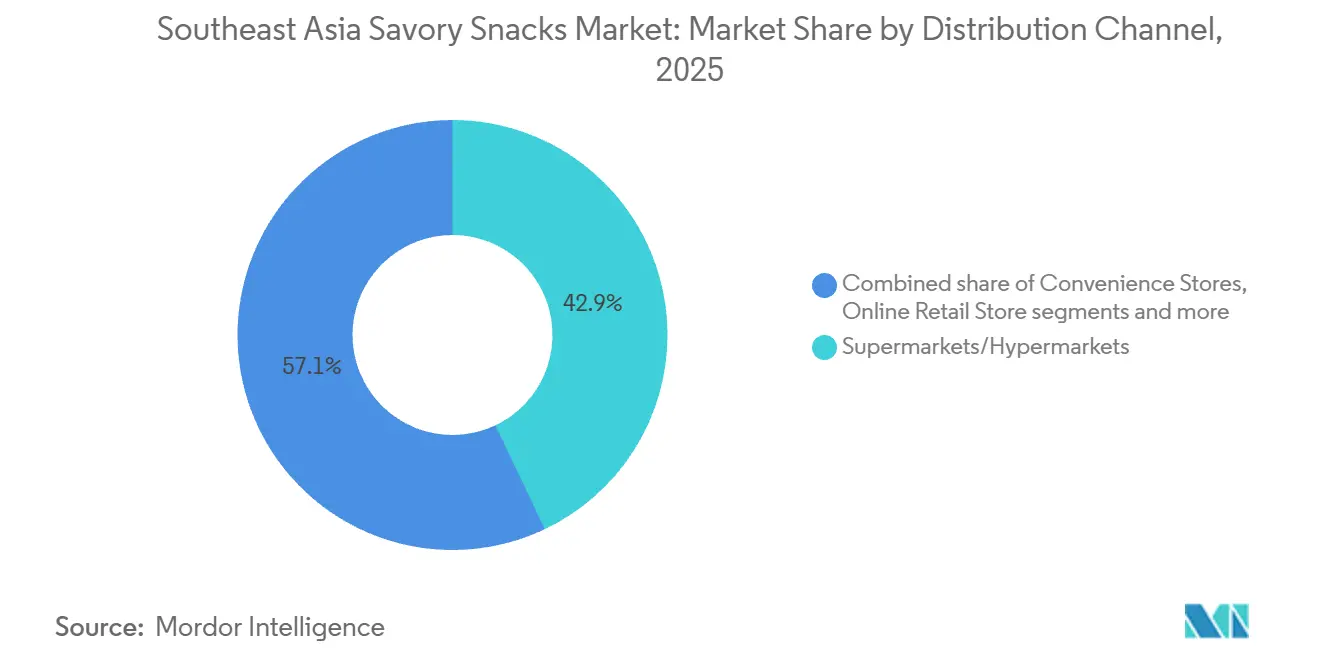
Digital transformation reshaping accessIn 2025, supermarkets and hypermarkets held a 42.94% share of Southeast Asia's savory snack market. This success was driven by strategies such as combining sales channels, using loyalty-card data, and placing attractive displays at the end of aisles. These stores offer a wide range of snack products in one location, meeting different customer preferences and making shopping more convenient. Their strong presence shows they are a key distribution channel for snack manufacturers targeting a broad audience. Additionally, in-store promotions and partnerships with snack brands have made supermarkets and hypermarkets more appealing, making them a top choice for both shoppers and suppliers.
Online retail is expected to grow at an 11.45% CAGR, far outpacing traditional physical stores. This growth is fueled by more people using the internet, the rising popularity of e-commerce platforms, and the convenience of home delivery. Online retailers are also attracting customers by offering personalized marketing and competitive prices. The rapid growth of online retail highlights its increasing role in distributing savory snacks in Southeast Asia. Furthermore, the use of digital payment systems and AI-based recommendations on e-commerce platforms is improving the shopping experience, driving even more growth in this channel.
Geography Analysis
Indonesia Savory Snacks Market
In 2025, Indonesia holds a leading 34.11% share of the Southeast Asian savory snacks market. This dominance is driven by its large population of over 270 million and a fast-growing middle class. The country's vast consumer base helps manufacturers scale their operations and lower costs through economies of scale. Expanding domestic extruder capacities has further reduced production costs, enabling manufacturers to offer affordable prices that attract consumers across different income levels. The growing demand for convenient, packaged snacks has boosted market reach in both cities and rural areas. Additionally, Indonesia benefits from strong distribution networks and the presence of both local and global companies, solidifying its top position in the region.
Vietnam Savory Snacks Market
Vietnam is becoming the fastest-growing market in the region, with a projected CAGR of 14.32% from 2026 to 2031, surpassing the regional average. This growth is supported by rising disposable incomes, urbanization, and the spread of modern retail beyond major cities like Hanoi and Ho Chi Minh City. The expansion of retail stores into smaller cities has made products more accessible. At the same time, the younger population's changing preferences have increased demand for new and innovative snack options. Government efforts to attract foreign investments in the food and beverage industry have also encouraged new companies to enter the market, increasing competition and driving growth.
Thailand Savory Snacks Market
Thailand is balancing a mature market with a focus on innovation, especially in health-focused snacks and unique flavors. The country’s well-established snack market benefits from consumers who are highly aware of and interested in premium, health-conscious products. Thai manufacturers are leading the way in creating snacks with less sugar, salt, and fat to meet the growing demand for healthier options. They are also introducing snacks with unique, locally-inspired flavors, which are gaining popularity both in Thailand and in export markets. With a strong supply chain and advanced manufacturing capabilities, Thailand remains a key player in the Southeast Asian savory snacks market.
Regulatory Landscape
Regulatory requirements for savory snacks in Southeast Asia are tightening around labeling, permitted additives, and food safety management systems. ASEAN is working toward harmonization through the ASEAN Food Safety Regulatory Framework, including updates such as the ASEAN Annex on maximum use levels of food additives (April 2025).
At the country level, Singapore is a key reference market for compliance discipline. The Singapore Food Agency brought the Food (Amendment) Regulations 2025 into operation on January 30, 2026, introducing new and revised requirements for prepacked food labeling that affect pack redesign and artwork lead times for snack brands selling through modern trade and e-commerce. Vietnam has also moved toward stricter, more document-intensive market access for processed foods. Decree No. 46/2026/ND-CP (dated January 26, 2026, effective April 16, 2026) clarified ministry responsibilities and requires food businesses to hold a Food Safety Eligibility Certificate (ATTP) in addition to independent management system certifications (such as HACCP, ISO 22000, or FSSC 22000), with the latter no longer substituting for the mandatory permit. This increases compliance workload for manufacturers and importers supplying chips, extruded snacks, and other packaged savory categories, and raises the value of standardized quality systems and regulatory-ready packaging and claims substantiation across markets.
Value Chain Analysis
The Southeast Asia savory snacks value chain starts with commodity inputs, including potatoes, palm oil and other edible oils, grains, nuts, and seasonings. Processing then covers frying, baking, extrusion and puffing, and drying, followed by flavoring and packaging, and ultimately distribution through modern trade, convenience stores, and fast-growing online channels.
Manufacturing capacity and supplier ecosystems are concentrated in established industrial clusters, including Thailand’s Eastern Seaboard, Vietnam’s Ho Chi Minh City and Hanoi corridors, and Indonesia’s Java, where co-packers, packaging converters, and third-party logistics providers help reduce time-to-market. Upstream volatility in key inputs, especially palm oil and potatoes, remains a recurring cost and procurement challenge across core chip and crisp-based segments. Midstream and downstream, logistics performance and ingredient/seasoning supply quality shape execution for packaged products. In June 2026, ofi (olam food ingredients) formed a joint venture with WNC Capital Holdings to establish ofi Philippines Blends, including a new Bulacan facility planned for commissioning by Q4 2026 to produce savory seasonings and dry mixes, supporting faster localization of flavor systems for snack manufacturers. CJ CheilJedang’s December 2025 partnership with CP Axtra (CP Group) targets wider distribution of K-food products, including savory snacks, across Thailand, Malaysia, and the Philippines. At the same time, port congestion at Indonesia’s Tanjung Priok and Thailand’s Laem Chabang has been cited as a bottleneck that can raise landed costs for imported specialty packaging films, pushing manufacturers to qualify alternate suppliers and simplify pack structures where feasible.
Competitive Landscape
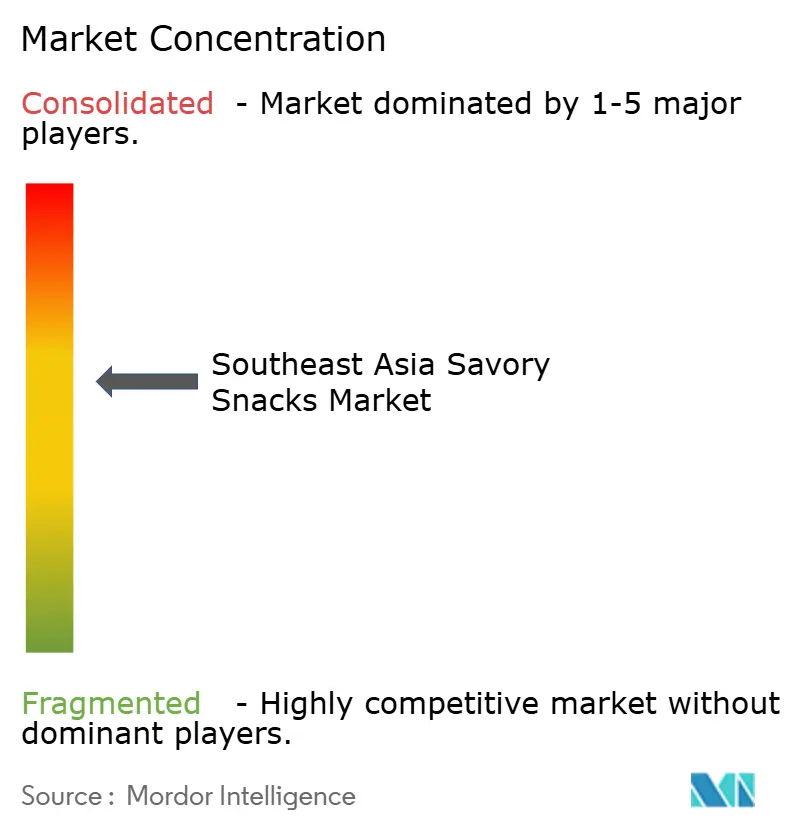
In the Southeast Asian savory snacks market, competition is balanced, with both multinational companies and local players actively competing. Global companies use their scale, international reach, and innovation to offer premium products that match changing consumer preferences. Meanwhile, local companies rely on their strong distribution networks and deep understanding of regional tastes to maintain their market position. Companies generally follow two main strategies: one focuses on creating premium products with health benefits and unique flavors, while the other ensures affordability and accessibility to reach a broader audience.
Newer companies are changing the market by using digital-first approaches, avoiding traditional distribution challenges, and connecting directly with consumers. These companies use e-commerce and social media to create a unique space for themselves. In response, established players are adopting technology, investing in tools to improve customer engagement through personalized marketing and loyalty programs, while also making their supply chains more efficient. These technological advancements are essential to staying competitive in the fast-changing market.
Competition is also increasing as companies from other industries, like beverage manufacturers, enter the snack market. These companies use their existing distribution networks and strong brand reputation to meet the growing demand for snacks in different situations. By combining snack products with their beverage offerings, they aim to grow their market presence and profits. This entry from other sectors makes the competition tougher, pushing existing snack companies to innovate and adapt to protect their market share.
Southeast Asia Savory Snacks Industry Leaders
-
Mondelēz International
-
PepsiCo Inc.
-
Universal Rubina Corporation
-
Kellanova
-
PT Garudafood Putra Putri Jaya Tbk
- *Disclaimer: Major Players sorted in no particular order
Southeast Asia Savory Snacks Market Companies Covered in this Report
- PepsiCo Inc.
- Mondelez International
- Teck Huat & Co. Pte Ltd
- Universal Robina Corporation
- Kellanova
- Calbee Inc.
- GarudaFood Putra Putri Jaya Tbk
- Tao Kae Noi Food & Marketing PCL
- Monde Nissin Corp.
- Want Want Holdings Ltd.
- VinaMit JSC
- J&D Food Industries Sdn Bhd
- Thai Snack Foods Co., Ltd
- Srisan Food Co., Ltd.
- Orang Tua Group
- Kameda Seika Co.
- PT Sekar Laut Tbk
- Liwayway Holdings (Oishi)
- Mamee-Double Decker (M) Sdn Bhd
- PT Mayora Indah Tbk
Market Opportunities and Future Outlook
Health and compliance-led renovation is a clear whitespace across savory snacks, especially for reformulated reduced-sodium or reduced-oil variants and cleaner ingredient decks that fit front-of-pack and labeling scrutiny. Government-backed programs also offer commercially relevant pathways. Singapore’s Healthier Choice Symbol and Thailand’s Healthier Choice logo program reinforce retailer and shopper visibility for reformulated offerings, while Singapore’s labeling requirements that took effect on January 30, 2026 raise the premium on accurate nutrition panels, ingredient statements, and pack claims. Vietnam’s tighter permitting and certification regime under Decree 46/2026/ND-CP (effective April 16, 2026) similarly favors manufacturers with standardized food safety systems and strong documentation, which benefits organized players and high-compliance co-manufacturers.
Digitization and industrial upgrading across the regional food ecosystem create additional room for snack manufacturers to raise throughput, traceability, and service levels for modern trade and online channels. Singapore launched a refreshed Food Manufacturing Industry Digital Plan in February 2026 to accelerate technology adoption among local food manufacturers, supporting uptake of tools such as automated order management and vision-based quality inspection. Investments by multinationals in Vietnam and Thailand also reinforce the region’s role as a production and distribution base. For example, Suntory PepsiCo opened a USD 300 million factory in Tay Ninh, Vietnam in July 2026 with an automated warehouse, demonstrating the scale of automation being deployed in local supply chains. These moves set competitive benchmarks for responsiveness, packaging formats, and portfolio localization, supporting expansion of premium and flavor-forward snacks in dense urban corridors served by modern retail and quick commerce.
Recent Industry Developments in Southeast Asia Savory Snacks Market
- July 2026: Suntory PepsiCo opened a USD 300 million factory in Tay Ninh, Vietnam, including its first fully automated warehouse in Asia. The investment strengthens high-speed, high-service manufacturing and logistics capabilities in a core ASEAN production corridor, lifting the bar for replenishment and availability for packaged food and snack portfolios.
- November 2025: PepsiCo inaugurated an approximately USD 89-90 million food factory in Ninh Binh, Vietnam, with annual capacity of over 25,000 tonnes of snacks and a focus on automation and sustainability features such as biomass boilers and solar energy. The site expands local snack output while supporting regional distribution from Vietnam into nearby markets.
- May 2024: Mondelēz International inaugurated its Regional Biscuit and Baked Snacks Lab and Innovation Kitchen in Singapore, supported by an investment of more than USD 5 million. The hub accelerates product development and localization for Southeast Asia and nearby Asia-Pacific markets, supporting faster innovation cycles in flavors, textures, and pack formats.
Southeast Asia Savory Snacks Market Report Scope and Research Methodology
Market Definition and Coverage
For this study, the market means the retail and foodservice sales value of savory snacks consumed across Southeast Asia, counted in USD and covering mainstream salty and spicy snack formats bought for between-meal eating.
Scope exclusions: Sweet snacks and confectionery, fresh bakery items, and full meal replacement products are not counted in this market sizing.
Segments Covered in This Report
- By Product Type
- Chips & Crisp- Based Snacks
- Potato Chips
- Tortilla & Corn Chips
- Rice & Pulse-Based Chips
- Multigrain Chips
- Seaweed & Marine-Based Crisps
- Nuts, Seeds & Trail Mixes
- Fruit and Vegetable Snacks
- Popcorn Snacks
- Meat & Jerky Snacks
- Extruded & Puffed Snacks
- Others Products
- Chips & Crisp- Based Snacks
- By Distribution Channel
- Supermarkets/Hypermarkets
- Convenience Stores
- Online Retailers
- Others Distribution Channels
- By Flavor Profile
- Classic Salted/ Plain
- Flavored
- By Country
- Indonesia
- Malaysia
- Vietnam
- Thailand
- Philippines
- Myanmar
- Singapore
- Rest of Southeast Asia
Data Sources, Market Sizing, and Validation
Desk Research
Desk work starts by building a clean demand and supply picture for Southeast Asia, so the snack categories and country coverage stay consistent. We typically refer to public statistics and reference data such as national statistics offices in the region, UN Comtrade trade data, FAOSTAT for key crop inputs (such as potato, corn, and palm oil proxies), World Bank macro indicators, and relevant food safety and labeling authorities for regulatory context.
After that, the model is shaped using manufacturer and brand owner disclosures, company annual reports and investor decks, retailer announcements, and reputable press coverage around launches and pricing. A paid subscription for company financials and intelligence can be used to normalize revenues and track ownership changes, and a shipment-level import and export database is used selectively to sanity check trade flows for packaged snack products. This list is not exhaustive, and many other public sources were also used to collect data, validate assumptions, and clarify open questions.
Primary Interviews and Surveys
Primary work is used to stress-test the desk assumptions with people who sit close to category decisions, including manufacturers, distributors, modern trade buyers, and ingredient and packaging participants. Since this is a multi-country market, inputs are balanced across larger ASEAN demand centers and smaller markets, and the feedback is used to adjust penetration, price ladders, and channel mix before totals are finalized.
Distribution of primary research fieldwork respondents
| Company type | Respondent position |
|---|---|
| Top tier: 28% | CXOs: 13% |
| Mid tier: 57% | Functional/Unit leaders: 36% |
| Smaller Players: 15% | Managers: 51% |
Market-Sizing & Forecasting
Sizing is built using a top-down approach where population, snacking incidence, and per-capita snack spend are reconstructed by country, then rolled up to a Southeast Asia total after channel weights are applied. To keep the numbers grounded, the outputs are checked with selective bottom-up approximations, such as sampled brand price points multiplied by observed pack sizes and expected velocities, followed by distributor and retailer channel checks.
Key inputs used in the model include urbanization and income trends, modern trade and e-commerce expansion rates, price and pack-size architecture, input-cost linked pricing movement (such as edible oil and potatoes), and the mix shift between chips, extruded snacks, nuts and seeds, and crackers. When country data is uneven, gaps are handled by using proxy indicators from similar markets and then reconciling them with interview feedback so the final values remain realistic.
For forecasting, scenario analysis is used so that upside and downside cases reflect different assumptions on pricing inflation, volume growth, and channel shifts, and then a central case is selected based on what most primary respondents view as the likely path.
Data Validation & Update Cycle
Validation is done in several passes, where totals are cross-checked against independent signals like snack food trade movements, raw material direction, and consumer spending growth to see if the story and the math stay aligned. Outliers are reviewed at the country and category level, and if a variance cannot be explained, assumptions are revisited and follow-up calls are triggered.
Before sign-off, the model and write-up go through multi-step analyst review so that definitions, currency treatment, and time series are consistent. The report is refreshed annually, and interim updates are made when a material event changes pricing, regulation, or channel structure, followed by a final pre-delivery review so clients get the most current view.
Mordor Intelligence's Southeast Asia Savory Snacks Market Size Compared Against Other Published Estimates
Published market sizes for Southeast Asia savory snacks can look different across sources, even when the time period sounds similar, because the product list and selling channels are not always treated the same way. Currency timing, base year choice, and how price increases are carried forward can also widen the gap.
In practice, the biggest differences usually come from whether traditional grocery and foodservice are counted, and whether adjacent categories like sweet biscuits or broader snack foods are blended into the savory total. Another driver is the way average selling prices are built, where some estimates apply one regional price uplift, while others adjust by country and by pack size, followed by a different refresh cadence.
Benchmark comparison
| Source | Market Size | Gaps in Research Methodology |
|---|---|---|
| Mordor Intelligence | USD 9.71 B (2026) | |
| Regional Consultancy A | USD 7.89 B (2024) | Uses an earlier base year and a longer end-horizon, and the product scope appears broader in some places, which can shift what is treated as savory versus adjacent snack categories when totals are rolled up. |
| Industry Publisher B | USD 10.20 B (2026) | Likely applies a wider snack definition that can fold in more traditional and ethnic variants and may handle channel coverage differently, which can raise the counted value in the same year. |
The spread in the table mainly reflects what is included in savory snacks and how channels and price ladders are applied across ASEAN markets, with the market size staying tied to explicit country coverage and category definitions, which is the specific approach used here by Mordor Intelligence.
Key Questions Answered in the Report
What is the current size of the Southeast Asia savory snacks market and how fast is it growing?
The Southeast Asia savory snacks market is valued at USD 9.71 billion in 2026 and is forecast to reach USD 16.02 billion by 2031, delivering a 10.53% CAGR.
Which product segments are expanding the quickest within the Southeast Asia savory snacks market?
Fruit and vegetable snacks are the fastest-growing category in the Southeast Asia savory snacks market, advancing at a 12.50% CAGR through 2031 as consumers gravitate toward natural, nutrient-dense options.
How important is e-commerce to future growth in the Southeast Asia savory snacks market?
Online Retail is the most dynamic channel in the Southeast Asia savory snacks market, projected to post an 11.45% CAGR (2026-2031) thanks to quick-commerce platforms that fulfil impulse orders within an hour.
Which country will be the primary engine of demand in the Southeast Asia savory snacks market between 2026 and 2031?
Vietnam is set to be the fastest-growing national segment of the Southeast Asia savory snacks market, with a 14.32% CAGR driven by rising incomes, urbanization and modern retail expansion beyond Hanoi and Ho Chi Minh City.