
Southeast Asia, Middle-East And Africa Small Arms And Ammunition Market Size and Share
Market Overview
| Study Period | 2020 - 2031 |
|---|---|
| Market Size (2026) | USD 1.48 Billion |
| Market Size (2031) | USD 1.69 Billion |
| Growth Rate (2026 - 2031) | 2.71 % |
| Fastest Growing Market | Middle East and Africa |
| Largest Market | South East Asia |
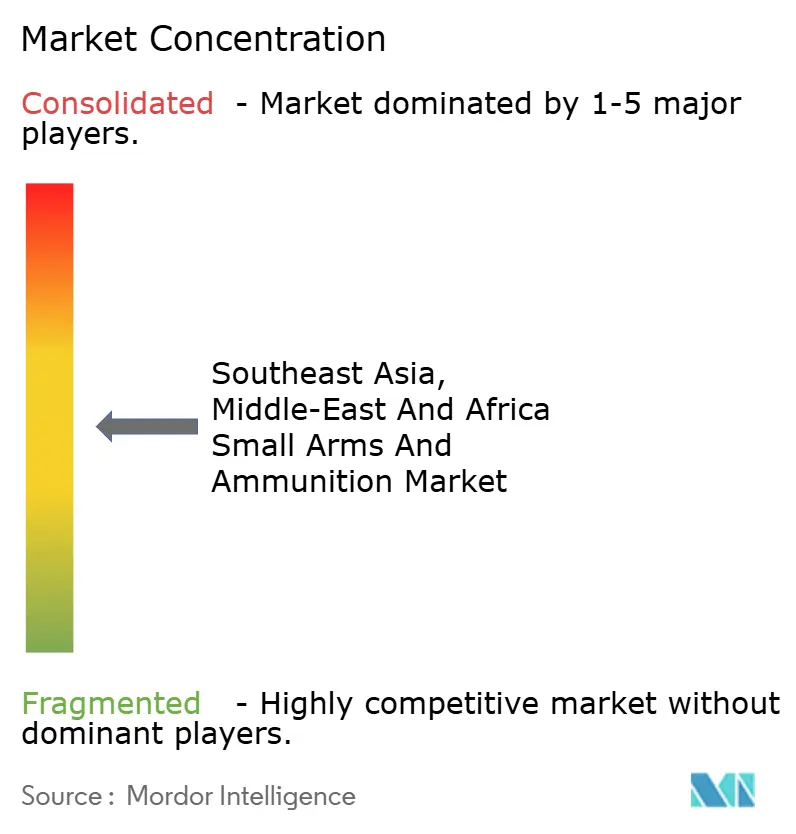
| Market Concentration | Medium |
Major Players *Disclaimer: Major Players sorted in no particular order Image © Mordor Intelligence. Reuse requires attribution under CC BY 4.0. | |
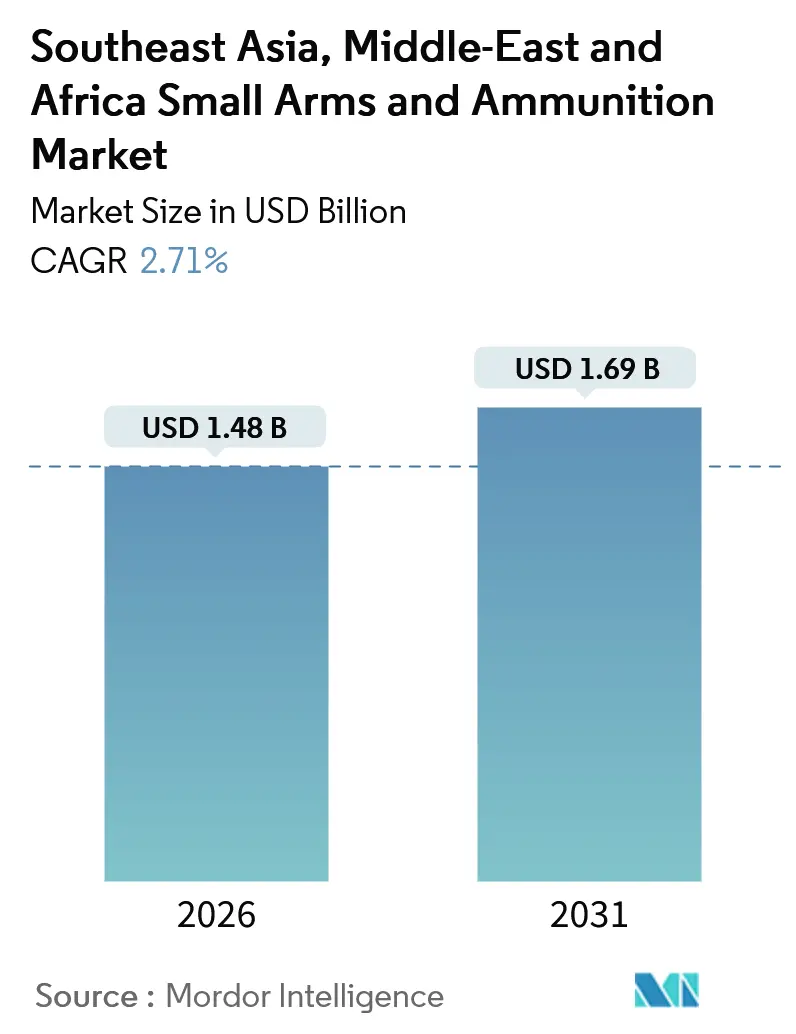
Southeast Asia, Middle-East And Africa Small Arms And Ammunition Market Analysis by Mordor Intelligence
The small arms and ammunition market in Southeast Asia, the Middle East, and Africa was valued at USD 1.48 billion in 2026 and is expected to reach USD 1.69 billion by 2031, registering a CAGR of 2.71%. The market is driven by ongoing counter-terrorism operations, defense modernization initiatives, and local content mandates, which sustain steady demand. However, fluctuations in oil prices and licensing challenges impact annual procurement cycles.
Regional buyers are increasingly adopting next-generation 6.8-millimeter cartridges, modular rifle platforms, and polymer-cased rounds to reduce logistics weight. Gulf and ASEAN governments are utilizing offset clauses to establish joint-venture manufacturing facilities closer to end users. Market competition is shifting from price-focused strategies to capabilities such as technology transfer, serial-number traceability, and efficient after-sales support.
Suppliers with established in-country partnerships, such as PT Pindad, Singapore Technologies Engineering, and Saudi Arabian Military Industries, are better positioned in the market. In contrast, vendors relying solely on imports face extended approval processes due to United Nations Programme of Action audit requirements. Additionally, private security firms protecting pipelines and LNG terminals represent a niche but growing market segment, with demand for durable weapons capable of withstanding harsh environmental conditions such as sand, salt, and tropical humidity.
Key Report Takeaways
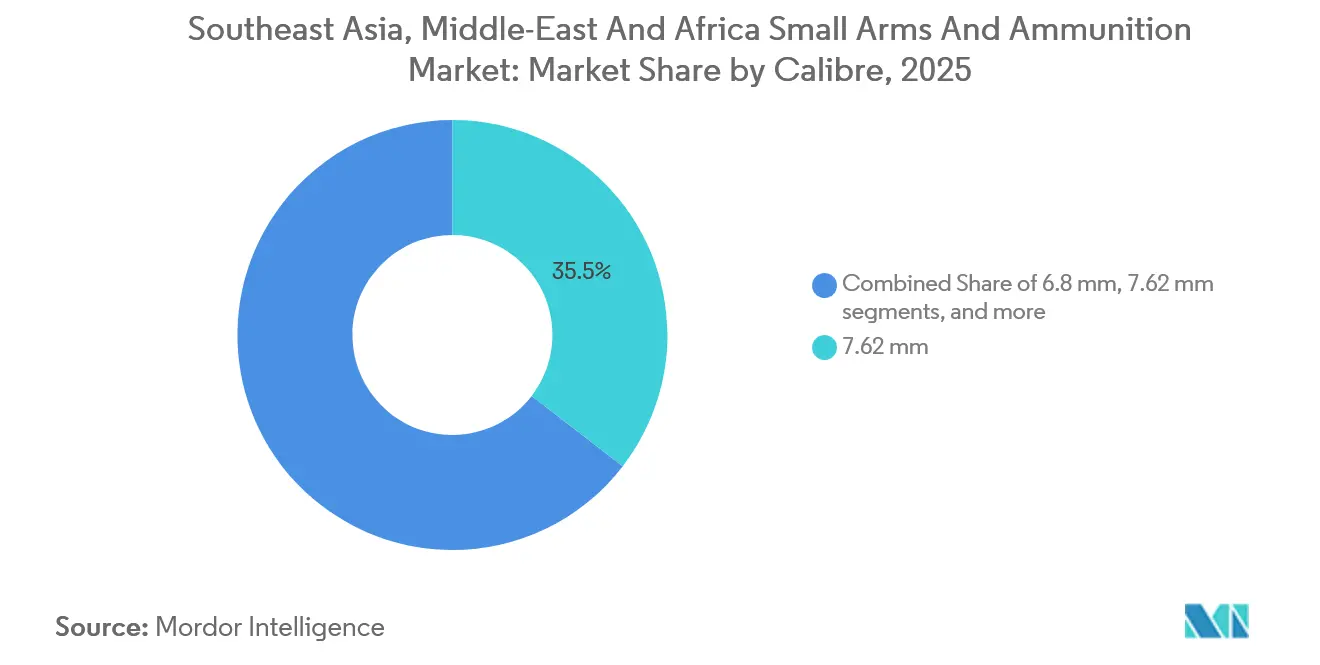
By caliber, 7.62 millimeter rounds led with 35.45% of Southeast Asia, Middle East, and Africa small arms and ammunition market share in 2025, while 6.8 millimeter cartridges are advancing at a 4.16% CAGR through 2031.
By weapon platform, rifles contributed 39.65% of the 2025 revenue, while submachine guns recorded the fastest growth at a 3.23% CAGR through 2031.
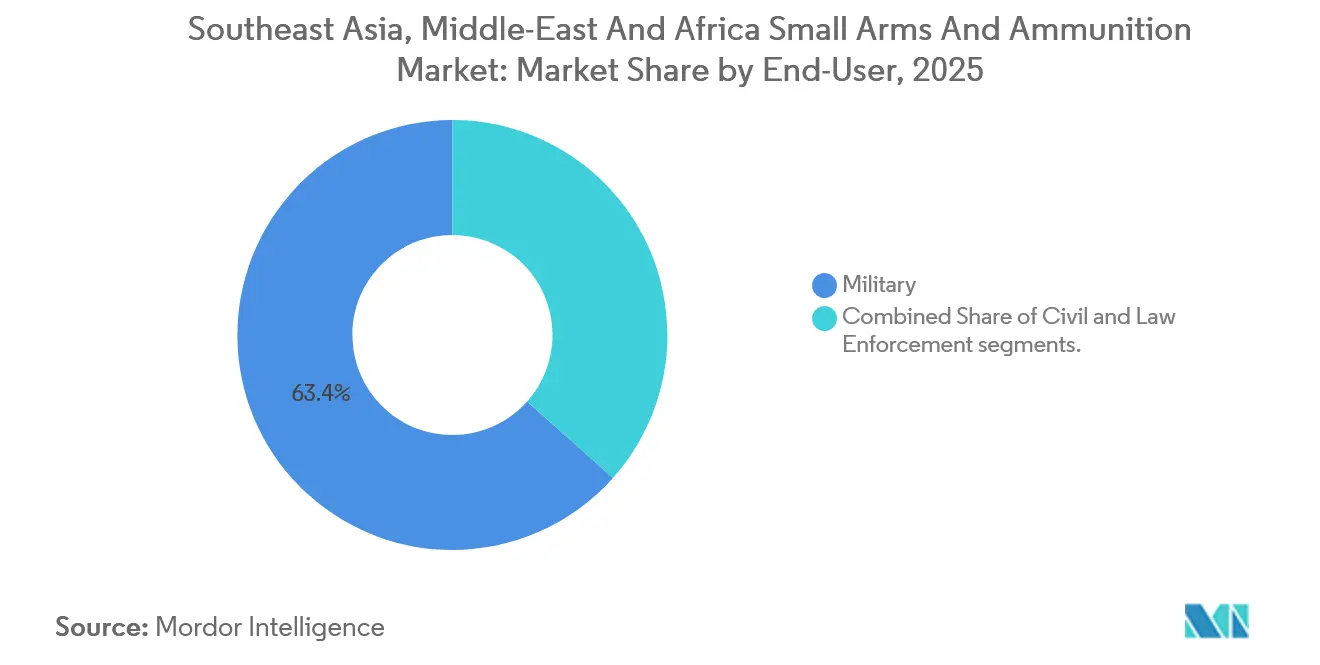
By end user, military customers captured 63.41% of 2025 sales, whereas law enforcement demand is expanding at a 3.11% CAGR, driven by urban security upgrades.
By geography, the Middle East accounted for 40.47% of the 2025 turnover; Africa is forecast to post the fastest growth of 4.01% CAGR between 2026 and 2031.
Note: Market size and forecast figures in this report are generated using Mordor Intelligence’s proprietary estimation framework, updated with the latest available data and insights as of January 2026.
Market Trends and Insights
Drivers Impact Analysis of Southeast Asia, Middle-East And Africa Small Arms And Ammunition Market*
| Driver | (%) Impact on CAGR Forecast | Geographic Relevance | Impact Timeline |
|---|---|---|---|
| Counter-terrorism and internal-security procurement surge | +0.60% | Philippines, Indonesia, Saudi Arabia, UAE, Nigeria, Kenya | Short term (≤ 2 years) |
| Military modernisation programmes across SEA and GCC | +0.50% | ASEAN nations, Gulf Cooperation Council states | Medium term (2-4 years) |
| Rising civilian gun ownership and shooting sports demand | +0.20% | UAE, Saudi Arabia, Singapore, Malaysia | Long term (≥ 4 years) |
| Offset and localisation policies boosting in-region production | +0.40% | Saudi Arabia, UAE, Indonesia, Malaysia, Philippines | Medium term (2-4 years) |
| Growth of private-security firms safeguarding energy assets | +0.30% | GCC oil facilities, Nigeria, Angola | Short term (≤ 2 years) |
| E-commerce-enabled grey-market ammunition sales | +0.10% | Concentrated in Southeast Asia | Short term (≤ 2 years) |
| Source: Mordor Intelligence | |||
Counter-terrorism and internal-security procurement surge
Armed-group violence and cross-border crime continue to accelerate procurements across Southeast Asia, the Middle East, and Africa's small arms and ammunition market. The Philippine National Police signed USD 21.5 million in 2024 contracts for pistols and carbines to counter Abu Sayyaf attacks, and Indonesia’s Brimob expanded rifle stocks by 15 percent in 2025 to confront separatists in Papua.[1] Saudi Arabia’s Ministry of Interior purchased more than 12,000 assault rifles in 2025 after drone incursions from Yemen. Kenya followed suit with 8,500 rifles for border patrols, highlighting the pivot toward compact, quick-deploy weapons fitted with suppressors and modular rails. These procurements underline the growing emphasis on enhancing internal security and counter-terrorism capabilities in the region.
Military modernisation programmes across SEA and GCC
Defense white papers across GCC states and ASEAN members channel spending toward bright optics, suppressors, and modular calibers that extend effective range. The UAE allocated USD 450 million in 2024 to adopt 6.8 millimeter systems, which deliver 30 percent longer reach, echoing the US Army’s Next Generation Squad Weapon logic. Singapore placed an order for 18,000 rifles with ST Engineering in 2025, and Malaysia earmarked USD 180 million for co-produced ordnance by 2028, rewarding vendors that embed technology-transfer clauses. These modernization efforts reflect a strategic shift toward advanced weaponry and collaborative production agreements aimed at strengthening military capabilities.
Rising civilian gun ownership and shooting-sports demand
The consumer segment of the Southeast Asia, Middle East, and Africa small arms and ammunition market, though modest, enjoys high margins. The UAE issued 12,400 new licenses in 2025 under streamlined rules, a 22 percent jump from the prior year.[2] Saudi Arabia granted 8,700 civilian permits in 2024, while Malaysia’s shooting-sports federation added 18 percent more members in 2025. Premium brass-cased ammunition and match-grade projectiles command price premiums, attracting suppliers keen on retail-chain partnerships. The rising interest in shooting sports and civilian gun ownership is creating a niche but profitable market for suppliers in the region.
Offset and localisation policies boosting in-region production
Localization dictates who wins bids. Saudi Arabia achieved 24.89 percent defense-spend localization in 2024 and targets 50 percent by 2030, prompting the establishment of a USD 580 million Rheinmetall joint-venture plant, which opened in 2025. Indonesia enforces a 35 percent local-content rule, which led PT Pindad to license FN Herstal processes. The Philippines’ Republic Act 12024 requires 10 percent reinvestment locally, prompting Israel Weapon Industries to open a barrel-forging line in 2025. Such policies reward entrenched joint ventures while deterring import-only hopefuls. These initiatives are reshaping the competitive landscape by prioritizing local production and technology transfer agreements.
Restraints Impact Analysis of Southeast Asia, Middle-East And Africa Small Arms And Ammunition Market*
| Restraint | (%) Impact on CAGR Forecast | Geographic Relevance | Impact Timeline |
|---|---|---|---|
| Stringent import licensing and end-user certification | -0.40% | Southeast Asia, Middle East | Medium term (2-4 years) |
| Oil-price-linked budget volatility in MEA states | -0.50% | GCC states, oil-dependent African economies | Short term (≤ 2 years) |
| Illicit trafficking concerns prompting tighter traceability | -0.20% | Sahel, Horn of Africa, SEA maritime corridors | Medium term (2-4 years) |
| Shift to non-lethal directed-energy crowd-control options | -0.10% | Urban centers in Middle East and Southeast Asia | Long term (≥ 4 years) |
| Source: Mordor Intelligence | |||
Stringent import licensing and end-user certification
United Nations frameworks require importers to verify end-users, extending procurement cycles in the Southeast Asia, Middle East, and Africa small arms and ammunition market by up to nine months. Singapore’s Arms and Explosives Act delayed three ammunition contracts in 2025, and ISACS marking rules strain smaller factories that cannot fund compliance teams. While incumbents absorb these costs, opportunistic suppliers withdraw, reducing competitive price pressure. The regulatory environment is becoming increasingly stringent, impacting the pace and cost of procurement processes across the region.
Oil-price-linked budget volatility in MEA states
Defense outlays track Brent crude prices, which fell from USD 82 in 2024 to USD 75 in mid-2025, prompting Saudi Arabia to defer a 25,000-rifle tender and Nigeria to cut its 2025 defense allocations by 12 percent.[3] Vendors respond with flexible payment terms and barter offers tied to crude cargoes, yet revenue-recognition uncertainty weighs on listed manufacturers. The volatility in oil prices continues to influence defense budgets, creating challenges for both governments and suppliers in maintaining consistent procurement plans.
*Our forecasts treat driver/restraint impacts as directional, not additive. The impact forecasts reflect baseline growth, mix effects, and variable interactions.
Southeast Asia, Middle-East And Africa Small Arms And Ammunition Market Segment Analysis
By Caliber:
Intermediate Cartridges Yield to Next-Generation BallisticsThe 7.62 millimeter segment accounted for 35.45% of 2025 sales, driven by legacy AK inventories. However, funding is increasingly directed toward calibers compatible with Western standards. For instance, Indonesia ordered 42 million 7.62×39 millimeter rounds in 2024 but allocated only 18% of its 2025-2029 small-arms budget to this caliber. In contrast, 6.8 millimeter ammunition is expected to grow at a 4.16% CAGR, the highest in the Southeast Asia, Middle East, and Africa small arms and ammunition market, following US combat tests that demonstrated 20% greater lethality at 600 meters. The 5.56 millimeter caliber remains essential, as evidenced by Malaysia’s order of 28 million rounds in 2025, while 9 millimeter stockpiles expand in tandem with police sidearm upgrades. Niche calibers like .338 Lapua Magnum attract special-operations units but contribute minimally to overall revenue.
The market benefits from caliber diversification as end users seek both backward compatibility and advanced ballistics. Suppliers are offering modular rifles that can accommodate 5.56mm, 6.8mm, and 7.62mm rounds by swapping barrels, thereby reducing lifecycle costs and simplifying logistics. Additionally, advancements in polymer-cased technology promise 30-40% weight reductions, enabling soldiers to carry more ammunition without exceeding load limits.

By Weapon Platform:
Close-Quarters Imperatives Reshape Procurement PrioritiesRifles generated 39.65% of 2025 revenue; however, urban operations strategies are accelerating demand for submachine guns, which are projected to grow at a 3.23% CAGR through 2031. For example, the UAE Presidential Guard procured 4,200 FN P90s in 2025 for VIP protection, while Indonesia’s Brimob acquired nearly 2,800 MP5s in 2024. Handguns are also in high demand, with police forces standardizing on high-capacity semiautomatic pistols; for example, Singapore ordered 8,500 SIG P226s in 2024. Light machine guns and shotguns continue to serve specialized roles, such as suppressive fire and riot control, with shorter replacement cycles in high-tempo units sustaining steady demand.
Procurement priorities in Southeast Asia, the Middle East, and Africa's small arms and ammunition markets now emphasize modularity, corrosion-resistant finishes, and suppressor compatibility over maximum muzzle velocity. Vendors capable of integrating advanced optics and Bluetooth-enabled training sensors command premium pricing.
By End User:
Law-Enforcement Modernization Narrows the Military–Civilian GapMilitary organizations accounted for 63.41% of 2025 spending, but law enforcement agencies are experiencing higher growth rates. For instance, the Philippine National Police allocated USD 86 million for small arms through 2026, while Saudi Arabia’s Special Security Forces deployed 12,500 new carbines in 2025, featuring capabilities previously exclusive to special-operations units. Civilian buyers remain a niche but profitable segment, supported by Gulf recreational-shooting initiatives tied to economic diversification efforts.
As urban unrest and organized crime increasingly blur traditional defense boundaries, interior ministries are demanding military-grade reliability in police weapons. This trend drives ammunition manufacturers to produce both crowd-control-optimized 9mm rounds and armor-piercing 5.56mm cartridges, thereby expanding their product portfolios and stabilizing production rates.
Geography Analysis
ASEAN and MEA Small Arms and Ammunition Market
The Middle East accounted for 40.47% of the 2025 revenue in the Southeast Asia, Middle East, and Africa small arms and ammunition market, supported by Vision 2030 localization initiatives that direct budgets toward domestic production. For example, the Rheinmetall-SAMI plant, launched in 2025 with an annual capacity of 120 million rounds, reduced cartridge imports by 35%. The UAE’s USD 450 million rifle-replacement program highlights the region’s focus on next-generation platforms. At the same time, Oman awarded an 18 million-round ammunition contract to a local producer in 2025, thereby enhancing its self-reliance. However, fluctuations in crude oil prices directly impact order volumes, prompting vendors to offer deferred-payment options.
Southeast Asia’s geographic challenges and insurgent threats necessitate the distribution of stockpiles. Examples include Indonesia’s purchase of 22,000 rifles for Papua units, the Philippines’ PHP 1.2 billion pistol-and-carbine contracts, and Singapore’s order of 18,000 SAR 21 Mk2 rifles. While procurement strategies vary, there is a shared emphasis on lightweight, optics-ready weapons. Offset policies, such as Indonesia’s 35% local-content requirement and Malaysia’s Industrial Collaboration Programme, influence procurement decisions, creating barriers to market entry for some suppliers.
Africa is projected to achieve the fastest growth, with a 4.01% CAGR through 2031. Kenya increased police rifle inventories by 8,500 units in 2024 and doubled plans for ammunition factory output to support regional exports. Nigeria commissioned a 12 million-round production line in Kaduna in 2024 but achieved only 60% capacity due to quality control issues, highlighting the gap between policy ambitions and operational execution. Meanwhile, Denel’s 2025 contract with the South African military demonstrates that established players can still secure contracts despite restructuring challenges.
Regulatory Landscape
Regulation across Southeast Asia and parts of MEA centers on licensing, end-user certification, and national control over import, production, and possession, which lengthen procurement lead times for non-incumbent suppliers. In the Philippines, Republic Act No. 10591 places ownership, manufacture, and importation under a permitting regime administered through the Philippine National Police Firearms and Explosives Office, while Thailand maintains defense ministry oversight for controlled arms and ammunition under the Arms Control Act B.E. 2530 (1987) alongside the Firearms, Ammunition, Explosives, Fireworks, and the Equivalent of Firearms Act B.E. 2490 (1947). Vietnam updated its framework with the 2024 Law on Management and Use of Weapons, Explosive Materials and Support Instruments, tightening conditions for research, production, trade, and cross-border movement.
Industrial participation rules also shape market access and supplier strategy. Indonesia's Defence Industry Law No. 16 of 2012 requires offsets and technology transfer in foreign procurements, with an offset value floor of 35% of the main contract, and Perpres 27 of 2019 reinforces prioritization of domestically produced defense products in procurement planning. Malaysia controls trade in strategic and dual-use items under the Strategic Trade Act 2010 through MITI's Strategic Trade Secretariat, with strategic items lists updated in 2025, influencing component flows (primers, propellants, and cases) as well as finished ammunition imports.
Value Chain Analysis
The regional value chain spans raw material sourcing (brass, steel, chemicals for primers and propellants), component manufacturing (cases, projectiles, primers), final assembly and proofing, then distribution through defense and interior ministry procurement channels and licensed commercial outlets. A recurring bottleneck is upstream dependence on imported inputs such as primers and propellants, which increases lead times and turns compliance with strategic trade controls and end-user documentation into a practical cost driver for assemblers and importers.
Localization and partnership-led capacity build-outs are reshaping midstream and downstream activities. PT Pindad's agreement with EDGE Group to establish an ammunition production line in Indonesia for 5.56x45 mm and 7.62x51 mm rounds (targeting production start in 2026) strengthens in-country conversion of imported inputs into finished rounds. In Malaysia, SME Ordnance's MOUs covering distribution and cross-border supply commitments point to tighter producer-distributor integration, while defense customers increasingly favor multi-year contracting structures, illustrated by the Ministry of Defence awarding Ketech Asia a three-year RM150 million supply contract for 9 mm and 5.56 mm ammunition in July 2026, which supports steadier plant loading and inventory planning across the chain.
Competitive Landscape
The small arms and ammunition market in Southeast Asia, the Middle East, and Africa is moderately fragmented, with the five largest suppliers accounting for approximately 38% of the combined revenue. Localization policies have led to the establishment of joint venture plants, creating country-specific mini oligopolies. For instance, SAMI and Rheinmetall in Saudi Arabia, ST Engineering across ASEAN, and PT Pindad in Indonesia benefit from preferred-bidder status under national content regulations. Examples of this include PT Pindad’s export of 12,000 rifles to the Philippines in 2024 and ST Engineering’s acquisition of a 51% stake in a Malaysian distributor in 2025, showcasing how incumbents capitalize on proximity and policy alignment to secure contracts.
Current innovation efforts focus on caliber-convertible rifles, polymer-cased ammunition, and innovative optics. FN Herstal introduced the FN EVOLYS system in 2024, featuring tool-free caliber swaps, which has drawn interest from Saudi Arabia’s National Guard and Malaysia’s police special actions unit. Turkish manufacturers MKEK and Sarsilmaz offer prices up to 30% lower than those of Western competitors, while adhering to ISACS marking standards, enabling them to secure a 15,000-rifle sale to Niger in 2024. However, suppliers without regional production facilities or compliance infrastructure face challenges, including reduced margins due to audit costs and extended bidding cycles.
Southeast Asia, Middle-East And Africa Small Arms And Ammunition Industry Leaders
-
Singapore Technologies Engineering Ltd.
-
PT Pindad
-
Saudi Arabian Military Industries (SAMI)
-
Israel Weapon Industries (IWI) Ltd.
-
Elbit Systems Ltd.
- *Disclaimer: Major Players sorted in no particular order
Southeast Asia, Middle-East And Africa Small Arms And Ammunition Market Companies Covered in this Report
- PT Pindad
- Singapore Technologies Engineering Ltd.
- SMEOrdnance Sdn. Bhd.
- Israel Weapon Industries (IWI) Ltd.
- Saudi Arabian Military Industries (SAMI)
- Oman Munition Production Company (OMPC)
- Elbit Systems Ltd.
- Jordan Ammunition Manufacturing Services (Jorammo)
- Kenya Ordnance Factories Corporation (KOFC)
- Defence Industries Corporation of Nigeria (DICON)
- Kalashnikov Concern JSC
- CBC Global Ammunition
- SIG SAUER, Inc.
- Rheinmetall AG
- Heckler & Koch GmbH
- Denel SOC Ltd.
- FN HERSTAL
Market Opportunities and Future Outlook
Opportunities concentrate around localization-driven supply substitution and the inputs that constrain domestic output, particularly primers and propellants. Malaysia's use of centrally managed, multi-year ammunition contracting, including the July 2026 RM150 million award to Ketech Asia for 9 mm and 5.56 mm supply, signals demand for assured local availability and creates room for qualified component makers, testing services, and licensed distributors able to meet strategic trade and traceability requirements. In Indonesia, planned domestic production initiatives, including PT Pindad's partnership with EDGE Group to stand up local 5.56x45 mm and 7.62x51 mm production, highlight a parallel avenue for technology transfer and local content compliance services tied to qualification, proofing, and acceptance testing.
A second opportunity is interoperability-aligned manufacturing and refurbishment capacity, as defense and internal security buyers standardize around NATO-compatible calibers and quality systems. In Africa, industrial upgrading efforts are visible in Denel's search for partners to modernize PMP's brass foundry and expand ammunition capacity, creating openings for equipment suppliers, automation integrators, and quality assurance partners. In North Africa, announcements around expanding NATO-standard munitions production in Morocco point to broader regional pull for standardized rounds, supporting suppliers that can deliver consistent metallurgy, case quality, and batch-level traceability for both government and commercial channels.
Recent Industry Developments in Southeast Asia, Middle-East And Africa Small Arms And Ammunition Market
- July 2026: ST Engineering secured an approximately USD 87.8 million contract with the UK Ministry of Defence to supply multiple variants of 40 mm grenades over five years. The award supports export competitiveness in ammunition products and enables higher-volume production runs that can improve unit economics across the wider munitions portfolio.
- February 2026: PT Pindad signed a memorandum of agreement with Saudi Arabian Military Industries (SAMI) Defence Systems at the World Defense Show in Riyadh to collaborate on development and production of 7.62 mm and 12.7 mm machine guns. The cooperation reinforces Saudi localization priorities and gives Pindad a pathway to deeper in-Kingdom industrial participation beyond one-off exports.
- May 2024: PT Pindad signed an agreement with EDGE Group to establish an ammunition production line in Indonesia for 5.56x45 mm and 7.62x51 mm rounds, with production scheduled to start in 2026. The project expands domestic manufacturing capability and reduces exposure to import lead times for high-consumption calibers used by military and law enforcement customers.
Southeast Asia, Middle-East And Africa Small Arms And Ammunition Market Report Scope and Research Methodology
Market Definition and Coverage
This market tracks the value of small arms and related ammunition supplied across Southeast Asia, the Middle East, and Africa, covering military, law enforcement, and permitted civilian demand. It includes common weapon types such as handguns and rifles, and the ammunition matched to them across standard calibers.
Scope exclusions: It excludes heavy weapons systems, crew-served artillery, missiles, armored platforms, and non-kinetic security tools, even if they appear in the same procurement programs.
Segments Covered in This Report
- By Caliber
- 5.56 mm
- 6.8 mm
- 7.62 mm
- 9 mm
- 12.7 mm
- Other Calibers
- By Weapon Platform
- Handguns
- Rifles
- Light Machine Guns (LMGs)
- Sub-Machine Guns (SMGs)
- Shotguns
- By End User
- Civil
- Law Enforcement
- Military
- By Geography
- Southeast Asia
- Indonesia
- Malaysia
- Philippines
- Singapore
- Rest of Southeast Asia
- Middle East and Africa
- Middle East
- United Arab Emirates
- Saudi Arabia
- Rest of Middle East
- Africa
- South Africa
- Rest of Africa
- Middle East
- Southeast Asia
Data Sources, Market Sizing, and Validation
Desk Research
Desk work started with mapping demand drivers and procurement pathways, because this market can move when contract awards, licensing cycles, and security conditions shift. We reviewed public defense budget documents and procurement releases, and we also used import and export trade statistics where small arms and ammunition codes can be separated at a usable level.
To ground the model, we relied on established open sources such as UN Comtrade, SIPRI databases and yearbooks, UNROCA submissions, country defense ministry publications, and World Bank macro indicators, then supplemented with company annual reports and investor presentations where available. We also used paid databases for company financials and intelligence, patents, and defense contracts and tenders to cross-check timelines and program activity without relying on a single channel. These examples are not exhaustive, and other public sources and documents were used for data collection, validation, and clarification.
Primary Interviews and Surveys
Primary work focused on validating what share of covered spending converts into small arms and ammunition deliveries across the included countries, and how replenishment orders show up over time. We spoke with stakeholders across procurement, distribution, and end-user communities, and we used their input to confirm caliber mix, replacement cycles, and pricing movement (including local production and offset-driven impacts) across Southeast Asia, the Middle East, and Africa.
Distribution of primary research fieldwork respondents
| Company type | Respondent position |
|---|---|
| Top tier: 36% | CXOs: 16% |
| Mid tier: 42% | Functional/Unit leaders: 37% |
| Smaller Players: 22% | Managers: 47% |
Market-Sizing & Forecasting
Sizing was built using both top-down and bottom-up logic, where defense and security procurement signals were first translated into an addressable pool for small arms and ammunition, then checked with supplier and pricing arithmetic. On the top-down path, we reconstructed demand by end user and country using budget lines, contract announcements, and trade movements, then applied shares for small arms and ammunition based on program mix and replacement needs.
A few practical inputs were treated as key drivers, including active procurement programs for infantry weapons, annual ammunition usage and training intensity indicators, the caliber mix (for example 5.56 mm, 7.62 mm, 9 mm, and 12.7 mm), local production and offset requirements that change sourcing, and average selling price ranges by weapon type and cartridge category. Where any country had limited disclosure, gaps were handled using proxy ratios from similar procurement structures, then adjusted after primary feedback.
For forecasting, we used scenario analysis so that different security and procurement cycles could be represented without forcing a smooth growth curve. Assumptions on budget direction, delivery timing, and pricing were reviewed with interviewees, and we kept the final path tied to observable procurement and trade signals rather than optimistic adoption jumps.
Data Validation & Update Cycle
Outputs were triangulated by comparing totals against independent checks such as import-export trends, visible contract pipelines, and known production capacity signals, followed by variance checks at country and end-user levels. When a number looked out of pattern, we re-opened the inputs, then triggered follow-up outreach to confirm whether the change reflected timing, a price effect, or a scope mismatch.
Before sign-off, the model goes through a multi-step analyst review so calculations, assumptions, and currency handling stay consistent across the region set. Reports are refreshed annually, and interim updates are made when material events occur, such as a major procurement award, a change in civilian licensing rules, or a sharp shift in budget direction. Right before delivery, we run a fresh review pass so clients receive the latest updated view.
Mordor Intelligence's Southeast Asia Middle East and Africa Small Arms and Ammunition Market Size Compared With Other Published Estimates
Published market sizes for small arms and ammunition can differ widely because each publisher covers the market boundaries in a different way, and then uses different evidence to convert defense intent into delivered value. Even within the same regions, timing choices, currency treatment, and what gets counted as part of supply can change the final number.
Trade-flow direction, visible defense contract pipelines, and cross-checked caliber and platform splits are the signals that keep Mordor Intelligence aligned with delivered procurement across the three-region set, including ammunition calibers and weapon platforms that are often summarized differently in narrower write-ups.
Benchmark comparison
| Source | Market Size | Gaps in Research Methodology |
|---|---|---|
| Mordor Intelligence | USD 1.48 B (2026) | |
| Industry Data Reseller A | USD 0.94 B (2025) | Uses an earlier base year and a shorter forecast window, and the public summary does not clarify caliber coverage or whether local production and offset-driven deliveries are captured consistently across all included countries. |
| Market Bulletin B | USD 1.12 B (2024) | Covers a narrower geography (Southeast Asia only), and the growth path typically assumes faster procurement conversion and steadier pricing without showing the same contract-timing and replenishment-cycle checks across the full region mix. |
Taken together, the spread mainly comes from geography choices, base-year timing, and how procurement intent is translated into shipments and revenue. By keeping the scope explicit and tying assumptions to observable procurement and trade indicators, we get a market size that is easier to trace and stress-test when conditions change.
Key Questions Answered in the Report
How large is the Southeast Asia, Middle-East and Africa small arms and ammunition market today?
The market stood at USD 1.48 billion in 2026 and is projected to reach USD 1.69 billion by 2031, growing at a 2.71% CAGR.
Which caliber is growing fastest in regional procurements?
6.8 millimeter ammunition is forecast to expand at a 4.16% CAGR as militaries pursue longer-range, higher-penetration rounds.
Why are localization mandates important for suppliers?
Countries such as Saudi Arabia and Indonesia require up to 50% local content, so foreign vendors must set up joint-venture factories or risk exclusion from tenders.
Which end-user segment is gaining share fastest?
Law-enforcement agencies are increasing purchases at a 3.11% CAGR as urban-security threats rise.
How do oil-price swings affect defense buying in the Middle East and Africa?
Lower crude prices reduce government revenue, often deferring rifle and ammunition tenders or shrinking annual order volumes.
What technologies will shape future regional procurement?
Modular rifles with caliber-conversion kits, polymer-cased ammunition that cuts weight, and smart optics integrated with ballistic calculators are gaining traction.