
Market Overview
| Study Period | 2019 - 2031 |
|---|---|
| Forecast Data Period | 2026 - 2031 |
| Base Year Market Size (2025) | USD 4.35 Billion |
| Market Size (2026) | USD 4.84 Billion |
| Market Size (2031) | USD 8 Billion |
| Growth Rate (2026 - 2031) | 10.58 % |
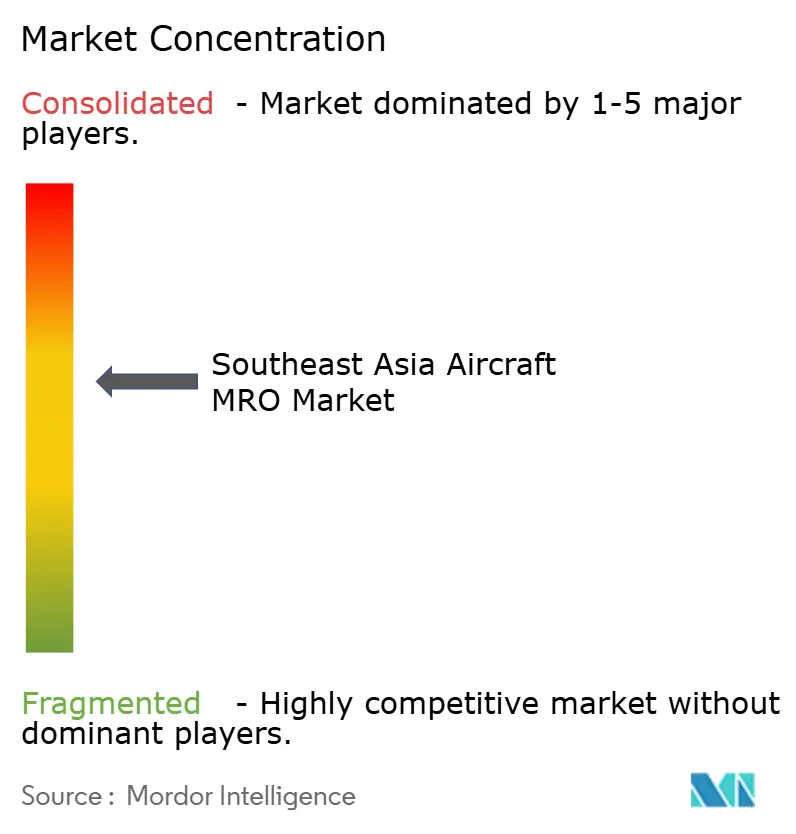
| Market Concentration | Medium |
Major Players *Disclaimer: Major Players sorted in no particular order Image © Mordor Intelligence. Reuse requires attribution under CC BY 4.0. | |
Southeast Asia Aircraft MRO Market Analysis by Mordor Intelligence
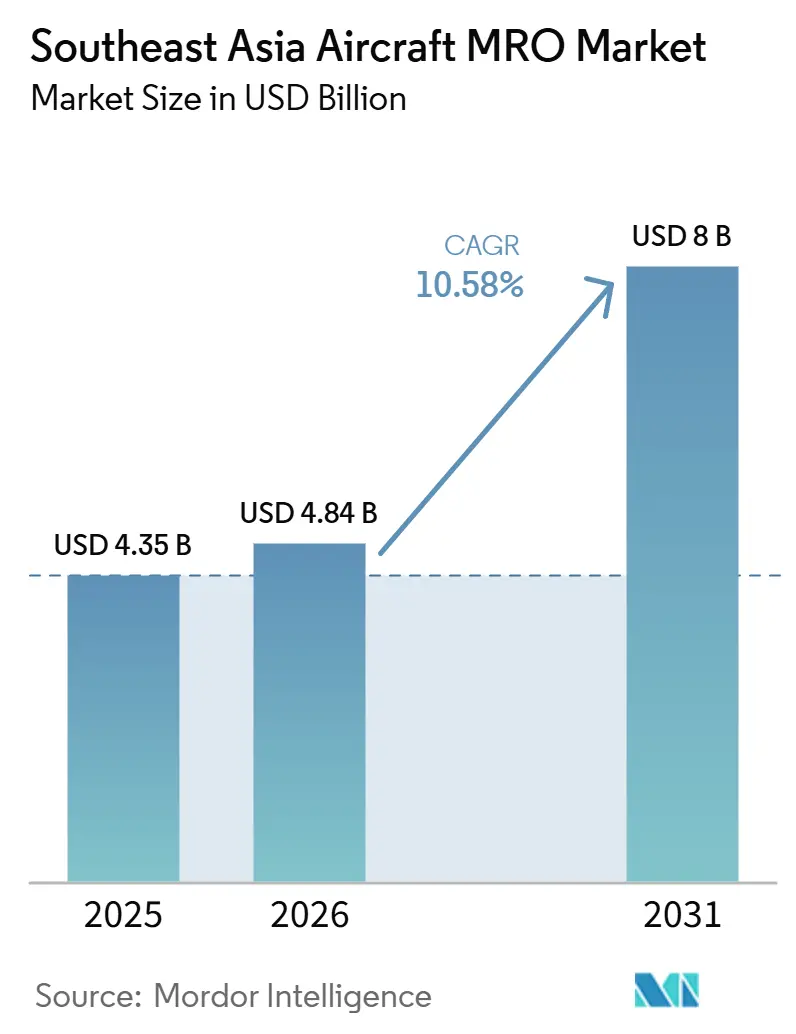
The Southeast Asia aircraft MRO market size is expected to grow from USD 4.35 billion in 2025 to USD 4.84 billion in 2026 and is forecasted to reach USD 8.00 billion by 2031 at a 10.58% CAGR over 2026-2031. Fleet up-gauging toward LEAP-powered A320neo and B737 MAX families keeps engines in the spotlight; however, high-pressure turbine (HPT) blade shortages are forcing operators to lease spare engines for up to USD 1.2 million per month, while shop-visit turnaround times exceed 300 days. Airlines are responding by expanding in-house maintenance wings, and governments are competing with single-digit tax regimes to attract fresh hangar, test-cell, and component-repair investments. Predictive analytics is another accelerant, trimming unscheduled removals by almost one-fifth and freeing scarce bay capacity. Finally, freighter conversions are adding an extra 12–18 heavy-check events per airframe, a structural tailwind that supports double-digit growth through the decade.
Key Report Takeaways
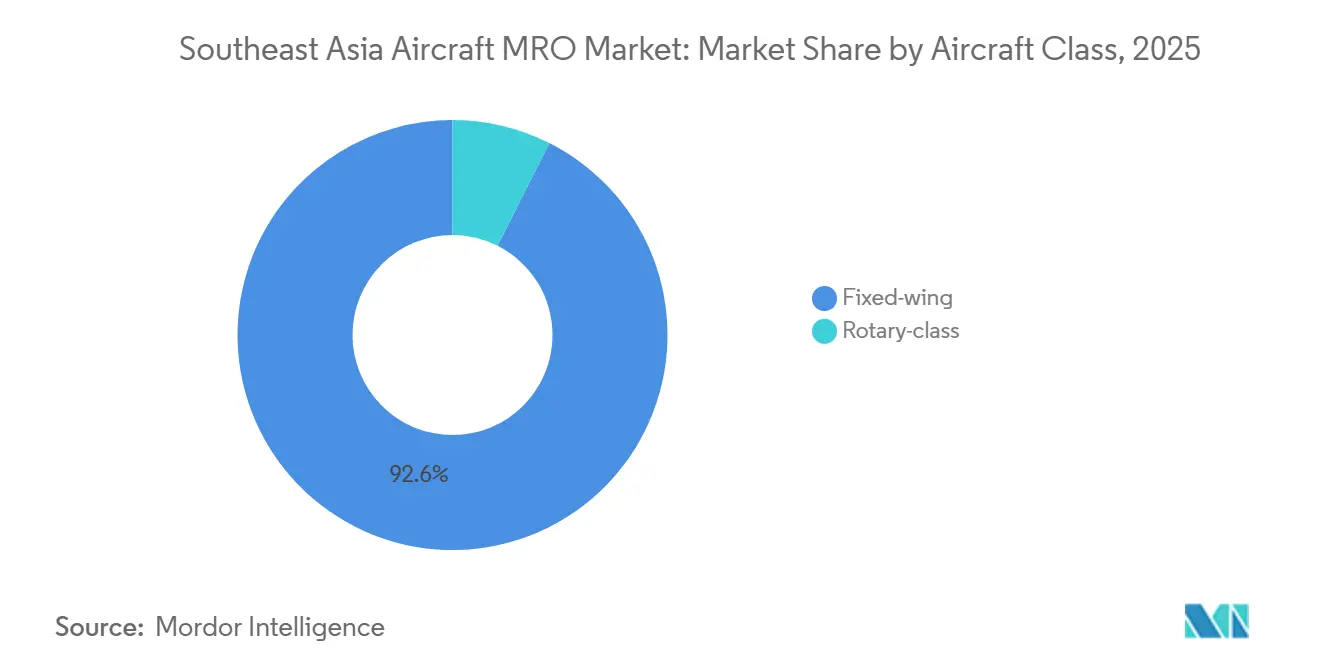
- By aircraft class, fixed-wing platforms accounted for 92.56% of the 2025 spend; rotary-wing work is forecast to grow at an 11.87% CAGR through 2031.
- By MRO type, engine work held 45.74% of the Southeast Asia aircraft MRO market share in 2025, while component repair is forecast to advance at a 12.25% CAGR through 2031.
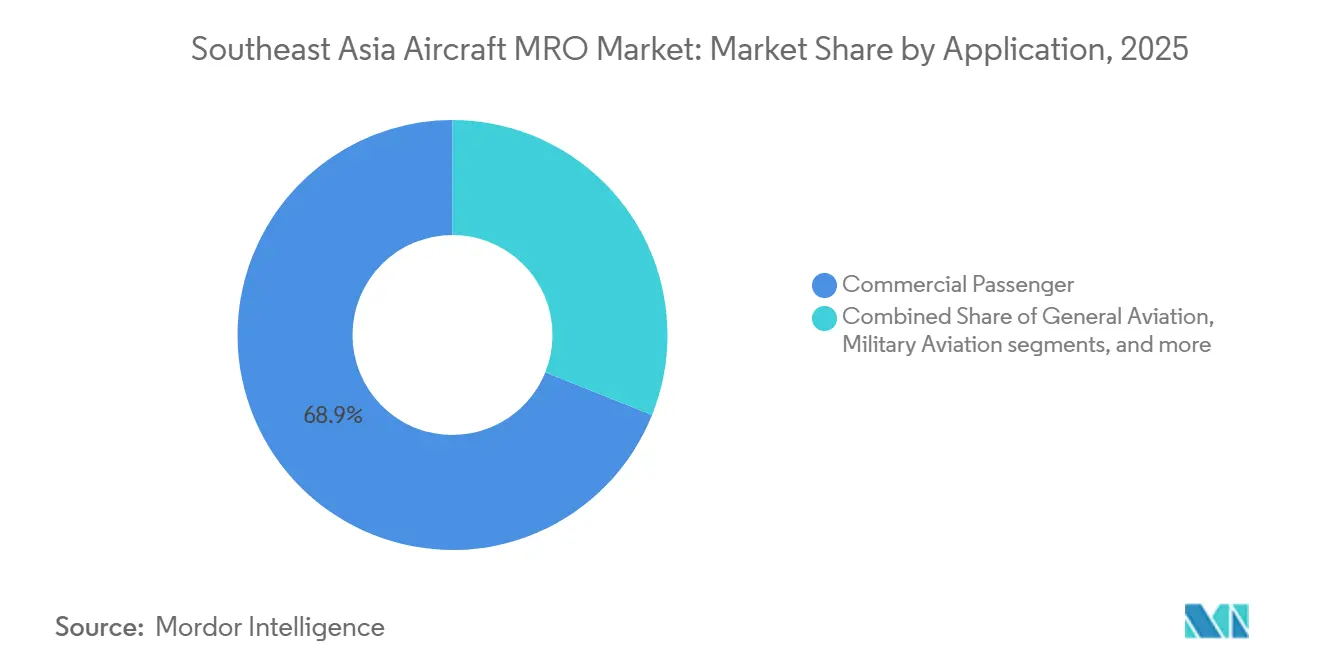
- By application, commercial passenger fleets generated 68.93% of 2025 revenue; general aviation is forecast to grow at a 12.78% CAGR through 2031, driven by expanding business-jet fleets.
- By service provider, airline-affiliated shops accounted for 53.67% of 2025 revenue, while independents are forecast to grow at a 11.65% CAGR through 2031, by focusing on component repairs and freighter conversions.
- By geography, Singapore led with 33.25% of 2025 revenue; Thailand is projected to grow at 12.11% CAGR through 2031, driven by the USD 12 billion U-Tapao Aviation City scheme.
Note: Market size and forecast figures in this report are generated using Mordor Intelligence’s proprietary estimation framework, updated with the latest available data and insights as of January 2026.
Market Trends and Insights
Drivers Impact Analysis of Southeast Asia Aircraft MRO Market*
| Driver | (~) % Impact on CAGR Forecast | Geographic Relevance | Impact Timeline |
|---|---|---|---|
| Passenger-fleet up-gauging to LEAP-powered narrowbody aircraft | +2.1% | Singapore, Malaysia, Thailand, Indonesia | Medium term (2–4 years) |
| Expansion of airline-affiliated “internal MRO” capacity to reduce third-party spend | +1.8% | Singapore, Indonesia, Thailand | Short term (≤ 2 years) |
| Digital-twin and predictive-maintenance ROI exceeding 15% on turnaround times | +1.5% | Early adoption in Singapore and Malaysia | Medium term (2–4 years) |
| Singapore-Malaysia cross-border tax incentives for engine-test-cell investment | +1.3% | Singapore, Malaysia | Long term (≥ 4 years) |
| OEM “open-ecosystem” programs (CFM, Pratt & Whitney) certifying new SEA independents | +1.2% | Thailand, Vietnam, Philippines | Medium term (2–4 years) |
| Up-cycle in freighter conversions driving heavy-check volumes | +1.4% | Singapore, Indonesia, Thailand | Short term (≤ 2 years) |
| Source: Mordor Intelligence | |||
Passenger-Fleet Up-Gauging to LEAP-Powered Narrow-Bodies
Carriers across the region are accelerating the switch from CFM56 and V2500 engines to LEAP-1A and LEAP-1B units, banking on 15% lower fuel burn and lower carbon intensity. GE Aerospace is spending USD 75 million to double LEAP maintenance throughput in Malaysia and Singapore and to install two new test cells by 2027.[1] ST Engineering obtained the first independent LEAP certification in Southeast Asia, positioning Seletar as a neutral hub for more than 500 annual shop visits. While the upgrade improves efficiency, the unique CMC liner, fine-mesh fuel nozzles, and additional borescope ports require specialized tooling and 18–24 months of technician retraining. CFM’s durability enhancement kit, certified in 2024, extends on-wing time by 2,000 cycles but obliges operators to adopt digital twins to monitor blade-cooling margins.
Expansion of Airline-Affiliated Internal MRO Capacity
Currency swings, particularly the IDR currency's 7% decline against the USD in 2025, prompted carriers to reclaim component and line maintenance to mitigate exposure. GMF AeroAsia's USD 1.50 billion plan will include adding four hangars at Soekarno-Hatta and a 24/7 component shop in Kertajati by 2030. Thai Airways is collaborating with Airbus to establish a widebody maintenance depot within U-Tapao Aviation City, aiming to capture one-fifth of regional revenue by 2028. SIA Engineering lifted quarterly revenue 12% year-on-year to SGD 325.50 million (USD 252.91 million) in FY2024/25 by shifting A350 and B787 checks in-house. The trend squeezes independents on narrow-body slots, yet frees up space in widebody and freighter conversions where airline shops lack the necessary tooling depth.
Digital-Twin and Predictive-Maintenance ROI
Predictive analytics trims unscheduled removals by roughly one-fifth and shortens shop visits. ST Engineering’s digital-twin platform handles 80,000 components annually and has reduced the turnaround time for landing-gear actuators and APUs by 15%. IATA projects that AI-driven planning could save the global sector USD 5 billion annually by 2030, with Southeast Asia capturing 12% of the savings, thanks to high daily utilization fleets.[2] Rolls-Royce’s IntelligentEngine collates 12,000 flight-hour data points per Trent engine to predict blade erosion six months ahead, allowing pre-emptive parts ordering that reduces HPT-blade lead times by 25%. Widebody and freighter fleets reap the most significant benefit because each day of downtime can cost USD 150,000.
Singapore-Malaysia Cross-Border Tax Incentives
The Johor–Singapore Special Economic Zone, which opened in January 2025, offers a 5% corporate tax rate and a 15% personal income tax rate on aerospace investments exceeding SGD 100 million (USD 77.70 million). GE Aerospace is leveraging the framework to split labor-intensive LEAP test-cell work between low-cost Johor and high-velocity Singapore logistics. Pratt & Whitney added a GTF line at its Singapore Engine Centre in 2025, supported by SGD 50 million (USD 38.85 million) in grants tied to the zone’s workforce program. Lower landed costs for tooling down 8-10% make the corridor the world’s most cost-efficient LEAP and GTF maintenance location outside North America.
Restraints Impact Analysis of Southeast Asia Aircraft MRO Market*
| Restraint | (~) % Impact on CAGR Forecast | Geographic Relevance | Impact Timeline |
|---|---|---|---|
| Long-cycle labor shortages for LEAP/GTF borescope-rated technicians | –1.6% | Thailand, Vietnam, Philippines; spill-over across the region | Medium term (2–4 years) |
| Supply-chain bottlenecks in HPT blades extending TAT for more than 300 days | –1.9% | Singapore and Malaysia engine shops | Short term (≤ 2 years) |
| Currency-linked cost pressure on imported spare parts | –0.9% | Indonesia, Thailand, Philippines, Vietnam | Short term (≤ 2 years) |
| Rising sustainability compliance costs for chromium-free strip and paint processes | –0.7% | Singapore, Malaysia, Thailand | Long term (≥ 4 years) |
| Source: Mordor Intelligence | |||
Long-Cycle Labor Shortages for LEAP/GTF Technicians
Borescope-rated technician roles shrank 12% during the pandemic and have yet to recover. Training a fresh recruit to LEAP or GTF standard takes roughly two years, and certification queues at national regulators add another six to nine months. Pratt & Whitney’s powder-metal recall grounded an average of 350 aircraft during 2025-26, resulting in 1,200 unplanned shop visits and exhausting available talent. The Asian Development Bank warns that the region must add 15,000 technicians by 2030 to keep up with fleet growth. ST Engineering’s 2024 apprenticeship scheme aims to train 500 LEAP-certified staff by 2027, but attrition rates exceed 15% as experienced staff migrate to higher-paying Middle East jobs.
HPT-Blade Supply Bottlenecks
Only three global suppliers produce single-crystal HPT blades for the LEAP engine family, and capacity has not kept pace with the 20% annual growth in LEAP deliveries. Airbus reduced A320neo production in May 2024 as a direct result, and MRO turnaround times increased to 300 days for carriers awaiting replacement modules. Safran released a life-extended blade in 2025; however, the upgraded casting sequence still requires 14 months from raw alloy to finished part.[3] GE Aerospace is adding a reclamation line in Malaysia that will refurbish 30% of used LEAP blades by 2027, easing but not eliminating the crunch.
*Our forecasts treat driver/restraint impacts as directional, not additive. The impact forecasts reflect baseline growth, mix effects, and variable interactions.
Southeast Asia Aircraft MRO Market Segment Analysis
By Aircraft Class:
Rotary Wing Gains AltitudeFixed-wing aircraft still dominated revenue, accounting for 92.56% in 2025; however, helicopter maintenance is growing at an annual rate of 11.87%, a clear outlier within the Southeast Asia aircraft MRO market. Weststar Aviation’s tie-up with Leonardo will create Malaysia’s first regional center capable of supporting 200 AW139, AW169, and AW189 heavy checks annually by 2028. Bell’s Asia Service Center in Singapore expanded to 15,500 square meters and completed 180 helicopter overhauls in 2025.[4] Growth drivers include offshore energy demand, medical evacuation services, and a rising need for search-and-rescue (SAR) readiness. Safran Helicopter Engines processed 320 Arriel and Makila shop visits in 2025, up 14% year-on-year. Meanwhile, Sikorsky and its local partner, MyCopter, opened an S-76 support center in Malaysia in 2024, ensuring 72-hour engine-swap availability for offshore operators. The Southeast Asia aircraft MRO market size for rotary-wing assets is therefore expected to become material well before 2031.
By MRO Type:
Component Repairs Outpace Engine WorkComponent services are projected to grow at a 12.25% CAGR through 2031, outpacing engines, even though engines accounted for 45.74% of 2025 spend in the Southeast Asia aircraft MRO market. Digital twins trigger part replacements at the first sign of abnormal vibration or thermal stress, cutting AOG events by roughly one-quarter and shifting revenue toward avionics, landing-gear, and APU shops. ST Engineering now processes 80,000 parts across 23,500 part numbers annually and maintains a USD 300 million rotable inventory to uphold its 48-hour turnaround promise.
Predictive maintenance favors smaller work scopes performed more often, a pattern that keeps bays busy but with shorter dwell times. Asia Pacific Aircraft Component Services, a joint venture between SIA Engineering and SR Technics, became a Honeywell channel partner in 2024 and is scaling a 600-part-number facility in Malaysia. GMF AeroAsia entered the APU market in 2025 under a Honeywell agreement, targeting 150 visits per year by 2027. As a result, the Southeast Asia aircraft MRO market size for component work is projected to expand faster than any other service line over the forecast period.
By Application:
General Aviation Climbs FastestCommercial passenger carriers generated 68.93% of 2025 revenue, but business-jet maintenance is the speed leader, with a 12.78% CAGR in the Southeast Asia aircraft MRO market. Jet Aviation Singapore became the only Airbus Corporate Jets service center between Dubai and Sydney in March 2025, to perform 30 ACJ heavy checks annually. StandardAero’s facilities in Singapore and Indonesia handled 140 Honeywell and P&WC engine shop visits in 2025.
On the cargo side, freighter MRO is rising 11.4% annually on e-commerce momentum and Boeing’s forecast for 1,430 regional freighters by 2043. Military MRO is driven by events such as Singapore's upgrade of its F-16 fleet under a USD 1.09 billion package with Lockheed Martin. These mixed applications help cushion the Southeast Asia aircraft MRO market against airline-specific cycles.
By Service Provider:
Independents Narrow the GapAirline-owned shops accounted for 53.67% of 2025 revenue, while independents are advancing at an 11.65% CAGR, significantly outpacing the overall Southeast Asia aircraft MRO market. GMF AeroAsia serves external operators such as Thai Vietjet and Cebu Pacific, while Thai Airways is building a joint venture with Airbus to secure widebody work. Independents gain ground by offering flexible pricing and faster turnarounds. ST Engineering’s component network averages 15% shorter turn times, thanks to its deep parts pools.
AAR CORP.’s 2024 deal with Thai Airways brings component distribution and landing-gear overhaul to Suvarnabhumi Airport, aiming for 250 shop visits a year by 2027. OEM-captive facilities, Safran’s LEAP and Rolls-Royce’s Trent centers, account for 18% of spend and are scaling to protect engine aftermarket margins. Military depots make up the balance, concentrated in Singapore and Indonesia.
Geography Analysis
Singapore Aircraft MRO Market
Singapore remains the anchor of the Southeast Asia aircraft MRO market, with 33.25% of 2025 revenue. The island’s 190 MRO companies employ 19,500 people and benefit from a well-oiled logistics chain at Changi Airport.[5] ST Engineering’s SGD 1 billion (USD 0.78 billion) Seletar expansion added three hangars and the region’s first independent LEAP lines in 2024. Rolls-Royce expanded its Trent shop to handle 80 Trent 7000 and XWB visits per year, while Pratt & Whitney added a dedicated GTF line backed by SGD 50 million (approximately USD 38.85 million) in grants.
Thailand Aircraft MRO Market
Thailand is the fastest riser, expanding at a 12.11% CAGR through 2031. The USD 12 billion U-Tapao Aviation City scheme offers an eight-year corporate tax holiday, plus duty-free spare part imports, attracting an Airbus-Thai Airways joint venture targeting one-fifth of the regional heavy-check volume by 2028. AAR CORP. invested USD 18 million in a 12,000 square meters component center at Suvarnabhumi, and Safran is scouting Rayong for a LEAP blade-repair plant.
APAC Aircraft MRO Market
Indonesia holds 22% of 2025 revenue thanks to GMF AeroAsia’s massive facilities near Jakarta and the nascent Kertajati Aerospace Park in West Java. Malaysia, the Philippines, and Vietnam together account for 18% of the spend. Weststar-Leonardo’s Melaka helicopter hub and GE Aerospace’s Johor test cells underscore Malaysia’s tilt toward rotary-wing and engine specialization. Lufthansa Technik’s Philippine arm added avionics and landing-gear work in 2024, while Vietnam is courting OEM licenses under an industrial park model.
Regulatory Landscape
Aircraft MRO oversight in Southeast Asia is administered through national civil aviation authorities, with approval frameworks centered on maintenance-organization certification and continuing-airworthiness controls. Singapore’s Civil Aviation Authority of Singapore (CAAS) regulates Approved Maintenance Organisations under SAR-145 and reinforces cross-border acceptance through bilateral maintenance arrangements, including a Singapore-USA Maintenance Implementation Procedures framework that supports reciprocal recognition under defined conditions. In 2026, CAAS updated guidance tied to SAR-145 application and aircraft-type listings (AC 145-20 and AC 145-19), indicating continued tightening around documentation and scope clarity for approved shops.
Across the region, compliance requirements stay sovereign and documentation-heavy: Malaysia’s Civil Aviation Authority of Malaysia (CAAM) applies CAD 8601 (CAAM Part 145) alongside continuing-airworthiness requirements under Part M; Thailand’s Civil Aviation Authority of Thailand (CAAT) certifies repair stations under TCAR 8 Part 145; and the Philippines’ Civil Aviation Authority of the Philippines (CAAP) issued NPRM-003-2025 in July 2025 proposing amendments to PCAR Part 9 on authority to perform and approve maintenance, overhaul, and modifications. Vietnam’s framework is administered under the Civil Aviation Authority of Vietnam (CAAV) through its published aviation safety regulations, which affects how quickly new entrants can secure the approvals needed to service international operators and lease-return work.
Value Chain Analysis
The Southeast Asia aircraft MRO value chain spans OEM design authority and parts provisioning (GE Aerospace, Rolls-Royce, Safran, Collins Aerospace), to operators and CAMO functions that schedule maintenance, and then to execution by airline-affiliated shops (SIA Engineering Company, GMF AeroAsia, Asia Digital Engineering) and independent MROs focused on components, structures, and conversions. Singapore sits at the center of the regional flow due to its dense ecosystem and logistics connectivity, while Malaysia and Thailand are expanding industrial zones and airport-linked parks that feed hangar capacity, tooling, and specialized component work.
Upstream constraints concentrate in high-value engine and critical component inputs, where shortages and long lead times elevate AOG risk and stretch shop planning, which then increases demand for rotable pools, OEM-licensed repair schemes, and distribution partners. Midstream, capability build-outs and OEM partnerships increasingly shape where work is performed. For instance, component and systems players are adding footprint in Malaysia, including the June 2026 Collins Aerospace expansion at Subang Aerotech Park (US$63 million) to scale advanced component maintenance. Downstream, airlines and lessors influence standards through reliability targets, lease redelivery conditions, and documentation requirements, pushing MROs to invest in digital workflow, predictive maintenance, and compliance systems that shorten turnaround time while preserving traceability.
Competitive Landscape
The Southeast Asia aircraft MRO market exhibits moderate concentration: the top five players, ST Engineering, SIA Engineering, GMF AeroAsia, Safran, and Rolls-Royce, command 58% of 2025 revenue. Airline-affiliated shops dominate narrowbody line checks, yet independents and OEMs are neck-and-neck in high-value engine and component niches. GE Aerospace’s USD 75 million outlay will double LEAP capacity across Malaysia and Singapore. At the same time, Pratt & Whitney’s GTF upgrade in Seletar preserves OEM control over an engine that already powers 170 aircraft in the region.
Technology is the chief differentiator. ST Engineering’s digital-twin system slashed the average component turnaround time by 15% and carved out an early lead in predictive analytics. Rolls-Royce’s IntelligentEngine, which has been operational since 2024, predicts blade wear six months in advance, providing Trent operators with a scheduling advantage. Smaller challengers, such as Asia Digital Engineering and Subang MRO, and a growing cluster in Vietnam, target the turboprop, business-jet, and helicopter niches to avoid head-to-head battles with Singapore’s giants.
Regulatory hurdles are material. Dual FAA and EASA Part-145 approvals can take up to two years, slowing market entry for shops in Vietnam and the Philippines. Conversely, Singapore and Malaysia attract investors with a 5% corporate tax rate and accelerated permit processing within their special economic zones, reinforcing their hub status.
Southeast Asia Aircraft MRO Industry Leaders
-
Safran SA
-
SIA Engineering Company
-
Singapore Technologies Engineering Ltd.
-
Rolls-Royce Holdings plc
-
PT GMF AeroAsia Tbk (Garuda Indonesia)
- *Disclaimer: Major Players sorted in no particular order
Southeast Asia Aircraft MRO Market Companies Covered in this Report
- Singapore Technologies Engineering Ltd.
- SIA Engineering Company
- Singapore Aero Engine Services Private Limited
- StandardAero, Inc.
- PT GMF AeroAsia Tbk (Garuda Indonesia)
- Triumph Group
- Safran SA
- Rolls-Royce Holdings plc
- ExecuJet MRO Services (Dassault Aviation SA)
- AVIA SOLUTIONS GROUP PLC
- Subang MRO Sdn Bhd
- Asia Digital Engineering Sdn Bhd
- Sepang Aircraft Engineering Sdn Bhd
- Asia AeroTechnic Sdn Bhd
- AAR CORP.
- Textron Inc.
- Lufthansa Technik AG
Market Opportunities and Future Outlook
Engine and component capacity additions remain a visible whitespace area as fleets shift toward next-generation narrowbody engines, while parts availability and labor constraints extend turnaround times. In 2026, SIA Engineering Company confirmed progress on additional hangar capacity in Singapore, and Malaysia added new base-maintenance throughput at Subang, including MAB Engineering commencing operations at a new Hangar 4 that doubled its capacity at the location. These developments support opportunities for third-party maintenance capture beyond airline-owned networks, especially where shops can offer faster induction, deeper rotable inventories, and OEM-aligned repair approvals.
New-build facilities and joint ventures are also shifting the competitive map toward multi-country networks that can absorb overflow and balance labor costs with logistics access. A major 2026 proof point is HAECO Group forming a joint venture with Sun Group, Toyota Tsusho, and Japan Airlines to develop a US$360 million maintenance facility at Van Don International Airport in Vietnam. This signals rising investor confidence in Vietnam as a maintenance location and creates openings for suppliers of tooling, training, parts distribution, and digital MRO systems. With predictive maintenance and digital-twin use uneven across the region, providers that industrialize data-driven planning and component health monitoring, while meeting national Part-145-style approval requirements, have an execution-led path to win work from high-utilization fleets and from operators seeking shorter ground time.
Recent Industry Developments in Southeast Asia Aircraft MRO Market
- June 2026: SIA Engineering Company and Safran Aircraft Engines formed a joint venture to establish a CFM LEAP engine maintenance, repair, and overhaul shop in Singapore, with a reported US$118 million investment and shareholding split favoring Safran. The move adds dedicated LEAP capacity in the region and reinforces Singapore’s position as a neutral engine hub for carriers operating A320neo and 737 MAX families.
- May 2026: SIA Engineering Company officially opened Base Maintenance Malaysia Sdn. Bhd. at Sultan Abdul Aziz Shah Airport (Subang), Malaysia, with a two-hangar facility designed to handle multiple concurrent aircraft checks. The added bays expand regional heavy maintenance throughput and gives airlines an alternative footprint outside Singapore for scheduled base work.
- September 2024: Capital A and GMF AeroAsia launched a joint venture backed by a US$12 million investment to build out landing gear MRO services. The partnership targets a high-value component niche that is sensitive to turnaround time and certification depth, improving local repair availability and reducing dependence on long-haul shipping for overhauls.
Southeast Asia Aircraft MRO Market Report Scope and Research Methodology
Market Definition and Coverage
For this study, the Southeast Asia aircraft MRO market is defined as the revenue earned from maintenance, repair, and overhaul work performed on aircraft operated in Southeast Asia, covering scheduled checks, unscheduled events, and component and engine work that keeps fleets airworthy.
Scope exclusions: We exclude new aircraft manufacturing and sales, airport ground handling, and pure pilot training services that do not directly generate MRO service revenue.
Segments Covered in This Report
- By Aircraft Class
- Fixed-wing
- Rotary-wing
- By MRO Type
- Airframe Heavy Maintenance
- Engine Maintenance
- Component Maintenance
- Line and Routine Checks
- Modifications and Upgrades
- By Application
- Commercial Passenger
- Commercial Cargo/Freighter
- Military Aviation
- General Aviation
- By Service Provider
- Airline-affiliated MRO
- Independent Third-party MRO
- OEM-Captive MRO
- Military Depots
- By Geography
- Malaysia
- Indonesia
- Singapore
- Thailand
- Philippines
- Vietnam
Data Sources, Market Sizing, and Validation
Desk Research
Desk research was used to set the factual base around fleet size, utilization, and maintenance rules that drive MRO demand in Southeast Asia. We referenced public aviation statistics and safety guidance from sources such as ICAO, IATA publications that are openly shared, civil aviation authority portals in the region, and accident and airworthiness updates shared by regulators and investigation bodies.
To translate activity into value, we also reviewed aircraft delivery and fleet outlook material such as OEM public forecast decks, customs and trade statistics for aircraft parts where relevant, and reputable association sites that track aviation services. Company filings, investor presentations, and press releases were reviewed to understand maintenance capacity additions, hangar utilization directionally, and typical service mix changes. In addition, paid subscriptions for aircraft level and engine level aviation databases, along with patent databases, were used to validate platform counts and technology adoption signals. These sources are illustrative only, and many other references were also used for data collection, cross-checks, and clarification.
Primary Interviews and Surveys
Primary work focused on discussions with airline engineering teams, independent MRO operators, component repair specialists, lessors, and parts distributors, so assumptions on check cycles, outsourcing rates, and pricing could be adjusted to real operating conditions. Because this is a regional market, inputs were balanced across major Southeast Asian hubs and emerging maintenance bases, to avoid over-weighting any single country's capacity expansion pace or labor cost structure.
Distribution of primary research fieldwork respondents
| Company type | Respondent position |
|---|---|
| Top tier: 31% | CXOs: 14% |
| Mid tier: 55% | Functional/Unit leaders: 32% |
| Smaller Players: 14% | Managers: 54% |
Market-Sizing & Forecasting
Market sizing was built using a top-down demand reconstruction, where active fleet by aircraft class and utilization patterns were converted into expected maintenance events, which were then valued using typical labor hours and parts intensity for common checks. Once the demand pool was formed, it was split by how work is typically executed in the region, including in-house versus outsourced maintenance, and cross-border heavy check flows.
Inputs treated as key drivers included commercial and military fleet counts in Southeast Asia, annual flight hours and cycles, the share of narrowbody aircraft in active service, heavy check timing (C and D checks), and engine shop visit frequency proxies. Pricing logic used blended service rate movement and parts content assumptions, and it was stress tested through operator and MRO discussions. Forecasting relied on scenario analysis, since fleet growth, shop capacity additions, and lease return activity can vary year to year, and then the scenarios were anchored to consensus ranges heard in primary discussions.
Where bottom-up data was patchy, sampled capacity and throughput checks were used, such as hangar bay count and typical annual slots, followed by adjustments for utilization and mix. Totals were then reconciled back to the demand-based model.
Data Validation & Update Cycle
Outputs were checked against independent signals such as regional fleet growth direction, known capacity expansions, and maintenance cycle logic, and then differences were investigated before final sign-off. When an input produced a sharp jump, the assumption was revisited, and follow-up calls were triggered with relevant operator or MRO respondents to confirm whether the change was real or model-driven.
A multi-step internal review was completed so calculations, unit conversions, and country rollups were consistent across the file. The report is refreshed annually, with interim updates when major events occur, such as large fleet order changes, regulatory shifts affecting maintenance intervals, or meaningful capacity moves. Right before delivery, a final pass is completed so clients receive the most current view available.
Mordor Intelligence's Southeast Asia Aircraft MRO Market Size Versus Other Published Estimates
Published market numbers for Southeast Asia aircraft MRO can look far apart because each publisher chooses a different service scope, aircraft coverage, and pricing path over the forecast window. Some also mix adjacent aviation services, which changes the totals even if the demand story appears similar.
The main gap comes from whether military and general aviation activity is counted alongside commercial fleets, and how cross-border heavy checks are attributed. In that context, Mordor Intelligence only counts MRO revenue tied to aircraft operated in Southeast Asia and values it using check cycle and utilization driven demand before applying region-appropriate blended rates.
Benchmark comparison
| Source | Market Size | Gaps in Research Methodology |
|---|---|---|
| Mordor Intelligence | USD 4.35 B (2025) | |
| Industry Publisher A | USD 5.30 B (2024) | Uses a broader service basket and appears to apply higher blended MRO spend per aircraft, with limited visibility on how military and general aviation are separated from airline activity in the total. |
| Press Summary B | USD 6.50 B (2026) | Presents a single-point forecast that can reflect an aggressive recovery case, and the underlying assumptions on flight-hour normalization, shop visit frequency, and currency timing are not clearly shown. |
The spread in the table is mostly explained by scope and pricing choices, rather than a disagreement on regional aviation growth. By tying the build to fleet activity, maintenance event logic, and simple rate checks that can be re-tested each year, the final number stays traceable and easier to update when utilization, capacity, or check timing shifts.
Key Questions Answered in the Report
How large will maintenance spending in Southeast Asia reach by 2031?
The Southeast Asia aircraft MRO market is projected to attain USD 8.00 billion by 2031, expanding at a 10.58% CAGR.
Which service line is growing fastest in regional maintenance budgets?
Component repair leads, advancing at a 12.25% CAGR on the back of digital-twin diagnostics and expanded Honeywell-licensed shops.
Why are freighter conversions important to local MRO providers?
Each passenger-to-freighter conversion adds 12-18 heavy-check events, generating up to USD 5.50 million in incremental MRO revenue per aircraft and sustaining bay utilization.
Which country offers the most attractive fiscal terms for new engine facilities?
The Johor–Singapore Special Economic Zone (SEZ) sets a 5% corporate-tax rate and 15% personal-income tax for qualifying aerospace investments, attracting GE Aerospace and Pratt & Whitney.
How serious is the technician shortage for next-generation engines?
The region must add roughly 15,000 certified technicians by 2030 because LEAP and GTF shop-visit demand outstrips current manpower, extending turnaround times (TAT) beyond 300 days.