
Market Overview
| Study Period | 2020 - 2031 |
|---|---|
| Forecast Data Period | 2026 - 2031 |
| Historical Data Period | 2020 - 2024 |
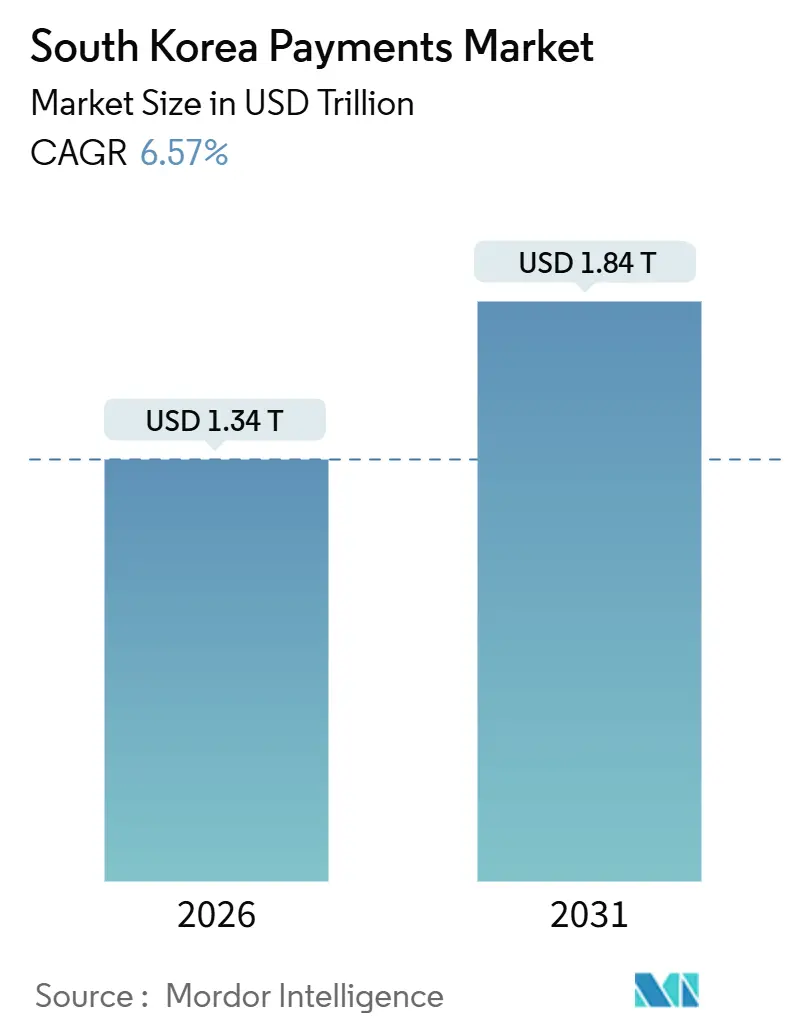
| Market Size (2026) | USD 1.34 Trillion |
| Market Size (2031) | USD 1.84 Trillion |
| Growth Rate (2026 - 2031) | 6.57 % |
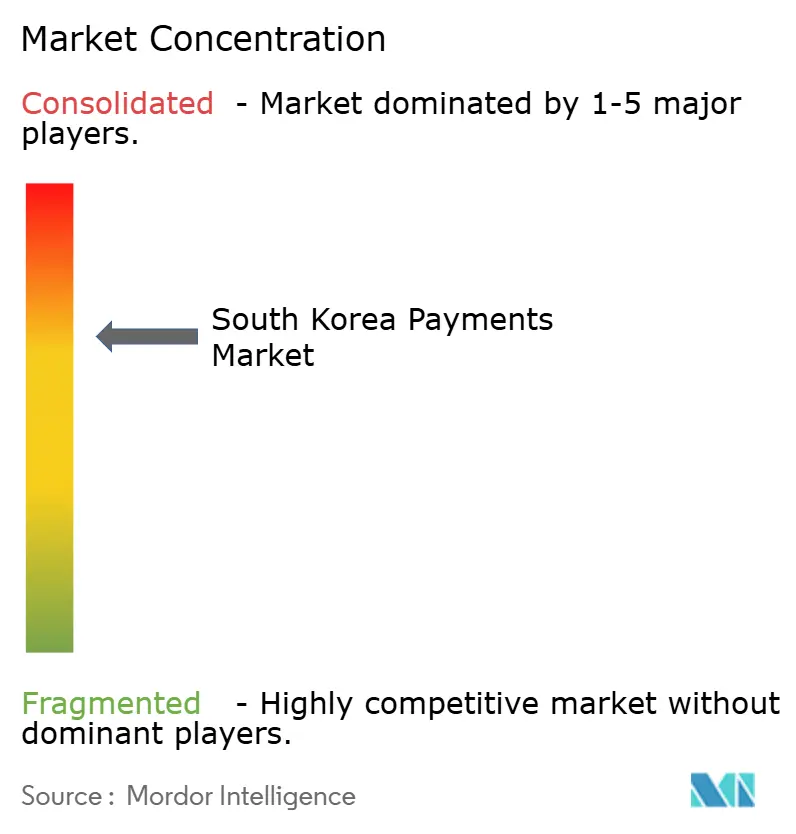
| Market Concentration | Medium |
Major Players *Disclaimer: Major Players sorted in no particular order Image © Mordor Intelligence. Reuse requires attribution under CC BY 4.0. | |
South Korea Payments Market Analysis by Mordor Intelligence
The South Korea payments market size reached USD 1.34 trillion in 2026 and is projected to climb to USD 1.84 trillion by 2031, translating into a 6.57% CAGR over the forecast period. Structural momentum favors real-time account-to-account rails, mobile wallets, and tokenized settlement networks that bypass legacy card infrastructure. Merchant take-up of QR codes, the 30 million-strong open-banking user base, and Samsung Wallet’s blockchain-backed digital identity credentials together reinforce a mobile-first consumer culture. Private-sector tokenization is also accelerating, as Naver’s planned won-pegged stablecoin ecosystem and Kakao’s parallel initiative highlight a shift away from sovereign digital-currency experiments. Meanwhile, elevated interchange fees, aging demographics in rural provinces, and high-profile deepfake fraud episodes temper the overall growth outlook for the South Korea payments market.
Key Report Takeaways
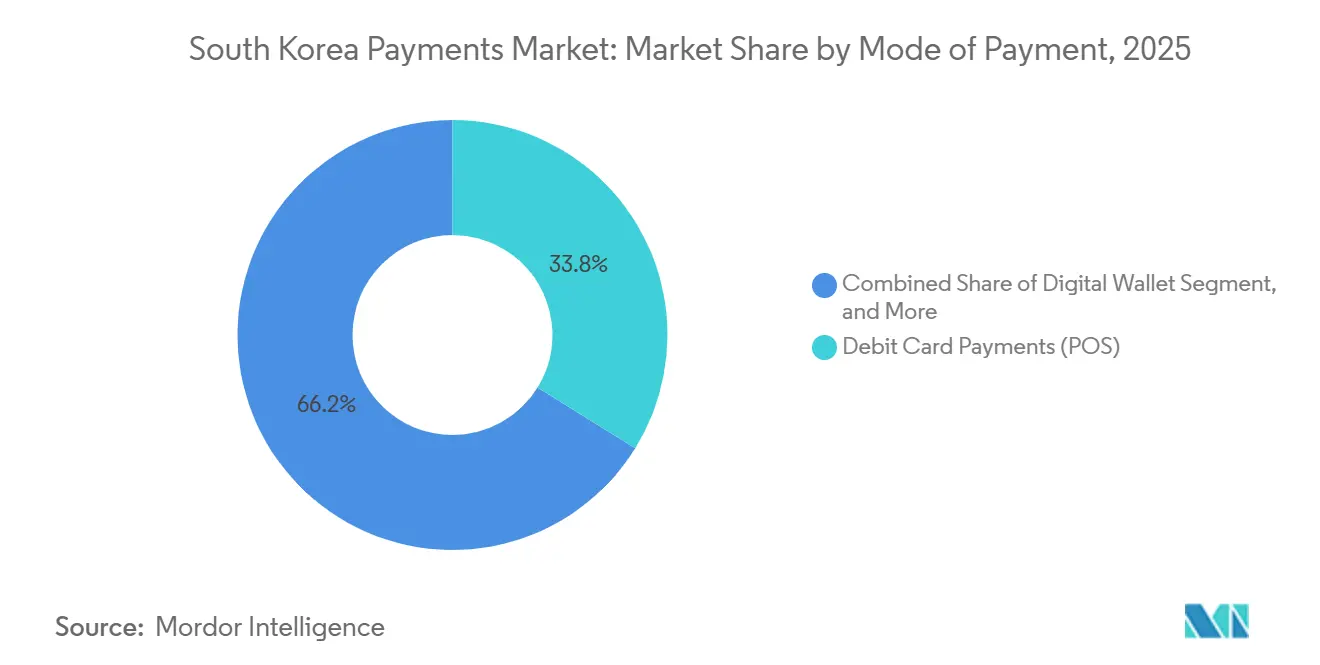
- By mode of payment, debit cards led with 33.82% of the South Korea payments market share in 2025. Digital wallets deployed online are forecast to expand at a 7.55% CAGR through 2031, the fastest pace among payment instruments.
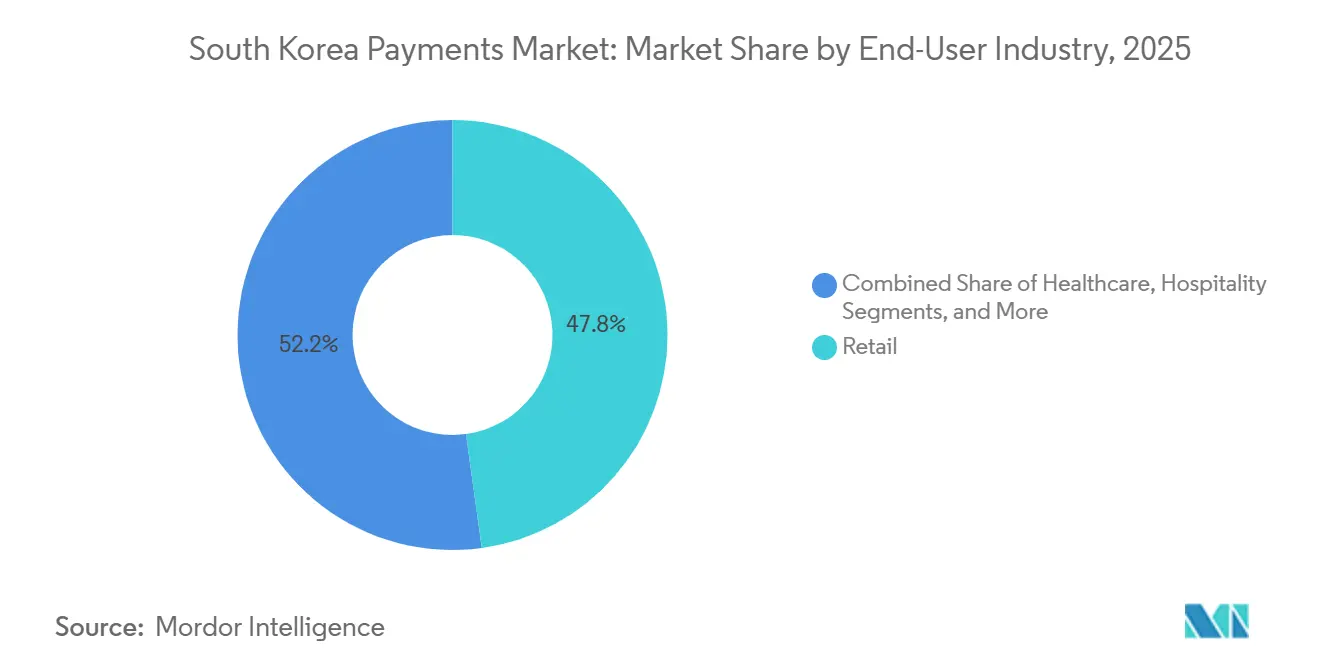
- By end-user industry, retail accounted for 47.83% of the South Korea payments market size in 2025. Healthcare payment volume is advancing at a 7.62% CAGR between 2026 and 2031, the quickest among major industries.
Note: Market size and forecast figures in this report are generated using Mordor Intelligence’s proprietary estimation framework, updated with the latest available data and insights as of January 2026.
South Korea Payments Market Trends and Insights
Drivers Impact Analysis*
| Driver | (~) % Impact on CAGR Forecast | Geographic Relevance | Impact Timeline |
|---|---|---|---|
| High proliferation of e-commerce and m-commerce | +1.8% | National, strongest in Seoul, Busan, Incheon | Short term (≤ 2 years) |
| Government digitization initiatives | +1.5% | Country-wide pilots in Seoul and Sejong | Medium term (2-4 years) |
| Growth of real-time payments and open banking | +1.2% | Urban centers nationwide | Medium term (2-4 years) |
| Rising adoption of mobile wallets and NFC | +1.0% | Led by Seoul Capital Area | Short term (≤ 2 years) |
| CBDC (Digital Won) pilot momentum | +0.6% | Wholesale pilots in major financial centers | Long term (≥ 4 years) |
| Blockchain-based corporate settlement | +0.4% | Early adoption in Seoul financial district | Long term (≥ 4 years) |
| Source: Mordor Intelligence | |||
High Proliferation of E-Commerce And M-Commerce
Mobile commerce already generates 76-79% of Korean online-retail value, a level unmatched in most OECD economies.[1] Daily simple-payment turnover reached KRW 954.5 billion (USD 715 million) during 2025 as one-click checkout became standard across Naver Shopping, Coupang, and others.[2] Kakao Pay processed KRW 167.3 trillion (USD 125 billion) in 4Q 2024 alone because its wallet lives inside KakaoTalk, creating social-commerce switching costs that card networks cannot match. Government plans to interconnect public-service portals with private fintech APIs under the Digital Platform Government blueprint lower merchant onboarding friction. Together, these forces channel transaction growth toward real-time rails that underpin the South Korea payments market.
Government Digitization Initiatives
Thirty million Koreans used open-banking services by 2024, and the MyData 2.0 rollout in 2025 granted consumers holistic control over credit, insurance, and investment data.[3] The Bank of Korea is phasing in an ISO 20022-compliant real-time gross-settlement platform that will finalize corporate transfers on central-bank money, eliminating interbank credit exposure. NH Nonghyup Bank and Hana Financial piloted cross-border ledger settlements on Partior’s blockchain in December 2025, shrinking remittance cycles from days to minutes. Blockchain-anchored digital IDs, live in Samsung Wallet since March 2025, add biometric security to card-not-present flows. Collectively, these moves upgrade the plumbing that propels the South Korea payments market toward higher real-time volume.
Growth of Real-Time Payments And Open Banking
Open-banking users equal roughly 58% of Korea’s adult population, yet they initiate just 2.3 account-to-account transfers monthly versus 6.1 card swipes. Planned instant-settlement functionality should tilt high-value B2B corridors toward bank rails that offer irrevocable finality. The nationwide QR-ATM service, launched in 2023, now lets any banking app withdraw cash from any ATM, eroding old network moats. Toss, Kakao Pay, and Naver Pay exploited open-banking APIs to move KRW 640.31 billion (USD 480 million) in foreign remittances during 2024, a 443% surge from 2022. This trajectory validates the real-time thesis that underpins long-run expansion of the South Korea payments market.
Rising Adoption of Mobile Wallets And NFC
Samsung Wallet counted 18.66 million users by 2025, moving KRW 88.6 trillion (USD 66 billion) annually, yet its magnetic-secure transmission keeps merchants from investing in NFC hardware. Apple Pay entered in 2023 but touches only KRW 2 trillion (USD 1.5 billion) a year because NFC terminals remain below 10% penetration. Terminal upgrades cost roughly KRW 200,000 (USD 150), a hurdle most merchants sidestep while Samsung Pay works on legacy equipment. The government’s blockchain ID program may reignite NFC demand in healthcare and public services where authentication rigor matters. Meanwhile, Naver Pay installations soared 186% after integrating with Samsung Pay, showing how platform alliances can scale wallet acceptance without new hardware.
Restraints Impact Analysis*
| Restraint | (~) % Impact on CAGR Forecast | Geographic Relevance | Impact Timeline |
|---|---|---|---|
| High credit-card interchange fees | -0.8% | National, acute for small and medium enterprises | Short term (≤ 2 years) |
| Cybersecurity and fraud risks | -0.6% | Metropolitan areas with high digital adoption | Short term (≤ 2 years) |
| Aging population’s payment habits | -0.4% | Rural provinces | Long term (≥ 4 years) |
| Cross-border data-transfer compliance | -0.3% | Multinational payment processors | Medium term (2-4 years) |
| Source: Mordor Intelligence | |||
High Credit-Card Interchange Fees
Merchant discount rates range from 1.5-2.5%, pressuring margins at convenience stores and quick-service restaurants. Tiered caps introduced in 2024 cut fees to 0.5% for micro-merchants under KRW 500 million turnover, yet loopholes persist for contactless and online categories. Regulatory arbitrage steers retailers toward zero-fee account-to-account QR options that sidestep card networks. BC Card’s travel card, launched in March 2025, charges a flat 1% FX markup to retain merchant loyalty without relying on interchange. Should policymakers mandate zero-fee ceilings for small tickets, card issuers may shrink rewards programs, diminishing transaction incentives and limiting the upside for the South Korea payments market.
Cybersecurity And Fraud Risks
A USD 4.1 million deepfake voice-phishing event in 2024 spurred new authentication requirements on transactions above KRW 1 million. The Virtual Asset User Protection Act broadened KYC obligations for token issuers in July 2024, but enforcement gaps surfaced when Kakao Pay transmitted user data to Alipay without explicit consent, triggering a temporary data-flow freeze. Strict data localization under the Personal Information Protection Act requires processors to host Korean records domestically, complicating cloud migrations for global gateways. Extra biometric and behavioral analytics layers add 15-20 basis points to processing costs, tightening margins for mid-tier acquirers. Such cost inflation could slow adoption among small merchants and moderate the South Korea payments market growth trajectory.
*Our forecasts treat driver/restraint impacts as directional, not additive. The impact forecasts reflect baseline growth, mix effects, and variable interactions.
Segment Analysis
By Mode of Payment: Digital Wallets Overtake Cards Online
Debit cards controlled 33.82% of point-of-sale value in 2025, anchoring habitual in-store spending patterns among salaried workers. Credit cards still dominate high-ticket travel and electronics categories thanks to installment plans and mileage perks, but their online share is slipping as one-click wallets streamline checkout. Digital wallets used in e-commerce are set to grow at a 7.55% CAGR to 2031, the swiftest among instruments, driven by tokenized credentials and biometric login that eliminate form-fill friction. Account-to-account transfers capture peer-to-peer and bill-pay use cases by leveraging the 30 million open-banking accounts. Cash on delivery remains a fallback in rural counties yet continues its steady retreat as logistics couriers embrace QR settlement. Overall, heightened convenience, loyalty integration, and cross-border reach cement wallets as the centerpiece of the South Korea payments market.
Processors now extend rails beyond borders to harness outbound tourism. KG INICIS debuted a Japan-optimized gateway in March 2025, while its December 2025 tie-up with Samsung Wallet Money lets users top up balances directly from bank accounts, bypassing card tolls. BC Card’s passport-linked QR service, live since December 2025, allows foreign visitors to pay domestically with linked overseas cards, widening merchant reach for inbound travel. Such innovations underscore how the South Korea payments market size for wallets is poised to cannibalize card-based revenue even in traditionally card-centric verticals.

By End-User Industry: Healthcare Emerges As Fastest Riser
Retail racked up 47.83% of total transaction value in 2025, underpinned by ubiquitous QR codes at convenience outlets and loyalty integrations that drive repeat footfall. Entertainment and hospitality benefit from the revival of domestic tourism, yet their expansion lags healthcare, which is on a 7.62% CAGR trajectory through 2031. Telemedicine pilots began in mid-2023 and gained ground when reimbursement schedules widened again in February 2024, spurring wallet-based copay settlements and subscription monitoring tools. The Ministry of Food and Drug Safety approved 376 software-as-a-medical-device products between 2020-2023, each requiring frictionless payment hooks for prescription delivery and data analytics subscriptions. As digital consults scale, hospitals integrate open-banking APIs to automate claim reconciliation, positioning healthcare as a pivotal contributor to the South Korea payments market.
Education and public-sector payments trail, constrained by procurement rules and legacy invoicing, yet the Digital Platform Government mandate for standardized APIs is lowering technical barriers. Stablecoins, once regulated under the forthcoming Phase 2 Digital Assets Act, could automate school-fee escrow and municipal disbursements, unlocking new flows. Consequently, healthcare’s current 7.62% CAGR marks only the foreground of broader industry diversification within the South Korea payments market.
Geography Analysis
Real-time payments adoption remains most intense in the Seoul Capital Area, where population density, 5G penetration, and NFC-enabled transit systems converge. Merchants in Gangnam and Songpa accounted for the bulk of mobile-wallet volume in 2025, reflecting high disposable income and tech affinity. Busan’s port logistics hub exhibits rising account-to-account B2B settlements as exporters embrace instant foreign-exchange quotes within open-banking dashboards. Incheon’s airport-driven hospitality sector benefits from BC Card’s passport-linked QR wallet, which captured a noticeable share of duty-free transactions during the Chuseok peak travel season. Together, the three metropolitan regions constitute the lion’s share of the South Korea payments market.
Secondary cities such as Daegu, Daejeon, and Gwangju are seeing accelerating wallet adoption as retail chains roll out standard QR code acceptance stickers, yet digital inclusion gaps persist in neighboring rural counties. Agricultural provinces in Jeolla and Gyeongsang still rely on cash-on-delivery for crop-supply purchases, although postal-bank pilots using QR-based subsidy disbursements show promise in nudging older residents toward mobile channels. The Statistics Korea projection that citizens aged 65 or older will exceed 24% of the population by 2030 underscores the necessity of geriatric-friendly UX design to maintain the South Korea payments market momentum.
Cross-border corridors also shape geographic dynamics. Outbound tourists originating from Seoul and Busan airports accounted for the largest share of KRW-denominated wallet spend in Japan and Malaysia, aided by processor partnerships that waive FX spreads. Conversely, inbound travelers from Southeast Asia increasingly leverage passport-linked QR wallets to pay in Korean won, boosting transaction counts in tourist zones from Myeong-dong to Haeundae. Regional policy coordination on stablecoin redemption guarantees could further blur domestic and cross-border boundaries, reinforcing geographic diversification inside the South Korea payments market.
Regulatory Landscape
South Korea regulates payments primarily through the Electronic Financial Transactions Act (EFTA), administered by the Financial Services Commission (FSC) and enforced alongside the Financial Supervisory Service (FSS), covering licensing and conduct requirements for funds transfer, prepaid/e-money, and payment gateway (PG) services. After legislative reforms finalized in December 2025, the FSC issued an advance notice in June 2026 proposing amendments to the EFTA Enforcement Decree and supervisory regulations to operationalize tighter controls on PG settlement flows. These changes include higher entry thresholds, such as KRW 2 billion minimum capital for PG operators exceeding KRW 30 billion in quarterly transaction volume.
Consumer-protection obligations for digital commerce platforms also tightened in 2026. The amended Act on Consumer Protection in Electronic Commerce (Law No. 21312) entered into force on July 21, 2026, adding platform accountability and requirements such as appointing a Korea-based representative for qualifying foreign e-commerce businesses. Separately, the revised EFTA is scheduled to take effect on December 17, 2026, mandating external management of 100% of unsettled PG funds. This raises compliance costs but reduces customer-fund commingling risk for wallet and checkout intermediaries.
Value Chain Analysis
The South Korea payments value chain begins with consumers and merchants using card rails, account-to-account transfers via open-banking-connected banks, and super-app wallets (Kakao Pay, Naver Pay, Samsung Pay, Toss). Payment gateways and processors such as NICE Payments, KG INICIS, NHN KCP, and Toss Payments support merchant onboarding, routing, risk controls, and settlement, while banks and card issuers provide accounts, credit lines, and authentication. Settlement is anchored by Bank of Korea infrastructure (BOK-Wire+ for large-value and retail settlement), alongside experimentation in tokenized settlement, including the Bank of Korea's Project Hangang, which entered Phase 2 in March 2026 and broadened toward real-transaction testing with nine banks starting in September 2026.
Distribution and access are shaped by licensing, data, and localization constraints. Foreign operators generally need Korean business registration and typically route through a licensed Korean PG rather than direct acquiring, while data residency requirements keep financial data on Korea-located servers and shape cloud architecture and vendor selection. Near-term bottlenecks center on working capital and governance around settlement floats. With the revised EFTA requiring PGs to externally manage 100% of unsettled funds (effective December 17, 2026) and raising capital requirements for higher-volume PGs, scale advantages shift toward better-capitalized processors, increasing the value of bank partnerships and segregated-funds operations.
Competitive Landscape
NICE Payments held most of the value-added-network throughput as of December 2024, servicing 1.16 million merchants and anchoring fee-based middleware for acquirers. Fintech challengers remain fragmented as Kakao Pay leverages 47 million messaging users, Naver Pay thrives on search and e-commerce traffic, Toss capitalizes on millennial budgeting tools, and Samsung Pay continues to ride handset pre-installs. Each platform courts distinct demographics, generating healthy rivalry that sustains user-centric innovation in the South Korea payments market.
Strategy is tilting toward vertical integration. Kakao Pay’s failed July 2025 bid for SSG Pay and Smile Pay sought to fold checkout data into its advertising flywheel. Naver’s January 2026 purchase of Dunamu earmarks KRW 10 trillion for building a won-pegged stablecoin backed by high-quality reserves, betting that programmable money will capture B2B escrow and royalty-split functions now underserved by card networks. NH Nonghyup Bank’s Partior pilot and Hana Financial’s Dunamu partnership show incumbents hedging against fintech encroachment through distributed-ledger experimentation.
Infrastructure gaps create openings for alliances. Only 10% of point-of-sale terminals support NFC, so Apple Pay relies on Shinhan Card’s June 2025 issuer approval but remains volume-constrained. This bottleneck primes account-to-account instant rails to siphon low-value spend, particularly after the Financial Services Commission hinted at a zero-fee model for micro-merchants. As interchange economics shift, participants pursue fee diversification via foreign-exchange markups, data-analytics subscriptions, and embedded lending. These maneuvers collectively reinforce medium-level rivalry, keeping the South Korea payments market in a dynamic equilibrium.
South Korea Payments Industry Leaders
-
Visa Inc.
-
American Express Company
-
Naver Financial Corp. (Naver Pay)
-
Samsung Electronics Co., Ltd. (Samsung Pay)
-
Toss Payments Co., Ltd.
- *Disclaimer: Major Players sorted in no particular order
Market Opportunities and Future Outlook
Programmable-money rails are creating payment workflows beyond card and wallet checkout, particularly for public-sector disbursements and bank-to-bank transfers. The Bank of Korea's Project Hangang moved into Phase 2 in March 2026 and expanded in July 2026 to include nine banks, with live-transaction testing beginning in September 2026. The testing includes bank-issued deposit tokens for peer-to-peer transfers and government subsidy payment flows, providing a concrete path for banks, fintechs, and processors to build token-compatible payout, reconciliation, and merchant-collection modules alongside existing open-banking transfers.
Compliance-driven restructuring of settlement operations also stands out, especially for PGs serving e-commerce marketplaces and high-volume merchants. The FSC's implementation push for the revised Electronic Financial Transactions Act, including the December 17, 2026 requirement for PGs to externally manage 100% of unsettled funds and higher capital thresholds (KRW 2 billion for larger-volume PGs), increases demand for escrow-like structures, segregated accounts, and more detailed settlement reporting. Providers that can bundle fund safeguarding, fraud controls, and localized hosting into merchant-facing offerings may benefit as platforms adapt to tighter consumer-protection requirements, including the July 21, 2026 amendments to the Act on Consumer Protection in Electronic Commerce that add platform accountability and require a Korea-based representative for qualifying foreign sellers.
Recent Industry Developments
- July 2026: The Bank of Korea expanded Project Hangang and outlined real-transaction testing with nine commercial banks beginning in September 2026. The pilot's focus on bank-issued deposit tokens for peer-to-peer and government subsidy payment flows accelerates infrastructure readiness for tokenized settlement in mainstream banking channels.
- February 2026: Samsung Wallet added support for American Express cards in South Korea, enabling broader overseas contactless payment capability for users with Samsung Card-issued Amex. The integration strengthens Samsung Wallet's role in travel-linked spend while deepening interoperability with global card networks.
- July 2024: The Virtual Asset User Protection Act broadened KYC and user-protection obligations for token and virtual-asset related services. The tighter compliance baseline influences how payment platforms structure onboarding, monitoring, and customer-fund controls when extending into tokenized payment or settlement use cases.
Research Methodology Framework and Report Scope
Market Definition and Coverage
For this study, the South Korea payments market is defined as the total value of consumer and merchant payments completed in the country across in-store and online channels, split by payment mode and by end-use industries.
Scope exclusions: We exclude cross-border payment flows booked outside South Korea, crypto-asset transfers, and pure lending products that do not result in a payment transaction.
Segmentation Overview
- By Mode of Payment
- Point of Sale
- Debit Card Payments
- Credit Card Payments
- Account-to-Account (A2A) Payments
- Digital Wallet
- Cash
- Other Point-of-Sale Payment Modes
- Online Sale
- Debit Card Payments
- Credit Card Payments
- Account-to-Account (A2A) Payments
- Digital Wallet
- Cash-on-Delivery
- Other Online-Sales Payment Modes
- Point of Sale
- By End-User Industry
- Retail
- Entertainment
- Hospitality
- Healthcare
- Other End-User Industries
Data Sources, Market Sizing, and Validation
Desk Research
Desk research was used to build the market boundary, compile the starting time series, and set realistic ranges for key payment behaviors. We relied on public data sources such as Bank of Korea statistics, Financial Supervisory Service disclosures, Statistics Korea (KOSTAT) household and retail indicators, Korea Customs Service trade data for e-commerce context, and OECD digital economy indicators, which helped anchor adoption and spending patterns.
To translate those signals into a consistent value model, we also reviewed bank and payment network public releases, listed-company filings and investor presentations, and reputable Korean and global business press coverage of payment trends and regulation. A paid subscription for company financials and news intelligence was used selectively to check revenue exposure and strategic focus for major ecosystem participants, rather than treated as the primary sizing input. The desk source list is illustrative, and many other public documents and datasets were also consulted to collect, validate, and clarify the final assumptions.
Primary Interviews and Surveys
Primary work was used to pressure-test the desk assumptions that typically swing the model, including the channel split between POS and online, wallet versus account-to-account usage, and acceptance constraints by merchant type. We interviewed and surveyed stakeholders across banks, payment processors and gateways, wallet ecosystem participants, merchants, and industry advisors, so gaps in public reporting could be filled and then checked back against the model. Since this is a single-country market, coverage focused on major metropolitan demand centers as well as mid-sized cities where card and wallet behaviors can differ.
Distribution of primary research fieldwork respondents
| Company type | Respondent position |
|---|---|
| Top tier: 31% | CXOs: 21% |
| Mid tier: 48% | Functional/Unit leaders: 32% |
| Smaller Players: 21% | Managers: 47% |
Market-Sizing & Forecasting
Market sizing was built using a top-down and bottom-up approach, where national payment value is reconstructed from published transaction value series and then distributed into POS and online payment modes, followed by end-use industry splits. To keep totals realistic, the model is cross-checked with selective bottom-up approximations, such as sampled average ticket sizes by merchant category, channel checks on wallet usage, and reasonableness checks against reported payment-related volumes.
Key inputs used in the model include card and account-based transaction value trends, e-commerce growth and online shopping intensity, digital wallet penetration and active usage patterns, cash usage decline signals, and sector activity indicators for retail, hospitality, and entertainment. When a data series was missing for a niche mode, we applied gap-handling through proxy indicators, for example using the closest comparable payment rail trend and adjusting by interview-led adoption ranges, and then rebalanced the splits so the overall market total stayed consistent.
For forecasting, scenario analysis was used so changes in consumer spending, online share, and payment-mode substitution could be reflected in a simple and explainable way. The forward assumptions were set using expert consensus ranges from primary interviews and then applied to the historical trajectory, with the final outlook reviewed for plausibility against macro and retail signals.
Data Validation & Update Cycle
After the first model build, outputs were validated through multiple checks that look for unusual jumps in mode shares, unexpected channel mix changes, and mismatches against independent demand indicators. When a variance showed up, we revisited the underlying driver, checked the source series again, and re-contacted interviewees when the explanation was not strong enough.
Before sign-off, the work goes through multi-step internal analyst review so that assumptions, formulas, and unit conversions are consistent across the full time series. The report is refreshed annually, and interim updates are made when material events occur, such as regulation shifts or meaningful changes in payment behavior. Right before delivery, we do a final pass to ensure the newest public releases are reflected in the numbers and narrative.
Mordor Intelligence's South Korea Payments Market Size Versus Other Published Estimates
Published estimates for South Korea payments can look far apart because some sources measure transaction value across all instruments, others only track cards, and a few report provider revenues instead of the value of money moved. Differences also show up when one estimate includes cash and cash-on-delivery and another excludes them, or when the year and currency conversion timing are not aligned.
Card transaction value series, central bank payment statistics, and e-commerce payment mix indicators are the evidence checks that tie Mordor Intelligence to a transaction value boundary that includes both POS and online flows by mode, rather than only counting one instrument class. Gaps usually come from narrower instrument coverage, different handling of cash-related payments, and forecasts that assume faster or slower wallet substitution without being re-tested through merchant acceptance feedback.
Benchmark comparison
| Source | Market Size | Gaps in Research Methodology |
|---|---|---|
| Mordor Intelligence | USD 1.34 T (2026) | |
| Trade Journal A | USD 0.97 T (2024) | This figure tracks card payments only and does not capture account-to-account, digital wallet, cash, or cash-on-delivery flows, so the total payment value footprint is structurally smaller. |
| Regional Consultancy B | USD 1.30 T (2024) | This estimate appears to use an overall payments headline for an earlier year and can understate later growth if the update cadence is slower, with limited transparency on how online versus POS mix shifts are carried into the forecast. |
Looking at the table, the spread is mostly explained by scope and timing rather than arithmetic differences. A card-only view will naturally land below an all-in payments definition, and older-year totals can lag when online share and wallet usage are still moving. By keeping the scope tied to observable payment value signals and then validating the splits through interviews, the final number stays traceable and repeatable.
Key Questions Answered in the Report
How large is the South Korea payments market in 2026?
The South Korea payments market size stood at USD 1.34 trillion in 2026 and is forecast to hit USD 1.84 trillion by 2031.
Which payment instrument is growing fastest online?
Digital wallets used in e-commerce are expanding at a 7.55% CAGR, the quickest among all modes of payment.
What segment holds the biggest share of transaction value?
Retail commands 47.83% of 2025 transaction value, reflecting widespread QR-code acceptance and loyalty integration.
Why is NFC adoption lagging despite Apple Pay’s entry?
Only about 10% of Korean point-of-sale terminals support NFC because Samsung Pay’s magnetic-secure transmission works on legacy hardware, limiting merchant incentive to upgrade.
How are interchange fees affecting small merchants?
Fees as high as 2.5% erode thin margins, prompting regulators to cap rates at 0.5% for micro-merchants and encouraging a shift toward zero-fee account-to-account options.