
Market Overview
| Study Period | 2020 - 2031 |
|---|---|
| Forecast Data Period | 2026 - 2031 |
| Base Year Market Size (2025) | USD 1.25 Billion |
| Market Size (2026) | USD 1.34 Billion |
| Market Size (2031) | USD 1.88 Billion |
| Growth Rate (2026 - 2031) | 6.99 % |
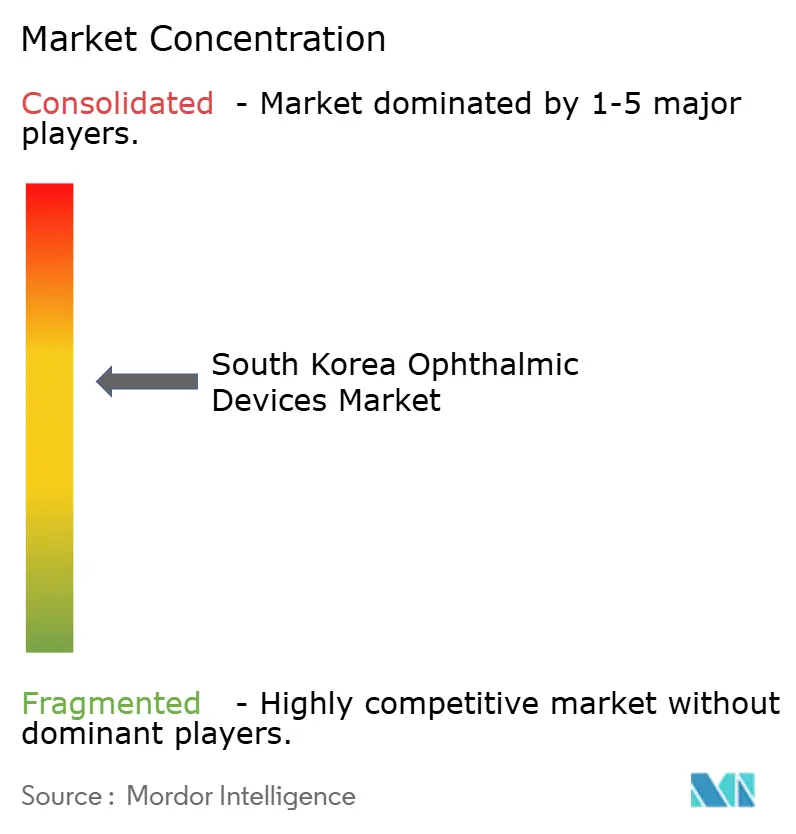
| Market Concentration | Medium |
Major Players *Disclaimer: Major Players sorted in no particular order Image © Mordor Intelligence. Reuse requires attribution under CC BY 4.0. | |
South Korea Ophthalmic Devices Market Analysis by Mordor Intelligence
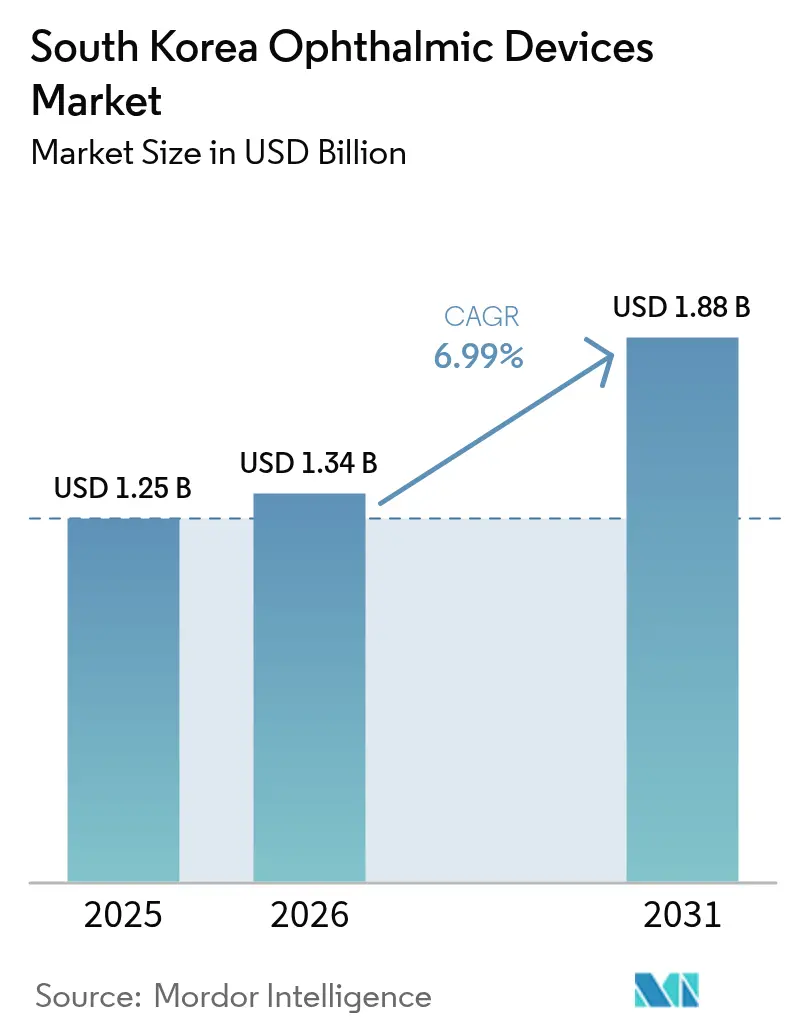
The South Korea ophthalmic devices market size was valued at USD 1.25 billion in 2025 and estimated to grow from USD 1.34 billion in 2026 to reach USD 1.88 billion by 2031, at a CAGR of 6.99% during the forecast period (2026-2031). Spiralling myopia rates, an older population that demands spectacle-free vision, and public reimbursements for early glaucoma detection underpin steady expansion. In 2024, vision-care products already accounted for 60.8% of the South Korea ophthalmic devices market as contact lenses, ortho-k lenses, and blue-light filters converged with fashion trends. Diagnostic hardware is catching up quickly; wide-field OCT angiography and AI-enabled fundus cameras are advancing at 9.23% CAGR on the back of new screening mandates. Hospitals command 43.6% of device placements, yet ambulatory surgery centres are carving share by offering day-case cataract and SMILE procedures. Multinational suppliers face long Ministry of Food and Drug Safety (MFDS) approval cycles, but they offset delays through joint ventures that localise service and training networks.
Key Report Takeaways
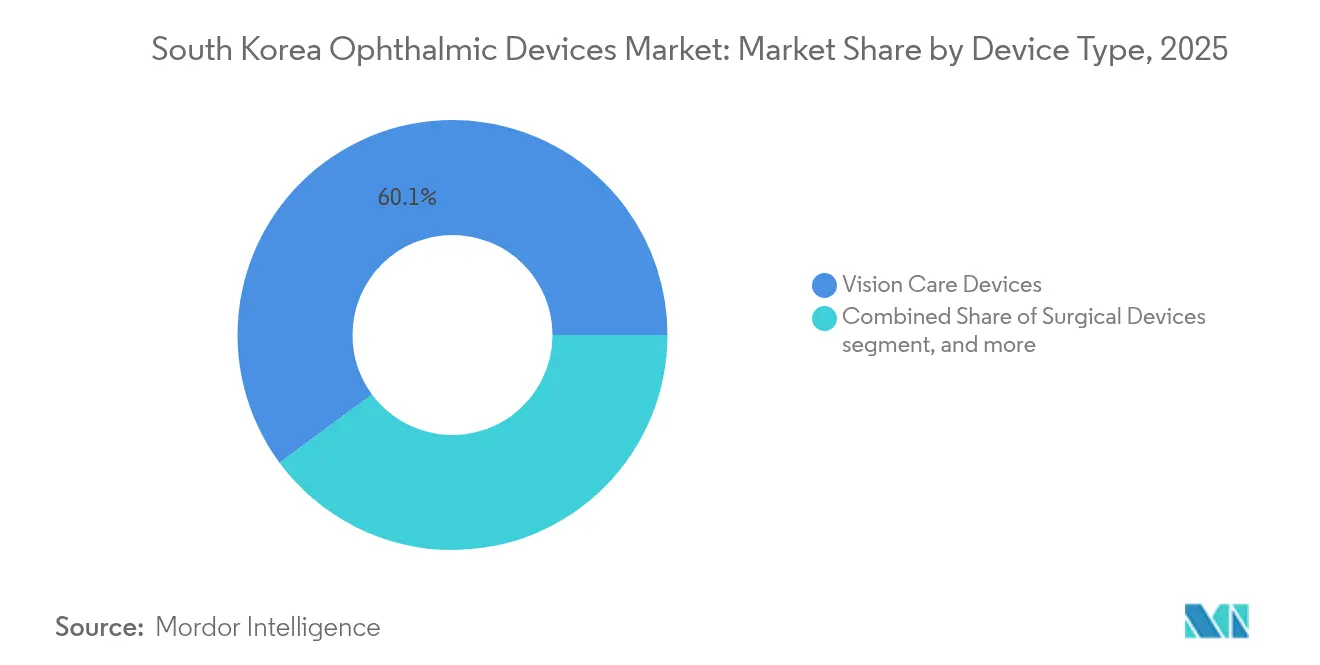
- By device type, vision-care products led with 60.12% of South Korea ophthalmic devices market share in 2025, while diagnostic and monitoring units record the fastest 9.08% CAGR to 2031.
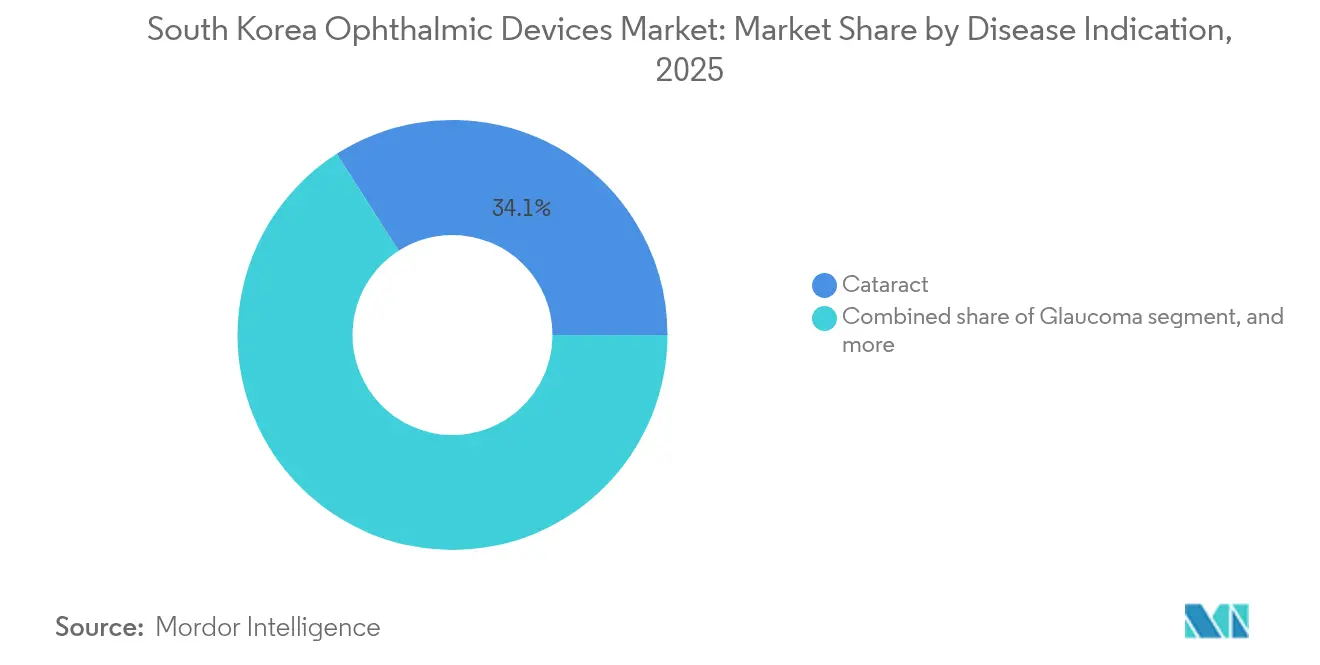
- By disease indication, cataract contributed 34.05% of the South Korea ophthalmic devices market size in 2025; diabetic-retinopathy solutions post the quickest 8.28% CAGR through 2031.
- By end-user, hospitals controlled 43.02% of 2025 revenues; ambulatory surgery centres are forecast to expand at an 8.12% CAGR over 2026-2031.
Note: Market size and forecast figures in this report are generated using Mordor Intelligence’s proprietary estimation framework, updated with the latest available data and insights as of 2026.
South Korea Ophthalmic Devices Market Trends and Insights
Drivers Impact Analysis*
| Driver | % Impact on CAGR Forecast | Geographic Relevance | Impact Timeline |
|---|---|---|---|
| Rapid adoption of premium IOLs among South Korea’s aging population | +1.8% | Seoul, Busan, Daegu | Medium term (2 – 4 years) |
| Government reimbursement expansion for nationwide glaucoma screening | +1.2% | Rural counties and provincial cities | Long term (≥ 4 years) |
| High penetration of LASIK driven by cosmetic-surgery culture | +0.9% | Seoul metropolitan area | Short term (≤ 2 years) |
| Growth of private-hospital health-check-up packages featuring OCT | +1.5% | Major hospitals nationwide | Medium term (2 – 4 years) |
| Surging myopia incidence in adolescents boosting diagnostic-device demand | +1.6% | Urban school districts | Long term (≥ 4 years) |
| Domestic AI-based ophthalmic diagnostic start-ups achieving MFDS approvals | +1.0% | National | Medium term (2 – 4 years) |
| Source: Mordor Intelligence | |||
Rapid Adoption of Premium IOLs Among the Aging Population
Multifocal optics reshaped cataract workflows, climbing from 16% usage in 2018 to 29% in 2020 and seizing 53.56% of the domestic IOL segment in 2023. Femtosecond laser-assisted cataract surgery expanded from 5% to 29% of cases over the same period, aided by 96% penetration of optical biometry. RxSight’s Light Adjustable Lens delivered unaided 20/20 vision to 70% of recipients versus 40% with other premium alternatives, bolstering surgeon uptake.
Government Reimbursement Expansion for Nationwide Glaucoma Screening
New National Health Insurance rules cover wide-field OCT angiography, which shows 87.28% sensitivity and 86.94% specificity for glaucoma diagnosis compared with legacy OCT units[1]. The initiative tackles disparities across 20 counties lacking any eye clinic, shrinking average travel time to specialised diagnostics.
High LASIK Penetration Driven by Cosmetic-Surgery Culture
Seoul’s refractive centres perform LASIK, LASEK, and SMILE at prices near USD 2,700, roughly one-third of typical Western tariffs. A 317-Hz excimer-laser study recorded 97.8% of treated eyes at 20/25 vision or better nine months after surgery, with patient satisfaction jumping from 27.7% to 98.1%.
Surging Myopia Incidence in Adolescents
Nationwide surveys report 65.4% myopia prevalence in children aged 5-18, while 19-year-old male conscripts in Seoul exhibit 96.5% prevalence; high myopia raises glaucoma odds 4.6-fold[3]. These trends spur demand for autorefractors, axial-length trackers, and low-dose atropine dispensing systems.
Restraints Impact Analysis*
| Restraints Impact Analysis | (~) % Impact on CAGR Forecast | Geographic Relevance | Impact Timeline |
|---|---|---|---|
| Stringent MFDS approval timelines versus global peers | −1.2% | Nationwide | Short term (≤ 2 years) |
| Foreign-exchange cost volatility from heavy import dependence | −0.8% | Nationwide; higher exposure for rural providers | Medium term (2 – 4 years) |
| Shortage of trained ophthalmic surgeons outside Seoul Capital Area | −1.5% | 20 counties with no clinics | Long term (≥ 4 years) |
| Price caps on cataract-surgery reimbursement limiting premium devices | −1.0% | National | Medium term (2 – 4 years) |
| Source: Mordor Intelligence | |||
Stringent MFDS Approval Timelines
AI-enabled scanners and new lens polymers fall into Class 3-4 risk categories. The Digital Medical Products Act of January 2024 demands extra cybersecurity validation, stretching launch cycles and raising documentation costs.
Foreign-Exchange Cost Volatility
Roughly 70% of high-end devices are imported. Won-dollar swings compress margins for smaller hospitals even though overall GDP is expected to grow 2.2% in 2024. Domestic suppliers see openings for mid-priced OCT decks.
*Our forecasts treat driver/restraint impacts as directional, not additive. The impact forecasts reflect baseline growth, mix effects, and variable interactions.
Segment Analysis
By Device Type: Vision-Care Dominance with Diagnostics Accelerating
Vision-care products controlled 60.12% of 2025 revenues as contact lenses served both corrective and cosmetic roles. The South Korea ophthalmic devices market continues to rely on repeat purchases of lens solutions, ortho-k modalities, and color tints. Diagnostic and monitoring systems post the quickest 9.08% CAGR. Their addressable value rises from USD 245.4 million in 2026 to an expected USD 379.3 million in 2031, anchoring future South Korea ophthalmic devices market size gains. Hospitals negotiate multi-year service contracts that bundle OCT hardware with AI subscription analytics, locking in predictable revenue for suppliers.
Surgical devices remain smaller but strategic. Femtosecond cataract platforms lifted operating efficiency and opened new premium IOL niches. Vendors now pitch disposable phaco tips and mobile surgical microscopes to ambulatory centres, a model suited to the South Korea ophthalmic devices market where outpatient cataract volumes are rising. Cross-licensing with Korean sensor makers shields multinationals from currency risk and qualifies them for preference points in public tenders.

By Disease Indication: Cataract Still Rules, Diabetic Retinopathy Rises
Cataract applications captured 34.05% of the South Korea ophthalmic devices market share in 2025, supported by nearly 420,000 annual surgeries. Multifocal IOLs, toric alignment tools, and intra-operative aberrometry reinforce premium-segment yields. Johnson & Johnson’s TECNIS Odyssey, cleared locally in 2024, improves low-light vision and commands premium price points. Diabetic-retinopathy devices are racing ahead at 8.28% CAGR. Only 29.5% of eligible diabetics undergo retinal screening, leaving ample headroom for AI fundus cameras and portable fluorescein angiography rigs.
Glaucoma devices benefit from national screening subsidies that emphasise early detection. Pediatric myopia management solutions, though a smaller revenue pool, present lifetime-value potential because patients transition from axial-length trackers to refractive surgery over decades. Companies explore sustained-release atropine implants that can be filed as combination products under MFDS rules, signalling convergence of therapeutics and diagnostics in the South Korea ophthalmic devices industry.
By End-User: Hospitals Lead, Ambulatory Centres Accelerate
Hospitals held 43.02% of 2025 sales thanks to 3,610 practising ophthalmologists concentrated in the Seoul Capital Area. Group purchasing contracts encompass femtosecond lasers, premium IOL consignments, and OCT networks that link provincial outpatient branches to metropolitan reading hubs. The hospital slice of the South Korea ophthalmic devices market size is projected to exceed USD 835 million by 2031.
Ambulatory surgery centres expand at 8.12% CAGR as insurers favour lower facility fees for cataract day-cases and LASIK. Their growth tempers hospital dominance and drives procurement of mobile phaco systems and compact SMILE lasers. Specialty ophthalmic clinics prosper in urban shopping districts by combining vision correction, cosmetic services, and tele-consultation platforms, which boosts high-margin diagnostic throughput. Optical retailers and e-commerce portals distribute daily-wear contact lenses, blue-light blockers, and smart-glasses add-ons, widening consumer touchpoints.
Regulatory Landscape
In South Korea, ophthalmic devices and drug-device combination products are regulated by the Ministry of Food and Drug Safety (MFDS) under the Medical Devices Act and, where applicable, the Pharmaceutical Affairs Act. Higher-risk ophthalmic technologies (commonly Class III and IV, including intraocular lenses) follow MFDS approval routes, while lower-risk products generally use certification pathways. For convergence medical products, MFDS determination of the primary mode of action sets the lead review pathway and dossier requirements.
Recent rulemaking tightens quality and clarifies emerging categories relevant to this market. MFDS revised its guidance on classification and designation of combination (convergence) products in June 2024, supporting clearer review pathways for drug-device combinations. MFDS also updated manufacturing and quality standards in December 2025 (Notice No. 2025-80) and released updated Medical Device GMP Regulations in February 2026, increasing emphasis on standardized quality management and inspection readiness. In March 2026, MFDS published a partial amendment (Notice No. 2026-18) to item and item-specific grade regulations that included new categories such as myopia progression inhibition spectacle lenses, aligning oversight with fast-growing myopia management subsegments.
Competitive Landscape
The South Korea ophthalmic devices market features moderate concentration. Alcon, Carl Zeiss Meditec, and Johnson & Johnson Vision retain strongholds in premium IOLs, femtosecond systems, and diagnostic workstations. Domestic firms such as HanitaLenses Korea and ViewPharm leverage local-language service and MFDS expertise to capture mid-range lens, injector, and tonometer categories. Approximate total share for the five largest players sits near 60%, leaving room for agile challengers.
Strategic moves shape competition. Carl Zeiss Meditec’s April 2024 purchase of Dutch Ophthalmic Research Center broadened its MIGS and vitrectomy line-up for Korean tenders. RxSight collaborated with Seoul National University Hospital to validate adjustable-lens algorithms on Korean biometric profiles, cementing clinician confidence. NIDEK unveiled the RS-1 Glauvas OCT in June 2024, providing layered vascular imaging tailored for glaucoma clinics. Domestic AI start-ups license deep-learning modules to camera makers on revenue-share agreements, accelerating MFDS clearances under new software-as-a-medical-device provisions.
Price pressure is acute in contact-lens consumables. Global brands face competition from K-beauty conglomerates that bundle colour tints with cosmetics. Conversely, surgical hardware remains value-driven; buyers prioritise rotational stability and postoperative visual quality over unit price. Looking ahead, mixed-reality microscopes that overlay 3-D guidance onto live feeds promise to shift the basis of competition toward integrated software ecosystems by 2027.
South Korea Ophthalmic Devices Industry Leaders
-
Alcon Inc.
-
Johnson and Johnson
-
Topcon Corporation
-
Hoya Corporation
-
Carl Zeiss Meditec AG
- *Disclaimer: Major Players sorted in no particular order
Market Opportunities and Future Outlook
AI-enabled ophthalmic screening and workflow-integrated diagnostics create a practical whitespace as payers and providers push earlier detection while managing specialist capacity constraints. In January 2026, Korea introduced the Market Immediate Entry Medical Technology system, which shortens the path to clinical use for designated innovative medical technologies (including AI and digital categories) by waiving separate HTA steps and reducing timelines from up to 490 days to 80 to 140 days. In parallel, MOHW launched a Rapid Commercialization Support Program in March 2026 to help AI medical devices move from clinical validation to market entry, supporting adoption of AI fundus photography, wide-field imaging, and software-as-a-medical-device analytics in hospitals and screening settings.
Localization and domestic capability-building also support supplier positioning where Korean manufacturing, QA, and clinical-validation footprints are present. The government is running a seven-year (2026 to 2032) pan-government R&D project totaling KRW 940.8 billion to localize essential medical devices and develop global flagship products, with KRW 59.325 billion allocated for 106 new projects in 2026. Commercial pull-through is evident in provider procurement: in May 2026, Daewoong Pharmaceutical announced a supply contract to Gangneung Asan Hospital that included its Optina digital fundus camera and Whisky AI fundus examination solution, reinforcing demand for packaged hardware-plus-AI screening offers tied to high-volume detection of macular degeneration, retinopathy, and glaucoma. Separately, MFDSs March 2026 addition of myopia progression inhibition spectacle lens categories signals a defined regulatory lane for myopia management products, supporting portfolio expansion across lenses, diagnostics, and monitoring tools linked to adolescent myopia burden.
Recent Industry Developments
- July 2026: Topcon Korea Medical launched the IRIDEX PASCAL ophthalmic laser platform in South Korea, bringing integrated pattern scanning and MicroPulse capability into local clinical workflows. The launch broadens therapy options for laser-based retinal treatment and supports clinic preferences for space-efficient, multifunction systems in urban settings.
- May 2026: Daewoong Pharmaceutical announced a supply contract with Gangneung Asan Hospital to provide three digital screening solutions, including the Optina fundus camera and Whisky AI fundus examination solution for eye disease screening. The deployment highlights hospital purchasing of bundled imaging hardware and AI analytics to increase throughput for detecting conditions such as macular degeneration, retinopathy, and glaucoma.
- June 2024: MFDS revised guidance on the classification and designation of combination (convergence) products, clarifying how drug-device combination products are routed through regulatory review. The update impacts filing strategy for ophthalmology offerings that pair devices with pharmacologic components or software functions by strengthening the need for early primary mode-of-action determination.
Research Methodology Framework and Report Scope
Market Definition and Coverage
For this study, the market includes the revenue earned in South Korea from ophthalmic devices used to diagnose, monitor, treat, or correct eye conditions in clinical and retail settings, counted at the point of sale into the country market.
Scope exclusions: We exclude ophthalmic pharmaceuticals, general purpose hospital equipment not dedicated to eye care, and non-device services such as surgery fees and clinic consultations.
Segmentation Overview
- By Device Type
- Diagnostic & Monitoring Devices
- OCT Scanners
- Fundus & Retinal Cameras
- Autorefractors & Keratometers
- Corneal Topography Systems
- Ultrasound Imaging Systems
- Perimeters & Tonometers
- Other Diagnostic & Monitoring Devices
- Surgical Devices
- Cataract Surgical Devices
- Vitreoretinal Surgical Devices
- Refreactive Surgical Devices
- Glaucoma Surgical Devices
- Other Surgical Devices
- Vision Care Devices
- Spectacles Frames & Lenses
- Contact Lenses
- Diagnostic & Monitoring Devices
- By Disease Indication
- Cataract
- Glaucoma
- Diabetic Retinopathy
- Other Disease Indications
- By End-user
- Hospitals
- Specialty Ophthalmic Clinics
- Ambulatory Surgery Centers (ASCs)
- Other End-users
Data Sources, Market Sizing, and Validation
Desk Research
Desk research starts by building a clean fact base on population aging, eye disease burden, care pathways, and device adoption in South Korea. We typically refer to public sources such as Korea Disease Control and Prevention Agency releases, Statistics Korea tables, National Health Insurance Service publications, and Ministry of Food and Drug Safety notices to understand treatment volumes and the regulated device landscape.
We also review peer-reviewed ophthalmology journals for procedure patterns, plus import and export statistics, company filings, investor presentations, and reputable press to map category momentum and pricing direction. In addition, we use paid subscriptions for company financials and for patent and technology tracking when we need to validate product pipelines and revenue exposure. These desk sources are illustrative only, and we also check other public and paid references for data collection, validation, and clarification.
Primary Interviews and Surveys
Primary work is used to pressure-test model assumptions that desk research cannot fully explain, especially pricing moves, channel mix, and the split between diagnosis, surgical, and vision care demand. We speak with a mix of manufacturers, distributors, hospital buyers, eye clinic administrators, and practicing clinicians so the input variables reflect how devices are actually purchased and used across South Korea.
Because the market is local, responses are balanced across national-level stakeholders and on-the-ground decision makers, and then fed back into the model to close gaps and confirm that totals align with real procurement and utilization patterns.
Distribution of primary research fieldwork respondents
| Company type | Respondent position |
|---|---|
| Top tier: 38% | CXOs: 14% |
| Mid tier: 44% | Functional/Unit leaders: 32% |
| Smaller Players: 18% | Managers: 54% |
Market-Sizing & Forecasting
Sizing starts with a top-down build that reconstructs demand from procedure and screening volumes, treated patient pools, and device replacement cycles, and then converts those into value using category-level price points. To keep the estimate practical, we focus on repeatable inputs, including cataract and glaucoma procedure activity, refractive correction demand signals, the installed base refresh rate for key diagnostic equipment, average selling price movements by device type, and the mix of reimbursement and out-of-pocket share that influences purchasing behavior.
We then apply selective bottom-up checks to keep totals grounded, such as rolling up sampled supplier revenues, distributor sell-through discussions, and sampled ASP multiplied by unit volumes in high-use categories. When company disclosures are incomplete, gaps are handled by applying peer benchmarks and channel mix ratios that were confirmed during interviews, then running a second pass to ensure no category is double counted.
For forecasting, we use scenario analysis with a simple driver set, where procedure growth, aging population trends, and price normalization are adjusted within ranges suggested by interviewees. The final trajectory is reviewed year by year to ensure growth does not break known constraints like capacity, training availability, or sudden reimbursement policy changes.
Data Validation & Update Cycle
Each major output is triangulated through at least three angles, which usually include demand signals, supply-side feedback, and an external sanity check such as trade flow movement or installed base replacement math. When large variances appear, assumptions are rechecked, and follow-up calls are triggered to confirm whether the issue is scope, timing, or pricing.
Before sign-off, the model goes through multi-step analyst reviews where category totals are checked against historical patterns and adjacent indicators, and then the full set is revalidated for arithmetic consistency and currency conversion logic. Reports are refreshed annually, and interim updates are made when material events occur, followed by a fresh final pass right before delivery so clients receive the most current view.
Mordor Intelligence's South Korea Ophthalmic Devices Market Size Compared With Other Published Estimates
Published market sizes for South Korea ophthalmic devices often do not match, even when they use the same years, because each publisher draws the line differently around vision care, clinical devices, and the selling point used for revenue counting. Differences also show up when one study uses older prices or mixes constant currency with current pricing, which can shift totals more than many readers expect.
Import and export flows for ophthalmic instruments and lenses, plus procedure volume signals from care settings, are the evidence checks that tie Mordor Intelligence's 2025 estimate to a defined demand pool rather than a broad healthcare equipment bundle. In some other estimates, the device scope is narrowed to diagnostic and surgical equipment only, or it is expanded without clearly separating spectacles, contact lenses, and related retail categories, and that choice changes the market value materially.
Benchmark comparison
| Source | Market Size | Gaps in Research Methodology |
|---|---|---|
| Mordor Intelligence | USD 1.25 B (2025) | |
| Industry Research Publisher A | USD 0.56 B (2025) | The published figure appears to use a tighter product boundary, which likely excludes parts of vision care devices or counts only selected device groups, leading to a smaller total for the same year. |
| Market Analytics Firm B | USD 0.53 B (2024) | This estimate is anchored to a different base year and seems to focus on surgical and diagnostic device revenue only, which can understate totals when retail vision care sales are not fully included or are treated separately. |
Taken together, the spread is mostly explained by what gets counted as a device sale in the market and how retail vision care is treated. By keeping scope rules explicit and checking them against trade, utilization, and pricing signals, the final number stays traceable to inputs that another analyst can reproduce and update.
Key Questions Answered in the Report
How large is the South Korea ophthalmic devices market in 2026?
The market stands at USD 1.34 billion in 2026 and will expand steadily through 2031.
Which segment is the fastest-growing within the South Korea ophthalmic devices market?
Diagnostic and monitoring devices register the quickest 9.08% CAGR, fuelled by nationwide glaucoma-screening reimbursements.
What is the role of hospitals versus ambulatory surgery centres?
Hospitals still hold 43.02% of 2025 revenues, yet ambulatory centres grow at 8.12% CAGR as insurers shift cataract and LASIK cases to day-care settings.
How significant is myopia for future demand?
Myopia prevalence reaches 96.5% among urban nineteen-year-olds, creating lifelong demand for refractive surgery, contact lenses, and monitoring devices.
What regulatory change affects AI-based ophthalmic devices?
The Digital Medical Products Act of 2024 imposes software-quality and cybersecurity validations, lengthening MFDS approval times for AI-driven hardware.
Which companies recently expanded their South Korea ophthalmic portfolios?
Carl Zeiss Meditec, Johnson & Johnson Vision, Santen, and NIDEK all launched or filed new products in 2024-2025, broadening competitive options for providers.