
Market Overview
| Study Period | 2020 - 2031 |
|---|---|
| Forecast Data Period | 2026 - 2031 |
| Base Year Market Size (2025) | USD 9.36 Billion |
| Market Size (2026) | USD 9.77 Billion |
| Market Size (2031) | USD 12.14 Billion |
| Growth Rate (2026 - 2031) | 4.44 % |
| Market Concentration | Medium |
Major Players *Disclaimer: Major Players sorted in no particular order Image © Mordor Intelligence. Reuse requires attribution under CC BY 4.0. | |
South Korea Major Home Appliances Market Analysis by Mordor Intelligence
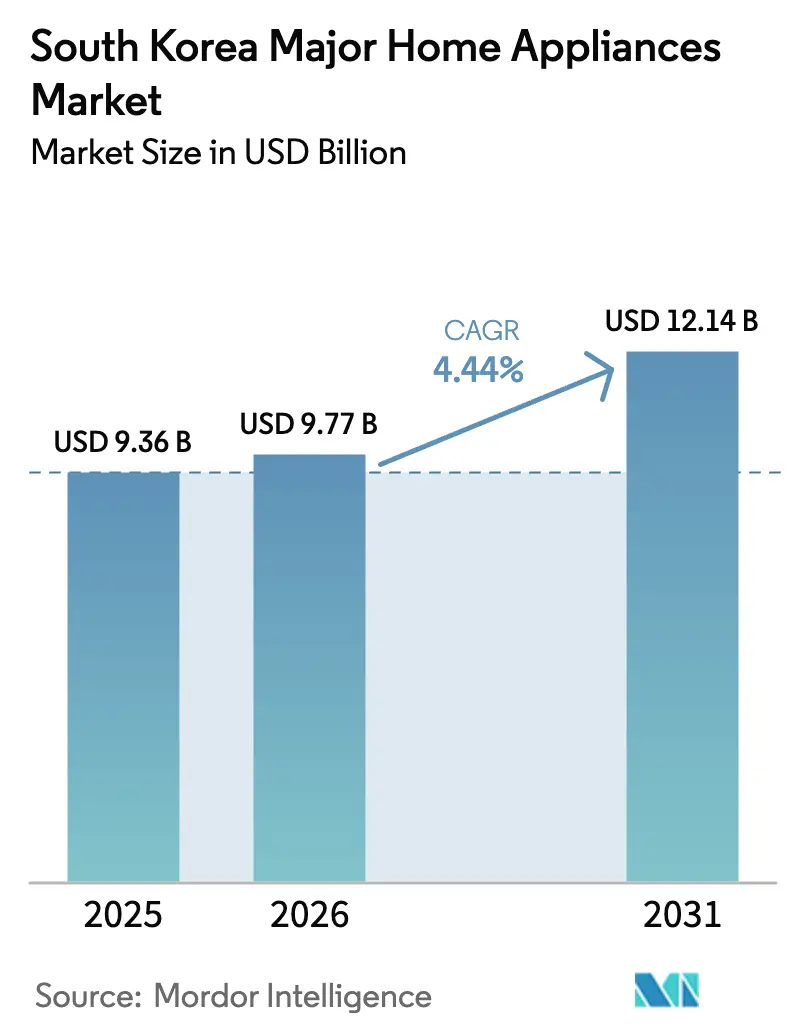
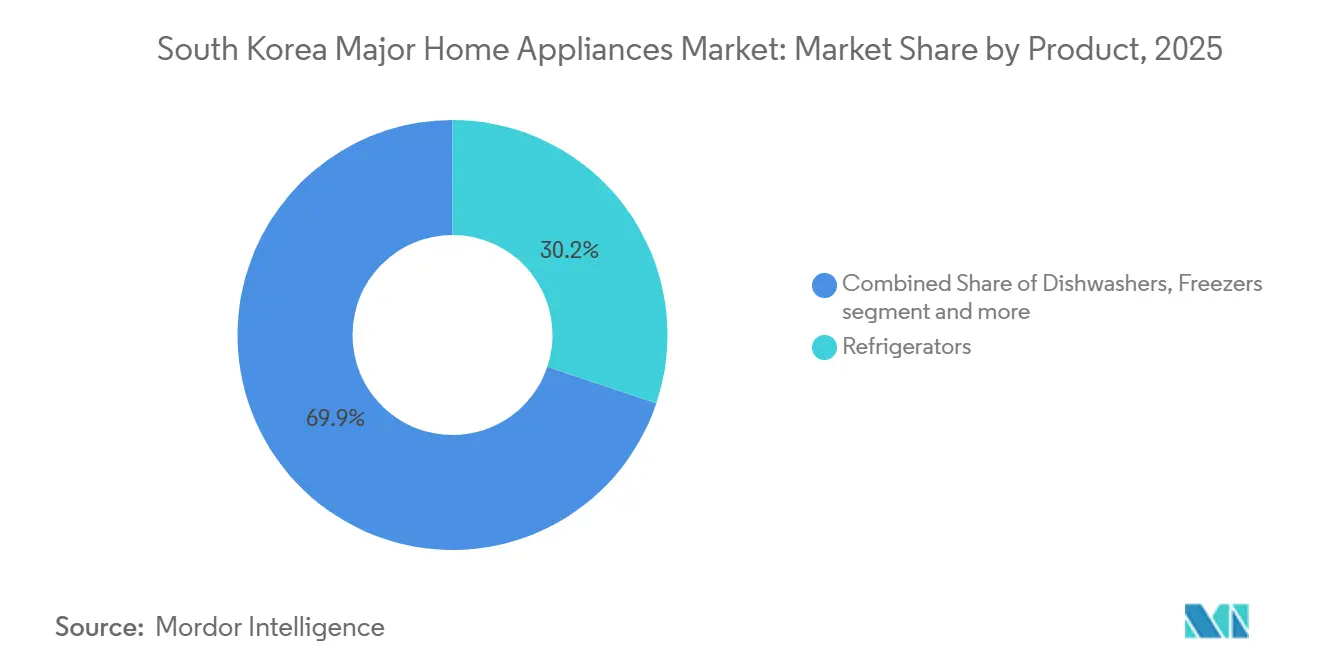
The South Korea major home appliances market size was valued at USD 9.36 billion in 2025 and is estimated to grow from USD 9.77 billion in 2026 to reach USD 12.14 billion by 2031, at a CAGR of 4.44% during the forecast period (2026-2031). Refrigerators lead revenue with a 30.15% share in 2025, while dishwashers remain a niche category, now growing fastest at a 4.62% CAGR, as single-person households favor compact, rental-ready formats suited to smaller living spaces. July 2025’s Top Efficiency Appliance Rebate Program unlocks a 10% refund for Grade-1 products within a 267.1 billion won budget cap, lifting first-month consumer spending to 882 billion won and helping trigger 29% year-on-year sales gains for participating retailers[1]. Minimum Energy Performance Standards restrict substandard models and require Grade-1 units in the public sector, which embeds replacement demand across both households and institutions. The South Korea major home appliances market benefits from ecosystem-led differentiation, where seven-year software support for new AI-enabled models and tighter energy rules together reinforce premium segments that offer visibility on margins over the forecast horizon.
Key Report Takeaways
- By product, refrigerators led with 30.15% of the South Korea major home appliances market share in 2025; dishwashers are forecast to expand at a 4.62% CAGR through 2031.
- By distribution channel, multi-brand stores held 38.72% of the South Korea major home appliances market share in 2025, while online recorded the highest projected CAGR at 5.84% through 2031.
- By geography, Gyeonggi Province accounted for 35.38% of the South Korea major home appliances market share in 2025, and Gyeongsang is projected to grow at a 5.47% CAGR through 2031.
Note: Market size and forecast figures in this report are generated using Mordor Intelligence’s proprietary estimation framework, updated with the latest available data and insights as of January 2026.
Market Trends and Insights
Drivers Impact Analysis of South Korea Major Home Appliances Market*
| Driver | (~) % Impact on CAGR Forecast | Geographic Relevance | Impact Timeline |
|---|---|---|---|
| E-commerce penetration is accelerating appliance sales | +0.8% | Global, strongest in the Seoul Capital Area and Gyeonggi due to logistics density | Short term (≤ 2 years) |
| Mandatory efficiency labels and standards elevating replacement demand | +1.2% | National, with early gains in public-sector buildings in Seoul, Busan, and Incheon | Medium term (2-4 years) |
| Smart-home adoption is fueling connected appliance uptake | +0.9% | National, with Seoul Capital Area and Gyeonggi leading | Medium term (2-4 years) |
| Government rebate program for replacing Grade-3 or lower appliances | +1.3% | National, metropolitan areas benefit from higher participation rates | Short term (≤ 2 years) |
| Rise of single-person households driving demand for premium compact formats | +0.9% | National, with spillover concentrated in Seoul, Busan, and Gyeonggi urban cores | Long term (≥ 4 years) |
| Export-oriented manufacturing clusters are shortening domestic refresh cycles | +0.4% | Gyeongsang Province and Chungcheong, due to proximity to semiconductor supply chains | Medium term (2-4 years) |
| Source: Mordor Intelligence | |||
E-commerce Penetration Accelerating Appliance Sales
Online channels post a 5.84% CAGR, the fastest among distribution modes for the South Korea major home appliances market, as nationwide digital adoption lifts transactions that rely on mobile-first behavior. The National Logistics Basic Plan enables warehouse automation and shortens bulky-goods delivery times to same-day windows in dense areas, which improves conversion for refrigerators and washing machines sold online. Blockchain-linked e-receipts strengthen trade-in funnels and bring forward replacement cycles for premium users who value speed and convenience in service flows. The economics of online fulfillment favor compact and mid-tier products that renters can install without technicians, while built-in and high-end units continue to move through specialist retail due to installation complexity. Samsung and LG promote augmented-reality previews through app ecosystems to reduce return rates and strengthen system lock-in across connected devices, which further widens the capability gap with smaller brands that lack software reach.
Mandatory Efficiency Labels and Standards Elevating Replacement Demand
Tighter Minimum Energy Performance Standards prohibit production or sale below fifth-grade efficiency and require Grade-1 units for public-sector procurement, which directly raises the replacement rate across key categories in the South Korea major home appliances market. Draft amendments extend coverage to additional categories, such as electric fans with BLDC motors and clothes dryers, reinforcing the pipeline of compliant products before deadlines in 2026 and 2027. Upgrading to inverter-based systems reduces power bills and shortens payback periods for households that adopt premium-grade models with smart energy features. Field data from the 2010-era EPR pilot showed that introducing mandatory labeling drove refrigerator recycling rates from 48% to 87%, demonstrating that information asymmetry—not purchase price—was the primary barrier[2]. Manufacturers that lead in inverter compressors and eco-friendly refrigerants build an advantage that translates into brand preference and stickier upgrade paths within connected homes.
Smart-Home Adoption Fueling Connected Appliance Uptake
Korea’s connected-home base benefits from early 5G rollout and the scale of Samsung’s SmartThings platform, which now spans hundreds of millions of global users and underpins seamless device orchestration in the South Korea major home appliances market[3]. Builder pre-installation in premium apartments normalizes plug-and-play experiences and removes friction at move-in, nudging households toward smart refrigerators, washing machines, and air-quality devices tied to a unified hub. Dynamic tariffs from the utility side strengthen the case for automated scheduling, as appliances shift cycles to off-peak hours through AI features to lower bills. The competitive tension centers on closed versus open ecosystems, with incumbents pushing end-to-end integrations while budget challengers adopt Matter standards to appeal to renters and mixed-brand households. Samsung’s 2026 integration of Google Gemini into its Bespoke AI Family Hub refrigerator expands food recognition and shares cooking parameters with synced ovens, which illustrates how AI elevates device utility while raising switching costs in the South Korea major home appliances market.
Government Rebate Program for Replacing Grade-3 or Lower Appliances
Grade-1 purchases up to 300,000 won per item, creating a clear near-term pull for energy-efficient models across the South Korea major home appliances market. First-month results registered 662,000 applications drawing 88.2 billion won in rebates, implying 882 billion won in total consumer spending and triggering 29% year-on-year sales lifts for participating retailers; one air-purifier partner saw sales jump 584%, and a rental corporation reported a 92% increase with dehumidifier demand spiking sixteen-fold[4]. Rental products qualify for the benefit, which supports subscription models that bundle maintenance and lower up-front costs for compact appliances like dishwashers. Policy debate continues over the distribution of benefits, but the program’s structure brings forward the retirement of older stock and accelerates the diffusion of high-efficiency baselines. The replacement effect is most visible in metropolitan areas with robust retail participation and strong awareness of energy-label criteria.
Restraints Impact Analysis of South Korea Major Home Appliances Market*
| Restraint | (~) % Impact on CAGR Forecast | Geographic Relevance | Impact Timeline |
|---|---|---|---|
| Household penetration approaching saturation | -0.7% | National, refrigerators and washing machines exceed 95% penetration | Long term (≥ 4 years) |
| Shrinking average floor space is limiting demand for large-format appliances | -0.3% | Urban cores in Seoul, Busan, and Incheon, with many single-person homes under 40 m² | Long term (≥ 4 years) |
| Extended-producer-responsibility recycling costs are squeezing margins | -0.5% | National obligations expanded in 2026 to all electrical and electronic products. | Medium term (2-4 years) |
| Volatile steel and resin prices linked to regional geopolitical shocks | -0.9% | National, compounded by reciprocal tariffs and resin-price spikes | Short term (≤ 2 years) |
| Source: Mordor Intelligence | |||
Household Penetration Approaching Saturation
Refrigerators and washing machines are already in almost every home, which shifts growth from first-time purchases to replacement cycles in the South Korea major home appliances market. New-build housing slows compared with prior periods, so the traditional move-in wave contributes less to volume than in past cycles. Consumers facing higher rates and prices extend the ownership period of larger appliances, which lengthens the interval between purchases. Premium households still replace faster to capture AI features and aesthetics, while lower-income cohorts stretch lifespans through repairs, which results in a bifurcated pattern that masks nuance in simple penetration metrics. Dishwashers stand out as a penetration gap where compact and rental-ready formats can scale despite saturation in core white goods.
Shrinking Average Floor Space Limiting Demand for Large-Format Appliances
Nearly half of single-person homes occupy less than 40 square meters, which constrains demand for large-capacity refrigerators and washers in dense urban cores. Consumers pivot toward French-door models with optimized internal organization and stackable or combo laundry formats that reclaim vertical space. Premium compact models can maintain price points by bundling AI features, voice control, and app diagnostics that boost perceived value without increasing size. Built-in solutions gain traction in renovations where integrated designs free up countertops and reduce clutter in smaller kitchens. Regional variations persist in less dense provinces, which require inventory strategies that balance compact demand with residual interest in large formats.
*Our forecasts treat driver/restraint impacts as directional, not additive. The impact forecasts reflect baseline growth, mix effects, and variable interactions.
South Korea Major Home Appliances Market Segment Analysis
By Product:
Refrigerators Lead Revenue While Dishwashers Post Segment's Fastest GrowthRefrigerators account for 30.15% of 2025 revenue, giving them the largest position in the South Korea major home appliances market, while households favor feature-dense formats that fit smaller urban layouts. Premium configurations with AI vision, flexible compartments, and app-based monitoring lift revenue share even as average unit sizes moderate in dense markets. Dishwashers remain under 5% penetration, but the category is the fastest mover, with a 4.62% CAGR through 2031, as compact and rental-ready units address space constraints and up-front costs. Rental eligibility within the national rebate program reduces barriers for first-time adopters and supports the expansion of subscription packages that include maintenance and consumables. This pattern elevates compact formats that monetize software, connectivity, and design as part of value creation in the major home appliances market in South Korea.
Dishwashers continue to show momentum as both households and small businesses standardize on convenience and hygiene features that match space limitations in dense housing. Washing machines have a significant market share, with AI cycles and resource optimization reducing energy and water use while improving convenience in laundry workflows. Air conditioners make a meaningful contribution and align with the national push toward high-efficiency systems and heat pump adoption within a broader decarbonization plan. Ovens and induction cooktops benefit from compact kitchens that reward built-in designs and precise temperature control, enhancing premium cooking experiences. The South Korea major home appliances industry aligns product roadmaps to software-supported features and over-the-air updates, which convert white goods into long-lived platforms with serviceable add-ons.

By Distribution Channel:
Multi-Brand Stores Anchor Sales Yet Online Posts Fastest CAGRMulti-brand stores retain 38.72% of 2025 sales as shoppers evaluate physical attributes and seek bundled services like installation, extended warranties, and take-back of old units. Brand-exclusive outlets complement this with immersive showrooms and ecosystem demos that drive attachment to connected platforms and premium aesthetics. The online channel posts the fastest 5.84% CAGR as same-day fulfillment becomes more common for bulky items and as mobile-first purchasing becomes a preferred path for compact appliances in the South Korea major home appliances market size context for channel growth. Virtual try-out tools reduce measurement and fit errors and lower return rates, which helps profitability at comparable delivery fees. Government procurement rules that restrict purchases to Grade-1 products concentrate institutional demand in brands with rapid compliance track records.
The channel mix reflects distinct product economics, as online excels in compact and mid-tier units while built-in and ultra-premium remain anchored offline due to site measurement, specialty installation, and synchronized scheduling with renovations. Subscription rentals now account for a rising share of online appliance transactions as consumers substitute monthly fees for up-front payments and receive scheduled maintenance. Exclusive brand outlets absorb higher operating costs, yet they serve as IoT integration hubs where connected experiences across refrigeration, laundry, air care, and energy management encourage multi-device adoption in the South Korea major home appliances industry. Regulatory oversight on pricing and cross-border marketplace practices will influence discounting headroom and sourcing transparency for imported appliances. The net outcome is a hybrid path where online and offline reinforce each other through showrooms, service integration, and digitized trade-in journeys in the South Korea major home appliances market.
Geography Analysis
Gyeonggi Province holds 35.38% of the 2025 demand and anchors the South Korea major home appliances market share through the density and income profile of the Seoul Capital Area. Strong logistics nodes enable faster delivery times, and high apartment penetration with builder-installed IoT infrastructure creates favorable conditions for connected premium models. Growth moderates as living space shrinks and primary demand is saturated, yet premium features maintain pricing power despite compact footprints. Single-person homes in the province exceed the national average, which amplifies demand for mini-refrigerators, stackable combos, and compact dishwashers with rental options. The region sets trends that diffuse nationwide through online channels and brand-exclusive showrooms that showcase ecosystem integrations in the South Korea major home appliances market.
Gyeongsang posts the fastest projected CAGR of 5.47% as engineering-heavy workforces and industrial clusters support frequent product refreshes and early adoption of AI-enabled models. Provincial AI programs earmark 1.19 trillion won through 2030 for factory transformation, which strengthens pilot-to-production cycles and speeds deployment of new SKUs in the South Korea major home appliances market size for regional momentum linked to industrial policy. Busan’s construction cycle supports built-in appliance adoption at the premium end, while white-collar households upgrade more frequently to connected products that fit compact city layouts. Co-location with advanced assembly and component suppliers bolsters the pace of learning across iterations and reduces lead times for parts that enable AI on-device performance. The region, therefore, balances premium residential demand with institutional and commercial requirements tied to local manufacturing strength in the South Korea major home appliances market.
Chungcheong, Gangwon, Jeolla, and Jeju together account for a meaningful share of revenue with slower CAGRs due to older demographics and more detached housing, which dampen the pace of smart adoption compared to the capital area. Each area maintains distinct niches, including commercial cooling tied to agriculture or tourism, and HVAC demand linked to year-round hospitality operations. Provincial enforcement timelines for energy codes and ZEB-aligned building standards roll out unevenly, which staggers the onset of mandated efficiency upgrades. Regions with earlier enforcement pull demand forward for Grade-1 units in procurement and new construction, then normalize as code cycles complete. Retailers and brands align inventory strategies to local housing patterns and price sensitivity to sustain conversion across the South Korea major home appliances market.
Regulatory Landscape
Major home appliances sold in South Korea follow a dual compliance stack covering safety and energy requirements. For safety, products fall under the Electrical Appliances Safety Control Act, administered through the Korea Agency for Technology and Standards (KATS), and are typically placed on the market via the KC mark. Depending on risk class, compliance is carried out through pathways such as Safety Certification, Safety Confirmation, and Supplier Declaration of Conformity. For energy, the Ministry of Trade, Industry and Energy (MOTIE) and the Korea Energy Agency (KEA) run the Energy Efficiency Label and Standard Program (grades 1 to 5), supported by Minimum Energy Performance Standards (MEPS). MEPS restrict the sale of non-compliant models and shape public-sector procurement requirements.
Rulemaking activity has continued through 2024 to 2026, with MOTIE Notice No. 2024-442 updating elements of the energy-efficiency labeling and standards framework (including categories such as refrigerators). In July 2025, the Top Efficiency Household Appliance Rebate Program was reintroduced with a 267.1 billion won budget and a 10% refund mechanism for Grade-1 products, directly tying compliance performance to near-term consumer purchase incentives. Additional MOTIE notices and announcements in 2025 expanded or tightened efficiency management across other equipment and components, which keeps manufacturers and importers focused on periodic revisions tied to target dates, registration, and test or reporting requirements.
Value Chain Analysis
The South Korea major home appliances value chain starts with upstream inputs and components, including steel and resins, compressors, BLDC motors, sensors, and embedded electronics. It then moves through assembly and testing and into multi-brand retail, exclusive brand outlets, and online channels, where installation and after-sales service are key points for value capture. Energy efficiency requirements and labeling (KEA/MOTIE) influence component choices and bills of materials, pushing manufacturers toward high-efficiency parts such as inverter compressors and motors to meet MEPS thresholds and support premium grade positioning. Recycling and take-back obligations are also becoming more central, since disposal and trade-in add cost and operational complexity even as they help sustain replacement-driven demand flows.
Midstream manufacturing is shifting toward higher automation and AI-enabled mixed production to manage product variety and faster refresh cycles. In May 2026, MOTIE convened the Home Appliance M.AX (Manufacturing AI) Alliance with broad participation, and the roadmap covers factory AI models, autonomous logistics (AGVs/AMRs), and standardized learning data, indicating a policy-backed push to raise productivity across domestic plants. Externally, global inputs and trade conditions remain a constraint on the chain, and in 2025 Samsung Electronics and LG Electronics publicly reviewed manufacturing footprint and supply-chain restructuring in response to US tariffs affecting steel-heavy appliances such as refrigerators and washing machines, showing how upstream material exposure can cascade into sourcing, routing, and production-location decisions.
Competitive Landscape
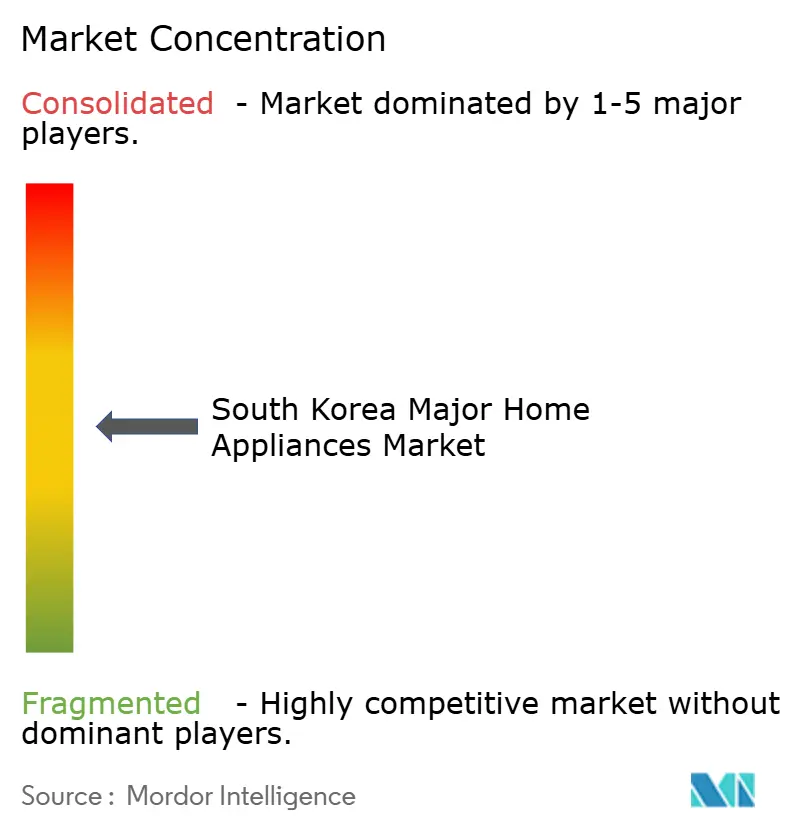
Market concentration remains moderate as LG Electronics and Samsung Electronics together hold half of 2025 revenue, while the top five brands collectively exceed two-thirds of the South Korea major home appliances market. The leading players leverage vertical integration, semiconductor expertise, and cloud ecosystems to defend share through cross-device functionality and long software support cycles. Platform lock-in raises switching costs as SmartThings users prefer compatible upgrades to preserve orchestration of refrigeration, laundry, air care, and cleaning devices. New entrants from China undercut on price in robot vacuums and selected washer formats, but they face a platform gap where over-the-air updates, service networks, and integrations remain thinner. Policy-driven efficiency criteria, certification timing, and procurement rules continue to shape shelf space and bid outcomes that favor early movers in compliance in the South Korea major home appliances market.
Strategic moves focus on AI-first products, integrated services, and expansion into higher-margin adjacencies, such as industrial and data-center HVAC equipment. Samsung announced a 2025 transaction to acquire FläktGroup to expand its reach into mission-critical cooling as data-center demand scales with AI workloads. LG operationalizes its AI in Action approach across ThinQ-enabled devices and explores partnerships that monetize predictive maintenance and energy optimization within connected homes. Product pipelines emphasize on-device AI, with chipsets designed for local inference to avoid cloud latency for functions such as object recognition and environmental sensing. Competitive intensity persists in under-penetrated categories like dishwashers and in nascent heat pump systems that align with decarbonization goals and building code trajectories in the South Korea major home appliances market.
Tariff exposure, resin volatility, and pressure on cost structures encourage materials innovation that reduces weight while maintaining rigidity and thermal performance. Long-dated supply agreements cushion the impact for some inputs, yet pricing resets and currency swings require margin defense through mix shifts toward premium and connected models. Standards engagement and interoperability initiatives influence the balance between closed and open ecosystems and guide investment in developer tools for third-party integration. The South Korea major home appliances market therefore centers competition on platform economics, service attachment, and lifecycle value rather than only unit shipments or hardware specs.
South Korea Major Home Appliances Industry Leaders
-
LG Electronics
-
Samsung Electronics
-
Winia Electronics
-
SK Magic (Dong Yang Magic)
-
Coway Co., Ltd.
- *Disclaimer: Major Players sorted in no particular order
South Korea Major Home Appliances Market Companies Covered in this Report
- LG Electronics
- Samsung Electronics
- Winia Electronics
- SK Magic (Dong Yang Magic)
- Coway Co., Ltd.
- BSH Hausgerate GmbH (Bosch/Siemens)
- Electrolux AB
- Whirlpool Corporation
- Panasonic Corporation
- Haier Smart Home Co.
- Midea Group Co.
- Hisense Group
- Arçelik A.Ş. (Beko/Grundig)
- Dyson Ltd.
- Balmuda Inc.
- Xiaomi Corporation
- Liebherr-Hausgeräte
- SMEG S.p.A.
- Mitsubishi Electric
- Daikin Industries
Read Analysis of South Korea Major Home Appliances Companies
Market Opportunities and Future Outlook
Policy-led efficiency replacement and premium connected ecosystems continue to open room for upgrades, especially when Grade-1 performance overlaps with rebates and tighter MEPS. The July 2025 Top Efficiency Appliance Rebate Program (267.1 billion won budget, 10% refund for eligible Grade-1 purchases) gives a direct demand trigger that manufacturers can combine with compliant model lineups and retail participation to accelerate trade-ins. Smart-home platforms also support higher-margin bundles such as appliances paired with app services, diagnostics, and software support, with Samsung SmartThings and LG ThinQ reinforcing cross-device integration for ecosystem-ready models rather than standalone hardware.
On the supply side, active capital and program commitments point to opportunities tied to AI-enabled manufacturing, heat pumps, and HVAC adjacencies linked to electrification and rising demand for advanced cooling. In May 2026, MOTIE progressed the Home Appliance M.AX Alliance workstreams, including national standards discussions for AI appliance technology levels and device security, which can benefit suppliers that align early with standardized data and security expectations. Investment priorities at leading vendors reinforce this shift, as LG Electronics disclosed a multi-trillion won 2026 investment focus across AI, robotics, and HVAC infrastructure, while Samsung outlined a long-term domestic investment program that includes a digital twin-based innovation hub at its Gwangju site and capacity linked to heat pumps and air-handling units. This widens the overlap between major appliances and climate-control solutions within the same vendor portfolios.
Recent Industry Developments in South Korea Major Home Appliances Market
- July 2026: Samsung Electronics launched the Bespoke AI Washer Dryer, positioning a two-in-one laundry platform around AI-driven fabric care and energy management. The release supports premium replacement demand in laundry while reinforcing Samsung's strategy to differentiate through software-enabled performance rather than incremental hardware changes.
- June 2026: Samsung Electronics announced a long-term domestic investment plan that includes establishing a digital twin-based innovation hub factory in Gwangju for smart home appliances, alongside facilities linked to heat pumps and air-handling units for AI data centers. The commitment strengthens local production capability and expands the addressable scope from household white goods into higher-value HVAC and cooling segments.
- November 2025: Samsung Electronics publicly announced a review of its manufacturing footprint and supply-chain restructuring to mitigate tariff exposure on steel-heavy appliances. The initiative signals a shift toward localized sourcing and capacity planning to reduce tariff-driven cost pressures across refrigerators and washing machines.
South Korea Major Home Appliances Market Report Scope and Research Methodology
Market Definition and Coverage
In this methodology, the market covers the value of major home appliances sold in South Korea, counted at the point of sale into households through offline and online retail channels. It includes large-ticket appliances that are typically installed or used daily in kitchens and laundry areas.
Scope exclusions: We exclude small countertop appliances and personal care devices, along with commercial-grade equipment used mainly in restaurants, hotels, or industrial laundries.
Segments Covered in This Report
- By Product
- Refrigerators
- Freezers
- Washing Machines
- Dishwashers
- Ovens (Incl. Combi & Microwave)
- Air Conditioners
- Other Major Home Appliances (hoods, hobs, etc.)
- By Distribution Channel
- Multi-Brand Stores
- Exclusive Brand Outlets
- Online
- Other Distribution Channels
- By Region
- Chungcheong
- Gangwon
- Gyeonggi
- Gyeongsang
- Jeolla
- Jeju
Data Sources, Market Sizing, and Validation
Desk Research
Desk work was used to set the guardrails for the model, so category coverage and recent demand shifts could be understood before assumptions were built. We leaned on public datasets and standards, such as Statistics Korea (KOSIS) household and retail series, Korea Customs Service trade statistics for major appliance flows, the Bank of Korea macro indicators, and Korea Energy Agency efficiency and labeling information that influences replacement cycles.
To translate these signals into market-ready inputs, we also reviewed sources such as corporate annual reports and investor decks, retailer announcements, and reputable business press for pricing moves and channel dynamics. In a few cases, subscription databases were used for company financials, shipment and import-export records, and patent activity around connected appliances. These desk sources are not exhaustive, and many additional references were used to confirm figures, clarify definitions, and validate assumptions.
Primary Interviews and Surveys
Primary work focused on validating what is happening on the ground across products and channels, especially on price points, promotion intensity, and replacement demand versus first-time purchases. Input from brand-side managers, distributors and retailers, and service ecosystem participants helped tighten the assumptions used for category replacement cycles and channel-specific unit movements. Coverage was balanced across South Korea's key demand regions so the model was not driven by one metro area alone.
Distribution of primary research fieldwork respondents
| Company type | Respondent position |
|---|---|
| Top tier: 35% | CXOs: 14% |
| Mid tier: 43% | Functional/Unit leaders: 40% |
| Smaller Players: 22% | Managers: 46% |
Market-Sizing & Forecasting
Market size was constructed using a top-down approach where consumer demand is rebuilt from South Korea appliance demand pools, and then filtered by category mix and channel split before being expressed in value terms. The totals were then checked using selective bottom-up approximations, such as sampled price points by channel combined with implied unit movements, and a limited roll-up of visible supplier and retailer signals to tighten the range.
Inputs used in the model included replacement cycle assumptions by appliance type, average selling price movements tied to promotions and premium-feature mix, channel share shifts toward e-commerce, housing and household formation indicators, and trade signals that help explain supply availability for certain categories. Where bottom-up checks were incomplete for smaller channels or niche subcategories, gaps were handled using proxy ratios from adjacent products and then re-tested with interview feedback. For forecasting, scenario analysis was used so near-term volatility (pricing, incentives, and consumer sentiment) could be reflected, and then moderated using a simple regression view of demand against income and housing-linked indicators agreed by interviewees.
Data Validation & Update Cycle
We validate outputs through cross-checks that connect the model to independent signals, including retail momentum, trade direction, and category-level pricing patterns. If a category shows an unusual jump, the drivers are rechecked, inputs are revisited, and follow-up calls are triggered to confirm whether the shift came from unit volumes, price inflation, or a mix change.
Before sign-off, the model is reviewed in multiple steps so calculations, assumptions, and unit conversions remain consistent across categories and channels. Reports are refreshed annually, and interim updates are done when a material event impacts demand, pricing, or supply. Right before delivery, a final analyst pass is completed so the shared numbers reflect the latest available public indicators and validated assumptions.
Mordor Intelligence's South Korea Major Home Appliances Market Size Compared With Other Published Estimates
It is normal to see different market sizes published for South Korea major home appliances because the "basket" of products is not always the same, and because pricing assumptions can be treated differently across channels. Differences also show up when one estimate is anchored on shipment value, and another is anchored on consumer spending value.
Some published figures fold in the full home appliances spend, which can include small appliances and personal care devices, and the totals rise quickly as a result. In Mordor Intelligence, the count is limited to major appliances and is kept aligned to the same channel coverage and USD conversion timing used in the market model, which reduces double counting from mixed category bundles and repeated currency snapshots.
Benchmark comparison
| Source | Market Size | Gaps in Research Methodology |
|---|---|---|
| Mordor Intelligence | USD 9.36 B (2025) | |
| Industry Report A | USD 11.81 B (2024) | This estimate is presented for the broader home appliances market, so it likely includes small appliances alongside major appliances, which expands the demand pool and lifts the total. |
| Sector Study B | USD 4.68 B (2025) | This figure appears closer to a white goods-only view, which can exclude categories like dishwashers or cooking appliances, and may also use a narrower channel or coverage assumption. |
Across the three figures, the spread is explained mainly by product scope and how value is converted and timed by year. By keeping the included appliance set consistent and then rechecking it with channel and pricing signals, the sizing stays traceable to a repeatable set of inputs that can be reviewed and updated cleanly.
Key Questions Answered in the Report
What is the current size and growth outlook for the South Korea major home appliances market?
The South Korea major home appliances market size is estimated USD 9.77 billion in 2026 and is projected to reach USD 12.14 billion by 2031, reflecting a 4.44% CAGR.
Which product categories are leading and which are growing fastest in South Korea?
Refrigerators lead with a 30.15% share in 2025, and dishwashers post the fastest 4.62% CAGR through 2031 as compact and rental-ready formats gain traction.
How are energy-efficiency policies affecting appliance replacement in South Korea?
Minimum Energy Performance Standards and the 2025 Grade-1 rebate program are accelerating replacement of older stock and prioritizing high-efficiency units in public procurement.
What regions are most important to appliance demand in South Korea?
Gyeonggi holds 35.38% of the 2025 demand, while Gyeongsang is the fastest-growing region with a 5.47% CAGR through 2031 supported by industrial clusters and AI-focused investments.