
Market Overview
| Study Period | 2020 - 2031 |
|---|---|
| Forecast Data Period | 2026 - 2031 |
| Base Year Market Size (2025) | USD 7.15 Billion |
| Market Size (2026) | USD 7.45 Billion |
| Market Size (2031) | USD 9.11 Billion |
| Growth Rate (2026 - 2031) | 4.13 % |
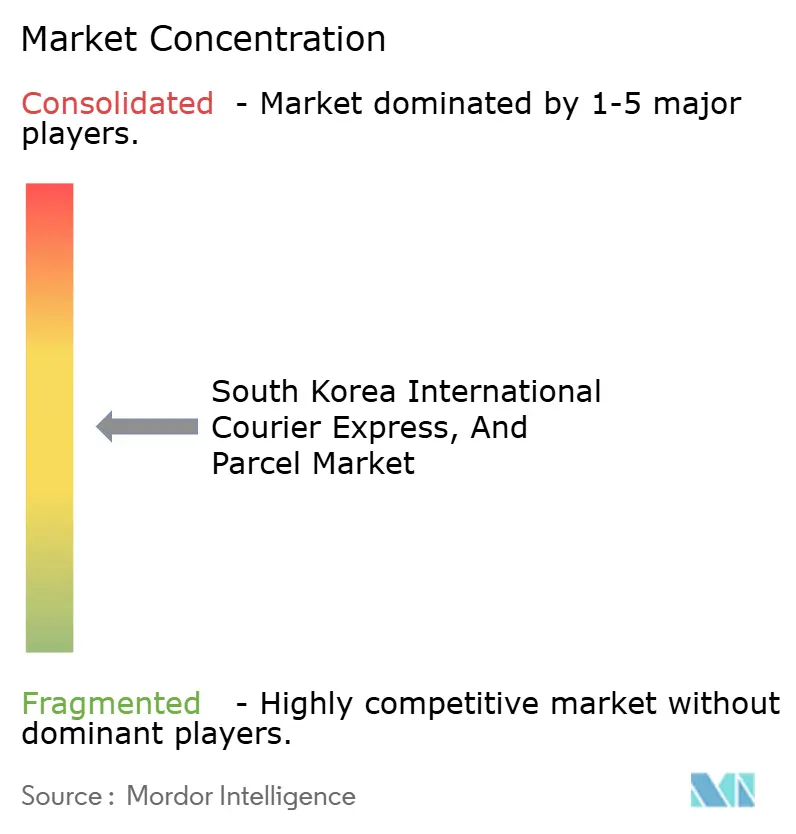
| Market Concentration | Medium |
Major Players *Disclaimer: Major Players sorted in no particular order Image © Mordor Intelligence. Reuse requires attribution under CC BY 4.0. | |
South Korea International Courier Express, And Parcel Market Analysis by Mordor Intelligence
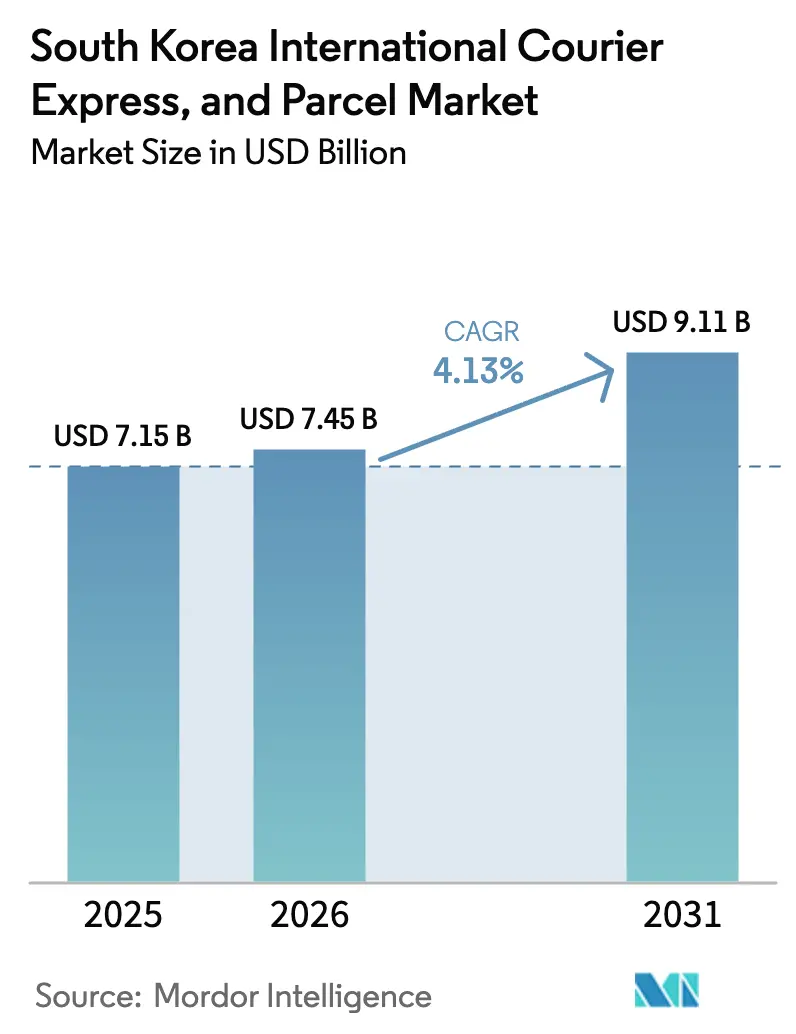
The South Korea International Courier Express, And Parcel Market size was valued at USD 7.15 billion in 2025 and estimated to grow from USD 7.45 billion in 2026 to reach USD 9.11 billion by 2031, at a CAGR of 4.13% during the forecast period (2026-2031).
Robust cross-border e-commerce activity, wide-ranging free-trade agreements, and a world-class digital infrastructure keep parcel volumes on an upward trajectory even though absolute values remain modest beside domestic logistics flows. Incheon Airport’s role as a Northeast Asian air-cargo gateway, coupled with dedicated belly-cargo capacity additions by major airlines, safeguards network resilience and frequency availability. Government programs that subsidize export-oriented SMEs and rapid growth in cold-chain parcels for pharmaceuticals further strengthen demand for premium, time-definite services. Competitive intensity continues to climb as domestic players, Korea Post EMS, and global couriers invest in automation, real-time visibility tools, and AI-driven routing. At the same time, high urban last-mile costs, cargo-terminal congestion, and rising green-air surcharges compel operators to refine cost structures without sacrificing service reliability.
Key Report Takeaways
- By speed of delivery, express services held 61.78% of the South Korea International Courier Express and Parcel Market share in 2025 and are advancing at a 4.56% CAGR through 2031.
- By shipment weight, light parcels accounted for 62.10% of the South Korea International Courier Express and Parcel Market size in 2025, while heavy-weight parcels are forecast to post a 4.44% CAGR to 2031.
- By end-user industry, e-commerce contributed 42.20% revenue share in 2025; healthcare is projected to grow at 4.29% CAGR over 2026-2031.
- By model, B2B transactions captured 50.40% of the 2025 market, whereas B2C flows are set to rise at 4.22% CAGR to 2031.
Note: Market size and forecast figures in this report are generated using Mordor Intelligence’s proprietary estimation framework, updated with the latest available data and insights as of 2026.
South Korea International Courier Express, And Parcel Market Trends and Insights
Drivers Impact Analysis*
| Driver | (≈) % Impact on CAGR Forecast | Geographic Relevance | Impact Timeline |
|---|---|---|---|
| Cross-border e-commerce export boom | +1.2% | Global with APAC and North America concentration | Medium term (2-4 years) |
| SME demand for time-definite delivery | +0.8% | National, spillover to regional partners | Short term (≤ 2 years) |
| FTAs and digital customs facilitation | +0.6% | Global, notably U.K., China, APEC | Long term (≥ 4 years) |
| Dedicated belly-cargo capacity expansion | +0.5% | APAC routes toward Americas & Europe | Medium term (2-4 years) |
| Cold-chain cross-border parcel growth | +0.4% | Developed markets worldwide | Long term (≥ 4 years) |
| Digital tourist-tax refund returns | +0.2% | National | Short term (≤ 2 years) |
| Source: Mordor Intelligence | |||
Cross-border e-commerce export boom
Online marketplaces allow Korean SMEs to reach global buyers, and the Ministry of SMEs and Startups has slashed freight charges by more than 60% for program participants. Exports still represent roughly 40% of national GDP, so seamless courier links are critical to macro performance. Beauty, fashion, and lifestyle brands prefer express parcels that offer integrated customs documentation and real-time tracking. Potential elimination of the U.S. de-minimis threshold could push shippers toward premium services that streamline new compliance requirements. Mobile commerce penetration and frictionless digital payments amplify traffic and encourage operators to embed checkout-to-doorstep fulfillment modules[1].
SME demand for time-definite delivery
Korean manufacturers in semiconductors, biotech, and precision machinery increasingly promise next-day shipping to overseas customers, forcing couriers to maintain tight delivery windows. UPS, DHL, and FedEx have all boosted overnight flight frequencies into Seoul to safeguard cut-offs. Real-time visibility tools, milestone alerts, and proactive exception handling now influence carrier selection as much as price. Government subsidies targeting SME export logistics ease adoption of higher-priced express tiers, supporting margin stability for operators[2].
FTAs and digital customs facilitation
A dense network of FTAs most recently with the U.K. under a continuity deal—eliminates or reduces duties on thousands of tariff lines, while Korea Customs Service’s single-window and pre-arrival systems accelerate clearance. The Asian Development Bank lists Korea with a 100% implementation score for sustainable trade facilitation measures. Electronic certificates of origin and paperless trade protocols cut dwell times and minimize documentation errors, directly benefiting express couriers that rely on predictable hand-overs.
Dedicated belly-cargo capacity expansion
Korean Air plans to introduce 54 new aircraft in 2025, combining freighters and passenger jets configured for cargo-friendly holds. ANA Group will operate at 108% of its 2024 international capacity, emphasizing cargo profitability on Asia-North America lanes. Flexible wide-body scheduling creates additional allotments for courier parcels, easing peak-season bottlenecks and enabling shorter transit times on multi-stop itineraries.
Restraints Impact Analysis*
| Restraint | (≈) % Impact on CAGR Forecast | Geographic Relevance | Impact Timeline |
|---|---|---|---|
| High urban last-mile costs | –0.7% | Seoul metropolitan area | Short term (≤ 2 years) |
| Incheon Airport cargo-terminal congestion | –0.5% | National gateway | Medium term (2-4 years) |
| Green-air-cargo surcharge pressure | –0.4% | Europe & North America lanes | Long term (≥ 4 years) |
| Low-cost Chinese postal packet rivalry | –0.3% | APAC with global spillover | Medium term (2-4 years) |
| Source: Mordor Intelligence | |||
High urban last-mile costs
Dense building clusters, short delivery windows, and rising labor expectations push per-stop expenses upward in Seoul. Delivery workers temporarily halted service in June 2025 to participate in snap-election voting, underscoring labor’s leverage. Local e-commerce players such as Coupang invest heavily in owned networks to contain costs, a level of vertical integration that international couriers struggle to replicate at lower volumes. Regulatory mandates on vehicle emissions and parking restrictions further squeeze margins[3].
Incheon Airport cargo-terminal congestion
The airport ranked among the world’s top three for international passenger throughput in 2024, stretching cargo infrastructure during peak travel seasons. Slot scarcity leads to sub-optimal departure times and standby freight, eroding the reliability premium attached to express services. Planned terminal upgrades require significant capital and multiyear timelines, so congestion is expected to persist through at least 2028.
*Our forecasts treat driver/restraint impacts as directional, not additive. The impact forecasts reflect baseline growth, mix effects, and variable interactions.
Segment Analysis
By Speed of Delivery: Express Services Drive Premium Growth
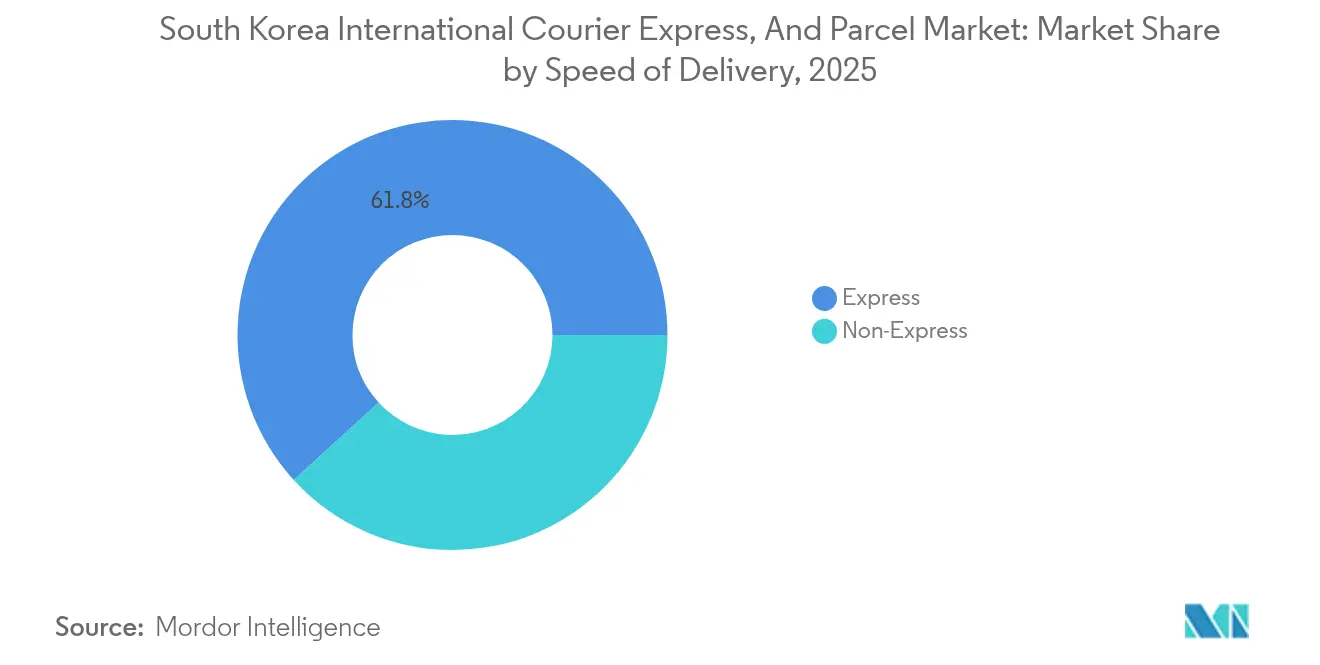
Express shipments captured a dominant 61.78% share of the South Korea international courier market in 2025, reflecting exporters’ willingness to pay for same- or next-day reliability. Non-express tiers cater to cost-sensitive bulk traffic but advance more slowly as customer expectations rise. FedEx’s nonstop Seoul-Taipei flights and DHL’s capacity upgrades on intra-Asia lanes shorten transit times and enlarge route density. Premium service providers continue to blend freighter lift with passenger belly space to preserve schedule flexibility.
Express operators leverage advanced tracking APIs, automated sortation, and AI-driven capacity forecasts to sustain customer satisfaction despite rising volumes. Integrated customs-brokerage modules handle electronic documents in seconds, offsetting Korea’s high labor costs by reducing manual touchpoints. As Korea’s semiconductor and bio-manufacturing firms widen overseas direct-to-customer channels, express parcels become integral to brand promises around speed and reliability. Over the outlook period, express shipments are on track to post a 4.56% CAGR, maintaining their central role within the South Korea international courier market.

By Shipment Weight: Light Parcels Dominate Volume
Light parcels represented 62.10% of the South Korea international courier market size in 2025, propelled by cross-border e-commerce orders for cosmetics, apparel, and consumer electronics. Their smaller physical footprint fits efficiently into passenger-aircraft belly holds, enabling higher flight frequency and rapid downstream processing. Conversely, heavy parcels—although only a minor share today—are projected to grow at 4.44% CAGR due to demand for industrial machinery, capital equipment, and oversized high-tech components. Couriers serving heavier segments adopt reinforced packaging, specialized handling crews, and dedicated freighter capacity.
Light-parcel dominance allows operators to standardize processes, install high-speed sorters, and negotiate favorable airline block-space agreements. Yet the growth in heavy parcels nudges carriers toward hybrid service models that blend courier-style tracking with freight-forwarder handling capabilities. Investments such as Taewoong Logistics’ T&C BUSAN hazardous-cargo terminal illustrate the infrastructure upgrades required to chase opportunities at the heavy end of the market.
By End-User Industry: E-commerce Leadership with Healthcare Acceleration
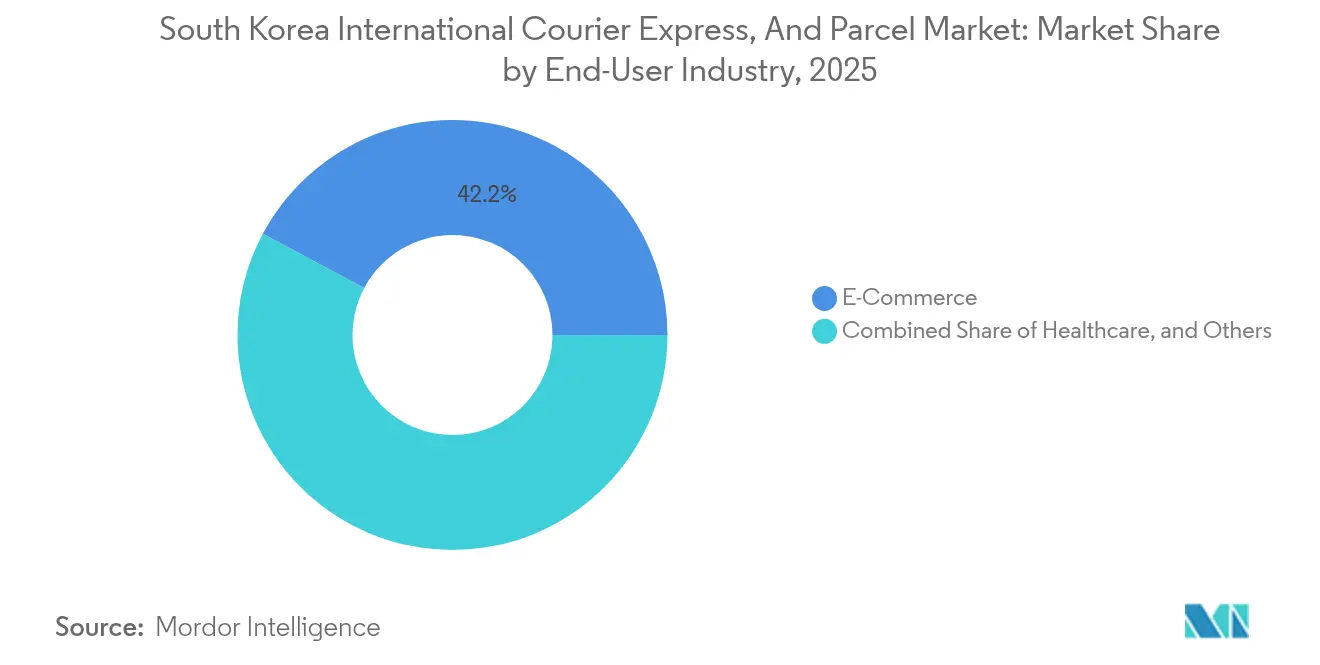
E-commerce sales accounted for 42.20% share in 2025, cementing their role as the single largest demand driver in the South Korea international courier market. The segment benefits from high smartphone penetration, quick adoption of global marketplaces, and government-backed SME export subsidies. Automated fulfillment hubs, such as CJ Logistics’ LoIS Parcel network, shorten outbound lead times and support same-day hand-over to air carriers.
Healthcare shipments, though smaller in value today, exhibit the fastest forward momentum at 4.29% CAGR thanks to Korea’s thriving biopharmaceutical pipeline. Temperature-controlled packaging, GDP-compliant chain-of-custody protocols, and on-board courier services create fresh revenue layers for operators able to certify compliance. Manufacturing, BFSI, and wholesale-retail continue to underpin base-load volume, safeguarding scale economies across the core network.
By Model: B2B Foundation with B2C Growth Momentum
B2B exchanges delivered 50.40% of 2025 transaction value, underscoring the export-oriented nature of Korea’s economy. Mature production networks in semiconductors, automotive parts, and precision instruments necessitate predictable delivery windows and deep customs-brokerage know-how. Nevertheless, B2C flows are climbing at 4.22% CAGR amid direct-to-consumer brand strategies and viral K-lifestyle product demand overseas. Integrated checkout-to-delivery APIs, transparent landed-cost calculators, and social-commerce extensions are reshaping service menus.
Customer-to-customer traffic remains a smaller steady niche covering personal gifts, student shipments, and relocation parcels. Digital self-service portals and drop-box networks keep this segment operationally viable despite its lower revenue per kilogram. Overall, balanced demand across models makes the South Korea international courier market resilient to sector-specific slowdowns.
Geography Analysis
South Korea’s compact national footprint concentrates shipment origins around the Seoul-Incheon corridor, enabling couriers to optimize pickup density and hub-sort cycles. The country’s 65.4% 5G penetration rate supports real-time parcel visibility and driver navigation, elevating customer service benchmarks. Incheon Airport remains the pivotal international node, with over 42 dedicated cargo aircraft in the national fleet as of 2025 and more on order to expand lift capacity.
Regional proximity to China, Japan, and Southeast Asian consumption hubs lets carriers capitalize on short haul, high-yield corridors, while deep-sea ports at Busan and Gwangyang offer intermodal alternatives for heavier consignments. Korea’s participation in APEC agendas and multiple bilateral FTAs speeds customs clearances and slashes tariff barriers, giving the South Korea international courier market a competitive edge on intra-Asia lanes. Still, single-gateway dependency on Incheon introduces congestion risks during peak export seasons, urging policymakers to fast-track terminal expansions and promote secondary air-cargo sites.
National digital trade initiatives including electronic certificates of origin and AI-assisted risk profiling minimize paperwork and reduce dwell times, allowing couriers to meet tight SLA promises to U.S. and European customers. Continued investment in AI, 6G pilots, and cybersecurity under the Digital Innovation & Diffusion Strategy ensures that the South Korea international courier market maintains its reputation for high service reliability and data transparency.
Regulatory Landscape
South Korea regulates parcel and last-mile activities through a combination of sector rules, labor-and-safety requirements, and competition enforcement, all of which affect courier cost structures and subcontracting models. A key update is the amended Last-Mile Logistics Industry Development Act, promulgated on December 2, 2025 and effective June 3, 2026, which mandates the use of standard outsourcing contracts for delivery workers and requires verification of safety training and commercial insurance coverage across contracted delivery arrangements.
Competition oversight has also tightened around contract terms and platform-style practices in delivery. On May 18, 2026, the Korea Fair Trade Commission fined five delivery companies a combined 3.078 billion won (including CJ Logistics, Lotte Global Logistics, Hanjin, Coupang Logistics Service, and Logen) for unfair terms that shifted safety-accident liabilities to agencies and for failures related to timely written contracts. Separately, proposals under review in the National Assembly to cap delivery platform intermediation and advertising fees indicate continuing regulatory attention on the economics of delivery platforms, with potential implications for pricing and partner strategies for carriers involved in cross-border parcel flows.
Value Chain Analysis
The international CEP value chain in South Korea starts with shippers, including cross-border e-commerce sellers, manufacturers, and healthcare exporters. It then moves through order capture and compliance steps such as labeling, HS classification, and e-documents, followed by first-mile pickup or drop-off and domestic line-haul feeding into the Seoul-Incheon corridor. Parcels are consolidated at sort centers and handed to airside operations, primarily Incheon Airport, for uplift. The sequence continues with destination-country line-haul, last-mile delivery, returns, and customer service, where end-to-end visibility and exception management increasingly define performance.
Public and quasi-public bodies influence service quality and network design alongside private integrators. The Ministry of Land, Infrastructure and Transport annually evaluates parcel service providers, and in its 2026 evaluation of 2025 performance, Lotte Global Logistics, Korea Post, and Hanjin received A+ ratings, reinforcing the role of measured service standards in carrier selection. Trade enablement and resilience initiatives also feed into the chain: in mid-2026, government supply-chain measures prioritized diversification and domestic production for high-dependency items through low-interest financing from a supply chain stabilization fund, while the Busan Port Authority operates an overseas logistics network, including bases such as Rotterdam, Barcelona, Los Angeles, and Hai Phong, to support exporters with additional routing and consolidation options for certain cross-border flows.
Competitive Landscape
Competition spans domestic integrators, the public postal operator, and global express giants. CJ Logistics and Korea Post EMS leverage dense national depots and localized know-how to manage challenging urban deliveries, whereas DHL, FedEx, and UPS bank on global networks for end-to-end visibility and cross-border capacity guarantees. Medium-size entrants such as SLX and ILYANG Logis carve out niches in specialized B2B lanes and hazardous cargo.
Technology forms the battleground. CJ Logistics’ LoIS Parcel platform automates warehousing and sortie planning, while DHL and UPS roll out AI-supported demand forecasting to match lift supply with volatile e-commerce peaks. Foreign direct investment is heating up: Ta-Hwa’s USD 15.48 million purchase of SKYWASTER EXPRESS secures a Korea-Japan dual-hub model to improve supply-chain resilience. Meanwhile, start-ups like Kokkan Logis deploy algorithmic brokerage engines that claim up to 20% route-cost savings, nudging incumbents toward pricing transparency.
Sustainability also shapes rivalry. Early movers lock in sustainable aviation fuel commitments to mitigate carbon surcharges, differentiating their B2B propositions on ESG compliance. Others retrofit city-center micro-hubs and deploy electric cargo vans to contain last-mile emissions and bypass traffic restrictions. Collective share held by the top five participants hovers near 45%, indicating moderate concentration yet ample space for specialized challengers.
South Korea International Courier Express, And Parcel Industry Leaders
-
CJ Logistics
-
Korea Post (EMS)
-
Hanjin Transportation
-
Lotte Global Logistics
-
DHL Express
- *Disclaimer: Major Players sorted in no particular order
Market Opportunities and Future Outlook
Automation and AI adoption across sorting and middle-mile operations is a key whitespace where policy support and demonstrable pilots are taking shape, giving carriers room to differentiate on speed, accuracy, and labor productivity. On July 14, 2026, the Ministry of Land, Infrastructure and Transport, Korea Post, and the Korea Integrated Logistics Association signed an MOU to pilot AI technologies at postal sorting centers nationwide. The plan provides a pathway for scaling machine-vision, predictive routing, and throughput optimization capabilities that can extend into export parcel processing.
There is also opportunity in higher-reliability line-haul and cross-border corridor development, since improved handoff consistency supports SLA delivery for exporters, particularly in time-definite segments. Hanjin began commercial paid freight transport using a 25-ton autonomous truck on July 9, 2026, running a 118-kilometer route between Gunsan Port and Daejeon Mega Hub three times a week, which points to operational experimentation that can be extended into hub-and-spoke parcel line-haul efficiency. In parallel, overseas logistics footprint build-outs by Korean trade infrastructure bodies support network optionality for shippers, as shown by the Busan Port Authority building a 10,310-square-meter logistics hub in Hai Phong, Vietnam, with operations scheduled for the first half of 2027.
Recent Industry Developments
- July 2026: CJ Logistics builds CJ Logistics America to help brands enter and grow in the U.S. market. The initiative expands cross-border e-commerce reach through a scalable U.S. logistics platform and integrated service network. This strengthens CJ's U.S.-bound logistics capabilities and end-to-end service scale for international brands.
- May 2026: CJ Logistics marks the 10-year anniversary of its strategic partnership with iHerb, noting that annual handling volume grew from 1.1 million to 10.4 million boxes in 2025. The collaboration signals a robust cross-border fulfillment engine supporting U.S. and other markets. The collaboration reinforces CJ’s position in cross-border e-commerce logistics and demonstrates scalable capacity through a key partner.
- May 2026: Lotte Global Logistics completes the Dong Nai Cold Chain Center in Vietnam (26,167 sqm within 55,553 sqm site) to support fresh and high-value goods distribution. The new facility enables enhanced regional cold-chain capacity for Southeast Asia. Creates a regional hub for Southeast Asia, enhancing resilience and speed for cold-chain pharma and food shipments.
Research Methodology Framework and Report Scope
Market Definition and Coverage
This market covers revenue earned from international courier, express, and parcel delivery linked to South Korea, including cross-border documents and parcels handled through express and standard international networks, and counted in USD value.
Scope exclusions: Domestic-only parcel movements within South Korea and in-house shipper delivery operations are excluded.
Segmentation Overview
- By Model
- Business-to-Business (B2B)
- Business-to-Customer (B2C)
- Customer-to-Customer (C2C)
- By Speed of Delivery
- Express
- Route
- Inter-Region
- Intra-Region
- Route
- Non-Express
- Express
- By Shipment Weight
- Heavy Weight Shipments
- Light Weight Shipments
- Medium Weight Shipments
- By End User Industry
- E-Commerce
- Financial Services (BFSI)
- Healthcare
- Manufacturing
- Primary Industry
- Wholesale and Retail Trade (Offline)
- Others
Data Sources, Market Sizing, and Validation
Desk Research
Desk research was used to set the outer boundaries of the market and to anchor key demand signals that typically move cross-border shipments. We referenced official trade and logistics indicators such as Korea Customs Service trade statistics, UN Comtrade, the Bank of Korea and IMF time series (for FX and macro trends), and Ministry of Land, Infrastructure and Transport releases, along with UPU postal statistics where relevant.
To convert activity into value, we also reviewed public company filings and investor presentations, transport and air cargo statistics published by airport operators, and reputable press coverage of rate changes and service disruptions. Where needed, paid subscriptions for company financials and intelligence, shipment-level import and export data, and tender tracking were used to sanity-check major lanes and pricing direction. The sources listed here are illustrative only, and many other public and paid references were also used for collection, validation, and clarification.
Primary Interviews and Surveys
We use expert interviews and surveys with shippers, postal and courier managers, customs and logistics specialists, and e-commerce operations leaders in South Korea. Their responses clarify shipment mix, fees, delivery speed, cross-border demand, and gaps in operator data, allowing us to reconcile secondary evidence with the final assumptions for this market.
Distribution of primary research fieldwork respondents
| Company type | Respondent position |
|---|---|
| Top tier: 30% | CXOs: 15% |
| Mid tier: 50% | Functional/Unit leaders: 30% |
| Smaller Players: 20% | Managers: 55% |
Market-Sizing & Forecasting
The core model uses a top-down build where trade-linked shipment activity and cross-border delivery intensity are reconstructed and then translated into revenue using an average selling price (ASP) curve by service speed and package type. Once the demand pool is formed, we corroborate it with selective bottom-up checks such as sampled shipper spend, lane-level rate cards, and carrier revenue splits that are visible in public disclosures.
Inputs that matter for this market include South Korea import and export volumes by major partners, air cargo throughput and capacity direction, cross-border e-commerce order momentum, express versus standard share shifts, and surcharge patterns tied to fuel and security screening. When a data point is missing for a lane or service type, we bridge gaps using nearby proxy indicators (for example, trade value and air cargo trends) and then re-test the implied ASP so it stays within the range validated by interviews.
Forecasting is run using scenario analysis supported by simple multivariate regression, where variables like FX direction, trade growth, and capacity conditions are stress-tested with expert feedback before finalizing the central case. The result is a model that can be explained and repeated, while still reflecting real operational drivers in international CEP.
Data Validation & Update Cycle
Validation is done through a few practical checks, so the totals remain consistent with independent signals like trade series, air cargo indicators, and publicly discussed rate movements. Variances are reviewed, and when the gap looks structural rather than timing related, assumptions are revisited and targeted re-contacts are triggered to confirm what changed.
Before sign-off, the work is reviewed in steps, including an internal logic check on units, currency conversion timing, and the link between volumes and ASP. Reports are refreshed annually, and interim updates are made when material events occur, after which a final pre-delivery pass is completed so clients receive the latest view.
Mordor Intelligence's South Korea International Courier Express and Parcel Cep Market Size Measured Against Other Published Estimates
Published market sizes can look far apart even when they talk about the same topic, because international CEP is sensitive to currency timing, fuel and remote-area surcharge treatment, and whether rates are taken as contracted or spot-like averages. Differences also show up when one publisher leans more on shipment counts, while another relies more on financial disclosures and then applies a broad price curve.
A refresh-led gap is common here because yearly FX averages and tariff changes can move the USD value even if local pricing is steady, and because ASP progression can be modeled using different pass-through speeds for surcharges. In this study, the market value is re-checked against trade and air cargo signals close to the cut-off date, and that refresh cadence and currency timing discipline is what keeps Mordor Intelligence aligned to the most current cross-border demand conditions.
Benchmark comparison
| Source | Market Size | Gaps in Research Methodology |
|---|---|---|
| Mordor Intelligence | USD 7.15 B (2025) | |
| Industry Advisory A | USD 6.60 B (2025) | Often applies a conservative ASP curve by assuming weaker surcharge pass-through and a higher share of economy services, which can understate revenue when express mix tightens during capacity constraints. |
| Trade Publication B | USD 7.90 B (2025) | Commonly blends international parcel with adjacent cross-border logistics fees and may convert to USD using a point-in-time FX rate, which can lift reported value versus a full-year average approach. |
The comparison mostly comes down to what is counted as CEP revenue, how ASP is stepped up with surcharges, and which FX timing is used for USD conversion. By keeping the scope tied to international courier, express, and parcel delivery revenue and by validating the pricing curve with recent market checks, we arrive at a balanced number that can be traced back to clear drivers.
Key Questions Answered in the Report
How big is the South Korea International Courier Express, and Parcel Market in 2026?
It is valued at USD 7.45 billion for 2026, with a projected rise to USD 9.11 billion by 2031.
Which segment grows fastest by speed of delivery?
Express services grow at a 4.56% CAGR thanks to strong SME demand for time-definite exports.
What drives the surge in healthcare parcels?
Expansion of Korea’s bio-pharma exports and the need for GDP-compliant cold-chain logistics boost healthcare parcels at 4.29% CAGR.
Why are last-mile costs a restraint?
Dense urban geography, labor pressures, and emission rules raise per-stop delivery expenses, reducing margins in Seoul-Incheon corridors.
Which players dominate the competitive landscape?
CJ Logistics, Korea Post EMS, DHL, FedEx, and UPS together hold roughly 45% of market revenue, reflecting moderate concentration.
What impact will potential U.S. de-minimis changes have?
Removal could raise compliance costs for low-value exports, steering SMEs toward premium couriers with advanced customs-brokerage services.