
South Korea Electric Vehicle Battery Market Size and Share
Market Overview
| Study Period | 2020 - 2031 |
|---|---|
| Forecast Data Period | 2026 - 2031 |
| Base Year Market Size (2025) | USD 8.36 Billion |
| Market Size (2026) | USD 9.87 Billion |
| Market Size (2031) | USD 22.62 Billion |
| Growth Rate (2026 - 2031) | 18.10 % |
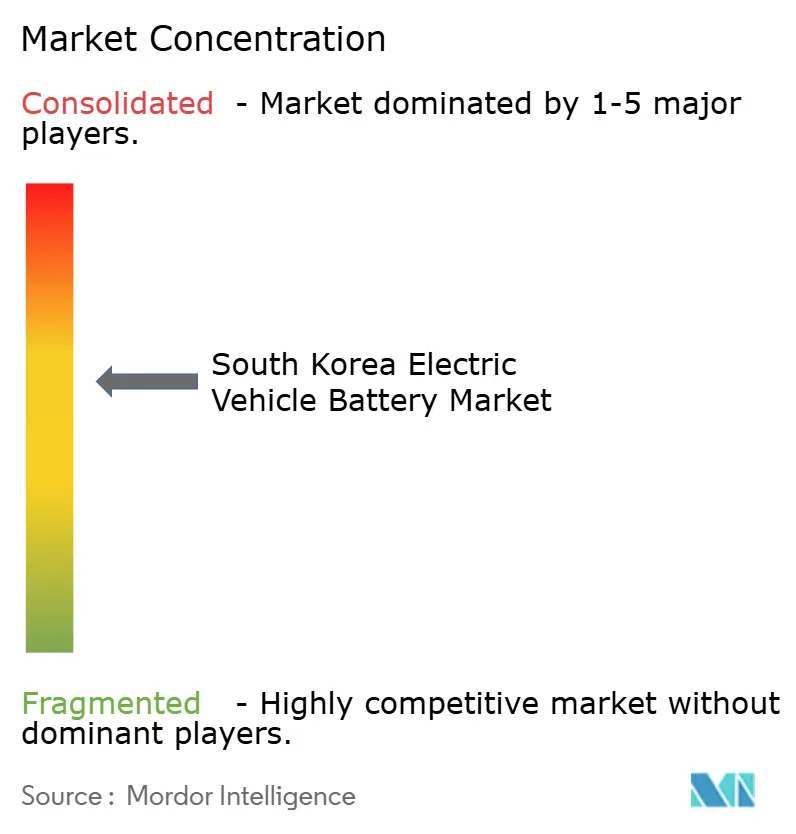
| Market Concentration | Medium |
Major Players *Disclaimer: Major Players sorted in no particular order Image © Mordor Intelligence. Reuse requires attribution under CC BY 4.0. | |
South Korea Electric Vehicle Battery Market Analysis by Mordor Intelligence
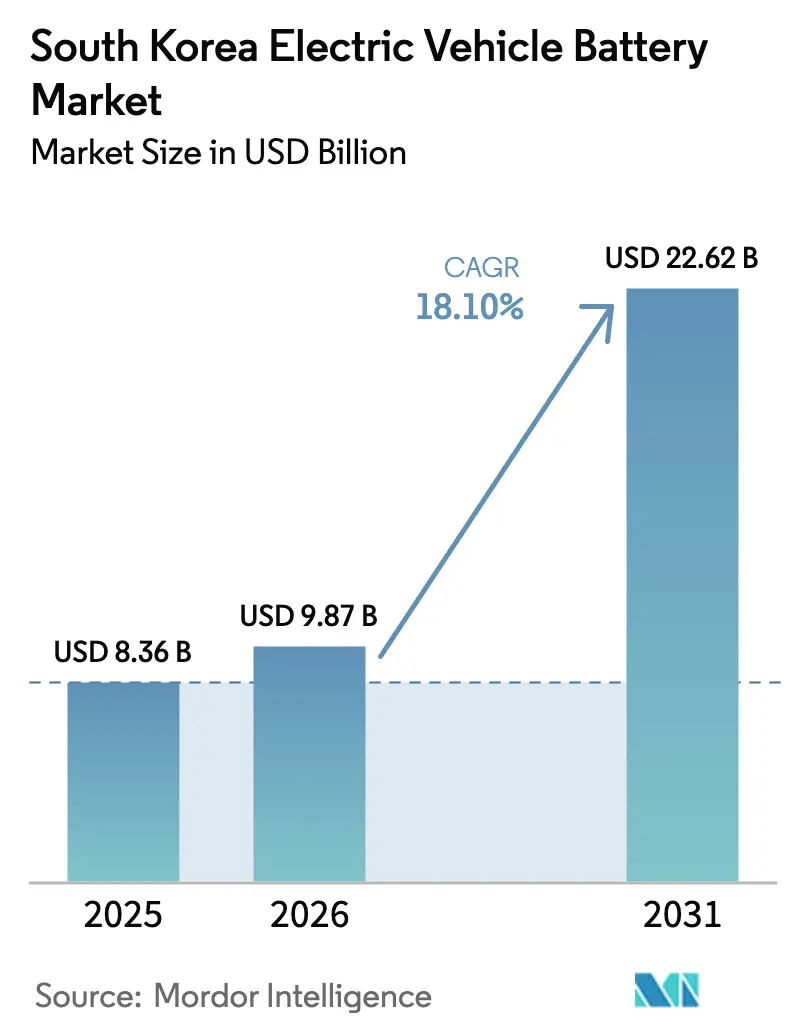
The South Korea Electric Vehicle Battery Market size is expected to grow from USD 8.36 billion in 2025 to USD 9.87 billion in 2026 and is forecast to reach USD 22.62 billion by 2031 at 18.1% CAGR over 2026-2031. The current South Korea electric vehicle battery market size demonstrates the nation’s ability to convert long-term industrial policy into immediate commercial scale, helped by rapid giga-factory build-outs and targeted consumer incentives. Demand surges as domestic automakers accelerate electrified model launches, while defense procurement and second-life initiatives open parallel revenue channels that lessen exposure to raw-material cost swings. Competitive intensity remains high. Yet, local firms sustain a technological edge in high-nickel and emerging LFP chemistries, allowing them to defend premium pricing in export markets. Grid-capacity constraints and commodity volatility weigh on near-term margins. Still, recycling frameworks and vertical integration efforts mitigate structural risks, underscoring the resilience of the South Korean electric vehicle battery market.
Key Report Takeaways
- By battery chemistry, lithium-ion led with 87.10% revenue share of the South Korean electric vehicle battery market in 2025, and it is also growing at a robust CAGR of 18.08% through 2031.
- By vehicle type, battery electric vehicles commanded 72.65% of South Korea's electric vehicle battery market share in 2025, while plug-in hybrid electric vehicles are projected to post an 18.22% CAGR through 2031.
- By cell form factor, pouch cells accounted for 50.68% of the South Korean electric vehicle battery market size in 2025, and cylindrical cells are expected to expand at an 18.31% CAGR to 2031.
- By battery component, cathode active material captured 36.25% share of the South Korean electric vehicle battery market size in 2025, whereas separators are forecast to grow at 18.28% CAGR during the outlook period.
Note: Market size and forecast figures in this report are generated using Mordor Intelligence’s proprietary estimation framework, updated with the latest available data and insights as of 2026.
Market Trends and Insights
Drivers Impact Analysis of South Korea Electric Vehicle Battery Market*
| Driver | (~) % Impact on CAGR Forecast | Geographic Relevance | Impact Timeline |
|---|---|---|---|
| OEM-Backed Giga-Factory Build-Outs | +4.1% | National core, with expansion to North America and Europe | Short term (≤ 2 years) |
| Escalating Government EV-Adoption | +3.2% | National, with spillover to ASEAN export markets | Medium term (2-4 years) |
| Rapid Growth In Domestic EV Exports | +2.8% | National production, global market reach | Medium term (2-4 years) |
| Rising ESS-To-EV Line Conversions | +1.9% | National, with technology transfer potential | Long term (≥ 4 years) |
| Second-Life Battery Repurposing Incentives | +1.1% | National, with regional demonstration effects | Medium term (2-4 years) |
| Military Electrification Programs | +0.7% | National defense applications | Long term (≥ 4 years) |
| Source: Mordor Intelligence | |||
OEM-Backed Giga-Factory Build-Outs
Between 2025 and 2028, Korean firms are executing a synchronized capacity surge exceeding 200 GWh, financed through rights issues, multilateral loans, and joint ventures. SK On completed its first solid-state pilot line in September 2025, giving the company a developmental lead in post-lithium chemistries [1]. Samsung SDI raised a vast amount in March 2025 to fund high-nickel and LFP modules. LG Energy Solution’s Michigan LFP project and a supply agreement with Tesla bind future cash flows to U.S. policy incentives [2]. The Blue Oval SK joint venture secured a massive amount in Department of Energy financing, confirming the strategic importance of Korean know-how to North American electrification. These announcements compress payback periods and position the South Korean electric vehicle battery market as the design hub supporting a dispersed manufacturing footprint.
Escalating Government EV-Adoption Mandates
Korea’s revised subsidy schedule eliminates many imported models from incentive eligibility, channeling household purchases toward Hyundai and Kia platforms that exclusively source domestic cells [3]. The program also covers light-duty commercial fleets and military vehicles, further deepening captive demand for the South Korean electric vehicle battery market. A 2025 budget allocation of up to KRW 200 billion extends preferential tax credits to battery plants labeled “advanced strategic industries,” trimming effective capital costs by as much as three-fifths [4]. Southeast Asian partner states mirror these rules through bilateral memoranda, creating export demand for Korean-made packs. Korea’s volume-based waste charging system and extended producer responsibility laws, which have been in force since 2003, supply the regulatory backbone for closed-loop material recovery, reinforcing domestic value retention.
Rapid Growth in Domestic EV Exports
Hyundai Motor Group shipped a record nearly three lakh battery-electric cars in 2024, a one-fifth year-on-year jump that directly translates into higher cell pull-through for local suppliers. Planned investment in the Georgia assembly represents a template for co-located battery sourcing, lowering freight and inventory costs. Still, the Federation of Korean Industries estimates restrictive U.S. tax credits could trim outward sales by a considerable amount yearly, exposing the South Korean electric vehicle battery market to regulatory swings. Global installations grew exponentially in Q1 2025, and Korean brands retained one-fifth share despite greater Chinese penetration, demonstrating that volume growth can coexist with sliding share ratios.
Rising ESS-to-EV Line Conversions
Maturing stationary-storage demand has prompted LG Energy Solution, Samsung SDI, and SK On to retool idle ESS capacity for automotive cells, raising blended factory utilization above four-fifths in 2025. Conversion leverages existing dry-room, calendaring, and formation assets, cutting capital intensity by one-fourth versus greenfield builds. Convergence of ESS and EV performance specs around cycle life and thermal tolerance simplifies design transfer, while flexible scheduling allows firms to toggle between markets if either segment softens. The strategy broadens output options for the South Korean electric vehicle battery market and acts as a hedge against commodity price shocks that affect deployment economics differently across use cases.
Restraints Impact Analysis of South Korea Electric Vehicle Battery Market*
| Restraint | (~) % Impact on CAGR Forecast | Geographic Relevance | Impact Timeline |
|---|---|---|---|
| Nickel + Lithium Price Volatility | -2.4% | Global supply chains, concentrated impact on Korean refiners | Short term (≤ 2 years) |
| Grid-Capacity Bottlenecks | -1.8% | National infrastructure constraints | Medium term (2-4 years) |
| Heightened ESG Scrutiny | -1.1% | Global operations, supply chain transparency | Long term (≥ 4 years) |
| Domestic Skilled-Labor Shortages | -0.9% | National manufacturing base | Medium term (2-4 years) |
| Source: Mordor Intelligence | |||
Raw Material Price Volatility
Due to their high-nickel cathode mix, Korean manufacturers carry added exposure to nickel swings. POSCO Future M’s diversification into non-Chinese graphite underscores the urgency of raw-material hedging. LG Chem’s March 2025 reveal of precursor-free LFP cathodes seeks to lessen dependence on volatile feedstocks. Meanwhile, domestic electricity tariffs climbed three-fifths from 2022 to 2024, amplifying input cost pass-through risks within the South Korean electric vehicle battery market.
Grid-Capacity Bottlenecks at New Cell Plants
Gigawatt-scale plants require up to 900 GWh of steady power annually, yet local substations often hit capacity ceilings during commissioning. Government commitments to expand high-voltage links lag implementation, forcing manufacturers to stagger ramp-ups or add on-site generation that raises capex. SK Nexilis cited power prices less than half Korean levels when justifying Malaysian expansion, reflecting how domestic grid limits dent cost competitiveness. Concentrated industrial parks intensify peak loads, disrupting process stability for cathode calcination and cell formation. These bottlenecks delay output, constrict the South Korean electric vehicle battery market, and compel firms to diversify buildouts overseas.
*Our forecasts treat driver/restraint impacts as directional, not additive. The impact forecasts reflect baseline growth, mix effects, and variable interactions.
South Korea Electric Vehicle Battery Market Segment Analysis
By Battery Chemistry:
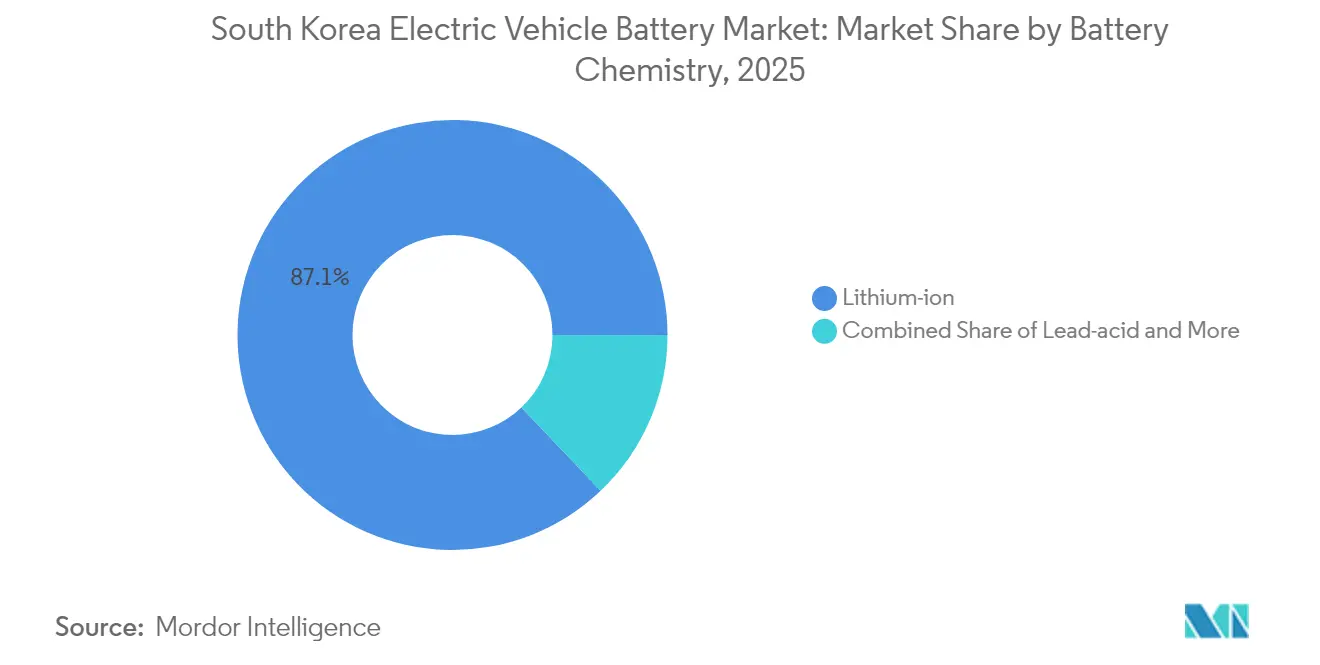
Lithium-ion Sustains Dominance While LFP Gains GroundLithium-ion technology accounted for 87.10% of the South Korean electric vehicle battery market in 2025, and the segment is forecast to grow at an 18.08% CAGR to 2031 as incremental improvements in high-nickel and silicon-rich anodes push performance benchmarks further. This chemistry continues to benefit from entrenched supply networks and advanced automation, allowing scale advantages that smaller alternatives struggle to match. Research initiatives such as LG Chem’s precursor-free cathodes cut energy use by 20% in coating stages, driving cost parity with entry-level chemistries. Conversely, lead-acid and nickel-metal hydride remain relegated to auxiliary and hybrid niches, reducing relevance as lithium-ion costs slide.
LFP capacity additions mark a strategic hedge against nickel volatility and emerging mass-market EV price points for Korean players. Next-generation R&D efforts at POSTECH explore fluoride-free systems to satisfy looming RoHS restrictions and enhance ion mobility. This widening chemistry portfolio allows the South Korean electric vehicle battery market to serve value-tier cars without sacrificing premium leadership in energy-dense segments.

By Vehicle Type:
BEVs Anchor Revenue as PHEVs AccelerateBattery electric vehicles held 72.65% of the South Korean electric vehicle battery market in 2025, leveraging greater range capability and expanding fast-charge networks to convert internal-combustion loyalists. Hyundai’s 300 Wh/kg LFP pack prototype cuts 7 minutes off two-fifths of the charging time, lifting consumer acceptance and strengthening local demand. Though smaller in volume, Plug-in hybrids are forecast to post an 18.22% CAGR through 2031 as automakers use them to meet tightening fleet-average requirements in cost-sensitive export regions.
Hybrid electric vehicles still fill a practicality gap in markets with sparse charging, giving Korean suppliers steady baseline orders that smooth factory utilization. Samsung SDI’s robot-platform battery deal illustrates how non-passenger segments diversify revenue streams, reinforcing the South Korean electric vehicle battery market against cyclical swings in personal vehicle sales.
By Cell Form Factor:
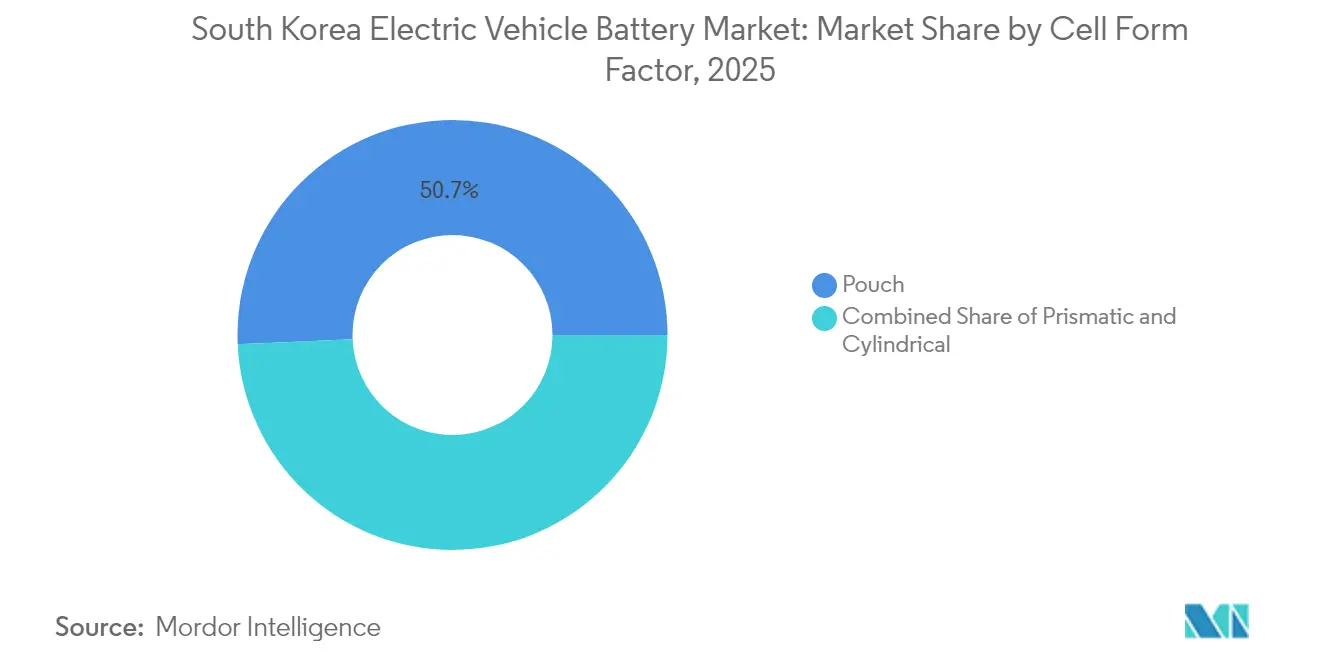
Pouch Supremacy Faces Cylindrical ExpansionPouch cells captured 50.68% of the South Korean electric vehicle battery market size in 2025, benefiting from design flexibility that lets automakers maximize cabin volume and manage thermal loads efficiently. However, cylindrical cells are projected to expand at an 18.31% CAGR through 2031 as automation advances drive down per-unit costs and Tesla’s 4680 standard gains broad OEM acceptance. LG Energy Solution’s new 46-series range bridges the structural advantages of prismatic formats with the cost profile of cylindrical, ensuring Korean manufacturers maintain a presence across architectures.
Prismatic formats retain specialized demand in commercial vehicles that value mechanical rigidity. Continuous form-factor diversification underpins the competitiveness of the South Korean electric vehicle battery market by matching varied OEM pack philosophies without compromising supply-chain economies of scale.
By Battery Component:
Cathode Materials Drive Value CreationCathode active material claimed 36.25% share of the South Korean electric vehicle battery market in 2025, reinforcing its role as the principal cost and performance lever in cell economics. Korean specialists EcoPro BM and L&F chase high-nickel NCM and manganese-rich variations to raise energy density above 750 Wh/L. Meanwhile, separators lead growth at an 18.28% CAGR as ceramic-coated films extend safety envelopes to 180 °C operating thresholds, permitting faster-charging architectures.
Anode R&D focuses on gradient-structured silicon integrations that deliver 10% energy gains with negligible swelling. Electrolyte innovators pursue fluoro-ether blends to widen temperature windows and align with forthcoming PFAS restrictions, ensuring the South Korean electric vehicle battery market sustains compliance-driven differentiation opportunities.
Geography Analysis
Domestic installations remain the bedrock of the South Korean electric vehicle battery market, with local demand supported by protectionist subsidies and a four-fifths recycling rate achieved under long-standing EPR rules. Military procurement adds a strategic layer as Samsung SDI supplies submarine batteries, extending utilization beyond civilian cars. Stable home-market cash flows finance aggressive foreign expansion while cushioning margin compression from export headwinds.
North America has emerged as the fastest external growth node following the U.S. Inflation Reduction Act. LG Energy Solution’s Michigan line and Blue Origin SK’s triplet of plants commit a considerable amount, unlocking supply deals with Ford and Tesla that elevate Korean content in U.S. vehicle assemblies. However, Policy-linked eligibility caps could trim Korean vehicle exports, which grew exponentially yearly, a scenario that underscores the need for further localization.
Due to strict fleet-average CO₂ limits and pension-fund ESG mandates, Europe offers complementary demand, enticing Samsung SDI and SK On into Polish and Hungarian ventures. Yet logistics and energy-price volatility require hedging strategies such as building cathode precursor facilities inside the block. ASEAN markets provide volume upside and tariff relief owing to existing FTAs, allowing Korean firms to counter Chinese pricing through brand positioning around reliability and safety, thereby broadening the geographic diversification base of the South Korean electric vehicle battery market.
Regulatory Landscape
South Korea is tightening traceability and safety-related disclosure requirements for EV batteries while building a legal framework for end-of-life management. In 2026, battery information transparency rules expanded disclosure categories from six to 10, increasing compliance obligations across cell makers, pack integrators, and automakers supplying the domestic market.
A major policy anchor is the Act on the Management and Promotion of the Used Battery Industry (Used Battery Act), which passed the National Assembly on April 23, 2026 and was approved by the Cabinet on May 20, 2026. The law introduces lifecycle tracking and a public platform for battery data, with implementation slated for one year after promulgation, and it sets up an End-of-Life Battery Policy Committee under the Ministry of Economy and Finance to coordinate used-battery policies. In parallel, battery recycling has been reclassified from waste treatment to critical mineral manufacturing, supporting industrial permitting and investment for recycling and material recovery.
Value Chain Analysis
South Korea's EV battery value chain spans upstream raw materials and processing (nickel, lithium, graphite, and precursors), active materials (cathode and anode), cell manufacturing (notably pouch, cylindrical, and prismatic lines), pack assembly and BMS integration, and downstream reuse/recycling. The domestic core is anchored by large cell manufacturers (LG Energy Solution, Samsung SDI, SK On) and Korean materials specialists (for example, cathode and separator ecosystems), with increasing emphasis on integrating cathode production and recycling to reduce exposure to commodity volatility and to align with export compliance requirements.
Policy and infrastructure initiatives are shaping how the chain operates. For 2026, the government raised passenger EV subsidies to KRW 936 billion and expanded guarantee programs for auto parts suppliers, supporting working capital and continuity for pack and component suppliers. On the compliance and trade side, MOTIE-led development of a Data Platform for Battery Supply Chain and a Transaction Information System is being positioned to support traceability, disclosure, and downstream reporting, while the reclassification of recycling as critical mineral manufacturing is encouraging tighter closed-loop linkages between collection, dismantling, and materials re-entry into cathode supply.
Competitive Landscape
Market concentration is high, with LG Energy Solution, Samsung SDI, and SK On collectively commanding most of domestic capacity and holding one-fifth of global installations in Q1 2025. LG Energy Solution emphasizes open-innovation alliances, signing a multi-year agreement with Tesla and co-developing silicon-rich anodes with startup Sila Nanotechnologies.
Samsung SDI prioritizes premium automotive niches, announcing a 10-layer stacked solid-state prototype promising 900 Wh/L by 2026. SK On advances vertical integration, merging upstream trading units to streamline nickel and graphite procurement.
White-space growth appears in circular-economy plays. Thoth Inc.’s AI robotic disassembly platform, winner of four CES 2025 awards, aims to trim recycling labor costs by two-fifths, offering collaborations with Korea’s legally mandated waste-recovery quotas. The national RoHS update, effective 2026, forces smaller foreign entrants to upgrade compliance systems, indirectly protecting incumbent share in the South Korean electric vehicle battery market. Intellectual-property barriers strengthen as POSTECH’s fluoride-free binder patents receive U.S. approvals, limiting imitation and sustaining premium margins.
South Korea Electric Vehicle Battery Industry Leaders
-
LG Energy Solution Ltd
-
Samsung SDI Co. Ltd
-
SK Innovation Co. Ltd
-
Hyundai Motor Group
-
POSCO Future M
- *Disclaimer: Major Players sorted in no particular order
South Korea Electric Vehicle Battery Market Companies Covered in this Report
- LG Energy Solution Ltd
- Samsung SDI Co. Ltd
- SK On Co. Ltd
- Hyundai Mobis Co. Ltd
- POSCO Future M Co. Ltd
- ECOPRO BM Co. Ltd
- Enertech International Inc.
- Kokam Co. Ltd
- L&F Co. Ltd
- Iljin Materials Co. Ltd
- SKC Ltd
- Hansol Chemical Co. Ltd
- OCI Co. Ltd
- Enchem Co. Ltd
- Doosan Mobility Innovation
- Hanwha Solutions
- Daejoo Electronic Materials
- Woongjin Energy
- S-Connect Co. Ltd
- CJ ENM Battery Division
Read Analysis of South Korea Electric Vehicle Battery Companies
Market Opportunities and Future Outlook
Regulatory-driven traceability and end-of-life governance are opening whitespace for battery data infrastructure and compliant circular-economy services across the domestic EV battery ecosystem. The Used Battery Act (passed April 2026, Cabinet-approved May 2026) embeds lifecycle tracking and a public battery-data platform, while MOTIE, MOE, and MOLIT are progressing integrated portals for battery lifecycle data with full integration targeted for 2027. This creates near-term demand for standardized identification, transaction systems, and analytics that connect automakers, cell makers, logistics providers, and recyclers.
Technology and capacity programs provide additional opportunity lanes across next-generation chemistries and recycling-linked vertical integration. The government announced KRW 280 billion over four years (Nov 2025) for next-generation batteries (including all-solid-state, lithium metal, and lithium sulfur), and MSIT is investing KRW 235.1 billion in 2026 across 27 projects spanning semiconductor, display, and battery fields, including R&D tied to recycled aluminum-air batteries. On the corporate side, Samsung SDI disclosed a KRW 25 trillion investment plan spanning 2026 to 2040 for Ulsan and Cheonan, spanning all-solid-state, LFP (including for ESS), and sodium-ion, reinforcing domestic piloting and scale-up pathways that can spill over into EV pack platforms and second-life applications.
Recent Industry Developments in South Korea Electric Vehicle Battery Market
- July 2026: Samsung SDI announced a KRW 25 trillion investment plan through 2040 for its Ulsan and Cheonan sites in South Korea. The plan assigns Ulsan to mass-produce next-generation batteries, including all-solid-state as well as LFP and sodium-ion lines, while Cheonan is positioned as a global mother factory for technology validation and R&D. The split strengthens the domestic pipeline from validation to scale manufacturing, supporting faster industrialization of new chemistries across EV and adjacent ESS demand.
- May 2026: LG Energy Solution secured a USD 1.6 billion contract to supply 6 GWh of energy storage system batteries to DTE Energy over two years, with production primarily at its Holland, Michigan facility. The deal reinforces the ESS-to-EV manufacturing flexibility strategy by keeping high utilization at large plants and diversifying revenue beyond passenger EV cycles. It also deepens LG Energy Solution's North American supply footprint, relevant for Korean battery technology leverage into IRA-linked markets.
- May 2026: SK On announced plans to mass-produce NCM pouch batteries for extended-range electric vehicles at its Seosan plant in the second half of 2026 to supply Hyundai Motor Group. The move adds a domestic production lane for EREV-oriented batteries, aligning with automaker demand for platforms that balance charging infrastructure constraints with electrified range. It also supports South Korea's pouch-cell ecosystem by anchoring local demand for high-nickel cathode-based packs.
South Korea Electric Vehicle Battery Market Report Scope and Research Methodology
Market Definition and Coverage
This market is measured as the revenue generated from batteries supplied for electric vehicles in South Korea, covering cells and packs used in passenger and commercial EV applications and counted at the point of battery sale into the EV value chain.
Scope exclusions: It excludes batteries used only for stationary storage, consumer electronics, and non-EV industrial equipment, even if the chemistry is similar.
Segments Covered in This Report
- By Battery Chemistry
- Lithium-ion
- Lead-acid
- Nickel-Metal Hydride
- Others
- By Vehicle Type
- Battery Electric Vehicles
- Hybrid Electric Vehicles
- Plug-in Hybrid Electric Vehicles
- By Cell Form Factor
- Pouch
- Prismatic
- Cylindrical
- By Battery Component
- Cathode Active Material
- Anode Active Material
- Electrolyte
- Separator
- Others
Data Sources, Market Sizing, and Validation
Desk Research
Desk work starts by grounding the model in visible demand signals and policy direction. We reviewed South Korean EV registration and incentive updates from public agencies, and then mapped how those signals translate into battery demand by vehicle output and model mix.
On the supply side, we rely on public trade and industry data to understand battery flows and pricing context, such as Korea Customs Service trade statistics, Statistics Korea (KOSTAT) industrial series, International Energy Agency EV outlook tables, and the International Trade Administration for auto and battery supply chain context, followed by peer reviewed papers on lithium ion cost drivers. Company annual reports, earnings decks, and credible press were also used to confirm capacity additions and shipment timing, while paid subscriptions for company financials, news and financials, patent intelligence, and shipment level import export reads helped tighten a few uncertain inputs. These desk research sources are illustrative only, and many other references were used to collect data, validate assumptions, and clarify open questions.
Primary Interviews and Surveys
Primary work is used to validate what the public data cannot fully explain, especially pack pricing movements, chemistry mix shifts, and how domestic and export programs are prioritized. We spoke with stakeholders across cell and pack supply, automotive purchasing and engineering, materials and equipment ecosystems, and downstream service channels, and then aligned the feedback to South Korea specific policy and production realities.
Given this is a country level market, respondents were selected to reflect the national supply chain and the buyer side, with follow ups triggered when assumptions moved beyond a reasonable range versus observed EV output and installed GWh trends.
Distribution of primary research fieldwork respondents
| Company type | Respondent position |
|---|---|
| Top tier: 28% | CXOs: 16% |
| Mid tier: 54% | Functional/Unit leaders: 31% |
| Smaller Players: 18% | Managers: 53% |
Market-Sizing & Forecasting
Sizing is built using a top-down demand pool where EV production and registration direction is translated into battery demand, and then into value through pack level pricing. For South Korea, the main build up is EV units by type, average battery capacity per vehicle (kWh), and the implied installed GWh, which is then multiplied by an ASP per kWh that is adjusted for chemistry and form factor.
To keep the totals realistic, the outputs are corroborated with selective bottom-up checks such as supplier shipment indications, announced capacity utilization ranges, and sampled pack pricing quotes from channel conversations, and gaps are handled by using conservative midpoint assumptions until confirmed. A few market fingerprints are tracked closely, including BEV versus PHEV mix, shifts between nickel rich chemistries and LFP, local versus export oriented battery deliveries, and raw material linked price movements that show up in contract resets.
Forecasting relies on scenario analysis supported by expert views, where EV penetration, average kWh per vehicle, and ASP per kWh are varied in a controlled way, and the final path is chosen after the assumptions look consistent with policy, model launch cadence, and manufacturing ramp timing.
Data Validation & Update Cycle
Results are checked through multiple layers before sign off. We compare modeled installed GWh and implied value against independent signals such as EV output trends, trade flows for battery materials and components, and visible capacity ramp news, and then investigate any large variances that do not reconcile cleanly.
When a number looks off, the assumptions are revisited and, where needed, experts are re-contacted to confirm what changed, such as a pricing reset, delayed plant ramp, or a chemistry shift. Reports are refreshed annually, and interim updates are made when material events occur, followed by a final pre-delivery pass so clients receive the most current view.
Mordor Intelligence's South Korea Electric Vehicle Battery Market Size Measured Against Other Published Estimates
Published market sizes for South Korea EV batteries can look far apart because the same demand can be counted at different points in the value chain, and because some studies mix domestic demand with export shipments. Differences also come from how pack value is treated versus cell value, and whether hybrid batteries are counted alongside BEV packs.
The main gap comes from including hybrid batteries and broader automotive batteries, where Mordor Intelligence counts only batteries supplied for EV applications in South Korea and values demand using kWh per vehicle and an ASP per kWh that is adjusted for chemistry mix and contract timing.
Benchmark comparison
| Source | Market Size | Gaps in Research Methodology |
|---|---|---|
| Mordor Intelligence | USD 8.36 B (2025) | |
| Industry Association A | USD 7.10 B (2025) | Often inferred from installed GWh with a conservative blended USD per kWh and limited adjustment for chemistry mix, which can understate value when premium packs dominate the mix. |
| Global Consultancy B | USD 10.40 B (2025) | Commonly includes a wider definition that blends domestic demand with export oriented battery shipments or broader automotive battery revenue, and it may assume faster ASP normalization than local contract resets indicate. |
The spread in the table mostly traces back to what is being valued (installed demand versus shipment revenue) and how pricing is progressed over the year. By keeping the demand build up traceable to EV output, average kWh per vehicle, and a transparent ASP per kWh path, the final number stays repeatable and easier to reconcile when new evidence appears.
Key Questions Answered in the Report
How large is the South Korean electric vehicle battery market in 2026?
The market is valued at USD 9.87 billion and is forecast to grow at an 18.1% CAGR to 2031.
Which chemistry dominates current production?
Lithium-ion holds 87.10% share, driven by high-nickel and emerging LFP product mixes.
What is the fastest-growing vehicle segment for Korean batteries?
Plug-in hybrid electric vehicles are projected to increase by 18.22% CAGR between 2026 and 2031.
Why are Korean firms converting ESS lines to EV battery output?
Higher automotive margins and converging performance specifications enable flexible capacity that raises overall plant utilization.
How are raw material price risks being mitigated?
Firms pursue vertical integration, secure alternative graphite and nickel sources, and develop precursor-free cathodes to reduce dependence on volatile inputs.