
South Korea Data Center Processor Market Size and Share
Market Overview
| Study Period | 2020 - 2031 |
|---|---|
| Base Year For Estimation | 2025 |
| Forecast Data Period | 2026 - 2031 |
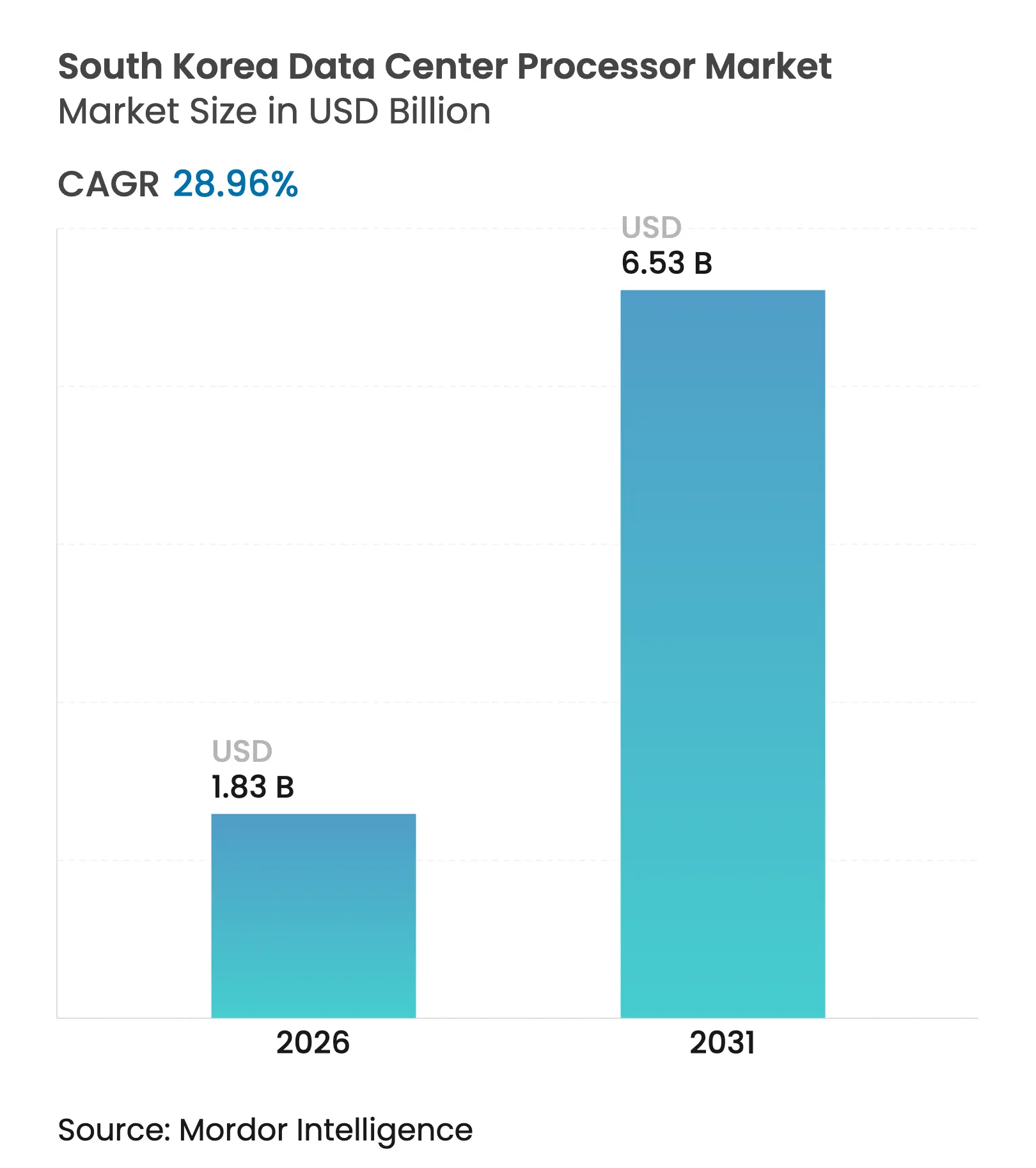
| Market Size (2026) | USD 1.83 Billion |
| Market Size (2031) | USD 6.53 Billion |
| Growth Rate (2026 - 2031) | 28.96 % CAGR |
| Market Concentration | Medium |
Major Players *Disclaimer: Major Players sorted in no particular order. Image © Mordor Intelligence. Reuse requires attribution under CC BY 4.0. |

South Korea Data Center Processor Market Analysis by Mordor Intelligence
The South Korea data center processor market size was valued at USD 1.42 billion in 2025 and estimated to grow from USD 1.83 billion in 2026 to reach USD 6.53 billion by 2031, at a CAGR of 28.96% during the forecast period (2026-2031). This growth reflects the nation’s ambition to become a global AI compute hub, underpinned by a USD 471 billion semiconductor investment pipeline and the national 10,000-GPU program. Hyperscaler demand, a rapid shift toward GPU-rich server architectures, and government incentives for advanced packaging have widened the total addressable market for processors. CPUs still anchor most server deployments, but AI accelerators and ARM-based alternatives are reshaping procurement priorities as operators seek lower total cost of ownership and higher energy efficiency. Rising electricity prices, RE100 compliance pressures, and ongoing HBM shortages temper short-term momentum, yet local champions—buoyed by supportive policy—continue to close technology gaps with multinational rivals.
Key Report Takeaways
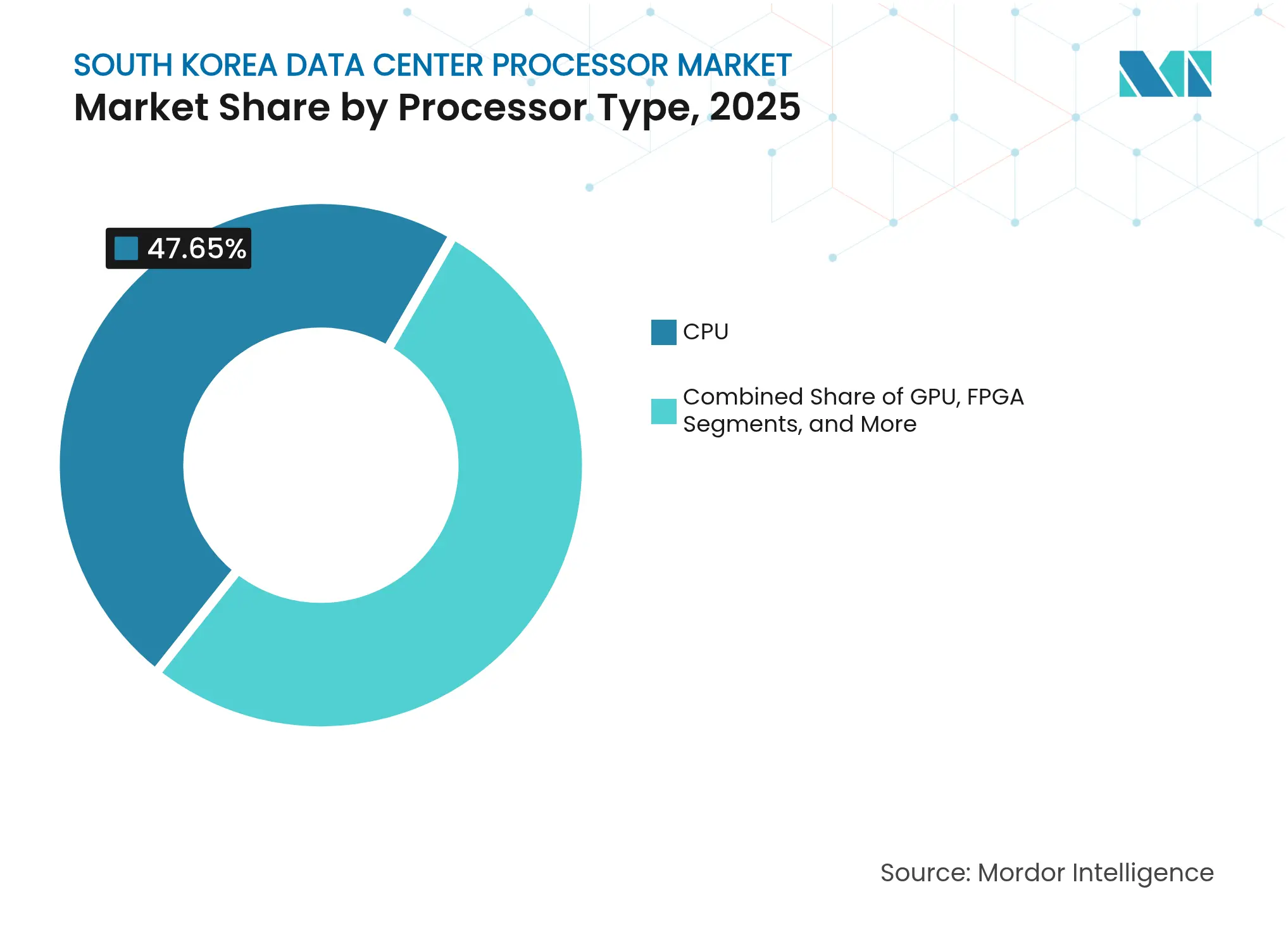
- By processor type, CPUs led with 47.65% of South Korea data center processor market share in 2025, while AI accelerators are set to expand at a 25.55% CAGR through 2031.
- By application, AI/ML training and inference accounted for 30.05% of the South Korea data center processor market size in 2025; advanced analytics is projected to grow at a 24.6% CAGR to 2031.
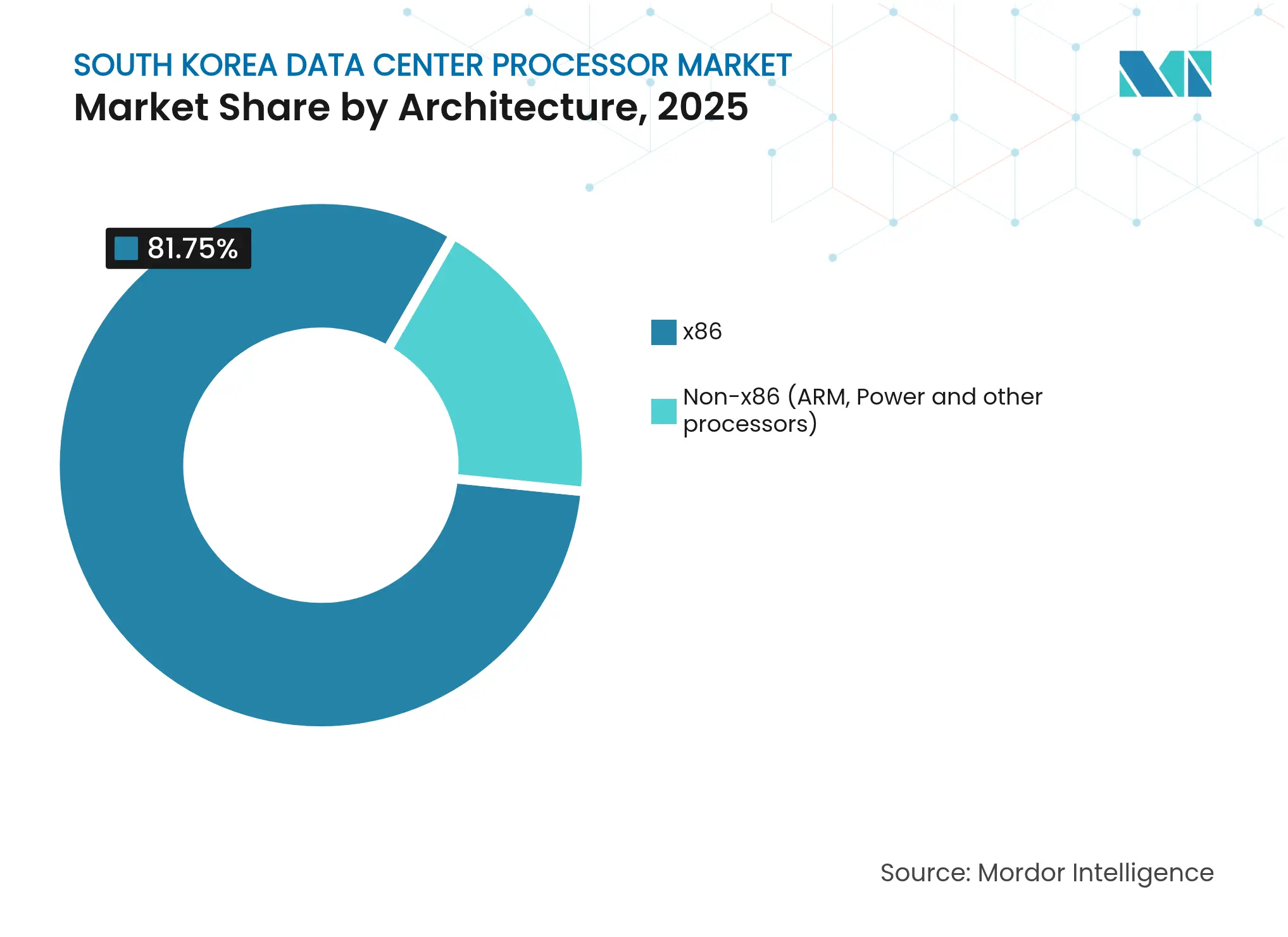
- By architecture, x86 maintained 81.75% revenue share in 2025, yet non-x86 platforms are forecast to grow at 23.9% CAGR.
- By data-center type, cloud service providers held 45.75% of South Korea data center processor market share in 2025 and are advancing at a 26.6% CAGR through 2031.
Note: Market size and forecast figures in this report are generated using Mordor Intelligence's proprietary estimation framework, updated with the latest available data and insights as of 2026.
South Korea Data Center Processor Market Trends and Insights
Drivers Impact Analysis
| Driver | (~) % Impact on CAGR Forecast | Geographic Relevance | Impact Timeline |
|---|---|---|---|
Soaring AI/ML compute demand from hyperscalers and
national 10,000-GPU programme
|
+8.5%
|
National (Seoul–Gyeonggi corridor)
|
Medium term (2-4 years)
|
USD 471 billion national semiconductor and AI-DC
investment pipeline
| +7.2% | National (Gyeonggi Province mega cluster) | Long term (≥ 4 years) |
Rapid GPU server mix-shift expands processor TAM
| +6.8% | National (cloud providers) | Short term (≤ 2 years) |
Arm/ASIC total-cost-of-ownership advantage accelerates
server refresh
| +3.1% | Global hyperscalers in Korea | Medium term (2-4 years) |
Emergency power-tariff discounts for high-density DC
clusters
| +2.4% | Jeollanam-do and industrial zones | Short term (≤ 2 years) |
Local glass-substrate supply chain boosts advanced
packaging yields
| +1.8% | National | Long term (≥ 4 years) |
| Source: Mordor Intelligence | |||
Soaring AI/ML Compute Demand from Hyperscalers and the 10,000-GPU Programme
Processor demand is accelerating as the government’s 10,000-GPU program stockpiles compute capacity while hyperscalers such as SK Telecom build gigawatt-scale AI data centers in Seoul and Gumi. Public procurement validates domestic AI chips and crowds in private investment, enabling startups like Rebellions to target one-third of local large-language-model inference workloads within 30 months. Naver’s 65-exabyte Sejong campus illustrates how national AI ambitions translate into record processor orders.
USD 471 Billion National Semiconductor and AI-DC Investment Pipeline
Sixteen new fabs and seven million wafers per month of output are slated by 2030, reducing reliance on foreign architectures and lowering production cost curves.[1] Samsung’s KRW 360 trillion commitment to advanced packaging and SK Hynix’s KRW 122 trillion HBM build-out reinforce long-run supply security. State-backed loans and tax relief trim capital costs, incentivizing local design houses to tape-out processors domestically.
Rapid GPU Server Mix-Shift Expands Processor TAM
GPU-equipped servers captured 45% of shipments in 2023, up from 26.2% a year earlier, reflecting the pivot to generative AI workloads.[2] The premium attached to HBM-driven GPU nodes inflates average server prices and stimulates auxiliary demand for cooling and power delivery upgrades. LG AI Research’s adoption of FuriosaAI chips underscores how local enterprises seek NVIDIA alternatives.
Arm/ASIC Total-Cost-of-Ownership Advantage Accelerates Server Refresh
ARM designs already command 13.2% of server revenue, and ASICs like Rebellions’ ATOM deliver 5× energy savings relative to legacy GPUs,[3] shortening payback periods as tariffs and carbon fees rise. Korean cloud operators are therefore retiring x86 racks ahead of schedule to curb operational costs.
Restraints Impact Analysis
| Restraint | (~) % Impact on CAGR Forecast | Geographic Relevance | Impact Timeline |
|---|---|---|---|
US export controls and China tensions squeeze supply
chains
|
-4.2%
|
National (China-linked chains)
|
Short term (≤ 2 years)
|
Chronic GPU/HBM shortages raise lead-times
| -3.8% | Global (Korean hyperscalers) | Medium term (2-4 years) |
High electricity cost and RE100 compliance risk
| -2.1% | National (metro areas) | Long term (≥ 4 years) |
Under-utilised provincial AI DCs dampen investor
confidence
| -1.6% | Secondary cities | Medium term (2-4 years) |
| Source: Mordor Intelligence | |||
US Export Controls and China Tensions Squeeze Supply Chains
Washington’s tightening of semiconductor tool exports heightens uncertainty for Samsung and SK Hynix facilities in China, threatening advanced node availability for Korean data centers. February 2025 exports to China fell 31.8%, prompting operators to delay processor orders amid policy flux.
Chronic GPU/HBM Shortages Raise Lead-Times
HBM capacity is booked solid through 2025, with SK Hynix and Samsung pushing high-volume runs into 2026. Lead times extending beyond a year complicate capex planning, while smaller buyers struggle to secure allocation behind hyperscaler queues. Alternative CXL-based memory expansion from Panmnesia offers partial relief
Segment Analysis
By Processor Type: AI Accelerators Shape Heterogeneous Servers
AI accelerators are forecast to post a 25.55% CAGR through 2031 even as CPUs retained 47.65% South Korea data center processor market share in 2025. The energy-efficiency gains of neural processing units such as Rebellions’ ATOM are key purchase triggers, while GPUs continue to dominate large-scale model training.
Hybrid configurations now blend CPUs, GPUs and AI ASICs on unified fabrics, reducing bottlenecks and maximizing HBM utilization. Samsung’s CXL 2.0 DRAM enables such interconnects, fostering demand for accelerators in workloads ranging from vision inference to autonomous robotics.
Note: Segment shares of all individual segments available upon report purchase
By Application: Analytics Outpaces Core AI Training
AI/ML training and inference controlled 30.05% of the South Korea data center processor market size in 2025, yet advanced analytics is growing faster at 24.6% CAGR as enterprises pivot to real-time insights. Financial services leverage processors for millisecond fraud detection, while manufacturers deploy edge inference for predictive maintenance.
Government investment in a KRW 94.6 billion national AI hub broadens adoption beyond big tech, driving fresh demand in healthcare diagnostics and public-sector services that value low-latency analytics.
By Architecture: Non-x86 Chips Gain Traction
Although x86 processors still deliver 81.75% revenue share, non-x86 alternatives will expand at 23.9% CAGR to 2031. ARM’s power-per-watt advantage resonates with hyperscalers chasing PUE reductions, and SEMIFIVE’s Neoverse-based HPC platform signals local momentum.
AMD’s server share climb to 27.2% also re-energizes competition within x86, spurring price-performance gains that benefit Korean operators. Neuromorphic designs from KAIST highlight longer-term pathways for ultra-low-power inferencing at the edge.
Note: Segment shares of all individual segments available upon report purchase
By Data Center Type: Cloud Providers Extend Lead
Cloud service providers captured 45.75% South Korea data center processor market share in 2025 and will grow at 26.6% CAGR. Hyperscalers exploit scale to lock in scarce GPUs and negotiate bespoke silicon roadmaps. Enterprise on-premises facilities persist for regulatory workloads, yet colocation and managed service providers bridge hybrid demand.
MegazoneCloud’s USD 7 billion IPO plan underlines sector capital intensity, while SK Telecom’s USD 200 million stake in SMART Global Holdings secures procurement leverage for future AI nodes.
Geography Analysis
Processor deployments cluster along the Seoul–Gyeonggi technology corridor, leveraging proximity to fabs, universities, and cloud regions anchored by Naver and Kakao. The proposed 3-gigawatt Jeollanam-do campus will shift demand southward, with USD 35 billion earmarked for construction. Busan’s Eco Delta City project and Gwangju’s AI cluster diversify capacity away from the capital, yet utilization lags in some provincial builds due to limited local budgets.
Regional power-tariff incentives offset higher grid costs, encouraging operators to pre-locate compute near renewable sources. Internationally, Korean developers are exporting know-how to Southeast Asia, evidenced by the USD 300 million Jakarta facility joint venture with Sinar Mas. Geographic spread reduces single-point risks and supports balanced national digital growth.

Competitive Landscape
Market Concentration
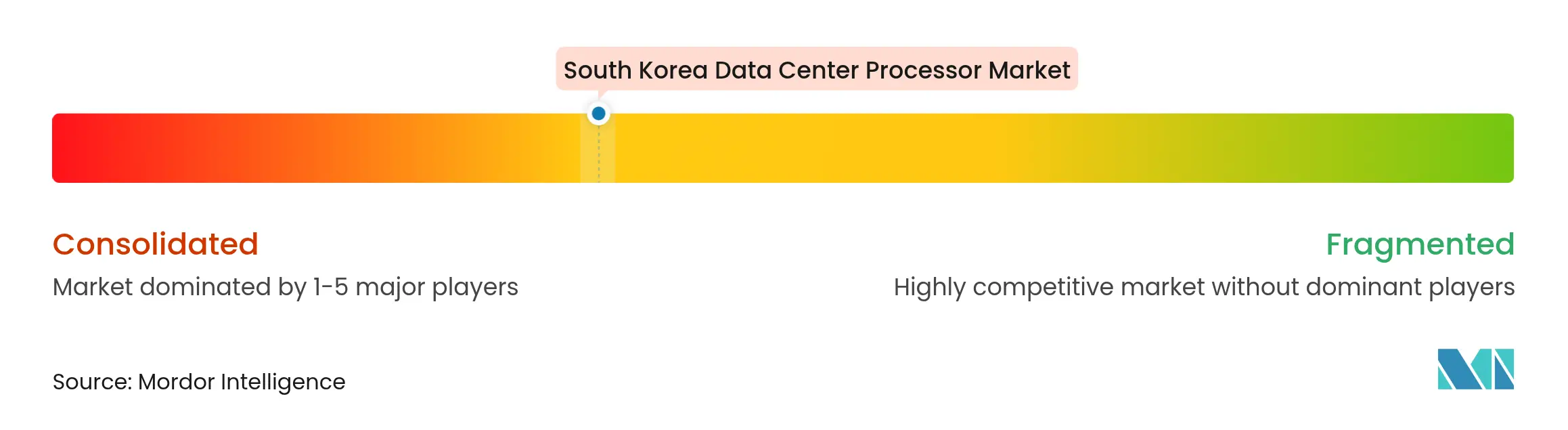
The market is moderately concentrated, with global giants NVIDIA, Intel and AMD sharing space with domestic innovators Rebellions, SAPEON and FuriosaAI. Product roadmaps increasingly hinge on ecosystem partnerships: Rebellions collaborates with ARM and Samsung Foundry on chiplets, while Samsung leverages CXL leadership for memory-centric differentiation.
The December 2024 merger between Rebellions and SAPEON formed Korea’s first AI chip unicorn valued near KRW 2 trillion, signaling a consolidation wave aimed at challenging foreign dominance. Access to HBM, advanced packaging, and export-license-free IP positions local vendors to secure domestic inferencing contracts, especially in public AI clouds, complying with data-residency rules.
Strategic moves include FuriosaAI’s rejection of an USD 800 million takeover by Meta to preserve sovereignty and Samsung’s adoption of a 64-hour R&D workweek to accelerate tape-outs. SK Hynix, meanwhile, fast-tracked HBM4 pilot lines to lock in NVIDIA design wins and sustain high margins on premium memory.
South Korea Data Center Processor Industry Leaders
*Disclaimer: Major Players sorted in no particular order
Recent Industry Developments
- June 2025: SK Hynix unveiled HBM4 with 2 TB/s bandwidth, shipping samples to NVIDIA.
- May 2025: Samsung adopted hybrid bonding for HBM4 mass production targeted for 2026.
- April 2025: Samsung instituted a 64-hour workweek for chip R&D teams to speed innovation.
- March 2025: FuriosaAI declined Meta’s USD 800 million offer, opting to stay independent.
- February 2025: Stock Farm Road agreed to build a USD 35 billion, 3-GW AI data center in Jeollanam-do.
- January 2025: Samsung introduced the industry’s first CXL 2.0-compliant DRAM.
- December 2024: Rebellions merged with SAPEON, creating Korea’s first AI chip unicorn.
Table of Contents for South Korea Data Center Processor Industry Report
1. INTRODUCTION
- 1.1 Study Assumptions and Market Definition
- 1.2 Scope of the Study
2. RESEARCH METHODOLOGY
3. EXECUTIVE SUMMARY
4. MARKET LANDSCAPE
- 4.1 Market Overview
- 4.2 Market Drivers
- 4.2.1 Soaring AI/ML compute demand from hyperscalers and national 10,000-GPU programme
- 4.2.2 USD 471 bn national semiconductor and AI-DC investment pipeline
- 4.2.3 Rapid GPU server mix-shift expands processor TAM
- 4.2.4 Arm/ASIC total-cost-of-ownership advantage accelerates server refresh
- 4.2.5 Emergency power-tariff discounts for high-density DC clusters
- 4.2.6 Local glass-substrate supply chain boosts advanced packaging yields
- 4.3 Market Restraints
- 4.3.1 US export controls and China tensions squeeze supply chains
- 4.3.2 Chronic GPU / HBM shortages raise lead-times
- 4.3.3 High electricity cost and RE100 compliance risk
- 4.3.4 Under-utilised provincial AI DCs dampen investor confidence
- 4.4 Value-/Supply-Chain Analysis
- 4.5 Regulatory Landscape
- 4.6 Technological Outlook
- 4.7 Porter’s Five Forces Analysis
- 4.7.1 Bargaining Power of Suppliers
- 4.7.2 Bargaining Power of Buyers
- 4.7.3 Threat of New Entrants
- 4.7.4 Threat of Substitutes
- 4.7.5 Competitive Rivalry Intensity
- 4.8 Investment Landscape
- 4.9 Assessment of Macro Economic Trends on the Market
5. MARKET SEGMENTATION
- 5.1 By Processor Type
- 5.1.1 GPU
- 5.1.2 CPU
- 5.1.3 FPGA
- 5.1.4 AI Accelerator
- 5.2 By Application
- 5.2.1 Advanced Data Analytics
- 5.2.2 AI/ML Training and Inferences
- 5.2.3 High Performance Computing
- 5.2.4 Security and Encryption
- 5.2.5 Network Functions
- 5.2.6 Others
- 5.3 By Architecture
- 5.3.1 x86
- 5.3.2 Non-x86 (ARM, Power and other processors)
- 5.4 By Data Center Type
- 5.4.1 Enterprise
- 5.4.2 Colocation
- 5.4.3 Cloud Service Providers
6. COMPETITIVE LANDSCAPE
- 6.1 Market Concentration
- 6.2 Strategic Moves
- 6.3 Market Share Analysis
- 6.4 Company Profiles (includes Global level Overview, Market level overview, Core Segments, Financials as available, Strategic Information, Market Rank/Share for key companies, Products and Services, and Recent Developments)
- 6.4.1 NVIDIA Corporation
- 6.4.2 Intel Corporation
- 6.4.3 Advanced Micro Devices Inc.
- 6.4.4 Samsung Electronics Co., Ltd.
- 6.4.5 SK hynix Inc.
- 6.4.6 SAPEON Inc.
- 6.4.7 FuriosaAI Co., Ltd.
- 6.4.8 Panmnesia Inc.
- 6.4.9 HyperAccel Inc.
- 6.4.10 Ampere Computing LLC
- 6.4.11 Arm Ltd.
- 6.4.12 Broadcom Inc.
- 6.4.13 IBM Corporation
- 6.4.14 Huawei Technologies Co., Ltd.
- 6.4.15 Marvell Technology, Inc.
- 6.4.16 Neuchips Corp.
- 6.4.17 Qualcomm Technologies, Inc.
- 6.4.18 Tenstorrent Inc.
- 6.4.19 MediaTek Inc.
- 6.4.20 Alibaba T-Head
7. MARKET OPPORTUNITIES and FUTURE OUTLOOK
South Korea Data Center Processor Market Report Scope
Data centers house and manage critical applications and data, using computing and storage networks for efficient delivery. Processors—GPUs, CPUs, and TPUs—are central to their operation. GPUs handle multitasking, excelling in graphics rendering and AI tasks. CPUs, with multi-core architecture, support parallel processing. TPUs, designed for machine learning, stand out from GPUs, which have transitioned from graphics to AI applications.
The South Korea Data Center Processor Market is Segmented by Processor Type (CPU, GPU, FPGA, AI Accelerators), by Application (Advanced Data Analytics, AI/ML Training and Inferences, High Performance Computing, Security and Encryption, Network Functions, and Others), by Architecture (x86 and Non-x86 (ARM, Power and other processors), and by Data Center Type (Enterprise, Colocation and Cloud Service Providers). The Report Offers the Market Size and Forecasts for all the Above Segments in Terms of Value (USD).
| By Processor Type | GPU |
| CPU | |
| FPGA | |
| AI Accelerator | |
| By Application | Advanced Data Analytics |
| AI/ML Training and Inferences | |
| High Performance Computing | |
| Security and Encryption | |
| Network Functions | |
| Others | |
| By Architecture | x86 |
| Non-x86 (ARM, Power and other processors) | |
| By Data Center Type | Enterprise |
| Colocation | |
| Cloud Service Providers |
Key Questions Answered in the Report
What is the current value of the South Korea data center processor market?
Which processor type is growing fastest?
How dominant are cloud service providers?
What major risk could slow market growth?
Why are ARM-based chips gaining traction?
How does South Korea plan to address processor supply constraints?
More reports on data centers
Find the right report below.
