
Market Overview
| Study Period | 2020 - 2031 |
|---|---|
| Forecast Data Period | 2026 - 2031 |
| Base Year Market Size (2025) | 324.36 Million Liters |
| Market Volume (2026) | 325.79 Million Liters |
| Market Volume (2031) | 333.03 Million Liters |
| Growth Rate (2026 - 2031) | 0.44 % |
| Market Concentration | Medium |
Major Players *Disclaimer: Major Players sorted in no particular order Image © Mordor Intelligence. Reuse requires attribution under CC BY 4.0. | |
South Korea Automotive Engine Oils Market Analysis by Mordor Intelligence
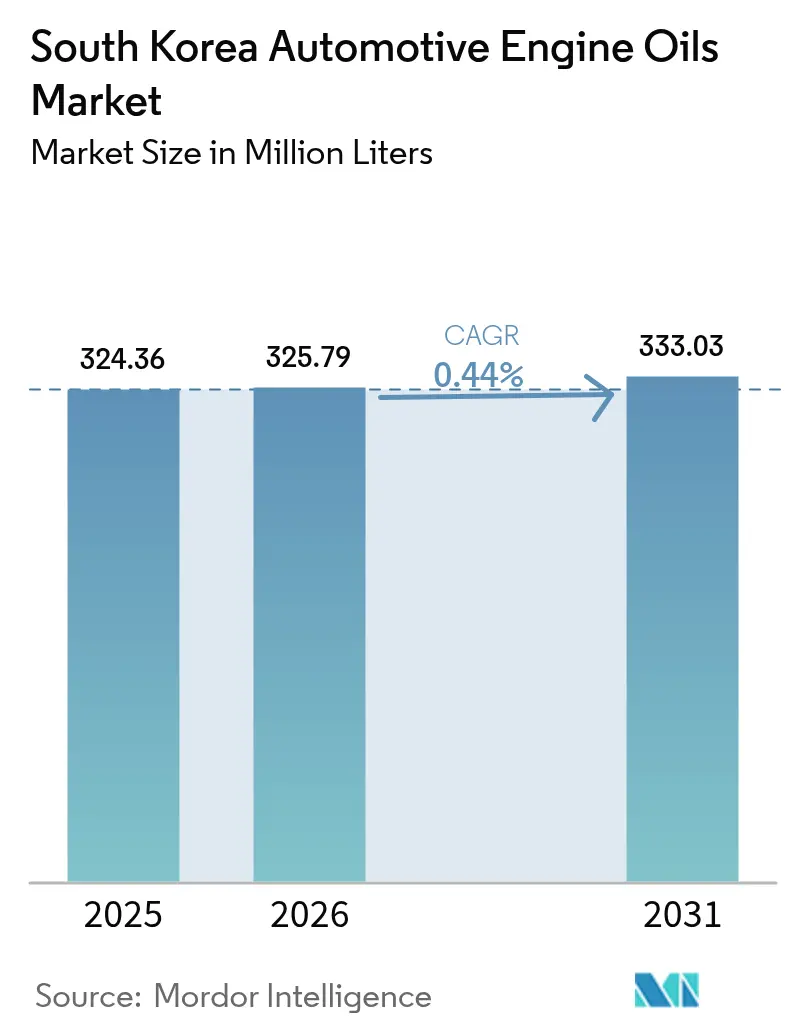
The South Korea Automotive Engine Oils Market size is expected to grow from 324.36 Million Liters in 2025 to 325.79 Million Liters in 2026 and is forecast to reach 333.03 Million Liters by 2031 at 0.44% CAGR over 2026-2031. Market size expansion continues even as electrification policies erode internal-combustion demand, because an aging vehicle parc, mandatory inspections, and the proliferation of premium cars sustain service-fill volumes. Synthetic migration drives margin growth, while refiners leverage the world’s largest Group III base-oil capacity to defend profitability. Supply resilience, export competitiveness, and ongoing bio-base investments position the South Korea automotive engine oils market for steady, value-oriented evolution.
Key Report Takeaways
- By product type, passenger car motor oil led with a 62.85% volume share in 2025. However, motorcycle engine oil is projected to advance at a 0.63% CAGR through 2031.
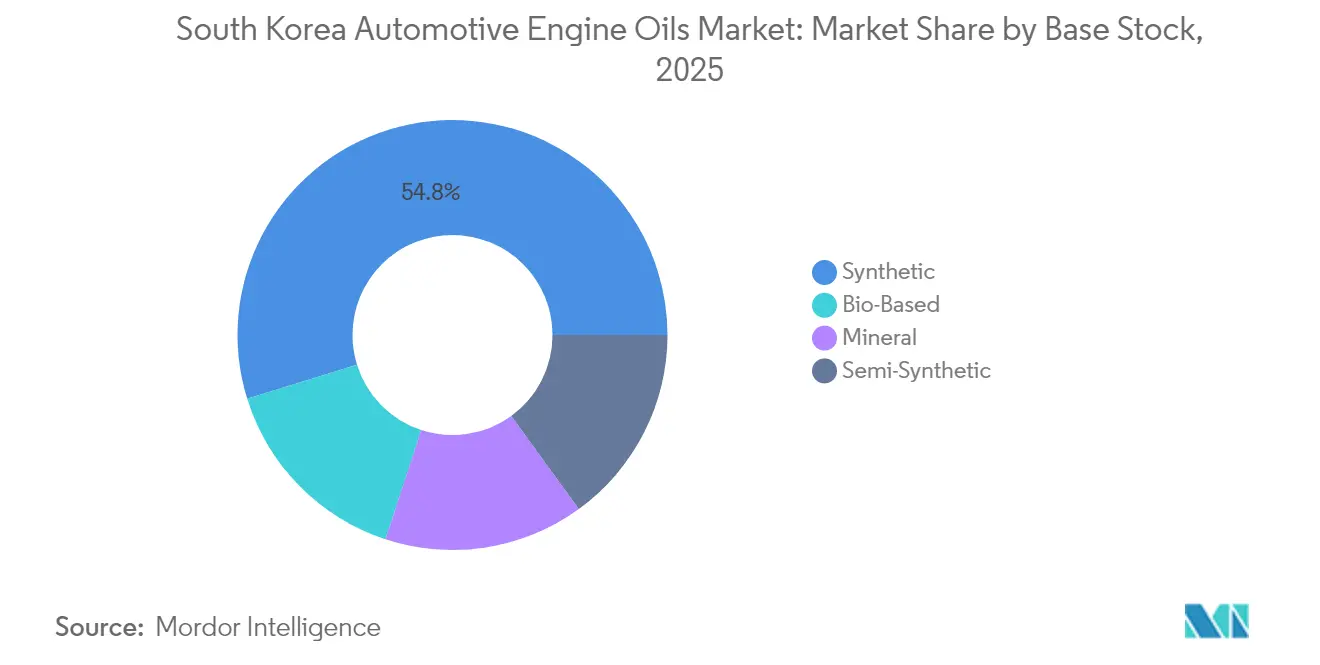
- By base stock, synthetics commanded 54.80% of the South Korea automotive engine oils market share in 2025, while bio-based oils are projected to expand at a 0.50% CAGR to 2031.
Note: Market size and forecast figures in this report are generated using Mordor Intelligence’s proprietary estimation framework, updated with the latest available data and insights as of 2026.
South Korea Automotive Engine Oils Market Trends and Insights
Drivers Impact Analysis*
| Driver | (~) % Impact on CAGR Forecast | Geographic Relevance | Impact Timeline |
|---|---|---|---|
| Growing vehicle parc and rising average vehicle age | +0.20% | National, concentrated in Seoul-Gyeonggi metropolitan area | Long term (≥ 4 years) |
| Rapid shift toward synthetic and low-viscosity oils | +0.10% | National, with premium vehicle concentration in major cities | Medium term (2-4 years) |
| Expansion of premium-segment passenger cars | +0.10% | National, with luxury vehicle clustering in affluent districts | Medium term (2-4 years) |
| Mandatory annual inspection regime boosting service-fill demand | +0.10% | National, uniform regulatory enforcement | Long term (≥ 4 years) |
| Last-mile 2-wheeler delivery boom raising oil-change frequency | +0.10% | Urban centers, particularly Seoul, Busan, and major metropolitan areas | Short term (≤ 2 years) |
| Source: Mordor Intelligence | |||
Growing Vehicle Parc and Rising Average Vehicle Age
Korea's vehicle fleet dynamics generate sustained aftermarket demand despite headwinds from electrification. The nation's total registered vehicles continue to expand while the average fleet age increases, generating higher maintenance frequency and oil consumption per vehicle. This demographic shift particularly benefits service-fill channels as older vehicles require more frequent oil changes and experience higher consumption rates. LPG commercial vehicles exemplify this trend, with registrations surging 77.3% in Q1 2024 to dominate the light commercial segment at 25,271 units, approaching 2014 peak levels with projected 2024 volumes of 166,000 units. The aging parc effect compounds as vehicles transition beyond warranty periods, shifting from factory-fill to aftermarket channels where Korean refiners capture higher margins through branded retail networks.
Rapid Shift Toward Synthetic and Low-Viscosity Oils
Premium gasoline demand tripled between 2015 and 2021, signaling consumer willingness to pay for performance enhancements extending to lubricants[1]. Hybrid registrations rose 27.6% in 2024 to 394,613, requiring 0W-16 and 0W-20 oils with shorter drain intervals. All four major refiners introduced full API SQ/ILSAC GF-7 lines in 2025, expanding synthetic penetration and lifting per-liter margins.
Expansion of Premium-Segment Passenger Cars
Korea's automotive market premiumization is directly correlated with the adoption of synthetic oil, as luxury vehicles require advanced formulations. Imported hybrid vehicles captured 75.8% of the total import share in January 2025, with three out of every four imported cars featuring hybrid powertrains that require low-viscosity synthetic oils. This shift benefits Korean refiners, who have invested heavily in Group III base oil capacity. SK Enmove operates the world's largest API Group III production facility, and GS Caltex's Yeosu plant produces 1.3 million tons annually of Group II and Group III base stocks. Premium vehicle owners demonstrate higher service frequency and brand loyalty, creating stable revenue streams for Korean lubricant manufacturers who leverage OEM approvals and dealer channel partnerships to capture factory-fill and first-service business.
Mandatory Annual Inspection Regime
Korea's comprehensive vehicle inspection system generates consistent aftermarket demand through mandatory maintenance requirements. However, recent regulatory changes present mixed implications, as light truck inspection intervals have been relaxed from 1 year to 2 years, affecting 2.96 million vehicles and potentially reducing inspection-driven oil changes[2]. This rationalization contrasts with the heavy vehicle segments, which maintain frequent inspection schedules, thereby preserving commercial oil demand. The effectiveness of the inspection system in driving service-fill consumption depends on enforcement rigor and consumer compliance. Korean refiners are adapting through O2O platforms, which cover 22 initial locations with expansion planned to 500 AutoOasis service shops, targeting the KRW 1.5 trillion online automotive consumables market.
Restraints Impact Analysis*
| Restraint | (~) % Impact on CAGR Forecast | Geographic Relevance | Impact Timeline |
|---|---|---|---|
| Electrification-driven ICE share erosion | -0.20% | National, with EV concentration in Seoul and major metropolitan areas | Long term (≥ 4 years) |
| Longer oil-drain intervals via advanced formulations | -0.10% | National, affecting all vehicle segments | Medium term (2-4 years) |
| Softening motorcycle sales | -0.05% | National, with urban market concentration in delivery service hubs | Short term (≤ 2 years) |
| Source: Mordor Intelligence | |||
Electrification-Driven ICE Share Erosion
Korea's electrification drive is reducing conventional engine oil demand as EV penetration rises toward 4.5 million zero-emission vehicles by 2030. In 2024, gasoline vehicles dropped to 47.8% of new registrations, while EVs and hybrids reached 14.6% and 24.1%, respectively, making up 38.7% of sales. Refiners are adapting, with S-Oil developing EV-specific lubricants and HD Hyundai Oilbank investing in bio-based feedstocks. The Ulsan industrial complex's plan to electrify 30,000 motorcycles, including 19,000 at HD Hyundai, underscores its sustainability efforts, resulting in an annual savings of KRW 120,000 per unit in engine oil costs.
Longer Oil-Drain Intervals via Advanced Formulations
Advanced synthetic formulations enable extended drain intervals, compressing volume demand despite premium pricing benefits. Modern API SQ/ILSAC GF-7 oils introduced by Korean refiners in 2025 offer superior oxidation resistance and thermal stability, allowing OEMs to extend service intervals while maintaining warranty coverage. This technical evolution creates a volume-value trade-off where Korean manufacturers capture higher per-liter margins through synthetic premiums but face reduced consumption frequency. The trend accelerates as Korean automakers, such as Hyundai, specify severe driving condition intervals of 5,000-7,500 km for Smartstream engines, while warning against mineral/semi-synthetic oils, effectively mandating synthetic formulations that last longer but cost more. This dynamic favors refiners with strong synthetic capabilities while pressuring those dependent on conventional mineral oil volumes.
*Our forecasts treat driver/restraint impacts as directional, not additive. The impact forecasts reflect baseline growth, mix effects, and variable interactions.
Segment Analysis
By Product Type: Passenger Car Oils Dominate While Motorcycle Oils Accelerate
Passenger car motor oils maintained a 62.85% share in 2025, primarily due to a passenger-vehicle-centric transportation mix and the rapid adoption of hybrid vehicles. The South Korea automotive engine oils market size is forecast to expand due to shorter drain intervals on hybrids. Motorcycle engine oil, though smaller, posts the fastest 0.63% CAGR as e-commerce fuels last-mile deliveries. Refiners responded with 16 new XTEER gasoline variants and six dedicated EV-hybrid oils launched in 2025, locking in synthetic migration gains.
Heavy-duty motor oil faces headwinds from alternative fuels and fleet electrification. LPG light trucks already claimed 77.3% of Q1 2024 segment registrations, curbing diesel-HDMO volumes. The South Korea automotive engine oils market hierarchy will likely hold but shift toward high-value synthetics, with MCO providing incremental growth until large-scale two-wheel electrification occurs.


By Base Stock: Synthetic Leadership Underpins Value Creation
Synthetic oils held 54.80% of 2025 volume, driven by Korea’s unmatched Group III export capability. Mineral oils retain price-sensitive segments yet suffer from crude volatility and substitution. Semi-synthetics strike a balance between cost and performance, while bio-based formulations are the most dynamic, with a 0.50% CAGR, as refiners commission biodiesel and co-processing units.
Exports climbed 15% year-on-year to 348,303 tons in February 2025, confirming Korea’s international competitiveness. Domestic bio-base adoption will advance as sustainability mandates tighten and refiners scale circular-economy feedstocks.
Geography Analysis
Regional demand is concentrated in the Seoul–Gyeonggi corridor, where premium car density and service frequency peak. Nationwide inspection rules, Euro VI emissions compliance since 2015, and aging fleets keep service-fill volumes stable. Korea’s Q1 2025 base-oil exports reached near 1.2 million tons valued at USD 1.3 billion, underscoring the global relevance of the South Korea automotive engine oils market.
The government aims to have 4.5 million zero-emission vehicles by 2030. While this erodes ICE volumes, refiners pivot toward EV fluids, immersion-cooling products, and bio-blends. Integrated value chains linking crude intake, base-oil production, and premium blending sustain margins despite headwinds in consumption.
Regulatory Landscape
South Korea regulates automotive engine oils through product-quality oversight and environmental compliance, led primarily by the Ministry of Environment (MOE) and the Ministry of Trade, Industry and Energy (MOTIE). Under the Petroleum and Petroleum Alternative Fuels Business Act, lubricant producers and importers face mandatory quality inspections, with execution handled by the Korea Institute of Petroleum Management (K-Petro). This framework shapes how blenders manage batch release, documentation, and distribution controls.
Technical conformity is anchored in Korean Industrial Standards (KS) for internal combustion engine oils and test methods used to verify performance and durability. In May 2026, the Korea Agency for Technology and Standards (KATS) updated KS M 2021-2026 (oxidation stability testing method for internal combustion engine oil), reinforcing the need for aligned laboratory capability and compliance testing workflows as suppliers roll out newer API SQ and ILSAC GF-7 grade products across passenger car, commercial vehicle, and motorcycle segments.
Value Chain Analysis
The South Korea automotive engine oils value chain is centered on vertical integration from refining and base-oil production to blending, packaging, and multi-channel distribution. Integrated refiners such as SK Enmove, GS Caltex, and S-Oil control key upstream inputs, notably Group II and Group III base oils, and push finished engine oils through OEM supply arrangements, service stations, quick-lube and franchise workshops, and e-commerce and O2O service platforms that capture service-fill demand.
Quality and distribution governance runs alongside the commercial chain, with MOTIE and the Korea Petroleum Quality and Distribution Authority providing market oversight under the petroleum business framework. In April 2026, MOTIE launched joint interagency inspections of lubricant manufacturers and distributors to prevent hoarding and supply disruptions, increasing compliance and traceability requirements across the production-to-retail corridor. The change raises the operational premium on reliable inventory planning, documented sourcing, and compliant labeling and claims for premium synthetic grades.
Competitive Landscape
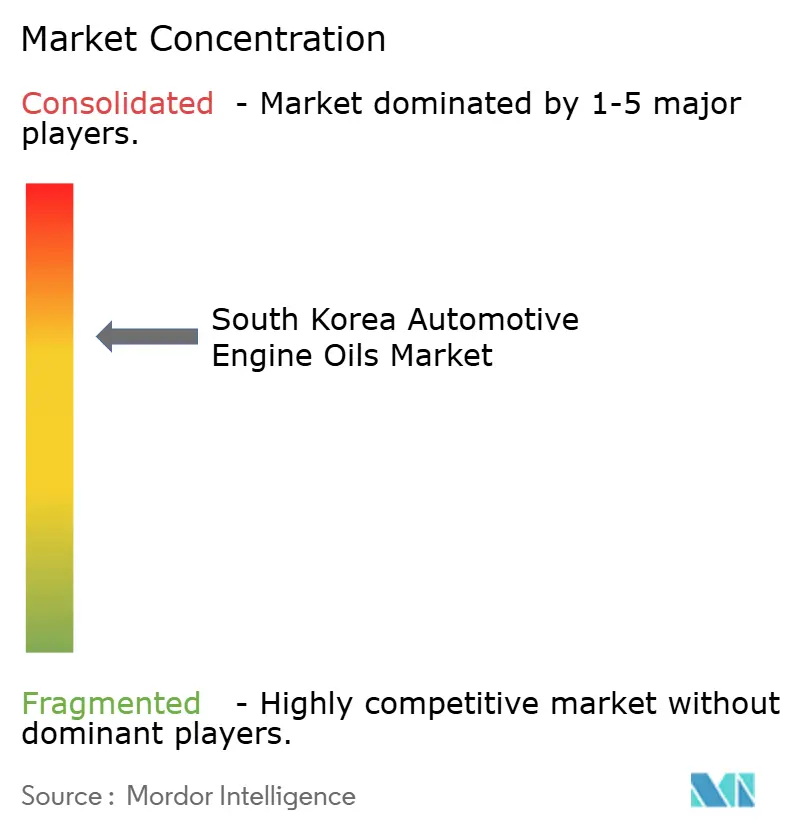
The South Korea Automotive Engine Oils Market is consolidated. Four integrated refiners dominate, booking KRW 1.9 trillion in lubricant operating profit during 2024 with margins ranging from 12.5% to 25.4%. SK Innovation led with KRW 686.7 billion, followed by S-Oil at KRW 571.2 billion, GS Caltex at KRW 474 billion, and HD Hyundai Oilbank at KRW 168.1 billion. All launched API SQ/ILSAC GF-7 synthetic portfolios in 2025. Strategic consolidation accelerated. HD Hyundai Oilbank acquired the remaining 50% of HD Hyundai Cosmo for USD 104.3 million, unlocking specialty production flexibility. Refiners are also diversifying into immersion-cooling fluids, bio-feedstocks, and EV-thermal products, widening competitive moats as the South Korea automotive engine oils industry navigates energy-transition challenges.
South Korea Automotive Engine Oils Industry Leaders
-
ExxonMobil Corporation
-
GS Caltex
-
Hyundai Oilbank
-
SK Inc.
-
S-OIL CORPORATION
- *Disclaimer: Major Players sorted in no particular order
Market Opportunities and Future Outlook
Product and channel mix are shifting toward higher-value synthetics, especially low-viscosity formulations for hybrids and premium passenger cars. This supports demand for API SQ and ILSAC GF-7 compliant portfolios and OEM and dealer-aligned service programs. The market already has a strong synthetic base, with synthetics at 54.80% of 2025 volume, while domestic suppliers benefit from Korea's Group III base-oil footprint, supporting both domestic availability and export competitiveness.
Two additional opportunity areas are emerging from visible 2026 market signals. First, supply transparency and distribution discipline have become a near-term commercial lever after MOTIE introduced weekly monitoring and joint inspections in April 2026 following reports of tight supply and rapid price increases, favoring players with robust compliance systems and auditable logistics. Second, the Korea Fair Trade Commission's June 2026 announcement of investigations and planned penalties tied to a long-running lubricant bid and price collusion scheme raises buyer sensitivity to governance and procurement practices. That creates room for differentiated supplier contracting, dealership programs, and branded service networks focused on consistent pricing, documentation, and verified product authenticity.
Recent Industry Developments
- April 2026: TotalEnergies renewed its global partnership with Kia Corporation for a five-year term effective April 1, 2026, continuing the supply of Quartz high-performance engine oils to Kia dealerships worldwide. The renewal supports OEM-linked service-fill routes and reinforces premium synthetic positioning for modern gasoline and hybrid fleets.
- August 2025: GS Caltex launched the Kixx GX7 synthetic engine oil lineup certified under the API SQ standard for gasoline passenger vehicles. The launch broadened its premium PCMO portfolio and increased competitive intensity around high-performance, low-viscosity formulations sold through retail and service channels.
- April 2024: Korea revised vehicle inspection rules by relaxing light truck inspection intervals from one year to two years, affecting about 2.96 million vehicles. This change reduces inspection-driven maintenance touchpoints in part of the parc, pushing engine oil suppliers to rely more on branded service programs, dealer channels, and digital/O2O demand capture to sustain service-fill volumes.
Research Methodology Framework and Report Scope
Market Definition and Coverage
For this study, we define the South Korea automotive engine oils market as the demand for crankcase engine oil used in on-road vehicles, measured in volume, across factory-fill and service-fill channels within South Korea.
Scope exclusions: This scope excludes transmission fluids, greases, coolants, brake fluids, and other non-engine automotive lubricants.
Segmentation Overview
- By Resin Type
- Passenger Car Motor Oil (PCMO)
- 0W-XX
- 5W-XX
- 10W-XX
- 15W-XX
- Monogrades
- Other Grades
- Heavy Duty Motor Oil (HDMO)
- 0W-XX
- 5W-XX
- 10W-XX
- 15W-XX
- Monogrades
- Other Grades
- Motorcycle Engine Oil (MCO)
- 0W-XX
- 5W-XX
- 10W-XX
- 15W-XX
- Monogrades
- Other Grades
- Passenger Car Motor Oil (PCMO)
- By Base Stock
- Mineral
- Synthetic
- Semi-Synthetic
- Bio-Based
Data Sources, Market Sizing, and Validation
Desk Research
Desk research was used to set the demand pool and align the model to real-world vehicle and lubricant signals. We referenced public sources such as South Korea vehicle parc and registration statistics from government transport agencies, energy and refinery product balance notes, customs trade statistics for lubricant base oils and additives, and technical standard updates from API and ILSAC that influence drain intervals and viscosity shifts.
To make the volume estimates realistic, we also reviewed manufacturer service schedules and maintenance guidance, association publications on lubricants and automotive service practices, and reported trends from reputed local and global press. In addition, our team used paid subscriptions for company financials and intelligence, patent databases, and import and export shipment-level checks to sense-test major supply and demand movements. The desk sources listed here are illustrative, and many other public references were reviewed for data collection, validation, and clarification.
Primary Interviews and Surveys
Primary work focused on verifying how engine oil demand forms in South Korea across OEM workshops, independent garages, quick service outlets, distributors, and fleet maintenance points. We spoke with channel participants and technical experts to validate drain intervals, pack mix (bulk vs packs), synthetic penetration, and the impact of hybrids and an aging vehicle parc on service-fill volumes. Feedback from different respondent groups was then used to tighten assumptions and resolve gaps left by public datasets.
Distribution of primary research fieldwork respondents
| Company type | Respondent position |
|---|---|
| Top tier: 25% | CXOs: 19% |
| Mid tier: 56% | Functional/Unit leaders: 32% |
| Smaller Players: 19% | Managers: 49% |
Market-Sizing & Forecasting
The core sizing logic uses a top-down build from South Korea's in-use vehicle parc, split by key engine categories, which is then converted into annual oil consumption using typical sump-fill sizes and observed drain intervals. To keep the totals grounded, we corroborate the output using selective bottom-up checks like sampled channel volumes from distributors and workshops, and then a practical ASP-per-liter sanity check only to detect outliers, not to create the full total.
Inputs that mattered most included the size and age mix of the on-road parc, annual mileage patterns that influence service frequency, shifts toward low-viscosity and synthetic grades that can extend drain intervals, the split between OEM service and independent service, and the steady reduction in engine-oil demand from battery-electric penetration. Where direct bottom-up coverage was thin, gaps were bridged using channel mix assumptions confirmed in interviews, and then pressure-tested against import and production indicators so the implied volumes stayed realistic.
For forecasting, we relied on scenario analysis supported by simple time-series smoothing around stable base demand, and then adjusted the trend using expected parc evolution and service behavior changes discussed by interviewees. This approach stays reproducible because each driver can be traced to a clear vehicle or maintenance metric and then re-run when a new data point is published.
Data Validation & Update Cycle
We validate the model through several checks that compare outputs against independent signals such as lubricant trade flows, refinery and blending activity cues, and the implied liters per vehicle per year by major vehicle groups. If a year shows a sharp swing that does not align with parc movement or known policy and technology changes, the assumptions are revisited, and selected respondents are re-contacted to confirm whether channel behavior has shifted.
Before sign-off, the work goes through analyst-to-analyst review, followed by variance checks across historical years so the trend stays consistent and explainable. Reports are refreshed annually, and interim updates are made when there are material events like major specification changes, notable shifts in vehicle sales mix, or supply disruptions. Right before delivery, a final pass is completed so clients receive the most current view available.
Mordor Intelligence's South Korea Automotive Engine Oils Market Size Measured Against Other Published Estimates
Published market sizes for South Korea engine oils do not always match because the underlying scope and unit choices are not consistent, and the conversion assumptions can move the final number a lot. Differences usually come from mixing value and volume, counting adjacent lubricant products, and using different service-fill assumptions, especially around drain intervals and synthetic adoption.
Some estimates are reported in USD and may bundle distribution margins, packaging, or even other automotive fluids into a single revenue pool. In Mordor Intelligence's model, the market is counted as engine oil demand only and is expressed in liters tied to vehicle parc and service behavior, which keeps the total aligned to physical consumption instead of pricing swings.
Benchmark comparison
| Source | Market Size | Gaps in Research Methodology |
|---|---|---|
| Mordor Intelligence | USD 324.36 M (2025) | |
| Industry Research Publisher A | USD 850.00 M (2024) | Reported as a value figure, which can embed retail and channel margins plus packaging mix, and the price-per-liter assumption may not be aligned to Korea-specific grade and channel splits. |
| Regional Research Publisher B | USD 207.18 M (2025) | Uses a different volume baseline and forecast window, and the underlying vehicle-type weighting and drain interval assumptions are not transparent, which can undercount service-fill intensity in higher-mileage cohorts. |
The table shows that the widest spread comes from mixing revenue-based totals with consumption-based totals, and then applying different price and channel assumptions on top. When the demand pool is anchored to vehicles in use and their oil-change behavior, the steps stay easy to audit and can be revalidated as new parc or service indicators are released.
Key Questions Answered in the Report
What is the current size of the South Korea automotive engine oils market in 2026?
It totals 325.79 million liters.
Which product type holds the largest share?
Passenger car motor oil accounts for 62.85% of 2025 volume.
Why are synthetic oils gaining ground?
Hybrid adoption and OEM requirements for low-viscosity formulations are pushing synthetic penetration above 54%.
How is electrification affecting lubricant demand?
EV uptake reduces ICE volumes, but refiners offset risk with EV-specific fluids and bio-based products.