
Market Overview
| Study Period | 2019 - 2031 |
|---|---|
| Forecast Data Period | 2026 - 2031 |
| Base Year Market Size (2025) | USD 1.05 Billion |
| Market Size (2026) | USD 1.13 Billion |
| Market Size (2031) | USD 1.58 Billion |
| Growth Rate (2026 - 2031) | 6.93 % |
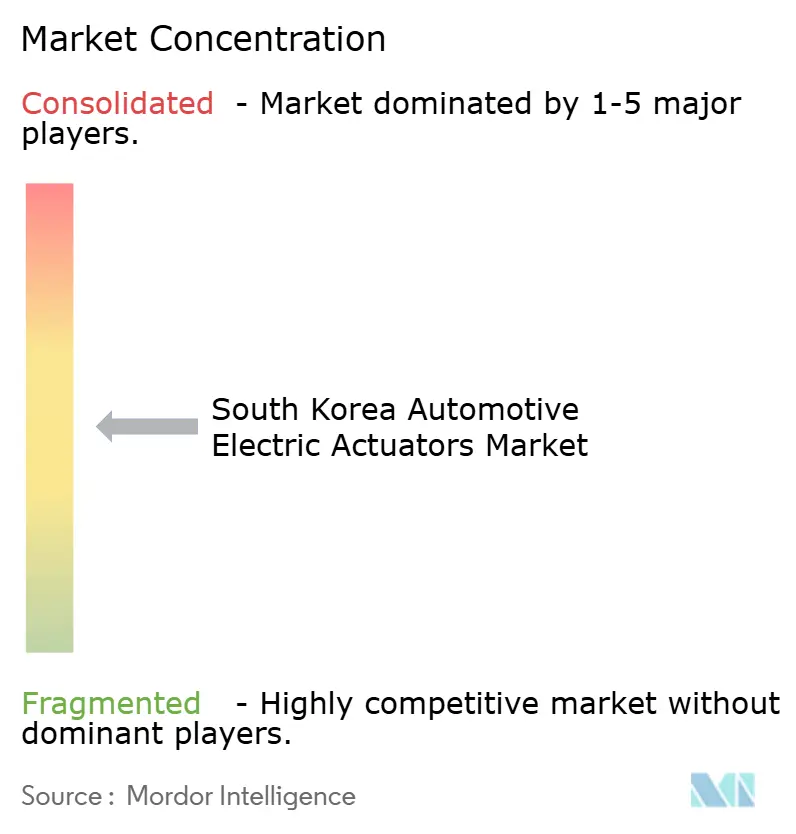
| Market Concentration | Medium |
Major Players *Disclaimer: Major Players sorted in no particular order Image © Mordor Intelligence. Reuse requires attribution under CC BY 4.0. | |
South Korea Automotive Electric Actuators Market Analysis by Mordor Intelligence
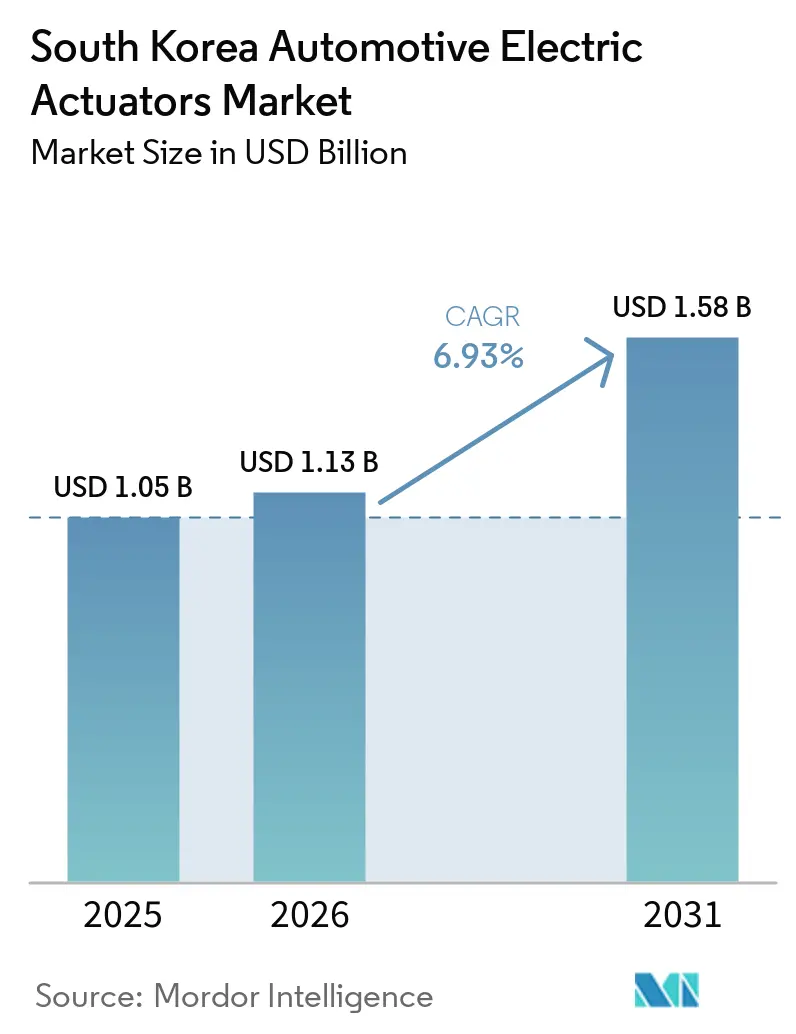
The South Korea automotive electric actuators market size was valued at USD 1.05 billion in 2025, is estimated at USD 1.13 billion in 2026, and is projected to reach USD 1.58 billion by 2031, growing at a CAGR of 6.93% from 2026 to 2031. Electrified vehicle production is increasing the number of electronically controlled functions installed in each vehicle. This change favors suppliers that serve EV platforms rather than suppliers focused on conventional drivetrain parts. Korean OEM export programs also extend local design decisions into overseas assembly markets. Premium EV models add closure, thermal management, and chassis functions that require more actuators per vehicle. Supply security and validation requirements remain important limits on the pace at which suppliers can capture this demand.
Key Report Takeaways
- By vehicle type, passenger cars held 83.11% of the South Korea automotive electric actuators market share in 2025, while commercial vehicles recorded the highest projected CAGR at 8.84% through 2031.
- By application type, closure actuators held 38.25% of the South Korea automotive electric actuators market share in 2025 and recorded the highest projected CAGR at 9.65% through 2031.
- By actuation technology, brushless DC actuators held 49.05% of the South Korea automotive electric actuators market share in 2025, while smart actuators recorded the highest projected CAGR at 9.11% through 2031.
- By motion type, linear actuators held 58.12% of the South Korea automotive electric actuators market share in 2025 and recorded the highest projected CAGR at 7.84% through 2031.
- By vehicle propulsion, battery electric vehicles held 34.28% of the South Korea automotive electric actuators market share in 2025 and recorded the highest projected CAGR at 10.23% through 2031.
- By sales channel, OEM channels held 88.45% of the South Korea automotive electric actuators market share in 2025, while the aftermarket recorded the highest projected CAGR at 8.42% through 2031.
- By region, Seoul Capital Area held 40.23% share in 2025, while Yeongnam, Southeastern Region is set to record the fastest CAGR of 7.33% through 2031.
Note: Market size and forecast figures in this report are generated using Mordor Intelligence’s proprietary estimation framework, updated with the latest available data and insights as of January 2026.
South Korea Automotive Electric Actuators Market Trends and Insights
Drivers Impact Analysis*
| Driver | (~) % Impact on CAGR Forecast | Geographic Relevance | Impact Timeline |
|---|---|---|---|
| EV and Hybrid Electrification | +2.3% | National, led by Yeongnam and Hoseo manufacturing hubs | Short term (≤ 2 years) |
| ADAS and By-Wire Safety | +1.4% | Seoul Capital Area research corridors and Yeongnam export programs | Medium term (2-4 years) |
| Comfort and Power Closure Features | +0.9% | Seoul Capital Area and export markets | Short term (≤ 2 years) |
| OEM Export Platform Localization | +0.7% | Yeongnam and Hoseo manufacturing hubs, with North American spillover | Medium term (2-4 years) |
| Software and Robotics Spillover | +0.4% | Seoul Capital Area and Daegu research corridors | Long term (≥ 4 years) |
| Homologation and Multi-Voltage Platform | +0.3% | National, with early gains in Yeongnam export clusters | Medium term (2-4 years) |
| Source: Mordor Intelligence | |||
EV and Hybrid Platform Electrification
South Korea's automotive electric actuators market demand rises as electrified platforms replace functions once handled mechanically. BEVs, hybrids, and plug-in hybrids require charge-port doors, thermal valves, and electronically controlled HVAC components. By-wire braking and steering also broaden the addressable content for suppliers with suitable safety systems. The result is a higher actuator count per vehicle than in a combustion-only platform. Hyundai Motor Group’s stated plan to raise electrified vehicle exports from 690,000 units in 2025 to 1.76 million units by 2030 creates a longer planning horizon for Korean suppliers. Export-oriented production can carry Korean component specifications into plants outside South Korea when an OEM reuses a vehicle platform. The South Korean automotive electric actuators market also benefits because electrification changes the value of individual components. An actuator that controls a thermal, chassis, or charging function can carry more design responsibility than a conventional comfort component. Suppliers must therefore combine mechanical design with electronics, software, and validation capability. This favors companies that qualify early in a vehicle program.
ADAS and By-Wire Safety Content
The South Korean automotive electric actuators market is being shaped by the move toward software-defined vehicles. In this architecture, chassis actuators act as electronic nodes that respond to digital commands and provide system feedback. Steer-by-wire and brake-by-wire applications require close coordination among actuators, sensors, control units, and vehicle software. HL Mando received 2 U.S. patents in January 2026 for steer-by-wire apparatus and road-wheel actuator compliance monitoring. The patents show continued competition around the design and monitoring of safety-related actuator systems. These systems can create durable supplier positions once an OEM completes qualification. The South Korea automotive electric actuators market has higher entry requirements in safety-related applications than in standard body functions. Suppliers need documented processes for functional safety, cybersecurity, and embedded communications. The Korean standards framework includes KS R ISO 26262 requirements relevant to automotive functional safety[1]. These requirements lengthen development work and increase the cost of proving performance. In return, qualified suppliers may compete in programs where price is not the only selection factor. The same conditions make supplier switching less practical after a vehicle platform enters production.
Premium Comfort and Power Closure Features
The South Korean automotive electric actuators market gains from the increasing fitment of comfort and closure features in EVs. A mid-range BEV SUV can use 7 to 9 closure actuators for power tailgates, windows, locks, charge-port doors, and sunroofs. A base combustion-engine hatchback can use 4 to 5 comparable units. Premium vehicle configurations add soft-close door functions and other features that raise actuator content further. Larger SUVs and MPVs support this pattern because they use more powered body functions. The result is that supplier revenue can grow even when vehicle unit growth is less pronounced. Closure actuators hold a leading position in the South Korea automotive electric actuators market and are expected to maintain steady growth through the forecast period. This position reflects the adoption of power features and the rising number of BEVs that require charge-port door actuation. Growth in this category depends on feature fitment, vehicle mix, and sustained demand for premium and mid-range EVs. As a result, the category remains closely tied to the broader shift toward larger and more highly equipped vehicle models.
South Korean OEM Export Platform Localization
The South Korean automotive electric actuators market is supported by Korean OEM programs that serve domestic production and export destinations. Platform choices made in local engineering centers can be used across vehicles assembled in North America, Europe, and other markets. This gives actuator suppliers a route to volume that is larger than local vehicle demand alone. The opportunity is strongest when a supplier is included in an export platform at the design stage. It is also strengthened when component specifications can be reused across multiple voltage and vehicle configurations. These conditions reward suppliers that can support global homologation and stable production quality. Commercial vehicle localization adds a distinct demand path for the South Korea automotive electric actuators market. The Ministry of Trade, Industry and Energy launched an ecosystem cooperation-type research and development program with Hyundai and domestic parts suppliers in July 2026. The program targets large commercial-vehicle actuators that were imported and supplied by global firms. It allocates a significant fund per project over 3 years and targets truck and bus mass production from 2029 [2]. Domestic Tier 1 and Tier 2 suppliers have a design-in opportunity if they meet the required durability and functional-safety standards. The program also supports a move from prototype work toward production deployment in buses and trucks.
Restraints Impact Analysis*
| Restraint | (~) % Impact on CAGR Forecast | Geographic Relevance | Impact Timeline |
|---|---|---|---|
| Safety and Cybersecurity Costs | -1.5% | National, with Seoul-area research centers and supply-chain compliance needs | Medium term (2-4 years) |
| Semiconductor and Magnet Supply | -1.2% | National, with pressure on the Daegu-Gyeongbuk magnet supply chain | Short term (≤ 2 years) |
| OEM Qualification and Platform | -0.8% | Yeongnam, with spillover to North American sourcing | Medium term (2-4 years) |
| Replacement Frequency and Limited Repairability | -0.6% | National, with early recovery in Seoul and major metropolitan areas | Long term (≥ 4 years) |
| Source: Mordor Intelligence | |||
Functional Safety and Cybersecurity Validation Costs
The South Korean automotive electric actuators market faces higher development costs where applications require ASIL-D-level capability. Safety-critical actuators need formal verification, redundant circuit designs, and detailed safety documentation. These activities add time and expense before production approval. Hyundai Mobis achieved an ASIL-D rating covering its semiconductor research and development process in August 2025. The example shows the scale of process capability needed for suppliers that aim to serve advanced electronic vehicle systems. The South Korean automotive electric actuators market can become more concentrated when smaller suppliers cannot absorb these validation costs. Larger companies can distribute the cost across more programs and maintain internal safety governance. Suppliers that build certification into standard research processes may shorten future OEM qualification work. This can improve their position in higher-value by-wire programs. However, the initial cost remains a barrier for companies without electronics and systems-engineering resources. Cybersecurity management requirements further widen the gap between basic actuator production and connected actuator systems.
Semiconductor and Rare-Earth Magnet Supply Exposure
Rare-earth magnet availability poses a direct supply risk to the South Korean automotive electric actuators market. China imposed export controls on dysprosium and terbium in 2025. A Daegu-based magnet manufacturer reported that it secured only a limited share of its requirements during the subsequent period. The disruption increased dysprosium costs and pressured component margins. Korean customers paid premiums for alternative magnet supply from outside China. This exposure is particularly relevant for actuator producers with less centralized procurement and lower inventory coverage. Finished-vehicle inventory planning partly buffered the South Korean automotive electric actuators market, but this protection remained uneven across the supply chain. Hyundai Motor Group held rare-earth stockpile coverage for finished-vehicle production in 2025. However, that position did not necessarily extend to smaller Tier 2 and Tier 3 suppliers. Closure and thermal-management suppliers faced greater disruption when magnet sourcing remained fragmented. OEM price-down expectations made it harder for suppliers to recover higher input costs. Therefore, supply diversification remained important, although alternative sources involved higher costs and longer qualification timelines.
*Our forecasts treat driver/restraint impacts as directional, not additive. The impact forecasts reflect baseline growth, mix effects, and variable interactions.
Segment Analysis
By Vehicle Type: Passenger Car Volume Persists As Commercial Vehicles Accelerate
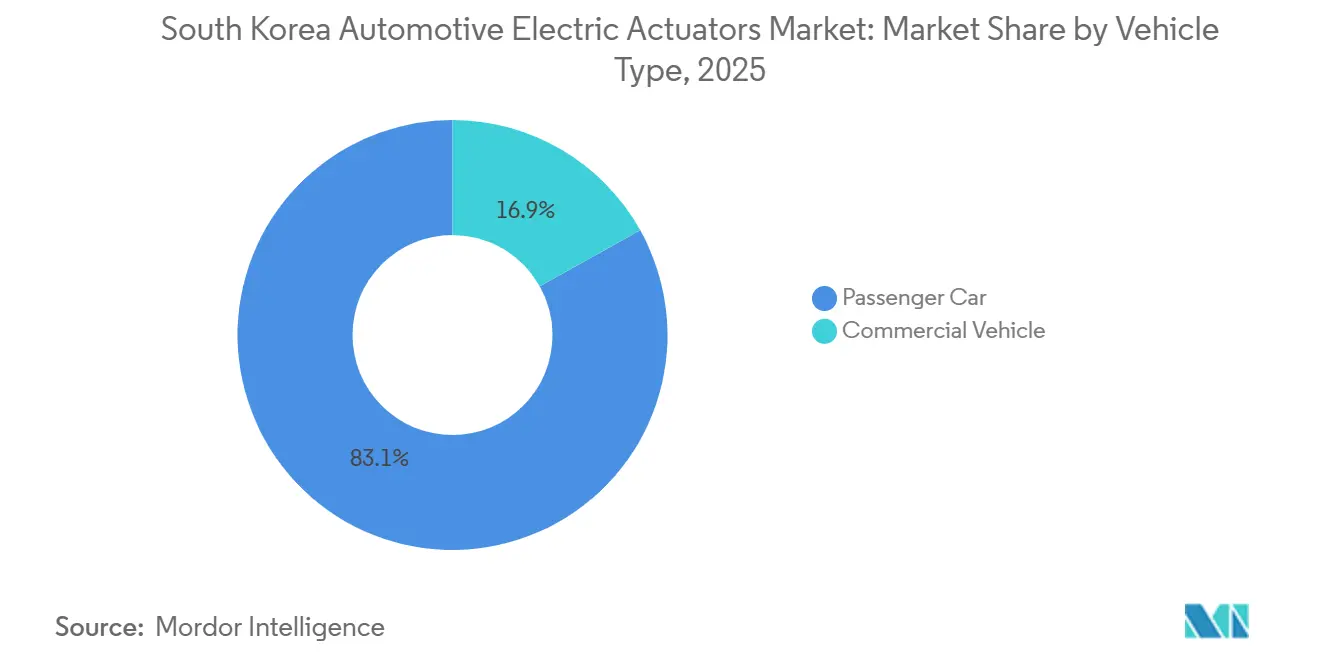
Passenger cars held 83.11% of the South Korean automotive electric actuators market size in 2025. Their position came from Hyundai production in Ulsan and Kia production in Gwangmyeong. SUVs and MPVs within passenger vehicles use more actuators for power tailgates, HVAC valves, and seat adjustment. These vehicles remain important to overall supplier volumes. Passenger-car demand also supports long-term OEM purchase orders that begin at vehicle-program inception. The South Korea automotive electric actuators industry therefore remains closely tied to the passenger vehicle production base.
Commercial vehicles are forecast to grow at an 8.84% CAGR from 2026 to 2031. The localization program for truck and bus actuators supports this faster growth rate. Electrification of buses and trucks increases demand for by-wire and thermal-management functions. Hyundai’s Ulsan campus is scheduled to begin dedicated EV plant operations in the fourth quarter of 2026. This production expansion gives suppliers in Yeongnam a larger electrified vehicle base to serve. Commercial programs can take longer to qualify, but successful suppliers may gain durable production positions.
By Application Type: Closure Actuators Lead Amid EV-Specific Feature Growth
Closure actuators accounted for 38.25% of the South Korean automotive electric actuators market share in 2025. They are also forecast to expand at a 9.65% CAGR through 2031. Charge-port doors, power tailgates, and sunroofs support demand in this application group. These features are increasingly used in premium and mid-range EVs. The category benefits from both a larger electrified fleet and higher feature content per vehicle. Its leadership combines volume demand with a strong growth outlook.
Throttle actuators remain an important application because hybrid platforms retain combustion engines. Their growth is likely to moderate as pure BEV adoption rises. Brake actuators and seat-adjustment actuators occupy mid-tier positions and serve distinct vehicle functions. Brake actuators have higher unit values because of functional-safety requirements. The remaining applications include headlamp, HVAC and thermal-management, shift-by-wire, parking-brake, and disconnect actuators. These applications form a secondary growth pool as electronic systems replace mechanical linkages in more vehicle functions.
By Actuation Technology: BLDC Dominance Faces Smart Actuator Disruption
Brushless DC (BLDC) actuators accounted for 49.05% of the South Korean automotive electric actuators market size in 2025. They are widely used in closure, seat, and throttle applications. Their appeal comes from operating efficiency and the absence of brushes in the commutation system. This technology supports many established vehicle applications where suppliers need a dependable design. Its installed base provides stable demand across both OEM and service channels. BLDC technology therefore remains central even as vehicle electronics become more sophisticated.
Smart actuators with integrated control electronics are forecast to grow at a 9.11% CAGR through 2031. These units can execute closed-loop commands, identify faults, and communicate through automotive Ethernet or CAN FD. Their unit prices are significantly higher than commodity BLDC equivalents. The mix shift can raise value growth faster than unit growth for suppliers with embedded-electronics capability. Smart actuators can also support onboard diagnostics and redundant failure modes. Those functions can ease compliance work in safety-related applications when the broader system meets applicable standards.
By Motion Type: Linear Actuators Power The By-Wire Transition
Linear actuators held 58.12% of the South Korean automotive electric actuators market size in 2025. They are forecast to grow at a 7.84% CAGR through 2031. Braking systems, door latches, and seat-rail adjustments are naturally suited to linear motion. This supports their use across several high-volume vehicle functions. Their leading position also reflects the spread of electronically controlled mechanical systems. Linear designs are expected to remain important as by-wire functions become more common.
Rotary actuators serve throttle-control and HVAC-valve applications and hold the second-largest position. Their growth is limited by lower demand for throttle functions as BEV penetration rises. Multi-axis modules remain smaller in volume but are more complex. They are used in advanced ADAS and steer-by-wire road-wheel applications.
By Vehicle Propulsion: BEV Platforms Redefine Actuator Intensity
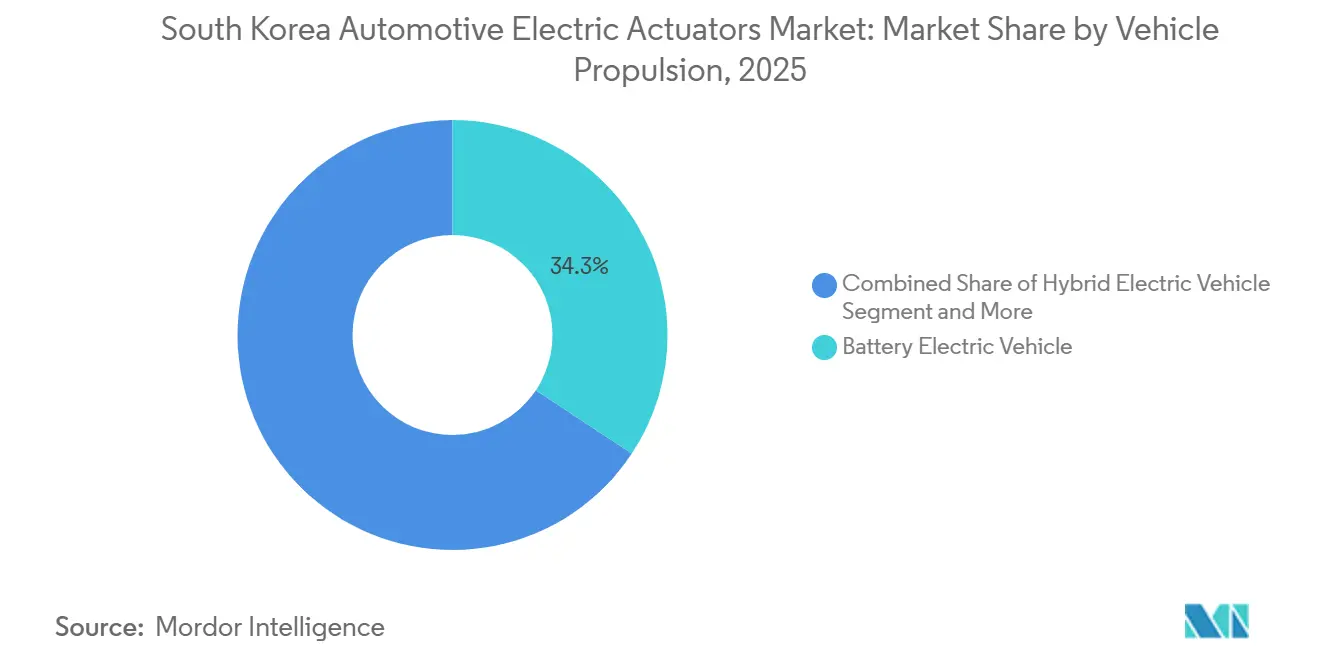
Battery Electric Vehicles (BEVs) held 34.28% of the South Korean automotive electric actuators market share in 2025 and are forecast to grow at a 10.23% CAGR through 2031. They have the highest growth rate among propulsion types. BEVs require charge-port-door, thermal-management, and by-wire chassis actuators that are not present in basic combustion vehicle layouts. This gives them higher actuator intensity than conventional platforms. Their growth will continue to shape the mix of component demand. It also raises the importance of electronics and safety capability among suppliers.
ICE vehicles retain the largest absolute volume base, but their actuator content is lower in many emerging functions. Hybrid electric vehicles remain the second-largest electrified propulsion group. They require thermal-management valves, variable-ratio transmission actuators, and engine-start mechanisms. Plug-in hybrids add charge-port door actuation to this equipment set. Hyundai Motor Group’s export plan supports the continued expansion of electrified platforms through 2030. The resulting demand base includes BEVs, hybrids, and plug-in hybrids rather than a single propulsion technology.

By Sales Channel: OEM Dominance Softens As Aftermarket Scales With BEV Fleet Maturation
OEM channels accounted for 88.45% of the South Korean automotive electric actuators market share in 2025. Actuators are normally specified when a vehicle program begins and supplied under long-term purchase orders. This design-in model limits mid-program supplier changes. It also explains why OEM demand remains much larger than service replacement demand. Vehicle manufacturers value actuator suppliers that can meet program timing and validation requirements. These relationships support a substantial portion of revenue in the South Korea automotive electric actuators market.
The aftermarket is forecast to grow at an 8.42% CAGR through 2031. Earlier BEV and hybrid models are moving into their first service intervals. This creates a wider base for replacement demand. Many closure and comfort actuators are module-integrated and are not designed for simple repair. That feature limits standalone replacement volumes. Independent workshops are nevertheless increasing their stocks of standardized BLDC modules for mid-range vehicles.
Geography Analysis
The Seoul Capital Area accounted for 40.23% of the South Korean automotive electric actuators market size in 2025. Its role comes primarily from design authority, supplier qualification, functional-safety approvals, and program management. Engineering decisions made in Seoul can be applied at production sites in Yeongnam, Honam, and Hoseo. The region also has engineering billings and aftermarket distribution activity. This revenue mix is less dependent on one plant’s production volume. The Seoul Capital Area remains central to OEM and supplier coordination.
Yeongnam is forecast to grow at a 7.33% CAGR from 2026 to 2031 and is the fastest-growing regional market. Ulsan accounted for a significant share of South Korea’s automotive output and supported a broad base of auto-related companies. Hyundai Motor Group announced a major investment in Yeongnam through 2036, covering an Ulsan EV plant, a Hyundai Mobis motor and control-unit line in Daegu, and a Hyundai Wia EV thermal-management line in Changwon. The program strengthens demand across propulsion, comfort, and safety applications. The Daegu-Gyeongbuk Free Economic Zone is also receiving funding through 2028 to develop a specialized complex for mobility motor materials and equipment.
Honam is the third-largest geography and is centered on Kia’s Gwangju plant. The area supports compact and mid-size platform production and a related local supply chain. The rest of South Korea includes smaller production footprints and supplier clusters in the inland Gyeonggi zone. These areas benefit as national EV adoption extends beyond the main industrial belt. Regional demand is supported by new-model production as well as replacement needs. Their growth is linked to the same national shift toward electrified vehicle platforms.
Competitive Landscape
The South Korean automotive electric actuators market is moderately concentrated, with domestic Tier 1 suppliers benefiting from established Hyundai Motor Group and Kia program relationships. These OEMs accounted for a major share of Korean OEM output, making their sourcing choices influential across the domestic supply base. HL Mando leads the by-wire chassis segment with brake-by-wire and steer-by-wire systems. Hyundai Mobis has expanded related control and motion capability through its Boston Dynamics collaboration. Domestic suppliers retain an advantage where OEM access, local engineering support, and reliable production execution are decisive.
Bosch, Continental, Nidec, ZF, Denso, and BorgWarner compete mainly in high-value chassis applications that require strong electronics and certification capability. Hyundai Motor Company and Kia received a U.S. Patent in 2025 for an integrated actuator assembly that combines disconnector and eLSD functions [3]. The patent shows the level of OEM activity around integrated electromechanical systems. It also raises the technical integration expected of external suppliers. Global competitors are strongest in functions where safety validation and control-system expertise outweigh basic component cost.
Commercial-vehicle localization provides an opening for domestic suppliers that can meet durability and functional-safety requirements. Smart actuators are another opportunity because embedded controls, diagnostics, and communications capability remain less established among suppliers focused on BLDC and brushed-DC products. Samhyun commercialized a shift-by-wire actuator in South Korea in 2020 and secured a second OEM customer in 2025. The market remains difficult to enter, but suppliers that align their technical capability with a clear OEM program can build durable design-in positions.
South Korea Automotive Electric Actuators Industry Leaders
-
HL Mando Corporation
-
Hyundai Mobis Co., Ltd.
-
Denso Corporation
-
Robert Bosch GmbH
-
Continental AG
- *Disclaimer: Major Players sorted in no particular order
Recent Industry Developments
- July 2026: South Korea's Ministry of Trade, Industry and Energy launched an "ecosystem cooperation-type R&D" program jointly with Hyundai and domestic parts suppliers to localize large commercial vehicle actuators currently monopolized by global firms. The program allocates KRW 8 billion (approximately USD 6.1 million) per project over 3 years, with mass-production deployment on trucks and buses targeted from 2029.
- January 2026: HL Mando was granted U.S. patents covering steer-by-wire apparatus and road wheel actuator compliance monitoring, strengthening the company's IP position in pure-play SbW actuation and supporting its active Middle East OEM production program.
South Korea Automotive Electric Actuators Market Report Scope
The scope includes segmentation by vehicle type (passenger car (sedan, hatchback, sport utility vehicle, and multi-purpose vehicle) and commercial vehicle (light commercial vehicle, medium and heavy duty trucks, and buses and coaches)), application type (throttle actuator, seat adjustment actuator, brake actuator, closure actuator (power window actuator, power door-lock actuator, power tailgate actuator, sunroof actuator, and charge-port door actuator), and other automotive electric actuators (headlamp actuator, HVAC and thermal-management actuator, shift-by-wire actuator, parking-brake actuator, and disconnect actuator)), actuation technology (brushed DC actuator, brushless DC actuator, stepper-motor actuator, electro-mechanical actuator, and smart actuator with integrated control electronics), motion type (rotary actuator, linear actuator, and multi-axis actuator module), vehicle propulsion (internal combustion engine vehicle, hybrid electric vehicle, plug-in hybrid electric vehicle, battery electric vehicle, and fuel cell electric vehicle), and sales channel (original equipment manufacturer (OEM) and aftermarket). The analysis also covers regional-level segmentation including Seoul Capital Area, Yeongnam Southeastern Region, Honam Southwestern Region, Hoseo Central Region, and Rest of South Korea. Market size and growth forecasts are presented by value in USD and volume in units.
By Vehicle Type
| Passenger Car | Sedan |
| Hatchback | |
| Sport Utility Vehicle | |
| Multi-Purpose Vehicle | |
| Commercial Vehicle | Light Commercial Vehicle |
| Medium and Heavy Duty Trucks | |
| Buses and Coaches |
By Application Type
| Throttle Actuator | |
| Seat Adjustment Actuator | |
| Brake Actuator | |
| Closure Actuator | Power Window Actuator |
| Power Door-Lock Actuator | |
| Power Tailgate Actuator | |
| Sunroof Actuator | |
| Charge-Port Door Actuator | |
| Other Automotive Electric Actuators | Headlamp Actuator |
| HVAC and Thermal-Management Actuator | |
| Shift-by-Wire Actuator | |
| Parking-Brake Actuator | |
| Disconnect Actuator |
By Actuation Technology
| Brushed DC Actuator |
| Brushless DC Actuator |
| Stepper-Motor Actuator |
| Electro-Mechanical Actuator |
| Smart Actuator with Integrated Control Electronics |
By Motion Type
| Rotary Actuator |
| Linear Actuator |
| Multi-Axis Actuator Module |
By Vehicle Propulsion
| Internal Combustion Engine Vehicle |
| Hybrid Electric Vehicle |
| Plug-in Hybrid Electric Vehicle |
| Battery Electric Vehicle |
| Fuel Cell Electric Vehicle |
By Sales Channel
| Original Equipment Manufacturer (OEM) |
| Aftermarket |
By Region
| Seoul Capital Area |
| Yeongnam, Southeastern Region |
| Honam, Southwestern Region |
| Hoseo, Central Region |
| Rest of South Korea |
| By Vehicle Type | Passenger Car | Sedan |
| Hatchback | ||
| Sport Utility Vehicle | ||
| Multi-Purpose Vehicle | ||
| Commercial Vehicle | Light Commercial Vehicle | |
| Medium and Heavy Duty Trucks | ||
| Buses and Coaches | ||
| By Application Type | Throttle Actuator | |
| Seat Adjustment Actuator | ||
| Brake Actuator | ||
| Closure Actuator | Power Window Actuator | |
| Power Door-Lock Actuator | ||
| Power Tailgate Actuator | ||
| Sunroof Actuator | ||
| Charge-Port Door Actuator | ||
| Other Automotive Electric Actuators | Headlamp Actuator | |
| HVAC and Thermal-Management Actuator | ||
| Shift-by-Wire Actuator | ||
| Parking-Brake Actuator | ||
| Disconnect Actuator | ||
| By Actuation Technology | Brushed DC Actuator | |
| Brushless DC Actuator | ||
| Stepper-Motor Actuator | ||
| Electro-Mechanical Actuator | ||
| Smart Actuator with Integrated Control Electronics | ||
| By Motion Type | Rotary Actuator | |
| Linear Actuator | ||
| Multi-Axis Actuator Module | ||
| By Vehicle Propulsion | Internal Combustion Engine Vehicle | |
| Hybrid Electric Vehicle | ||
| Plug-in Hybrid Electric Vehicle | ||
| Battery Electric Vehicle | ||
| Fuel Cell Electric Vehicle | ||
| By Sales Channel | Original Equipment Manufacturer (OEM) | |
| Aftermarket | ||
| By Region | Seoul Capital Area | |
| Yeongnam, Southeastern Region | ||
| Honam, Southwestern Region | ||
| Hoseo, Central Region | ||
| Rest of South Korea | ||
Key Questions Answered in the Report
What is the forecast growth rate for automotive electric actuators in South Korea?
The South Korea automotive electric actuators market is forecast to grow at a 6.93% CAGR from 2026 to 2031, reaching USD 1.58 billion.
Which vehicle propulsion type is expanding fastest?
BEVs are forecast to grow at a 10.23% CAGR through 2031, the highest rate among propulsion types.
Which actuator application has the largest share?
Closure actuators held 38.25% of revenue in 2025 and are forecast to grow at a 9.65% CAGR through 2031.
Which region is growing fastest for actuator demand?
Yeongnam is forecast to grow at a 7.33% CAGR through 2031, supported by Ulsan production and related investments.