
Market Overview
| Study Period | 2021 - 2032 |
|---|---|
| Forecast Data Period | 2027 - 2032 |
| Base Year Market Size (2026) | USD 8.80 Billion |
| Market Size (2027) | USD 9.40 Billion |
| Market Size (2032) | USD 12.5 Billion |
| Growth Rate (2027 - 2032) | 5.87 % |
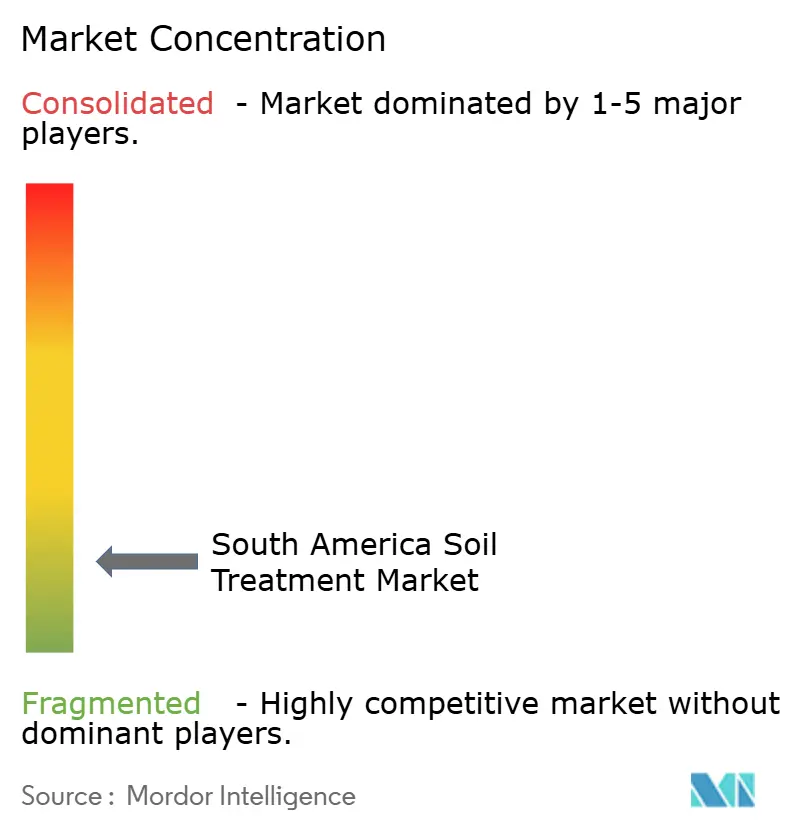
| Market Concentration | Low |
Major Players *Disclaimer: Major Players sorted in no particular order Image © Mordor Intelligence. Reuse requires attribution under CC BY 4.0. | |
South America Soil Treatment Market Analysis by Mordor Intelligence
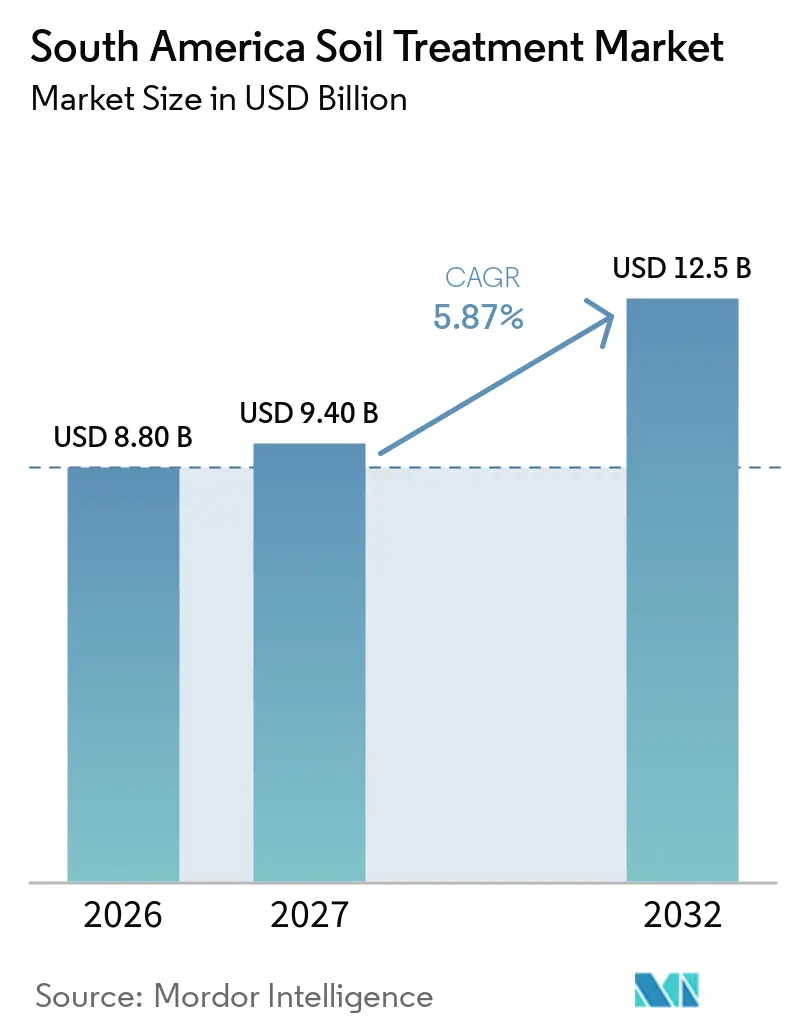
The South America soil treatment market size was valued at USD 8.80 billion in 2026 and is estimated to reach USD 9.40 billion in 2027. The market is forecast to grow at a CAGR of 5.87% from 2027 to 2032, reaching USD 12.5 billion by 2032. South America has emerged as a dominant force in global agriculture, maintaining preeminent positions in the export markets for essential commodities, including sugar, coffee, orange juice, soybeans, and soybean oil, while securing a robust second-place position in corn and soybean meal exports. The agricultural sector faces substantial challenges from soil-borne diseases across Latin America, where destructive pathogens, including Fusarium spp., Verticillium spp., Phytophthora spp., and various nematode species, inflict considerable damage on agricultural production, particularly affecting major crops such as soybean, maize, cotton, and potatoes. These pathogenic infections cause substantial annual economic losses of billions of dollars, posing significant threats to regional food security and agricultural productivity. In response, governmental bodies and research institutions have implemented comprehensive soil health programs and advanced technological initiatives to combat soil-borne pathogens, demonstrating promising results in reducing losses and enhancing productivity.
The increasing use of pesticides drives the demand for soil treatment. According to FAOSTAT data, Argentina's agricultural pesticide consumption increased from 241,519.9 metric tons in 2021 to 262,506.9 metric tons in 2022. Pesticides harm beneficial soil organisms, including earthworms, ants, and beetles, which maintain soil health. This soil degradation requires treatment measures to restore and preserve soil fertility and structure.
Innovation and product development remain fundamental strategic priorities within the agricultural industry, with major corporations consistently introducing advanced solutions to address increasingly complex agricultural challenges. Throughout 2023-2024, industry leaders demonstrated significant technological advancement, exemplified by Bayer's introduction of sophisticated fungicide technologies and FMC's development of advanced herbicide formulations. The industry has witnessed a substantial shift toward developing agricultural products that effectively balance performance requirements with environmental sustainability considerations, responding to heightened regulatory oversight and evolving farmer preferences. This commitment to innovation is particularly pronounced in the agricultural biologicals and precision agriculture segments, where substantial research and development investments are directed toward creating sustainable agricultural solutions that meet modern farming requirements.
Note: Market numbers in this report are based on Mordor Intelligence's proprietary estimation framework, which combines nine months of actuals with Q4 projections for base year 2026.
South America Soil Treatment Market Trends and Insights
Physiochemical Treatment Dominates the Market
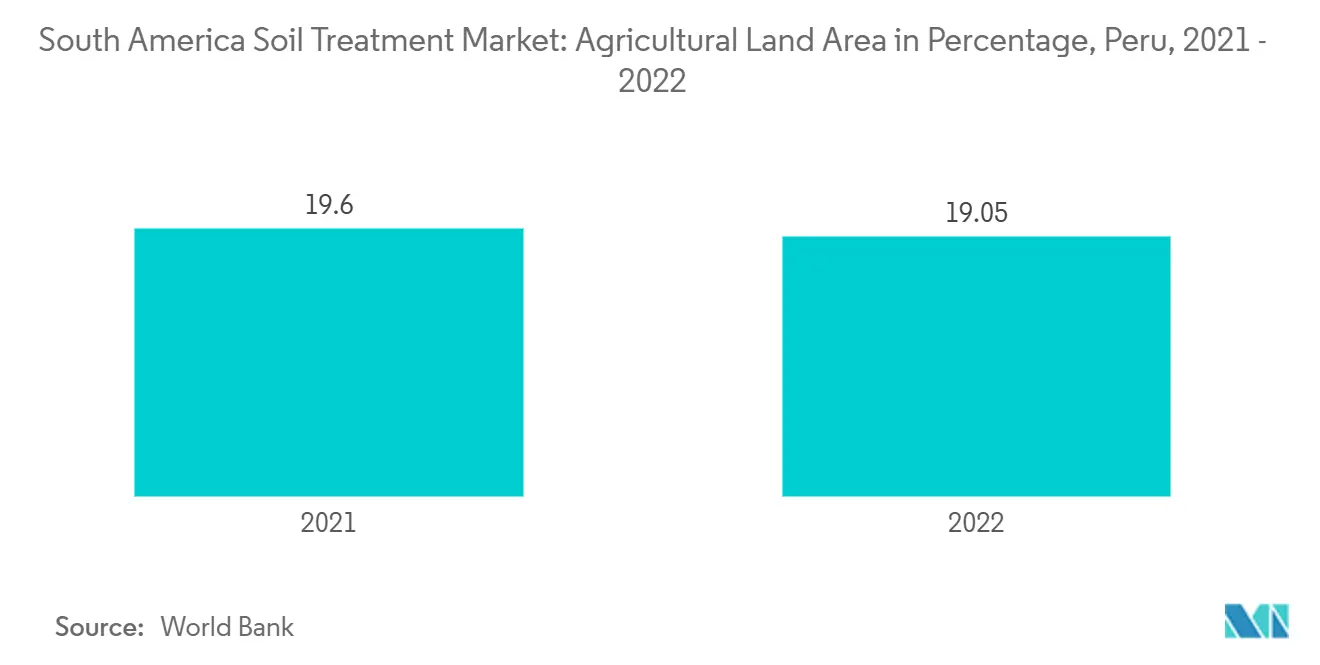
In South America, the decline in arable land has intensified farming practices in remaining agricultural areas, resulting in soil degradation. Peru's agricultural land area decreased from 19.60% in 2021 to 19.05% in 2022, according to World Bank data. Physiochemical treatments, including soil conditioners and amendments, help restore soil structure, fertility, and pH balance. The reduction in farmable land requires optimizing crop yields from existing agricultural areas. These treatments improve nutrient availability and plant uptake, maintaining soil productivity under intensive farming conditions. The limited availability of arable land increases pest and disease risks due to monocropping and reduced crop rotation. Soil fumigants and biocides, as part of physiochemical treatments, help control these risks and maintain crop health.
Land degradation significantly impacts South America's agricultural landscape, affecting 22% of the region's total land area, equivalent to 378 million hectares in 2023. This substantial decline in arable land has emerged as a primary driver for the soil treatment market expansion. The region demonstrates a strategic shift toward implementing sustainable agricultural methodologies, incorporating advanced practices such as integrated pest management systems and biological crop protection solutions. Brazil's comprehensive regenerative agriculture initiatives specifically target the rehabilitation of 40 million hectares of degraded pastureland, while Colombia's agricultural sector implements sophisticated silvopasture techniques to enhance soil quality and agricultural productivity. These systematic approaches to land management have generated increased demand for specialized soil treatment solutions, simultaneously supporting market expansion and establishing long-term agricultural sustainability across the region.
Brazil Dominates the Market
Brazil holds the major part of soil treatment market share in South America. The conventional method of cultivating crops has led to a high application rate of macronutrient fertilizers which is a major source of soil contamination in Brazil. Field evaluations in Brazil revealed a number of pests in the soil resulting in yield losses. All these soil contaminations resulted in the increased application of soil treatment.
In Brazil, soil-borne pests, encompassing nematodes, fungi, and bacteria, present substantial challenges to agricultural productivity by compromising crop health and yield potential. Nematode infestations severely impair root system functionality, resulting in diminished nutrient absorption capabilities and inhibited plant development. Pathogenic fungi, specifically Fusarium and Rhizoctonia species, induce various plant diseases that substantially deteriorate plant vigor and agricultural output. The Brazilian agricultural sector has implemented comprehensive soil treatment protocols to address these challenges. These protocols incorporate advanced biocontrol agents, including Trichoderma harzianum and Metarhizium species, which effectively suppress soil-borne pathogens while enhancing plant defense mechanisms. The industry has also adopted sophisticated soil management techniques, such as soil solarization through transparent plastic deployment for pathogen elimination, complemented by the strategic application of compost-enriched soil amendments. These methodologies demonstrate significant efficacy in pest population management while simultaneously improving soil health parameters. This multifaceted approach not only ensures effective pest control but also promotes agricultural sustainability through reduced chemical dependence and enhanced soil microbiological diversity.
Competitive Landscape
The South American soil treatment market is fragmented, with many players in the market. Syngenta AG, BASF SE, UPL, Novonesis, and Bayer AG are some of the global and regional players in the region. These companies are actively investing in research and development to create innovative soil treatment solutions, particularly focusing on environmentally sustainable products and precision application technologies. Strategic expansion through manufacturing facility investments has been a key trend, with companies establishing new production sites to strengthen their regional presence and supply chain capabilities.
South America Soil Treatment Industry Leaders
-
BASF SE
-
Bayer AG
-
Syngenta AG
-
UPL Limited
-
Novonesis A/S
- *Disclaimer: Major Players sorted in no particular order
Recent Industry Developments
- January 2023: Bayer formed a new partnership with Oerth Bio to enhance crop protection technology and create more eco-friendly crop protection solutions.
- May 2022: UPL partnered with Bayer for Spirotetramat insecticide to develop new pest management solutions. Through this long-term global data access and supply agreement with Bayer, specifically for addressing farmer demands regarding resistance management and difficult-to-control sucking pests, UPL will develop, register, and distribute new unique solutions, including Spirotetramat, using its experience in insecticides and worldwide research and development network.
South America Soil Treatment Market Report Scope
Soil treatment refers to nutritional management that improves soil fertility and increases organic matter content. It also kills pathogens and pests in the soil, thereby making it healthier. The South American Soil Treatment Market is segmented by Technology Type (Physiochemical Treatment, Thermal Treatment, Biological Treatment, and Other Technology Types) and Geography (Brazil, Argentina, and the Rest of South America). The report provides market size and forecasts by value (USD) for all the above segments.
By Technology Type
| Physiochemical Treatment |
| Thermal Treatment |
| Biological Treatment |
| Other Technology Types |
By Geography
| Brazil |
| Argentina |
| Rest of South America |
| By Technology Type | Physiochemical Treatment |
| Thermal Treatment | |
| Biological Treatment | |
| Other Technology Types | |
| By Geography | Brazil |
| Argentina | |
| Rest of South America |
Key Questions Answered in the Report
How big is the South America soil treatment market?
The South America soil treatment market size was valued at USD 8.80 billion in 2026.
What is the current South America soil treatment market size?
In 2027, the South America soil treatment market size is estimated to reach USD 9.40 billion.
What is the forecasted growth rate of the South America Soil Treatment Market from 2027 to 2032?
The South America soil treatment market is forecast to grow at a CAGR of 5.87% from 2027 to 2032.
Who are the key players in South America soil treatment market?
UPL Limited , BASF SE, Bayer AG, Syngenta AG and Novonesis A/S are the major companies operating in the South America soil treatment market.