
Market Overview
| Study Period | 2021 - 2031 |
|---|---|
| Forecast Data Period | 2026 - 2031 |
| Base Year Market Size (2025) | USD 1.25 Billion |
| Market Size (2026) | USD 1.32 Billion |
| Market Size (2031) | USD 1.83 Billion |
| Growth Rate (2026 - 2031) | 6.71 % |
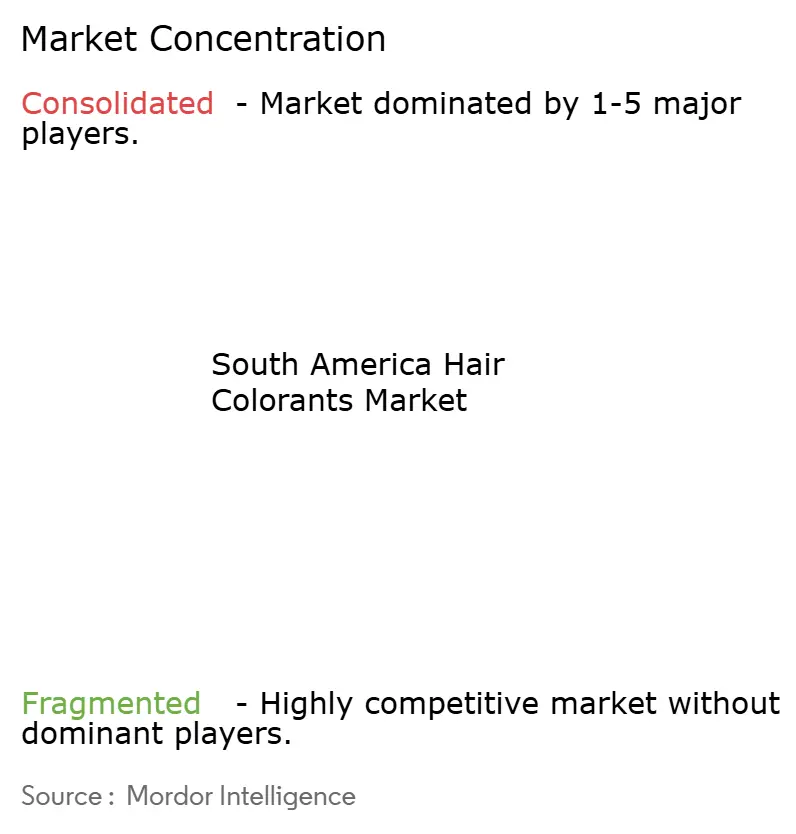
| Market Concentration | Medium |
Major Players *Disclaimer: Major Players sorted in no particular order Image © Mordor Intelligence. Reuse requires attribution under CC BY 4.0. | |
South America Hair Colorants Market Analysis by Mordor Intelligence
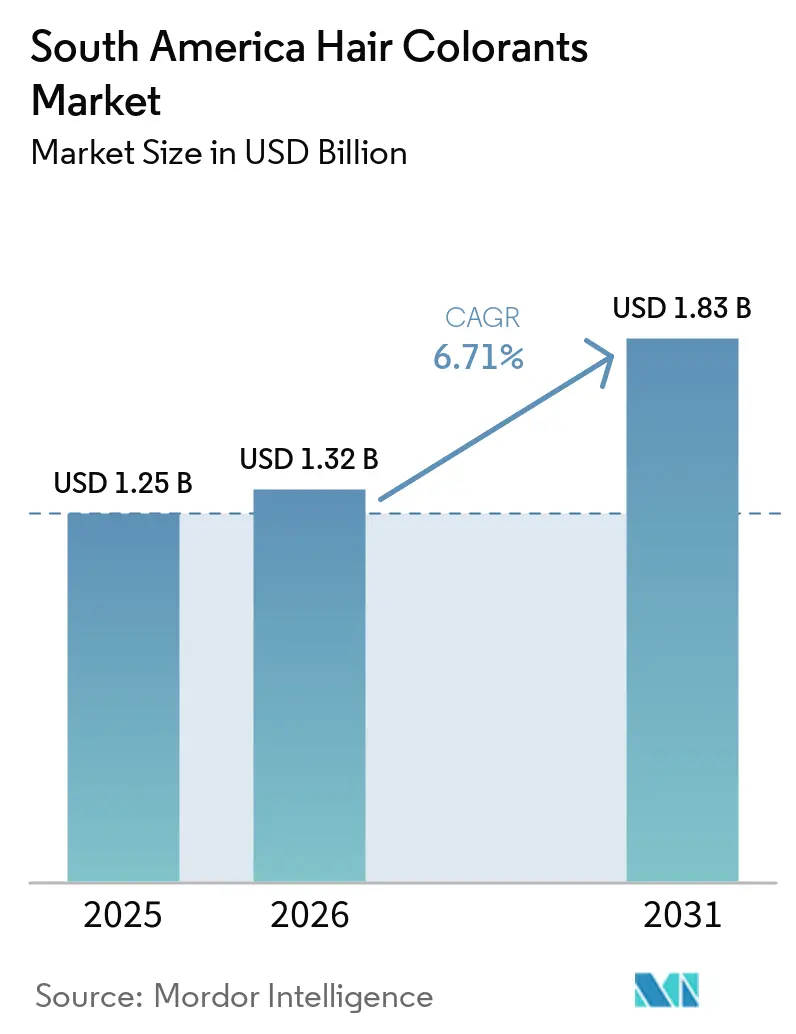
The South America hair colorants market size was valued at USD 1.32 billion in 2026, up from USD 1.25 billion in 2025, and is projected to reach USD 1.83 billion by 2031, registering a CAGR of 6.71% over the forecast period. The South America hair colorants market is supported by routine color use among urban consumers, rather than by occasional salon-led purchases alone. Demand is also broadening as online access brings branded products to consumers outside the largest cities. Product safety, ingredient disclosure, and reliable gray coverage are becoming more important parts of the purchase decision. The South America hair colorants market gives both regional and multinational brands room to compete, although the strongest positions depend on formulation, local shade preferences, and credible compliance practices. Brazil remains central to the regional outlook, while Argentina offers the fastest forecast growth among the countries covered.
Key Report Takeaways
- By product type, Temporary Colorants held 38.46% of regional value in 2025, while Semi-Permanent Colorants are forecast to grow at an 8.34% CAGR through 2031.
- By category, Mass held 75.68% of regional value in 2025, while Premium is forecast to grow at an 8.11% CAGR through 2031.
- By distribution channel, Supermarkets and Hypermarkets held 41.28% of regional value in 2025, while Online Retail Channels are forecast to grow at an 8.89% CAGR through 2031.
- By geography, Brazil held 45.37% of the South America hair colorants market share in 2025, while Argentina is forecast to grow at an 8.72% CAGR through 2031.
Note: Market size and forecast figures in this report are generated using Mordor Intelligence’s proprietary estimation framework, updated with the latest available data and insights as of January 2026.
South America Hair Colorants Market Trends and Insights
Drivers Impact Analysis*
| Driver | (~) % Impact on CAGR Forecasts | Geographic Relevance | Impact Timeline |
|---|---|---|---|
| Growing focus on personal grooming and appearance | +0.9% | Global, concentrated in urban Brazil and Argentina | Medium term (2-4 years) |
| Rising popularity of hair coloring and styling trends | +1.2% | Brazil, Argentina, Chile, with spillover to Colombia and Peru | Short term (≤ 2 years) |
| Increasing influence of social media and beauty influencers | +1.0% | Brazil-led, with Latin America-wide digital reach | Short term (≤ 2 years) |
| Growing demand for gray hair coverage | +0.8% | Brazil, Argentina, and Chile | Long term (≥ 4 years) |
| Development of natural, herbal, and ammonia-free formulations | +1.1% | Global, with stronger regulatory relevance in Brazil | Medium term (2-4 years) |
| Rising demand for premium and professional hair colorants | +0.7% | Brazil and Argentina, with spillover to Chile | Medium term (2-4 years) |
| Source: Mordor Intelligence | |||
Rising Popularity of Hair Coloring and Styling Trends
Hair coloring is becoming part of regular grooming for more consumers across the region. The South America hair colorants market benefits when consumers use color to refresh their appearance between salon visits. Professional techniques developed for Latin hair textures are receiving broader attention in salons, including morenas iluminadas, sun-kissed gradients, and satin blondes. This has supported demand for at-home kits, salon touch-ups, and repeat purchase options. Black and brown hair accounts for a large share of the Latin American consumer base, although preferred tones vary by country. Brazil favors warmer copper and blonde tones, while Argentina has stronger interest in ash and cool-toned looks.
Increasing Influence of Social Media and Beauty Influencers
Social platforms have become an important discovery route for hair color products in Brazil and neighboring markets. The South America hair colorants market is affected by this shift because product demonstrations, social proof, and purchase decisions can happen in the same viewing session. Salon Line presented more than 40 products at Beauty Fair 2025 that were aligned with creator communities and social-commerce activity[1]. The company also described a concept-to-shelf cycle of less than 1 month, which favors companies able to react quickly to changing consumer interest. Creator content can make premium formulations more familiar to consumers who would not first encounter them through a salon. Brands still need clear product instructions and safety information because frequent experimentation can increase the risk of incorrect home use.
Development of Natural, Herbal, and Ammonia-Free Formulations
Demand for ammonia-free and ingredient-conscious products is reshaping portfolio decisions in the South America hair colorants market. The change is linked to consumer interest in gentler formulations and to closer regulatory attention to cosmetic safety[2]. classifies hair colorants as Grade 2 cosmetics, which places greater importance on complete product files and safety support before market entry. Brazil also considered restrictions on 28 substances in personal care products during 2025, which showed the direction of regulatory discussion around cosmetic ingredients. Regional ingredients can help brands explain product positioning when they are paired with credible formulation benefits. The South America hair colorants market therefore rewards companies that combine safety evidence, clear labeling, and hair-performance claims. The same approach can reduce the gap between consumer concern and product efficacy.
Growing Demand for Gray Hair Coverage
Gray coverage remains a recurring source of demand because the need for coverage returns as hair grows. The South America hair colorants market is also gaining interest in products that frame gray-hair care as treatment-oriented rather than as simple concealment. Natura introduced Lumina Antissinais Regenerador Capilar in October 2025 with Pró-Melanina and Bio Proteína Tripla Ação technology. The offering targets consumers who may not identify with conventional dye messaging. This approach creates space between traditional colorants and restorative hair care. It may also change shelf placement and portfolio design for products addressing the 40-60-year-old consumer group.
Restraints Impact Analysis*
| Restraint | (~) % Impact on CAGR Forecasts | Geographic Relevance | Impact Timeline |
|---|---|---|---|
| Growing concerns about chemical ingredients | -0.7% | Brazil, Argentina, and Chile | Medium term (2-4 years) |
| Risk of allergic reactions and scalp irritation | -0.5% | Brazil and Argentina | Short term (≤ 2 years) |
| High cost of premium and professional hair colorants | -0.4% | Argentina, Peru, and Colombia | Medium term (2-4 years) |
| Competition from low-cost and counterfeit products | -0.5% | Brazil, Colombia, Peru, and Rest of South America | Medium term (2-4 years) |
| Source: Mordor Intelligence | |||
Growing Concerns About Chemical Ingredients
Consumers are giving greater attention to colorant ingredient lists, especially when safety concerns circulate on social platforms. The South America hair colorants market can be affected even when enforcement action concerns adjacent hair-product categories. In July 2025, ANVISA published Resolução RE 2.442 and RE 2.443, canceled irregular hair products, and suspended manufacturing activity at facilities covered by its operation. Such actions reinforce the importance of transparent declarations and complete compliance records. Brands with recognized safety credentials can be better positioned when category concerns rise. The South America hair colorants market also faces cost pressure when imported inputs and packaging become more expensive. This gives locally sourced botanical inputs a potential role in formulation and sourcing strategies.
Risk of Allergic Reactions and Scalp Irritation
Reports of adverse reactions can discourage trial purchases, particularly among consumers who use color only occasionally. PPD is a recognized contact allergen, and it remains relevant to the safety discussion around permanent colorants[3]. Removing PPD completely can make it harder to preserve color fastness and gray-coverage performance. This creates a product-development challenge for manufacturers working on gentler alternatives. The issue is important for temporary and semi-permanent products because repeat use may increase cumulative scalp exposure. Clear patch-test guidance and straightforward application instructions remain important safeguards for the South America hair colorants market.
*Our forecasts treat driver/restraint impacts as directional, not additive. The impact forecasts reflect baseline growth, mix effects, and variable interactions.
Segment Analysis
By Product Type: Ammonia-Free Formulations Support Semi-Permanent Growth
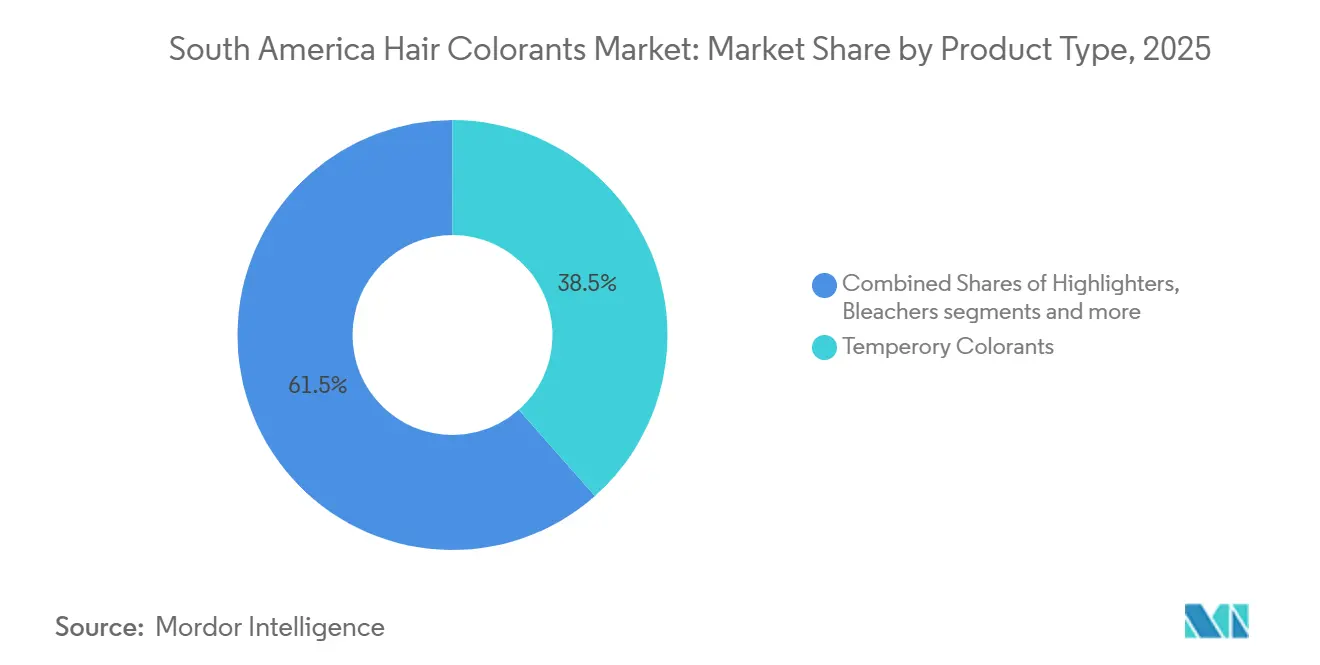
Temporary Colorants are projected to account for 38.46% of the South America hair colorants market in 2025, while Semi-Permanent Colorants are forecast to grow at a CAGR of 8.34% through 2031. Temporary products appeal to consumers seeking frequent, low-commitment color changes. Semi-permanent products offer longer-lasting results without the permanence of conventional alternatives. Demand for ammonia-free formulations also supports this category, as consumers seek gentler options. Permanent Colorants remain relevant for reliable gray coverage, while Bleaches and Highlighters are gaining traction with balayage and foilyage services in Brazil’s salon network. Professional colorists need products that work across different porosity levels and chemically processed hair. Predictable lift, even color deposition, and clear aftercare guidance are therefore important. Consumers also consider fading, maintenance needs, and potential hair damage. As a result, reversible color applications and salon-supported services can coexist in the same consumer routine.
Formulation choices and shade selection are shaping the South America hair colorants market. ANVISA’s Grade 2 classification increases the importance of established safety documentation in Brazil, favoring brands with strong regulatory and testing capabilities. Brazilian brands use regional ingredients to differentiate ammonia-free offerings, while European clean-label brands are expanding into the region, including Naturtint’s planned entry into Venezuela in 2025. The market provides opportunities for local and imported brands, provided they balance gentler chemistry with reliable color performance. Formulation credibility is likely to matter more than packaging. Regional ingredients must support clear functional claims rather than broad natural-product messaging. Brands must also communicate trade-offs involving gray coverage, durability, and scalp comfort to align ingredient-led promises with everyday color results.

By Category: Mass Retains Reach While Premium Grows Faster
Mass products are projected to hold 75.68% of the South America hair colorants market in 2025, driven by the region’s demand for affordable colorants. Supermarket availability and broad shade ranges support their reach, while consumers prioritize price, coverage, and ease of application. The premium category is projected to grow at a CAGR of 8.11% through 2031, outpacing the overall market. Urban consumers increasingly buy salon-style products for home use, and social media helps premium brands reach secondary cities. This is creating a layered market structure, with consumers moving between mass and premium tiers as needs change. Clear shade systems, trusted safety profiles, and product availability remain important across price levels.
Consumers trade up based on professional-quality formulations, ingredient transparency, and clear performance claims. L’Oréal’s Brazil operations emphasize products for diverse local hair profiles, illustrating premium localization. According to the supplied research base, beauty purchases in Argentina are expected to remain resilient in current terms during 2025 despite high inflation, supporting demand for affordable premiumization. However, price sensitivity remains significant. Mass brands face competition from private labels and consumers selectively shifting to premium products. Premium suppliers must demonstrate superior wear, color quality, or care benefits while ensuring easy application. Mass suppliers must maintain familiar price points while improving perceived safety and formula quality. These factors influence whether consumers view an upgrade as worthwhile.
By Distribution Channel: Online Retail Expands the Purchase Journey
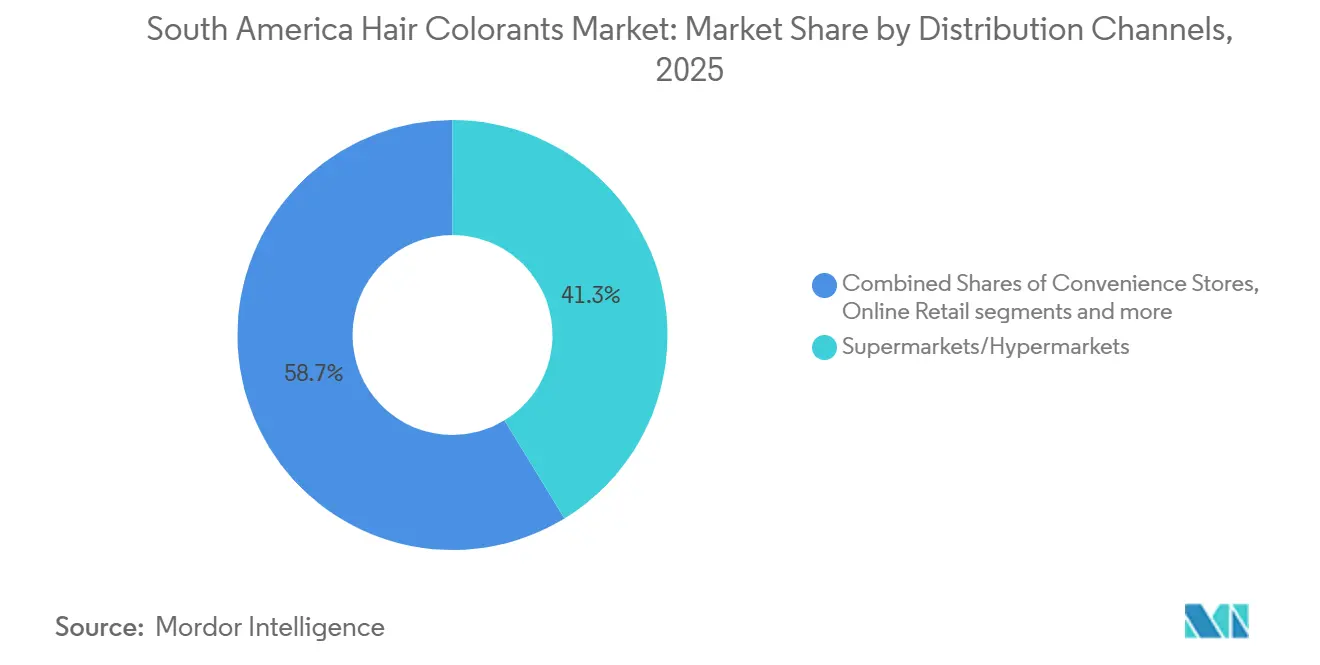
Supermarkets and Hypermarkets accounted for 41.28% of the South America hair colorants market in 2025, while Online Retail Channels are projected to grow at an 8.89% CAGR through 2031. Physical stores remain the main channel for mass-market products, allowing consumers to compare prices and products in person. Their broad reach is particularly important where online delivery remains inconsistent. Online retail is expanding through brand websites, e-commerce platforms, and social commerce, helping brands reach consumers beyond major metropolitan areas. Physical and online channels serve complementary needs. Store shelves support routine purchases, while digital content helps consumers explore new techniques and shades. Brands must keep product names, shade information, and availability consistent across both channels.
The South America hair colorants market requires an integrated channel strategy as online discovery gains influence. Health and Beauty Stores remain important for imported and premium products, particularly where staff advice supports higher-value purchases. Pharmacy networks and direct-selling channels also retain reach in some Andean markets. Embelleze’s entry into TikTok Shop in 2025 demonstrated how live commerce can combine product demonstrations with in-app purchasing. Brands with strong supermarket distribution but limited online availability may lose visibility among first-time users. Online product pages should include complete instructions and authentic distribution controls, especially in markets where counterfeit products and informal retail affect trust. Digital storefronts can provide patch-test guidance, application videos, and aftercare information, reducing uncertainty for first-time users and strengthening brand trust.
Geography Analysis
Brazil held 45.37% of the South America hair colorants market share in 2025. Its scale reflects a dense professional salon base, broad consumer familiarity with hair products, and local demand across multiple hair textures. Brazil’s hair-care sales reached BRL 35.3 billion in 2025, according to the supplied research base. The country is important for product testing and localized formulation. L’Oréal’s Rio de Janeiro Research and Innovation Center has a role in developing products for Brazil’s diverse hair profiles. Brazil is also central to social-commerce activity and regional product launches. Brazil’s product landscape includes demand for colorants that perform across diverse curl patterns, tones, and levels of chemical processing. This makes the country a useful setting for testing both formula performance and practical consumer communication. Brands that develop in Brazil can also apply some of these learnings to other markets with diverse hair needs.
Argentina is projected to record an 8.72% CAGR through 2031, the fastest rate among the geographic segments in the South America hair colorants market. The outlook reflects recovery in beauty demand despite ongoing economic pressure. Argentina’s retail hair-care sales rose 35% in current terms during 2025 in the supplied research base. Local preferences differ from those in Brazil, with more interest in ash tones, gray blending, and silver-highlight services. Henkel has direct operations in Argentina through Schwarzkopf Professional and consumer brands. Brands need localized shade ranges and pricing suited to the country’s economic conditions. The country’s conditions also encourage careful pack sizing and an assortment that covers both routine touch-ups and salon-inspired looks. Local salon education can help ensure that new shades and techniques are applied consistently. This matters where consumers seek visible results but remain cautious about price.
Chile, Colombia, Peru, and the Rest of South America provide volume opportunities for companies able to extend distribution beyond the main cities. Chile’s higher income and modern retail access can support premium product testing. Colombia’s salon scene is increasing its focus on technical color services in Bogotá and Medellín. Peru and smaller markets are gaining access through e-commerce, although informal retail remains a challenge. The South America hair colorants market benefits when products are available through authenticated sellers. Country-level differences in color preference and distribution maturity require selective expansion plans. In these markets, a distributor’s ability to protect product authenticity can be as important as its ability to reach smaller cities. Professional partners can also provide useful feedback on local shade preferences. A single regional range is less likely to work well when retail access, salon maturity, and consumer expectations differ sharply.
Competitive Landscape
The South America hair colorants market is moderately consolidated. Global companies such as L’Oréal, Henkel, and Wella hold strong premium positions through research capability and salon education. Brazilian brands, including Embelleze, Salon Line, Natura, and Surya Brasil, compete through local relevance and faster reactions to consumer interest. Henkel brought together more than 700 professional clients, distributors, and salon partners at its 2025 Latin America Experience Festival. The event covered Schwarzkopf Professional, Tec Italy, and Authentic Beauty Concept. This type of professional engagement supports channel relationships in Argentina, Brazil, Colombia, and Peru. It also helps suppliers introduce technical product information through the people who advise end users. Salon education can strengthen a premium position when the product needs skillful application or explanation.
The South America hair colorants market has opportunities in ammonia-free professional colorants developed for textured and Afro-Latin hair types. Gray-coverage products that use a treatment-led message are another area of competition. Natura’s Lumina Antissinais launch illustrates this approach through its focus on Pró-Melanina and Bio Proteína Tripla Ação. Direct-to-consumer subscription models remain less developed in the region than in North America. Digital sales, however, suggest that more repeat-purchase models could be considered. Compliance with Brazilian registration requirements can also work as a competitive safeguard. It signals product readiness and may help distinguish formal brands from informal sellers. This is particularly relevant in a category where product safety and authenticity affect repeat purchase. A complete regulatory file does not replace a strong formula, but it supports confidence with retailers, salons, and consumers. The combined effect can create a more durable position than a short-term promotional campaign.
Competition is not based on a single capability. Multinationals bring salon relationships, established systems, and broader research resources. Local brands can respond quickly to regional ingredients, social content, and local hair needs. Salon Line’s Beauty Fair 2025 activity showed the value of faster product timing around creator communities. The South America hair colorants market remains moderately concentrated because several major groups are active, but no single company controls the category. Companies that align formulation, safety support, shade localization, and channel execution are better placed to gain share. Local competitors may have an advantage when they can turn a social trend into an accessible product without losing formulation quality. Larger companies can counter this with broader technical resources and professional networks. The competitive balance will depend on which approach best fits local demand and channel conditions.
South America Hair Colorants Industry Leaders
-
Henkel AG & Co. KGaA
-
L'Oreal S.A
-
Kao Corporation
-
Hoyu Co., Ltd.
-
Avon Products, Inc.
- *Disclaimer: Major Players sorted in no particular order
Recent Industry Developments
- November 2025: Embelleze introduced a vegan, ammonia-free, cruelty-free colorant collection enriched with 6 Amazonian biodiversity oils, tucumã, andiroba, buriti, açaí, castanha-do-Pará, and linhaça, extending a portfolio with more than 25 Natucor shades. The collection used regional oils as functional ingredients within its colorant system and positioned Amazonian ingredient provenance as a product differentiator.
- October 2025: Henkel assembled over 700 professional clients, distributors, and salon partners at Riviera Maya, Mexico, presenting innovations across Schwarzkopf Professional, Tec Italy, and Authentic Beauty Concept. The event reinforced Henkel's direct operational footprint across Argentina, Brazil, Colombia, Mexico, and Peru, and distributor presence in 14 additional Latin American countries.
- October 2025: Natura introduced a biotechnology-based hair-care line using proprietary Pró-Melanina and Bio Proteína Tripla Ação to prevent and reverse gray hair at the follicular level. National campaigns, supported by actress Juliana Paes and activations in Curitiba and Fortaleza, reached consumers in major and secondary Brazilian cities.
South America Hair Colorants Market Report Scope
The South America hair colorant market report provides a comprehensive analysis of the market based on product type, category, distribution channel, and geography. By product type, the market is segmented into bleachers, highlighters, permanent colorants, semi-permanent colorants, and temporary colorants. By category, the market is divided into mass-market and premium products. Based on distribution channel, the market covers supermarkets and hypermarkets, health and beauty stores, online retail stores, and other distribution channels. Geographically, the report examines Brazil, Argentina, Chile, Peru, Colombia, and the rest of South America.
By Product Type
| Bleachers |
| Highlighters |
| Permanent Colorants |
| Semi-Permanent Colorants |
| Temporary Colorants |
By Category
| Mass |
| Premium |
By Distribution Channel
| Supermarkets/Hypermarkets |
| Health and Beauty Stores |
| Online Retail Stores |
| Other Distribution Channels |
By Geography
| Brazil |
| Argentina |
| Chile |
| Peru |
| Colombia |
| Rest of South America |
| By Product Type | Bleachers |
| Highlighters | |
| Permanent Colorants | |
| Semi-Permanent Colorants | |
| Temporary Colorants | |
| By Category | Mass |
| Premium | |
| By Distribution Channel | Supermarkets/Hypermarkets |
| Health and Beauty Stores | |
| Online Retail Stores | |
| Other Distribution Channels | |
| By Geography | Brazil |
| Argentina | |
| Chile | |
| Peru | |
| Colombia | |
| Rest of South America |
Key Questions Answered in the Report
What is the projected growth rate for South America hair colorants?
The category is projected to grow at a 6.71% CAGR and reach USD 1.83 billion by 2031.
Which product type is growing fastest in South America?
Semi-Permanent Colorants are projected to expand at an 8.34% CAGR through 2031.
Which sales channel is expanding most quickly for hair color products?
Online Retail Channels are forecast to grow at an 8.89% CAGR through 2031.
Which country has the largest demand for hair colorants in South America?
Brazil held 45.37% of regional value in 2025. Its salon base, consumer familiarity with hair products, and locally focused formulation activity support its leading position.