
Market Overview
| Study Period | 2021 - 2031 |
|---|---|
| Forecast Data Period | 2026 - 2031 |
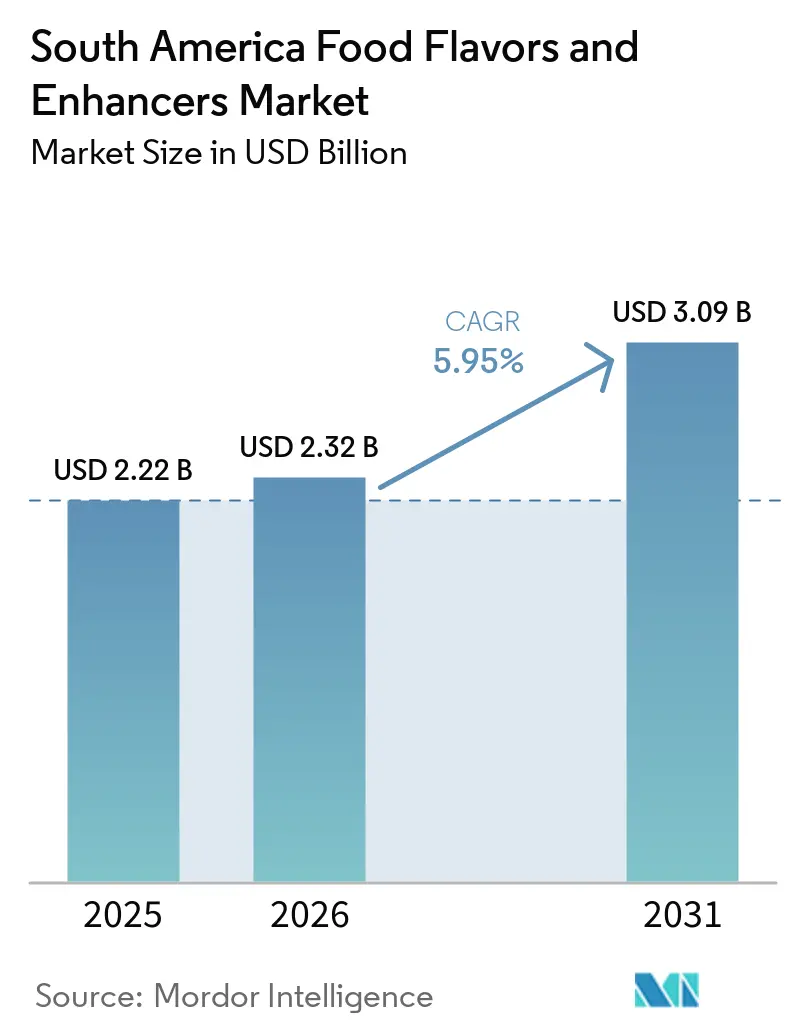
| Base Year Market Size (2025) | USD 2.22 Billion |
| Market Size (2026) | USD 2.32 Billion |
| Market Size (2031) | USD 3.09 Billion |
| Growth Rate (2026 - 2031) | 5.95 % |
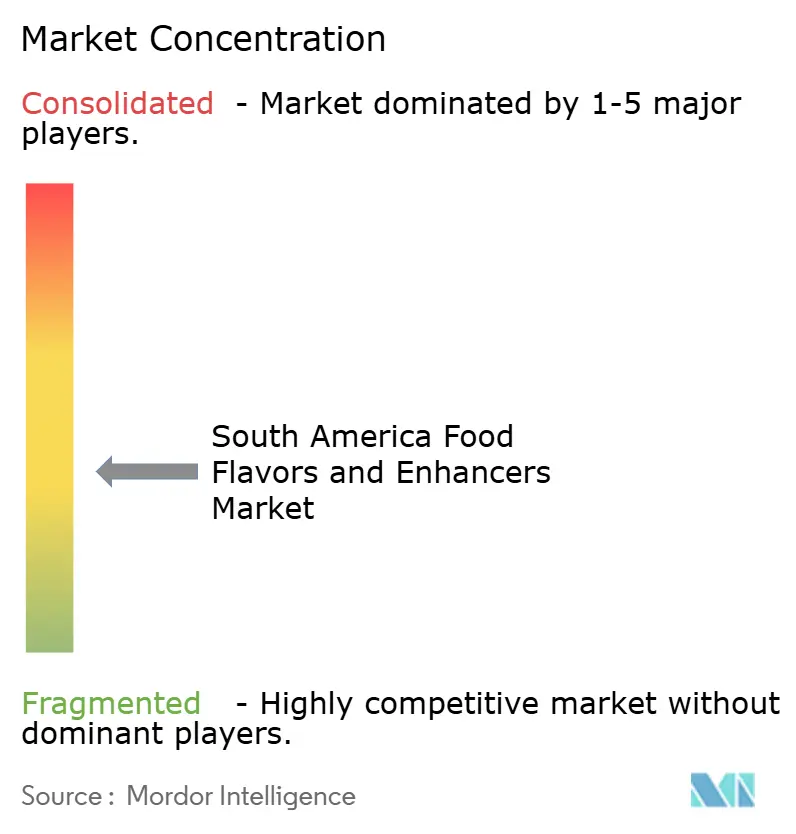
| Market Concentration | Medium |
Major Players *Disclaimer: Major Players sorted in no particular order Image © Mordor Intelligence. Reuse requires attribution under CC BY 4.0. | |
South America Food Flavors and Enhancers Market Analysis by Mordor Intelligence
The South America Food Flavors and Enhancers Market was valued at USD 2.22 billion in 2025 and is estimated to grow from USD 2.32 billion in 2026 to reach USD 3.09 billion by 2031, at a CAGR of 5.95% during the forecast period (2026-2031). Market growth is driven by the increasing importance of sensory differentiation, formulation innovation, and consistent taste delivery across the food manufacturing industry. The market is also benefiting from advancements in flavor extraction, encapsulation, and taste-modulation technologies, which improve flavor stability and expand formulation possibilities. Growing interest in clean-label formulations and naturally derived ingredients is further shaping product development, encouraging the use of botanical extracts, fruit-derived compounds, and other natural flavoring materials.
Key Report Takeaways
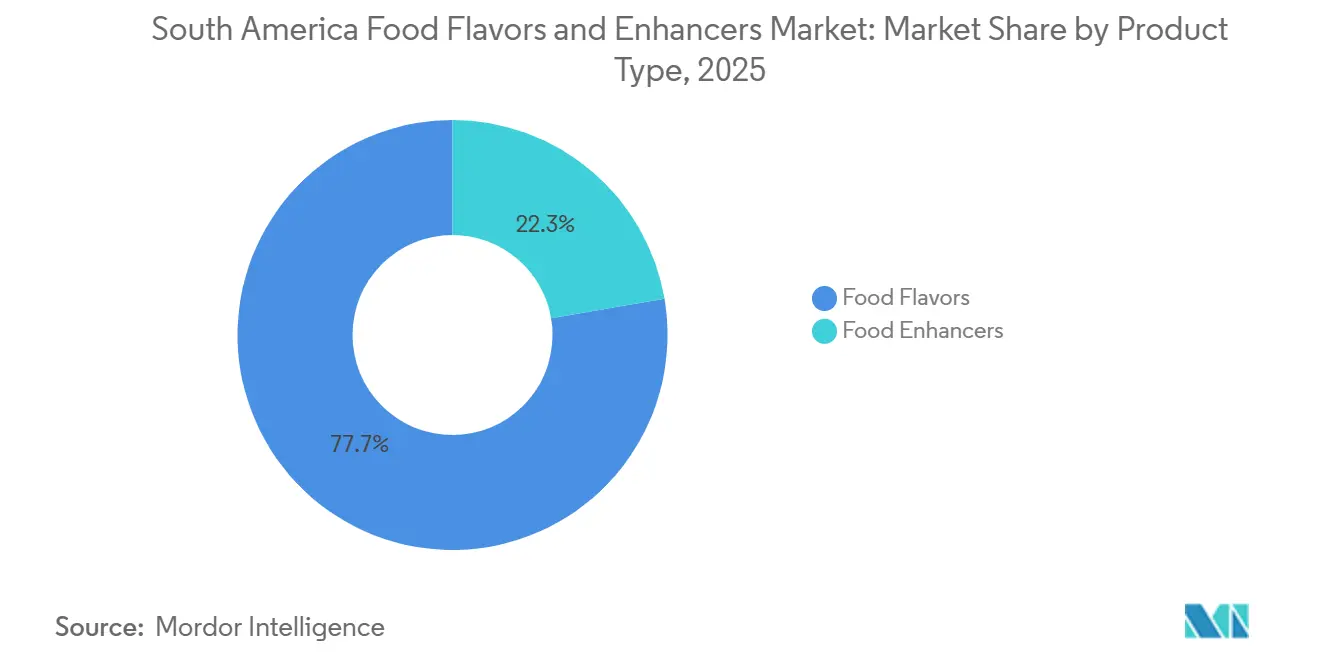
- By product type, Food Flavors held 77.69% of the South America food flavors and enhancers market share in 2025, while Food Enhancers are forecast to grow at a 7.67% CAGR through 2031.
- By type, Synthetic Flavors accounted for 70.61% of the South America food flavors and enhancers market share in 2025, while Natural Flavors are projected to expand at an 8.56% CAGR through 2031.
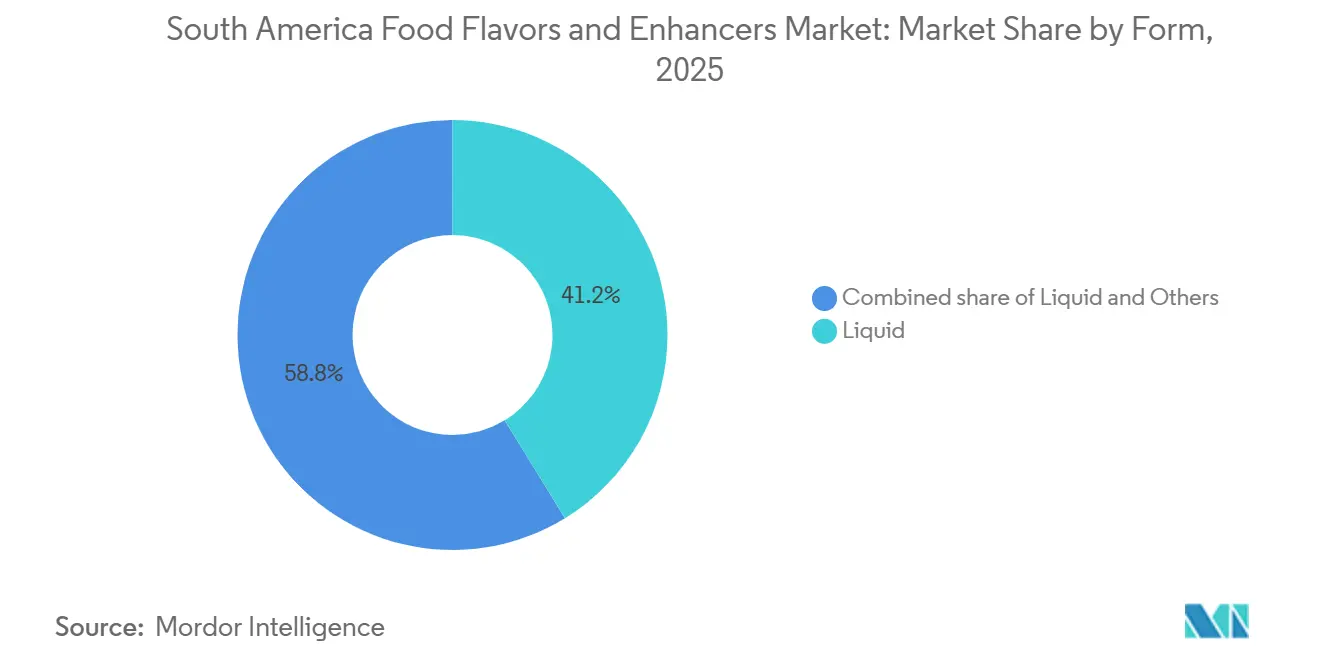
- By form, Liquid systems represented 41.23% of the South America food flavors and enhancers market share in 2025, while Powder formats are forecast to grow at a 7.59% CAGR through 2031.
- By application, Savory Snacks accounted for 26.34% of the South America food flavors and enhancers market size in 2025, while Beverages are projected to advance at an 8.09% CAGR through 2031.
- By geography, Brazil held 56.78% of the South America food flavors and enhancers market share in 2025 and is forecast to grow at a 7.48% CAGR through 2031.
Note: Market size and forecast figures in this report are generated using Mordor Intelligence’s proprietary estimation framework, updated with the latest available data and insights as of January 2026.
South America Food Flavors and Enhancers Market Trends and Insights
Drivers Impact Analysis*
| Driver | (~) % Impact on CAGR Forecast | Geographic Relevance | Impact Timeline |
|---|---|---|---|
| Expansion of the meat and processed meat industry | +1.2% | Brazil (primary), Argentina, Chile | Short term (≤ 2 years) |
| Increasing demand for sodium-reduction and taste-modulation solutions | +0.9% | Brazil, Colombia, Argentina | Medium term (2–4 years) |
| Growing consumer preference for spicy, smoky, and bold flavor profiles | +0.7% | Brazil, Colombia, Peru | Short term (≤ 2 years) |
| Growing adoption of plant-based food products and demand for flavor optimization | +0.5% | Brazil, Chile, Argentina | Medium term (2–4 years) |
| Rising demand for natural flavors and clean-label ingredients | +1.1% | Brazil, Argentina, Chile | Medium term (2–4 years) |
| Advancements in flavor encapsulation and controlled-release technologies | +0.6% | Brazil, regional spill-over | Long term (≥ 4 years) |
| Source: Mordor Intelligence | |||
Expansion of the Meat and Processed Meat Industry
The growth of the meat and processed meat industry is driving demand for food flavors and enhancers, as manufacturers seek to develop distinctive savory profiles, improve taste consistency, and enhance the sensory quality of meat-based products. Flavor ingredients such as smoke, roasted, grilled, peppery, and umami notes help manufacturers differentiate processed meat formulations while maintaining consistent flavor characteristics across production batches. According to the Brazilian Beef Exporters Association (ABIEC), Brazil slaughtered 47.79 million cattle in 2025, produced 12.35 million tonnes of beef in carcass-weight equivalent, and exported USD 18 billion worth of beef to 177 countries[1]. This scale of production and export activity underlines the size of Brazil's beef industry and the opportunities for flavor solutions that support sensory consistency, product differentiation, and the evolving requirements of meat processing.
Increasing Demand for Sodium-Reduction and Taste-Modulation Solutions
The growing focus on reducing sodium content without compromising sensory quality is driving demand for food flavors and enhancers across South America. Food manufacturers are increasingly incorporating yeast extracts, umami compounds, flavor potentiators, and taste-modulation ingredients to preserve savory intensity and compensate for taste changes associated with lower salt levels. These solutions help balance flavor profiles, reduce bitterness, improve mouthfeel, and maintain palatability in reformulated products. Advances in flavor-modulation technologies are enabling manufacturers to address complex sensory challenges while meeting product formulation targets and consumer expectations. Additionally, the need to maintain recognizable taste characteristics during reformulation is encouraging ingredient suppliers to develop customized flavor systems that deliver greater control over salt perception and overall flavor intensity.
Growing Consumer Preference for Spicy, Smoky, and Bold Flavor Profiles
Growing consumer interest in intense and distinctive taste experiences is driving demand for flavor profiles featuring chili, pepper, smoked meat, chargrilled, roasted, and umami notes. These profiles allow manufacturers to differentiate products and introduce innovative sensory combinations. Flavor suppliers are responding with customized seasoning blends, smoke flavorings, spice extracts, and taste-enhancement solutions that deliver consistent intensity and aroma across formulations. The ability to layer multiple flavor notes allows manufacturers to create more complex taste experiences and refresh established product concepts without substantially changing their core formulations. This trend is driving continuous innovation in flavor development, with ingredient suppliers focusing on improved aroma retention, balanced heat intensity, and reproducible sensory performance to meet evolving consumer expectations.
Rising Demand for Natural Flavors and Clean-Label Ingredients
Growing interest in recognizable ingredients and naturally derived formulations is encouraging South American food processors to source botanical flavor inputs that align with clean-label positioning and export market requirements. Food manufacturers are increasingly exploring natural extracts and plant-derived aromatic compounds to improve ingredient transparency and meet the formulation preferences of international buyers. This trend is creating opportunities for flavor suppliers to improve extraction, standardization, and stabilization techniques, helping address challenges related to batch consistency, flavor intensity, and shelf-life performance. South America's agricultural diversity further supports the development of botanical flavor ingredients, reinforcing the role of natural flavors in product innovation and export-oriented food manufacturing.
Restraints Impact Analysis*
| Restraint | (~) % Impact on CAGR Forecast | Geographic Relevance | Impact Timeline |
|---|---|---|---|
| Stringent food safety and labeling regulations | -0.7% | Brazil (ANVISA), Argentina (ANMAT), Colombia (INVIMA) | Medium term (2–4 years) |
| Supply chain and storage limitations | -0.6% | Brazil interior, Andean corridor, spill-over to Rest of South America | Short term (≤ 2 years) |
| Long product development and reformulation cycles | -0.4% | Regional, with higher impact in smaller markets | Long term (≥ 4 years) |
| Taste-masking challenges in functional food products | -0.3% | Brazil, Chile, Colombia | Medium term (2–4 years) |
| Source: Mordor Intelligence | |||
Stringent Food Safety and Labeling Regulations
Stringent food safety requirements and labeling regulations restrain the South America Food Flavors and Enhancers Market by increasing compliance costs, extending product approval timelines, and complicating the introduction of new flavoring ingredients. Manufacturers and ingredient suppliers must ensure that flavoring compounds meet applicable authorization requirements, permitted-use conditions, safety standards, and labeling obligations before commercialization. Brazil's National Health Surveillance Agency (ANVISA) operates a comprehensive regulatory framework for food flavoring additives, with Resolution RDC No. 725/2022 establishing requirements for flavorings and their use in food. Compliance with these provisions can require additional documentation, technical assessments, and formulation adjustments, particularly when introducing novel or modified flavor systems.
Supply Chain and Storage Limitations
Inadequate transportation infrastructure, inconsistent warehousing conditions, and limited access to specialized storage facilities can restrain the growth of the South America Food Flavors and Enhancers Market. Certain flavoring ingredients, particularly natural extracts, essential oils, and volatile aromatic compounds, require controlled temperature, moisture, and light exposure to preserve their quality and functional properties. Disruptions during transportation or prolonged storage under unsuitable conditions can cause flavor degradation, oxidation, and reduced ingredient performance, increasing wastage and inventory management costs. Large geographical distances between agricultural sourcing regions, ingredient manufacturers, and food-processing facilities can further complicate distribution and extend delivery schedules.
*Our forecasts treat driver/restraint impacts as directional, not additive. The impact forecasts reflect baseline growth, mix effects, and variable interactions.
Segment Analysis
Food flavors hold a 77.69% market share in 2025, supported by their versatility in flavor formulation and their ability to deliver precise sensory characteristics across diverse product development requirements. The scale of the food processing industry further strengthens this demand. According to the United States Department of Agriculture (USDA), Brazil had approximately 42,000 active food processing companies in 2025, reflecting a substantial manufacturing base that requires ingredients to support product formulation and sensory consistency[2]. This extensive processing ecosystem provides opportunities for flavor suppliers to serve manufacturers seeking differentiated formulations.
Food enhancers are the fastest-growing product segment, projected to expand at a 7.67% CAGR over 2026–2031, driven by food manufacturers' increasing focus on improving taste intensity, strengthening savory notes, and optimizing sensory performance without substantially changing product formulations. Ingredients such as yeast extracts, umami compounds, flavor potentiators, and taste modulators are gaining relevance because they help balance flavor profiles, reduce undesirable aftertastes, and maintain palatability in reformulated products. The segment also benefits from growing demand for sodium-reduction solutions, as manufacturers use flavor enhancers to preserve savory depth when lowering salt content.
By Type: Synthetic Scale Faces Natural's Growing Premium Pull
Synthetic flavors held a 70.61% market share in 2025, supported by their cost-effectiveness, consistent sensory performance, and suitability for large-scale food manufacturing. Their ability to deliver standardized taste profiles with controlled intensity and stability enables manufacturers to maintain uniform product quality across production batches. Synthetic flavor compounds also offer greater formulation precision, allowing specific aroma and taste characteristics to be reproduced without relying on the natural variability of agricultural raw materials. Their versatility in flavor design, predictable performance during processing, and availability across a broad range of taste profiles reinforce their established position in commercial formulations. These characteristics continue to support demand from food ingredient manufacturers seeking reliable, scalable solutions for consistent sensory outcomes.
Natural flavors are forecast to grow at a CAGR of 8.56% over 2026–2031, driven by increasing interest in recognizable ingredient sources and flavor formulations aligned with clean-label product positioning. Extracts derived from fruits, herbs, spices, botanicals, and other natural materials offer manufacturers opportunities to develop distinctive sensory profiles while responding to consumer preferences for naturally sourced ingredients. Improvements in extraction, concentration, and flavor stabilization technologies are also helping suppliers preserve delicate aromatic compounds and improve the performance of natural ingredients during processing. The ability to develop differentiated flavor profiles from identifiable natural sources is strengthening their appeal in premium and innovation-focused product development, supporting faster growth than the established synthetic flavor segment.
By Form: Powder Gains as Encapsulation Solves the Stability Problem
Liquid flavor systems retain a 41.23% market share in 2025, supported by their ease of incorporation into liquid formulations, precise dosing capabilities, and efficient blending characteristics. Their ability to disperse readily in compatible formulations allows manufacturers to achieve uniform flavor distribution while simplifying production processes and reducing batch inconsistencies. Liquid formats also provide flexibility in adjusting flavor concentration and combining multiple aromatic compounds, enabling greater control over sensory intensity and finished-product characteristics. Their suitability for automated dosing systems and large-scale manufacturing further reinforces their adoption, as processors prioritize formulation accuracy, operational efficiency, and reproducible taste profiles. These functional advantages sustain the segment's leading position in the South America Food Flavors and Enhancers Market.
Powder flavors are projected to grow at a 7.59% CAGR over 2026–2031, driven by their storage convenience, ease of transportation, and compatibility with dry-blending processes. Their generally lower moisture content supports longer storage stability for appropriately formulated products, while reduced handling complexity makes them attractive for manufacturers seeking efficient ingredient management. Spray-drying and encapsulation technologies are also improving flavor retention, protecting sensitive aromatic compounds, and enabling controlled flavor release during food preparation or processing. The ability to distribute powder flavors uniformly through dry ingredient blends further supports formulation flexibility and consistent flavor delivery. These characteristics are strengthening the segment's appeal among manufacturers seeking stable, convenient, and technologically adaptable flavoring solutions.

By Application: Savory Snacks Lead as Beverages Accelerate
Savory snacks account for a 26.34% application share in 2025, supported by the need for distinctive taste profiles, consistent seasoning performance, and strong sensory appeal in snack product development. Flavor ingredients play a central role in differentiating products through roasted, smoky, spicy, cheesy, tangy, and umami-rich notes, enabling manufacturers to introduce new flavor variants and refresh existing product lines. Precise flavor blending helps maintain taste uniformity across production batches, while advances in seasoning adhesion and flavor delivery improve the distribution of taste compounds across snack surfaces. The ability to create layered flavor experiences and adapt formulations to changing taste preferences reinforces the importance of food flavors and enhancers in this application, sustaining its dominant position in the South America Food Flavors and Enhancers Market.
Beverages are forecast to grow at an 8.09% CAGR over 2026–2031, driven by continuous innovation in flavor combinations, aromatic complexity, and sensory differentiation across beverage formulations. Manufacturers are exploring tropical fruit blends, botanical extracts, citrus notes, and complementary flavor combinations to develop distinctive beverage profiles and strengthen product differentiation. Flavor masking technologies are also becoming important in formulations containing proteins, vitamins, minerals, and other functional ingredients that can introduce bitterness or undesirable aftertastes. Improvements in flavor stability and solubility are helping ingredient suppliers address challenges associated with acidity, carbonation, and processing conditions. These formulation advances are expanding the role of specialized flavor systems in beverage innovation and supporting the segment's projected growth.
Geography Analysis
Brazil accounted for a dominant position in South America, holding a 56.78% market share in 2025 and growing at a 7.48% CAGR over 2026–2031. Its position is supported by an extensive food-processing ecosystem, diverse agricultural resources, and established capabilities in packaged food and beverage manufacturing. The country's large manufacturing base creates sustained demand for flavor ingredients that deliver consistent sensory characteristics, enable product differentiation, and support formulation innovation. Food ingredient suppliers benefit from opportunities to develop customized flavor solutions that address evolving taste preferences and product development requirements. Brazil's established agricultural supply chains and industrial processing capabilities also facilitate the integration of flavor ingredients into commercial formulations, reinforcing its position as the region's primary growth market.
Argentina represents South America's second-largest market, supported by its agricultural production base and export-oriented food industry. According to 2025 data from IFOAM – Organics International, Argentina had approximately 4 million hectares of certified organic farmland, highlighting its potential for supplying organically produced agricultural ingredients[3]. This provides opportunities for natural flavor development, particularly through the use of botanical extracts and other agricultural raw materials. The country's established food-processing capabilities also support demand for flavor solutions that deliver consistent taste profiles and meet product quality requirements.
Peru and the remaining South American markets collectively represent a smaller but strategically notable share of the market, supported by diverse agricultural resources, distinctive culinary traditions, and developing food-processing industries. Peru's native fruits, herbs, and chili varieties provide opportunities for developing distinctive flavor profiles inspired by regional ingredients. Other markets, including Chile and Colombia, offer growth opportunities through food and beverage product innovation and demand for customized flavor formulations. Suppliers can address these opportunities through natural extracts, specialized flavor blends, and solutions tailored to local sensory preferences.
Competitive Landscape
The South America food flavors and enhancers market is moderately consolidated, with global ingredient companies such as Givaudan S.A., International Flavors & Fragrances Inc. (IFF), Kerry Group plc, dsm-firmenich AG, and Symrise AG competing through extensive flavor portfolios, formulation expertise, and established customer relationships. These companies differentiate themselves through investments in research and development, customized flavor systems, natural ingredient sourcing, and technical support for food manufacturers. Alongside these multinational players, regional manufacturers compete through local taste expertise, application-specific solutions, and responsiveness to customer requirements.
Competition is increasingly shaped by product innovation and the development of specialized flavor systems that address evolving formulation needs. Suppliers are expanding their capabilities in natural flavors, botanical extracts, taste modulation, and flavor stability to support manufacturers developing clean-label products and differentiated sensory profiles. Companies are also developing integrated ingredient solutions for high-protein and high-fiber formulations, where bitterness masking and taste optimization can improve product acceptability. Flavor suppliers also compete through application laboratories, technical collaboration, and customized formulations that help food manufacturers maintain consistent sensory performance while adapting recipes and production processes.
Strategic expansion, acquisitions, and distribution partnerships remain important competitive approaches for strengthening regional presence and accessing new customers. Global suppliers leverage their technical capabilities and international networks, while regional manufacturers benefit from their understanding of local ingredients, culinary preferences, and customer requirements. Partnerships with distributors can broaden market access and improve ingredient availability across geographically dispersed markets, while acquisitions can expand product portfolios, manufacturing capabilities, and customer reach.
South America Food Flavors and Enhancers Industry Leaders
-
Givaudan S.A.
-
International Flavors and Fragrances Inc.
-
Kerry Group plc
-
dsm-firmenich AG
-
Symrise AG
- *Disclaimer: Major Players sorted in no particular order
Recent Industry Developments
- February 2026: Kerry Group inaugurated a Customer Co-Creation Centre in Medellín, Colombia. The new center provides dedicated flavor development laboratories for beverages, meat, dairy, bakery, and snacks, integrating with Kerry's Technology Hub network.
- November 2025: Carbery Group, through its Synergy Flavors business, acquired Solutaste, a São Paulo-based flavors and ingredients manufacturer and distributor. The acquisition expanded its regional flavor portfolio and strengthened its customer reach in Brazil.
- July 2025: Solina acquired New Max Industrial Ltda., a Brazilian supplier of savory solutions, flavoring systems, and natural colorants headquartered in Americana, São Paulo. The acquisition marked Solina's entry into South America and provided access to Brazil's food ingredient and meat-processing markets.
South America Food Flavors and Enhancers Market Report Scope
Food flavors and enhancers are substances added to foods to impart, amplify, modify, or magnify taste profiles and sensory experiences. The South America Food Flavors and Enhancers Market is segmented by product type, by type, form, application, and country. Based on product type, the market is segmented into food flavors and food enhancers. Based on type, the market is segmented into natural, synthetic, and nature-identical. Based on form, the market is segmented into powder, liquid, and others. Based on application, the market is segmented into dairy, bakery, confectionery, savory snacks, meat and seafood, beverages, and other applications. Based on country, the market is segmented into Brazil, Argentina, Colombia, Chile, Peru, and the rest of South America. For each segment, the market sizing and forecast have been done based on value (in USD).
By Product Type
| Food Flavors |
| Food Enhancers |
By Type
| Natural |
| Synthetic |
| Nature Identical |
By Form
| Powder |
| Liquid |
| Others |
By Application
| Dairy |
| Bakery |
| Confectionery |
| Savory Snacks |
| Meat and Seafood |
| Beverages |
| Other Applications |
By Country
| Brazil |
| Argentina |
| Colombia |
| Chile |
| Peru |
| Rest of South America |
| By Product Type | Food Flavors |
| Food Enhancers | |
| By Type | Natural |
| Synthetic | |
| Nature Identical | |
| By Form | Powder |
| Liquid | |
| Others | |
| By Application | Dairy |
| Bakery | |
| Confectionery | |
| Savory Snacks | |
| Meat and Seafood | |
| Beverages | |
| Other Applications | |
| By Country | Brazil |
| Argentina | |
| Colombia | |
| Chile | |
| Peru | |
| Rest of South America |
Key Questions Answered in the Report
What is the projected growth rate of the South America food flavors and enhancers market?
The South America food flavors and enhancers market is projected to grow at a CAGR of 5.95% from 2026 to 2031, reaching USD 3.09 billion by 2031.
Which product category holds the largest share in South America?
Food Flavors lead the regional market, accounting for 77.69% of revenue in 2025. Their broad use in savory foods, dairy products, bakery items, confectionery, and beverages supports this position.
Which product category is growing the fastest?
Food Enhancers are the fastest-growing product category, with a projected CAGR of 7.67% through 2031. Demand is supported by sodium-reduction programs and the use of umami, yeast extracts, and taste-modulation systems.
Why are natural flavors growing faster than synthetic flavors?
Natural Flavors are forecast to grow at 8.56% CAGR through 2031 because food manufacturers are responding to clean-label demand and closer regulatory attention on flavoring labels.