
Market Overview
| Study Period | 2021 - 2031 |
|---|---|
| Forecast Data Period | 2026 - 2031 |
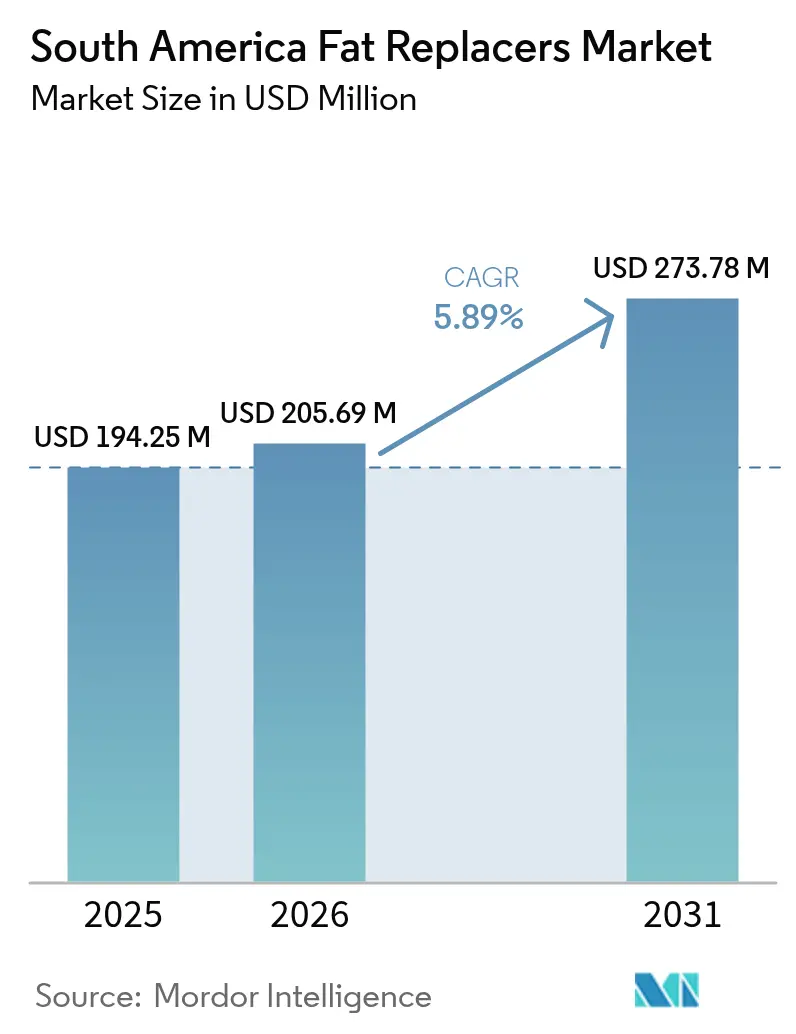
| Base Year Market Size (2025) | USD 194.25 Million |
| Market Size (2026) | USD 205.69 Million |
| Market Size (2031) | USD 273.78 Million |
| Growth Rate (2026 - 2031) | 5.89 % |
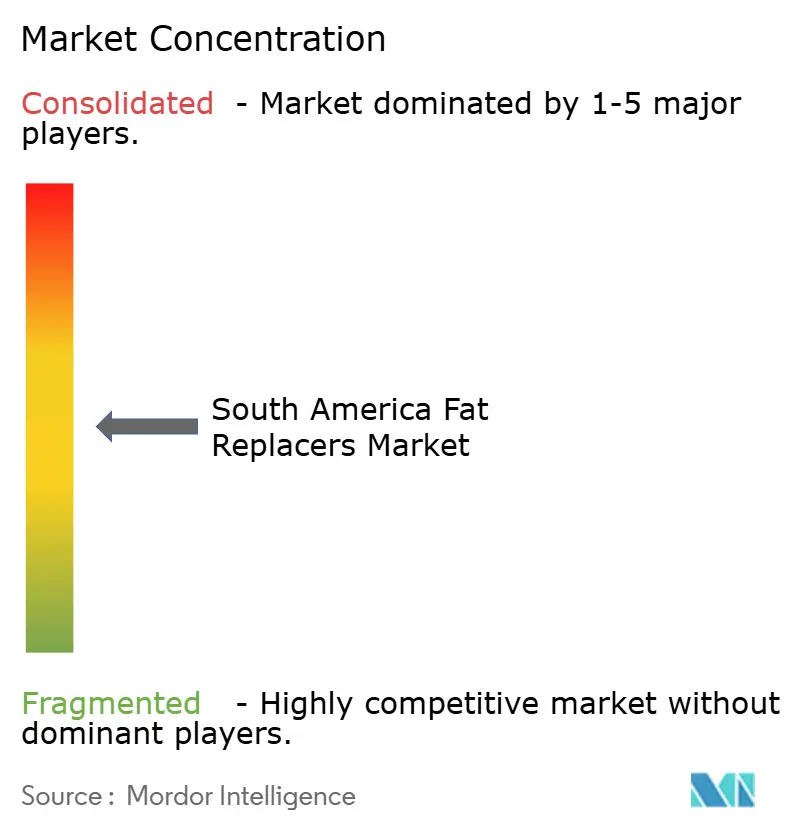
| Market Concentration | Medium |
Major Players *Disclaimer: Major Players sorted in no particular order Image © Mordor Intelligence. Reuse requires attribution under CC BY 4.0. | |
South America Fat Replacers Market Analysis by Mordor Intelligence
South America fat replacers market size in 2026 is estimated at USD 205.69 million, growing from 2025 value of USD 194.25 million with 2031 projections showing USD 273.78 million, growing at 5.89% CAGR over 2026-2031. The fat replacers market growth is driven by regulatory changes, increasing consumer demand for healthier processed foods, and advancements in plant-based product development. The implementation of clean-label requirements and front-of-package (FOP) labeling regulations has increased the adoption of carbohydrate, protein, and lipid-based technologies. These technologies enable manufacturers to reduce saturated fat content while maintaining product texture, taste, and shelf stability. Companies are expanding their local research and development capabilities, utilizing agricultural by-products for functional ingredients, and establishing strategic partnerships to secure raw materials and enhance technical expertise. The market development in South America is particularly influenced by Brazil's established functional food regulations and Argentina's updated labeling requirements, creating opportunities for companies that can validate fat reduction claims and efficiently navigate regulatory processes.
Key Report Takeaways
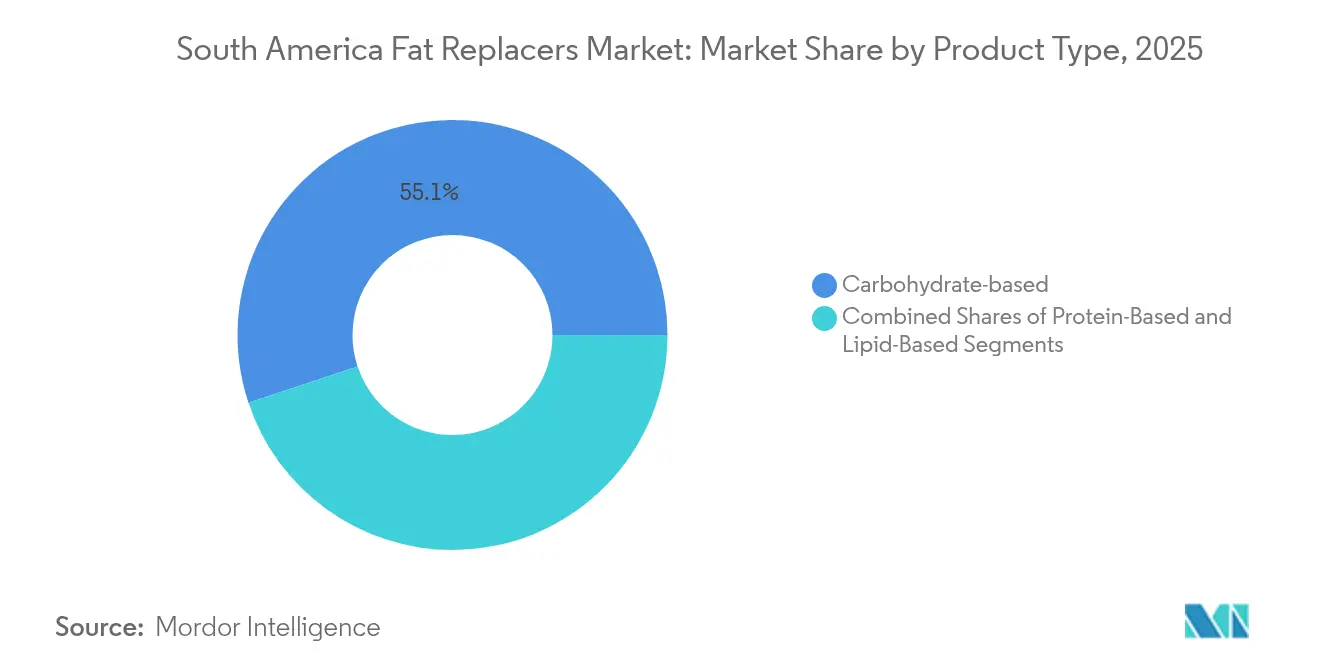
- By type, carbohydrate-based solutions led with 55.10% of South America's fat replacers market share in 2025, while protein-based alternatives posted the fastest 7.18% CAGR through 2031.
- By source, plant-based offerings accounted for 63.05% share of the South America fat replacers market size in 2025 and are projected to expand at 7.46% CAGR between 2026-2031.
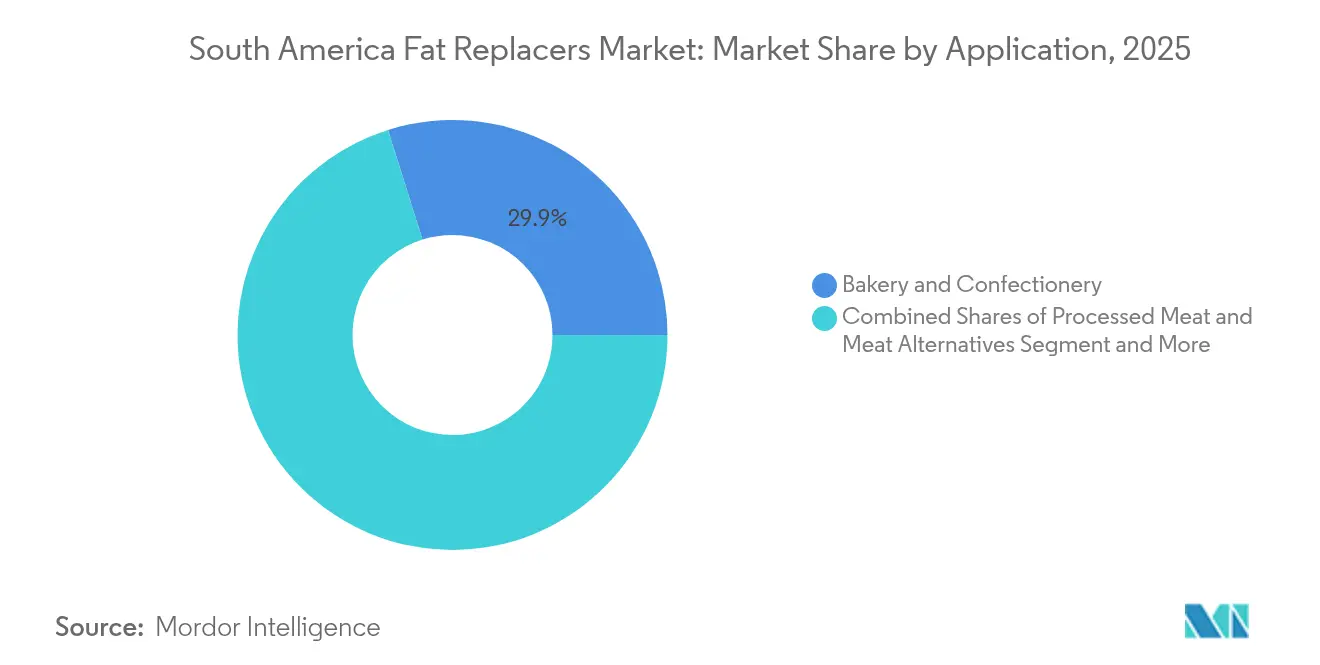
- By application, bakery and confectionery captured 29.85% revenue share in 2025; processed meat and meat alternatives are expected to grow at a 7.05% CAGR to 2031.
- By geography, Brazil held 46.55% of the South America fat replacers market in 2025, whereas Argentina records the highest 6.42% CAGR through 2031.
Note: Market size and forecast figures in this report are generated using Mordor Intelligence’s proprietary estimation framework, updated with the latest available data and insights as of 2026.
South America Fat Replacers Market Trends and Insights
Drivers Impact Analysis*
| Driver | (~) % Impact on CAGR Forecast | Geographic Relevance | Impact Timeline |
|---|---|---|---|
| Growing consumer demand for healthier processed foods | +1.8% | Brazil, Argentina, Colombia | Medium term (2-4 years) |
| Growth in functional food and beverage segment | +1.5% | Brazil, Argentina | Long term (≥ 4 years) |
| Regulatory push for nutritional labeling | +1.2% | Brazil, Argentina, Colombia | Short term (≤ 2 years) |
| Rising demand for vegan and plant-based products | +1.0% | Brazil, Argentina | Medium term (2-4 years) |
| Increased adoption of low-calorie traditional and regional foods | +0.8% | Colombia, Rest of South America | Long term (≥ 4 years) |
| Expansion of low-fat dairy product lines | +0.7% | Brazil, Argentina | Medium term (2-4 years) |
| Source: Mordor Intelligence | |||
Growing Consumer Demand for Healthier Processed Foods
McKinsey's regional survey shows that 46% of South American millennials to pay premiums for healthier packaged foods after the pandemic[1]. Retail scans confirm declining sales of high-saturated-fat SKUs, motivating Brazilian and Argentinian manufacturers to retrofit flagship lines with carbohydrate-based bulking agents or protein emulsifiers. Reformulation preserves brand equity, avoids re-registration costs, and secures shelf space, especially in supermarkets that now rank products on nutrition scores. Mass-market bakeries have reduced average fat content per serving, illustrating how incremental tweaks, rather than entirely new launches, can defend market share. Similar dynamics appear in Colombia's ready-meal aisles, where low-fat arepas gained prominence despite historically fat-rich recipes. The increasing consumer awareness of health risks associated with high-fat diets has prompted manufacturers to invest in fat replacement technologies. Government initiatives promoting healthier food choices have further accelerated the adoption of fat replacers across the South American food industry.
Growth in Functional Food and Beverage Segment
The market for fat replacers is experiencing growth due to several key factors. Functional beverages containing plant-derived emulsifiers show higher growth rates compared to carbonated soft drinks in urban markets. Baru almond protein isolates serve dual purposes by providing protein content and enabling viscosity control, which facilitates sugar reduction and fat replacement. The streamlined MERCOSUR mutual-recognition procedures enable efficient cross-border shipments, reducing delivery times for Argentine co-packers targeting the functional dairy market. The consistent increase in disposable incomes supports the growth of premium-priced functional snacks, ensuring sustained market expansion. Apart from that, ANVISA's 1999 recognition of "alimentos funcionais" normalized health claims within Brazil's regulatory lexicon, enabling straightforward label statements linking fat reduction to cardiovascular benefits[2]. Consumer awareness of health benefits associated with fat replacers encourages manufacturers to diversify their product offerings. Regional food processors continue to invest in research and development to develop effective fat-replacement solutions that maintain product quality while reducing calories.
Regulatory Push for Nutritional Labeling
Argentina's ANMAT Resolution 267/2024 replaced black octagon warnings with a mandatory FOP disclosure grid that lists total fat, saturated fat, and calories per 100 g according to the Ministry of Health, Argentina[3]. The 2026 compliance deadline for new labeling regulations is accelerating the adoption of fat replacer ingredients as manufacturers seek to improve their products' nutrient profiles. Brazil's ANVISA reinforced this trend by implementing enhanced labeling requirements in March 2024. The existing MERCOSUR additive regulations already include approved carbohydrate- and protein-based replacers, allowing manufacturers to focus on reformulation rather than ingredient approval processes. Limited implementation timeframes are pushing manufacturers toward established global suppliers who offer ready-to-use solutions and local technical support. These regulatory developments across South America have generated immediate market demand for fat replacers, particularly in high-fat processed food segments. Food manufacturers are directing resources toward product reformulation efforts to maintain organoleptic properties while meeting new requirements.
Rising Demand for Vegan and Plant-Based Products
Trend in plant-based adoption has influenced other South American markets, with expanding vegan and flexitarian communities in São Paulo, Buenos Aires, and Bogotá driving purchase decisions. Plant-based formulations naturally reduce saturated fat content, leading to increased use of soy, chickpea, and mycoprotein emulsifiers for texture enhancement. NotCo's AI technology reduces prototype development time to 3 months, enabling manufacturers to introduce dairy-free spreads and pâtés tailored to regional preferences. Green-banana biomass combined with teff flour reduces recipe fat while maintaining texture quality. While cost remains a challenge, manufacturers address this through vertical integration and utilization of agricultural waste streams. Consumer awareness of health benefits and sustainability drives continuous innovation in fat replacement technologies. Regional food manufacturers invest in research and development to develop cost-effective, locally sourced fat replacement solutions that satisfy both nutritional requirements and sensory expectations.
Restraints Impact Analysis*
| Restraint | (~) % Impact on CAGR Forecast | Geographic Relevance | Impact Timeline |
|---|---|---|---|
| Low consumer awareness of fat replacers | -0.9% | Colombia, Rest of South America | Short term (≤ 2 years) |
| Technical challenges in replicating taste and texture | -0.7% | Brazil, Argentina, Colombia | Medium term (2-4 years) |
| Consumer perception of inferiority in low-fat products | -0.5% | Brazil, Argentina | Medium term (2-4 years) |
| Shelf-life and storage challenges with certain fat replacers | -0.4% | Colombia, Rest of South America | Long term (≥ 4 years) |
| Source: Mordor Intelligence | |||
Low Consumer Awareness of Fat Replacers
The fat replacers market faces significant challenges in consumer adoption and market penetration. Despite the growing health consciousness among consumers, the lack of awareness about fat replacers remains a major obstacle. Without dedicated educational campaigns, consumers tend to choose traditional full-fat products, particularly in rural areas. Retailers avoid emphasizing "fat-reduced via fiber" claims on product packaging to prevent alienating traditional customers. While major dairy companies develop QR-code educational microsites, small and medium enterprises lack resources for such initiatives, limiting market penetration in smaller cities. Government-funded nutrition programs may reduce the knowledge gap over the next two years, but immediate purchasing barriers persist. Unclear labeling regulations for fat replacer ingredients and insufficient industry-wide consumer education about product safety and benefits further restrict market growth.
Technical Challenges in Replicating Taste and Texture
The fat replacers market faces several technical constraints. Protein isolates undergo denaturation at temperatures exceeding 190°C in cassava-based snacks, resulting in inconsistent mouthfeel. Carbohydrate bulking agents introduce unwanted sweetness, conflicting with sugar reduction objectives. Manufacturing scale-up encounters difficulties when viscosity increases surpass pump capacities, particularly affecting contract manufacturers with diverse equipment lines. Regional small and medium enterprises experience extended product launch timelines due to repeated formulation adjustments. High-temperature processing stability remains a technical challenge, especially in extruded snack production. The interaction between fat replacers and native food components creates texture and flavor issues requiring extensive reformulation. Some fat replacer compounds demonstrate limited shelf-life stability, requiring additional preservation systems. Temperature-sensitive fat replacers demand specific handling and storage conditions, increasing operational expenses for manufacturers.
*Our forecasts treat driver/restraint impacts as directional, not additive. The impact forecasts reflect baseline growth, mix effects, and variable interactions.
Segment Analysis
By Product Type: Protein Innovation Accelerates Despite Carbohydrate Dominance
Carbohydrate-based variants hold 55.10% of the South America fat replacers market share in 2025, primarily due to their lower cost and established performance in high-volume bakery applications. The well-established distribution networks for cassava and corn starches provide stable cost structures for manufacturers serving price-sensitive markets. However, the South America fat replacers market shows a clear shift toward protein-based alternatives, which are growing at a 7.18% CAGR through 2031. These protein-based ingredients meet consumer demands for reduced fat content while providing higher protein content, making them suitable for clean-label products in dairy beverages and sports nutrition bars.
Green-banana biomass combined with chickpea protein achieves a viscosity of 1.4 Pa·s at 25 °C, comparable to palm fat standards in confectionery fillings. This performance reduces the traditional advantages of lipid-based alternatives. The partnership between Enifer and ethanol manufacturer FS demonstrates this shift, as they transform corn-ethanol byproducts into mycoprotein at costs competitive with imported whey. Their pilot facility's planned capacity of 500 t in 2025 may accelerate widespread adoption beyond specialty products. In response, carbohydrate-based manufacturers are combining native starch with soluble fiber to improve moisture retention and product longevity, maintaining their market position in regions where protein ingredients remain expensive. The South American fat replacers market demonstrates a dynamic balance between established carbohydrate-based solutions and emerging protein alternatives, each serving distinct market segments and price points. The ongoing innovation in both categories, coupled with regional manufacturing capabilities, indicates sustained growth potential across multiple food applications.

By Source: Plant-Based Dominance Reflects Sustainability Priorities
Plant-derived ingredients captured 63.05% of the market in 2025 and are on track for a 7.46% CAGR, cementing their leadership through 2031. South America's fat replacers market size for plant-based variants is buoyed by abundant soybean, corn, and emerging crop supply chains. Broad consumer perception of plant sources as “natural” and environmentally friendly offsets taste prejudices that once plagued early formulations. Microbial solutions—led by mycoprotein butter prototypes—collect momentum, yet their combined revenue remains minor compared to botanical inputs.
Brazilian R and D institutes illustrate how agribusiness waste valorization cuts ingredient costs while boosting rural incomes. Microbial-based alternatives, exemplified by Mycorena, report 55% saturated-fat reduction versus dairy butter but must scale fermentation infrastructure and satisfy nascent regulatory pathways. Animal-based replacers persist in specialty charcuterie, yet regulatory scrutiny on cholesterol keeps their outlook stagnant. The success of alternative fat sources depends heavily on technological advancements in production methods and regulatory approvals. Market adoption will likely accelerate as manufacturers overcome these challenges while maintaining cost competitiveness.
By Application: Processed Meat Innovation Drives Growth Despite Bakery Leadership
The bakery and confectionery segment accounted for 29.85% of the South American fat replacers market in 2025, as carbohydrate fibers effectively provide bulk to dough and frostings without affecting baking times. The processed meat and meat alternatives segment is projected to grow at a CAGR of 7.05%, driven by health-focused product reformulations. The South American fat replacers market is witnessing robust expansion as manufacturers develop innovative solutions to meet consumer demands for healthier food options. Rising obesity rates and increasing consumer awareness of the health risks associated with high-fat diets are accelerating the adoption of fat replacers across the region. Fat replacers are gaining prominence in South America as consumers seek healthier food alternatives. The market is experiencing significant growth due to increasing health consciousness and regulatory pressure to reduce fat content in processed foods.
The South American food industry is experiencing significant transformations in fat reduction technologies across multiple segments. Brazil's expanding chilled-meat sector integrates lipid-mimicking hydrocolloids that permit sodium and nitrite reduction, satisfying multilayer health policies. Plant-forward burgers gain mainstream traction through improved juiciness delivered by structured vegetable fats, further lifting demand. Dairy receives tailored innovations like Cargill's Lévia+c, which maintains overrun and melt resistance in ice cream even after a 35% saturated-fat reduction. Beverage use cases remain exploratory, primarily focusing on mouthfeel enhancement in oat or rice milks served in café chains across Buenos Aires and Rio.
Geography Analysis
Brazil stacked up 46.55% of the South American fat replacers market in 2025, thanks to its USD 209 billion food-processing complex and long-standing functional-food regulations that simplify new ingredient clearance, according to the Food Export Association. Brazil's food manufacturing sector demonstrates significant technological advancement in alternative protein production. The country's robust infrastructure supports efficient product development and distribution processes. Companies utilize established cold-chain logistics networks and numerous co-packing facilities to enable nationwide product distribution at competitive costs. Research partnerships between universities and industries in Minas Gerais and São Paulo regions facilitate the integration of international fat replacement technologies into traditional Brazilian foods like pão de queijo.
Argentina follows as the fastest grower at a 6.42% CAGR. ANMAT’s late-2024 decree obliges stricter disclosure of saturated fat and calories, effectively compelling reformulation across bakery, dairy, and ready-meal segments, according to the Government of Argentina. Ingredient vendors focusing on turnkey carbohydrate-fiber blends gain quick traction because large FMCGs prioritize speed-to-compliance. Additionally, Buenos Aires’ incubation hubs host startups engineering algal lipids designed to match charcuterie mouthfeel, widening local supplier choice.
Colombia and the rest of South America offer emerging prospects as public-health authorities inch toward stricter nutrient limits. Economic Commission for Latin America and the Caribbean (ECLAC) projects 11% growth in South American agricultural exports in 2024, enlarging raw-material pools for plant-based fats. Bogotá’s processed-meat plants already experiment with cassava-derived hydrocolloids to satisfy budding urban health awareness. Smaller markets such as Chile and Peru demonstrate consumer uptake of FOP “Nutri-Score”-style labeling pilots, signaling future legislative convergence. Nonetheless, fragmented retail landscapes and lower purchasing power delay ubiquitous adoption.
Regulatory Landscape
South America fat replacers demand is linked to food additive authorization pathways and nutrition-labeling enforcement, especially in Brazil and Argentina. In Brazil, ANVISA regulates food additives and technology adjuvants under RDC 778/2023, with positive lists referenced in IN 211/2023, and it reinforced compliance documentation expectations through IN 281/2024. The region also operates under MERCOSUR technical regulations for additives, including updates such as Res. GMC 03/2025 and Res. GMC 22/2025, which support cross-border alignment of permitted substances while still requiring national incorporation for legal effect.
The regulatory process itself is increasingly used as a competitive lever by ingredient suppliers and importers. In 2025, ANVISA introduced an optimized review route (IN 344/2025) that lets evaluation petitions leverage documentation from equivalent foreign regulatory authorities (AREE), creating a faster path for ingredients already assessed in major jurisdictions. In markets outside the largest hubs, Paraguay expanded DINAVISA authority through Law 7361/2024 and routes sanitary registration via the SIGRA platform, which adds a digital compliance step for products moving through smaller MERCOSUR-adjacent channels.
Value Chain Analysis
The value chain for fat replacers in South America begins with agricultural and industrial feedstocks (cassava, corn, soy, citrus, and animal by-products) and moves into specialized processing of fibers, starches, proteins, emulsifiers, and fermentation-derived ingredients. This is followed by formulation support for bakeries, dairy, processed meat, and ready-meal manufacturers. Brazil is the anchor for both production and application development, with formulation talent and application labs concentrated around Sao Paulo and demand shaped by nutrition-label transparency requirements that elevate the need for texture and mouthfeel solutions that reduce saturated fat without sacrificing performance.
Downstream distribution typically runs through importers and ingredient distributors that provide technical service and regulatory documentation support to large FMCGs and co-manufacturers, while smaller processors often rely on turnkey blends. The chain remains dependent on imports for higher-purity functional inputs and some specialty systems, which increases exposure to port and customs friction (including at major gateways such as Santos) and to country-specific sanitary registration steps. As a result, local inventory positions, in-market application labs, and suppliers that can deliver complete dossiers aligned to ANVISA and MERCOSUR additive frameworks carry more operational value.
Competitive Landscape
The South American fat replacers market shows moderate concentration, with the top five firms controlling major revenue. Some of the major companies include Cargill, Incorporated, Archer Daniels Midland Co., Ingredion Inc., Tate and Lyle PLC, Kerry Group plc, etc. Global ingredient majors maintain scale advantages, but regional specialists exploit deep knowledge of indigenous crops and localized taste preferences. Tate and Lyle’s intended USD 1.8 billion acquisition of CP Kelco aims to fuse hydrocolloid and sweetening technologies, broadening solutions that deliver simultaneous fat, sugar, and texture optimization. Also, Cargill, Incorporated invests USD 8.5 million in South American facility upgrades to meet WHO iTFA guidelines, positioning its edible oils arm for stricter policy eras.
Localization remains decisive. Cargill’s Lévia+c for Brazilian dairy underscores how bespoke formulation wins over generic global offerings. Enifer’s waste-to-mycoprotein partnership with FS illustrates circular-economy narratives that resonate with regulators and sustainability-minded brands. Start-ups leverage AI and precision fermentation to slash pilot times, placing competitive pressure on incumbents to accelerate their own digitalization roadmaps. Meanwhile, distributors such as IMCD and Brenntag expand value-added application labs that help tier-two clients navigate technical hurdles without heavy R and D spend, ensuring a pipeline of mid-market customers.
Consolidation momentum coexists with vibrant start-up scenes. Venture funding gravitates toward microbial and precision-lipid platforms that address outstanding sensory gaps. Yet, given regulatory lead times and capital intensity, collaborative models—licensing, joint ventures, or toll manufacturing—dominate commercialization strategies. Intellectual-property depth, regional regulatory fluency, and robust technical-service teams collectively decide competitive staying power.
South America Fat Replacers Industry Leaders
-
Ingredion Inc.
-
Archer Daniels Midland Co.
-
Cargill, Incorporated
-
Kerry Group plc
-
Tate and Lyle PLC
- *Disclaimer: Major Players sorted in no particular order
Market Opportunities and Future Outlook
Labeling-driven reformulation and the push for clean-label texture systems continue to create room for suppliers that combine compliant additive status with application support for bakery, dairy, and processed meat. Argentina's switch to a mandatory front-of-pack disclosure grid under ANMAT Resolution 267/2024, with a 2026 compliance deadline, has generated time-sensitive demand for established carbohydrate and protein systems that reduce total and saturated fat per 100 g without triggering sensory regressions. In Brazil, ANVISA's additive framework (RDC 778/2023 and IN 211/2023) and the 2025 optimized petition pathway (IN 344/2025) expand the opportunity for global suppliers that can reuse foreign-authority documentation while localizing formulations to regional staples.
Investment and capability build-outs across the broader ingredient ecosystem also support more localized fat-replacement solutions. In March 2026, IFF expanded regional biosciences capacity by converting its Arroyito, Argentina site into a fermentation-based enzyme production hub, and it opened an application laboratory in Brazil to reinforce technical service for reformulation programs. In April 2026, JBS inaugurated JBS Biotech in Florianopolis as an R&D center focused on functional bioactive ingredients, and in April 2026 Ingredion announced plans to double polyols capacity at Mogi Guacu, Brazil, signaling deeper regional manufacturing footprints for low-calorie formulation toolkits that often complement fat-reduction strategies. Together, these actions support faster prototyping and shorter replenishment cycles for South American manufacturers working under FOP scrutiny and clean-label constraints.
Recent Industry Developments
- May 2026: MBRF announced a BRL 500 million investment to expand production at Gelprime, targeting a doubling of annual capacity to 30,000 tonnes and the launch of a new functional collagen line in the second half of 2026. The added collagen and functional protein capacity broadens locally available texture and mouthfeel tools used in reduced-fat meat and dairy formulations, helping shorten lead times versus imported systems.
- June 2025: Enifer partnered with Brazilian ethanol producer FS to establish a 500-ton pilot facility for producing mycoprotein from corn-ethanol byproducts, supported by BRL 9.8 million from FINEP. The project advances circular feedstock models for protein ingredients and creates a platform that can extend from animal nutrition into food applications where protein-based fat replacers and structuring agents are used.
- June 2024: Tate and Lyle announced the proposed USD 1.8 billion acquisition of CP Kelco to build a larger specialty food and beverage solutions business spanning hydrocolloids, sweetening, and texture systems. The combination strengthens portfolios used to replicate fat-like mouthfeel and stability in reduced-fat products, raising competitive intensity for suppliers serving bakery, dairy, and processed foods in South America.
Research Methodology Framework and Report Scope
Market Definition and Coverage
In this methodology, the market covers ingredients used to replace part of the fat in food and beverage formulations. In practice, these inputs are used to lower fat content while keeping texture, mouthfeel, and stability within acceptable limits for consumers in South America.
Scope exclusions: We exclude household table-use fat substitutes, pharmaceutical fat excipients, and dietary supplements that are not primarily sold as food formulation inputs.
Segmentation Overview
- By Product Type
- Carbohydrate-Based
- Protein-Based
- Lipid-Based
- By Source
- Plant-based
- Animal-based
- Microbial-based
- By Application
- Bakery and Confectionery
- Dairy and Frozen Desserts
- Beverages
- Processed Meat and Meat Alternatives
- Convenience Food/Ready Meals
- Others
- By Geography
- Brazil
- Argentina
- Rest of South America
Data Sources, Market Sizing, and Validation
Desk Research
Desk research was used to map the demand pool and operating context for low-fat reformulation in South America, before assumptions were taken into fieldwork for confirmation. We relied on public references such as national food and health regulator publications, customs and trade statistics for key food-ingredient categories, and food consumption series from sources such as FAOSTAT.
To avoid overcounting, the desk step also checked how fat replacers are described across technical literature and labeling guidance, using sources such as peer-reviewed food science journals and regional trade association publications. Company annual reports, investor presentations, and reputable press were then used to confirm manufacturing footprints, product positioning, and application focus. We also used paid subscriptions for company financials and intelligence, plus an import and export shipment-level database when ingredient flow needed validation. The examples above are illustrative, and many other public and paid sources were also consulted for data collection, validation, and clarification.
Primary Interviews and Surveys
We use expert interviews and surveys with ingredient suppliers, food manufacturers, formulators, distributors, and procurement or regulatory leaders across South America. Their feedback checks secondary revenue and trade signals, fills gaps where smaller countries have limited disclosure, and tests application mix, prices, adoption, and forecast assumptions. Re-contact is requested when reported movements conflict with trade or production evidence, after which analysts triangulate the final model.
Distribution of primary research fieldwork respondents
| Company type | Respondent position |
|---|---|
| Top tier: 27% | CXOs: 15% |
| Mid tier: 48% | Functional/Unit leaders: 32% |
| Smaller Players: 25% | Managers: 53% |
Market-Sizing & Forecasting
Sizing started from a top-down demand pool build where packaged food output and reformulation pressure were translated into an addressable need for fat-replacer inputs, and then converted into value using realistic price bands. To keep the model grounded, we cross-checked the totals with selective bottom-up approximations, such as sampled supplier revenue attribution, channel checks with distributors, and volume-by-application estimates multiplied by typical prices.
Key inputs used in the model included processed food production and consumption direction, category-level reformulation activity (especially bakery and dairy), typical dosage or use-rate ranges by application, ingredient price movement and currency timing, and the adoption pace of carbohydrate-based, protein-based, and lipid-based solutions. Where bottom-up views had gaps, including limited visibility in smaller local channels, we applied conservative coverage factors that were reviewed again in interviews.
For forecasting, scenario analysis was used because the growth path depends on consumer health trends, labeling and nutrition policy moves, and relative ingredient costs. The base case trajectory was set only after the expected direction of these variables was confirmed by primary respondents, and the forecast was then applied consistently across countries and key applications.
Data Validation & Update Cycle
Outputs were validated through triangulation across three layers, namely desk indicators, interview feedback, and internal model logic checks. Large variances were flagged, checked against independent signals such as trade flows and packaged food growth, and then reviewed by another analyst before sign-off.
The model is refreshed annually so that input series, price assumptions, and key demand drivers are kept current. Interim updates are also made when a material event shifts the market outlook. Before delivery, we run a fresh review pass to confirm that recent policy changes, inflation and FX movement, and major capacity moves are reflected in the final numbers.
Mordor Intelligence's South America Fat Replacers Market Size Measured Against Other Published Estimates
Published market sizes for South America fat replacers can look far apart because the scope line is not always drawn the same way, and because price and currency assumptions change the result quickly for ingredient markets. Differences also come from how firms treat application coverage, base year selection, and how much real-world validation is done versus desk-only estimation.
Import and export trade signals for relevant food-ingredient categories, paired with application-level adoption checks from formulators, are the evidence used to keep Mordor Intelligence tied to a food-only demand pool and to avoid counting adjacent ingredient systems that do not function as fat replacers in finished recipes.
Benchmark comparison
| Source | Market Size | Gaps in Research Methodology |
|---|---|---|
| Mordor Intelligence | USD 194.25 M (2025) | |
| Regional Consultancy A | USD 850.00 M (2024) | The estimate appears to use a broader ingredient bucket and a larger implied price-volume base, which can happen when fat replacers are grouped with general specialty food ingredients and when the boundary across food categories is not tightly filtered. |
| Industry Publisher B | USD 250.00 M (2030) | This figure is presented as a single future-year point, and the approach can understate or overstate the path if it applies a simplified CAGR to a narrow set of applications without rechecking dosage, price bands, and country mix changes. |
The spread in the table is mainly explained by scope boundaries and by how price and application coverage are treated. By anchoring demand to specific food categories and then validating the conversion assumptions through interviews and trade checks, the final number stays traceable to clear inputs and can be repeated when the same steps are followed.
Key Questions Answered in the Report
What is the current size of the South America fat replacers market?
The market is valued at USD 205.69 million in 2026 and is projected to hit USD 273.78 million by 2031.
Which segment grows fastest in the South America fat replacers market?
Protein-based replacers expand at a 7.18% CAGR through 2031, driven by dual fat-reduction and protein-fortification benefits.
How do recent regulations influence market demand?
Argentina’s stricter front-of-package labeling and Brazil’s updated ANVISA framework compel rapid product reformulation, spurring near-term ingredient uptake.
Why are plant-based fat replacers so dominant?
They hold 63.05% share thanks to abundant regional crops, favorable sustainability perceptions, and clean-label positioning.
Which application area offers the highest growth?
Processed meat and meat alternatives show a 7.05% CAGR as oleogel and structured-lipid technologies enable low-fat formulas without sensory compromise.