
South America Air Purifier Market Size and Share
| Study Period | 2019 - 2030 |
| Forecast Data Period | 2025 - 2030 |
| Historical Data Period | 2019 - 2023 |
| Market Size (2025) | USD 0.73 Billion |
| Market Size (2030) | USD 1.02 Billion |
| CAGR (2025 - 2030) | 6.75% |
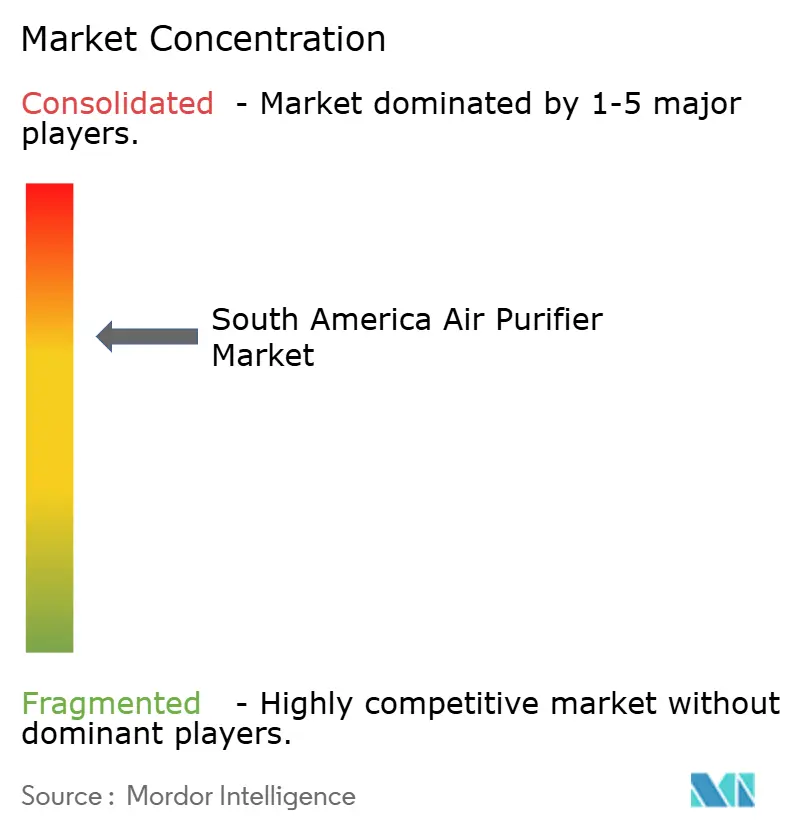
| Market Concentration | Medium |
Major Players *Disclaimer: Major Players sorted in no particular order |
South America Air Purifier Market Analysis by Mordor Intelligence
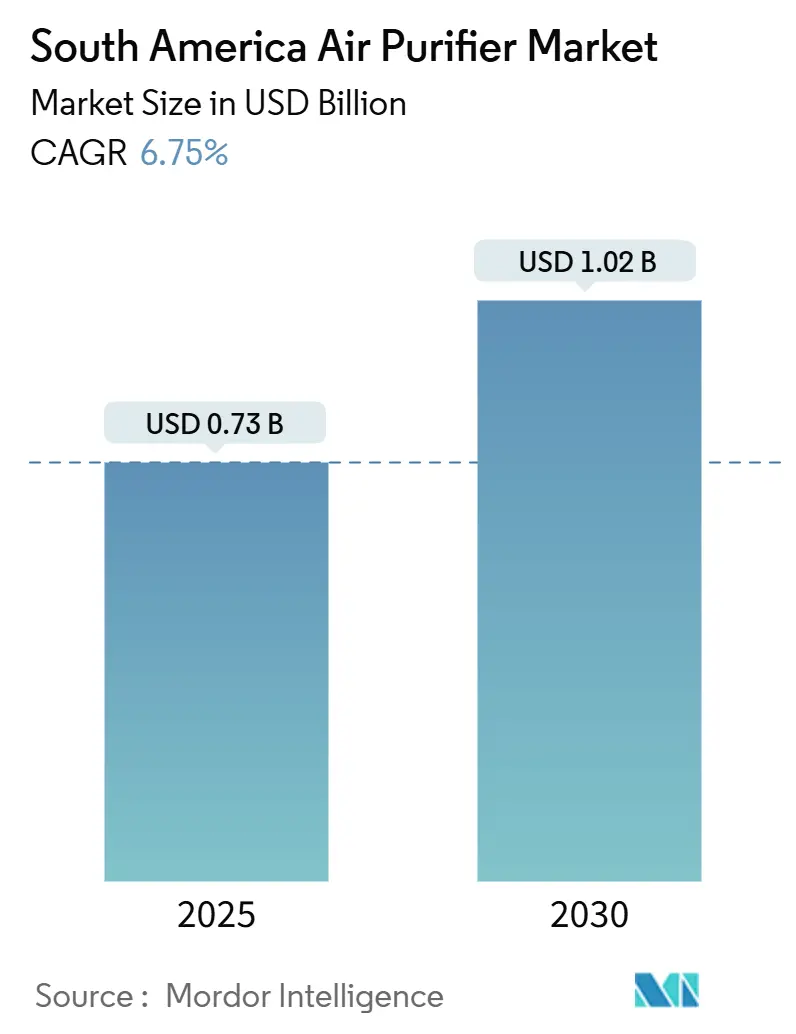
The South America Air Purifier Market size is estimated at USD 0.73 billion in 2025, and is expected to reach USD 1.02 billion by 2030, at a CAGR of 6.75% during the forecast period (2025-2030).
- Over the medium period, increasing airborne diseases, rising emissions due to industrial activities, and growing consumer health consciousness are driving the South America air purifier market.
- On the other hand, the high costs of premium air purifiers equipped with advanced filtration technologies limit their accessibility for price-sensitive consumers, hindering market growth during the forecast period.
- Nevertheless, as businesses and households respond to stricter air quality regulations and emission standards by investing in air purification solutions, a significant opportunity emerges in the forecast period.
- The Brazil is expected to be the fastest-growing region in the South America air purifier market during the forecast period.
South America Air Purifier Market Trends and Insights
The High-efficiency Particulate Air (HEPA) Segment is Expected to Dominate the Market
- Mechanical air filters, like HEPA filters, capture airborne particles on their filter materials. These filters effectively trap larger particles, including dust, pollen, mold spores, and allergens from dust mites and cockroaches. HEPA filters, characterized by their extended surface area, boast higher efficiencies in removing both large and small airborne particles. Compared to pleated filters, HEPA filters excel in capturing respirable particles. HEPA air purifiers typically adhere to two primary standards: the European Standard mandates a 99.95% particle removal efficiency, while the ASME Standard requires 99.97%, both for particles sized 0.3 micrometers and above.
- Over the past decade, HEPA filters have effectively curtailed the spread of airborne viruses and bacteria in healthcare settings. Leading engineering organizations advocate for HEPA filters in hospitals and clinics, underscoring their role in eliminating harmful microbes.
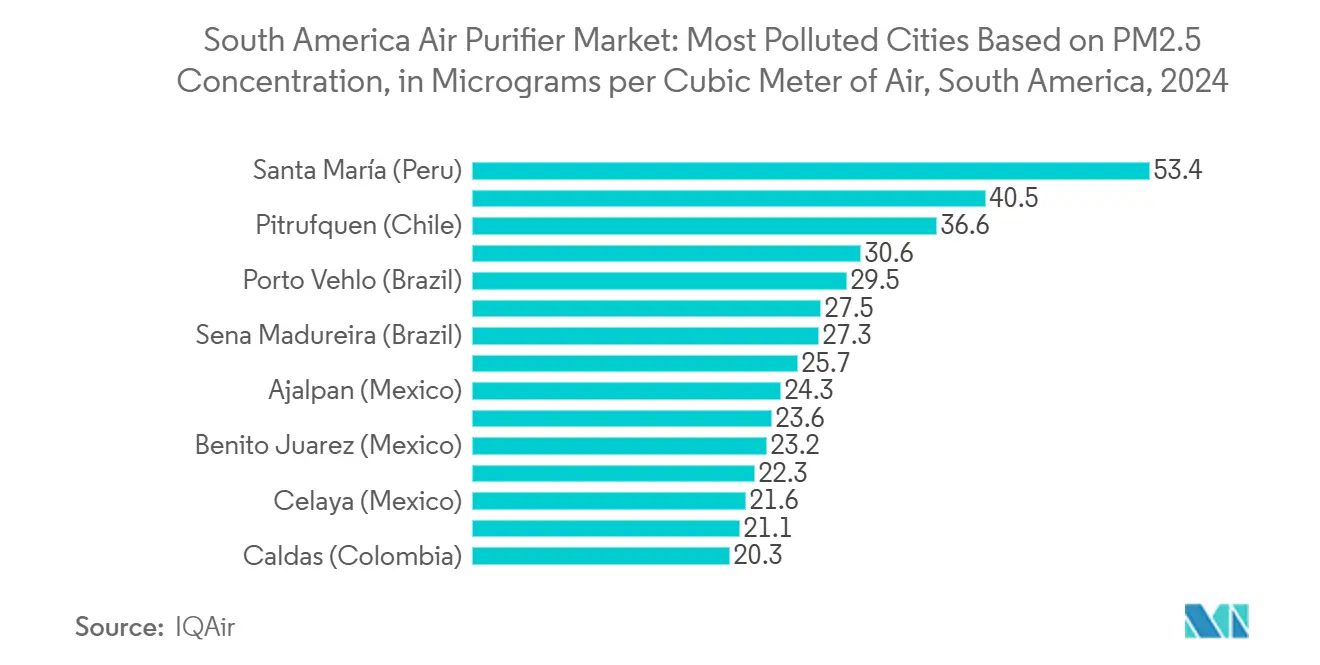
- Heightened awareness of air pollution and its health repercussions has spurred a surge in demand for efficient air purification solutions, notably HEPA filters. As reported by IQAir, in 2024, Santa María, a city in Peru situated west of the Andes, topped the list as Latin America's most polluted city, gauged by the concentration of fine particulate matter (PM2.5) in the air. That year, Santa María recorded an average PM2.5 concentration of 53.4 micrograms per cubic meter. Following closely was Coyhaique in Chile, with an estimated PM2.5 concentration of 40.5 μg/m³. Given this backdrop, the rising awareness to control air pollution in the region is poised to amplify the demand for HEPA filters, which play a pivotal role in controlling air particulate matter concentrations.
- Furthermore, industries like pharmaceuticals, food and beverage, and healthcare are driving the need for stringent air quality standards, consequently fueling the adoption of HEPA filtration systems. In light of the escalating use of air filters across these diverse sectors in the region, numerous companies are forging collaborations and partnerships.
- For instance, in February 2023, EDF teamed up with the Latin America and the Caribbean (LAC) Office of the United Nations Environment Programme (UNEP) to roll out a new initiative. Their goal is to establish clean air solutions across 33 countries in Latin America and the Caribbean over the next four years. This partnership seeks to overcome challenges in promoting clean air initiatives in a region that boasts a population exceeding 650 million.
- Given the rising parnerships and heightened awareness, HEPA technology is poised to lead the market in the coming years.
Brazil is Expected to have a Significant Share
- Brazil's air purifier market is booming, fueled by rising air pollution, growing health consciousness, and tech innovations. Major cities, including São Paulo and Rio de Janeiro, grapple with heightened pollution due to urbanization and industrial activities. This has intensified public concern over air quality, leading to a spike in air purifier demand.
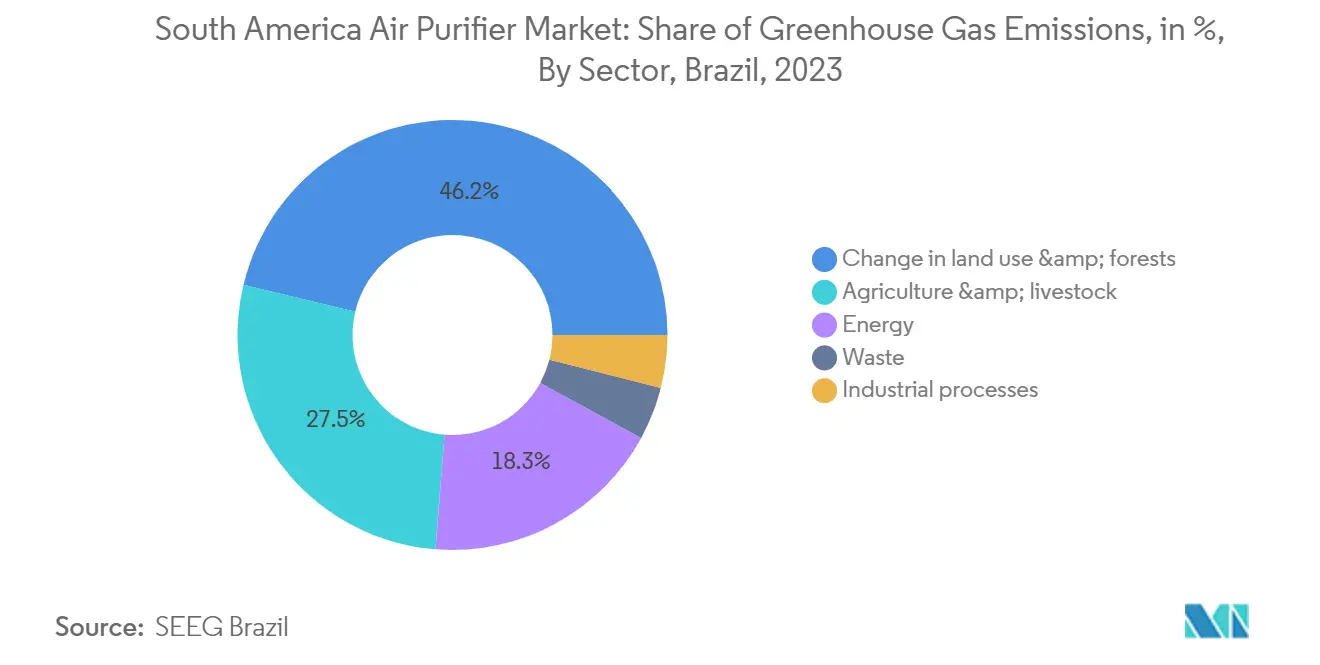
- According to Global Change Data Lab, Brazil, by the close of 2023, had released approximately 139 billion metric tons of carbon dioxide (GtCO₂) since 1850. This figure positions the Brazil as the fourth-largest contributor to global historical emissions. Additionally, data from SEEG Brazil reveals that Brazil's energy sector emitted around 420 million metric tons of carbon dioxide equivalent in 2023. This marks a modest uptick of about 1% from the prior year. Furthermore, the industrial sector in Brazil is responsible for approximately 18.3% of the nation's greenhouse gas emissions. In response to these rising emissions, Brazil is intensifying its air quality management efforts, acknowledging the adverse impacts on public health, the environment, and the economy.
- Furthermore, the National Environmental Council (Conama) is at the forefront of regulating Brazil's air quality. Notable legislations include Conama Resolution No. 5/1989, which launched the National Air Quality Control Program (Pronar), and Conama Resolution No. 491/2018, which established National Air Quality Standards.
- Moreover, at the U20 Summit in November 2024, Rio de Janeiro unveiled the 'Breathe Rio de Janeiro' initiative in collaboration with Breathe Cities. This initiative aims to combat air pollution, reduce carbon emissions, enhance public health, and address inequalities in one of Brazil's largest cities. With mayors from across the globe in attendance, Mayor Eduardo Paes, alongside leaders from the global initiative, detailed the strategy to purify the city's air. Such initiatives are poised to amplify the demand for air purifiers.
- Technological strides in air purifiers hint at a promising market future. Currently, High-Efficiency Particulate Air (HEPA) filters dominate, adept at trapping microscopic particles like dust and pollen. Meanwhile, Activated Carbon Filters, celebrated for eliminating odors and volatile organic compounds (VOCs), are the fastest-growing segment, underscoring a trend towards holistic air purification.
- Given these government-led air quality initiatives, Brazil's air purifier market is set for substantial growth.
Competitive Landscape
The South America air purifier market is semi-consolidated. Some of the major players in the market (in no particular order) include Thermomatic do Brasil Ltd, Panasonic Holdings Corporation, Honeywell International Inc., IQAir, and LG Electronics Inc., among others.
South America Air Purifier Industry Leaders
-
Thermomatic do Brasil Ltd
-
Panasonic Holdings Corporation
-
Honeywell International Inc.
-
IQAir
-
LG Electronics Inc.
- *Disclaimer: Major Players sorted in no particular order
Recent Industry Developments
- October 2024: Hengst Filtration made its second foray into Brazil's air purifier market, acquiring São Paulo-based Aeroglass. This follows Hengst's 2022 acquisition of Linter.
- :
South America Air Purifier Market Report Scope
Air purifiers, often referred to as air cleaners, enhance indoor air quality by eliminating pollutants and contaminants from room air. These devices intake air, filter out pollutants such as dust, pollen, smoke, and allergens, and subsequently release purified air back into the environment. Most air purifiers utilize filters, such as HEPA filters, to capture particles. Additionally, some models incorporate technologies like activated carbon filters, which are effective in removing gases and odors.
The South America air purifier market is segmented by filter technology, type, end-user, and geography. By filter technology, the market is segmented into high-efficiency particulate air (HEPA), other filtration technologies (electrostatic precipitators (ESPs), ionizers, and ozone generators). By type, the market is segmented into stand-alone and in-duct. By end-user, the market is segmented into residential, commercial, and industrial. The report also covers the market size and forecasts for the South America air purifier market across major countries in the region.
For each segment, the market sizing and forecasts have been done based on revenue (USD).
| High-Efficiency Particulate Air (HEPA) |
| Other Filtration Technologies (Electrostatic Precipitators (ESPs), Ionizers, and Ozone Generators) |
| Stand-Alone |
| In-Duct |
| Residential |
| Commercial |
| Industrial |
| Brazil |
| Argentina |
| Colombia |
| Chile |
| Rest of the South America |
| Filter Technology | High-Efficiency Particulate Air (HEPA) |
| Other Filtration Technologies (Electrostatic Precipitators (ESPs), Ionizers, and Ozone Generators) | |
| Type | Stand-Alone |
| In-Duct | |
| End-User | Residential |
| Commercial | |
| Industrial | |
| Geography | Brazil |
| Argentina | |
| Colombia | |
| Chile | |
| Rest of the South America |
Key Questions Answered in the Report
How big is the South America Air Purifier Market?
The South America Air Purifier Market size is expected to reach USD 0.73 billion in 2025 and grow at a CAGR of 6.75% to reach USD 1.02 billion by 2030.
What is the current South America Air Purifier Market size?
In 2025, the South America Air Purifier Market size is expected to reach USD 0.73 billion.
Who are the key players in South America Air Purifier Market?
Thermomatic do Brasil Ltd, Panasonic Holdings Corporation, Honeywell International Inc., IQAir and LG Electronics Inc. are the major companies operating in the South America Air Purifier Market.
What years does this South America Air Purifier Market cover, and what was the market size in 2024?
In 2024, the South America Air Purifier Market size was estimated at USD 0.68 billion. The report covers the South America Air Purifier Market historical market size for years: 2019, 2020, 2021, 2022, 2023 and 2024. The report also forecasts the South America Air Purifier Market size for years: 2025, 2026, 2027, 2028, 2029 and 2030.
South America Air Purifier Market Report
Statistics for the 2025 South America Air Purifier market share, size and revenue growth rate, created by Mordor Intelligence™ Industry Reports. South America Air Purifier analysis includes a market forecast outlook for 2025 to 2030 and historical overview. Get a sample of this industry analysis as a free report PDF download.