
Market Overview
| Study Period | 2020 - 2031 |
|---|---|
| Forecast Data Period | 2026 - 2031 |
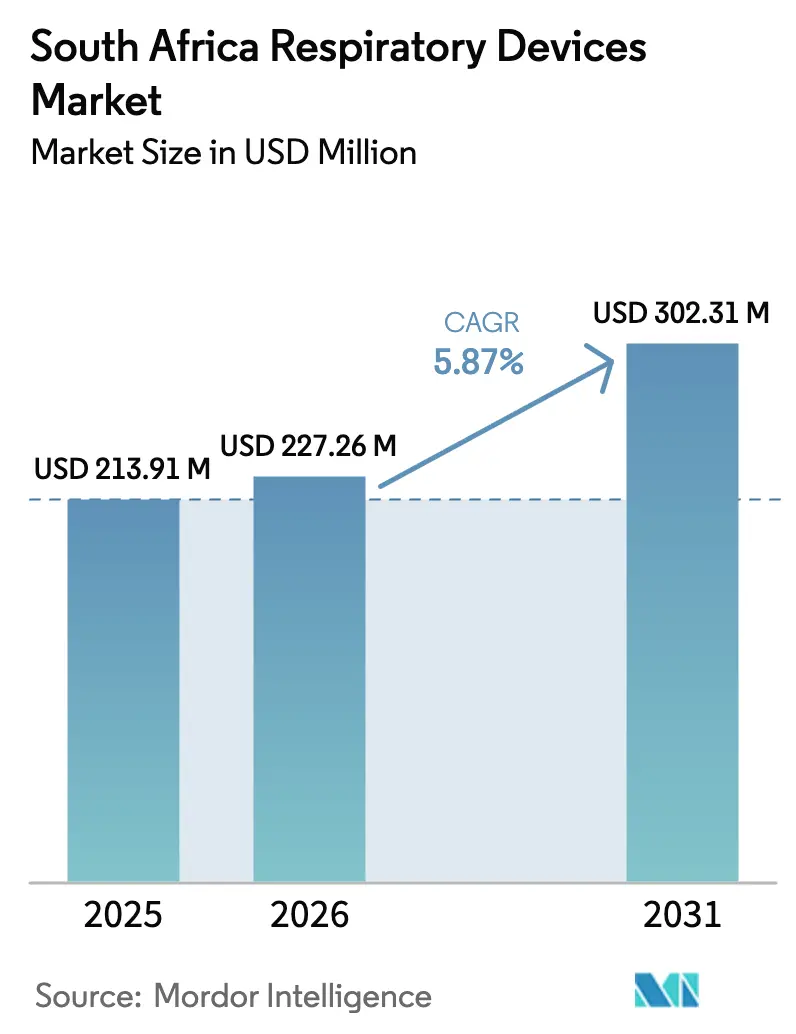
| Base Year Market Size (2025) | USD 213.91 Million |
| Market Size (2026) | USD 227.26 Million |
| Market Size (2031) | USD 302.31 Million |
| Growth Rate (2026 - 2031) | 5.87 % |
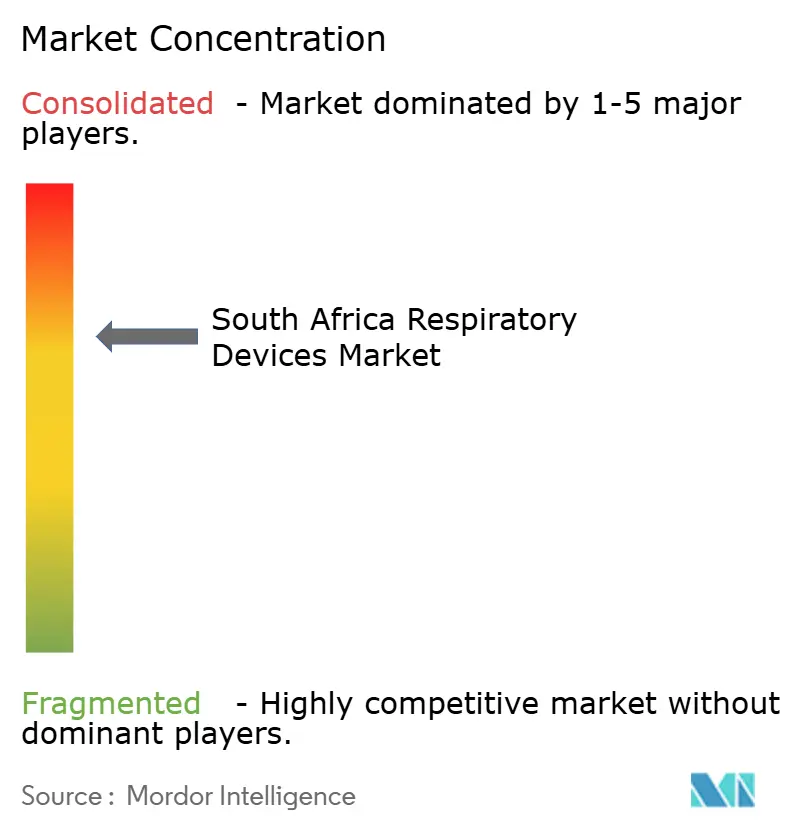
| Market Concentration | Medium |
Major Players *Disclaimer: Major Players sorted in no particular order Image © Mordor Intelligence. Reuse requires attribution under CC BY 4.0. | |
South Africa Respiratory Devices Market Analysis by Mordor Intelligence
The South Africa Respiratory Devices Market size is projected to expand from USD 213.91 million in 2025 and USD 227.26 million in 2026 to USD 302.31 million by 2031, registering a CAGR of 5.87% between 2026 to 2031.
Accelerating chronic disease prevalence, an expanding base of home care users, and mandated infection control protocols form the core narrative of growth. Hospitals replaced aging intensive-care ventilators in the wake of the COVID-19 pandemic, while private sleep clinics upgraded to connected positive-airway-pressure (PAP) systems that upload adherence data to cloud-based dashboards. Simultaneously, demand for single-use masks and breathing circuits surged as facilities tightened hygiene standards, moving disposables ahead of capital equipment in growth momentum. A reliance above 90% on imports leaves procurement costs exposed to rand depreciation, yet new local-assembly incentives aim to trim landed expenses by 15% to 25% over the next five years. Electricity supply instability imposes a structural surcharge on devices that require continuous mains power, prompting the adoption of battery-equipped concentrators and ventilators designed for off-grid resilience.
Key Report Takeaways
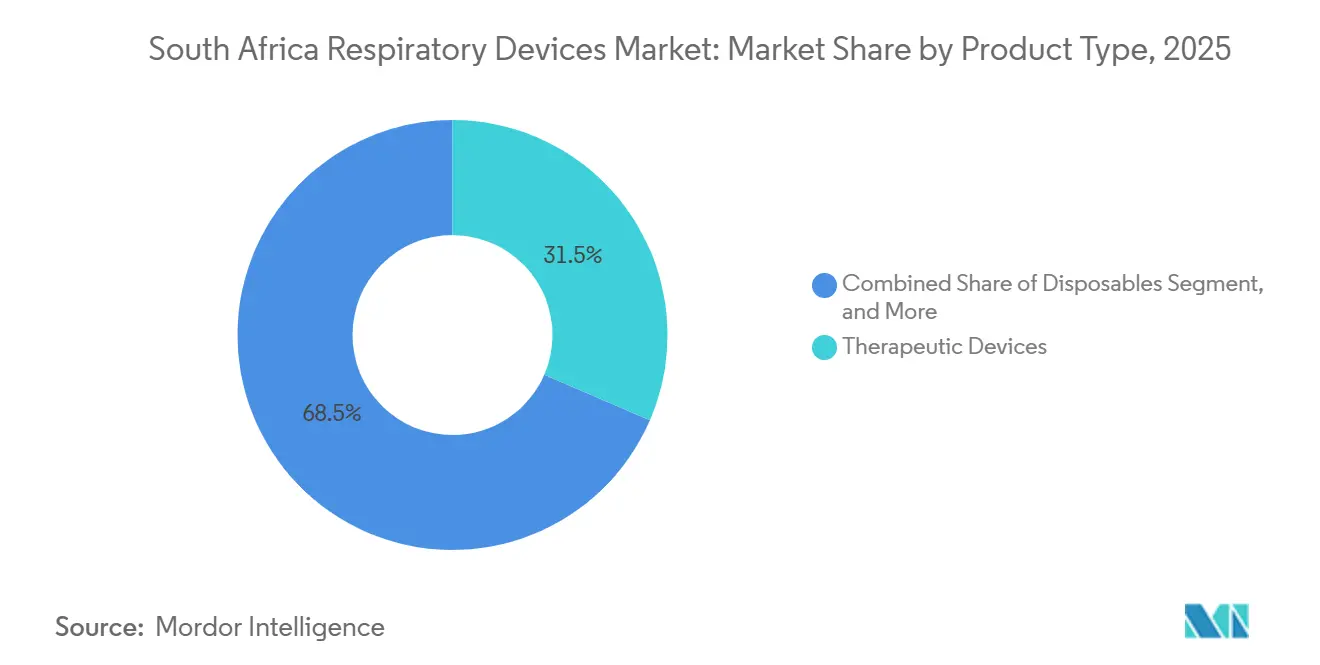
- By product type, therapeutic devices led with 46.31% revenue share in 2025; disposables are forecast to expand at an 8.72% CAGR through 2031.
- By application, COPD accounted for 39.73% of the South African respiratory devices market share in 2025, while sleep apnea is projected to record the fastest growth at a 9.29% CAGR through 2031.
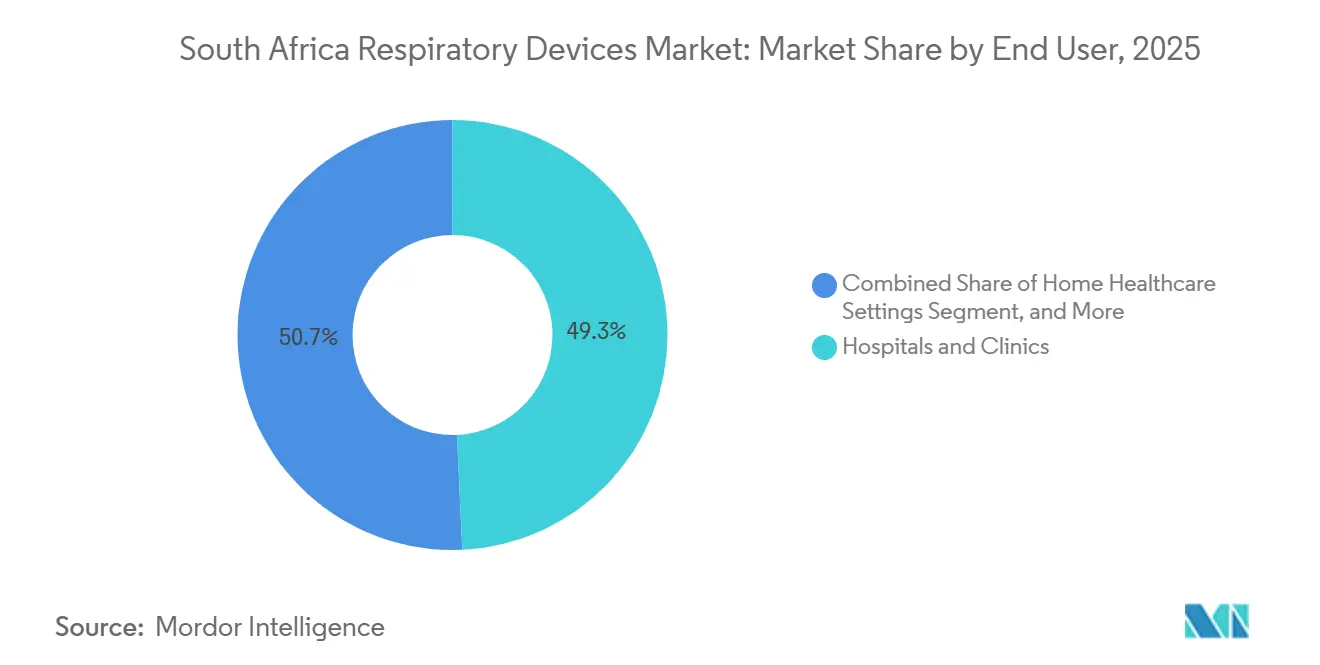
- By end user, hospitals and clinics accounted for 49.28% of the 2025 demand; meanwhile, home healthcare settings are projected to advance at a 7.64% CAGR through 2031.
Note: Market size and forecast figures in this report are generated using Mordor Intelligence’s proprietary estimation framework, updated with the latest available data and insights as of January 2026.
South Africa Respiratory Devices Market Trends and Insights
Drivers Impact Analysis*
| Driver | (~) % Impact on CAGR Forecast | Geographic Relevance | Impact Timeline |
|---|---|---|---|
| Rising Prevalence of COPD, Asthma, TB & Sleep Apnea | +1.3% | National, with concentration in Gauteng, Western Cape, KwaZulu-Natal | Long term (≥ 4 years) |
| Increasing Adoption of Home-Care & Portable Devices | +1.1% | National, accelerated in urban metros (Johannesburg, Cape Town, Durban) | Medium term (2-4 years) |
| Technological Advances: AI-Enabled & Connected Devices | +0.9% | Gauteng and Western Cape private sector, gradual public-sector uptake | Medium term (2-4 years) |
| Expansion of Private-Sector Healthcare Expenditure | +0.8% | Gauteng, Western Cape, KwaZulu-Natal with spillover to Free State | Long term (≥ 4 years) |
| Growth in Tele-Respiratory and Remote-Monitoring Services | +0.7% | National, with early adoption in private medical schemes | Short term (≤ 2 years) |
| Local Manufacturing Incentives for Critical Devices | +0.5% | Gauteng and Western Cape industrial zones, potential expansion to Eastern Cape | Long term (≥ 4 years) |
| Source: Mordor Intelligence | |||
Rising Prevalence of COPD, Asthma, TB & Sleep Apnea
Tuberculosis notifications fell from 450,000 in 2015 to about 230,000 in 2022, yet drug-resistant strains sustain the need for portable nebulizers in community clinics. Sleep apnea affects 29.3% of rural older adults but remains underdiagnosed in urban areas, leaving a sizeable potential for PAP therapy expansion.[1] Biomass-fuel exposure and post-TB airway damage elevate COPD risk, driving oxygen-concentrator rentals across informal settlements. The prevalence of urban childhood asthma, reaching up to 20%, signals an ongoing demand for peak-flow meters and inhalers as primary care infrastructure expands. Population aging and deteriorating air quality in industrial corridors ensure these diseases remain the main demand anchor through 2031.
Increasing Adoption of Home-Care & Portable Devices
The National Health Insurance (NHI) Act prioritizes decentralized care, promoting the use of portable concentrators weighing under 3 kg for enhancing mobility and load-shedding resilience.[2] Private medical schemes reimburse home PAP therapy at rates up to 50% lower than facility-based titration, incentivizing clinics to prescribe auto-adjusting devices that minimize follow-up visits. Nebulizer rentals bundled with nursing services cut readmissions by roughly 20% at leading hospital groups. Frequent power interruptions reported by 30% to 40% of home-care patients make battery backup a must-have specification. User-friendly interfaces and six-month filter-replacement intervals cater to caregivers in multigenerational households.
Technological Advances: AI-Enabled & Connected Devices
ResMed’s AirSense 11 utilizes machine-learning algorithms to tailor pressure delivery, resulting in lower early therapy abandonment rates, which are below the historical 30% mark.[3] Philips’ DreamStation 2 relays nightly usage to cloud dashboards, helping clinicians intervene when adherence drops under the 4-hour threshold for reimbursement. Fisher & Paykel’s Optiflow adjusts humidity based on real-time sensor data, improving patient tolerance in step-down units. Bluetooth-enabled spirometers automatically upload lung-function data to electronic records, although public-sector adoption lags due to gaps in Wi-Fi coverage. The South African Society of Anaesthesiologists offers training modules to bridge the digital literacy divide among clinicians.
Growth in Tele-Respiratory & Remote-Monitoring Services
Pulse oximeters with cellular chips alert clinicians when saturation falls below 88%, averting emergency visits for COPD patients. Medical schemes reimburse virtual monitoring at 60% to 70% of in-person rates, opening a viable revenue stream for pulmonologists. Western Cape pilots using connected nebulizers in TB care raised treatment completion by 15%. The 2025 Telemedicine Framework mandates HL7 FHIR compliance for device interoperability; however, 4G coverage below 60% in parts of the Eastern Cape and Limpopo hampers real-time data flow.
Restraints Impact Analysis*
| Restraint | (~) % Impact on CAGR Forecast | Geographic Relevance | Impact Timeline |
|---|---|---|---|
| High Upfront Cost & Import Dependency of Advanced Devices | -0.6% | National, acute in public sector and rural facilities across all provinces | Long term (≥ 4 years) |
| Stringent SAHPRA Regulatory Approvals & Tender Delays | -0.4% | National, affecting both public and private sector procurement timelines | Medium term (2-4 years) |
| Shortage of Trained Respiratory Therapists | -0.3% | National, severe in Eastern Cape, Limpopo, Northern Cape, Mpumalanga | Long term (≥ 4 years) |
| Electricity-Supply Instability Impacting Device Uptime | -0.4% | National, severe in Gauteng, KwaZulu-Natal, Eastern Cape during peak demand | Medium term (2-4 years) |
| Source: Mordor Intelligence | |||
High Upfront Cost & Import Dependency of Advanced Devices
More than 90% of respiratory devices are imported, making landed prices vulnerable to currency swings and customs duties. ICU ventilators that leave factories at USD 25,000 to USD 35,000 reach USD 50,000 after taxes and logistics. Median household income constraints force many sleep-apnea patients to rent PAP units for ZAR 800–1,200 per month. The 2024 Medical Devices Localization Strategy offers tax credits to spur the assembly of ventilators and concentrators; however, uptake remains slow due to unclear regulatory pathways for locally built units. Rand depreciation averaging 8% to 12% annually further stretches replacement cycles to seven years and drives demand for refurbished imports.
Electricity-Supply Instability Impacting Device Uptime
Load shedding reached 6,342 hours in 2023, compelling facilities to purchase diesel generators and UPS systems, which increase total device costs by up to 20%. Home-based COPD patients risk hypoxemic events during four-hour blackouts because concentrators halt mid-therapy. Battery-equipped portable concentrators cost 20% to 30% more but posted 12% to 15% annual sales growth as patients seek uninterrupted care. Rural public hospitals lacking backup power often resort to manual bag-valve ventilation during outages, which increases caregiver fatigue and risks of complications. Eskom pledges to cut outages below 1,000 hours by 2027, yet funding and execution risks remain high.
*Our forecasts treat driver/restraint impacts as directional, not additive. The impact forecasts reflect baseline growth, mix effects, and variable interactions.
Segment Analysis
By Product Type: Infection-Control Mandates Lift Disposables
The South Africa respiratory devices market size for disposables is growing faster than any other category, expanding at an 8.72% CAGR to 2031 as single-use masks and breathing circuits become mandatory in revised hospital protocols. Therapeutic devices retained a 46.31% revenue share in 2025, primarily driven by the installation of ventilators and PAP units during pandemic-era upgrades. Ventilators such as the Carescape R860 and Evita V800 lead ICU budgets due to their lung-protective modes, which lower the risk of barotrauma. CPAP systems, spearheaded by AirSense 11 and DreamStation 2, account for roughly one-third of therapeutic revenue as diagnostic labs double output. Portable battery-powered concentrators captured 40% of fresh home-therapy placements in 2025, underscoring consumer preference for mobility amid load shedding.
Private pulmonologists invest in handheld spirometers, shortening the diagnosis-to-treatment window from four weeks to same-day initiation. Smart inhalers with Bluetooth-enabled adherence logs are awaiting SAHPRA clearance, creating pent-up demand among asthma specialists. Local assembly of entry-level nebulizers could shave prices by 20%, positioning domestic firms for public tenders that favor local content. Overall, tightening infection-control rules and a push toward local manufacturing position disposables and basic therapeutic devices for above-market growth.

By Application: Sleep Apnea Surges Ahead of COPD
COPD accounted for 39.73% of the revenue in 2025, driven by chronic oxygen therapy and nebulized bronchodilators. However, sleep-apnea revenue is climbing at a 9.29% CAGR as awareness and employer screening programs proliferate. Diagnostic polysomnography labs remain scarce, with fewer than 50 nationwide, so payers approving home sleep-test kits are catalyzing shifts in volume. Home studies cost ZAR 2,500–4,000 compared with ZAR 8,000–12,000 for in-lab tests, unlocking demand among middle-income groups.
Asthma affects up to 20% of urban children, resulting in substantial turnover of inhalers and nebulizers in primary-care clinics. Tuberculosis still underpins specialized demand for aerosol antibiotic nebulizers, with Omron and Drive DeVilbiss competing on ease of cleaning for community-based programs. Smaller segments such as cystic fibrosis obtain devices via SAHPRA’s Section 21 pathway, reflecting high-value but low-volume dynamics. Inclusion of chronic respiratory care in the NHI essential benefits package could add 50,000–70,000 new device users by 2028.
By End User: Home Healthcare Accelerates Under NHI
Hospitals and clinics generated 49.28% of 2025 revenue, yet home-healthcare spending is rising at a 7.64% CAGR as reimbursement models shift toward community care. Medical schemes now contract home-nursing agencies on a capitated basis, cutting per-patient cost by up to 40%. Gauteng and the Western Cape account for 60%–65% of home placements, thanks to their dense nursing networks and higher insurance coverage.
Ambulatory surgical centers utilize high-flow nasal oxygen systems to support procedural sedation, thereby creating a modest but growing market for advanced humidification platforms. Occupational health clinics in mining utilize spirometers for mandated lung-function surveillance, thereby establishing a recurring niche for diagnostic devices. Long-term care and rehabilitation centers, which collectively account for less than 10% of demand, seek battery-ready devices to hedge against power outages. Overall, the integration of portable device innovation and telehealth makes the home channel the most dynamic growth pocket through 2031.
Regulatory Landscape
Respiratory devices in South Africa are regulated by the South African Health Products Regulatory Authority (SAHPRA) under the Medicines and Related Substances Act, 1965 (Act 101 of 1965). SAHPRA applies a risk-based medical device classification framework (Class A to Class D), which shapes evidence expectations, conformity assessment depth, and time-to-market for higher-risk products such as ventilators and PAP systems. For borderline drug-device combination presentations, SAHPRA uses designation principles to determine the lead oversight pathway, which is relevant for inhalation or co-packaged respiratory therapies that straddle medicines and devices.
On pricing and market access, policy activity in 2025 included a draft interim block exemption process for tariff determination in the healthcare sector. It supports multi-stakeholder approaches to tariff setting and coding that can influence private-sector reimbursement for respiratory procedures and device-linked services. Import exposure continues to shape landed costs, with SARS publishing ongoing tariff amendment schedules (including 2026 updates) that affect how specific product categories are treated at customs, reinforcing the need for accurate tariff classification and documentation for imported respiratory equipment and consumables.
Competitive Landscape
Five to seven multinationals - ResMed, Philips, Fisher & Paykel Healthcare, GE Healthcare, Medtronic, Dräger, and Getinge - dominate the market, driven by ICU ventilators and connected PAP systems. These firms lock in clients through service contracts, clinician education, and IT integration that raise switching costs. ResMed’s myAir platform, with 2.5 million connected users, exemplifies ecosystem monetization, where device placements generate recurring cloud subscription and replacement mask income.
Local-assembly opportunities in nebulizers and CPAP masks could trim costs by 20% and win price-sensitive public tenders. Post-acute facilities represent a white-space segment for intermediate-complexity ventilators and high-flow oxygen systems. Telemedicine platforms that bundle device rental with virtual pulmonology visits appeal to medical schemes seeking cost efficiency. SAHPRA’s alignment with ISO 13485 and IEC 60601 raises the compliance bar but offers clearer pathways for global entrants.
South Africa Respiratory Devices Industry Leaders
-
Drägerwerk AG & Co. KGaA
-
Koninklijke Philips NV
-
Akacia Medical & Healthcare Group
-
Hamilton Bonaduz AG (Hamilton Medical AG)
-
Teleflex Incorporated
- *Disclaimer: Major Players sorted in no particular order
Market Opportunities and Future Outlook
Localizing portions of the respiratory device supply chain stands out as a concrete opportunity, given the market's dependence on imports and the sensitivity of device pricing to logistics and currency movements. SAHPRA's revised Local Manufacturing Policy (June 2025) supports inclusion of local manufacturing sites through a defined regulatory lever, namely shorter evaluation times and reduced assessment fees for Type II variation applications tied to local site inclusion. This creates a workable route for OEMs and local partners to shift assembly or packaging of selected respiratory consumables and therapy accessories closer to demand centers, while meeting SAHPRA licensing requirements for manufacturers, importers, and distributors.
Whitespace on the demand side is reinforced by national programs that expand the addressable testing and chronic-care pool. The National Department of Health's 2026-2027 Annual Performance Plan prioritizes non-communicable disease management, including chronic respiratory diseases, within its strategy, supporting procurement and service models spanning diagnostic and home-care respiratory technologies. The End TB Campaign for 2025/26 targets testing 5 million people, which increases the need for respiratory-adjacent diagnostic workflows and clinic-ready device ecosystems (such as pulse oximetry and oxygen therapy support in community and referral settings), creating space for suppliers that can bundle devices, disposables, training, and after-sales service for decentralized care delivery.
Recent Industry Developments
- January 2026: Inogen launched its Aurora CPAP masks, expanding beyond oxygen therapy into sleep apnea accessories. The product broadens its addressable respiratory portfolio and gives clinics a mask option aimed at improving PAP comfort and long-term adherence. It also raises competitive pressure in the mask and disposables layer, where replacement cycles support recurring demand.
- October 2025: Cipla expanded the reach of its Breathefree respiratory initiative focused on asthma and COPD patient awareness, education, and access support. Wider program coverage can lift diagnosis-to-therapy conversion and sustain turnover of inhalation and home-use respiratory products across more geographies. The initiative also strengthens connections with care pathways that influence device and consumable selection in chronic management.
- May 2025: The Lung Institute of South Africa shared updates on its ongoing respiratory research, innovation, and clinical programs, including work that supports clinical trials and public health initiatives. Continued local research activity helps build clinical confidence and supports protocol adoption for respiratory interventions, which can translate into more structured demand for diagnostics, monitoring, and therapy devices. It also supports partnerships between providers and suppliers seeking evidence-backed pathways for new technologies.
Research Methodology Framework and Report Scope
Market Definition and Coverage
For this study, the market covers medical devices used to diagnose, monitor, treat, or support breathing in South Africa, including therapy equipment and resuscitation support used in hospitals and home settings.
Scope exclusions: We exclude pharmaceuticals, general hospital consumables not specific to respiratory care, and non-medical wellness gadgets marketed for breathing.
Segmentation Overview
- By Product Type
- Diagnostic & Monitoring Devices
- Spirometers
- Sleep Test Devices
- Peak Flow Meters
- Pulse Oximeters
- Capnographs
- Other Diagnostic & Monitoring Devices
- Therapeutic Devices
- CPAP Devices
- BiPAP Devices
- Humidifiers
- Nebulizers
- Oxygen Concentrators
- Ventilators
- Inhalers
- Other Therapeutic Devices
- Disposables
- Masks
- Breathing Circuits
- Other Disposables
- Diagnostic & Monitoring Devices
- By Application
- COPD
- Asthma
- Sleep Apnea
- Tuberculosis
- Other Application
- By End User
- Hospitals & Clinics
- Home Healthcare Settings
- Ambulatory Surgical Centers
- Other End Users
Data Sources, Market Sizing, and Validation
Desk Research
Desk research was used to build the starting market structure and to anchor inputs that can be checked repeatedly each year. We relied on public health and population signals, including World Health Organization reporting on respiratory disease burden, plus South Africa health system publications that describe care pathways and service coverage.
To support sizing assumptions, we reviewed South Africa official statistics for population and age mix, World Bank indicators for spending and inflation context, UN Comtrade trade statistics for import trends of relevant equipment categories, and South African Health Products Regulatory Authority updates for device registration and compliance cues. Company annual reports, product catalogs, tender notices, and credible news were also reviewed to understand product positioning and price movement. In parallel, we used paid subscriptions for company financials and intelligence, news and financials, patent databases, and shipment-level trade datasets to sanity-check directional trends. These desk sources are illustrative and not exhaustive, and many other public references were used to collect, validate, and clarify data points.
Primary Interviews and Surveys
Primary work focused on interviews and short surveys with manufacturers, distributors, clinical stakeholders, and procurement teams across public and private care settings, so the usage patterns behind each device group could be confirmed. We also collected input tied to hospitals and clinics, home healthcare providers, and ambulatory centers, which helped fill gaps on pricing ranges, replacement cycles, and demand shifts by indication (including COPD, asthma, sleep apnea, and tuberculosis).
Distribution of primary research fieldwork respondents
| Company type | Respondent position |
|---|---|
| Top tier: 39% | CXOs: 14% |
| Mid tier: 46% | Functional/Unit leaders: 36% |
| Smaller Players: 15% | Managers: 50% |
Market-Sizing & Forecasting
Sizing starts with a top-down build where disease prevalence and treated-patient pools are translated into expected device demand by care setting, then aligned to observed procurement and trade patterns in South Africa. Once the demand pool is constructed, we corroborate it with selective bottom-up approximations, such as sampled unit volumes by device category multiplied by typical selling prices, followed by channel checks with distributors to adjust for coverage gaps.
Key inputs used in the model include the diagnosed and treated base for COPD, asthma, sleep apnea, and tuberculosis, plus hospital and ICU capacity signals that influence ventilator and monitoring needs, home care adoption for CPAP and oxygen therapy, replacement cycles for durable devices, and price movement for disposables and accessories. Where direct unit references were limited, we bridged assumptions using import trends, tender activity, and interview-led ranges for utilization and replacement, then cross-checked to avoid overstating double counting across care settings.
For forecasting, we used scenario analysis because purchasing can shift with budget cycles, guideline updates, and outbreaks, and these drivers do not always move in a straight line. Variables were projected using input from primary respondents on expected penetration, pricing direction, and the pace of shift toward home care, then applied consistently across the device groups.
Data Validation & Update Cycle
Validation was done through stepwise checks so each major assumption could be traced back to a visible signal and stress-tested. We compared the model outputs against independent indicators, such as trade value movement, public tender direction, and reported utilization shifts in hospitals and home care, and then reworked outliers where implied prices or unit needs looked unrealistic.
Before sign-off, the numbers go through analyst review rounds that include variance checks across years, indication logic checks, and consistency checks between device categories and end-user totals. If a major inconsistency is seen, respondents are re-contacted to confirm whether it reflects a real market change or a modeling issue. Reports are refreshed annually, with interim updates triggered by material events, and a final pre-delivery review is completed to ensure the latest information is incorporated.
Mordor Intelligence's South Africa Respiratory Devices Market Size Measured Against Other Published Estimates
Published market values for South Africa respiratory devices can differ across sources, even when they appear to cover similar products. The gap usually comes from how each source defines the device scope, which year is treated as the anchor, and how prices and volumes are translated into a single revenue number.
The main gap comes from whether disposables and resuscitation-related breathing support are counted alongside diagnostic and therapeutic equipment, and in Mordor Intelligence's approach these are included only when they fall inside the defined respiratory devices scope, then validated through end-user and channel checks for South Africa.
Benchmark comparison
| Source | Market Size | Gaps in Research Methodology |
|---|---|---|
| Mordor Intelligence | USD 213.91 M (2025) | |
| Regional Consultancy A | USD 312.40 M (2026) | Uses a later anchor year and appears to apply a broader device basket with faster growth assumptions, which can raise the total when pricing and adoption are projected more aggressively. |
| Trade Journal B | USD 227.26 M (2026) | Reports the next-year value and may rely more on published figures without fully adjusting for local channel mix, replacement timing, and end-user split, which can shift totals between years. |
The table shows that the spread is largely explained by year anchoring and what gets bundled into the respiratory devices definition, followed by how pricing and adoption are carried forward. By keeping scope rules explicit and tying assumptions back to observable demand signals, the final number stays traceable to repeatable steps rather than one-off adjustments.
Key Questions Answered in the Report
What is the projected value of the South Africa respiratory devices market in 2031?
The market is expected to reach USD 302.31 million by 2031.
Which product category is growing fastest in South Africa’s respiratory segment?
Disposables such as single-use masks and breathing circuits are expanding at an 8.72% CAGR.
Why are portable oxygen concentrators gaining popularity in South Africa?
Frequent load shedding and the National Health Insurance focus on home care are driving demand for battery-equipped portable units.
Which application segment is poised for the highest growth through 2031?
Sleep apnea devices are projected to grow at a 9.29% CAGR as diagnosis rates rise.
How does electricity instability affect respiratory device usage?
Load shedding raises ownership costs by 15%–20% and forces hospitals and patients to adopt battery-ready or generator-backed solutions.