
Market Overview
| Study Period | 2020 - 2031 |
|---|---|
| Forecast Data Period | 2026 - 2031 |
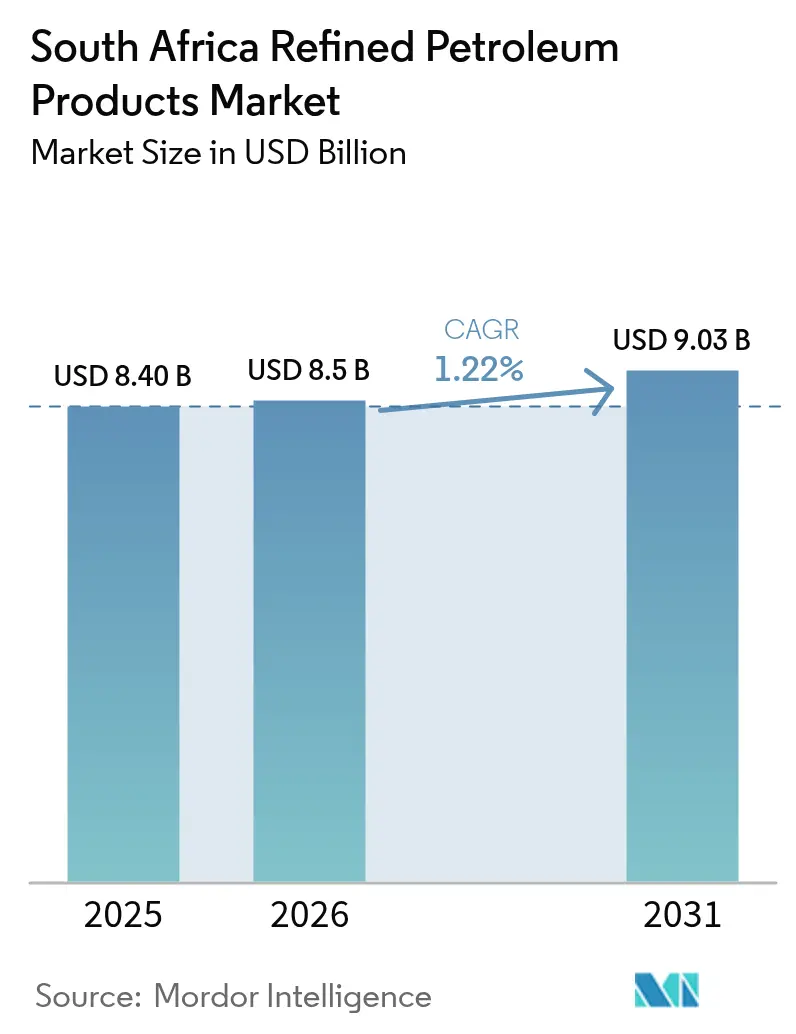
| Base Year Market Size (2025) | USD 8.40 Billion |
| Market Size (2026) | USD 8.5 Billion |
| Market Size (2031) | USD 9.03 Billion |
| Growth Rate (2026 - 2031) | 1.22 % |
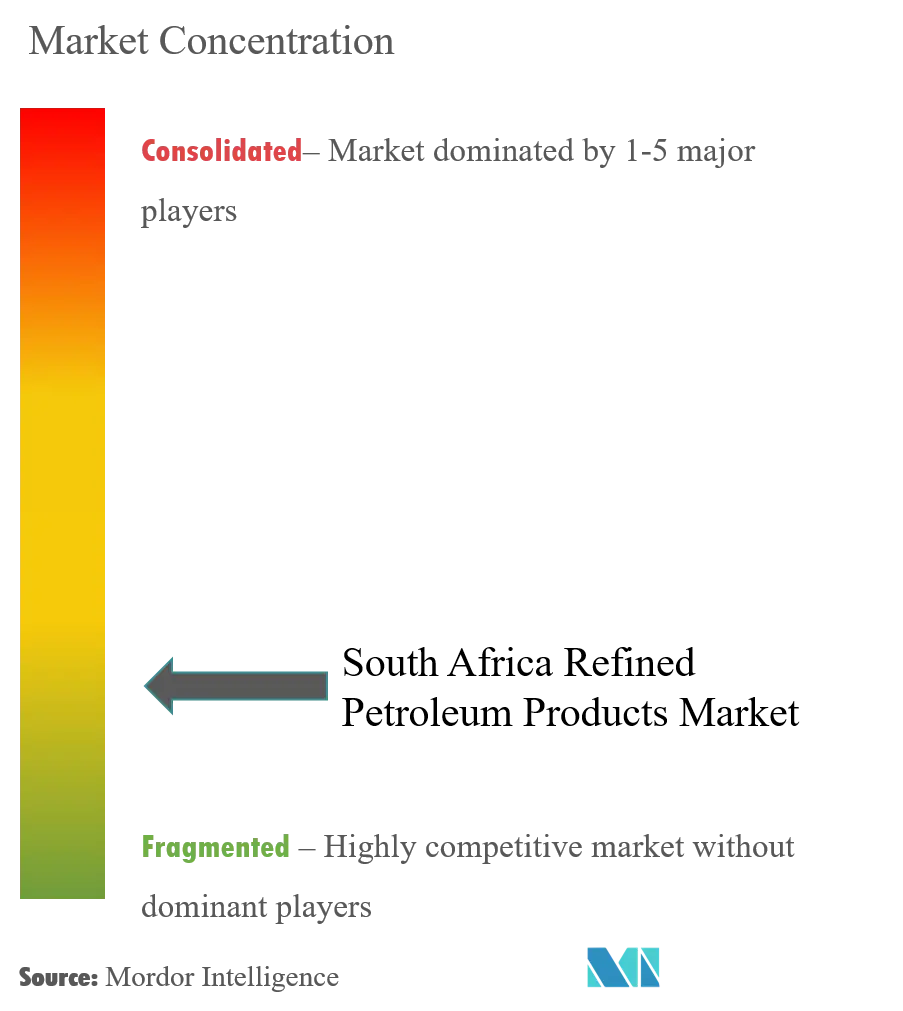
| Market Concentration | Medium |
Major Players.webp) *Disclaimer: Major Players sorted in no particular order Image © Mordor Intelligence. Reuse requires attribution under CC BY 4.0. | |
South Africa Refined Petroleum Products Market Analysis by Mordor Intelligence
South Africa Refined Petroleum Products Market size in 2026 is estimated at USD 8.50 billion, growing from 2025 value of USD 8.40 billion with 2031 projections showing USD 9.03 billion, growing at 1.22% CAGR over 2026-2031.
South Africa's refined petroleum products market is undergoing significant structural changes amid evolving energy dynamics and infrastructure challenges. The country's refining system has been notably impacted by underinvestment, with the nation losing approximately half of its oil-processing capacity in recent years due to various factors, including the emergence of cleaner fuel specifications. According to the South African Revenue Service (SARS), the country imported more than 6 billion liters of crude oil in 2022, highlighting its substantial dependence on imports. This transformation has positioned South Africa as one of the largest crude oil importers in the African region, fundamentally reshaping the industry's operational landscape.
The transportation sector continues to be a crucial driver of petroleum product demand, particularly in commercial applications. The sector has shown remarkable resilience and growth, as evidenced by commercial vehicle sales increasing by more than 13% between 2021 and 2022. This growth in the commercial vehicle segment has directly influenced the demand for transportation fuel, especially diesel fuel and gasoline. The average petrol price in South Africa reached 22.27 South African rand per liter in June 2023, reflecting the dynamic nature of fuel pricing in the country and its impact on consumption patterns.
Infrastructure development and modernization efforts are reshaping the industry's capabilities and future outlook. In May 2023, renewable power company Rubicon, in partnership with Audi, announced plans to expand its charging infrastructure across the country, including the addition of 150 new chargers. This development, while primarily focused on electric vehicle infrastructure, signals a broader transition in South Africa's energy landscape. The SA Petroleum Industry Association (SAPIA) has estimated that upgrading all refineries in the nation to meet new environmental standards would require approximately USD 3.9 billion in investment, highlighting the significant capital requirements for modernization.
The industry is witnessing a gradual shift toward cleaner and more sustainable fuel alternatives. In July 2023, the Organization of Petroleum Exporting Countries (OPEC) announced production cuts of around 1.16 million bpd for member countries, affecting global oil supply dynamics and pricing. This development has particular significance for South Africa's petroleum industry, as the country's manufacturing sector has demonstrated notable growth, with output increasing to approximately 92.46 in 2022. The sector's expansion, coupled with international market dynamics, continues to influence the demand for refined petroleum products while simultaneously driving the exploration of alternative energy sources. Additionally, the focus on downstream petroleum activities is becoming more pronounced as the industry adapts to these changes.
Note: Market size and forecast figures in this report are generated using Mordor Intelligence’s proprietary estimation framework, updated with the latest available data and insights as of 2026.
South Africa Refined Petroleum Products Market Trends and Insights
Increasing Consumption of Petroleum Products
The robust growth of South Africa's industrial sector has emerged as a significant driver for hydrocarbon fuels consumption, with various industries demonstrating increased demand for refined petroleum derivatives. According to the Organization for Economic Co-operation and Development, the South African manufacturing output showed remarkable recovery, reaching approximately 92.46 in 2022, a substantial increase from 87.44 in 2020. This industrial growth is further evidenced by new manufacturing investments, such as ALPLA Group's inauguration of a cutting-edge manufacturing facility in Lanseria near Johannesburg in October 2022, which serves as their headquarters for Sub-Saharan Africa operations. The expansion of manufacturing facilities, coupled with the growth in construction projects and industrial activities, has created a consistent demand for motor fuel used in machinery, equipment, and various industrial processes.
The transportation sector stands as another major contributor to the increasing consumption of diesel fuel, particularly in commercial and heavy-duty vehicle segments. The International Organization of Motor Vehicle Manufacturers reported that commercial vehicle sales in South Africa grew by more than 13% between 2021 and 2022, indicating a significant expansion in the commercial transportation fleet. This growth in the transportation sector is further supported by the Department of Energy's announcement in May 2023 regarding price reductions of approximately 80 cents per liter in petrol prices and 90 cents per liter in diesel fuel prices, resulting in an excess recovery between USD 0.069 and USD 0.075 per liter. The combination of steady urbanization, expanding transportation infrastructure, and growing population has intensified the demand for refined transportation fuel across various sectors, including private vehicles, commercial fleets, and public transportation systems. Additionally, key industries such as mining, agriculture, and construction heavily rely on gasoline for their daily operations, creating a sustained demand pattern across multiple sectors of the economy.
Segment Analysis
Automotive Gas Oil/Diesel Segment in South Africa Petroleum Market
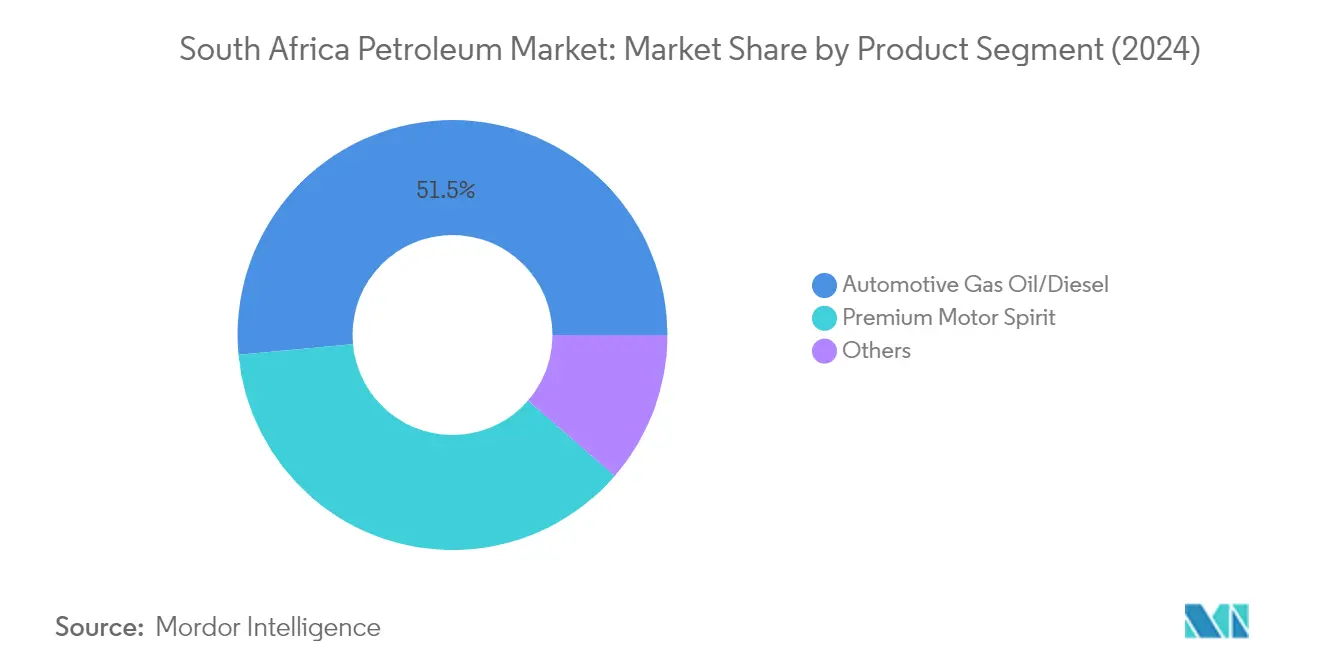
The Automotive Gas Oil (AGO)/diesel fuel segment continues to dominate the South African petroleum market, commanding approximately 50.32% market share in 2025. This substantial market position is primarily driven by the segment's crucial role in the country's transportation and power generation sectors. The segment's prominence is particularly evident in its extensive use across heavy-duty vehicles, mining operations, and agricultural machinery. Additionally, the segment has gained increased significance due to its critical role in power generation, especially as the country deals with electricity shortages. The demand is further bolstered by the growing commercial vehicle sector, with diesel fuel remaining the preferred motor fuel for trucks, buses, and mining equipment due to its higher energy density and superior torque characteristics.
Liquefied Petroleum Gas Segment in South Africa Petroleum Market
The Liquefied Petroleum Gas (LPG) segment is emerging as the most dynamic sector in the South African petroleum market, with an expected growth rate of approximately 12.48% during the forecast period 2026-2031. This remarkable growth trajectory is supported by several key factors, including the government's implementation of the Liquefied Petroleum Gas Rollout Strategy, which aims to advance the domestic industry and expand LPG applications in diversifying the energy mix. The segment's growth is further accelerated by increasing adoption in both domestic and commercial sectors as consumers seek alternatives to traditional electricity sources. The development of new import and storage terminals in Cape Town and Richards Bay has significantly improved supply infrastructure, while rising electricity costs continue to drive consumers toward LPG as a more cost-effective energy solution.
Remaining Segments in South Africa Petroleum Market
The other segments in the South African petroleum market, including Premium Motor Spirit (PMS), Illuminating Paraffin, and fuel oil, each play distinct roles in serving various economic sectors. Premium Motor Spirit remains a crucial component for personal transportation, while kerosene continues to serve essential lighting and heating needs, particularly in rural and peri-urban areas. Fuel oil maintains its significance in industrial applications, particularly in manufacturing processes and marine applications. These segments are experiencing varying levels of transformation as the market adapts to changing environmental regulations, technological advancements, and evolving consumer preferences, with each segment addressing specific needs across residential, commercial, and industrial sectors. Additionally, the market is witnessing a growing interest in petroleum derivatives and lubricants as essential petroleum byproducts that support various industrial applications.
Regulatory Landscape
South Africa regulates refined petroleum products through licensing requirements, fuel price administration processes, and oversight of midstream infrastructure. The Department of Mineral Resources and Energy (DMRE) administers petroleum products licensing under the Petroleum Products Act, including wholesale licensing via the DMRE application process (for example, a DMRE 38 wholesale licence application fee of R1,000 with an annual renewal fee of R500), which influences how manufacturing, wholesaling, and retailing participants enter and scale operations.
Economic regulation for petroleum pipelines and storage facilities falls under the National Energy Regulator of South Africa (NERSA) through the Petroleum Pipelines Act. Tariffs are reviewed via formal determinations and public consultation. In June 2026, NERSA invited public comment on Airports Company South Africa (ACSA) petroleum storage facility tariff applications for Cape Town, King Shaka, and OR Tambo international airports. In July 2026, it issued decisions for Sasol Oil (Pty) Ltd tariff applications for the Secunda storage facility and the Secunda to Natref Integrated pipeline (tariff period 1 July 2026 to 30 June 2027).
Value Chain Analysis
South Africa's refined petroleum products value chain is increasingly import-led, tied to a structural reduction in domestic refining capacity of about half. Imports supply a large share of local consumption (about 75% per the evidence pack). The chain starts with crude and refined product sourcing (international suppliers and traders), moves into import reception and storage at coastal terminals, then shifts to inland distribution via pipelines and road, before products are delivered to end users that include mining, agriculture, construction, and logistics, along with retail service-station networks operated by majors and local players (including Shell, TotalEnergies, Sasol, PetroSA, Astron Energy, and Engen).
Natref remains pivotal within the inland supply stack, with performance and ownership structure shaping product availability and price dynamics. The evidence pack points to logistics constraints as a recurring friction point, including restricted pipeline throughput from ports to inland depots and limited inland refined product storage, which increases reliance on trucking from coastal import terminals. Industry conditions also show financial and operational interdependencies around Natref, including the October 2025 business rescue filing by Prax South Africa and continued operations under Sasol management, reinforcing how terminal, storage, and transport capacity are used to manage higher import flows.
Competitive Landscape
Top Companies in South Africa Petroleum Market
The South African petroleum market is dominated by established players, including TotalEnergies, Shell PLC, Sasol Ltd, Astron Energy, PetroSA, BP PLC, and FFS Refiners. These companies have demonstrated a strong market presence through continuous product innovation, particularly in developing cleaner and more efficient refined petroleum products like low-sulfur diesel fuel and premium-grade gasoline. The industry has witnessed significant operational improvements through the modernization of refineries and storage facilities, alongside digital transformation initiatives to enhance supply chain efficiency. Strategic partnerships and collaborations have become increasingly common, particularly in infrastructure development and retail network expansion. Companies are actively investing in upgrading their facilities to meet new environmental regulations while expanding their retail footprint through service station networks and convenience stores. The market leaders have also shown commitment to sustainability through investments in cleaner fuel technologies and environmental compliance measures.
Market Structure Shows Strong Local Presence
The South African petroleum market exhibits a balanced mix of global energy conglomerates and strong local players, with domestic companies like Sasol and PetroSA maintaining significant market positions alongside international majors like TotalEnergies and Shell. The market structure is characterized by high barriers to entry due to substantial capital requirements for refinery operations and infrastructure development, leading to a relatively consolidated competitive landscape. The industry has witnessed notable merger and acquisition activities, exemplified by the Vivo Energy-Engen merger and Glencore's acquisition of Chevron's South African assets (now Astron Energy), indicating ongoing market consolidation.
Recent years have seen increased collaboration between market players, particularly in sharing infrastructure and distribution networks to optimize operational efficiency. The competitive dynamics are further shaped by the government's role in regulating fuel prices and environmental standards, which influences company strategies and market positioning. Joint ventures and strategic partnerships have become common, especially in developing storage facilities and expanding retail networks, while companies also focus on vertical integration to strengthen their market presence across the downstream petroleum value chain.
Innovation and Sustainability Drive Future Success
Success in the South African petroleum market increasingly depends on companies' ability to adapt to evolving environmental regulations and consumer preferences while maintaining operational efficiency. Market incumbents are focusing on modernizing their infrastructure, particularly in upgrading refineries to meet cleaner fuel standards and expanding storage capabilities to ensure supply security. Companies are also investing in retail network expansion and differentiation through enhanced service offerings and digital solutions, while developing stronger relationships with commercial customers through tailored product solutions and service agreements.
For new entrants and smaller players, success lies in identifying and exploiting niche market segments while building strategic partnerships to overcome infrastructure limitations. The industry's future competitive landscape will be shaped by companies' ability to navigate regulatory changes, particularly regarding environmental standards and fuel specifications. Market players must also address the growing threat of alternative energy sources by diversifying their product portfolios and investing in renewable energy solutions. The ability to maintain strong relationships with key stakeholders, including government authorities and major industrial customers, while demonstrating commitment to environmental sustainability and local economic development, will be crucial for long-term success. Additionally, the focus on petroleum derivatives will play a significant role in adapting to market demands.
South Africa Refined Petroleum Products Industry Leaders
-
ENGEN PETROLEUM LTD
-
PetroSA
-
Sasol Limited
-
TotalEnergies SE
-
Shell Plc
- *Disclaimer: Major Players sorted in no particular order
Market Opportunities and Future Outlook
Opportunities in South Africa's refined petroleum products market center on strengthening import, storage, and distribution resilience while pursuing targeted domestic processing upgrades where economics and compliance allow it. Evidence in 2026 indicates active capital allocation into storage and refinery-linked assets. Vivo Energy announced a USD 130 million investment to convert parts of the former Engen refinery in Durban into a fuel storage hub, adding 125,000 cubic meters of capacity, with a targeted completion window between Q3 2026 and Q3 2027. At the same time, Astron Energy (Glencore) committed about R6 billion to upgrade its Cape Town refinery (around 100,000 bpd), pointing to a route for improved local supply contribution alongside the import-based system.
A second opportunity involves premium and lower-carbon fuel pathways within downstream assets and a growing policy emphasis on supply security. Natref obtained ISCC PLUS certification for producing sustainable aviation fuel (SAF) and renewable diesel from renewable feedstocks, creating a base for differentiated products where offtake can be secured. Policy actions also point to near-term demand for storage and stock management capacity. The Department of Mineral and Petroleum Resources signaled prioritization of revitalizing local refining capacity and expanding strategic stocks (June 2026), and a July 2026 draft policy proposed a 60-day strategic fuel reserve requirement with SANPC positioned to manage refined product stockpiles, which supports opportunities for storage capacity expansion, stock management services, and logistics upgrades linked to mandated inventory levels.
Recent Industry Developments
- June 2026: PetroSA initiated a request for bidders to conduct an engineering assessment to extend the operational life of the FA Platform offshore Mossel Bay. This supports continuity of upstream-linked operations and creates optionality around longer-term utilization of PetroSA-linked downstream assets and supply security.
- April 2026: Sasol revised upward its full-year FY26 fuel sales volume guidance to 10% to 15% higher than FY25, citing stable Secunda production and higher Natref volumes. The update points to improved operational reliability at core supply nodes that are increasingly important as South Africa relies more heavily on a constrained domestic refining base.
- October 2025: Sasol confirmed it received notice that Prax South Africa filed for business rescue, while stating that operations at Natref remained uninterrupted. The event highlighted counterparty and asset-ownership risk around an inland refinery and reinforced the need for contingency planning across crude sourcing, product distribution, and terminal logistics.
Research Methodology Framework and Report Scope
Market Definition and Coverage
For this methodology, the market covers the sales value of refined petroleum products supplied into South Africa for end use, including volumes coming from local refining and imports that are sold in-country.
Scope exclusions: This sizing does not include crude oil, upstream activities, or the value of cross-border exports of refined products.
Segmentation Overview
- Refined Products
- Illuminating Paraffin
- Fuel Oil
- Automotive Gas Oil (AGO)/Diesel
- Premium Motor Spirit (PMS)
- Liquefied Petroleum Gas (LPG)
- Other Refined Products
Data Sources, Market Sizing, and Validation
Desk Research
Desk work started by mapping South Africa fuel supply and demand using public datasets that stay consistent year to year, and then aligning those trends with pricing signals. We typically relied on sources such as the South Africa Revenue Service trade statistics for imports and exports, the South African Reserve Bank and Statistics South Africa macro series, and public energy balance and policy documents from the Department of Mineral Resources and Energy.
To keep product coverage realistic, we cross-checked definitions and typical uses using sources such as the South African Petroleum Industry Association publications, customs tariff descriptions, and peer reviewed downstream and transport fuel studies. We also reviewed company annual reports, investor presentations, and reputable press for refinery utilization, shutdown timing, and infrastructure constraints. Where the underlying inputs were not fully available in public material, we supported targeted checks using paid subscriptions for company financials and an import/export shipment-level database. These desk sources are illustrative rather than exhaustive, and other references were used to collect data, validate patterns, and clarify open questions.
Primary Interviews and Surveys
Primary work focused on confirming what drives refined product revenue in South Africa each year, especially the split between locally produced volumes and imported finished fuels, and how pricing is passed through the value chain. We spoke with downstream participants and informed observers such as refiners and blenders, distributors, storage and logistics stakeholders, large commercial buyers, and industry specialists to sanity-check assumptions and to close gaps left by public data.
Distribution of primary research fieldwork respondents
| Company type | Respondent position |
|---|---|
| Top tier: 30% | CXOs: 15% |
| Mid tier: 55% | Functional/Unit leaders: 37% |
| Smaller Players: 15% | Managers: 48% |
Market-Sizing & Forecasting
The model starts from a top-down build where national refined product supply is reconstructed from trade flows and domestic output indicators, and then converted into value using product-level price series that reflect local pass-through. Once the country total is formed, we corroborated it with selective bottom-up checks, such as sampled volume times average realized price for key fuels and channel checks on distribution margins, and then adjusted only when the two views could be reconciled.
A few inputs mattered most in this market, including import dependence trends for diesel and gasoline, refinery operating rates and outage timing, regulated and benchmark-linked fuel price movements, the exchange rate path that affects import parity pricing, and road freight and passenger activity as demand signals. For forecasting, scenario analysis was used around supply continuity, price environment, and consumption recovery, and then the final path was chosen based on what primary respondents saw as the most likely planning case. Where company-level disclosures were incomplete, gaps were handled by using conservative coverage ratios and applying them consistently across years before totals were rechecked against macro and trade signals.
Data Validation & Update Cycle
Outputs were tested through triangulation across independent signals, including trade balances, refinery events, and implied consumption patterns, before any number was finalized. We also ran variance checks across products and years to flag outliers, and then re-opened assumptions when a move could not be explained by prices, volumes, or policy.
Each report goes through a multi-step internal review, followed by selective re-contact with sources when new information changes the picture. The study is refreshed annually, and interim updates are made when material events occur, such as major refinery outages or sharp shifts in import reliance. Before delivery, we do a final data pass so clients receive the latest updated view.
Mordor Intelligence's South Africa Refined Petroleum Products Market Sizing Compared With Other Published Estimates
Published market values for South Africa refined petroleum products can look far apart because authors do not always count the same product basket, apply the same pricing basis, or treat imports and exports consistently, and those choices quickly change the total.
Some published figures expand the coverage into wider downstream revenue pools such as retail margins, logistics services, or broader petroleum industry activity. For Mordor Intelligence, the total is limited to refined product sales value supplied into South Africa across the covered product set, and it is checked against import volumes and domestic supply signals so the number stays tied to a repeatable demand pool.
Benchmark comparison
| Source | Market Size | Gaps in Research Methodology |
|---|---|---|
| Mordor Intelligence | USD 8.40 B (2025) | |
| Global Consultancy A | USD 30.14 B (2026) | Uses a wider downstream definition that can bundle broader petroleum industry revenues and value chain services, and the base year differs, which reduces year-on-year comparability versus a refined products-only basket. |
| Industry Data Publisher B | USD 12.10 B (2025) | Often applies generalized pricing assumptions and may not fully reconcile local refinery outages and import parity movements for the year, which can push implied average prices above what trade and supply signals support. |
The spread is mainly explained by what is counted in scope and how prices are converted into revenue for the same physical fuel pool. By keeping inputs anchored to observable trade and supply signals, and by making pricing assumptions explicit year by year, we keep the result easier to audit and to reuse for planning.
Key Questions Answered in the Report
How big is the South Africa Petroleum Market?
The South Africa Petroleum Market size is expected to reach USD 8.50 billion in 2026 and grow at a CAGR of 1.22% to reach USD 9.03 billion by 2031.
What is the current South Africa Petroleum Market size?
In 2026, the South Africa Petroleum Market size is expected to reach USD 8.50 billion.
Who are the key players in South Africa Petroleum Market?
ENGEN PETROLEUM LTD, PetroSA, Sasol Limited, TotalEnergies SE and Shell Plc are the major companies operating in the South Africa Petroleum Market.
What years does this South Africa Petroleum Market cover, and what was the market size in 2025?
In 2025, the South Africa Petroleum Market size was estimated at USD 8.40 billion. The report covers the South Africa Petroleum Market historical market size for years: 2019, 2020, 2021, 2022, 2023, 2024 and 2025. The report also forecasts the South Africa Petroleum Market size for years: 2026, 2027, 2028, 2029, 2030 and 2031.