
Market Overview
| Study Period | 2020 - 2031 |
|---|---|
| Forecast Data Period | 2026 - 2031 |
| Base Year Market Size (2025) | USD 124.63 Million |
| Market Size (2026) | USD 130.93 Million |
| Market Size (2031) | USD 167.79 Million |
| Growth Rate (2026 - 2031) | 5.06 % |
| Market Concentration | Medium |
Major Players *Disclaimer: Major Players sorted in no particular order Image © Mordor Intelligence. Reuse requires attribution under CC BY 4.0. | |
South Africa Nuclear Imaging Market Analysis by Mordor Intelligence
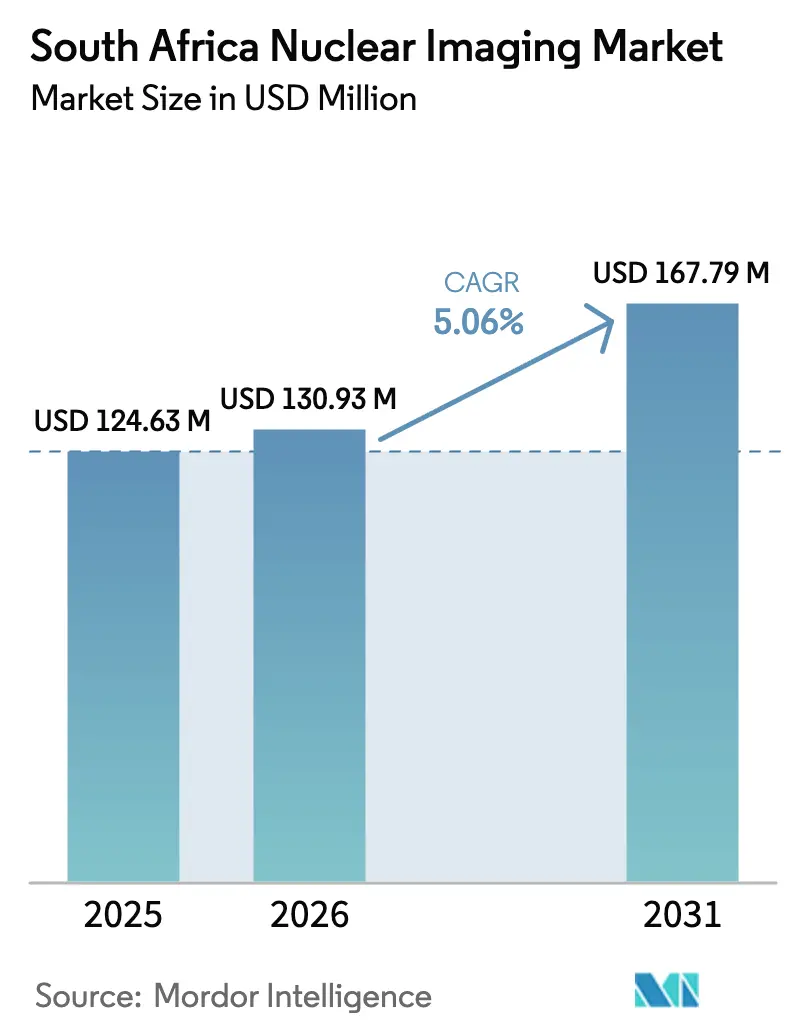
The South Africa nuclear imaging market size in 2026 is estimated at USD130.93 million, growing from 2025 value of USD124.63 million with 2031 projections showing USD167.79 million, growing at 5.06% CAGR over 2026-2031. Continued demand for PET and SPECT scans, expanding private‐sector capital expenditure, and on-going National Health Insurance (NHI) roll-out sustain the current growth tempo. Domestic radioisotope production from SAFARI-1 secures clinical scheduling while underpinning export earnings, yet the reactor’s 60-year age profile elevates supply-side risk. Hybrid imaging suites in Gauteng and Western Cape signal competitive differentiation among private hospital groups. Meanwhile, the regulatory backlog at SAHPRA prolongs product launch timelines, prompting vendors to include extended service contracts and flexible financing in bids. Baseline demand is further strengthened by rising cancer and cardiovascular disease prevalence, aligning with global shifts toward precision imaging and theranostics.
Key Report Takeaways
- By product, equipment led with 54.12% of South Africa nuclear imaging market share in 2025, Radioisotopes are projected to expand at a 5.58% CAGR through 2031.
- By application, cardiology captured 38.42% of South Africa nuclear imaging market size in 2025, Neurology applications are expected to grow at a 5.76% CAGR between 2026 and 2031.
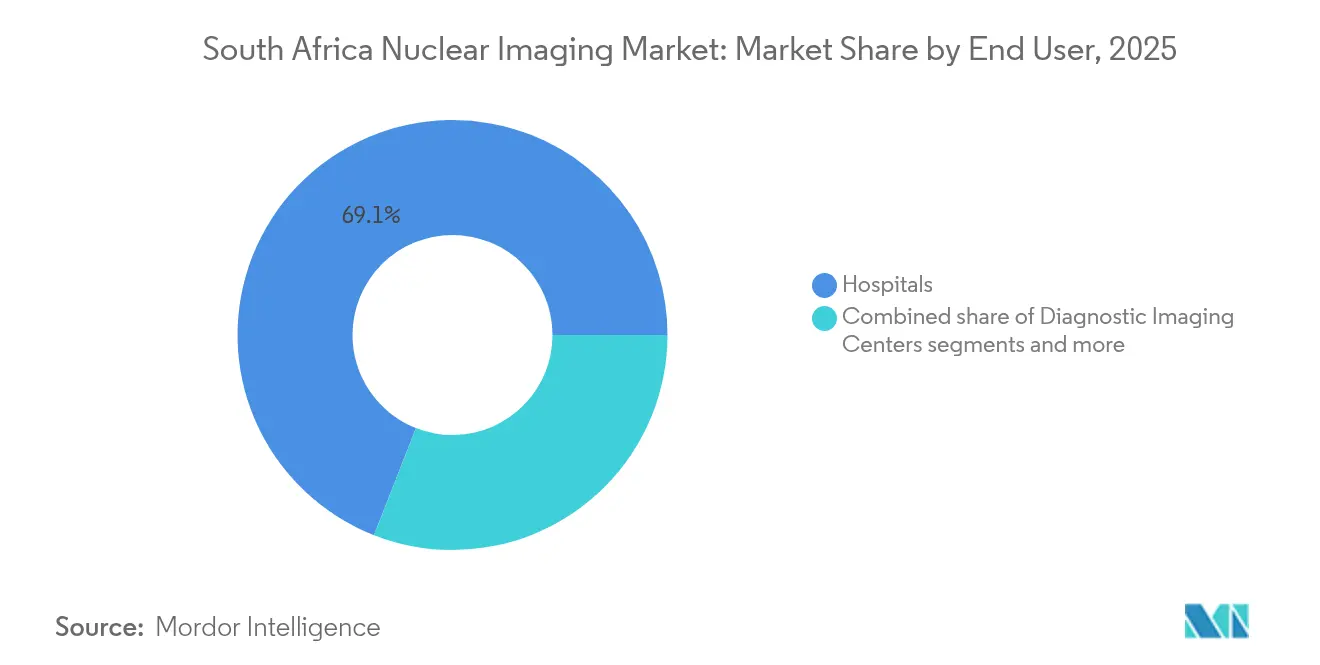
- By end user, hospitals held 69.05% revenue share in 2025, while diagnostic imaging centers register the fastest trajectory at 5.94% CAGR to 2031.
Note: Market size and forecast figures in this report are generated using Mordor Intelligence’s proprietary estimation framework, updated with the latest available data and insights as of 2026.
South Africa Nuclear Imaging Market Trends and Insights
Drivers Impact Analysis*
| Driver | (~) % Impact on CAGR Forecast | Geographic Relevance | Impact Timeline |
|---|---|---|---|
| Rising oncology & CVD incidence driving PET/SPECT demand | +1.8% | National, concentrated in Western Cape, Gauteng | Medium term (2-4 years) |
| Expanding private hospital investments in hybrid imaging suites | +1.2% | Major metropolitan areas, Western Cape, Gauteng | Short term (≤ 2 years) |
| National Health Insurance reimbursement reforms | +0.9% | National implementation, phased rollout | Long term (≥ 4 years) |
| In-country Mo-99 supply via Necsa SAFARI-1 reactor | +0.7% | National supply security, export markets | Medium term (2-4 years) |
| Growing theranostics programs at academic centers | +0.4% | Academic hospitals, Steve Biko, Tygerberg | Medium term (2-4 years) |
| Technological shift to digital detectors & AI image-reconstruction | +0.2% | Private sector early adoption, urban centers | Long term (≥ 4 years) |
| Source: Mordor Intelligence | |||
Rising Oncology & CVD Incidence Driving PET/SPECT Demand
Cancer and cardiovascular disease keep imaging volumes on an upward curve as demographic aging and lifestyle transitions converge. Higher-resolution PET studies improve staging accuracy, enabling clinicians to tailor therapy plans earlier in care pathways. The 225Ac-PSMA program at Mediclinic Panorama illustrates therapeutic innovation with minimal off-target toxicity. Domestic radioisotope supply limits price volatility, keeping scan costs stable despite currency swings. Nonetheless, payer pre-authorization processes can delay access, highlighting an administrative hurdle that tempers immediate volume conversion. Governmental plans to add new scanning hubs promise scale efficiencies that may lower procedure costs over time.
Expanding Private Hospital Investments in Hybrid Imaging Suites
Life Healthcare’s multiyear, ZAR2.1 billion allocation underscores a race toward integrated PET/CT and SPECT/CT installations. Hybrid rooms compress diagnostic timelines, allowing same-day anatomical and functional studies that feed value-based care metrics. Concentration in Gauteng and Western Cape means rural patients still travel long distances, a pattern aggravated by uneven public-sector capacity. Comparative billing studies show South African private tariffs approximate those of higher-income economies despite lower national GDP per capita, suggesting premium positioning that may narrow addressable demand. Vendors now counter affordability objections with refurbished systems and usage-based payment models that shrink capital hurdles for mid-tier facilities.
National Health Insurance Reimbursement Reforms
The NHI Act introduces strategic purchasing that could fold nuclear imaging into a USD30 billion pooled budget by 2030, broadening access beyond the 16% of citizens with private cover. Health technology assessments will determine service inclusion, placing cost-effectiveness at center stage. During the transition, private medical schemes retain authority, sustaining existing referral volumes. Dual oversight—pharmaceutical quality and radiation safety—prolongs dossier review, yet accredited private providers may secure NHI contracts to bridge early capacity gaps. Successful integration hinges on robust fraud controls and clear reimbursement coding to safeguard budget integrity.
In-Country Mo-99 Supply via Necsa SAFARI-1 Reactor
SAFARI-1 contributes roughly 20% of global Mo-99, anchoring a regional export franchise while meeting domestic diagnostic demand. Cabinet approval of a ZAR1.2 billion multipurpose successor reactor secures future output, though construction timelines invite interim disruption risk. Rosatom’s planned small reactors and cyclotrons diversify isotope sources and hedge against unplanned outages. NTP Radioisotopes holds a 90% domestic share, providing scale advantages but concentrating supply risk. Conversion to low-enriched uranium keeps the facility compliant with global non-proliferation standards.
Restraints Impact Analysis*
| Restraint | (~) % Impact on CAGR Forecast | Geographic Relevance | Impact Timeline |
|---|---|---|---|
| High capital & lifecycle costs of PET/SPECT equipment | -1.4% | National, more pronounced in rural areas | Short term (≤ 2 years) |
| Shortage of nuclear medicine specialists & technologists | -0.8% | National, severe in public sector | Medium term (2-4 years) |
| Ageing SAFARI-1 reactor creating future isotope-supply risk | -0.6% | National supply chain, export markets | Long term (≥ 4 years) |
| SAHPRA approval delays for new radiopharmaceuticals | -0.4% | National regulatory bottleneck | Medium term (2-4 years) |
| Source: Mordor Intelligence | |||
High Capital & Lifecycle Costs of PET/SPECT Equipment
Purchase prices for state-of-the-art PET/CT scanners can exceed USD2 million, straining public budgets. Maintenance and calibration add recurring expenses that often outpace CPI inflation, particularly when imported parts require hard-currency outlays. Private facilities pass costs to patients, yielding tariffs comparable with OECD averages despite South Africa’s lower income baseline. Refurbished systems offer savings but raise questions about warranty coverage and detector longevity. Leasing and pay-per-scan contracts help first-time entrants, yet these models remain underused in public procurement.
Shortage of Nuclear Medicine Specialists & Technologists
Only 26.8% of imaging centers employ the required complement of medical physicists, causing scheduling bottlenecks and quality-assurance gaps30198-3/abstract). Training pipelines output fewer than 15 new physicists annually, insufficient to meet incremental equipment installations. The diagnostic radiology workforce has diversified demographically, yet absolute numbers lag population norms. Private-sector internships could absorb surplus graduates from related physics disciplines, but stipend funding remains inconsistent. International recruitment supplies a short-term stopgap but risks brain-drain critiques.
*Our forecasts treat driver/restraint impacts as directional, not additive. The impact forecasts reflect baseline growth, mix effects, and variable interactions.
Segment Analysis
By Product: Equipment Remains Foundational While Radioisotopes Accelerate
Equipment held 54.12% South Africa nuclear imaging market share in 2025, with PET/CT upgrades accounting for the largest capital spending tranche. The South Africa nuclear imaging market size tied to equipment is projected to expand steadily as private groups refresh analog fleets and public tenders catch up to digital standards. Radioisotopes, however, post the faster 5.58% CAGR, buoyed by theranostics demand and domestic Mo-99 production security.
SPECT tracers such as Technetium-99m dominate volume, leveraging SAFARI-1’s weekly output. PET tracers led by Fluorine-18 underpin oncology and neurology protocols, while Gallium-68 enables PSMA imaging. ASP Isotopes’ enrichment of Ytterbium-176 positions the nation to support Lutetium-177 therapy production, further tilting momentum toward therapeutic isotopes. Vendors improve system uptime with AI-driven predictive maintenance, reducing unscheduled downtime that historically plagued public installations.


By Application: Cardiology Anchors Volume, Neurology Captures Growth
Cardiology led with 38.42% South Africa nuclear imaging market size in 2025 as SPECT myocardial perfusion imaging (MPI) remained standard for ischemia evaluation. Neurology, though smaller, outpaces other segments with a 5.76% CAGR on the back of dementia screening programs and FDG-PET uptake.
The South Africa nuclear imaging market share for neurology will likely increase as third-generation tracers for amyloid and tau receive approvals. Oncology benefits from dual imaging-therapy workflows where PSMA scans guide alpha- or beta-emitter treatments, closing feedback loops within a single care episode. Thyroid imaging maintains steady demand, supported by standard iodine protocols that require minimal capital investment. Cross-disciplinary protocols, such as infection imaging with labeled white blood cells, keep the other-applications bucket relevant, though absolute volumes remain modest.
By End User: Hospitals Dominate While Imaging Centers Gain Speed
Hospitals controlled 69.05% of total examinations in 2025, reflecting their integrated service footprints and ready access to surgical and oncology suites. Diagnostic centers, however, enjoy a 5.94% CAGR as entrepreneurs leverage flexible hours and suburban locations to attract insured walk-ins. Private providers integrate PACS and cloud reporting, shortening turnaround and winning referrals from busy cardiology clinics.
The South Africa nuclear imaging market size sourced from academic institutes remains smaller but strategic; these sites handle high-complexity theranostics and spearhead clinical trials. NHI purchasing could reallocate volumes once accreditation frameworks mature, shifting some activity from private hospitals to contracted independent centers. All end-user categories grapple with SAHPRA compliance, and most pursue ISO 9001 or ISO 13485 certification to streamline audits.
Geography Analysis
Western Cape and Gauteng account for well over half of national equipment installations, propelled by higher private-insurance penetration and proximity to academic hubs. Gauteng hosts the NuMeRI facility and the Steve Biko Academic Hospital, reinforcing its status as a translational research nexus. Western Cape benefits from Tygerberg’s protocol innovation and Mediclinic’s aggressive suite roll-outs.
KwaZulu-Natal and Eastern Cape trail in scanner density, creating outbound patient flows to metropolitan centers. Limpopo’s workforce growth accelerates from a low base, signaling potential for future site expansion once NHI reimbursements stabilize. Free State and Northern Cape rely on mobile outreach and tele-consulting, methods that partially offset travel distances.
Internationally, South Africa functions as a continental nuclear medicine anchor, supplying over 40 African hospitals with Mo-99 derivatives. The African Association of Radiopharmacy, co-chaired by South African experts, underlines leadership in professional standards. This role attracts technology transfers and training grants that may ease provincial inequities over the forecast horizon.
Regulatory Landscape
South Africa’s nuclear imaging oversight is split between device quality and radiation safety. The South African Health Products Regulatory Authority (SAHPRA) operates as the central regulator through multiple units, including Radiation Control. Under the Hazardous Substances Act (Act 15 of 1973), SAHPRA’s Radiation Control Unit requires import and use licensing for ionising-radiation equipment used in nuclear medicine, including gamma cameras, SPECT, and PET systems, alongside compliance checks and inspectorate functions for radionuclides at licensed facilities.
Alongside this, the Medicines and Related Substances Act (Act 101 of 1965) anchors medical device establishment licensing and quality system expectations. Establishments involved in supplying and servicing nuclear imaging equipment must hold a SAHPRA licence and typically demonstrate ISO 13485-aligned quality management. At the facility level, governance also depends on trained Radiation Protection Officers registered with the Health Professions Council of South Africa (HPCSA), linking clinical operations, safety programs, and audit readiness.
Value Chain Analysis
The South Africa nuclear imaging value chain starts with radiopharmaceutical and isotope production and distribution, then moves into imported equipment procurement, installation, and lifecycle service. Upstream, South Africa operates as a regional nuclear medicine hub, supported by a reported installed base of 83 cameras (including 18 PET scanners) and domestic radiopharmaceutical supply capabilities that feed hospital and imaging-center demand. Distribution and cold-chain logistics, dispensing, and on-site radiopharmacy operations connect production to point-of-care dosing.
Midstream and downstream, the equipment layer is heavily import-dependent. Major nuclear imaging systems and critical components are largely sourced from international OEM supply chains, including the United States and Germany, with local service organizations handling maintenance, calibration, and uptime management. Sector enablers include the Department of Trade, Industry and Competition (DTIC) and the Council for Scientific and Industrial Research (CSIR). Industry coordination and standards engagement are reinforced through associations such as SAMED and the Medical Device Manufacturers of South Africa (MDMSA), which shape localization agendas, supplier development, and quality compliance pathways.
Competitive Landscape
Global OEMs—GE HealthCare, Siemens Healthineers, Philips—compete fiercely for replacement cycles, bundling service, AI modules, and financing to entice hospital groups. GE HealthCare’s acquisition of Nihon Medi-Physics expands its radiopharmaceutical line-up and could reshape tracer availability and pricing locally.
On the isotope front, NTP Radioisotopes wields scale economics while ASP Isotopes enters with niche enriched products, adding supply diversity. Smaller cyclotron operators offer F-18 FDG regionally but lack nationwide distribution. Clinical service competition centers on patient experience; providers differentiate with shorter wait times, AI-enhanced reporting, and bundled oncology pathways.
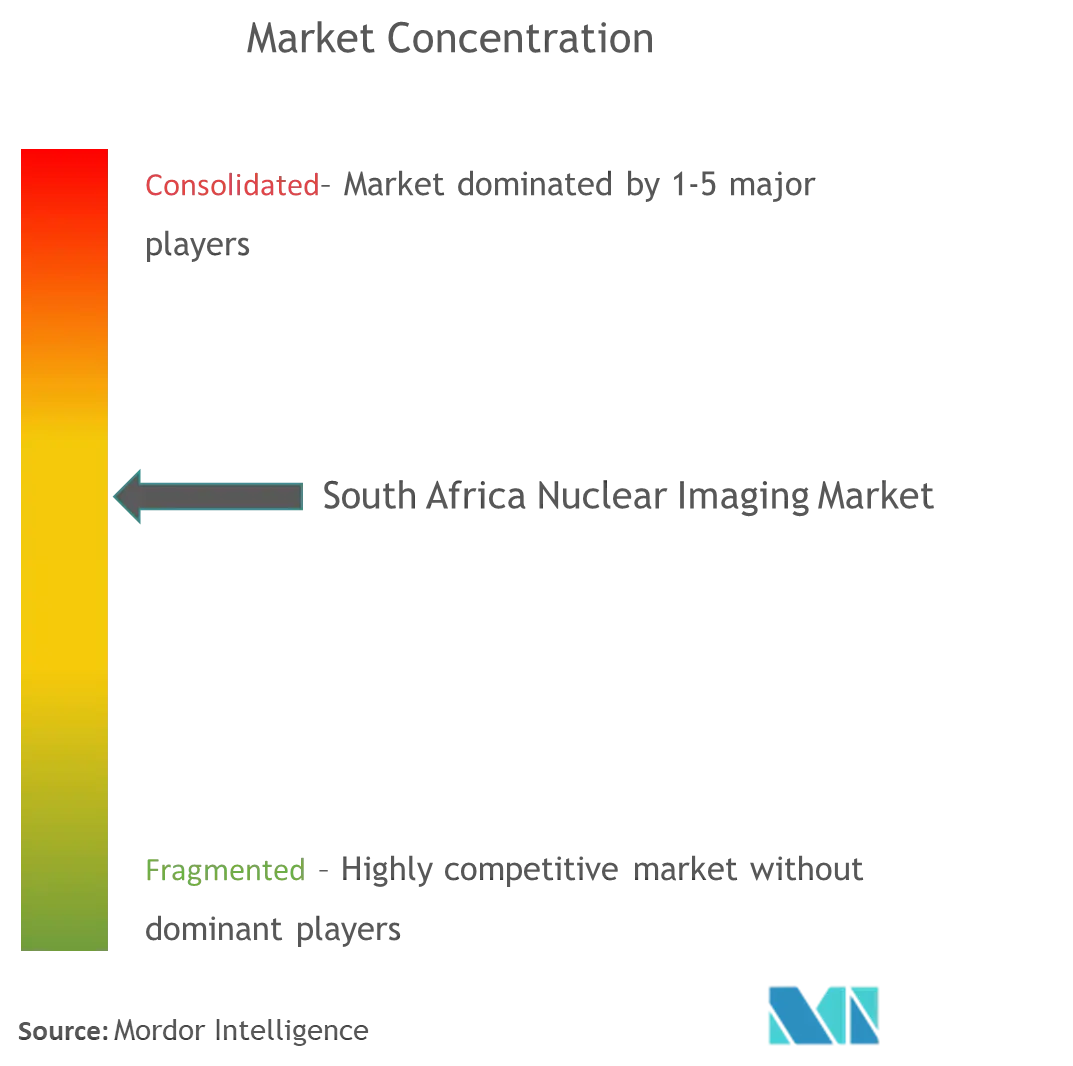
Moderate market concentration persists because high fixed costs deter new entrants, yet no single player exceeds 25% of service volumes. Workforce limitations act as a protective moat for incumbents but also cap total market throughput. OEM after-sales networks influence tender awards, as hospitals favor suppliers with local engineer pools capable of sub-4-hour response times.
South Africa Nuclear Imaging Industry Leaders
-
Bracco Imaging Spa
-
GE Healthcare
-
Siemens AG
-
Koninklijke Philips N.V.
-
Canon Medical Systems
- *Disclaimer: Major Players sorted in no particular order
Market Opportunities and Future Outlook
Public-sector capacity gaps and uneven provincial access create whitespace for nuclear imaging deployment beyond the existing metro-heavy footprint, especially for PET scanning in state facilities where diagnostic imaging infrastructure is described as underdeveloped. Market activity is also reflecting alternative procurement approaches that reduce upfront capital barriers. This is illustrated by the January 2025 commissioning of a pay-per-use PET-CT scanner at the Precision Nuclear Oncology and Theranostics facility in Rustenburg (North West Province) under an Equipment-as-a-Service model, which extends access for nearby provinces and cross-border patients.
On the supply side, South Africa’s position as the primary regional supplier of 99Mo/99mTc generators to a large share of English-speaking African countries supports opportunities in regional distribution, reliability-focused contracts, and radiopharmacy network expansion backed by local production and quality systems. The South African Medical Devices Masterplan (2024) and prior landscape assessments point to low levels of local manufacturing (about 10% in consumables), leaving room for localization of selected consumables, shielding, QA tools, and service-intensive subsystems. This also ties into workforce-aligned training and servicing capabilities that can reduce import reliance and improve equipment uptime economics for hospitals and diagnostic imaging centers.
Recent Industry Developments
- May 2026: NECSA and Sibanye-Stillwater partner to advance nuclear medicine development (radiopharmaceuticals) in South Africa. The collaboration expands domestic radiopharmaceutical development capacity and strengthens the local isotope supply chain for medical applications. It supports potential improvements in local PET radiopharmaceutical availability and pricing by accelerating in country capabilities.
- April 2026: NECSA and Sibanye-Stillwater announce collaboration to develop Palladium-103 brachytherapy radiopharmaceuticals. The partnership advances the targeted radionuclide therapy pipeline in SA and broadens theTheranostics landscape. Vertical integration of isotope production with clinical therapies strengthens South Africa's capability in theranostics and improves treatment options for patients.
- March 2026: Life Healthcare / GE HealthCare launches a digital PET-CT scanner at Life Vincent Pallotti Hospital in Cape Town in collaboration with GE HealthCare. The rollout expands hybrid imaging capacity in private South African hospitals and demonstrates rapid adoption of advanced imaging modalities. The collaboration positions Life Healthcare with differentiated imaging offerings and enhances patient throughput.
Research Methodology Framework and Report Scope
Market Definition and Coverage
For this report, the market covers spending generated in South Africa from nuclear imaging procedures and the enabling products used to deliver them, covering both routine and specialized clinical settings. It includes nuclear imaging systems and the radioisotopes consumed to run PET and SPECT imaging workflows.
Scope exclusions: Non-nuclear modalities such as CT, MRI, ultrasound, and X-ray are excluded, even when they are used alongside nuclear imaging in the same patient pathway.
Segmentation Overview
- By Product
- Equipment
- Radioisotope
- SPECT Radioisotopes
- Technetium-99m (TC-99m)
- Thallium-201 (TI-201)
- Gallium (Ga-67)
- Iodine (I-123)
- Other SPECT Radioisotopes
- PET Radioisotopes
- Fluorine-18 (F-18)
- Rubidium-82 (RB-82)
- Other PET Radioisotopes
- SPECT Radioisotopes
- By Application
- Cardiology
- Neurology
- Thyroid
- Oncology
- Other Applications
- By End User (Value)
- Hospitals
- Diagnostic Imaging Centres
- Academic & Research Institutes
Data Sources, Market Sizing, and Validation
Desk Research
Desk work started with building a fact base around disease burden and procedure demand signals that can translate into imaging volumes and isotope consumption in South Africa. Public sources such as Statistics South Africa, the National Department of Health, the World Health Organization, and the International Atomic Energy Agency were used to understand population, care delivery capacity, and nuclear medicine footprint trends.
We also reviewed items that typically influence nuclear imaging spend, such as communications from the South African Health Products Regulatory Authority, tariff and coding references used by payers and facilities, and, where relevant, import-export indicators for isotopes and components. To cross-check company presence and product exposure, we used annual reports, investor presentations, and reputed press coverage, and we selectively referenced paid subscriptions for company financials, shipment-level trade checks, and patent databases to confirm ongoing product activity. These desk sources are illustrative only, and many other public documents and data points were also consulted to collect, validate, and clarify assumptions.
Primary Interviews and Surveys
Primary work focused on confirming what drives spend locally, including modality mix across facilities, typical utilization patterns, and how frequently isotopes are procured and used across key clinical applications. We spoke with a balanced mix of stakeholders, such as hospital administrators, heads of imaging, nuclear medicine physicians, radiopharmacy staff, and local distributors, so gaps from desk findings could be closed and assumptions stress-tested.
Because this is a country-wide scope, coverage was intentionally spread across major urban provinces and referral corridors, and then checked against how public and private care are delivered before finalizing the model.
Distribution of primary research fieldwork respondents
| Company type | Respondent position |
|---|---|
| Top tier: 35% | CXOs: 16% |
| Mid tier: 46% | Functional/Unit leaders: 34% |
| Smaller Players: 19% | Managers: 50% |
Market-Sizing & Forecasting
Sizing started from a top-down demand pool build, where procedure volumes for PET and SPECT were reconstructed using facility capacity signals, installed base direction, and practical utilization ranges shared in interviews, and then translated into spend using typical per-scan and per-dose value markers. To keep totals realistic, we corroborated results with selective bottom-up approximations, including sampled system ASP ranges for new placements and replacement cycles, and isotope consumption checks using dose frequency and the PET versus SPECT modality mix.
Key model inputs included the split of PET versus SPECT usage, installed base and replacement timing for nuclear imaging systems, radioisotope usage patterns by application (for example, oncology versus cardiology), local supply reliability signals tied to radiopharmacy availability, and currency timing for imported equipment pricing. Where direct data was patchy, we used bounded ranges and then narrowed them through repeated interview checks, so outliers did not pull the total.
Forecasting relied mainly on scenario analysis, anchored on expected procedure growth, reasonable price progression assumptions, and feasible capacity additions, followed by a conservative adjustment when constraints like staffing and scanner downtime were flagged by respondents. The final forecast series was kept traceable so each year can be explained through a small set of variables.
Data Validation & Update Cycle
Outputs were validated through triangulation across independent signals, such as procedure trend direction, installed base movement, and procurement behavior for isotopes and equipment. When a line item looked inconsistent, we rechecked unit assumptions, recalculated the implied utilization, and then revisited respondents to confirm whether the variance reflected a real market nuance or a modeling error.
Before sign-off, the model goes through a multi-step analyst review where definitions, arithmetic, and implied ratios are challenged, and then revised where needed. Reports are refreshed annually, with interim updates triggered when material events occur, such as policy shifts, supply disruptions, or large procurement announcements, followed by a final pre-delivery pass so clients receive the latest updated view.
Mordor Intelligence's South Africa Nuclear Imaging Market Size Versus Other Published Estimates
Published market values for this space can vary more than expected because firms do not always count the same items, and they do not always apply the same year and currency timing. Differences also show up when one estimate leans more toward equipment revenues, while another includes ongoing consumables and scan activity.
PET and SPECT radioisotopes sit inside Mordor Intelligence's scope, which is why this market value can differ from equipment-only writeups or broader diagnostic imaging totals that bundle in non-nuclear modalities.
Benchmark comparison
| Source | Market Size | Gaps in Research Methodology |
|---|---|---|
| Mordor Intelligence | USD 130.93 M (2026) | |
| Trade Analytics Brief A | USD 98.00 M (2026) | Often modeled as nuclear imaging equipment revenues only, which can undercount recurring radioisotope spend and the ongoing scan-driven demand that continues even when equipment purchasing slows. |
| Regional Healthcare Outlook B | USD 155.00 M (2026) | Commonly extends scope into adjacent diagnostic imaging revenue pools or applies higher utilization and price progression assumptions without enough checks against local capacity constraints and practical scan throughput. |
Across the three figures, the spread mainly comes from whether the estimate captures consumable isotope demand in addition to equipment, and how tightly utilization and pricing are tied back to realistic site capacity. Our approach keeps the total explainable through a small set of variables, and the same steps can be repeated each year as new public signals and interview feedback become available.
Key Questions Answered in the Report
What is the current value of the South Africa nuclear imaging market?
The market is valued at USD130.93 million in 2026 and is forecast to reach USD167.79 million by 2031.
How fast is demand for radioisotopes growing?
Radioisotopes are projected to expand at a 5.58% CAGR through 2031, outpacing equipment growth.
Which application segment is expanding the quickest?
Neurology is advancing at a 5.76% CAGR owing to increased PET adoption for dementia diagnosis.
Why is SAFARI-1 important to imaging services?
The reactor supplies about 20% of global Mo-99, guaranteeing tracer availability for local scans and exports.
How will National Health Insurance affect imaging access?
NHI strategic purchasing could finance nuclear imaging for uninsured citizens, potentially increasing scan volumes nationwide.