
Market Overview
| Study Period | 2021 - 2031 |
|---|---|
| Forecast Data Period | 2026 - 2031 |
| Base Year Market Size (2025) | USD 1.02 Billion |
| Market Size (2026) | USD 1.07 Billion |
| Market Size (2031) | USD 1.39 Billion |
| Growth Rate (2026 - 2031) | 5.38 % |
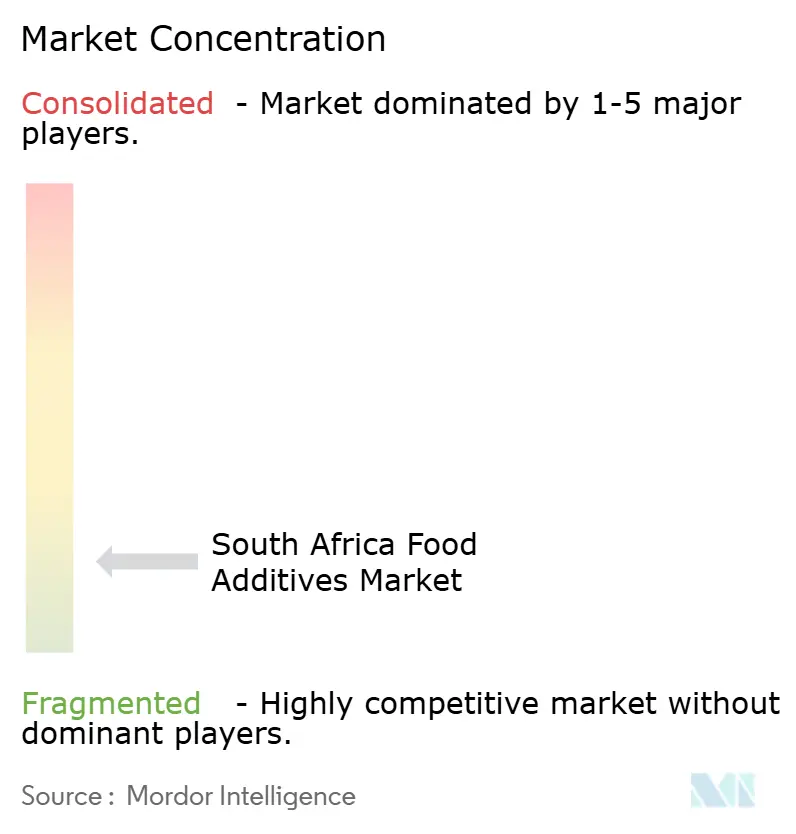
| Market Concentration | Low |
Major Players *Disclaimer: Major Players sorted in no particular order Image © Mordor Intelligence. Reuse requires attribution under CC BY 4.0. | |
South Africa Food Additives Market Analysis by Mordor Intelligence
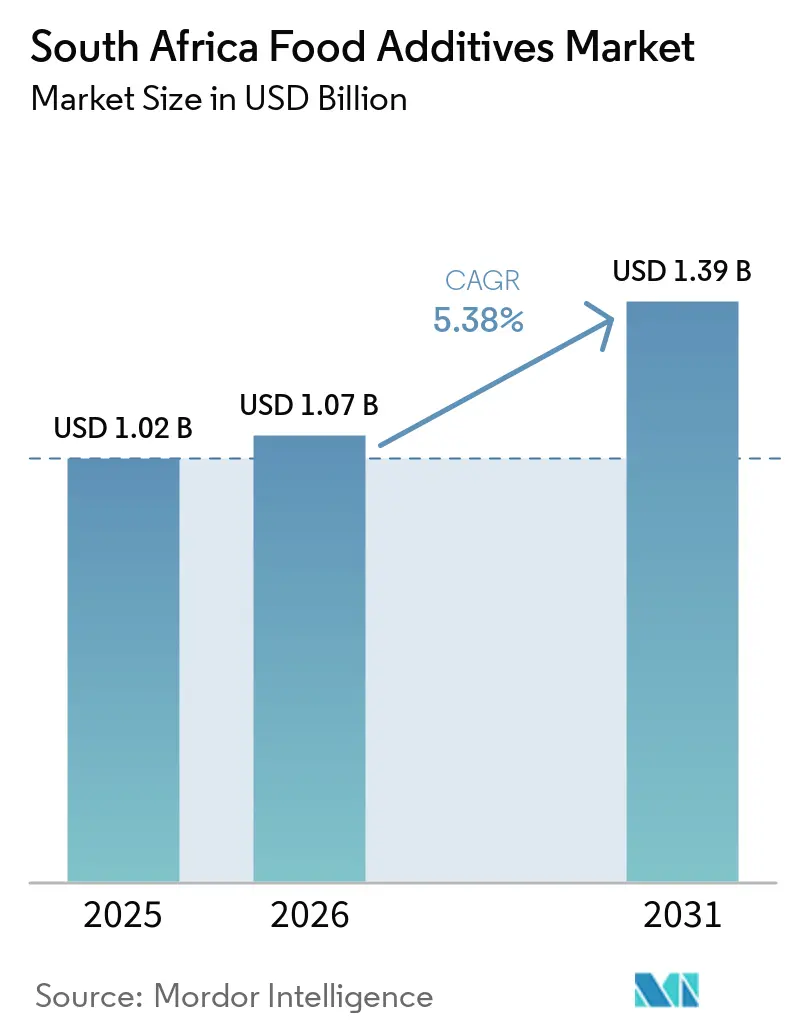
The South African food additives market size was valued at USD 1.02 billion in 2025 and estimated to grow from USD 1.07 billion in 2026 to reach USD 1.39 billion by 2031, at a CAGR of 5.38% during the forecast period (2026-2031). Food processing is an important base for the South African food additives market because the sector generated ZAR 131 billion in gross value added in 2023 and remained a major manufacturing activity[1]. It serves a broad packaged-food base across bakery, beverages, cereals, dairy, convenience foods, meat products, and retail private-label lines, with each category relying on specialized formulation, preservation, flavor, color, and texture inputs throughout production and distribution. Manufacturers in Gauteng and KwaZulu-Natal also serve regional export routes, including routes to Zimbabwe, Mozambique, and Zambia, which extends ingredient demand beyond domestic consumption. Health Promotion Levy reformulation is changing sweetener purchasing and has made texture, moisture, and taste management more important for manufacturers. The South African food additives market is also shaped by mandatory flour and maize meal fortification, a continuing requirement that supports demand for vitamin and mineral premixes. Import dependence and more demanding documentation remain practical constraints for buyers and suppliers.
Key Report Takeaways
- By product type, Bulk Sweeteners led the South African food additives market with a 54.23% share in 2025, while Food Colorants are projected to grow at the fastest CAGR of 6.61% during 2026-2031.
- By form, Dry additives held a 64.64% share of the South African food additives market in 2025, while Liquid additives are forecast to expand at a 6.06% CAGR through 2031.
- By source, Synthetic additives accounted for a 68.63% share of the South African food additives market in 2025, while Natural additives are projected to register the fastest CAGR of 6.49% during 2026-2031.
- By application, Bakery and Confectionery retained 32.75% of the South African food additives market in 2025, whereas Dairy and Desserts are forecast to expand at a 6.35% CAGR through 2031.
Note: Market size and forecast figures in this report are generated using Mordor Intelligence’s proprietary estimation framework, updated with the latest available data and insights as of January 2026.
South Africa Food Additives Market Trends and Insights
Drivers Impact Analysis*
| Driver | (~) % Impact on CAGR Forecast | Geographic Relevance | Impact Timeline |
|---|---|---|---|
| Expansion of Processed and Convenience Food Manufacturing | +1.2% | Gauteng, KwaZulu-Natal, Western Cape | Short term (≤ 2 years) |
| Health Promotion Levy Driving Sugar-to-Sweetener Reformulation | +0.9% | National, with early gains in Gauteng and Western Cape | Short term (≤ 2 years) |
| Growth of Shelf-Life Extension Requirements | +0.8% | National, amplified across inland provinces | Medium term (2-4 years) |
| Rising Demand for Natural, Clean-Label, and Functional Additives | +0.8% | Gauteng and Western Cape premium retail corridors | Medium term (2-4 years) |
| Increasing Adoption of Functional and Fortified Foods | +0.6% | National, concentrated in urban centres | Medium term (2-4 years) |
| Expansion of Beverage Flavor Innovation | +0.4% | Gauteng, KwaZulu-Natal, Western Cape | Short-to-medium term (1-3 years) |
| Source: Mordor Intelligence | |||
Expansion of Processed and Convenience Food Manufacturing
South Africa's food processing sector reported wholesale trade sales of ZAR 132.4 billion in food, beverages, and tobacco in Q2 2025, a 6.4% year-on-year increase, while food production capacity utilization reached 83.1%, signaling a market operating near full throughput and compelling procurement of throughput-enabling ingredients such as emulsifiers, enzymes, and preservatives (Department of Agriculture, Q2 2025 Quarterly Economic Review)[1]. Stats SA's manufacturing production data for October 2025 confirmed the food and beverages division grew 1.9% year-on-year, contributing 0.7 percentage points to overall manufacturing output growth, the most consistent positive contributor across the sector. South Africa also serves as a regional manufacturing platform: food processing exports reached ZAR 85 billion in 2023, with 63% directed to other African markets (TIPS, 2025), meaning ingredient demand from Johannesburg-based production facilities effectively addresses SADC's broader consumer market of over 350 million people. A critical but underweighted insight is that ingredient innovation commercially validated in Gauteng facilities has an amplified addressable market relative to the country's domestic GDP scale, making South Africa the most leveraged entry point for additive suppliers targeting sub-Saharan growth.
Health Promotion Levy Driving Sugar-to-Sweetener Reformulation
South Africa's HPL operates at ZAR 2.1 cents per gram of sugar content exceeding 4 grams per 100 ml and, according to a 2025 peer-reviewed UNU-WIDER working paper drawing on SARS excise return data, caused a 33% reduction in sugar consumption through taxable beverages within two years, while non-taxable SSB consumption rose 15% as manufacturers shifted formulations below the tax threshold[3]. High-intensity sweeteners, including stevia glycosides, sucralose, and aspartame, have shifted from aspirational to operationally essential for beverage producers at the national scale. A second-order dynamic that is commercially underappreciated is the cascade into bakery: producers adjusting sugar-reduced lines simultaneously procure functional bulking agents and humectants to maintain texture and moisture retention, generating compound demand across two distinct additive sub-categories. The South African Revenue Service (SARS) has intensified compliance scrutiny of manufacturers and importers under the HPL regime (Shepstone & Wylie, 2025), with the National Treasury actively considering extending the levy to fruit juices, a development that would bring another beverage sub-segment into large-scale reformulation.
Rising Demand For Natural, Clean-Label, And Functional Additives
Retail requirements are increasing interest in traceable, simpler ingredient systems across the South African food additives market. Shoprite’s Simple Truth range had 287 products across 49 categories in 2025, and it excludes artificial colors, flavors, and sweeteners. This gives manufacturers a visible commercial reason to review color, flavor, and sweetening choices. SAAFoST identified the shelf life of fortified whole-grain products and plant-based food innovation as technical priorities for its 2025 program. Those priorities support demand for preservation, fortification, and plant-based formulation ingredients. Suppliers with complete specifications and consistent traceability are better placed to support private-label programs.
Increasing Adoption of Functional and Fortified Foods
South Africa's mandatory fortification framework, requiring commercial maize meal and wheat flour to be enriched with six vitamins and minerals under Regulations R504 of 2003 and R1206 of 2008 (Department of Health), creates a non-discretionary base demand for fortification premix additives that few regional markets replicate at a comparable scale. The Department of Health's actively maintained Registered Fortification Mix Manufacturers list, updated as recently as May 2026, signals sustained regulatory investment in this ingredient segment. Beyond compliance demand, consumer uptake of functional food formats is accelerating: published research from BIO Web of Conferences (September 2025) on protein- and probiotic-fortified sorghum-based foods developed for Southern African communities demonstrates an active academic-to-commercial translation pipeline feeding the fortified food ingredient market. South Africa's millennial and Gen Z urban consumers, who read ingredient labels at materially higher rates than prior generations, are driving the premiumization of functional formats, including probiotic yogurts, high-protein snacks, and gut-health beverages.
Restraints Impact Analysis*
| Restraint | (~) % Impact on CAGR Forecast | Geographic Relevance | Impact Timeline |
|---|---|---|---|
| Negative Consumer Perceptions of Synthetic Additives | -0.5% | Gauteng, Western Cape (urban, high-literacy consumer concentrations) | Medium term (2-4 years) |
| Complex Food-Safety Approval and Labeling Requirements | -0.4% | National | Short term (≤ 2 years) |
| Dependence on International Additive Suppliers | -0.6% | National, amplified in rand-volatile and inland supply route conditions | Long term (≥ 4 years) |
| Higher Cost of Natural and Clean-Label Alternatives | -0.4% | National, most acute in price-sensitive informal retail and secondary cities | Medium term (2-4 years) |
| Source: Mordor Intelligence | |||
Complex Food-Safety Approval and Labeling Requirements
South Africa's food safety governance spans three primary agencies, the Department of Health's Food Control Division, the Department of Agriculture (DoA), and the Border Management Authority (BMA), operating under the Foodstuffs, Cosmetics and Disinfectants Act, 1972 (Act 54 of 1972), with coordination limitations that the USDA's 2025 FAIRS Country Report notes can produce inconsistent enforcement outcomes at ports of entry. In the absence of a dedicated food additive law, manufacturers or importers seeking to use an additive not on South Africa's positive list or outside Codex Alimentarius coverage must petition DoH directly with a full safety dossier, a process that can delay reformulation timelines by 12 to 18 months, disproportionately impacting smaller manufacturers with limited regulatory affairs capacity. Regulation R3287 of 2023 on the labeling and advertising of foodstuffs adds compositional disclosure, allergen declaration, and GMO labeling requirements as multilayered obligations, legally distinct from the additive use regulations, compounding the overall compliance burden. The FCD Act was further updated in February 2026 with Regulations on Maximum Levels of Mycotoxins in Foodstuffs (effective February 2028), illustrating a legislative cadence that continues to expand documentation requirements for food processors operating in South Africa.
Dependence on International Additive Suppliers
South Africa's specialty additive imports, modified starches, food enzymes, natural flavours, hydrocolloids, emulsifiers, and nutritional premixes, are sourced predominantly from China (21.7% of total food imports by origin), the United States (7.5%), Germany (7.4%), and India (6.8%), according to the Department of Agriculture's Q2 2025 Quarterly Economic Review, with none manufactured domestically at commercial scale. The country's 2024 mid-summer drought reduced local soybean production by 35% and drove agricultural import volumes sharply higher, a disruption pattern that cascades into raw material shortages for processed foods within 6 to 9 months (USDA 2025 FAIRS Country Report for South Africa). South African food-ingredient imports in the food preparations and specialty ingredient category reached USD 480 million in 2024 (Food Ingredients South Africa, 2025), and continued rand depreciation translates directly into landed-cost inflation for additive purchasers without local sourcing alternatives. The structural underdevelopment of domestic additive manufacturing relative to consumption scale is a strategic vulnerability that no operating global ingredient company has yet materially addressed through local production investment in South Africa.
*Our forecasts treat driver/restraint impacts as directional, not additive. The impact forecasts reflect baseline growth, mix effects, and variable interactions.
Segment Analysis
By Product Type: Bulk Sweeteners Hold the Largest Position While Colorants Grow Fastest
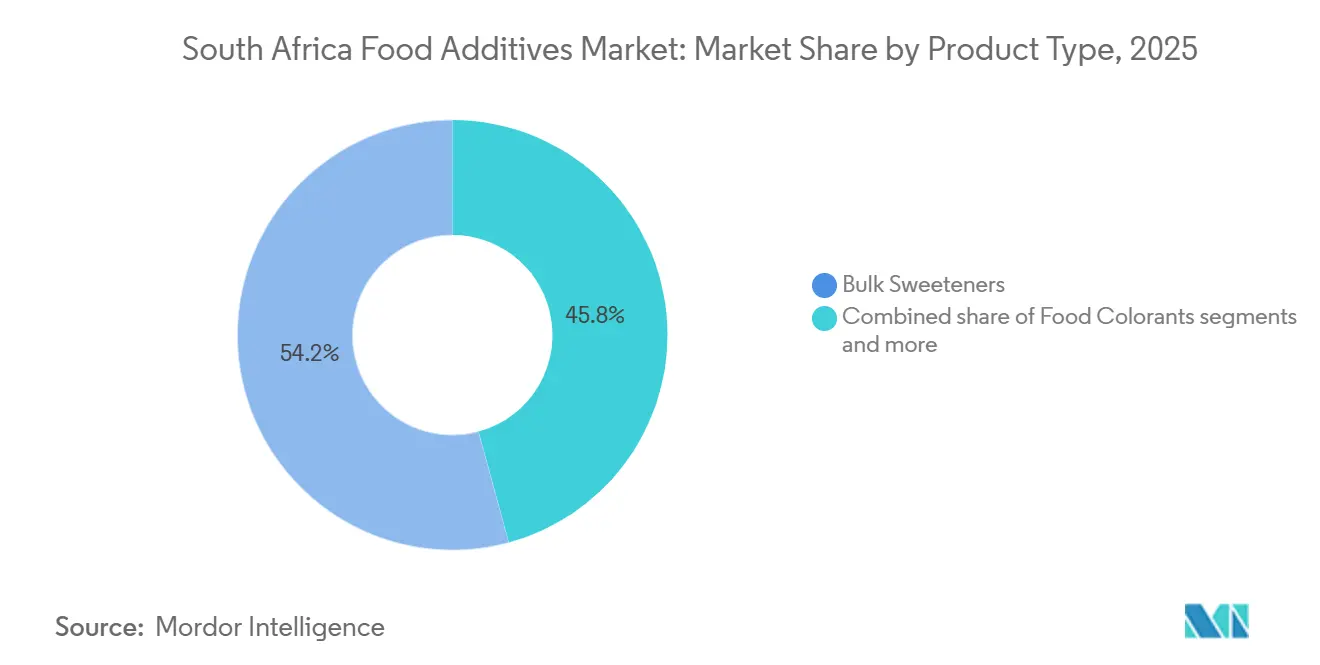
Bulk Sweeteners held 54.23% of the South African food additives market share in 2025. Their scale reflects use in soft drinks, breakfast cereals, and baked goods. The Health Promotion Levy has not removed the need for sweetness in packaged foods. Instead, it has encouraged manufacturers to use a mix of bulk and high-intensity sweetening systems. High-intensity options such as stevia glycosides, sucralose, and aspartame can support lower-sugar formulations. Preservatives also remain important because long ambient distribution routes require dependable product stability. Enzymes support bread softness and dairy fermentation. Hydrocolloids are used where processed meat and dairy manufacturers need texture control.
Food Colorants are forecast to grow at 6.61% CAGR during 2026-2031, the fastest rate among product types. Natural botanical pigments can support product launches positioned around simpler ingredient declarations. Color selection increasingly has to meet visual, stability, and documentation requirements simultaneously. This creates a broader supplier role that can include application testing, stability advice, and records supporting customer specifications. The choice of colorant can affect shelf appeal, processing compatibility, and consistency across batches. Acidulants and anti-caking agents serve sauces, dressings, and powdered convenience foods. Sugar substitutes have stronger acceptance in beverages than in baked goods, which can slow their use in some bakery lines. Retailer requirements for supplier certification also raise traceability expectations across the South Africa food additives industry. Product suppliers that combine application support with clear documentation can reduce the reformulation burden for customers.

By Form: Dry Additives Lead Processing While Liquid Systems Gain in Beverage Applications
Dry additives held 64.64% of the South African food additives market in 2025. Their position is supported by ambient warehousing, long inland transport routes, and dry-blending lines. Powdered colors, vitamin premixes, bakery enzymes, and emulsifiers fit established processing practices. Dry systems are easier to store for many bakery, cereal, and confectionery operations. They can also be less sensitive to temperature variation during storage than some liquid products. This matters where cold-chain reliability can be uneven. The large installed base of dry handling equipment supports the continued role of this format.
Liquid additives are expected to grow at a 6.06% CAGR during 2026-2031. Beverage manufacturing generated ZAR 54.8 billion in sales value in the second quarter of 2025. That activity supports demand for liquid flavors, soluble colors, and preservation systems. In-line dosing can make liquid formats useful in continuous beverage production. These systems can reduce dissolution steps that occur with powders. Functional beverages, probiotic dairy drinks, and sauces are likely users of liquid formats. KwaZulu-Natal and Western Cape processing clusters provide a relevant operating base for this demand.
By Source: Synthetic Additives Retain Scale While Natural Alternatives Expand
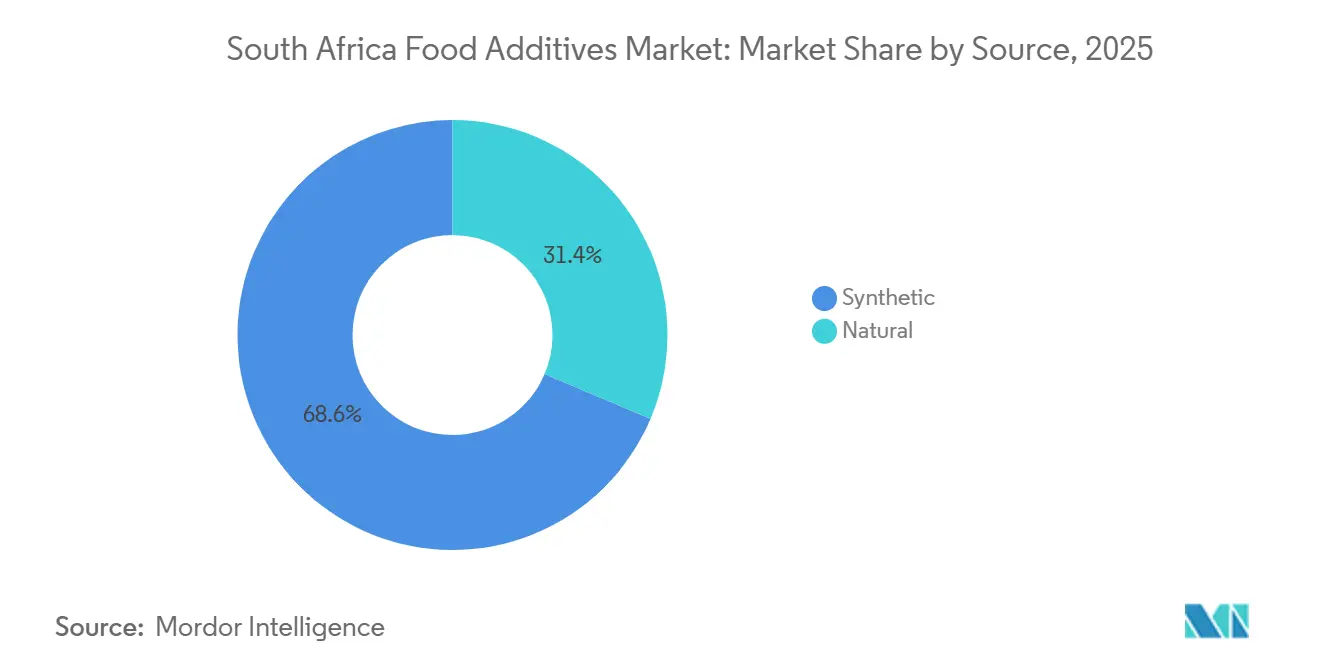
Synthetic additives accounted for 68.63% of the South African food additives market in 2025. Their position is linked to pricing, supply reliability, and established documentation. The 10 largest food processing firms generate more than 80% of sector production revenue. Large producers often require consistent inputs at substantial volumes. Currency weakness and energy costs also keep cost control important. Synthetic materials can offer predictable functional performance in high-volume production. This provides an enduring reason for their broad use across mainstream food categories.
Natural additives are forecast to grow at a 6.49% CAGR during 2026-2031. Retail product ranges free of artificial colors, flavors, and sweeteners drive demand for natural alternatives. The South African food additives market can also benefit from greater use of ingredients with clear origins and safety documentation. Botanical options can support provenance-led product development where technical performance is suitable. Natural ingredients still have to meet color, flavor, stability, and cost requirements. Their growth depends on manufacturers managing those trade-offs without making products inaccessible to price-sensitive consumers. The source choice will therefore remain application-specific rather than uniform across all food categories.
By Application: Bakery and Confectionery Lead While Dairy and Desserts Expand Fastest
Bakery and Confectionery accounted for 32.75% of the South African food additives market share in 2025. The segment benefits from widespread consumption of commercial bread across income groups. Mandatory vitamin and mineral fortification of commercial maize meal and wheat flour supports a continuing premix requirement. This creates procurement that is not limited to premium product launches. Bakery makers also require enzymes, emulsifiers, preservatives, and sweetening systems. Such functions help maintain texture, volume, freshness, and taste. The category, therefore, provides a broad application base for ingredient suppliers.
Dairy and Desserts are projected to grow at a 6.35% CAGR during 2026-2031. Protein-enriched yogurts, probiotic dairy drinks, and lower-sugar desserts support demand for cultures, stabilizers, flavors, sweeteners, and color systems. Scientific research on protein- and probiotic-fortified sorghum foods reflects continued interest in functional products to meet local nutritional needs. Beverage producers remain directly exposed to sugar-reduction requirements. Meat and seafood processors need preservatives, phosphates, and flavor enhancers for product quality and shelf life. Soups, sauces, and dressings draw on acidulants, thickeners, flavors, and anti-caking systems. These application needs give the South Africa food additives market several demand paths beyond bakery.
Geography Analysis
Gauteng accounted for the largest share of national food-processing gross value added in 2025. This makes it the largest provincial demand center associated with the South African food additives market. The province hosts major food producers and regional offices of global ingredient companies. Demand spans sweeteners and emulsifiers for industrial bakeries and preservation systems for processed meat. Food price inflation rose 5.1% year over year in the second quarter of 2025. That environment favors cost-effective formulation choices in high-volume production. Johannesburg and Pretoria also remain important centers for levy-related beverage reformulation activity.
KwaZulu-Natal accounted for the second largest share of national food-processing gross value added in 2025. It has a distinct role because sugar processing and food manufacturing are both important to the provincial economy. Close to 70% of South Africa’s sugarcane is grown within 30 km of the KwaZulu-Natal coast. The province gives suppliers access to beverage, flavor, acidulant, and sweetener demand. Mineral water and flavored beverage exports reached ZAR 953 million in the second quarter of 2025. Coastal logistics can support export activity, but weather disruptions make resilient inventory planning important. Shelf-life additives are particularly relevant where climate events interrupt normal supply routes.
The Western Cape accounted for a significant share of national food-processing gross value added in 2025. It holds a large share of registered food and beverage employers, the highest provincial share. This higher employer share indicates a strong base of smaller food and beverage businesses. Premium food, wine, and artisanal producers support demand for specialty flavors, colors, and emulsifiers. Gauteng, KwaZulu-Natal, and the Western Cape together account for approximately 75% of food-processing gross value added. Other provinces offer a wider opportunity for preservation systems as formal retail reaches more secondary cities. The geographic spread of the South Africa food additives market therefore follows production concentration but also responds to inland distribution needs.
Competitive Landscape
The South African food additives market is highly fragmented, encompassing global ingredient companies, regional distributors, and local extraction businesses. Competition centers on price, formulation support, reliability, and the ability to meet clean-label requirements. Cargill has a broad portfolio in starches, sweeteners, and emulsifiers. Kerry focuses on taste and nutrition solutions across food and beverage applications. Tate & Lyle offers ingredients used in sweetening, texture, and fortification. Corbion focuses on preservation technologies and bakery solutions. The competing offers overlap in key applications, but each company has different strengths in product range and technical support.
Kerry launched Smart Taste in September 2025 to help food and beverage manufacturers manage cost volatility and formulation complexity without compromising taste. Tate & Lyle launched its Sensation sensory formulation tool in September 2025. The tool is intended to support work on mouthfeel and texture. Corbion introduced Vantage 12E and 11E egg replacers in June 2025 for bakery applications. These moves show that suppliers are competing by offering faster formulation support and ingredient supply. They are relevant to local customers managing sugar reduction, labeling expectations, and cost pressure.
The June 2026 announcement of Ingredion’s proposed acquisition of Tate & Lyle would be a significant structural change if completed in the second half of 2027. The proposed transaction has an announced value of GBP 3.7 billion, stated as USD 5.0 billion in the announcement. A combined portfolio would cover starches, fibers, gums, pectins, sweeteners, and proteins. This could give customers a wider single-supplier option. It could also change the balance between broad portfolio providers and specialized distributors serving individual needs. At the same time, niche suppliers can still address smaller manufacturers that need localized application support.
South Africa Food Additives Industry Leaders
-
Cargill, Incorporated
-
Kerry Group plc
-
Ingredion Incorporated
-
Tate & Lyle PLC
-
Corbion N.V.
- *Disclaimer: Major Players sorted in no particular order
Recent Industry Developments
- June 2026: Ingredion Incorporated announces recommended all-cash acquisition of Tate & Lyle PLC for approximately GBP 3.7 billion, stated as USD 5.0 billion. The transaction is pending completion in H2 2027, subject to shareholder approval and antitrust clearance.
- September 2025: Kerry Group plc launches Smart Taste proprietary flavor platform integrating biofermentation and AI-driven flavor science. Smart Taste addresses cost volatility and supply chain complexity in flavor creation for food and beverage manufacturers.
- September 2025: Tate & Lyle PLC launches Tate & Lyle Sensation™ sensory formulation tool in Asia Pacific, extending ALFIE AI-robotics capabilities to EMEA customers: ALFIE runs ingredient characterization tests at 10x conventional speed and enables South African dairy and bakery customers to accelerate texture reformulation with precision data.
South Africa Food Additives Market Report Scope
Food additives are substances added to food and beverage products to serve functional roles such as preservation, sweetening, stabilization, emulsification, flavor enhancement, coloring, texture modification, and acidity regulation. The South Africa Food Additives Market is segmented by product type, form, source, and application. By product type, the market includes Preservatives, Bulk Sweeteners, Sugar Substitutes, Emulsifiers, Anti-Caking Agents, Enzymes, Hydrocolloids, Food Flavors and Enhancers, Food Colorants, and Acidulants. By form, the market is segmented into Dry and Liquid. By source, the market is categorized into Natural and Synthetic. By application, the market is divided into Bakery and Confectionery; Dairy and Desserts; Beverages; Meat and Seafood Products; Soups, Sauces, and Dressings; and Other Applications. The market sizing has been done in value terms in USD and volume terms in Metric Tons for all the abovementioned segments.
By Product Type
| Preservatives |
| Bulk Sweeteners |
| Sugar Substitutes |
| Emulsifiers |
| Anti-Caking Agents |
| Enzymes |
| Hydrocolloids |
| Food Flavors and Enhancers |
| Food Colorants |
| Acidulants |
By Form
| Dry |
| Liquid |
By Source
| Natural |
| Synthetic |
By Application
| Bakery and Confectionery |
| Dairy and Desserts |
| Beverages |
| Meat and Seafood Products |
| Soups, Sauces, and Dressings |
| Other Applications |
| By Product Type | Preservatives |
| Bulk Sweeteners | |
| Sugar Substitutes | |
| Emulsifiers | |
| Anti-Caking Agents | |
| Enzymes | |
| Hydrocolloids | |
| Food Flavors and Enhancers | |
| Food Colorants | |
| Acidulants | |
| By Form | Dry |
| Liquid | |
| By Source | Natural |
| Synthetic | |
| By Application | Bakery and Confectionery |
| Dairy and Desserts | |
| Beverages | |
| Meat and Seafood Products | |
| Soups, Sauces, and Dressings | |
| Other Applications |
Key Questions Answered in the Report
What is the South Africa food additives market size?
The South Africa food additives market size is USD 1.02 billion in 2025 and is forecast to reach USD 1.39 billion by 2031, at a 5.38% CAGR.
Which product type has the largest share in South Africa?
Bulk Sweeteners lead product demand with a 54.23% share in 2025, supported by use in beverages, cereals, and baked goods.
Which food additive category is growing the fastest?
Food Colorants are projected to record the fastest product-type growth, at a 6.61% CAGR during 2026-2031.
Why are natural ingredients gaining use in food formulation?
Natural additives are forecast to grow at a 6.49% CAGR as retailers and manufacturers seek ingredients with clearer sourcing and simpler labels.