
Soldering Equipment Market Size and Share
Market Overview
| Study Period | 2021 - 2031 |
|---|---|
| Market Size (2026) | USD 1.29 Billion |
| Market Size (2031) | USD 1.99 Billion |
| Growth Rate (2026 - 2031) | 9.06 % |
| Fastest Growing Market | Asia-Pacific |
| Largest Market | Asia-Pacific |
| Market Concentration | Medium |
Major Players *Disclaimer: Major Players sorted in no particular order Image © Mordor Intelligence. Reuse requires attribution under CC BY 4.0. | |
Soldering Equipment Market Analysis by Mordor Intelligence
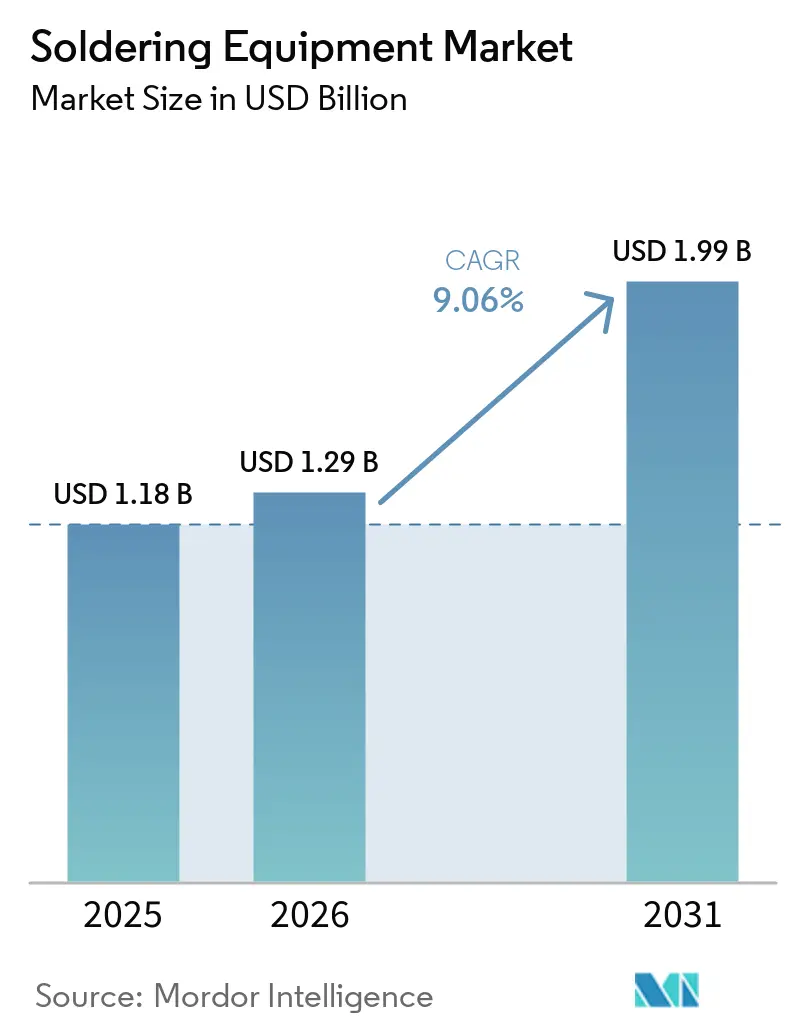
The Soldering Equipment Market size was valued at USD 1.18 billion in 2025 and is estimated to grow from USD 1.29 billion in 2026 to reach USD 1.99 billion by 2031, at a CAGR of 9.06% during the forecast period (2026-2031). Electronics miniaturization is raising requirements for thermal control, placement accuracy, and repeatable solder-joint quality. Electric vehicle production and advanced semiconductor packaging are also increasing demand for systems that can manage complex power and interconnect assemblies. Suppliers are responding through laser, vacuum-reflow, selective soldering, and data-enabled automation platforms. The soldering equipment market also faces slower adoption among smaller electronics manufacturing services providers because complex systems require significant capital and specialized operating skills. Regional manufacturing expansion creates opportunities, while compliance requirements and supply-chain shifts will shape the pace of equipment replacement.
Key Report Takeaways
- By type, reflow soldering held 38.65% of the soldering equipment market share in 2025, while laser soldering is projected to advance at a 9.75% CAGR through 2031.
- By application, consumer electronics held 41.34% of the soldering equipment market share in 2025, while automotive is projected to advance at a 10.34% CAGR through 2031.
- By geography, Asia-Pacific held 45.87% of the soldering equipment market share in 2025 and is projected to advance at a 10.07% CAGR through 2031.
Note: Market size and forecast figures in this report are generated using Mordor Intelligence’s proprietary estimation framework, updated with the latest available data and insights as of January 2026.
Global Soldering Equipment Market Trends and Insights
Drivers Impact Analysis*
| Driver | (~) % Impact on CAGR Forecast | Geographic Relevance | Impact Timeline |
|---|---|---|---|
| Accelerating Electronics Miniaturization and High-Density PCB Assembly | +2.5% | Asia-Pacific core; spillover to North America | Short term (≤ 2 years) |
| Rising EV, Battery-Management and Power-Electronics Production | +2.1% | Global; North America, Europe, China core | Medium term (2-4 years) |
| Expansion of Semiconductor Packaging and Advanced Interconnects | +1.5% | Asia-Pacific core, North America rising | Medium term (2-4 years) |
| Automation, Robotics and Industry 4.0 Adoption in Electronics Manufacturing | +1.2% | Global; early gains in Japan, Germany, South Korea | Short term (≤ 2 years) |
| Regionalization of Electronics Manufacturing and EMS Capacity | +0.8% | North America, Europe, Southeast Asia | Medium term (2-4 years) |
| Source: Mordor Intelligence | |||
Accelerating Electronics Miniaturization and High-Density PCB Assembly
High-density interconnect assembly has tightened allowable variation in solder volume and temperature across complex boards. Systems used for 01005 passive components and 0.3 mm-pitch ball grid arrays must maintain a temperature difference within ±5 °C across boards with more than 40 layers. Equipment designed for older component formats cannot consistently deliver the yield needed for sub-100 µm pitch assemblies. High-density interconnect boards for 5G, Internet of Things, and advanced driver-assistance systems are supporting replacement demand for qualified soldering platforms. The soldering equipment market benefits when electronics manufacturing services providers renew equipment to meet high-reliability requirements in aerospace, medical, and automotive production. Documentation aligned with International Electrotechnical Commission and Association Connecting Electronics Industries (IPC) requirements is becoming necessary for suppliers seeking new production contracts.
Rising EV, Battery-Management and Power-Electronics Production
Electric vehicles require soldered assemblies in motor inverters, onboard chargers, and battery management systems. The move to 800 V vehicle architectures increases electrical stress on isolation electronics and requires tighter void-control performance. SEHO Systems GmbH introduced its PowerSelective-HD system for e-mobility, battery management, and converter technology applications at productronica 2025. Bosch began sample production at its silicon carbide semiconductor facility in Roseville, California, in 2026 after a USD 225 million direct funding agreement with the U.S. Department of Commerce. These requirements favor vacuum reflow and selective systems that can support automotive-grade power modules. The soldering equipment market, therefore, has a longer equipment upgrade cycle as vehicle platforms shift toward higher-voltage designs.
Expansion of Semiconductor Packaging and Advanced Interconnects
Advanced packaging investment is increasing demand for precise thermal processing in wafer-level and panel-level workflows. The National Institute of Standards and Technology reported in July 2026 that Taiwan Semiconductor Manufacturing Company (TSMC) committed USD 265 billion for 12 advanced semiconductor manufacturing and packaging facilities in Arizona[1]. This investment expands the domestic base for soldering equipment used in advanced packaging. BTU, an Amtech Systems Company, introduced the Aurora Vacuum Reflow Oven in August 2026 for artificial intelligence infrastructure, automotive electronics, and advanced packaging applications. Its 24-inch vacuum chamber, dual-lane architecture, and 10 pre-chamber heated zones address the thermal-control needs of large boards and complex packages. Packaging demand gives the soldering equipment market exposure to artificial intelligence infrastructure spending that is separate from consumer electronics production cycles.
Automation, Robotics and Industry 4.0 Adoption in Electronics Manufacturing
Manufacturers increasingly evaluate soldering equipment as part of a connected production process. Real-time monitoring, thermal-drift correction, traceability, and remote diagnostics are important in electronics manufacturing services contracts. LG Innotek’s South Korean flip-chip ball grid array facility used artificial intelligence-based quality management, real-time defect detection, and autonomous mobile robots to reduce manual intervention. Automation also helps manufacturers respond to shortages of skilled process technicians and equipment engineers. Collaborative robot systems with teach-in programming can broaden access for high-mix, low-volume producers. The soldering equipment market increasingly rewards vendors that combine hardware capability with manufacturing execution system integration and process-data tools.
Restraints Impact Analysis*
| Restraint | (~) % Impact on CAGR Forecast | Geographic Relevance | Impact Timeline |
|---|---|---|---|
| High Capital Requirements for Automated and Selective Soldering Systems | -1.2% | Global; most acute in South America and MEA | Short term (≤ 2 years) |
| Tight Process Windows for Lead-Free Soldering | -0.8% | Global; compliance pressure concentrated in Europe and China | Medium term (2-4 years) |
| Shortage of Skilled Operators and Process-Validation Specialists | -0.6% | North America & Europe; emerging pressure in Southeast Asia | Long term (≥ 4 years) |
| Source: Mordor Intelligence | |||
High Capital Requirements for Automated and Selective Soldering Systems
Selective and laser soldering platforms used for advanced packaging or automotive production can cost more than USD 500,000 per unit. Smaller electronics manufacturing services providers also face facility costs for nitrogen supply, vibration control, and thermal management. These changes can add 20% to 40% to the initial equipment cost. The resulting total cost often leads mid-sized assemblers to continue using older wave-soldering lines. Leasing and pay-per-yield models can reduce this barrier, but they remain limited in markets with restricted equipment financing. Capital constraints are most acute in South America and Middle East and Africa, even as local assembly capacity grows.
Tight Process Windows for Lead-Free Soldering
Lead-free alloys such as SAC305 require peak reflow temperatures of 245 °C to 260 °C. These temperatures increase the risk of thermal stress for sensitive components and narrow the operating range for manufacturers. European Union lead restrictions are also requiring manufacturers to review solder applications and technical documentation before the relevant exemptions expire on December 31, 2027. Separate tooling and storage are needed where leaded and lead-free production streams operate together. Automated X-ray and optical inspection can add to the cost of a compliant production line. Nitrogen-atmosphere reflow is becoming a standard requirement for high-reliability production because it can limit oxidation and improve process control.
*Our forecasts treat driver/restraint impacts as directional, not additive. The impact forecasts reflect baseline growth, mix effects, and variable interactions.
Segment Analysis
By Type: Reflow Soldering Holds Revenue Leadership While Laser Soldering Expands
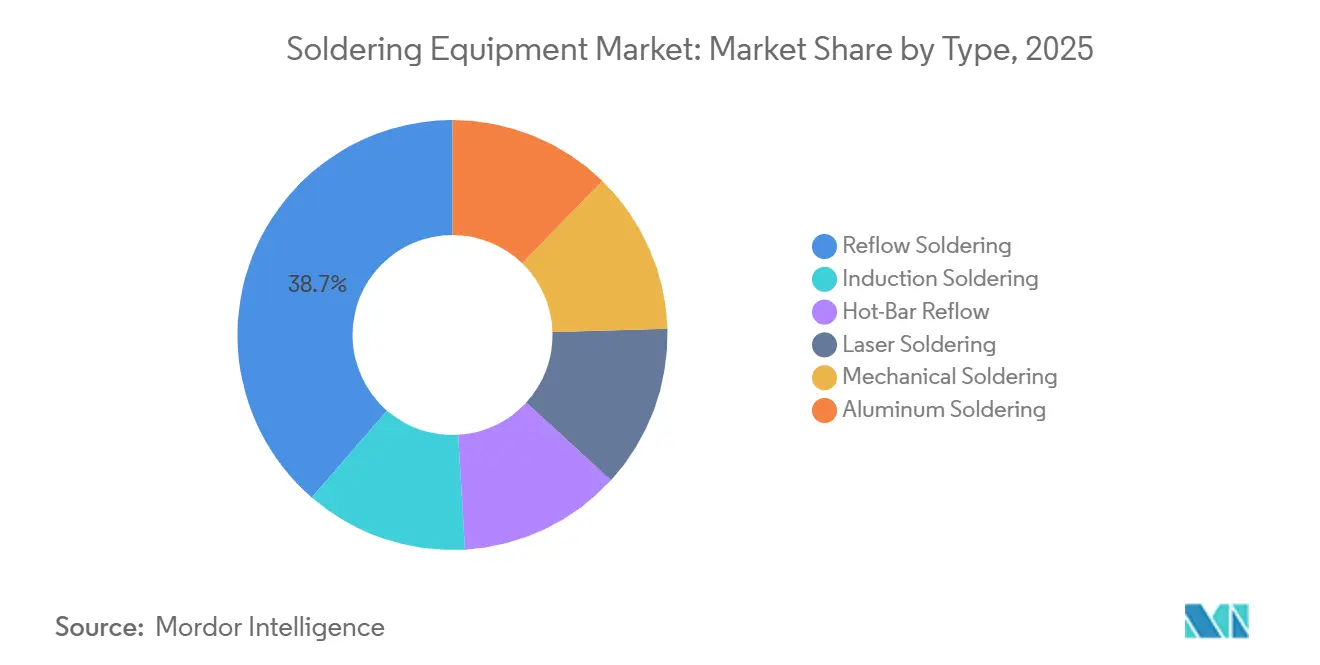
Reflow soldering held 38.65% of the soldering equipment market share in 2025, supported by high-volume surface-mount technology assembly. It is widely used for consumer electronics, networking boards, and automotive electronic control units. High-density interconnect boards need multi-zone thermal profiles for small components and micro ball grid array placements. Energy consumption, nitrogen use, and shorter maintenance intervals can raise the operating cost of high-throughput reflow lines. Rehm Thermal Systems GmbH presented its VisionXP+ generation at EFX 2026 with reported idle-period energy savings of up to 60% through electronically commutated motors, intelligent fan control, and a nitrogen shutter. Induction and hot-bar reflow systems remain relevant where a localized heat source is preferable, including flexible circuit bonding for wearables and organic light-emitting diode displays.
Laser soldering is projected to advance at a 9.75% CAGR through 2031, the fastest type growth rate in the soldering equipment market size. It provides noncontact heating for camera modules, microelectromechanical systems devices, flexible printed-circuit connectors, and automotive sensor assemblies. Han’s Laser introduced dedicated laser soldering systems for 3C electronics manufacturing in 2026, covering camera modules, true wireless stereo earbuds, and flexible printed-circuit connectors. Artificial intelligence accelerator packages also require alignment control at small pad pitches. Laser systems carry a higher acquisition cost than reflow systems, but the cost of a rejected advanced package can justify the investment. Mechanical and aluminum soldering platforms continue to serve through-hole and heavy-component work in industrial, defense, and power-infrastructure assembly.

By Application: Consumer Electronics Dominates While Automotive Gains Momentum
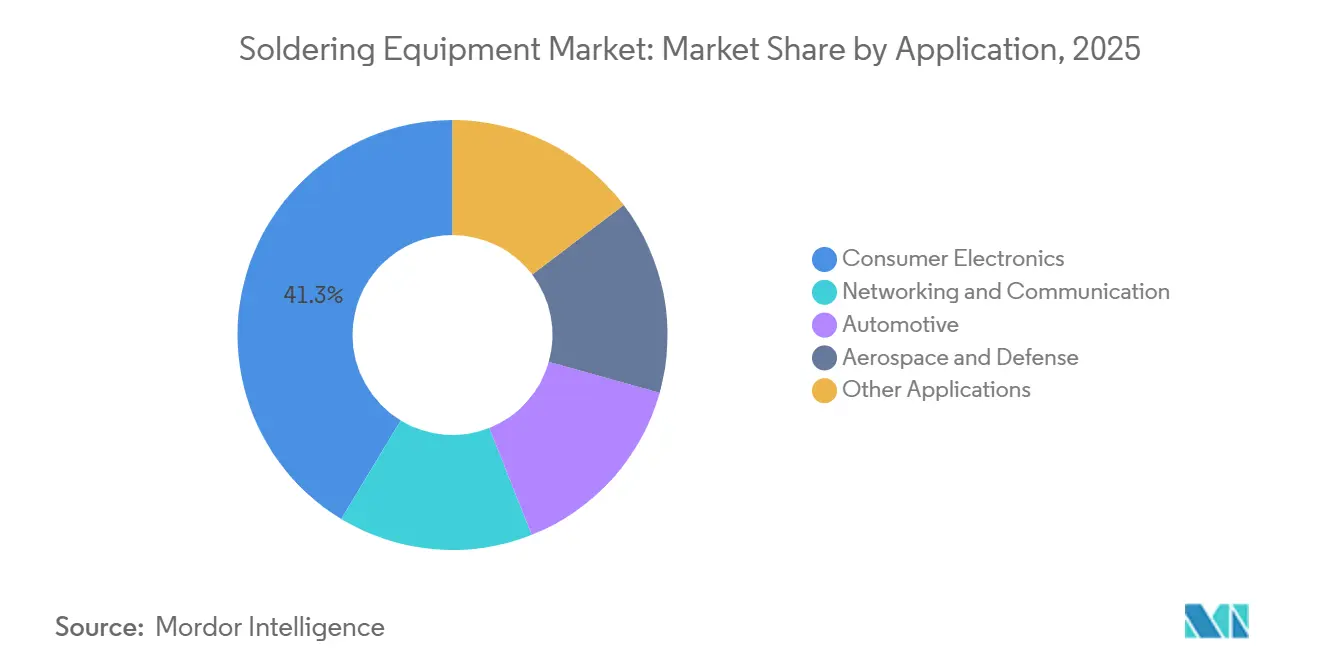
Consumer electronics held 41.34% of the soldering equipment market share in 2025, supported by smartphone, tablet, wearable, and smart-home device assembly in the Asia-Pacific. Mature smartphone printed-circuit board lines place strong emphasis on throughput and yield consistency. Networking and communication equipment is gaining importance as artificial intelligence data centers need reliable servers and switching boards. These boards have greater power-distribution and signal-integrity requirements than earlier data-center designs. Aerospace and defense applications require validated process documentation under high-reliability standards. Medical devices, energy systems, and industrial machinery can benefit as automotive and aerospace qualification requirements raise general expectations for process quality.
Automotive is projected to advance at a 10.34% CAGR through 2031, the fastest application growth rate in the soldering equipment market size. Electric vehicles use high-voltage battery management system nodes, silicon carbide traction inverters, and advanced driver-assistance system sensors. These assemblies require close control of void fraction and thermal profiles. JAPAN UNIX CO., LTD. listed General Motors and Toyota Motor Corporation among its automotive soldering-system reference customers in 2025. The shift from 400 V to 800 V architectures requires tighter temperature control across automotive supply chains. The same performance expectations are spreading into medical implantable-device and aerospace power-supply assemblies.
Geography Analysis
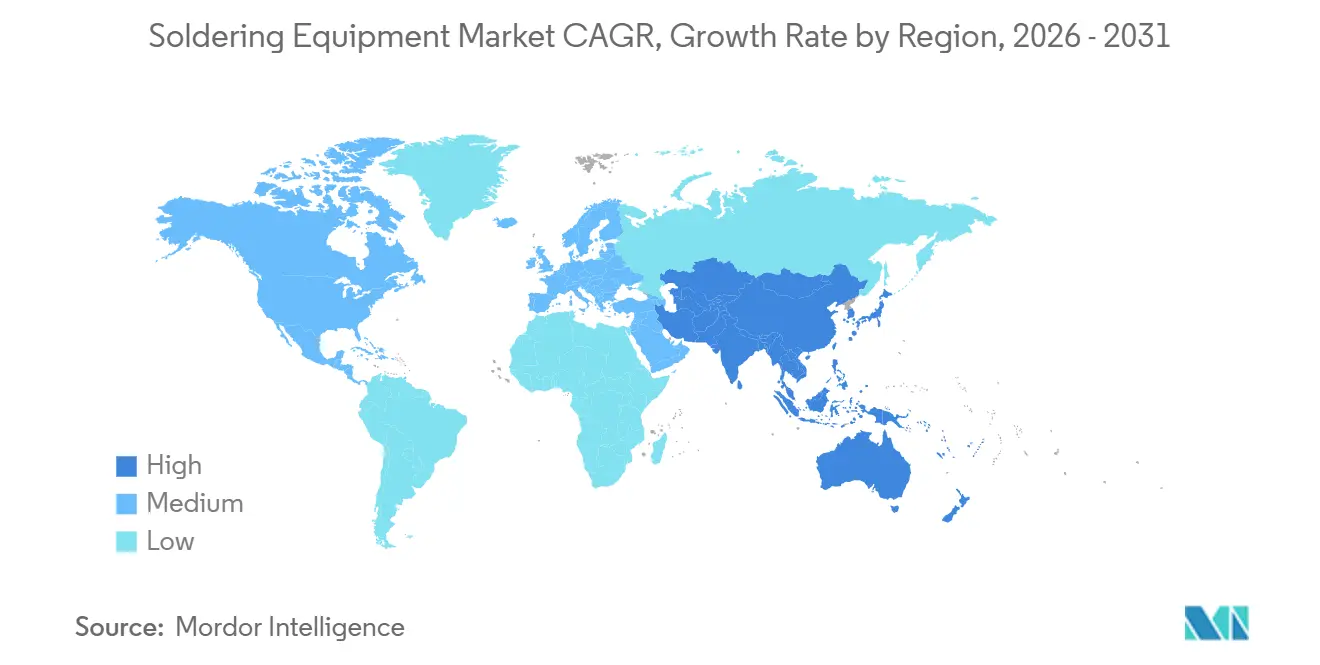
Asia-Pacific held 45.87% of the soldering equipment market share in 2025 and is projected to advance at a 10.07% CAGR through 2031. China’s surface-mount technology base, Japan’s precision-equipment capabilities, South Korea’s semiconductor and display clusters, and India’s growing electronics manufacturing services capacity support this position. India’s electronics output rose 15.8% year over year to INR 13.11 lakh crore (approximately USD 156 billion) in fiscal year 2025-26[2]. The soldering equipment market size in the region is also supported by India’s production-linked incentive programs and semiconductor investment plans. SEHO Systems GmbH announced an August 2026 partnership with NMTronics India Pvt. Ltd. and plans to manufacture wave soldering systems locally at Heller Industries, Inc.’s Indian facility.
North America is gaining equipment demand through semiconductor reshoring and advanced packaging investment. TSMC’s USD 265 billion Arizona commitment supports reflow, flip-chip bonding, and other advanced packaging workflows. Mexico is also absorbing nearshoring activity in automotive-related electronics manufacturing. Nordson Corporation expanded its distribution partnership with Assembly Products Inc. in March 2026 to include MARCH plasma systems and SELECT selective soldering products across the United States and Canada. This commercial move aligns with a broader shift toward regional electronics capacity and local service coverage.
Europe’s soldering equipment market is shaped by automotive electronics production, precision manufacturing, and lead-free compliance requirements. European Union amendments published in November 2025 narrowed legacy lead-in-solder exemptions and required manufacturers to prepare updated technical files before applicable deadlines. Rehm Thermal Systems GmbH presented the VisionXC Nitro reflow platform at IPC APEX EXPO 2026 for nitrogen-atmosphere processing and energy management. South America and Middle East and Africa remain smaller demand areas that are expanding with electronics manufacturing services capacity. Brazil and Argentina support South American demand through consumer electronics and automotive component production, while Saudi Arabia and South Africa offer longer-term distribution and service opportunities.
Competitive Landscape
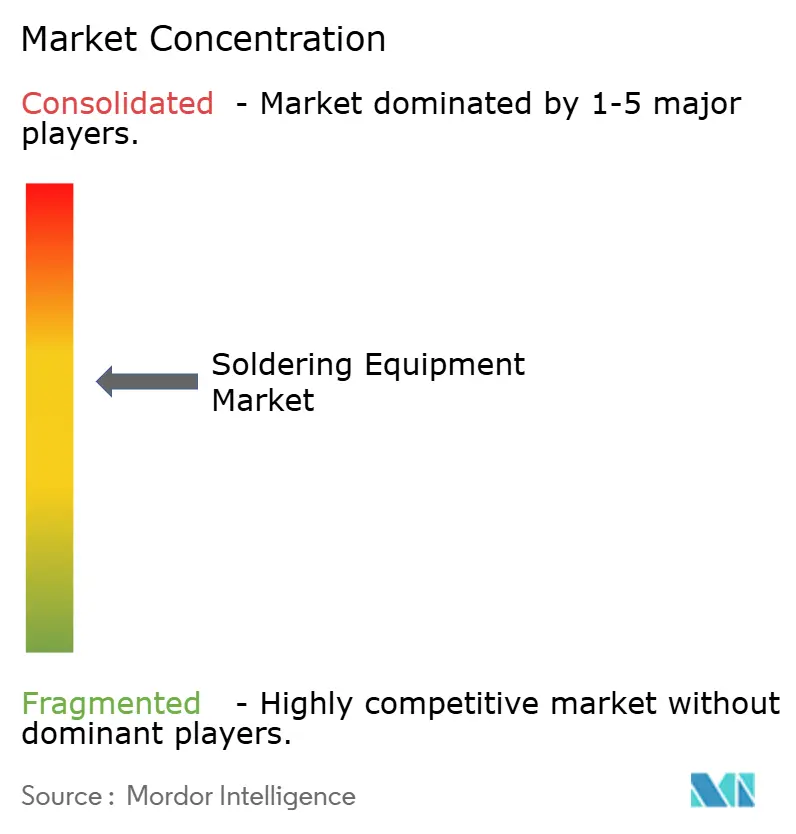
The soldering equipment market is moderately concentrated, with the top five players including Kurtz Ersa, Heller Industries, Inc., Rehm Thermal Systems GmbH, Nordson Corporation, and Illinois Tool Works Inc. Apollo Seiko Ltd. and JAPAN UNIX CO., LTD. are active in robotic and laser applications for consumer and automotive electronics. Illinois Tool Works Inc. and Nordson Corporation combine process traceability with broad equipment portfolios. Illinois Tool Works Inc. received U.S. Patent 12356555 in July 2025 for wave-solder flow control and U.S. Patent 12496647 in December 2025 for nitrogen-diffuser optimization. These patents addressed wave contact control and dross reduction in continuous-wave production.
Nordson Corporation reported that a Kamstrup deployment of its SELECT Synchro selective soldering system increased throughput by 20% and recovered 6 square meters of factory floor space in 2026. The supplier uses demonstrated customer productivity results to support its commercial approach. SEHO Systems GmbH launched the PowerSelective-HD system in November 2025 for heavy e-mobility, battery management, and converter assemblies. BTU, an Amtech Systems Company, launched the Aurora Vacuum Reflow Oven in August 2026 for large server boards and advanced packaging. These launches target applications where precise thermal control and low voiding are important.
Vacuum reflow, connected process data, and financing for smaller assemblers remain areas of competitive activity. Collaborative robot integrators are making automation more accessible for high-mix, low-volume operations. Established suppliers are responding with focused products instead of relying on conventional equipment formats. Compliance with IPC standards, International Electrotechnical Commission 63000 documentation, and European Union restrictions on hazardous substances affects supplier qualification. Vendors with validated documentation can have an advantage in regulated production programs.
Soldering Equipment Industry Leaders
-
Kurtz Ersa
-
Heller Industries, Inc.
-
Rehm Thermal Systems GmbH
-
Nordson Corporation
-
Illinois Tool Works Inc.
- *Disclaimer: Major Players sorted in no particular order
Recent Industry Developments
- September 2026: SEHO Systems GmbH announced a strategic partnership with NMTronics India Pvt. Ltd. to expand its presence in India’s electronics manufacturing market, alongside plans to locally manufacture wave soldering systems at Heller Industries’ Indian facility. The initiative will shorten supply routes and improve local availability of soldering equipment, supporting the expansion of electronics and Printed Circuit Board (PCB) assembly manufacturing in India.
- August 2026: American Hakko Products, Inc. introduced the HAKKO FX-310 Wave Soldering Pot, a redesigned wave soldering system offering improved process control, flexibility, and reliability for electronics manufacturing and production environments. The launch supports demand for advanced soldering equipment as manufacturers handle increasingly complex electronic assemblies.
Global Soldering Equipment Market Report Scope
Soldering equipment comprises tools and systems used to join components and materials by applying controlled heat and solder. These systems support reliable connections while enabling precision, consistency, and efficient assembly across electronic and industrial manufacturing processes.
The Soldering Equipment Market is segmented by type, application, and geography. By type, the market is segmented into reflow soldering, induction soldering, hot-bar reflow, laser soldering, mechanical soldering, and aluminum soldering. By application, the market is segmented into consumer electronics, networking and communication, automotive, aerospace and defense, and other applications. The report also covers the market size and forecasts for soldering equipment in 15 countries across major regions. For each segment, the market sizing and forecasts have been done on the basis of value (USD).
| Reflow Soldering |
| Induction Soldering |
| Hot-Bar Reflow |
| Laser Soldering |
| Mechanical Soldering |
| Aluminum Soldering |
| Consumer Electronics |
| Networking and Communication |
| Automotive |
| Aerospace and Defense |
| Other Applications |
| Asia-Pacific | China |
| India | |
| Japan | |
| South Korea | |
| ASEAN Countries | |
| Rest of Asia-Pacific | |
| North America | United States |
| Canada | |
| Mexico | |
| Europe | Germany |
| United Kingdom | |
| France | |
| Italy | |
| NORDIC Countries | |
| Rest of Europe | |
| South America | Brazil |
| Argentina | |
| Rest of South America | |
| Middle East and Africa | Saudi Arabia |
| South Africa | |
| Rest of Middle East and Africa |
| By Type | Reflow Soldering | |
| Induction Soldering | ||
| Hot-Bar Reflow | ||
| Laser Soldering | ||
| Mechanical Soldering | ||
| Aluminum Soldering | ||
| By Application | Consumer Electronics | |
| Networking and Communication | ||
| Automotive | ||
| Aerospace and Defense | ||
| Other Applications | ||
| By Geography | Asia-Pacific | China |
| India | ||
| Japan | ||
| South Korea | ||
| ASEAN Countries | ||
| Rest of Asia-Pacific | ||
| North America | United States | |
| Canada | ||
| Mexico | ||
| Europe | Germany | |
| United Kingdom | ||
| France | ||
| Italy | ||
| NORDIC Countries | ||
| Rest of Europe | ||
| South America | Brazil | |
| Argentina | ||
| Rest of South America | ||
| Middle East and Africa | Saudi Arabia | |
| South Africa | ||
| Rest of Middle East and Africa | ||
Key Questions Answered in the Report
What is the size of the soldering equipment market?
The soldering equipment market stands at USD 1.29 billion in 2026 and is projected to reach USD 1.99 billion by 2031.
What is driving demand for soldering equipment?
Electronics miniaturization, electric vehicle power electronics, semiconductor packaging, and manufacturing automation are supporting demand.
Which type is expected to grow fastest through 2031?
Laser soldering is projected to advance at a 9.75% CAGR through 2031 because it provides precise, noncontact heating for compact assemblies.
Which application is expected to grow fastest through 2031?
Automotive is projected to advance at a 10.34% CAGR through 2031, supported by electric vehicles, battery management systems, and power modules.