
Solar Inverter Battery Market Size and Share
Market Overview
| Study Period | 2021 - 2031 |
|---|---|
| Market Size (2026) | USD 2.24 Billion |
| Market Size (2031) | USD 3.11 Billion |
| Growth Rate (2026 - 2031) | 6.78 % |
| Fastest Growing Market | Asia-Pacific |
| Largest Market | Asia-Pacific |
| Market Concentration | Medium |
Major Players *Disclaimer: Major Players sorted in no particular order Image © Mordor Intelligence. Reuse requires attribution under CC BY 4.0. | |
Solar Inverter Battery Market Analysis by Mordor Intelligence
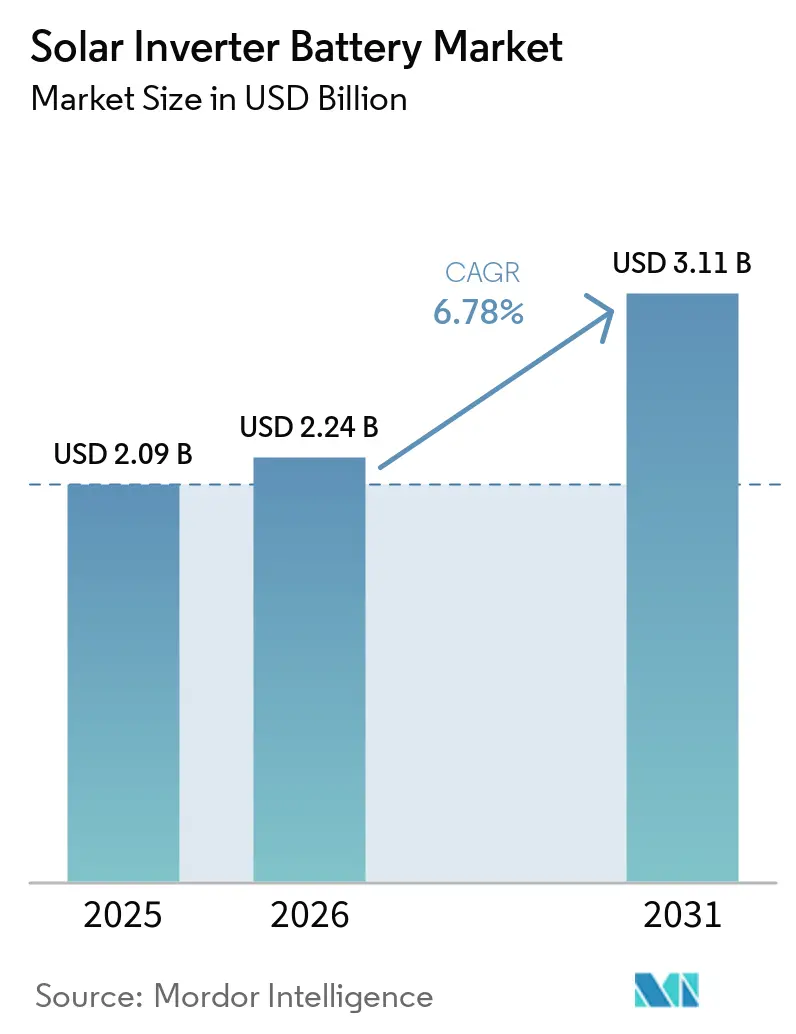
The Solar Inverter Battery Market size is projected to expand from USD 2.09 billion in 2025 and USD 2.24 billion in 2026 to USD 3.11 billion by 2031, at a CAGR of 6.78% between 2026 and 2031. The solar inverter battery market is supported by greater use of storage with rooftop and utility-scale solar systems. Lower lithium iron phosphate cell costs have improved the case for storage across household and commercial installations. Changes to net-metering arrangements also make stored electricity more valuable to solar owners. Policy requirements, safety certification, and grid rules shape which systems can enter each country. Suppliers are responding with integrated inverters, batteries, energy management software, and service offerings.
Key Report Takeaways
- By battery chemistry, lithium-ion held 72.1% revenue share in 2025, while sodium-ion recorded the highest projected CAGR at 9.1% through 2031.
- By battery capacity, the 5-10 kWh band held 43.2% revenue share in 2025, while the 10-20 kWh band recorded the highest projected CAGR at 7.4% through 2031.
- By end user, residential held 51.3% revenue share in 2025, while commercial recorded the highest projected CAGR at 7.6% through 2031.
- By geography, Asia-Pacific held 46.4% revenue share in 2025 and recorded the highest projected CAGR at 8.5% through 2031.
Note: Market size and forecast figures in this report are generated using Mordor Intelligence’s proprietary estimation framework, updated with the latest available data and insights as of January 2026.
Market Trends and Insights
Drivers Impact Analysis of Solar Inverter Battery Market*
| Driver | % Impact on CAGR Forecast | Geographic Relevance | Impact Timeline |
|---|---|---|---|
| Solar-Plus-Storage Deployment | +2.20% | Global; led by North America and APAC | Short term (≤ 2 years) |
| Falling Lithium-Ion System Costs | +1.80% | Global; particularly APAC manufacturing hubs | Short term (≤ 2 years) |
| Grid Reliability and Energy Independence | +1.50% | Global; emphasis on Europe and North America | Medium term (2–4 years) |
| Renewable-Energy Incentives and Storage Mandates | +0.80% | Global; early gains in US, China, and Germany | Medium term (2–4 years) |
| Cybersecurity and Bankability Requirements Elevating Qualified Suppliers | +0.50% | EU and North America primarily | Medium term (2–4 years) |
| Software-Led Virtual Power Plant Monetization | +0.40% | North America, Western Europe, Australia | Long term (≥ 4 years) |
| Source: Mordor Intelligence | |||
Solar-Plus-Storage Deployment Lifts Attachment Rates
The solar inverter battery market benefits as storage becomes a standard part of new solar projects. The U.S. residential solar storage attachment rate reached 45% in the first quarter of 2026, compared with 38% in the first quarter of 2025[1]. This change reflected revised net-metering arrangements as well as customer interest in retaining more solar generation for later use in the solar inverter battery market. SEIA reported that the United States added 58 GWh of energy storage capacity in 2025. Paired systems require suppliers to coordinate inverter controls, battery management, and site design. This favors firms that can offer a complete system rather than a separate hardware component.
Falling Lithium-Ion System Costs Support Wider Adoption
The solar inverter battery market has gained from lower lithium iron phosphate, or LFP, cell costs. LFP cell prices were near USD 50/kWh in 2025, helping residential systems compete in high-tariff European and Australian settings. A rise in 314 Ah storage-cell prices during the first half of 2026 did not remove the economic case for commercial projects in the solar inverter battery market. Sungrow introduced PowerHarbor in June 2026 with 314 Ah prismatic cells and module-level DC-DC conversion. The design aims to reduce balance-of-system costs and simplify capacity additions. Certification expenses still limit savings for smaller installers operating under the national grid and safety rules.
Grid Reliability and Energy Independence Strengthen Demand
The solar inverter battery market serves buyers who need protection from supply interruptions as well as lower electricity bills. SolarPower Europe reported that cumulative installed battery capacity in the EU-27 exceeded 100 GWh in 2025 after 36 GWh of new installations. The organization reported a 48% increase in new installations during that year[2]. Germany added 3.4 GWh of storage in the first 5 months of 2026, according to BSW-Solar[3]. Dynamic tariffs have made the financial value of charging and discharging batteries more visible to households in the solar inverter battery market. Customers seeking longer backup periods tend to select larger systems, while cost-sensitive buyers continue to favor mid-range capacity.
Renewable-Energy Incentives and Storage Mandates Improve Project Visibility
The solar inverter battery market responds strongly to rules that link solar development with storage capability. China introduced requirements for grid-forming storage penetration in new projects in Northwest China during 2025. These requirements make storage an active element of grid support rather than a passive add-on. In the United States, revisions to the investment tax credit framework shaped expectations for utility-scale battery deployment in 2025 and 2026. The EU Batteries Regulation requires carbon footprint declarations for batteries placed on the European Union market from 2025. Traceability requirements can favor suppliers with established documentation and tested supply chains in the solar inverter battery market.
Restraints Impact Analysis of Solar Inverter Battery Market*
| Restraint | % Impact on CAGR Forecast | Geographic Relevance | Impact Timeline |
|---|---|---|---|
| High Upfront System and Installation Cost | -0.90% | Global; strongest in South/Southeast Asia, Sub-Saharan Africa, South America | Short term (≤ 2 years) |
| Interconnection, Permitting, and Safety-Compliance Delays | -0.70% | North America, Europe, high-grid-density APAC; spillover to MEA | Medium term (2–4 years) |
| Hybrid-System Interoperability and Warranty Risk | -0.50% | Global, particularly retrofit residential markets | Medium term (2–4 years) |
| Trade Barriers, Local-Content Rules, and Skilled-Labor Shortages | -0.40% | North America (UFLPA, ITC sourcing rules), EU (NIS2/cybersecurity) | Long term (≥ 4 years) |
| Source: Mordor Intelligence | |||
High Upfront Costs Limit Access in Emerging Geographies
The solar inverter battery market remains less accessible, where consumer financing and installer capacity are limited. Lower cell prices have not eliminated total equipment, installation, and financing costs. Brazil had more than 500 MWh of behind-the-meter storage installed by January 2026, while the country was expected to add more than 650 MWh during 2026. Brazil’s electricity regulator was reviewing Consulta Pública 39 in 2026, which could clarify storage business models. All-in-one equipment can shorten commissioning time in the solar inverter battery market, but this does not fully offset labor costs in markets with limited installer networks. These limits also constrain purchases of larger capacity systems by commercial customers.
Interconnection and Compliance Timelines Slow Deployment
The solar inverter battery market can be delayed by grid connection, permitting, and certification requirements, even when equipment is available. The American Clean Power Association identified interconnection queues and federal sourcing uncertainty as factors affecting utility-scale storage planning through 2027[4]. National safety and grid codes can increase time to market for new battery products in the solar inverter battery market. Sodium-ion residential products face a narrower certification pathway than established LFP products. This makes installers more cautious about adopting systems without a well-established compliance record. Interoperability and warranty concerns also make retrofit decisions more difficult when homeowners combine products from different suppliers.
*Our forecasts treat driver/restraint impacts as directional, not additive. The impact forecasts reflect baseline growth, mix effects, and variable interactions.
Solar Inverter Battery Market Segment Analysis
By Battery Chemistry:
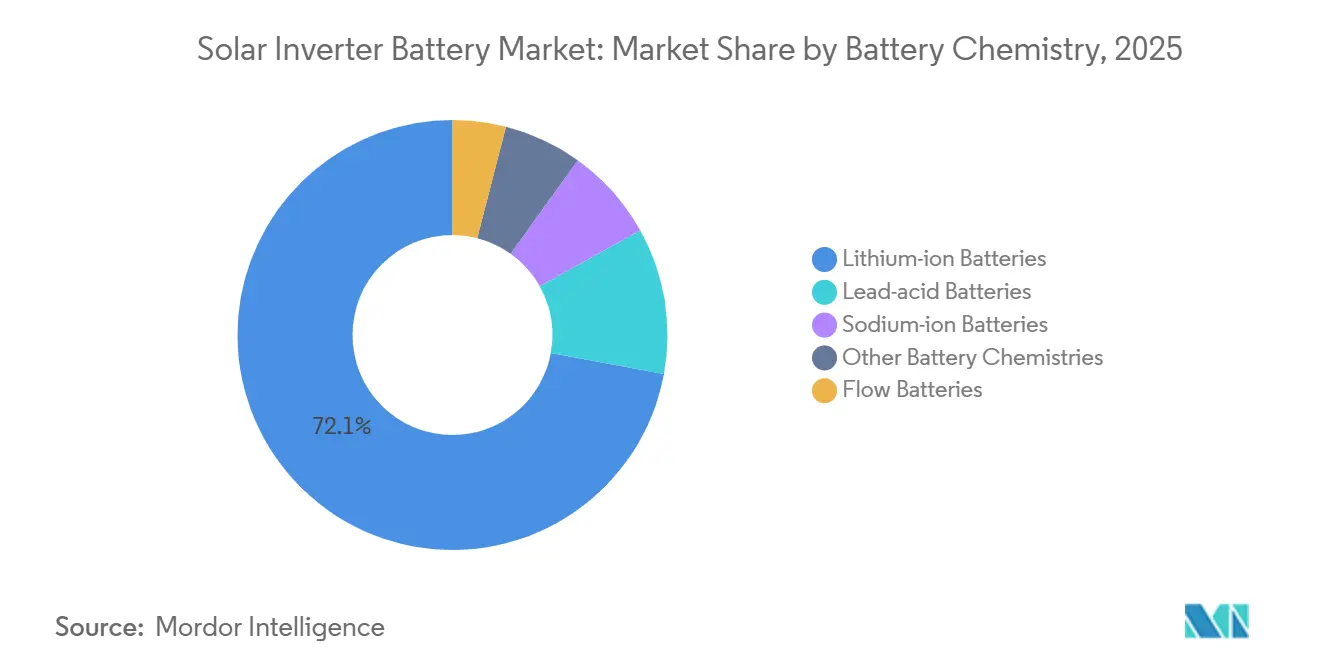
Lithium-Ion Leads While Sodium-Ion Broadens OptionsLithium-ion batteries held 72.1% of the solar inverter battery market share in 2025. LFP products formed the main part of this position because they have established supply chains and known performance in residential storage. Their operating range, cell-level safety characteristics, and compatibility with standard battery management systems support use in certified systems. Lead-acid batteries retained a role in cost-sensitive applications. Flow batteries continued to serve a limited set of long-duration commercial and industrial projects, where installation complexity and capital needs constrain wider use.
Sodium-ion batteries are forecast to grow at a 9.1% CAGR from 2026 to 2031. CATL stated that its sodium-ion cells can reach 97% system efficiency and more than 15,000 cycles to 80% capacity. The company’s cell design does not use cobalt, nickel, or copper, which supports its cost position at larger production volumes. Alfen and CATL agreed in July 2026 to deploy 5 GWh of sodium-ion storage across Europe. The agreement shows that the solar inverter battery industry is moving beyond pilot-scale interest in this chemistry.

By Battery Capacity:
Mid-Range Systems Hold the Largest PositionThe 5-10 kWh band accounted for 43.2% of the solar inverter battery market size in 2025. This capacity range aligns with daily self-consumption needs for many single-household installations in Germany, the United States, Australia, and Japan. It is large enough to store daytime solar output for evening use without imposing the cost of a larger backup system. Systems below 5 kWh remain relevant for partial backup and lower-income customer groups. Their margins face pressure as the incremental price difference between capacity tiers narrows.
The 10-20 kWh band is forecast to grow at a 7.4% CAGR from 2026 to 2031. It benefits from an upgrade cycle among early solar adopters who want longer backup periods and eligibility for virtual power plant programs. Sungrow’s PowerHarbor supports modular storage from 6 kWh to 120 kWh, allowing capacity expansion without replacing inverter hardware. Programs that require a minimum usable capacity can encourage solar inverter battery market customers with smaller batteries to upgrade. Capacity above 20 kWh is also gaining relevance in small commercial sites that combine solar generation, backup power, and demand management.
By End User:
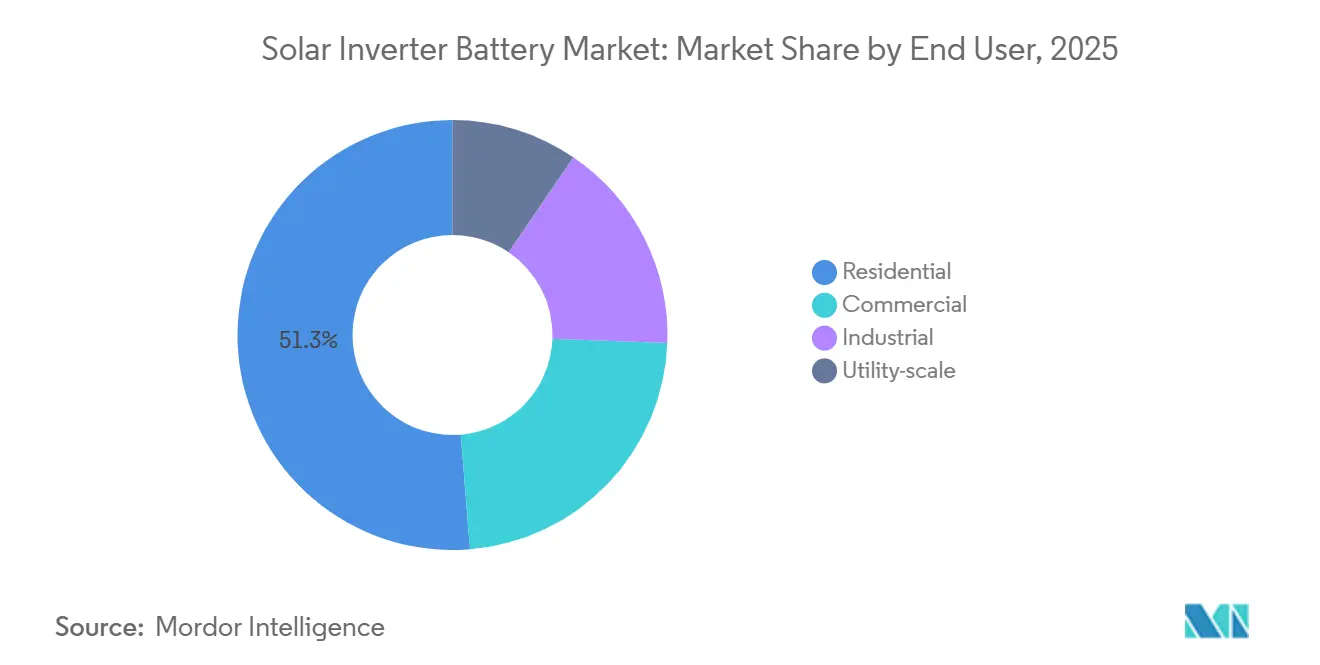
Residential Demand Leads While Commercial Use Grows FasterResidential customers accounted for 51.3% of the solar inverter battery market in 2025. Behind-the-meter adoption was strongest in Germany, the United States, Japan, and Australia. The U.S. residential storage segment added 3.1 GWh in 2025, supported by participation in virtual power plant programs. Japan’s home-storage demand is also tied to replacement demand from earlier rooftop solar installations. Industrial and utility-scale deployments sell fewer systems but carry substantial revenue because their equipment has much larger capacity.
Commercial use is forecast to expand at a 7.6% CAGR from 2026 to 2031. Buyers use storage to shift load, reduce peak demand charges, and support corporate energy goals. Fox ESS introduced its Power Beast system in July 2026 for commercial and industrial buyers needing extended backup, solar integration, and electric-vehicle charging support. Commercial customers increasingly evaluate storage as part of an energy management platform instead of as an isolated product. This gives vendors with integrated controls and service capability a stronger position than suppliers offering hardware only.
Geography Analysis
APAC Solar Inverter Battery Market
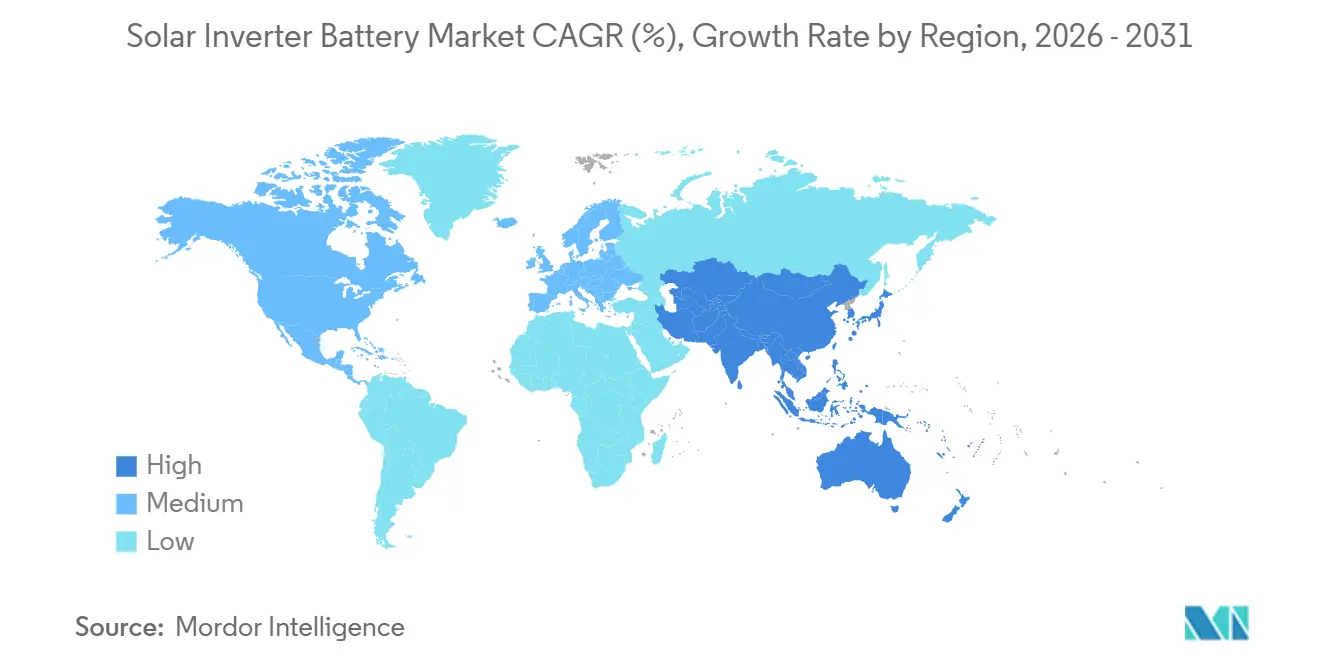
Asia-Pacific held 46.4% of the solar inverter battery market share in 2025 and is forecast to grow at an 8.5% CAGR through 2031. China remains the region’s largest source of equipment production and a major storage deployment center. National planning supports grid-forming storage and broader use of batteries with renewable generation. India adds demand through distributed solar expansion. Japan, South Korea, and Australia support steady household demand, while Vietnam, Indonesia, and Thailand offer early demand for smaller systems where power reliability matters.
North America Solar Inverter Battery Market
North America remains important to the solar inverter battery market because the United States combines utility-scale deployment with a growing household attachment rate. SEIA reported 58 GWh of new U.S. energy storage capacity in 2025. California, Texas, and Arizona account for a large share of utility-scale activity. Virtual power plant programs in Massachusetts, Texas, New Jersey, and the Mid-Atlantic create an additional route to customer revenue. Canada and Mexico remain earlier-stage markets, but clean electricity rules and distributed generation plans support future demand.
EMEA and South America Solar Inverter Battery Market
Europe added 36 GWh of storage in the EU-27 during 2025, taking cumulative capacity above 100 GWh. Germany, the United Kingdom, and Italy were the largest national markets. Germany’s 2026 installation growth reflects the effect of dynamic tariffs and an established household solar base. South America, the Middle East, and Africa remain earlier-stage regions with clear demand drivers. Brazil combines distributed solar, unreliable grids, and time-of-use tariff opportunities, while Saudi Arabia and the United Arab Emirates draw utility-scale battery investment.
Competitive Landscape
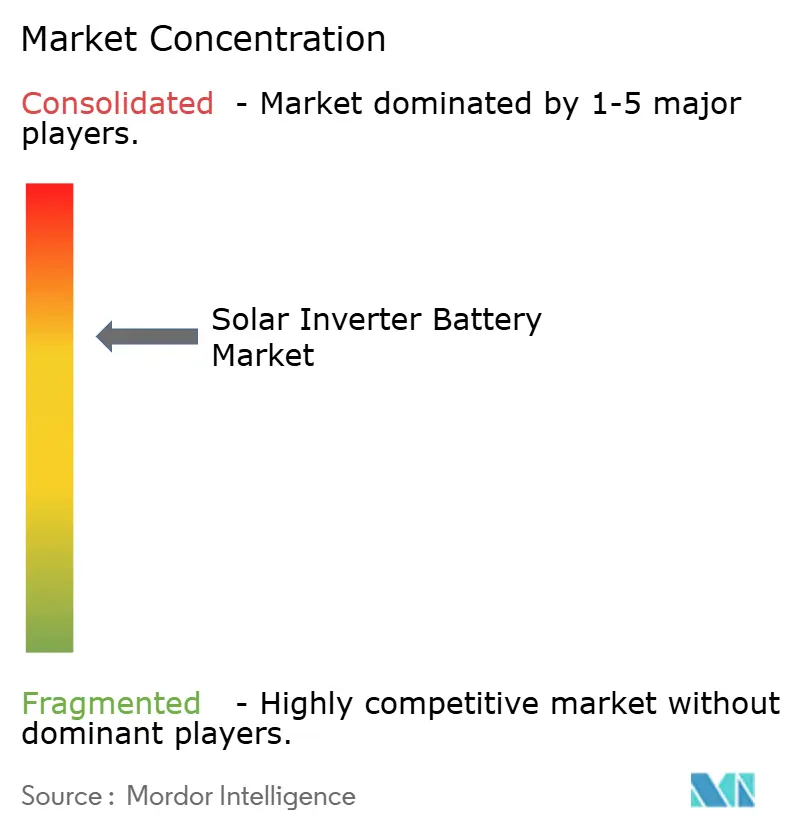
The solar inverter battery market is moderately consolidated among leading suppliers and fragmented beyond the top tier. Sungrow, Huawei Digital Power, BYD, CATL, and GoodWe are important suppliers of inverters, cells, and storage equipment. Their scale supports control over component sourcing, delivery schedules, and product development. Several leading Chinese suppliers pursue vertical integration from battery cells to inverter controls and energy management software. This approach can reduce system integration problems and provide a single supplier relationship for installers.
Sungrow launched PowerHarbor in June 2026 as an all-in-one residential energy storage system with scalable LFP storage and iHomeManager forecasting. CATL and Alfen agreed in July 2026 to deploy 5 GWh of sodium-ion storage in Europe. Fox ESS introduced Power Beast for commercial and industrial use, combining a three-phase hybrid inverter with high-voltage LFP batteries. These moves show that product competition increasingly includes capacity flexibility, commissioning speed, grid compliance, and software functions.
Western suppliers compete through manufacturing location, installation design, software, and compliance capability. SolarEdge positioned its Nexis platform for U.S. domestic content requirements and virtual power plant participation. SMA Solar and Fronius compete through power electronics and certifications for European interconnection rules. Enphase combines microinverters, storage, and module-level monitoring for providers managing residential fleets. The solar inverter battery market has room for certified sodium-ion systems, predictive energy management, and storage designed for data-center co-location. No combined market-share figure is available for the top global suppliers, so a market concentration score cannot be assigned on the required evidence basis.
Solar Inverter Battery Industry Leaders
-
Sungrow Power Supply Co., Ltd.
-
Huawei Digital Power Technologies Co., Ltd.
-
SMA Solar Technology AG
-
GoodWe Technologies Co., Ltd.
-
Enphase Energy, Inc.
- *Disclaimer: Major Players sorted in no particular order
Solar Inverter Battery Market Companies Covered in this Report
- BYD Company Limited
- Contemporary Amperex Technology Co., Limited (CATL)
- Dyness Digital Energy Technology Co., Ltd.
- Enphase Energy, Inc.
- Fluence Energy, Inc.
- Fronius International GmbH
- Ginlong Technologies Co., Ltd. (Solis)
- GoodWe Technologies Co., Ltd.
- Growatt New Energy Technology Co., Ltd.
- Huawei Digital Power Technologies Co., Ltd.
- LG Energy Solution Ltd.
- Panasonic Holdings Corporation
- Pylon Technologies Co., Ltd.
- Samsung SDI Co., Ltd.
- Schneider Electric SE
- SMA Solar Technology AG
- SolarEdge Technologies, Inc.
- Sungrow Power Supply Co., Ltd.
- Tesla, Inc.
Recent Industry Developments in Solar Inverter Battery Market
- August 2026: JinkoSolar unveiled the "Sunny 365" Smart Solar-Storage System for AI data centers, integrating high-efficiency PV, long-duration storage, and AI-driven operations for 24/7 power supply and emergency backup. The launch targets AI data center operators seeking to meet green-power procurement commitments while managing grid connection constraints.
- July 2026: Alfen and CATL agreed to deploy 5 GWh of sodium-ion battery energy storage systems across Europe, expanding an existing lithium-ion supply partnership. CATL’s sodium-ion cell targets a 30-40% cost advantage over LFP at scale with a cycle life exceeding 15,000 cycles to 80% capacity.
- July 2026: SolarEdge Technologies announced nationwide U.S. availability of its Nexis residential solar and storage platform, with 13 kW on-grid output, scalability to 80 kWh, and installation in under 20 minutes. The platform also integrates with SolarEdge virtual power plant programs.
- July 2026: Fox ESS unveiled Power Beast, a commercial and industrial energy storage solution pairing its H3 Plus three-phase hybrid inverter with the CQ7 high-voltage LFP battery architecture. The system targets buyers requiring more than 6 hours of continuous backup with electric-vehicle charging and solar integration.
Global Solar Inverter Battery Market Report Scope
A solar inverter battery is an energy storage battery used in a solar power system to store electricity generated by solar photovoltaic (PV) panels and supply it to electrical loads when solar generation is unavailable or insufficient, such as during nighttime, cloudy periods, or grid outages. The battery works in conjunction with a solar inverter, which manages the conversion and flow of electricity between the solar panels, battery, grid, and electrical loads. During periods of excess solar generation, the system charges the battery. When electricity is needed, the stored DC energy is supplied to the inverter and converted into AC electricity for household, commercial, or industrial use.
The Solar Inverter Battery Market is segmented by battery chemistry, battery capacity, end user, and geography. By battery chemistry, the market is segmented into lithium-ion batteries, lead-acid batteries, sodium-ion batteries, flow batteries, and other battery chemistries. By battery capacity, the market is segmented into below 5 kWh, 5–10 kWh, 10–20 kWh, and above 20 kWh. By end user, the market is segmented into residential, commercial, industrial, and utility-scale applications. The report also covers the market size and forecasts for the global solar inverter battery market across 26 countries in key regions. For each segment, the market sizing and forecasts have been provided on the basis of value (USD).
| Lithium-ion Batteries |
| Lead-acid Batteries |
| Sodium-ion Batteries |
| Flow Batteries |
| Other Battery Chemistries |
| Below 5 kWh |
| 5–10 kWh |
| 10–20 kWh |
| Above 20 kWh |
| Residential |
| Commercial |
| Industrial |
| Utility-scale |
| North America | United States |
| Canada | |
| Mexico | |
| Europe | Germany |
| France | |
| Italy | |
| Spain | |
| United Kingdom | |
| Poland | |
| Russia | |
| Rest of Europe | |
| Asia-Pacific | China |
| India | |
| Japan | |
| South Korea | |
| Australia | |
| Indonesia | |
| Vietnam | |
| Thailand | |
| Rest of Asia-Pacific | |
| South America | Brazil |
| Argentina | |
| Chile | |
| Rest of South America | |
| Middle East and Africa | Saudi Arabia |
| United Arab Emirates | |
| Egypt | |
| South Africa | |
| Morocco | |
| Rest of Middle East and Africa |
| By Battery Chemistry | Lithium-ion Batteries | |
| Lead-acid Batteries | ||
| Sodium-ion Batteries | ||
| Flow Batteries | ||
| Other Battery Chemistries | ||
| By Battery Capacity | Below 5 kWh | |
| 5–10 kWh | ||
| 10–20 kWh | ||
| Above 20 kWh | ||
| By End User | Residential | |
| Commercial | ||
| Industrial | ||
| Utility-scale | ||
| By Geography | North America | United States |
| Canada | ||
| Mexico | ||
| Europe | Germany | |
| France | ||
| Italy | ||
| Spain | ||
| United Kingdom | ||
| Poland | ||
| Russia | ||
| Rest of Europe | ||
| Asia-Pacific | China | |
| India | ||
| Japan | ||
| South Korea | ||
| Australia | ||
| Indonesia | ||
| Vietnam | ||
| Thailand | ||
| Rest of Asia-Pacific | ||
| South America | Brazil | |
| Argentina | ||
| Chile | ||
| Rest of South America | ||
| Middle East and Africa | Saudi Arabia | |
| United Arab Emirates | ||
| Egypt | ||
| South Africa | ||
| Morocco | ||
| Rest of Middle East and Africa | ||
Key Questions Answered in the Report
What is the projected value of the solar inverter battery market by 2031?
The solar inverter battery market is forecast to reach USD 3.11 billion by 2031, rising from USD 2.24 billion in 2026 at a 6.78% CAGR.
Which battery chemistry leads solar inverter battery adoption?
Lithium-ion led with 72.1% share in 2025. Sodium-ion is forecast to be the fastest-growing chemistry at a 9.1% CAGR through 2031.
What battery capacity is most common for solar storage systems?
The 5-10 kWh band held 43.2% share in 2025 because it suits daily self-consumption for many single-household systems.
Which end user is expected to grow fastest through 2031?
Commercial customers are forecast to grow at a 7.6% CAGR as they use storage for load shifting, peak-demand management, and backup power.
Which region is expanding fastest for solar inverter batteries?
Asia-Pacific is forecast to grow at an 8.5% CAGR through 2031, supported by China’s storage deployment and distributed solar growth in the region.
Why are virtual power plants important for battery owners?
Virtual power plants allow aggregated household batteries to provide grid services, which can add a revenue source beyond solar self-consumption.