
Soil Conditioners Market Size and Share
Market Overview
| Study Period | 2021 - 2031 |
|---|---|
| Market Size (2026) | USD 4.81 Billion |
| Market Size (2031) | USD 7.06 Billion |
| Growth Rate (2026 - 2031) | 7.99 % |
| Fastest Growing Market | South America |
| Largest Market | Asia Pacific |
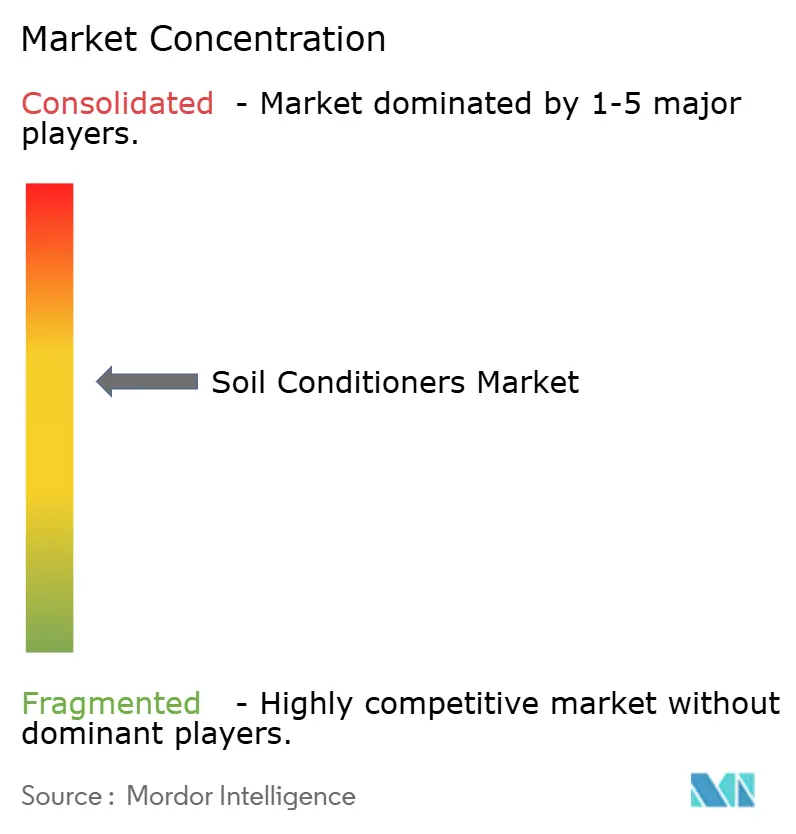
| Market Concentration | Medium |
Major Players *Disclaimer: Major Players sorted in no particular order Image © Mordor Intelligence. Reuse requires attribution under CC BY 4.0. | |
Soil Conditioners Market Analysis by Mordor Intelligence
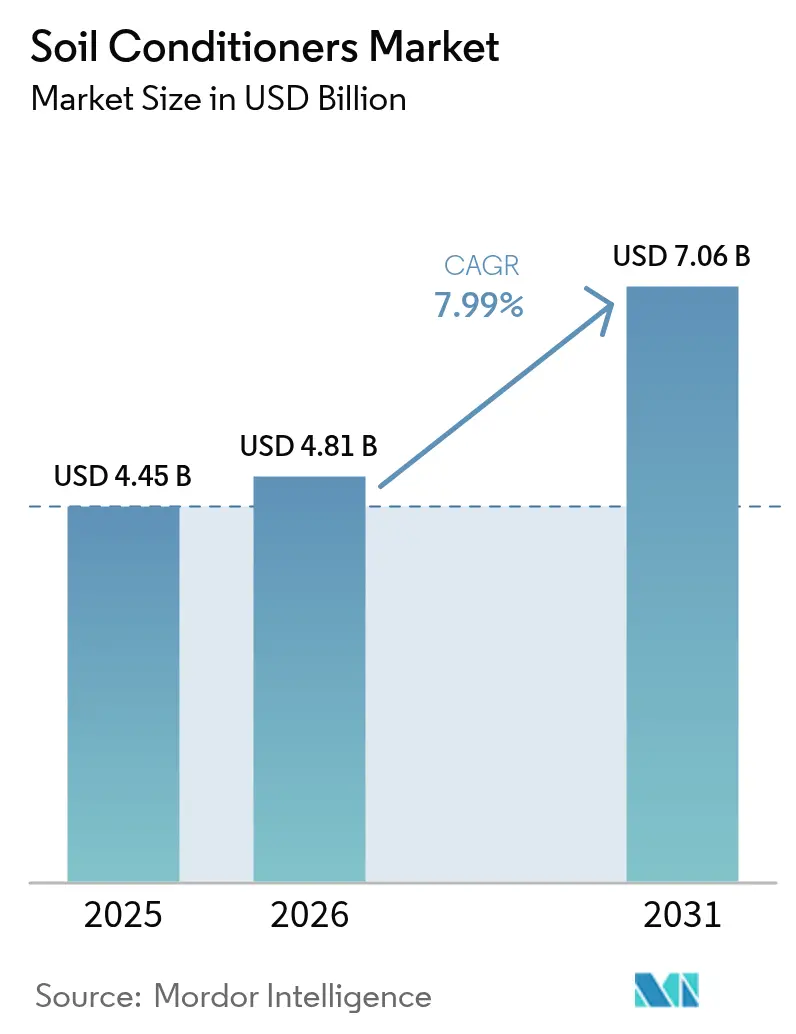
The soil conditioners market size is expected to grow from USD 4.45 billion in 2025 to USD 4.81 billion in 2026 and is forecast to reach USD 7.06 billion by 2031 at 7.99% CAGR over 2026-2031. Organic formulations already command the majority share, and liquid products are advancing quickly as protected and vertical farming expand. Digital soil-mapping tools are sharpening application precision, while leading suppliers are bundling biological products with data-driven advisory services to differentiate in a medium-concentrated playing field. Asia-Pacific remains the largest regional contributor, but Europe, the Middle East, and Africa are registering the fastest gains on the back of stringent soil-health regulations.
Key Report Takeaways
- By product type, organic inputs held a 55.60% market share of the soil conditioners market in 2025, while enzyme-enhanced variants are predicted to grow at an 8.54% CAGR through 2031.
- By crop type, cereals and grains captured 33.60% of the soil conditioners market size in 2025. Fruits and vegetables are projected to expand at a 9.21% CAGR from 2026 to 2031.
- By formulation, dry products led with a 43.20% revenue share of the soil conditioners market size in 2025, whereas liquid solutions are advancing at a 9.65% CAGR from 2026 to 2031.
- By geography, the Asia-Pacific region accounted for 37.90% market share of the soil conditioners market in 2025. South America is the fastest-growing region, with an 8.15% CAGR.
Note: Market size and forecast figures in this report are generated using Mordor Intelligence’s proprietary estimation framework, updated with the latest available data and insights as of 2026.
Market Trends and Insights
Drivers Impact Analysis of Soil Conditioners Market*
| Driver | (~) % Impact on CAGR Forecast | Geographic Relevance | Impact Timeline |
|---|---|---|---|
| Rising adoption of organic and regenerative farming | +1.2% | North America, Europe, global spread | Medium term (2-4 years) |
| Increasing soil-health degradation and erosion | +1.8% | Asia-Pacific, Africa, global | Long term (≥ 4 years) |
| Rapid growth in protected and vertical farming acreage | +0.8% | Europe, North America, urban hubs | Medium term (2-4 years) |
| Carbon-credit monetization for soil-health inputs | +1.0% | North America, Europe, emerging Asia-Pacific | Medium term (2-4 years) |
| Enzyme-activated bio-conditioners boosting nutrient-use efficiency | +1.1% | Developed agricultural markets | Short term (≤ 2 years) |
| Government "4 per 1000" and similar soil-carbon initiatives are linking subsidies to conditioner adoption | +0.7% | Europe, with expanding coverage to Asia-Pacific and South America | Long term (≥ 4 years) |
| Source: Mordor Intelligence | |||
Rising Adoption of Organic and Regenerative Farming
A global pivot toward regenerative practices is elevating the soil conditioners market. Retail sales of organic fruits and vegetables reached USD 60 billion in 2022, underscoring consumer willingness to pay for sustainably grown produce[1]Source: Michel Cavigelli, “The Economics of Regenerative Agriculture,” USDA Agricultural Research Service, ars.usda.gov. Agrology’s 2024 trials revealed that Merced rye cover crops boosted microbial activity and soil water retention in drought-prone orchards. As farmers seek inputs compatible with both soil health and certification standards, demand for organic conditioners accelerates.
Increasing Soil Health Degradation and Erosion
Roughly 40% of farmland is now classified as degraded, placing food security at risk, with the most severe effects in Asia-Pacific and Africa. Biochar applications have demonstrated water-retention gains of up to 154% and plant-growth increases of nearly 70% in rehabilitation trials. The soil conditioners market is therefore viewed as a strategic lever to restore productivity and mitigate the economic drag linked to land degradation.
Rapid Growth in Protected and Vertical Farming Acreage
Controlled-environment agriculture is a high-density, high-value production system that requires precise substrate management. Liquid humate solutions such as LIQHUMUS Liquid 18 have demonstrated superior nutrient uptake and root development in hydroponic tomato trials, positioning liquid conditioners as the preferred format in vertical farms. Because performance outcomes are more predictable indoors, product attributes such as enzyme activation and rapid solubility command price premiums, reinforcing the growth prospects for specialty formulations.
Carbon-Credit Monetization for Soil-Health Inputs
Carbon markets are turning soil improvement into a revenue stream. Verified biochar projects fetch between USD 171.2 (EUR 150) and USD 627.8 (EUR 550)/metric ton CO₂ on European exchanges[2]Source: Alessandro Pinzuti, “Biochar: Analysis and Economic Potential with a Focus on European Producers,” Politecnico di Torino, webthesis.biblio.polito.it. Field data from the Mid-Southern United States show that carbon-credit revenue bridges yield dips during the switch to regenerative systems. This incentive loop accelerates the adoption of conditioners that both sequester carbon and elevate soil fertility.
Restraints Impact Analysis of Soil Conditioners Market*
| Restraint | (~) % Impact on CAGR Forecast | Geographic Relevance | Impact Timeline |
|---|---|---|---|
| Premium pricing of advanced soil conditioners | −1.1% | Developing regions worldwide | Medium term (2-4 years) |
| Fragmented on-farm advisory and awareness gaps | −0.9% | South Asia, Africa | Short term (≤ 2 years) |
| Regulatory uncertainty on emerging bio-stimulant classifications | -0.6% | Global, with particular impact in Europe and North America | Medium term (2-4 years) |
| Supply-chain risk for speciality raw materials | -0.8% | Global, with supply chains concentrated in Asia-Pacific | Short term (≤ 2 years) |
| Source: Mordor Intelligence | |||
Premium Pricing of Advanced Soil Conditioners
Enzyme-activated and microbial conditioners can command higher prices, reflecting their high R&D intensity. While early adopters justify the cost through higher yields and carbon credits, smallholders in developing markets remain price-sensitive. Producers are also experimenting with tiered product lines to accommodate diverse purchasing power, tempering the negative impact on the soil conditioners market.
Fragmented On-Farm Advisory and Awareness Gaps
Optimal use of conditioners is site-specific, yet extension services in South Asia and Africa are often under-resourced. A Kenyan field study found that information deficits and dominance of inorganic fertilizer channels constrain farmers' preference for organic inputs. Partnering with ag-retail intermediaries and deploying mobile agronomy support can close these gaps, restoring growth momentum in currently under-penetrated regions.
*Our forecasts treat driver/restraint impacts as directional, not additive. The impact forecasts reflect baseline growth, mix effects, and variable interactions.
Soil Conditioners Market Segment Analysis
By Product Type:
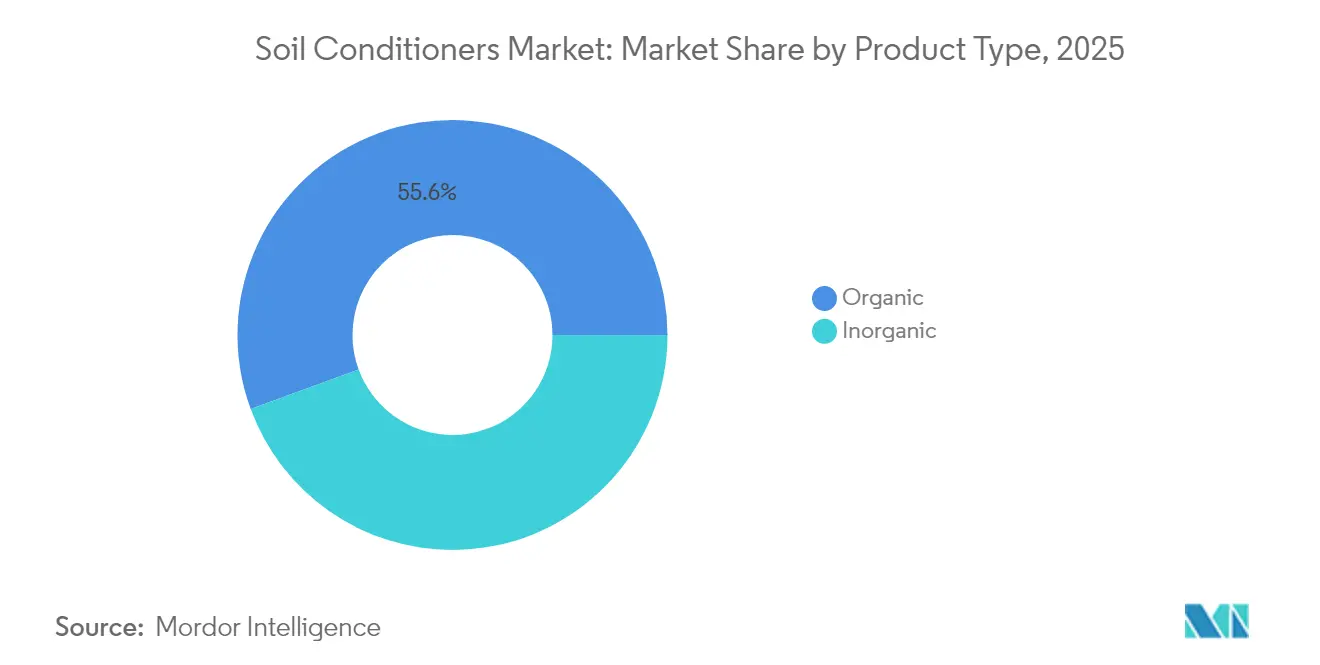
Organic dominance, enzyme-enhanced accelerationOrganic inputs held 55.60% of the soil conditioners market share in 2025, while enzyme-enhanced variants are predicted to grow at an 8.54% CAGR through 2031, aided by burgeoning demand for residue-free produce and regulatory support for biological inputs. Organic amendments also align with carbon credit frameworks, reinforcing their uptake. Enzyme-enhanced organic variants are emerging within this space, offering faster nutrient cycling and micro-aggregate formation.
The inorganic segment, although smaller, continues to address pH imbalances and structural issues in heavy soils, with liquid gypsum gaining favour in the United Kingdom’s new Agriculture Bill compliance programs. The soil conditioners market is witnessing increased R&D in polymer-based micro-granules that combine soil structural benefits with enhanced moisture retention.


By Crop Type:
Cereals retain scale, fruits and vegetables escalateCereals accounted for 33.60% of the soil conditioners market size in 2025, as growers seek yield stability across vast acreage. Organic amendments can raise soil organic matter by 69% and microbial biomass by 11% in cereal systems. This re-energises soils prone to monoculture fatigue and nutrient mining. Meanwhile, the high-value fruits and vegetables segment is forecast to grow at a rate of 9.21% annually to 2031, driven by quality premiums associated with taste, shelf life, and appearance.
Trials in tomato cultivation show that cow-manure conditioners yield up to 103 metric tons/ha under optimum regimes . Innovations, such as coal tailings–based pellets, increased tomato yield by 11.1%, demonstrating potential for circular-economy amendments. As controlled-environment systems scale, fruits and vegetables will further drive the growth of the soil conditioners market.
By Formulation:
Dry formats lead, liquids gather momentumDry products accounted for 43.20% of the soil conditioners market size in 2025, supported by logistical ease and compatibility with broadcasting equipment. Granular biochar, pelletised compost, and powdery humates deliver measured nutrient release, suiting broad-acre operations. Recent enzyme-fortified granules improve microbial colonization and nutrient mineralization, widening the appeal of dry formats.
Liquid conditioners, however, are projected to rise at a 9.65% CAGR to 2031, driven by the demand for rapid assimilation from fertigation and hydroponic systems. Potassium humate liquids, exemplified by LIQHUMUS Liquid 18, have shown enhanced root elongation and stress resilience in leafy greens. Ultra-low pH acidifiers, such as Absolute Acid 1-0-0, balance alkaline irrigation water in arid zones, extending the reach of the soil conditioners market to saline-affected geographies.

Geography Analysis
APAC and South America Soil Conditioners Market
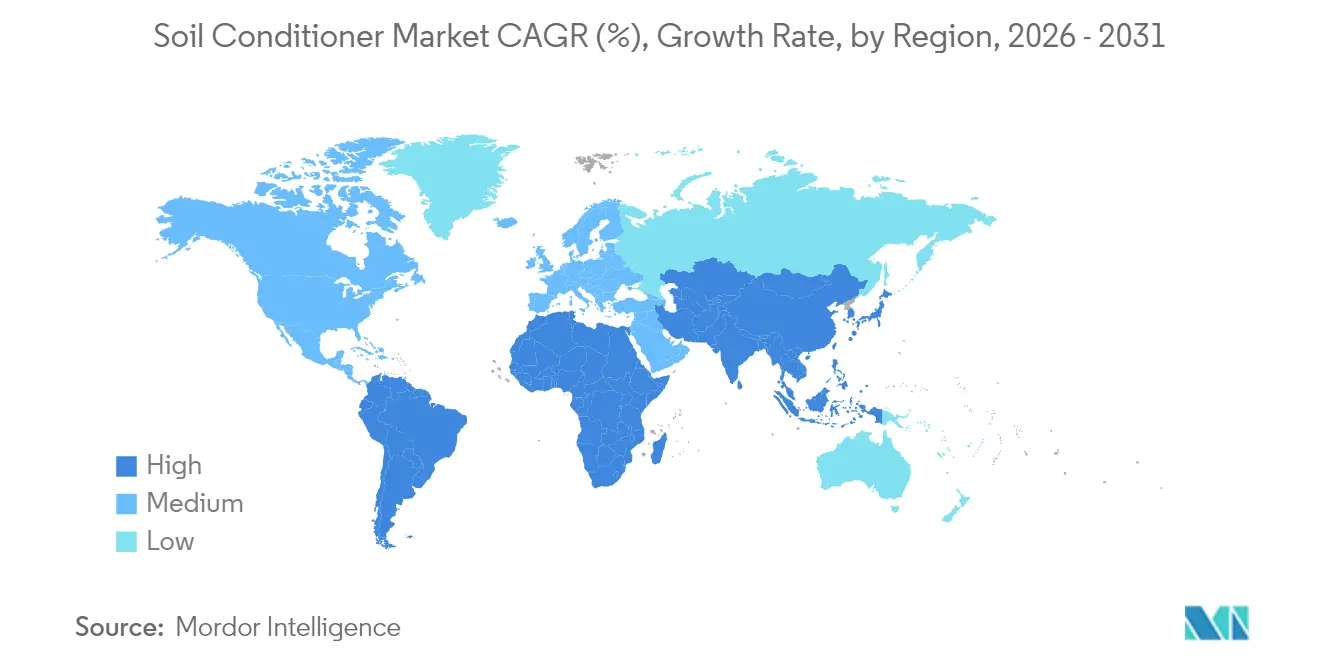
Asia-Pacific accounted for 37.90% of the market share of the soil conditioners market in 2025, and South America is the fastest-growing region at 8.15% CAGR. An extensive agricultural base and acute challenges related to soil erosion drive the soil conditioners market. Government programs in China and India subsidise organic inputs, and protected cultivation is expanding in Japan and Australia. Biomass-ash conditioners increased soil pH by up to 13.6% and crop yield by 25.3% in Guizhou field tests, demonstrating notable performance gains.
EMEA Soil Conditioners Market
Europe, the Middle East, and Africa record the fastest market growth as policy shifts embed soil health into agricultural legislation. The European Union’s organic-farming targets mandate biologically driven fertility management. Biochar adoption is surging in Germany and the Nordics, while African recycling initiatives propose that organic and bio-fertiliser streams could supply 20-40% of crop nutrient demand.
North America Soil Conditioners Market
North America maintains a technologically advanced position within the soil conditioners market. Carbon-credit revenues now offset early yield dips associated with conservation agriculture, underpinning investments in soil amendments. Precision-ag platforms integrate soil-conditioner recommendations with equipment-mounted variable-rate applicators, reinforcing regional leadership.

Regulatory Landscape
Regulation is tightening around soil-health outcomes and product-material characteristics, raising the bar for documentation and performance claims across organic and inorganic soil conditioners. In the European Union, Regulation (EU) 2024/2770 set biodegradability criteria for coating agents and water retention polymers used in fertilising products, including a requirement of 90% degradation within 48 months. That requirement directly affects polymer-based conditioners and coated formulations. Separately, the EU Soil Monitoring Law, Directive (EU) 2025/2360 entered into force on 16 December 2025, increasing institutional focus on soil monitoring and comparability of soil-health indicators, which supports data-backed conditioner programs.
Outside the EU, frameworks for biologicals and related input categories are becoming more standardized, but implementation remains uneven across markets. In India, the Ministry of Agriculture and Farmers Welfare notified the Fertilizer Control Order Fourth Amendment Order, 2026 (March 2026), expanding biostimulant regulations with defined compositions and use protocols. This increases the importance of compliant labeling and tested efficacy for biological conditioner-adjacent products. In the United Kingdom, Defra is advancing the UK Fertilising Product Regulations (UK FPR) to replace existing legislation with a harmonised, conformity-based approach. In the United States, the EPA issued a draft Pesticide Registration Notice (PRN) in January 2026 aimed at streamlining certain minor formulation and labeling amendments, helping suppliers manage iterative changes for products covered by pesticide registration requirements.
Competitive Landscape
The soil conditioners market exhibits a medium level of concentration, with incumbent agrochemical firms and niche biological specialists competing for market share. BASF, UPL, Syngenta, and ICL steer R&D toward enzyme-activated and microbial conditioners, leveraging robust distribution networks. Monty’s Plant Food Company differentiates through proprietary humic-activation technology that enhances consistency across diverse soil types.
Merger and acquisition momentum is reshaping competitive dynamics. Huma acquired Gro-Power to expand its biological portfolio. Lesaffre purchased Altar to accelerate fermentation innovation, and ICL acquired Nitro 1000 for South American expansion, signaling a drive to embed technology and gain regional access. Companies are also forming data partnerships. Syngenta’s Interra Scan delivers soil maps that inform conditioner dosage, creating bundled service propositions appealing to progressive growers.
White-space opportunities include conditioners tailored for vertical farms and regenerative systems. Suppliers integrating digital agronomy, carbon-footprint calculators, and subscription models are likely to gain durable competitive advantage. The pursuit of multifunctional products such as UPL’s NIMAXXA, combining bionematicide and biostimulant traits further intensifies product-development races.
Soil Conditioners Industry Leaders
UPL Limited
BASF SE
Syngenta Group
Coromandel International Ltd.
FMC Corporation
- *Disclaimer: Major Players sorted in no particular order
Soil Conditioners Market Companies Covered in this Report
- BASF SE
- UPL Limited
- Syngenta Group
- Croda International Plc
- Solvay S.A.
- Evonik Industries AG
- Coromandel International Ltd.
- Novonesis Group
- Humintech GmbH
- FMC Corporation
- Yara International ASA
- Haifa Group

Market Opportunities and Future Outlook
Public programs and policy actions that explicitly fund or accelerate whole-farm soil-health practices are strengthening demand signals for soil conditioners that can be supported within conservation and regenerative frameworks. In the United States, USDA launched the USD 700 million Regenerative Pilot Program in December 2025 through NRCS, and a June 2026 Executive Order directed the Secretary of Agriculture to expand the program reach and build public-private partnerships to increase adoption capacity. This creates room for supplier offerings that bundle conditioners with digital soil mapping, variable-rate guidance, and reporting tools that translate improvements into auditable outcomes for farm plans and incentive programs.
Product whitespace is also forming around multifunctional amendments designed to reduce reliance on synthetic nitrogen and improve water and nutrient management in protected, high-value cropping systems. InVivo, for instance, was reported in July 2026 to be constructing a production facility to support a planned commercial launch of a liquid-formulation, zeolite-based crop nutrition product. The company positions the product as enabling a 30% reduction in synthetic nitrogen fertilizer application. Alongside biochar and polymer innovations already present in the market scope, such moves point to near-term opportunities for conditioners that combine mineral or carbon-based matrices with biological activity and precision-application compatibility, especially in fruits and vegetables and controlled-environment agriculture where repeatable performance and dosing accuracy influence purchasing decisions.
Recent Industry Developments in Soil Conditioners Market
- June 2026: Jain Irrigation Systems Ltd commissioned a 20,000-tonne-per-year biochar facility in Jalgaon, Maharashtra, to convert agricultural residues into soil-enhancing biochar. The project expands regional supply of a carbon-rich amendment used to improve soil structure and moisture retention. It also signals growing industrial-scale capacity for circular-economy soil inputs in Asia-Pacific.
- May 2026: UPL secured Fertilizer Control Order (FCO) registration in India for its Bioclassic biostimulant, enabling national commercialization. The approval reduces a key market-entry barrier for biological products that sit adjacent to, or are bundled with, soil conditioner programs. It improves UPL's ability to scale its biological portfolios in a high-volume market where compliance drives adoption.
- December 2025: UPL launched a new seaweed-based biostimulant positioned to address abiotic stress and enhance nitrogen uptake. The launch broadens the company's biological offering set that is frequently marketed alongside soil health and conditioner-led agronomy packages. It reflects continued supplier emphasis on biological actives that complement soil-conditioning outcomes in high-value crops.


Soil Conditioners Market Report Scope and Research Methodology
Market Definition and Coverage
For this study, the market covers materials applied to soil to improve physical condition, moisture holding, aeration, and nutrient use efficiency in crop production, and it is measured as the value of products sold for agricultural use.
Scope exclusions: We exclude conventional N-P-K fertilizers and standalone soil testing services, even if they are promoted together with soil health programs.
Segments Covered in This Report
- By Product Type
- Organic
- Compost
- Green and Farmyard Manure
- Peat
- Other Organic Types
- Inorganic
- Polymers
- Gypsum
- Organic
- By Crop Type
- Cereals and Grains
- Fruits and Vegetables
- Oilseeds and Pulses
- Other Crops
- By Formulation
- Dry
- Liquid
- Granular
- Pellets and Others
- By Geography
- North America
- United States
- Canada
- Mexico
- Rest of North America
- South America
- Brazil
- Argentina
- Rest of South America
- Europe
- Germany
- France
- United Kingdom
- Spain
- Italy
- Russia
- Rest of Europe
- Asia-Pacific
- China
- India
- Japan
- Australia
- Rest of Asia-Pacific
- Middle East
- Saudi Arabia
- Rest of Middle East
- Africa
- South Africa
- Rest of Africa
- North America
Data Sources, Market Sizing, and Validation
Desk Research
To set the market boundaries and build the first view of demand, we start with public agriculture and soil health references, such as FAOSTAT crop and land-use series, USDA and ERS publications, Eurostat agriculture inputs data, and national soil or agronomy agencies where available. We also review standards and guidance from organizations like the International Fertilizer Association, along with academic journals covering soil organic matter, soil structure, and amendment performance.
On the supply side, we screen company annual reports, investor decks, and press coverage to understand product mix and regional exposure. Trade statistics and customs summaries help when imports of soil amendments are meaningful, and we selectively use paid subscriptions for company financials and patent databases to cross-check innovation activity and revenue scale. These desk sources are not exhaustive, and we use additional public and paid references to validate figures and clarify assumptions during the work.
Primary Interviews and Surveys
Primary interviews and surveys were run with manufacturers, distributors, agronomists, and large farm operators to confirm adoption patterns and the logic behind pricing across crop cycles. As the market is global, input was balanced across APAC, EMEA, and the Americas so assumptions on application rates, product switching, and currency translation could be checked with people close to buying decisions.
Distribution of primary research fieldwork respondents
| Company type | Respondent position | Region |
|---|---|---|
| Top tier: 25% | CXOs: 14% | APAC: 39% |
| Mid tier: 55% | Functional/Unit leaders: 28% | EMEA: 36% |
| Smaller Players: 20% | Managers: 58% | Americas: 25% |
Market-Sizing & Forecasting
We size the market mainly through a top-down build that reconstructs the addressable demand pool by linking cultivated area and crop mix with typical soil-conditioning application intensity, and then converting that into value using region-specific average selling prices. Results are then corroborated with selective bottom-up approximations, where product revenue ranges and channel feedback are used to sanity-check totals and adjust obvious over- or under-counts.
A few practical inputs that guide the model include: trends in arable land and permanent crop area, crop planting mix shifts, soil degradation and salinity signals discussed in agronomy literature, organic matter management practices, and the split between organic and inorganic conditioners where it changes price levels. Pricing is handled through a simple ASP ladder by region and formulation, followed by year-by-year currency conversion aligned to the reporting year so inflation and FX effects are not mixed up.
For forecasting, we use scenario analysis with a base case anchored on expected acreage, crop price sentiment, and soil health policy direction, which are then stress tested through expert feedback. Where bottom-up datapoints are missing in smaller countries, gaps are handled through proxy ratios from comparable agronomic zones, and then rechecked in interviews before finalizing.
Data Validation & Update Cycle
After the first model run, we compare outputs against independent signals such as amendment import momentum, revenue direction from suppliers with material exposure, and observed pricing movement for key conditioner types. Large variances are flagged, and the assumptions that caused them are reworked, followed by a second review so the final numbers do not rely on one data path.
Before sign-off, an analyst conducts anomaly checks at the region level and at the global roll-up, and re-contacts sources when pricing or adoption statements conflict with the desk view. Reports are refreshed annually, with interim updates triggered by material events such as policy changes, sharp FX moves, or sudden shifts in input costs. Right before delivery, a final pass is made so the client receives the most current view available.
Mordor Intelligence's Soil Conditioners Market Size Versus Other Published Estimates
Published market sizes for soil conditioners often do not match because the scope boundary can shift, and pricing and currency treatment can change totals even when volumes look similar. We also see gaps when one estimate relies more on broad agriculture spending ratios, while another uses application-led demand indicators.
In this study, the refresh cadence and the timing of FX conversion are treated as part of the sizing discipline, since price inflation in amendments and shifting exchange rates can otherwise distort year-to-year comparisons. This approach is reinforced through repeat validation checks with channel respondents, which is a workflow used in the market sizing process at Mordor Intelligence.
Benchmark comparison
| Source | Market Size | Gaps in Research Methodology |
|---|---|---|
| Mordor Intelligence | USD 4.81 B (2026) | |
| Trade Journal A | USD 5.54 B (2024) | Uses an earlier base year and is presented as a single-point current value, with limited visibility on ASP progression and whether adjacent soil amendment items are included in the same basket. |
| Global Consultancy B | USD 9.50 B (2031) | Reported as an end-year projection that can differ based on scenario choice, inflation pass-through in ASPs, and how organic and inorganic conditioners are priced across regions over the forecast window. |
Overall, the spread is largely explained by year selection and how price and currency effects are layered into the value build, followed by the exact inclusion line between conditioners and nearby amendment categories. By keeping assumptions tied to observable acreage-linked demand inputs and rechecking price logic with practitioners, the estimate stays traceable and repeatable for planning.


Key Questions Answered in the Report
What is the current and forecast value of the Soil Conditioners market?
The market stands at USD 4.81 billion in 2026 and is projected to reach USD 7.06 billion by 2031 at a 7.99% CAGR.
Which product type holds the largest share?
Organic inputs represent 55.60% of market revenue owing to demand for sustainable farming practices.
Why are liquid soil conditioners growing faster than dry formats?
Liquids integrate quickly into substrates, suit fertigation and hydroponic systems, and deliver immediate nutrient availability, driving a 9.65% CAGR.
How do carbon credits influence soil-conditioner adoption?
Biochar and other amendments earn USD 171.2 (EUR 150) and USD 627.8 (EUR 550)/ metric ton CO₂ on carbon markets, offsetting costs and accelerating uptake.
Which region is expanding most rapidly?
South America lead growth, bolstered by strict soil-health regulations and rising organic-farming targets.
What technological trend is reshaping competition?
The integration of digital soil mapping with biological conditioners is enabling precision application and measurable ROI for growers.
Page last updated on:


 Your data is secure and never sold or shared.


