
Software Consulting Market Size and Share
Market Overview
| Study Period | 2020 - 2031 |
|---|---|
| Market Size (2026) | USD 380.26 Billion |
| Market Size (2031) | USD 801.43 Billion |
| Growth Rate (2026 - 2031) | 16.08% CAGR |
| Fastest Growing Market | Asia-Pacific |
| Largest Market | North America |
| Market Concentration | Low |
Major Players *Disclaimer: Major Players sorted in no particular order Image © Mordor Intelligence. Reuse requires attribution under CC BY 4.0. | |
Software Consulting Market Analysis by Mordor Intelligence
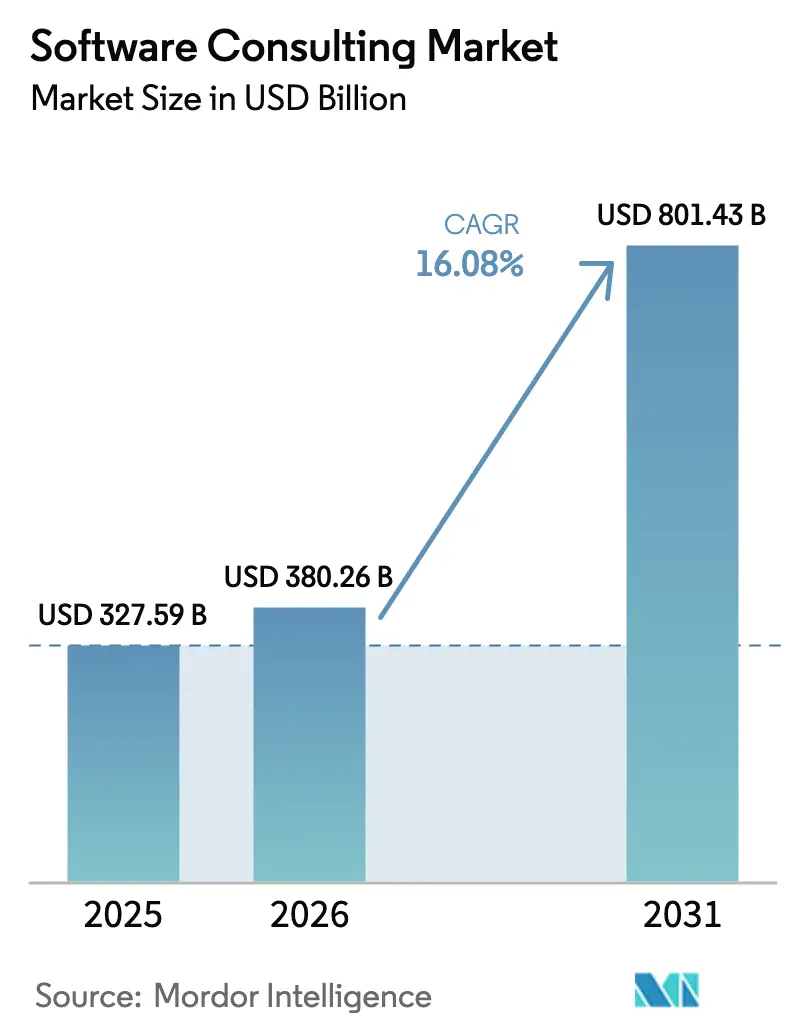
The software consulting market size was valued at USD 327.59 billion in 2025 and estimated to grow from USD 380.26 billion in 2026 to reach USD 801.43 billion by 2031, at a CAGR of 16.08% during the forecast period (2026-2031). Enterprises have shifted from cost-containment toward revenue-growth goals, driving large-scale modernization programs anchored in cloud-native platforms, AI-enabled business processes, and data-centric operations. The looming retirement of SAP ECC is adding urgency as more than two-thirds of installed customers still need to move to S/4HANA. At the same time, public-sector digitalization and sector-specific regulations, especially in healthcare and financial services, are broadening consulting opportunities. Competitive intensity centers on AI partnerships, with leading firms earmarking multi-billion-dollar budgets for generative AI tooling and domain models.
Key Report Takeaways
- By service type, application development and modernization led with 37.72% of software consulting market share in 2025, while data and AI/ML consulting is projected to expand at a 17.02% CAGR to 2031.
- By deployment model, public cloud solutions accounted for 46.12% share of the software consulting market size in 2025 and hybrid/multi-cloud architectures are advancing at a 19.12% CAGR through 2031.
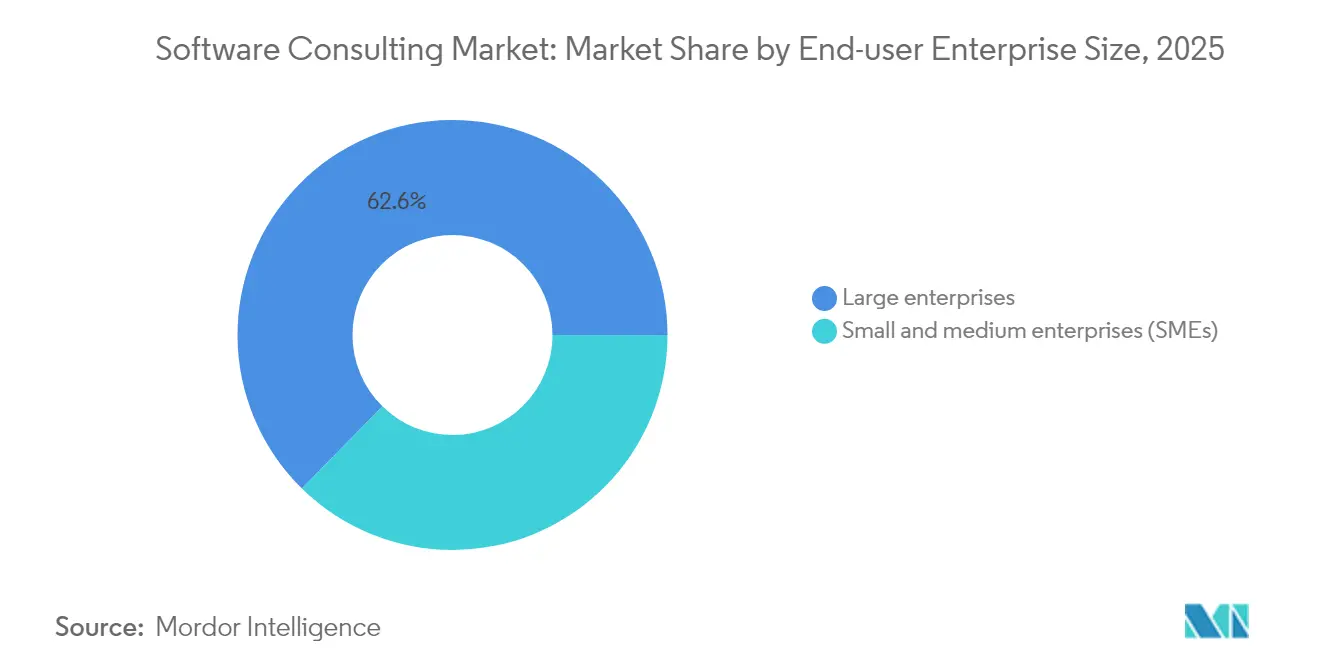
- By enterprise size, large enterprises held 62.65% share of the software consulting market size in 2025, whereas the SME segment records the fastest 16.84% CAGR to 2031.
- By end-user industry, the BFSI sector commanded 24.18% share of the software consulting market size in 2025; healthcare and life sciences is set to grow at a 16.42% CAGR through 2031.
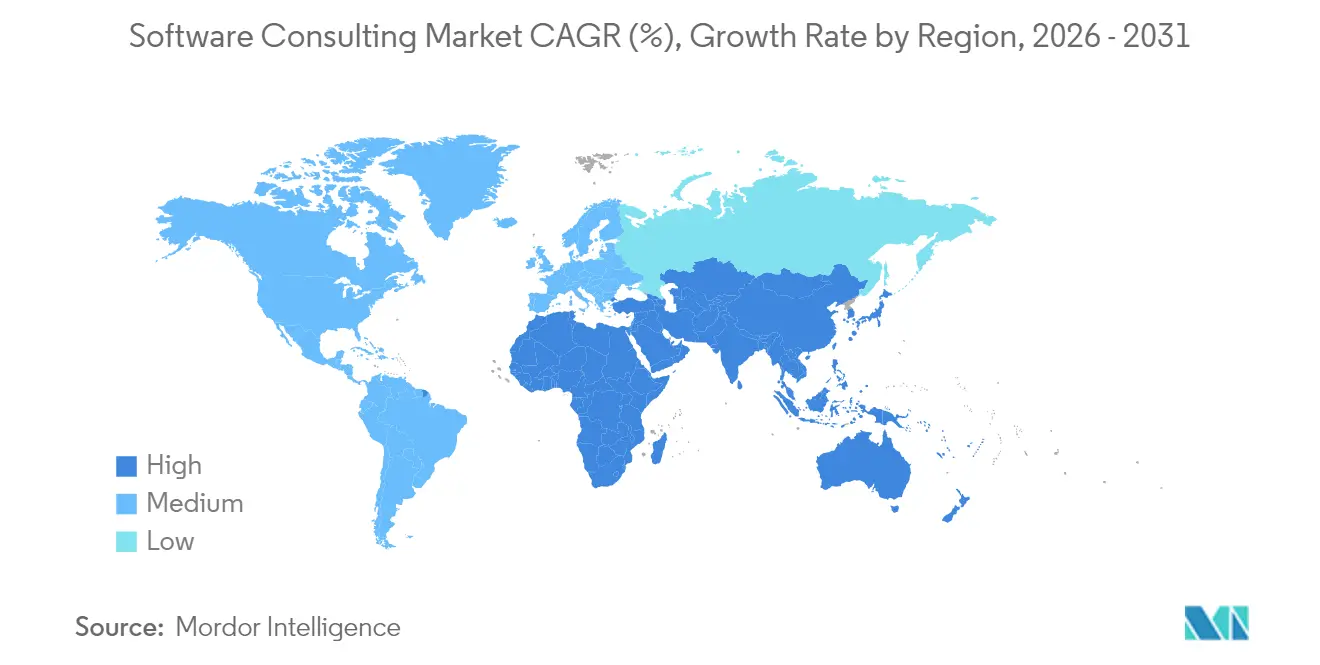
- By geography, North America captured 27.55% software consulting market share in 2025; Asia-Pacific is forecast to post the strongest 18.02% CAGR between 2026-2031.
Note: Market size and forecast figures in this report are generated using Mordor Intelligence’s proprietary estimation framework, updated with the latest available data and insights as of 2026.
Global Software Consulting Market Trends and Insights
Drivers Impact Analysis*
| Driver | ( ) % Impact on CAGR Forecast | Geographic Relevance | Impact Timeline |
|---|---|---|---|
| Enterprise cloud-migration acceleration | +3.2% | Global, North America and Europe leading | Medium term (2-4 years) |
| Digital-transformation mandates post-COVID | +2.8% | Global, strongest in Asia-Pacific | Short term (≤ 2 years) |
| Need for operational efficiency and cost optimisation | +2.1% | Global, manufacturing-led | Long term (≥ 4 years) |
| Growing data-analytics and AI adoption | +4.5% | North America and Europe core, Asia-Pacific spill-over | Medium term (2-4 years) |
| Looming SAP ECC sunset fuelling S/4HANA consulting demand | +2.7% | Global, DACH concentration | Short term (≤ 2 years) |
| Emerging AI-governance and compliance mandates | +1.9% | Europe and North America | Long term (≥ 4 years) |
| Source: Mordor Intelligence | |||
Enterprise Cloud-Migration Acceleration
Cloud migration has become foundational for digital agendas. Enterprises are shifting mission-critical workloads to public and hybrid clouds to support distributed workforces and real-time analytics. European software spending climbed 5.1% in 2024, and off-the-shelf AI software investments in Germany, France, and the United Kingdom are rising 21% each year. Nordic economies recorded USD 44 billion in software revenues with 16% annual growth, underscoring how cloud-first strategies underpin export competitiveness.[1]Julie Sweet, “Accenture Reports Fourth-Quarter and Full-Year 2024 Results,” accenture.com With 85% of organizations adopting cloud-first development, global cloud outlays are set to surpass USD 675.4 billion. These complex transitions require consultants skilled in multi-cloud architecture, data-sovereignty design, and workload refactoring, areas where in-house teams often lack depth.
Digital-Transformation Mandates Post-COVID
Post-pandemic priorities have reframed digital transformation as a survival requirement. Surveys show 87% of consulting clients launched enterprise-wide programs in the last three years and 92% relied on external partners for execution. Technology consulting spend exceeds USD 400 billion in 2025, with implementation services representing more than half. Public-sector agencies are especially active; only 17% of UK decision makers deemed earlier initiatives successful, and 63% expect higher budgets for third-party support. This momentum sustains demand across all industries as digital capabilities shift from optional efficiency plays to the baseline for competitiveness.
Growing Data-Analytics and AI Adoption
AI consulting now represents the steepest growth slope. Leading consultancies tripled AI revenues to roughly USD 900 million annually, and one major strategy firm generated one-fifth of total fees from AI within two years. With 79% of executives convinced generative AI will reshape their companies and 91% expecting productivity lifts, advisory needs span strategy, data-fabric design, model governance, and workforce re-skilling. The value proposition rests on turning proof-of-concept pilots into scaled, production-grade systems that integrate compliantly with core business processes.
Looming SAP ECC Sunset Fuelling S/4HANA Consulting Demand
SAP will cease mainstream maintenance for Business Suite 7 on 31 December 2027. Only 28% of the original 35,000 ECC customers were live on S/4HANA by end-2023. Projects involve data cleansing, process standardization, and change management that can span seven years. Studies show 65% of early adopters missed quality targets and 55% overshot budgets, reinforcing the premium on seasoned consulting talent.
Restraints Impact Analysis*
| Restraint | (~) % Impact on CAGR Forecast | Geographic Relevance | Impact Timeline |
|---|---|---|---|
| Heightened cybersecurity and data-privacy concerns | -1.8% | Global, strongest in Europe | Medium term (2-4 years) |
| Talent shortage and rising consulting rates | -2.3% | Global, North America and Europe acute | Short term (≤ 2 years) |
| Rapid low-code / no-code adoption | -1.5% | Global, SME-led | Long term (≥ 4 years) |
| Gen-AI automating basic advisory tasks | -1.1% | North America and Europe | Medium term (2-4 years) |
| Source: Mordor Intelligence | |||
Heightened Cybersecurity and Data-Privacy Concerns
Cyber risk escalates faster than defensive postures. Three-quarters of enterprises raised security budgets, yet execution lags as talent shortages stretch project timelines. The United States needs 225,000 additional cybersecurity professionals, while Europe faces overlapping mandates such as the EU AI Act and Data Act.[2]Clar Rosso, “Cybersecurity Workforce Study 2024,” isc2.org These frameworks lengthen deployment schedules and inflate engagement costs as consultants navigate privacy-by-design requirements alongside business goals. The dilemma both fuels security consulting demand and constrains overall delivery velocity.
Talent Shortage and Rising Consulting Rates
Global shortfalls could leave 85 million technical jobs vacant by 2030, with potential USD 8.4 trillion revenue at risk. The United States already tracks 918,000 open technology roles. Major Indian IT firms plan aggregate hiring of more than 60,000 graduates for FY26, yet attrition persists. Wage inflation and aggressive retention incentives pressure margins, particularly for mid-tier consultancies.[3]US Bureau of Labor Statistics, “Employment Projections 2024-2030,” bls.gov Firms have responded with expanded training programs, automation of repeatable tasks, and offshore delivery hubs, but the skills gap continues to limit project throughput.
*Our forecasts treat driver/restraint impacts as directional, not additive. The impact forecasts reflect baseline growth, mix effects, and variable interactions.
Segment Analysis
By Service Type: AI Consulting Drives Premium Growth
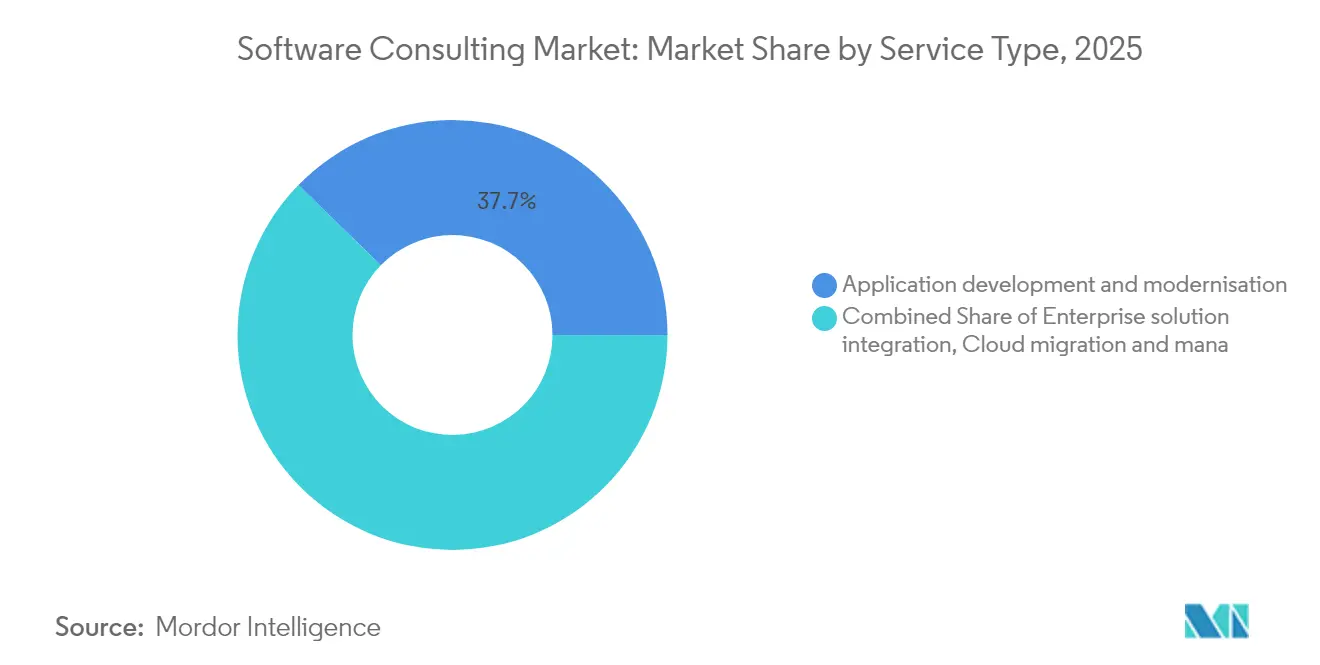
Application development and modernization retained 37.72% software consulting market share in 2025, reflecting the urgency to re-platform legacy applications on cloud-native, API-centric stacks. Enterprises depend on these services to unlock continuous deployment, improve system resilience, and reduce ownership costs. The segment remains anchored in large-scale refactoring and containerization projects that support omnichannel and real-time use cases across verticals.
Data and AI/ML consulting posts the fastest 17.02% CAGR toward 2031. Clients view machine learning models, predictive analytics, and generative AI frameworks as differentiators rather than efficiency levers. Advisory scope is expanding from algorithm selection to data-fabric design, ethical guardrails, and value-tracking dashboards. As model risks attract regulatory scrutiny, demand is shifting toward explainability assessments and governance protocols embedded into end-to-end AI pipelines.


By Deployment Model: Hybrid Architectures Gain Momentum
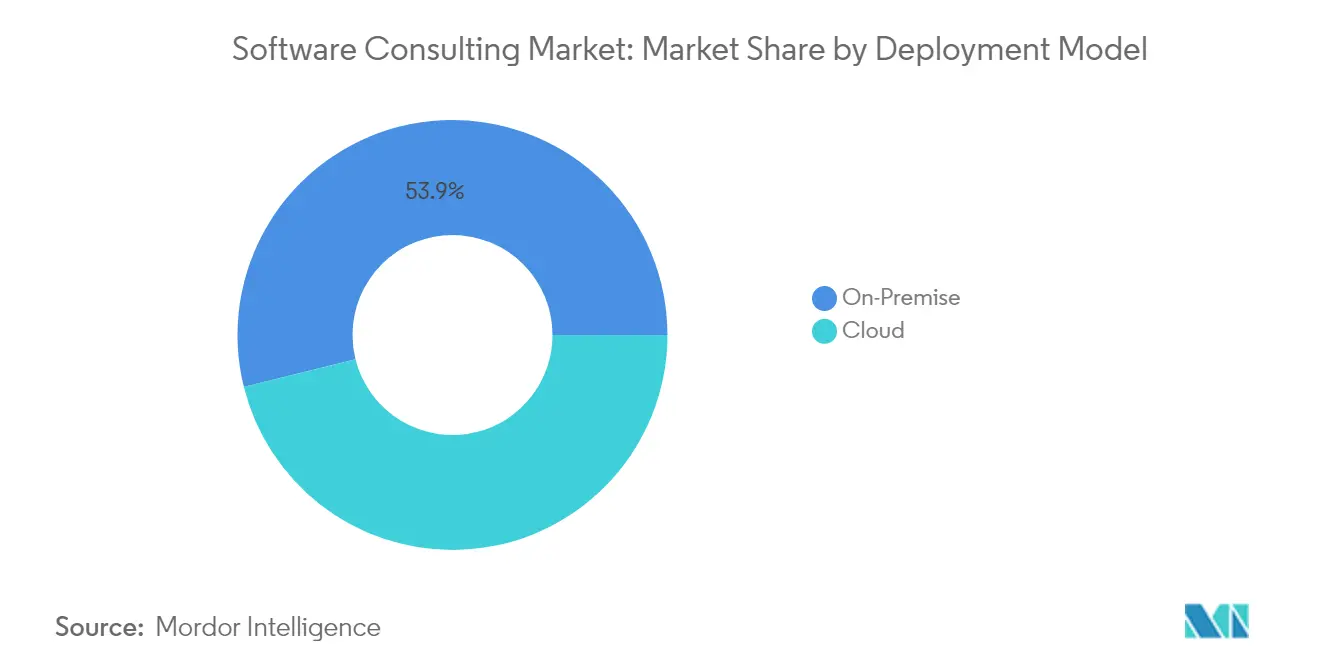
On Premises retained 53.88% share of the software consulting market size in 2025, propelled by scalability and pay-as-you-go economics that appeal to both greenfield and modernization programs. Offerings now span platform refactoring, DevSecOps automation, and cloud FinOps advisory that helps enterprises rein in rising consumption costs.
Also the cloud architectures record the highest 19.12% CAGR. Clients favor workload portability for data sovereignty and vendor risk mitigation. Consulting demand concentrates on cloud center-of-excellence design, unified observability stacks, and secure connectivity between on-premise, edge, and public cloud nodes. Edge computing adds complexity as 75% of enterprise data is processed closer to its source, generating new opportunities for architects versed in distributed data governance.
By Enterprise Size: SME Adoption Accelerates
Large enterprises continued to command 62.65% of the software consulting market size in 2025, leveraging deep budgets and global footprints that require multifaceted transformation programs. Engagements range from strategic road-mapping to full-stack implementation, often spanning finance, supply chain, and customer-experience revamps delivered across multiple continents.
SMEs show the briskest 16.84% CAGR, fueled by lower entry barriers from cloud-delivered consulting models and the democratization of low-code development. “Citizen developer” programs are proliferating, yet governance gaps remain, opening advisory niches in platform oversight, security, and skills enablement. Fixed-price, outcome-based packages are gaining favor among SMEs seeking predictable costs.
By End-User Industry: Healthcare Leads Growth Trajectory
BFSI accounted for 24.18% share of the software consulting market size in 2025. Regulatory reporting automation, open-banking API strategies, and AI-driven fraud detection dominate project pipelines. Consultancies with sector-specific accelerators and compliance frameworks command premium rates.
Healthcare and life sciences expand to 16.42% CAGR. Telemedicine platforms, IoMT ecosystems, and AI-powered diagnostics drive complex integrations with electronic health records. Data-privacy mandates such as HIPAA intensify the need for specialized domain knowledge. Supporting services now include algorithm-bias audits, clinical-workflow redesign, and secure cloud migration for sensitive patient data.
Geography Analysis
North America led with 27.55% market share in 2025, backed by strong enterprise IT budgets and a dense ecosystem of technology vendors and hyperscale clouds. US consulting expenditure approaches USD 400 billion annually, with advanced analytics outlays expected to rise 11% in 2025. Canada contributes meaningful growth through public-sector modernization and energy-sector digitization projects.
Asia-Pacific is the fastest-growing region, advancing at an 18.02% CAGR. India’s technology spending will reach USD 59 billion in 2025, driven by government digital initiatives and manufacturing modernization. China’s enterprises invest heavily in AI-enabled supply chains and smart factories, while Southeast Asian governments ramp up e-services and cybersecurity frameworks that require external advisory capabilities. Japan and South Korea sustain momentum through advanced manufacturing and 5G-driven applications.
Europe demonstrates steady expansion anchored by Germany, which holds roughly one-quarter of regional software value. SMEs are upgrading ERP and customer-experience platforms to compete globally. The EU AI Act introduces stringent governance obligations, boosting consulting demand for compliance assessments and audit-ready AI architectures. Nordic countries maintain outsized influence thanks to export-oriented software ecosystems and early adoption of cloud-first policies.
Mordor Intelligence provides coverage of the software consulting market across other key regional markets. Detailed country-level analysis extends to United States incorporating local coverage and market participation, as required.

Regulatory Landscape
Software consulting engagements are increasingly shaped by AI, privacy, and public-procurement controls that govern how client data is handled in cloud and AI programs. In the United States, the General Services Administration (GSA) issued a proposed GSAR clause (552.239-7001) on June 17, 2026 focused on data safeguarding requirements for large language model (LLM) AI systems used in federal contracting, raising the compliance bar for consultants delivering modernization, managed services, and AI-enabled workflows to government buyers.
In Europe, the EU AI Act and related EU data-governance rules are pushing consulting scope toward audit-ready AI architectures, transparency controls, and documentation for high-risk use cases, especially in regulated industries such as BFSI and healthcare. The EU AI Act transparency obligations under Article 50(2), including disclosure and watermarking for certain AI outputs, take effect on December 2, 2026, creating near-term demand for implementation support alongside broader AI governance and risk management programs.
Value Chain Analysis
The software consulting value chain starts with demand generation and deal structuring (RFPs, partner-led opportunities with hyperscalers and enterprise software vendors), followed by solutioning and delivery across application modernization, cloud migration and managed services, enterprise integration, security, and data and AI. Core delivery activities include discovery and architecture, build and integration, testing and release engineering (often via DevSecOps), and ongoing operations with SLAs, while client support spans change management, training, and continuous optimization for cost, performance, and compliance.
Support functions in the chain include talent acquisition and training, IP and accelerator development, vendor and subcontractor procurement (cloud platforms, SaaS and ISV tools, and cybersecurity products), and governance for quality and risk. AI-centric work also adds clearer role separation across the supply chain (model developers, system operators, system integrators, and service providers), which increases the need for contractual controls, data handling processes, and shared responsibility models when consultants embed third-party models, industry templates, and platform engineering into client environments.
Competitive Landscape
The software consulting market features moderate fragmentation. Accenture leads with USD 67.2 billion FY24 revenue, propelled by a USD 3 billion investment commitment in generative AI partnerships and talent.[5]Julie Sweet, “Accenture Reports Fourth-Quarter and Full-Year 2024 Results,” accenture.comThe firm’s Copilot collaboration with Microsoft underpins end-to-end productivity solutions across finance, supply chain, and customer service.
Indian majors strengthen share based on cost-effective global delivery. TCS posted USD 30.18 billion FY25 revenue and is scaling AI services through its proprietary cognitive suite. Infosys earned USD 4.94 billion during its most recent quarter and focuses on AI-first transformation, cloud modernization, and ESG reporting solutions.
Strategic acquisitions shape competitive dynamics. IBM added Hakkoda to deepen Snowflake and data-engineering expertise, complementing earlier purchases of Accelalpha and Applications Software Technology for Oracle-cloud consulting. Cognizant’s proposed USD 1.3 billion Belcan deal extends engineering R&D capabilities. Big Four professional-services firms collectively invested more than USD 4 billion in AI tooling to defend share against IT-services incumbents.
White-space prospects lie in quantum-safe cryptography advisory, AI governance frameworks, and verticalized large-language-model offerings. Boutique firms with niche IP and accelerator assets remain attractive targets as large players seek differentiation through specialized capability bundles.
Software Consulting Industry Leaders
Capgemini
Accenture PLC
Cognizant
Deloitte
IBM Corporation
- *Disclaimer: Major Players sorted in no particular order


Market Opportunities and Future Outlook
AI governance and compliant deployment are emerging as a distinct opportunity area as enterprises move from pilots to production and face new transparency, data handling, and model risk requirements. The EU AI Act transparency measures effective December 2, 2026, along with US federal procurement attention on LLM data safeguarding (GSA proposed GSAR clause 552.239-7001 dated June 17, 2026), are expanding demand for consulting around model documentation, security-by-design, data lineage, and operational controls across data and AI/ML consulting and software security consulting.
Another opportunity is platform-led consulting delivery, where firms package repeatable industry templates, platform engineering, and managed services into modular offerings suited to both vendor-consolidating large enterprises and cost-conscious mid-market buyers. Ongoing hyperscaler-led programs and partnerships, along with the market-wide shift toward hybrid and multi-cloud architectures, continue to create whitespace for consultancies that can standardize delivery across public cloud, on-premise, and edge environments while maintaining governance for sovereignty, cybersecurity, and regulated data handling.
Recent Industry Developments
- July 2026: Cognizant expands partnership with Google Cloud to accelerate enterprise AI adoption with Gemini Enterprise and Google Workspace. The collaboration accelerates AI enabled transformation for large enterprises by integrating Gemini Enterprise with existing cloud and collaboration tools. It strengthens Cognizant's AI first services and platform based delivery for enterprise scale modernization.
- June 2026: Capgemini signs a multi-year contract with HM Revenue and Customs HMRC to transform customer experience operations. The contract expands public sector digital transformation and AI automation footprint in government services. It broadens Capgemini's government sector delivery scale and capabilities.
- June 2026: Cognizant completes acquisition of Astreya, expanding AI infrastructure and managed services capabilities. The acquisition enlarges the AI infrastructure and managed services footprint for Cognizant. It enhances delivery scale for AI enabled modernization and cloud native programs.


Research Methodology Framework and Report Scope
Market Definition and Coverage
For this study, the software consulting market covers third-party services where external specialists advise, design, implement, integrate, and optimize software so organizations can run or improve business and IT processes.
Scope exclusions: This sizing excludes packaged software license revenue and ongoing software maintenance that is sold as a product fee rather than a consulting service.
Segmentation Overview
- By Service Type
- Application development and modernisation
- Enterprise solution integration
- Cloud migration and managed services
- Software security consulting
- Data and AI/ML consulting
- Others
- By Deployment Model
- On-premise
- Cloud
- By End-user Enterprise Size
- Large enterprises
- Small and medium enterprises (SMEs)
- By End-user Industry
- BFSI
- Healthcare and life-sciences
- Manufacturing and industrial
- Retail and e-commerce
- Government and public sector
- Telecom and media
- Others
- By Geography
- North America
- United States
- Canada
- Mexico
- South America
- Brazil
- Argentina
- Rest of South America
- Europe
- Germany
- United Kingdom
- France
- Italy
- Russia
- Spain
- Switzerland
- Rest of Europe
- Asia-Pacific
- China
- India
- Japan
- South Korea
- Malaysia
- Singapore
- Vietnam
- Indonesia
- Rest of Asia-Pacific
- Middle East and Africa
- Middle East
- Saudi Arabia
- United Arab Emirates
- Turkey
- Rest of Middle East
- Africa
- Nigeria
- South Africa
- Rest of Africa
- Middle East
- North America
Data Sources, Market Sizing, and Validation
Desk Research
Desk research is used to set the market boundaries and to build a reliable demand context before any modeling begins. We typically refer to public and official sources such as the U.S. Bureau of Labor Statistics, the U.S. Census Bureau, Eurostat, the OECD, and World Bank indicators to understand IT services activity, wage inflation, and enterprise spending signals.
The desk work is then extended using sources such as annual reports and investor presentations, audited financial statements, public procurement portals, standards and policy pages from government agencies, and peer reviewed articles that discuss cloud migration, application modernization, and cybersecurity priorities. Where helpful, we also use paid subscriptions for company financials and intelligence, news and financials, patent databases, and global contracts and tenders to cross-check revenue mix, deal activity, and technology investment direction. The sources listed here are illustrative only, and many other references are reviewed to collect, validate, and clarify the inputs used in the model.
Primary Interviews and Surveys
Primary work is used to test assumptions that are harder to infer from public data, especially pricing progression, utilization levels, and the balance between advisory and implementation heavy engagements. We speak with consulting leaders, delivery heads, and project managers across major buyer regions so that growth drivers like cloud adoption, AI related change programs, and modernization backlogs are reflected in the final sizing.
Distribution of primary research fieldwork respondents
| Company type | Respondent position | Region |
|---|---|---|
| Top tier: 25% | CXOs: 13% | APAC: 45% |
| Mid tier: 57% | Functional/Unit leaders: 28% | EMEA: 32% |
| Smaller Players: 18% | Managers: 59% | Americas: 23% |
Market-Sizing & Forecasting
The sizing starts with a top-down build where IT services spend and enterprise software change budgets are reconstructed by region, and then filtered down using consulting intensity assumptions for major transformation themes. To keep the model practical, we rely on a small set of inputs that can be checked repeatedly, such as enterprise IT spending direction, cloud migration and modernization activity, availability and cost of skilled labor, average billing rate movements, and the observed shift toward multi-year transformation programs.
Those totals are subsequently corroborated using selective bottom-up approximations, including sampled provider revenue disclosures, channel and partner checks, and simple volume times average price logic for common engagement types (for example, implementation programs and application modernization waves). Where bottom-up signals are missing for smaller countries or niche verticals, gap handling is done through peer market proxying using similar IT spend profiles and a conservative utilization adjustment.
For forecasting, scenario analysis is used, and it is anchored to the expected pace of cloud adoption, AI enablement demand, and macro indicators that affect discretionary IT projects. Assumptions are reviewed with interview inputs so that growth does not only follow historic curves, but also matches how deal cycles and budgets are behaving now.
Data Validation & Update Cycle
Model outputs are checked against independent signals such as hiring trends for software roles, public digital spending programs, and consulting backlog commentary in financial disclosures. When the model differs from these indicators, we investigate it through step-by-step review. If a value looks inconsistent, the underlying assumption is re-tested, and in some cases we trigger a follow-up discussion with relevant respondents.
Before sign-off, the work is reviewed by another analyst to confirm that definitions, units, and currency treatments are consistent across regions and years. Reports are refreshed annually, and interim updates are made when material changes affect pricing, demand, or delivery capacity. Right before delivery, a final pass is done so clients receive the latest updated view.
Mordor Intelligence's Software Consulting Market Sizing Compared With Other Published Estimates
Published market sizes for software consulting often differ because the service boundary is not treated the same way, and because pricing and utilization assumptions are refreshed at different times. Differences can also come from the way firms convert currencies and how they handle blended delivery models for global programs.
Packaged software licensing is excluded here, and it sits outside Mordor Intelligence's scope even when it is bundled in the same vendor contract, which explains why some higher figures appear in other publications. Another common gap is that some estimates count only advisory work or only project based revenue, while others add managed enhancement work and application support, which changes the effective demand pool and the implied average billing rate trend.
Benchmark comparison
| Source | Market Size | Gaps in Research Methodology |
|---|---|---|
| Mordor Intelligence | USD 380.26 B (2026) | |
| Trade Journal A | USD 273.10 B (2024) | Uses an earlier base year and a narrower interpretation that leans toward project led consulting, with limited clarity on whether managed application enhancement and long-term optimization work are included. |
| Regional Consultancy B | USD 651.04 B (2032) | Extends the scope closer to broader IT services in practice by bundling adjacent categories and applying aggressive price escalation, which lifts the long-range value even if delivery volumes do not scale at the same pace. |
The spread in the table mainly reflects what gets counted as consulting revenue and how far adjacent IT service lines are allowed into the total. By keeping the inputs tied to clear demand signals and re-checking key assumptions like billing rates, utilization, and program duration, the estimate stays easier to replicate and explain across regions and years.


Key Questions Answered in the Report
What is the software consulting market size in 2026?
The software consulting market size is USD 380.26 billion in 2026.
What compound annual growth rate (CAGR) is expected for the market through 2031?
The market is projected to expand at a 16.08% CAGR between 2026 and 2031.
Which service line is growing the fastest?
Data and AI/ML consulting services post the highest 17.02% CAGR as enterprises prioritize intelligent automation and predictive analytics.
Which geography shows the strongest growth outlook?
Asia–Pacific leads regional growth with an 18.02% CAGR driven by India’s rising tech outlays and China’s enterprise-modernization programs.
Why does the SAP ECC sunset matter for consulting demand?
SAP will end mainstream maintenance for Business Suite 7 on 31 December 2027, and 70% of customers have yet to migrate, creating a surge in S/4HANA consulting projects .
Page last updated on:






