
Smoking Cessation Aids Market Size and Share
Market Overview
| Study Period | 2020 - 2031 |
|---|---|
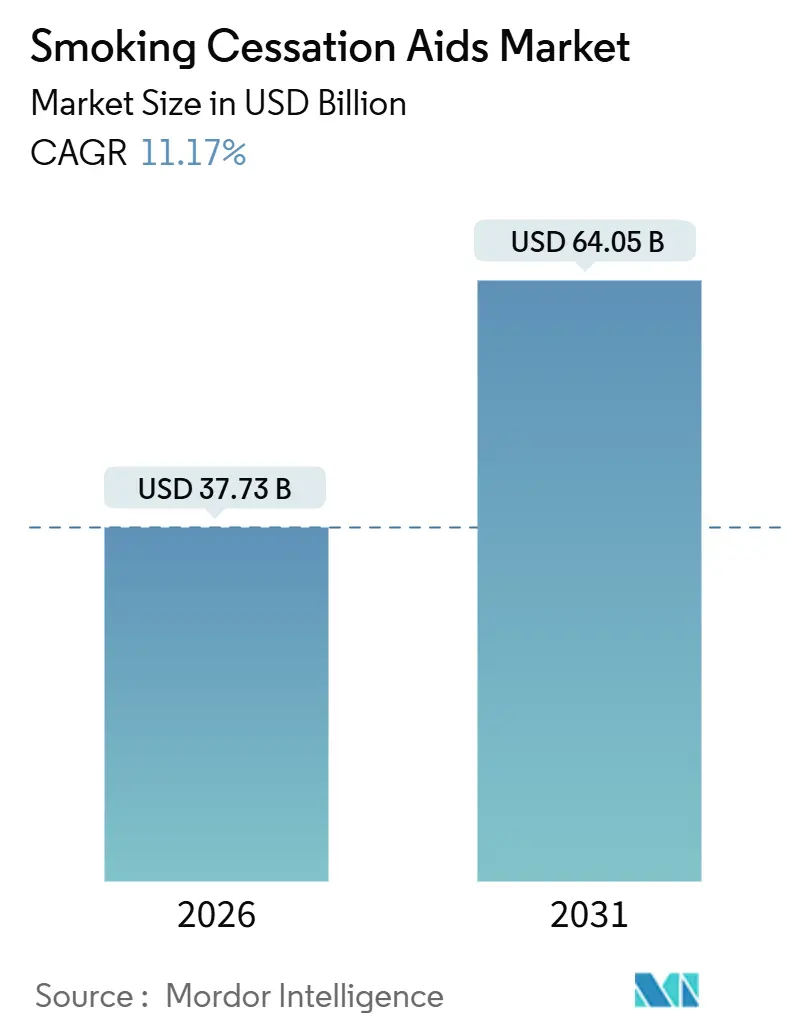
| Market Size (2026) | USD 37.73 Billion |
| Market Size (2031) | USD 64.05 Billion |
| Growth Rate (2026 - 2031) | 11.17 % |
| Fastest Growing Market | Asia-Pacific |
| Largest Market | North America |
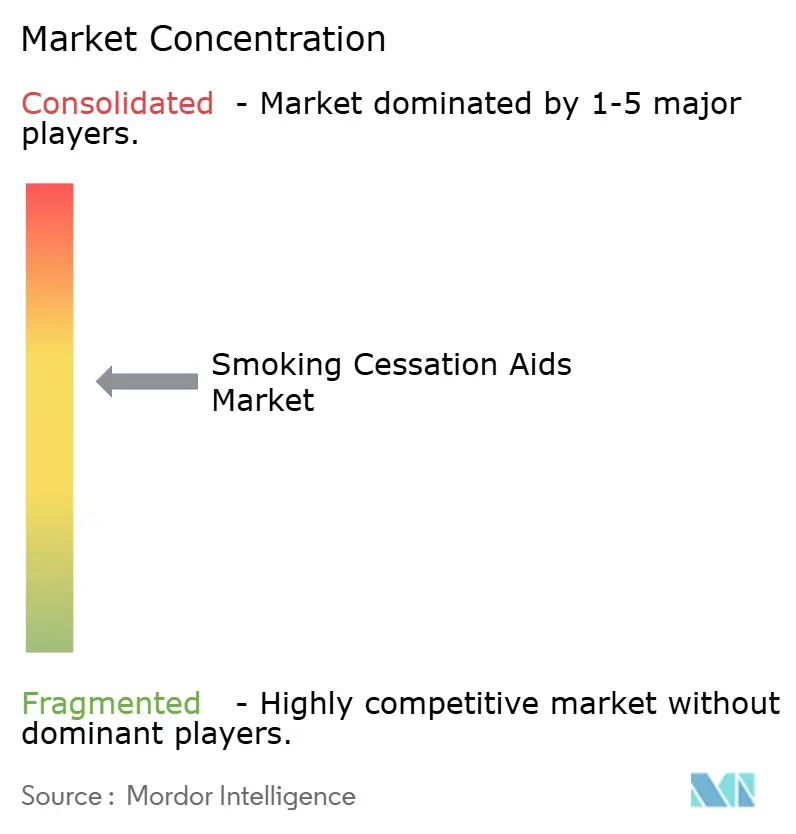
| Market Concentration | Medium |
Major Players *Disclaimer: Major Players sorted in no particular order Image © Mordor Intelligence. Reuse requires attribution under CC BY 4.0. | |
Smoking Cessation Aids Market Analysis by Mordor Intelligence
The Smoking Cessation Aids Market size is estimated at USD 37.73 billion in 2026, and is expected to reach USD 64.05 billion by 2031, at a CAGR of 11.17% during the forecast period (2026-2031).
Heightened tobacco taxes, rising employer-funded wellness plans, and broader reimbursement for over-the-counter (OTC) nicotine-replacement products continue to redirect smokers toward regulated nicotine delivery and behavioral support. Electronic nicotine delivery systems (ENDS) remain the leading revenue contributor, yet payers increasingly fund counseling add-ons because pharmacotherapy alone delivers sub-30% long-term abstinence. Retail pharmacies still provide the broadest shelf exposure, but e-commerce is closing the gap, helped by fast fulfillment models from Amazon Pharmacy and digital health integration at CVS. End-user behavior is also shifting: individual self-use dominates today, though insurer-mandated supervision is gaining traction. Regionally, North America commands the greatest share, but Asia-Pacific is expanding faster as hard-edged bans on flavored e-cigarettes spur demand for low-price patches and gums.
Key Report Takeaways
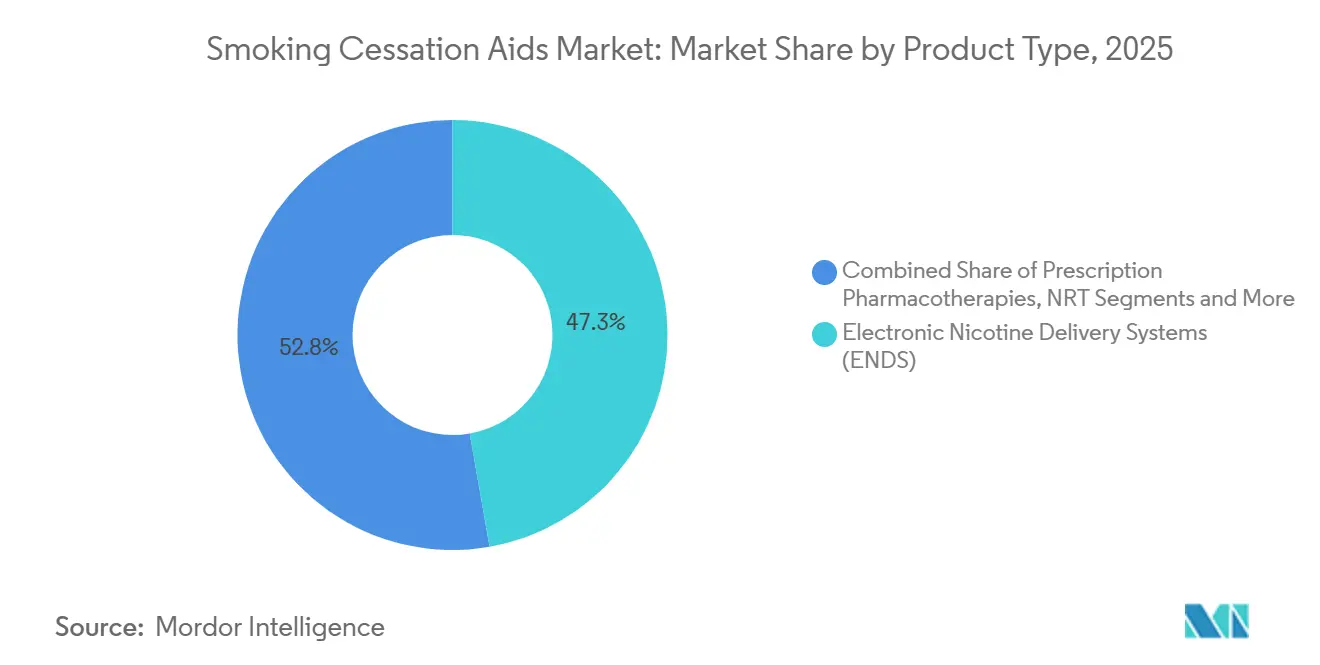
- By product type, electronic nicotine delivery systems accounted for 47.25% of smoking cessation aids market share in 2025, while behavioral support and services are forecast to expand at a 14.76% CAGR through 2031.
- By distribution channel, retail pharmacies and drug stores led with 41.85% of the smoking cessation aids market share in 2025; online pharmacies and e-commerce are advancing at a 15.03% CAGR to 2031.
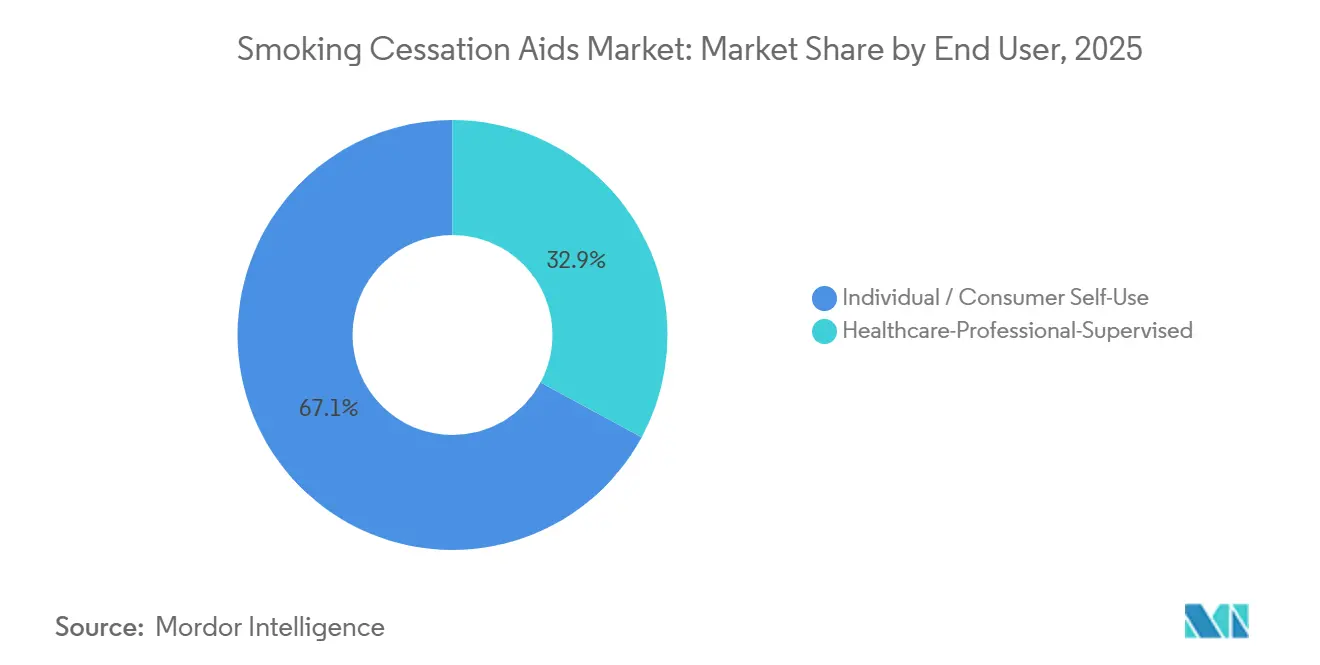
- By end user, individual self-use captured 67.12% of smoking cessation aids market size in 2025 and professional-supervised programs are on course for a 13.32% CAGR through 2031.
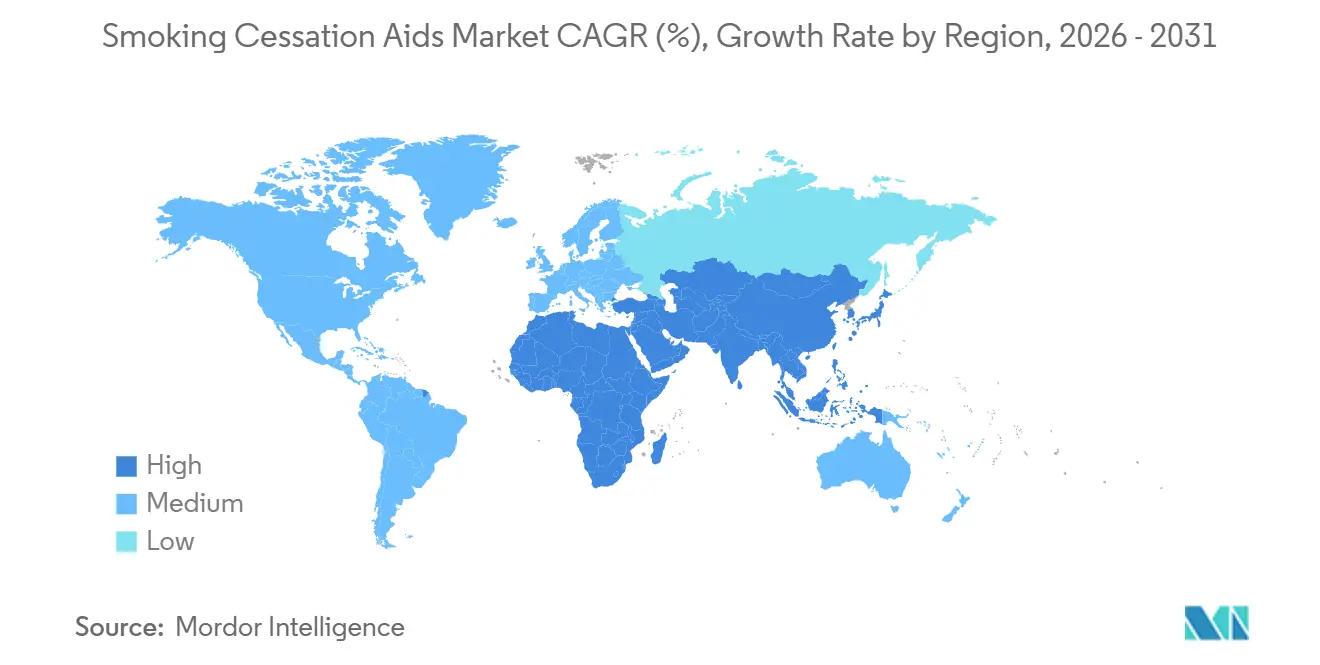
- By geography, North America held 34.83% of 2025 revenue and Asia-Pacific is on track for a 12.79% CAGR through 2031.
Note: Market size and forecast figures in this report are generated using Mordor Intelligence’s proprietary estimation framework, updated with the latest available data and insights as of January 2026.
Market Trends and Insights
Drivers Impact Analysis of Smoking Cessation Aids Market*
| Driver | (~) % Impact on CAGR Forecast | Geographic Relevance | Impact Timeline |
|---|---|---|---|
| Rising quit attempts post-COVID-19 pandemic | +2.1% | Global, peak in North America and Europe | Short term (≤ 2 years) |
| Government tobacco-control taxes and smoke-free laws | +2.3% | Australia, UK, Canada, India, Brazil | Medium term (2-4 years) |
| OTC switch and wider reimbursement of NRT products | +1.8% | North America, Europe, GCC, South Africa | Medium term (2-4 years) |
| Digital health integration (apps, quitlines) | +1.5% | North America, Europe, Australia, urban Asia-Pacific | Short term (≤ 2 years) |
| Venture-backed psychedelic-assisted cessation trials | +0.9% | US, Canada, early Europe | Long term (≥ 4 years) |
| Employer-funded cessation benefits in emerging markets | +1.2% | India, China, Brazil, Mexico | Medium term (2-4 years) |
| Source: Mordor Intelligence | |||
Rising Quit Attempts Post-COVID-19 Pandemic
Hospital admission data showed smokers experienced a 1.8-fold higher risk of severe COVID-19, driving a 23% spike in quitline calls during 2024 compared with pre-pandemic levels. Persisting respiratory complications make continued use physiologically difficult for many former patients, so cessation is now seen as essential care. The United Kingdom’s Swap to Stop campaign distributed free starter vape kits to 350,000 adults by mid-2025 and doubled six-month quit rates compared with unaided attempts.[1] Although the surge is expected to plateau by 2028, sustained public-health messaging under the WHO Framework Convention on Tobacco Control keeps the pressure high. These combined forces provide the smoking cessation aids market with a large influx of motivated quitters.
Government Tobacco-Control Taxes and Smoke-Free Laws
Australia lifted pack prices to AUD 50 (USD 33) in 2024 and cut adult smoking prevalence to 8.3%.[2] Similar tax escalators in Canada and India narrowed the price gap between cigarettes and OTC patches that cost CAD 35 per two-week supply. Brazil’s 2025 extension of smoke-free zones reduces social triggers and normalizes abstinence. These measures compress combustibles’ affordability, inducing more quit attempts and buoying the smoking cessation aids market.
OTC Switch and Wider Reimbursement of NRT Products
The US FDA cleared stronger 4 mg lozenges for behind-the-counter sale in 2024, broadening access for heavy users. Fifteen US states dropped co-pays for all FDA-approved cessation medicines in 2025, prompting a 41% prescription jump among seniors. NICE in the UK began favoring dual-form NRT the same year, which doubled reimbursement claims. Patchy policies persist in Germany and elsewhere, but harmonized EU rules are likely after 2027, keeping reimbursement momentum positive.
Digital Health Integration (Apps, Quitlines)
Three smoking-cessation apps received 510(k) clearance in 2024, marking the FDA’s first software-only approvals in tobacco control. These mobile tools, paired with harm reduction-based smoking cessation approaches, show increased efficacy in smoking abstinence rates.[3] Quitline calls rose 34% in Australia once toll-free numbers appeared inside cigarette packs. While rural bandwidth limits adoption in parts of India, urban populations welcome this digital layer, further enlarging the smoking cessation aids market.
Restraints Impact Analysis of Smoking Cessation Aids Market*
| Restraint | (~) % Impact on CAGR Forecast | Geographic Relevance | Impact Timeline |
|---|---|---|---|
| Adverse-event recalls (varenicline nitrosamines) | -1.1% | Global, sharpest in North America and Europe | Short term (≤ 2 years) |
| Stringent e-cigarette flavor bans | -0.8% | UK, EU, California, Massachusetts | Short term (≤ 2 years) |
| Stagnant pharmacy shelf space | -0.6% | North America, Western Europe | Medium term (2-4 years) |
| High relapse rates | -0.9% | Global | Long term (≥ 4 years) |
| Source: Mordor Intelligence | |||
Adverse-Event Recalls (Varenicline Nitrosamines)
Pfizer’s recall removed varenicline for three years, forcing physicians to default to less effective options until reformulated tablets returned in 2024. By late 2024, prescriptions regained only 62% of prior volume, as clinicians waited for long-term safety data. New generics from Indian manufacturers entered Europe at lower prices yet face batch-testing rules that raise costs. The episode dented patient trust, with 34% now favoring unregulated alternatives.
Stringent E-Cigarette Flavor Bans
The UK outlawed fruit-flavored disposables in 2024, removing 68% of SKUs and shrinking legal sales 22%. Illicit imports quickly filled some demand, but patch sales also increased. California applied similar restrictions, eliminating 9,000 SKUs and cutting shelf space 40%. A draft EU directive aims to harmonize bans by 2027. These policies curtail youthful uptake but risk sending some users back to cigarettes, limiting ENDS growth inside the smoking cessation aids market.
*Our forecasts treat driver/restraint impacts as directional, not additive. The impact forecasts reflect baseline growth, mix effects, and variable interactions.
Smoking Cessation Aids Market Segment Analysis
By Product Type:
ENDS Dominance Masks Behavioral Support SurgeElectronic nicotine delivery systems accounted for 47.25% of smoking cessation aids market revenue in 2025. Heated tobacco devices and nicotine pouches grew fastest inside the segment, fueled by IQOS ILUMA and Zyn distribution. Nicotine-replacement therapy (NRT) held 28%, with patches making up 42% of NRT receipts thanks to once-daily dosing and established reimbursement tracks. Prescription therapies contributed 18% but still lag due to the recent varenicline recall and uneven cytisine approvals.
Behavioral support and services will outpace all other lines with a 14.76% CAGR through 2031 as payers bundle counseling with medicines. Digital apps and quitlines, while small today, are mandatory components for many insurance plans. That shift enlarges total addressable demand and broadens competitive entry points for software-only players. Overall, the product mix highlights an incremental transition from pure pharmacotherapy toward holistic packages that blend devices, drugs, and coaching, a structure that broadens smoking cessation aids market share opportunities for newcomers.

By Distribution Channel:
E-Commerce Disrupts Pharmacy IncumbencyRetail pharmacies owned 41.85% of 2025 revenue, yet their share slipped as Amazon Pharmacy launched same-day patch and gum delivery in 12 US metro areas. CVS added telehealth consults at online checkout, moving the in-store counseling model to the web. Hospital pharmacies commanded 22% because inpatient programs mandate cessation before discharge. Specialist vape shops accounted for 14% but now confront biometric ID rules that cut traffic 29% overall.
Online pharmacies and general e-commerce will compound at 15.03% through 2031, eroding brick-and-mortar dominance. Workplace wellness portals and direct-to-consumer subscriptions round out the remaining 22%, bypassing retail margins altogether. Omnichannel integration therefore becomes central to defending smoking cessation aids market share, especially as payment networks tighten compliance checks on cross-border flavor sales.
By End User:
Professional Supervision Gains Reimbursement TractionIndividual self-use represented 67.12% of 2025 revenue. High relapse and low refill rates weaken its growth arc, but easy OTC access still pulls volume. In contrast, professional-supervised programs will see a 13.32% CAGR because insurers now require counseling records before reimbursing medicines. The United States permits eight funded counseling sessions per attempt with no annual cap.
Germany covers 80% of supervised program costs, prompting similar moves elsewhere. Workforce capacity remains a bottleneck, with only one tobacco-treatment specialist for every 15,000 smokers in the US. Telehealth eases some strain, yet state licensing barriers restrict interstate practice. The segment’s progress is therefore tied to policy reforms and digital service deployment, factors that reinforce long-run expansion of the smoking cessation aids market.
Geography Analysis
North America Smoking Cessation Aids Market
North America generated 34.83% of 2025 revenue. The United States alone contributed USD 12.4 billion, buoyed by Medicare’s expanded counseling coverage and private payers’ willingness to fund dual-form NRT. Flavor bans in several states created a near-term drag on ENDS but simultaneously drove patch and gum sales. Canada’s indexed excise tax further narrowed price gaps, sustaining demand for regulated substitutes.
APAC Smoking Cessation Aids Market
Asia-Pacific posted the fastest growth, projected at a 12.79% CAGR. China’s ban on flavored e-cigarettes in 2024 redirected consumers to hospital pharmacy channels where patches and prescriptions dominate. India’s 2024 legal age hike and expanded pictorial warnings increase quit attempts, especially among urban smokers who already face higher cigarette prices. Employers in both countries now subsidize cessation programs, broadening access for middle-income groups. Low-cost cytisine also resonates in budget-constrained populations.
EMEA and South America Smoking Cessation Aids Market
Europe supplied nearly 1/4th of 2025 turnover, led by the UK, Germany, and France. The UK’s Swap to Stop added 360,000 users and showed policy openness to harm-reduction pathways. Eastern European markets embraced cytisine due to attractive pricing, while Western payers still prioritize varenicline and dual-form NRT. The Middle East & Africa is supported by Gulf state investments in national quitlines, while South America is anchored by Brazil’s promise of universal pharmacotherapy coverage despite distribution gaps in remote regions. Collectively, these dynamics underscore varied regional drivers yet all funnel additional revenue into the smoking cessation aids market.
Regulatory Landscape
Regulation spans medicines, OTC NRT, software-based behavioral tools, and nicotine-delivery devices, creating a multi-track compliance burden across major markets. In the United States, the FDA remains central for drug approvals (for example, varenicline, bupropion, and NDA reviews such as cytisinicline). It also advanced regulation of digital cessation tools, including 510(k) clearances in 2024 for software-only smoking-cessation apps, which formalized a pathway for prescription-grade behavioral support integrated with pharmacotherapy.
Global standard setting has tightened around evidence-based cessation care. The WHO 2024 clinical treatment guideline for tobacco cessation in adults explicitly recommends varenicline, NRT, bupropion, and cytisine, reinforcing demand for regulated pharmacotherapies alongside counseling. At the same time, country-level rules for ENDS and nicotine pouches continue to diverge (for example, flavor restrictions in the UK and parts of the United States). The WHO Global Tobacco Control Report 2025 also notes that only a limited set of countries provide cessation services at best-practice levels, leaving reimbursement and access policies uneven across geographies.
Value Chain Analysis
The value chain starts with upstream APIs and excipients for nicotine and prescription therapies (notably varenicline), with meaningful supply concentration in India and China. It then moves into midstream finished-dose manufacturing across oral solids, gums and lozenges, and specialized transdermal patch production that depends on polymer films, adhesives, and controlled-release know-how. Quality systems and batch-testing requirements remain pivotal given recent safety scrutiny around varenicline, elevating the role of qualified CDMOs and in-house QA/QC, especially for companies rebuilding trust and supply continuity after recall-linked disruptions.
Downstream, channel power is increasingly shaped by PBM formulary placement and payer rules that tie reimbursement to counseling documentation. Mail-fulfillment models also connect e-commerce with telehealth and digital coaching. Regulatory packaging and labeling shifts further affect downstream operations: Health Canada enacted the Supplementary Rules Respecting Nicotine Replacement Therapies Order (SOR/2024-169) on August 28, 2024, with sell-through allowances for non-compliant stock until November 28, 2025. This forces manufacturers, importers, and pharmacy distributors to manage packaging transitions, inventory write-down risk, and relabeling timelines in Canada.
Competitive Landscape
The five largest suppliers include Haleon, Pfizer, Philip Morris International, British American Tobacco, and Johnson & Johnson, and together held a sizable share of 2025 sales, confirming moderate fragmentation. PMI’s USD 16 billion purchase of Swedish Match secured Zyn pouches and a broad U.S. store footprint, enabling cross-promotion with IQOS devices. Pfizer filed 14 patents on extended-release varenicline and GABA-combo formulas during 2024-2025, pointing to life-cycle management strategies.
New entrants such as Ditch Labs and Lucy Goods exploit direct-to-consumer subscriptions, trimming acquisition costs 40% below sector norms and targeting millennials who treat quitting as part of broader wellness routines. Tech-heavy plays include Haleon’s prototype smart patch that transmits dose data to companion apps. At the same time, psychedelic developers like Compass Pathways chase FDA breakthrough status, although reimbursement debate clouds commercial timelines.
Competitive white space clusters around low-price combination therapies for emerging markets, long-acting formats that improve adherence, and AI-driven digital coaching that predicts cravings. Players with in-house API capacity and advanced analytics stand to navigate tightening nitrosamine rules and batch-testing mandates most smoothly. As capital moves toward integrated device-drug-data portfolios, nimble software firms may partner or be absorbed, reshaping future smoking cessation aids market share allocations.
Smoking Cessation Aids Industry Leaders
-
British American Tobacco plc
-
Haleon plc
-
Johnson & Johnson (McNeil)
-
Pfizer Inc.
-
Philip Morris International Inc.
- *Disclaimer: Major Players sorted in no particular order
Smoking Cessation Aids Market Companies Covered in this Report
- 22nd Century Group Inc.
- Alkalon A/S
- Axsome Therapeutics
- British American Tobacco plc
- Cipla
- Ditch Labs Inc.
- Dr. Reddy’s Laboratories Ltd.
- Enorama Pharma AB
- Glenmark Pharmaceuticals
- Haleon plc
- Imperial Brands plc
- Japan Tobacco International
- Johnson & Johnson (McNeil)
- Lucy Goods Inc.
- Perrigo Company
- Pfizer
- Philip Morris International Inc.
- Rubicon Research Pvt. Ltd.
- Rusan Pharma Ltd.
- Sparsha Pharma International Pvt. Ltd.
Market Opportunities and Future Outlook
A clear whitespace is in differentiated, tolerable pharmacotherapies beyond the current core of varenicline and bupropion, alongside widely used NRT formats. In 2026, Achieve Life Sciences received an FDA Complete Response Letter for its cytisinicline NDA due to third-party manufacturing inspection issues and incomplete labeling. No clinical safety or efficacy deficiencies were cited, which points to an opportunity for new entrants that pair strong clinical packages with inspection-ready, redundant manufacturing. Achieve also shifted manufacturing to US-based Adare Pharma Solutions, underscoring how supply-chain design and cGMP readiness can determine time-to-market as much as clinical data in this category.
A second opportunity is in integrated care bundles that link OTC NRT or prescription medicines with reimbursable behavioral support delivered through regulated software and telehealth workflows. The market already shows payer movement toward bundling counseling with medicines, and FDA 510(k) clearances in 2024 for software-only smoking-cessation apps create an actionable route for digital players to enter via regulated products rather than purely wellness positioning. For pharmacy and e-commerce platforms, this supports differentiation beyond fulfillment by embedding coaching, adherence support, and supervised-program documentation that aligns with insurer requirements.
Recent Industry Developments in Smoking Cessation Aids Market
- June 2026: Achieve Life Sciences received a Complete Response Letter from the US FDA for its cytisinicline NDA, with issues tied to third-party manufacturing inspection findings and labeling completeness rather than clinical safety or efficacy. The outcome keeps a potential new prescription entrant out of the US market near term and reinforces that cGMP execution and inspection readiness are gating factors for smoking-cessation drug launches.
- April 2026: Achieve Life Sciences reported completion of analytical method technology transfer for cytisinicline to Adare Pharma Solutions in Vandalia, Ohio. The operational milestone supports a more controllable domestic manufacturing pathway and reduces dependence on prior third-party facilities implicated in the FDA review.
- January 2024: The US FDA cleared stronger 4 mg nicotine lozenges for behind-the-counter sale, expanding access for heavier nicotine users within regulated NRT. This type of access-oriented regulatory action supports volume growth in pharmacy channels and complements payer and provider efforts to pair NRT with counseling.
Smoking Cessation Aids Market Report Scope and Research Methodology
Market Definition and Coverage
This methodology covers the smoking cessation aids market value for products and support offerings used to help people reduce nicotine dependence and quit smoking. The scope includes nicotine replacement options, prescription therapies, and other quit-support tools sold through common healthcare and retail channels.
Scope exclusions: We exclude general wellness programs that are not designed for smoking cessation and we also exclude tobacco products that are not positioned and used as quit aids.
Segments Covered in This Report
- By Product Type
- Nicotine Replacement Therapy (NRT)
- Patches
- Gums
- Lozenges
- Sprays & Inhalers
- Other Oral & Transdermal
- Prescription Pharmacotherapies
- Varenicline
- Bupropion
- Cytisine
- Combination Therapies
- Electronic Nicotine Delivery Systems (ENDS)
- E-cigarettes / Vaping Devices
- Heated Tobacco Products
- Nicotine Pouches (Tobacco-Free Oral)
- Behavioral Support & Services
- Digital / Mobile Apps
- Telephone Quitlines
- In-person Counseling Programs
- Nicotine Replacement Therapy (NRT)
- By Distribution Channel
- Retail Pharmacies & Drug Stores
- Hospital Pharmacies
- Online Pharmacies & E-commerce
- Specialist Smoke/Vape Shops
- By End User
- Individual / Consumer Self-Use
- Healthcare-Professional-Supervised (Clinics & De-addiction Centers)
- By Geography
- North America
- United States
- Canada
- Mexico
- Europe
- Germany
- France
- United Kingdom
- Italy
- Spain
- Rest of Europe
- Asia-Pacific
- China
- Japan
- India
- South Korea
- Australia
- Rest of Asia-Pacific
- Middle East & Africa
- GCC
- South Africa
- Rest of Middle East & Africa
- South America
- Brazil
- Argentina
- Rest of South America
- North America
Data Sources, Market Sizing, and Validation
Desk Research
To set the starting point, we rely on public health and consumption indicators that track how many adults use tobacco and how quit attempts are changing over time. Typical sources used include the World Health Organization, the US CDC, the FDA for product and regulatory updates, and national health ministries that publish smoking prevalence and cessation program data.
We also review clinical guidance and safety updates from sources such as the National Institutes of Health and peer reviewed journals, then follow with trade association publications and reputable press coverage that tracks launches and policy moves. Company filings, investor presentations, and annual reports are used to understand category focus and broad revenue exposure to cessation portfolios. Where helpful, paid subscriptions are used for company financial intelligence and patent databases to cross check product pipelines and ownership signals. These desk research sources are illustrative, and many other public and paid references are also used for data collection, validation, and clarification.
Primary Interviews and Surveys
Primary work is used to pressure test desk assumptions on pricing, channel mix, and switching between product types, especially where public data is reported with time lags. We speak with a mix of manufacturers, distributors, pharmacy and e-commerce channel participants, and healthcare professionals involved in cessation counseling. We then validate the patterns across APAC, EMEA, and the Americas so regional adoption differences are reflected rather than assumed.
Distribution of primary research fieldwork respondents
| Company type | Respondent position | Region |
|---|---|---|
| Top tier: 26% | CXOs: 16% | APAC: 44% |
| Mid tier: 57% | Functional/Unit leaders: 24% | EMEA: 35% |
| Smaller Players: 17% | Managers: 60% | Americas: 21% |
Market-Sizing & Forecasting
Sizing starts with a top-down build that uses smoking prevalence, estimated quit attempts, and treatment uptake rates to reconstruct the addressable demand pool. That demand is then translated into value using channel level pricing logic. The totals are corroborated with selective bottom-up checks, including sampled supplier revenue mapping, pharmacy and online channel checks, and an ASP times volume sanity check across the main therapy types, so the model remains anchored to what is actually sold.
Key inputs for this market include adult smoker population by region, annual quit attempt rates, the share of quitters using pharmacotherapy versus counseling only, average duration of therapy use per quit attempt, and the split of sales across retail pharmacy, hospital pharmacy, and online. We also track policy and access signals that can change demand, including nicotine rules, prescription patterns, and reimbursement coverage, since these shift both adoption and pricing. For forecasting, we run scenario analysis alongside trend extrapolation, and we review upside and downside cases with primary respondents so the implied penetration and price progression stays realistic. Where bottom-up clues are incomplete for smaller channels, we apply region specific channel shares and therapy duration assumptions that are rechecked during interviews.
Data Validation & Update Cycle
Outputs are checked in several steps so obvious overcounts and timing mismatches are removed before finalization. We compare model results against independent signals such as quitline or program utilization trends, public health prevalence changes, and visible retail availability patterns. Variances are then reviewed with a second analyst before sign-off.
When an outlier shows up, we reopen the assumptions and, where needed, re-contact experts to confirm whether the shift is structural or temporary. Reports are refreshed annually, and interim updates are triggered when material events occur, including major regulatory actions or step-changes in product availability. Before delivery, a final pass is completed so clients receive the most current view based on the latest accessible data.
Mordor Intelligence's Smoking Cessation Aids Market Size Versus Other Published Estimates
It is common to see different published market sizes for smoking cessation aids even when the topic name appears similar. The differences usually come from what is counted as an aid, which sales channels are included, and how quickly assumptions such as therapy duration and pricing are refreshed.
A few gap drivers show up often in this market, including whether behavioral support and counseling services are counted inside the market value, whether ENDS are treated as cessation tools or excluded, and whether the study uses a 2024 base year versus a later base year with a different price and adoption mix. Some estimates also convert currencies using a single point in time rate and do not revisit it during the forecast, which can widen the spread when exchange rates move.
Benchmark comparison
| Source | Market Size | Gaps in Research Methodology |
|---|---|---|
| Mordor Intelligence | USD 37.73 B (2026) | |
| Global Consultancy A | USD 23.02 B (2024) | Uses an earlier base year and a shorter forecast window, and it commonly bundles product categories with different real-world adoption timing, which can keep the starting value lower versus a later-year demand pool build. |
| Industry Publisher B | USD 28.90 B (2024) | Focuses on a defined set of product forms and standard pharmacy and online channels, and it may not fully account for service-led quit support or the same treatment duration assumptions, which changes the implied spend per quit attempt. |
The spread across the table is largely explained by base year timing and what is treated as in-scope value, especially around services and the way newer quit tools are counted. By tying demand to quit attempts, therapy uptake, and channel pricing, then rechecking the assumptions with regional experts, the 2026 figure is kept consistent with what is actually purchased across the included offerings, which is the approach used by Mordor Intelligence.
Key Questions Answered in the Report
How large is the smoking cessation aids market in 2026?
It reached USD 37.73 billion in 2026 and should expand to USD 64.05 billion by 2031.
What is the forecast CAGR for smoking cessation aids through 2031?
Mordor Intelligence projects an 11.17% CAGR for the period 2026-2031.
Which product category grows fastest over the forecast?
Behavioral support and services lead with a 14.76% CAGR.
Why is Asia-Pacific growing faster than North America?
Flavor bans and new tobacco-control laws in China and India are boosting demand for lower-cost patches and gums.
What role does e-commerce play in distribution?
Online pharmacies and e-commerce are increasing at a 15.03% CAGR, eroding traditional retail share by offering fast delivery and integrated digital coaching.