
Smart Personal Protective Equipment Market Size and Share
Market Overview
| Study Period | 2021 - 2031 |
|---|---|
| Market Size (2026) | USD 5.55 Billion |
| Market Size (2031) | USD 10.16 Billion |
| Growth Rate (2026 - 2031) | 12.85 % |
| Fastest Growing Market | Asia Pacific |
| Largest Market | North America |
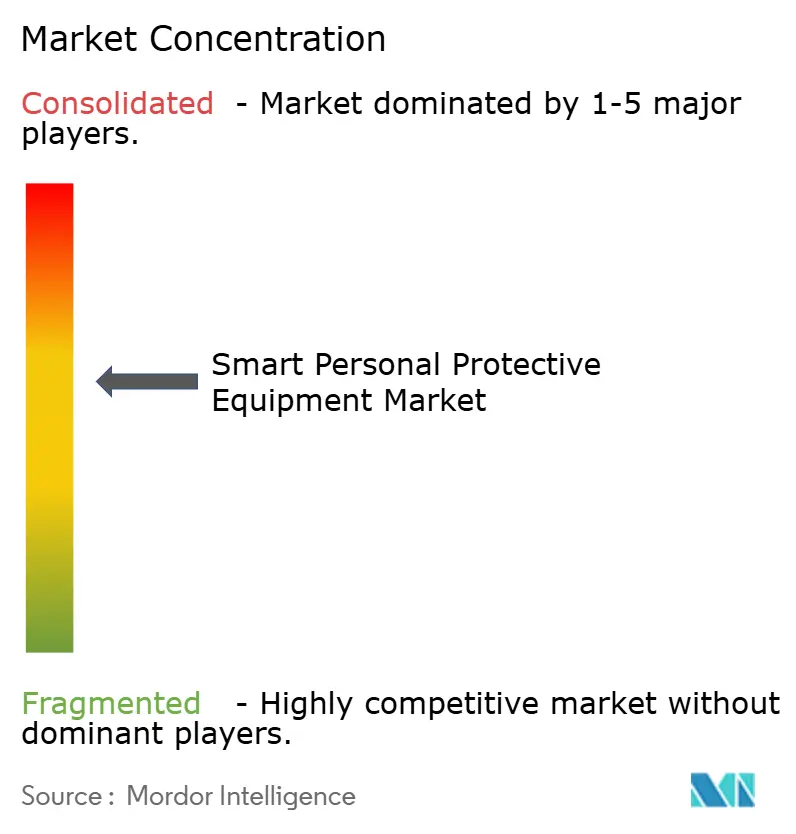
| Market Concentration | Medium |
Major Players *Disclaimer: Major Players sorted in no particular order Image © Mordor Intelligence. Reuse requires attribution under CC BY 4.0. | |
Smart Personal Protective Equipment Market Analysis by Mordor Intelligence
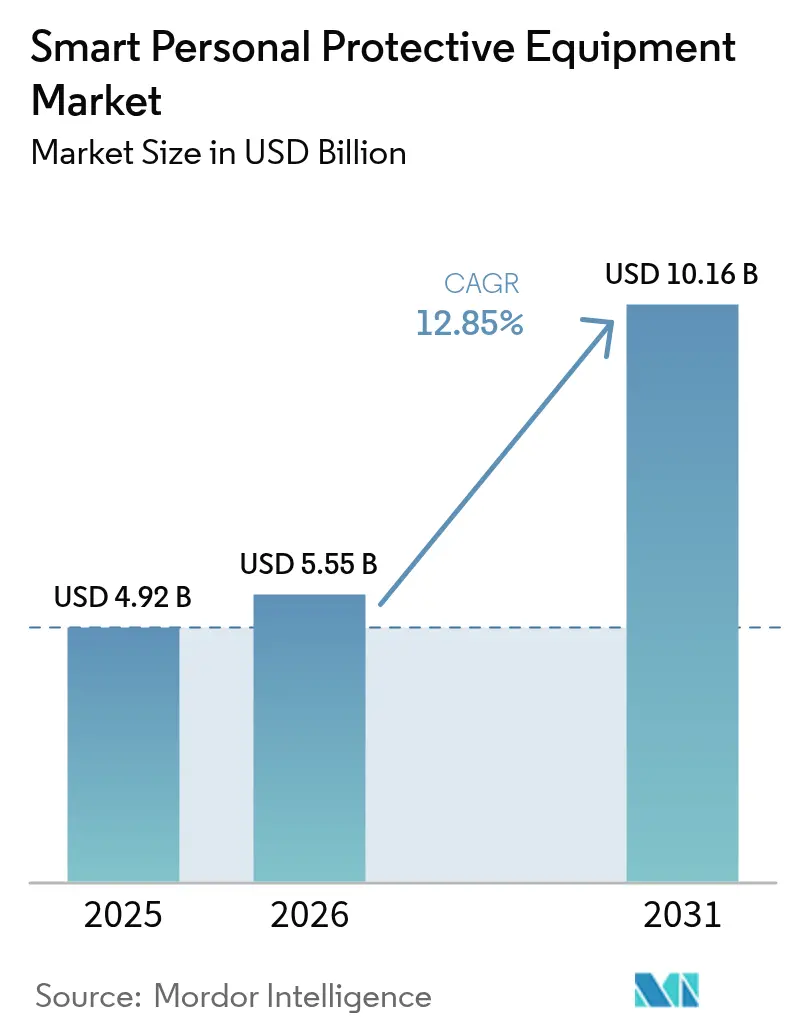
The smart personal protective equipment market size was valued at USD 4.92 billion in 2025 and estimated to grow from USD 5.55 billion in 2026 to reach USD 10.16 billion by 2031, at a CAGR of 12.85% during the forecast period (2026-2031). Accelerated growth stems from OSHA’s 2025 heat-safety standards, European Union privacy mandates, and expanding Construction 4.0 programs that embed connected monitoring into day-to-day operations. Real-time biometrics, sensor miniaturization, and falling connectivity costs shift procurement decisions from reactive compliance toward proactive productivity gains. Industrial insurers increasingly discount premiums when connected-worker programs are in place, further strengthening the business case for smart PPE adoption. Battery innovations such as textile-integrated fiber cells extend runtime in remote settings, while edge analytics resolve privacy tensions by processing sensitive data on the device rather than in the cloud.
Key Report Takeaways
- By type, body protection led with 29.76% of smart personal protective equipment market share in 2025, whereas smart gloves are set to expand at a 14.11% CAGR through 2031.
- By technology, IoT-enabled PPE dominated with 60.85% market share in 2025, while AR/VR smart glasses are forecast to advance at a 13.04% CAGR to 2031.
- By connectivity, Bluetooth Low Energy held 49.12% share of smart personal protective equipment market size in 2025 and cellular solutions are rising at a 13.83% CAGR through 2031.
- By sensor type, environmental sensors accounted for 41.95% of smart personal protective equipment market size in 2025 and motion plus proximity sensors are tracking a 14.04% CAGR to 2031.
- By end-user industry, oil and gas captured 24.05% of smart personal protective equipment market share in 2025, while construction is growing fastest at a 12.95% CAGR up to 2031.
- By geography, North America accounted for 39.98% revenue share in 2025 and Asia Pacific is advancing at a 12.96% CAGR over the forecast horizon.
Note: Market size and forecast figures in this report are generated using Mordor Intelligence’s proprietary estimation framework, updated with the latest available data and insights as of 2026.
Market Trends and Insights
Drivers Impact Analysis of Smart Personal Protective Equipment Market*
| Driver | (~) % Impact on CAGR Forecast | Geographic Relevance | Impact Timeline |
|---|---|---|---|
| Stringent Safety Regulations in Europe and North America | +2.8% | Europe and North America | Medium term (2-4 years) |
| Real-time Biometric and Location Monitoring in Underground Mining | +2.1% | Global, concentrated in Asia-Pacific and Americas | Long term (≥ 4 years) |
| Connected-Worker Programs Lowering Insurance Costs in Oil and Gas | +1.9% | Global, led by North America and Middle East | Medium term (2-4 years) |
| Construction-4.0 Megaprojects in Asia-Pacific | +2.3% | Asia-Pacific core, spill-over to MEA | Long term (≥ 4 years) |
| Post-COVID Demand for Contact-less Safety Monitoring in Manufacturing | +1.7% | Global | Short term (≤ 2 years) |
| Declining IoT Sensor Costs Driving SME Retro-fit Adoption (LatAm) | +1.4% | Latin America, expanding to emerging markets | Medium term (2-4 years) |
| Source: Mordor Intelligence | |||
Stringent Safety Regulations in Europe and North America
OSHA’s 2025 heat-safety rule compels real-time physiological monitoring, and updated fitting guidelines close protection gaps for female and smaller-statured workers.[1] European GDPR constraints create a paradox because continuous biometrics raise privacy concerns. Manufacturers respond with edge-computing smart glasses that anonymize data yet still trigger instant alerts. Enterprise buyers see these hybrid solutions as the optimal route to meet dual compliance and privacy requirements.
Real-time Biometric and Location Monitoring in Underground Mining
Smart helmets with integrated gas sensors deliver 97% toxic-gas detection accuracy and cut response times by half in deep mines.[2] BLE beacons combined with 6G backhaul extend coverage to previously unreachable shafts. Operators aggregate gas, temperature, and location data to fine-tune ventilation systems and schedule predictive maintenance, framing smart PPE as an operational intelligence layer rather than a simple safety accessory.
Connected-Worker Programs Lowering Insurance Costs in Oil and Gas
Major producers deploy hydration patches, fatigue sensors, and environmental monitors to validate risk-mitigation programs for insurers. Chevron’s three-year agreement with Epicore Biosystems is the reference case; early results show fewer heat-related incidents and demonstrable premium reductions.[3] Exoskeletons supply quantifiable strain-reduction metrics that strengthen negotiations with workers ’-comp carriers.
Construction-4.0 Megaprojects in Asia Pacific
Regional contractors embed IoT-enabled safety systems into Building Information Modeling workflows. AI body cameras and vital sign wearables reduce collision incidents and optimize task sequencing on dense sites. The Osaka-Kansai Expo validates large-scale deployment economics, creating credible case studies that help smaller contractors justify investments.
Restraints Impact Analysis of Smart Personal Protective Equipment Market*
| Restraint | (~) % Impact on CAGR Forecast | Geographic Relevance | Impact Timeline |
|---|---|---|---|
| High Up-front Investment and Uncertain ROI for SMEs | -1.8% | Global, particularly pronounced in emerging markets | Short term (≤ 2 years) |
| GDPR and CCPA Restricting Continuous Biometric Capture | -1.2% | Europe and North America, expanding globally | Medium term (2-4 years) |
| Battery-Life Constraints Causing Device Downtime in Remote Sites | -1.5% | Global, critical in mining and offshore operations | Medium term (2-4 years) |
| Lack of Interoperability Across PPE and IoT Platforms | -1.1% | Global | Long term (≥ 4 years) |
| Source: Mordor Intelligence | |||
High Up-front Investment and Uncertain ROI for SMEs
Smart PPE often costs 300 % to 500 % more than conventional gear, so many small enterprises delay adoption. Modular retrofit kits and PPE-as-a-Service leasing reduce capital intensity, while falling sensor prices make phased rollouts viable for Latin American manufacturers.
GDPR and CCPA Restricting Continuous Biometric Capture
Privacy law limits heart rate, location, and fatigue monitoring unless data are anonymized or processed on-device. Vendors now integrate differential-privacy algorithms and consent portals, complying with regulations yet retaining real-time alerting capabilities. Added complexity raises development costs but creates niches for privacy-first platform providers.
*Our forecasts treat driver/restraint impacts as directional, not additive. The impact forecasts reflect baseline growth, mix effects, and variable interactions.
Smart Personal Protective Equipment Market Segment Analysis
By Type:
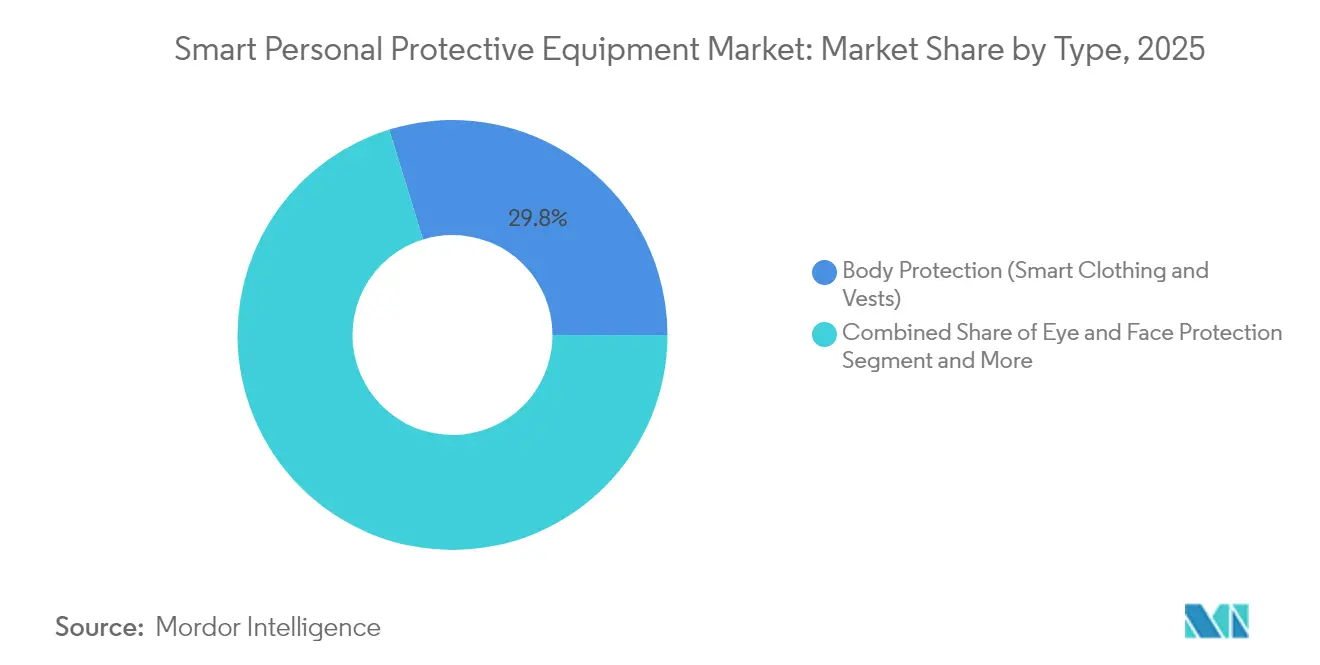
Body Protection Dominates Smart IntegrationBody protection held a 29.76% revenue share in 2025, cementing its status as the anchor layer for multi-sensor arrays. Smart vests fuse temperature, gas, and posture tracking without compromising comfort. This category benefits from established textile supply chains that enable conductive fiber integration at scale. The large surface area also supports embedded fiber batteries, solving run-time challenges during extended shifts.
Smart gloves are tracking a 14.11% CAGR, the fastest within the segment. Voice-free gesture recognition and haptic feedback allow technicians to interact with automation systems while wearing chemical-resistant protection. Manufacturers add micro-electromechanical sensors that tally grip-force data, which supervisors mine to identify musculoskeletal strain patterns. These analytics minimize downtime and elevate productivity.

By Technology:
IoT Platforms Enable Connected EcosystemsIoT-enabled PPE retained 60.85% of the smart personal protective equipment market in 2025, forming the backbone for cloud analytics and fleet management. Standardized APIs let enterprises plug multiple PPE types into a single dashboard and feed incidents directly into enterprise resource planning modules. This uniformity shortens proof-of-concept cycles and underpins multiyear replacement contracts.
AR/VR smart glasses, growing at 13.04% CAGR, provide hands-free instructions and remote expert support. Battery advances now allow a full shift of operation, removing a historical adoption barrier. The hardware integrates thermal imaging, which overlays heat maps onto the user’s view to flag hot surfaces before contact. AI-driven predictive safety software mines sensor trends to forecast near-miss scenarios, pushing preemptive warnings.
By Connectivity:
Bluetooth Leads with 5G AccelerationBluetooth Low Energy owns 49.12% share because of low power draw and near-universal smartphone compatibility. Wearables offload processing to the user’s handset or a ruggedized industrial gateway, extending battery life in harsh conditions. BLE mesh capabilities allow peer-to-peer data relay when cellular service is weak, sustaining alert coverage in remote mines.
Cellular connectivity, expanding at a 13.83% CAGR, removes the need for local gateways in widespread oilfields or linear construction corridors. The advent of private 5G networks brings low-latency data paths that support AR overlays and real-time video troubleshooting. Wi-Fi persists inside fixed plants where bandwidth-intensive streaming is required. Zigbee and LPWAN support agriculture and long-tunnel operations due to kilometer-scale range at minimal power draw.
By Sensor Type:
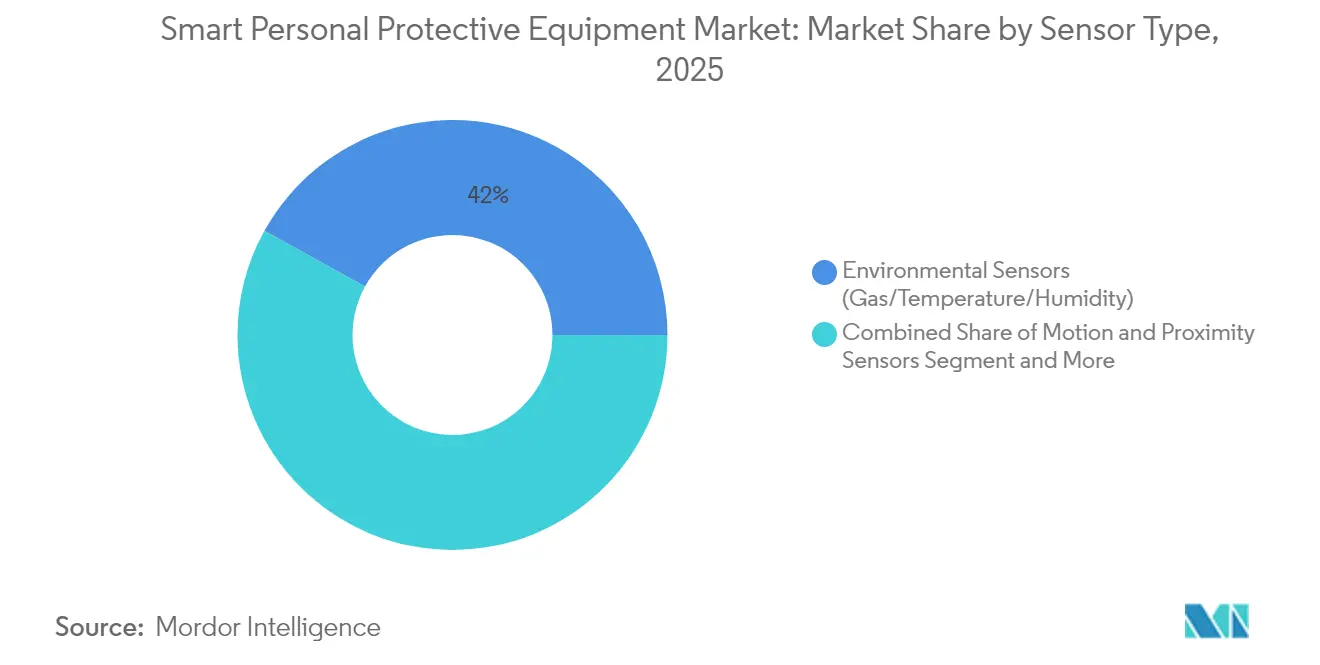
Environmental Monitoring Drives AdoptionEnvironmental sensors captured 41.95% revenue in 2025. Gas, temperature, and humidity modules serve as immediate life-saving devices by issuing audible alerts once thresholds are crossed. Vendors now integrate AI pattern-recognition to cut false positives while remaining sensitive to sudden hazards.
Motion and proximity sensors, the fastest-growing sub-segment at 14.04% CAGR, enable collision avoidance between heavy equipment and pedestrian workers. Combining ultrawide-band ranging with inertial measurement units gives centimeter-level precision, critical on congested construction sites. Vital-sign sensors detect dehydration, fatigue, and cardiac stress without invasive contacts, further broadening monitoring scope.
By End-user Industry:
Oil and Gas Leads with Construction AcceleratingOil and gas held 24.05% revenue in 2025, reflecting decades of high-risk operations and deeper pockets for innovation adoption. Offshore teams use satellite-linked smart vests to share vitals with onshore medical centers, achieving faster triage decisions when evacuations are triggered. Connected exoskeletons feed strain readings to asset-integrity models, linking human performance data with equipment-health metrics.
Construction, projected to grow 12.95% CAGR, rides momentum from megaprojects that bundle IoT safety, autonomous machinery, and BIM. Contractors rationalize investments by lowering incident downtime and meeting new government mandates that penalize safety breaches. Mining, utilities, and manufacturing round out demand as each sector connects previously isolated workflows to corporate dashboards.
Geography Analysis
North America Smart Personal Protective Equipment Market
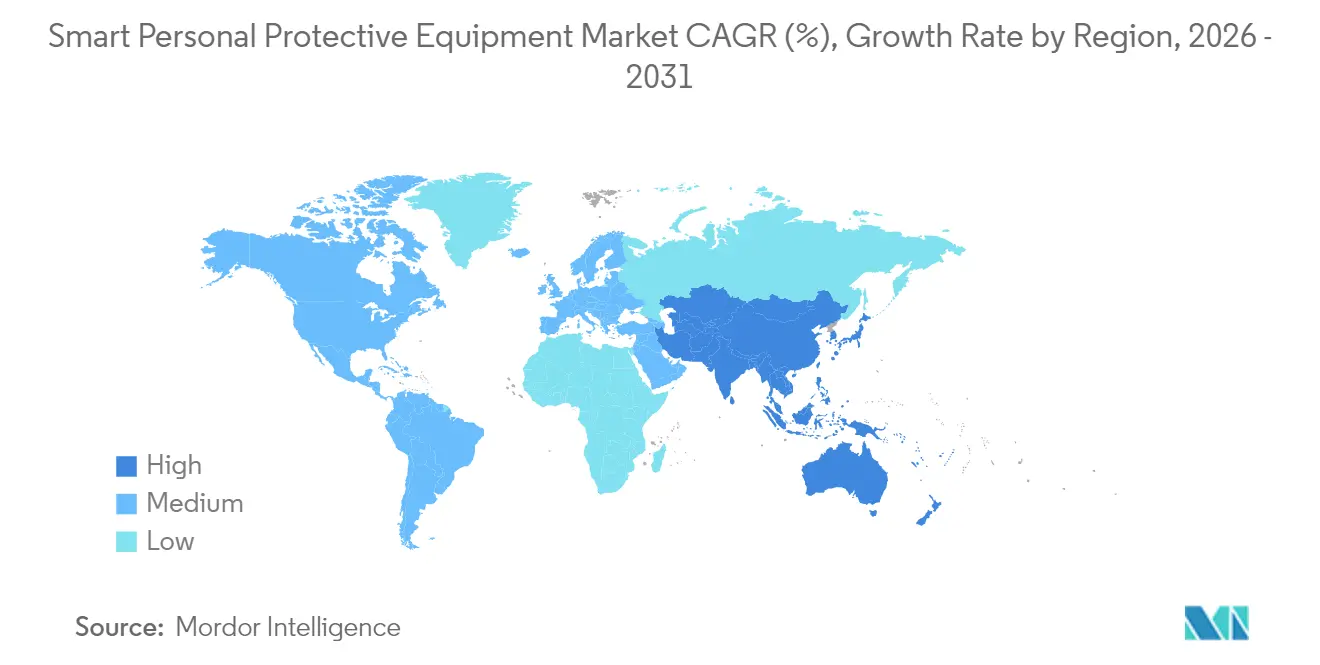
North America generated 39.98% of global revenue in 2025. OSHA’s heat-safety mandate plus insurance premium incentives have cemented connected-worker programs as standard practice. Chevron’s hydration-patch deployment provides benchmark evidence, demonstrating measurable reductions in heat events and workers-comp costs. Mature 4G/5G coverage and robust data-protection frameworks underpin large-scale rollouts.
APAC Smart Personal Protective Equipment Market
Asia Pacific is advancing at a 12.96% CAGR through 2031. China converted advisory PPE guidelines into binding requirements, immediately enlarging the addressable base. Japan’s Osaka-Kansai Expo acted as a live laboratory for heat-stress wearables on 300 cleaning staff, showcasing real-time dashboards for supervisors. India’s SAMARTH Udyog Bharat 4.0 policy weaves smart PPE into national manufacturing modernization, aligning safety with productivity.
EMEA and LATAM Smart Personal Protective Equipment Market
Europe records steady uptake. GDPR drives edge-processing adoption, while sustainability goals shift buyers toward durable, sensor-rich garments that reduce waste. The Middle East and Africa leverage smart PPE in high-temperature oil fields and deep mines where remote medical infrastructure is sparse. Latin America benefits from falling sensor costs and emerging PPE-as-a-Service models that lower entry barriers for SMEs.
Regulatory Landscape
Smart personal protective equipment sits at the intersection of traditional PPE conformity rules and newer requirements for electronics, software, and data handling. In the European Union, Regulation (EU) 2016/425 governs PPE design and manufacture, including conformity assessment and CE marking for products placing protection functions first even when electronics are embedded. Standards work continues to clarify how connected components can coexist with safety-critical performance, with EN 17673:2022 serving as a reference for protective clothing using integrated smart textiles.
In 2026, the European Commission issued Implementing Decision (EU) 2026/1279 to update references to harmonized standards supporting Regulation (EU) 2016/425, reinforcing how harmonized standards support presumption of conformity for PPE suppliers selling into the EU. For specialized end uses, the ISO 11999 series for firefighter PPE progressed through ISO 11999-1:2024 (general requirements), ISO 11999-3:2025 (protective clothing requirements), and ISO 11999-10:2026 (respiratory protective devices for firefighters). These updates shape how connected sensing and telemetry can be integrated while keeping certified protection performance intact.
Value Chain Analysis
The smart PPE value chain extends conventional PPE sourcing and manufacturing into an electronics and software stack. Upstream inputs include textiles, polymers, metals, and certified protective components, complemented by MEMS sensors, flexible or textile-integrated power sources, connectivity modules (BLE, LoRa, cellular), and embedded compute for edge analytics. Core manufacturing and integration steps span garment or hard-hat fabrication, sensor and wiring integration, sealing and ruggedization, device calibration, and certification workflows that maintain the underlying protective rating while adding connected capabilities.
Downstream, value capture increasingly shifts toward platforms, including device management, incident dashboards, APIs, and integrations into enterprise systems used to orchestrate connected-worker programs across multiple PPE categories. Channel partners include industrial distributors, safety integrators, and connectivity providers supporting private LTE/5G or site gateways, while end users in construction, oil and gas, and mining often require deployment services for onboarding, policy configuration, and data governance. Bottlenecks persist around the availability and cost of advanced sensors and flexible batteries, alongside fragmentation across multi-vendor hardware and software stacks. This dynamic elevates the importance of open APIs and interoperability-focused partnerships.
Competitive Landscape
The market shows moderate concentration. Legacy manufacturers recalibrate portfolios toward connected solutions. Honeywell divested its conventional PPE unit for USD 1.325 billion, reallocating capital to automation and aerospace focus areas. Protective Industrial Products acquired those assets to deepen its industrial channel presence. Ansell added the Kimtech and KleenGuard brands for USD 640 million, expanding clean-room and scientific lines.
Technical differentiation hinges on power management, analytics, and interoperability. Johns Hopkins University’s textile-embedded fiber battery patent tackles run-time limitations without adding bulk. AI body cameras from pair video with GPS and LTE, enabling remote supervisors to audit compliance in real time. Partnerships between PPE makers and cloud-analytics firms surface integrated stacks that streamline deployment, addressing the key barrier of multi-vendor fragmentation.
Emerging firms focus on vertical niches. Mining-specific gas helmets claim accuracy advantages in methane detection, while construction-centric fall-arrest harnesses link to BIM platforms. Privacy-preserving analytics, a European imperative, becomes a global differentiator as regulators elsewhere study GDPR’s template.
Smart Personal Protective Equipment Industry Leaders
-
Honeywell International Inc.
-
3M Company
-
MSA Safety Inc.
-
Ansell Ltd.
-
Uvex Group
- *Disclaimer: Major Players sorted in no particular order
Smart Personal Protective Equipment Market Companies Covered in this Report
- Honeywell International Inc.
- 3M Company
- MSA Safety Inc.
- Ansell Ltd.
- Uvex Group
- DuPont de Nemours Inc.
- Intellinium
- Corvex Connected Worker
- Guardhat Inc.
- Kenzen Inc.
- Tenacious Holdings Inc. (Ergodyne)
- Vuzix Corp.
- Iristick NV
- Draegerwerk AG
- Cybertree Technologies (Modjoul)
- Optrel AG
- Guardhat Inc.
- Seebo Interactive Ltd. (Augury)
- Climax Technologies
- Forcite
Read Analysis of Smart Personal Protective Equipment Companies
Market Opportunities and Future Outlook
A key whitespace lies in scaling smart PPE beyond pilots into multi-site standardization, where buyers prioritize consistent device governance, simpler integration, and fewer false alarms. In construction and infrastructure settings without reliable onsite networks, deployments combining worker location, fall detection, and live monitoring are being rolled out, supported by a 2026 case-documented rollout of 1,200 IoT-enabled industrial helmets across three active construction sites. This deployment pattern supports opportunities for vendors that bundle hardware, connectivity, and fleet management into repeatable rollout templates for contractors running temporary worksites.
Electrification and high-risk maintenance work also drive demand for role-specific sensing, particularly for electrical hazard prevention. A 2026 case-documented implementation of Proxxi wrist-worn voltage detection sensors at Tri-City Electric points to targeted smart PPE that augments standard protection with near-field hazard alerts and straightforward workflow adoption. On the compliance side, Regulation (EU) 2016/425 and standards such as EN 17673:2022 increase emphasis on certified integration of electronics into protective shells. That creates room for suppliers that can deliver certified, modular sensor packages and edge-processing configurations aligned with privacy constraints and site IT policies.
Recent Industry Developments in Smart Personal Protective Equipment Market
- June 2026: MSA Safety demonstrated new firefighter safety innovations at Interschutz 2026, including expanded M1 SCBA telemetry along with updates spanning a GALLET firefighter helmet and Bristol fire protective clothing. The set of launches reinforces the move toward connected ecosystems that pair certified protective gear with telemetry for incident visibility and fleet-level management.
- March 2026: MSA Safety launched the ALTAIR io 6 multigas detector with pumped gas detection and built-in cellular connectivity to the MSA Grid cloud platform. Cellular-native connectivity supports remote monitoring without dependence on local gateways, strengthening adoption in distributed industrial sites where real-time hazard escalation is critical.
- September 2024: MSA Safety debuted MSA Grid Shared Alerts as an enhancement to its Connected Work Platform, enabling cross-device notification of gas detection alarms. Shared alerting improves interoperability across connected devices and helps safety teams coordinate responses using a unified notification layer.
Smart Personal Protective Equipment Market Report Scope and Research Methodology
Market Definition and Coverage
For this study, the smart personal protective equipment market covers protective wear and gear that has embedded sensors, connectivity, and related electronics to monitor worker safety and help prevent incidents across industrial settings.
Scope exclusions: This sizing excludes standard non-connected PPE and broader workforce wearables that are not sold and used as protective equipment.
Segments Covered in This Report
- By Type
- Eye and Face Protection
- Hearing Protection
- Head Protection
- Respiratory Protection
- Hand Protection (Smart Gloves)
- Body Protection (Smart Clothing and Vests)
- Fall Protection Devices
- Foot Protection (Smart Footwear)
- Integrated Multi-Sensor PPE
- By Technology
- IoT-Enabled PPE
- AR/VR-Enabled Smart Glasses
- AI-Based Predictive Safety Analytics
- Cloud-Connected PPE Platforms
- By Connectivity
- Bluetooth Low Energy
- Wi-Fi
- Cellular (4G/LTE/5G)
- Zigbee / LPWAN
- Wired
- By Sensor Type
- Environmental Sensors (Gas/Temperature/Humidity)
- Motion and Proximity Sensors
- Biometric and Vital-Sign Sensors
- By End-user Industry
- Construction
- Oil and Gas
- Mining
- Manufacturing
- Automotive
- Chemicals and Pharmaceuticals
- Utilities (Energy and Power)
- Healthcare and Life Sciences
- Firefighting and Law Enforcement
- Transportation and Logistics
- By Geography
- North America
- United States
- Canada
- Mexico
- South America
- Brazil
- Argentina
- Chile
- Rest of South America
- Europe
- Germany
- France
- United Kingdom
- Italy
- Spain
- Rest of Europe
- Asia Pacific
- China
- Japan
- India
- South Korea
- ASEAN
- Australia
- New Zealand
- Rest of Asia Pacific
- Middle East and Africa
- Middle East
- GCC
- Turkey
- Israel
- Rest of Middle East
- Africa
- South Africa
- Nigeria
- Egypt
- Rest of Africa
- Middle East
- North America
Data Sources, Market Sizing, and Validation
Desk Research
Desk research started with public safety and labor indicators to understand where PPE demand sits, and where connected features are becoming more common. We reviewed OSHA (US), the EU-OSHA portal, the International Labour Organization (ILO), and the US Bureau of Labor Statistics for injury rates, industry workforce patterns, and safety enforcement direction that influence connected PPE adoption.
To anchor the technology side, we checked standards and guidance signals that affect product requirements, then used company annual reports, investor presentations, and reputable trade press to map launch timelines and pricing direction. Where available, we used paid subscription databases only for company financials and patent lookups, so that product roadmaps and R and D focus could be cross-checked across sources. The listed sources are illustrative, and additional public and paid references were also used for data collection, validation, and clarification.
Primary Interviews and Surveys
Primary work focused on interviews and structured surveys with PPE product leaders, safety managers, procurement teams, and channel participants who see real purchase cycles and replacement behavior. For a global market like this, we intentionally captured viewpoints across major industrial regions, then used follow-up calls to resolve gaps around average selling price ranges, attach rates for sensors and software, and deployment pace in high-risk sites.
Distribution of primary research fieldwork respondents
| Company type | Respondent position | Region |
|---|---|---|
| Top tier: 27% | CXOs: 13% | APAC: 39% |
| Mid tier: 58% | Functional/Unit leaders: 27% | EMEA: 35% |
| Smaller Players: 15% | Managers: 60% | Americas: 26% |
Market-Sizing & Forecasting
Sizing was built using a top-down and bottom-up approach, with the main logic starting from the addressable worker and site base in higher-risk industries and then applying smart PPE adoption rates by use case. Those demand pools were shaped using inputs such as industrial employment levels, reported workplace injury rates, safety compliance intensity, replacement cycles for core PPE, and typical pricing premiums for connected features (sensors, connectivity modules, and supporting software).
After the demand-based build, we ran selective bottom-up checks using supplier revenue cues, sampled product price bands, and channel feedback on shipment mix to confirm totals stayed realistic by region and product family. Forecasts relied mainly on scenario analysis, where adoption and price progression were adjusted based on interview consensus around connectivity standardization, battery and sensor cost trends, and the speed of safety digitization programs. When company disclosures did not clearly separate smart from traditional PPE, we filled gaps by applying interview-based smart-share ranges, then re-tested outputs against the broader PPE spend envelope to avoid overstating penetration.
Data Validation & Update Cycle
Results were validated through multiple passes, starting with checks on year-over-year movement, regional shares, and implied pricing so outliers could be flagged early. We compared the final model against independent signals such as incident-rate trends, industrial activity direction, and observed product pricing ranges, and then re-contacted respondents when a key assumption created unusual swings.
Before sign-off, the work goes through an analyst review where assumptions, conversions, and aggregation logic are re-checked, followed by a final consistency check across all tables and charts. Reports are refreshed annually, and interim updates are added when material events shift demand or pricing, after which a last pre-delivery review is completed so clients receive the most current view.
Mordor Intelligence's Smart Personal Protective Equipment Market Size Compared Against Other Published Estimates
Published numbers for smart PPE can vary widely, even when they look like they describe the same market, because the product boundary and the counted value components are not always consistent. Differences also show up when firms use different base years, exchange-rate timing, or rely on assumed penetration without enough checks from buyers and channels.
The main gap comes from whether connected modules and supporting software are counted only when bundled with certified protective gear. In Mordor Intelligence sizing, we include these components only when they are sold as part of smart PPE deployments, rather than general wearables or stand-alone devices.
Benchmark comparison
| Source | Market Size | Gaps in Research Methodology |
|---|---|---|
| Mordor Intelligence | USD 5.55 B (2026) | |
| Industry Publication A | USD 3.27 B (2025) | Uses an earlier base year and often blends connected worker wearables with smart PPE, which can shift totals downward or upward depending on what is treated as PPE versus monitoring devices. |
| Trade Journal B | USD 7.72 B (2025) | Appears to apply broad adoption assumptions and longer-horizon growth, and the scope can fold in adjacent PPE categories without consistently separating smart-enabled value from conventional equipment. |
The table shows that the spread is mostly explained by scope choices and how smart value is attached to PPE, and then by base-year and pricing assumptions. By keeping the counted revenue tied to certified protective equipment plus its smart-enablement value, and by re-checking adoption and price inputs with practitioners, the final number stays traceable to clear variables and repeatable steps.
Key Questions Answered in the Report
What is the current value of the smart personal protective equipment market?
The market is valued at USD 5.55 billion in 2026 and is forecast to grow to USD 10.16 billion by 2031.
Which region leads the smart personal protective equipment market?
North America leads with 39.98% revenue share in 2025, driven by stringent OSHA regulations and early connected-worker adoption.
Which technology segment is growing fastest?
AR/VR-enabled smart glasses are expanding at a 13.04% CAGR due to hands-free remote guidance and training advantages.
How are insurers influencing smart PPE adoption?
Insurance carriers offer premium discounts when connected-worker programs are in place, providing a direct financial return on investment.
What are the main barriers for small and medium enterprises?
High initial costs and uncertain payback periods deter SMEs, although PPE-as-a-Service models and falling sensor prices are reducing this hurdle.