
Smart Hospital Market Size and Share
Market Overview
| Study Period | 2020 - 2031 |
|---|---|
| Market Size (2026) | USD 96.61 Billion |
| Market Size (2031) | USD 218.19 Billion |
| Growth Rate (2026 - 2031) | 17.68 % |
| Fastest Growing Market | Asia Pacific |
| Largest Market | Europe |
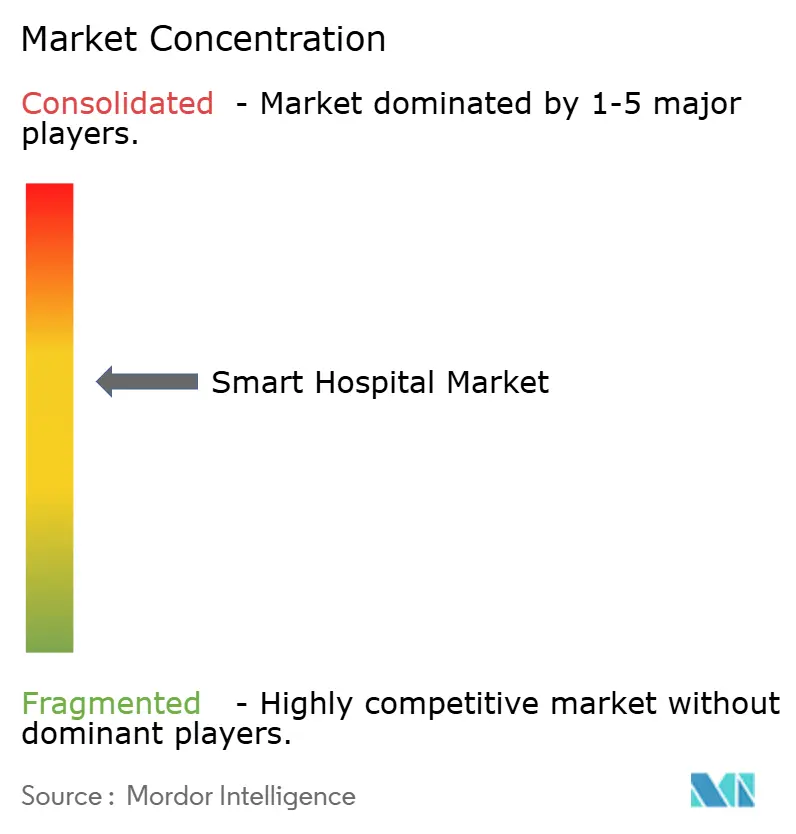
| Market Concentration | Medium |
Major Players *Disclaimer: Major Players sorted in no particular order Image © Mordor Intelligence. Reuse requires attribution under CC BY 4.0. | |
Smart Hospital Market Analysis by Mordor Intelligence
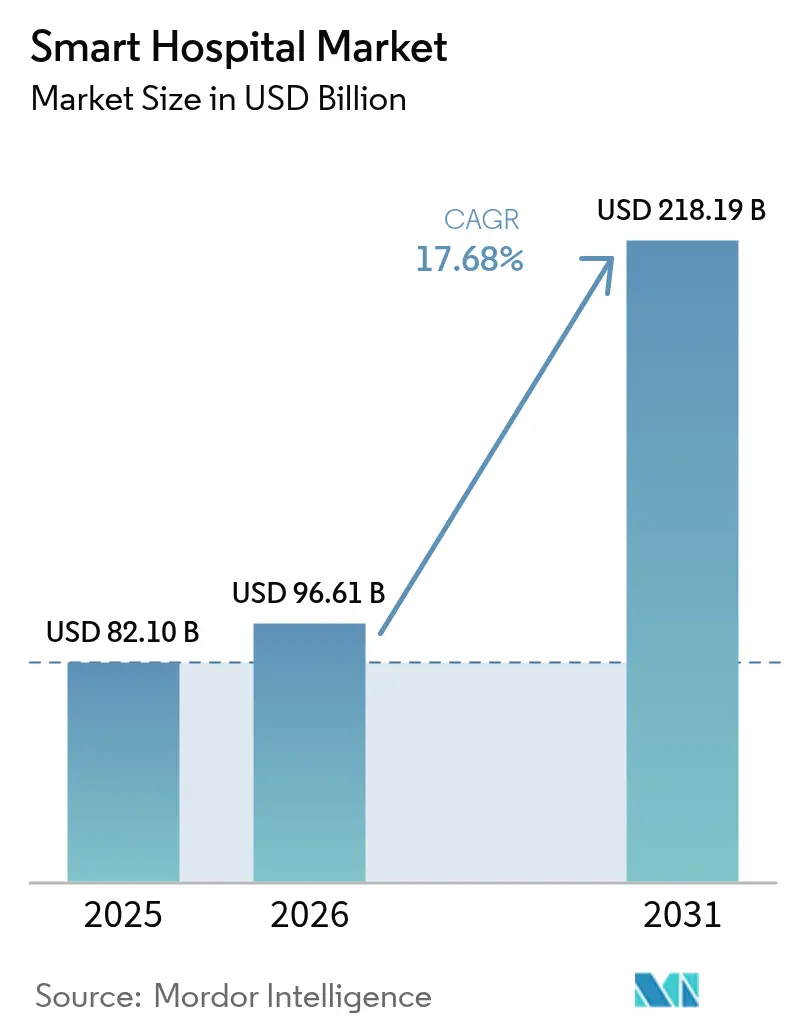
The Smart Hospital Market size was valued at USD 82.10 billion in 2025 and estimated to grow from USD 96.61 billion in 2026 to reach USD 218.19 billion by 2031, at a CAGR of 17.68% during the forecast period (2026-2031).
This expansion reflects accelerated digital transformation in healthcare, underpinned by infrastructure modernization and next-generation connectivity. Early 6G pilots reduce latency, permitting near-real-time analytics that reshape patient monitoring and clinical decision-making. [1]Hardware remains the largest component, yet services grow the fastest as hospitals shift from capital purchases to managed partnerships. Remote Patient Monitoring (RPM) outpaces Electronic Health Records (EHR) growth, signalling a move toward patient-centric, location-agnostic care. While North America leads in adoption, Asia-Pacific offers the most dynamic growth, driven by government stimulus and foundational digitisation efforts.
Key Report Takeaways
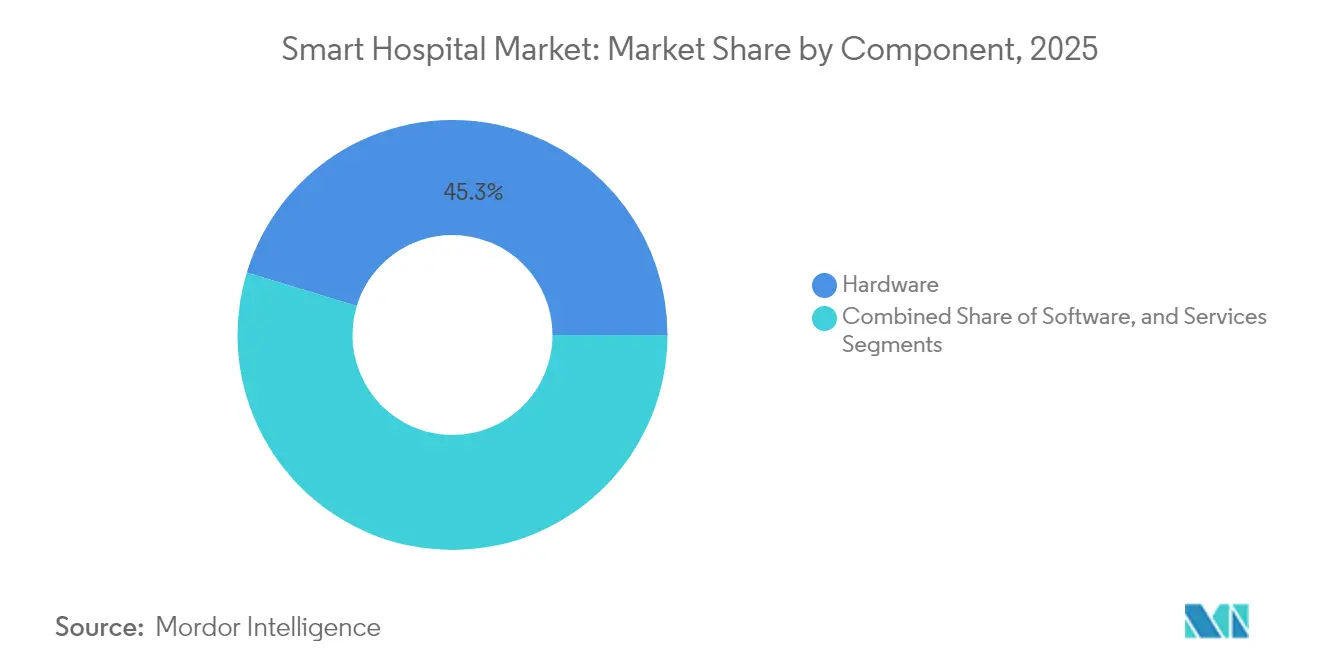
- By component, hardware held 45.30% of the smart hospital market share in 2025, whereas services are projected to expand at a 20.78% CAGR through 2031.
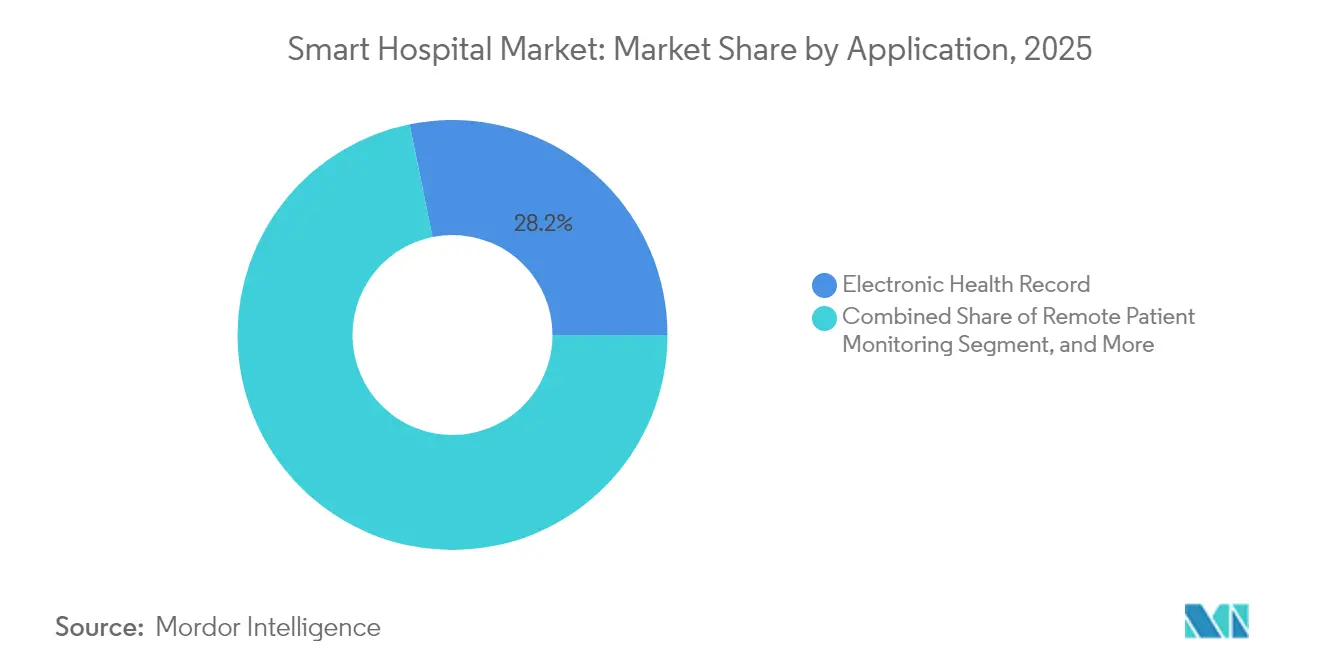
- By application, electronic health records led with a 28.20% revenue share in 2025 in the smart hospital market; remote patient monitoring is forecast to advance at a 22.05% CAGR to 2031.
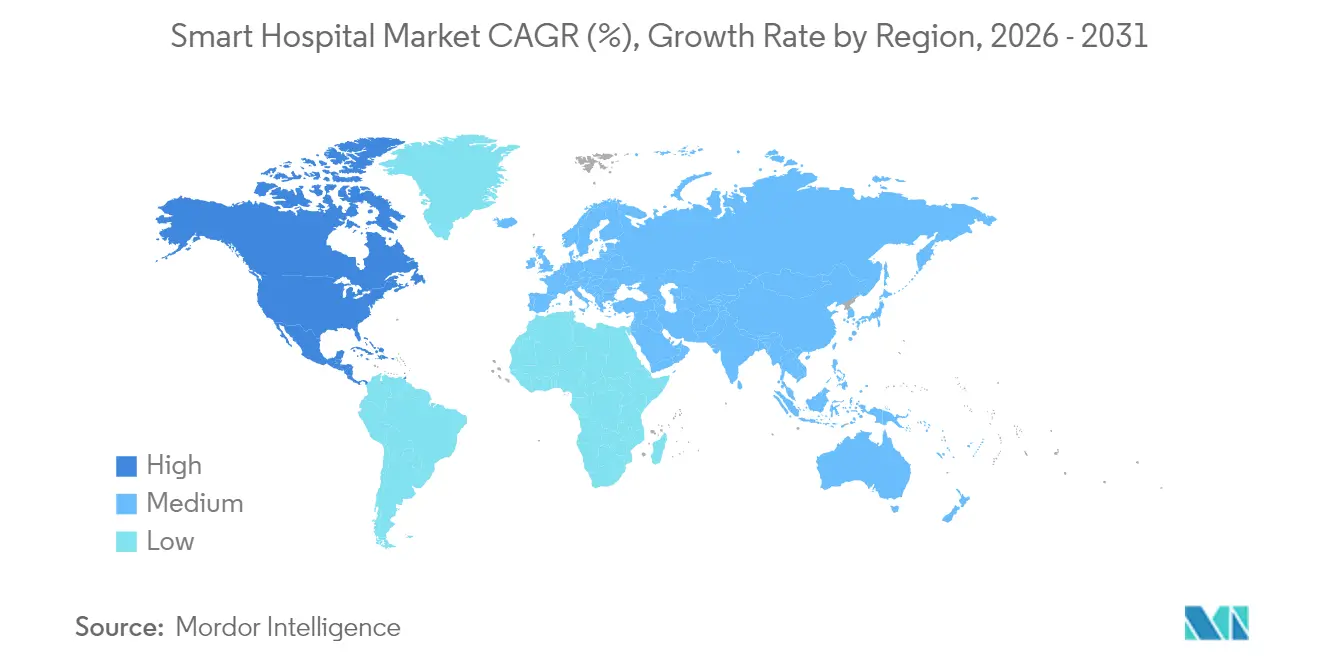
- By geography, North America commanded 40.45% of the smart hospital market share in 2025 in the smart hospital market, while Asia-Pacific is set to grow at a 19.62% CAGR through 2031.
Note: Market size and forecast figures in this report are generated using Mordor Intelligence’s proprietary estimation framework, updated with the latest available data and insights as of 2026.
Market Trends and Insights
Drivers Impact Analysis of Smart Hospital Market*
| Driver | (~) % Impact on CAGR Forecast | Geographic Relevance | Impact Timeline |
|---|---|---|---|
| Modernization of healthcare infrastructure | +4.2% | Global, with concentrated impact in North America and Europe | Medium term (2-4 years) |
| Surge in connected-device penetration | +3.8% | Global, led by Asia-Pacific and North America | Short term (≤ 2 years) |
| Government "smart-hospital" stimulus programs | +3.1% | Asia-Pacific core, particularly China, with spillover to emerging markets | Long term (≥ 4 years) |
| Corporate net-zero mandates driving smart-building retrofits | +2.4% | North America and EU, with selective adoption in APAC | Medium term (2-4 years) |
| Nursing-staff shortages accelerating virtual-care adoption | +2.9% | Global, most acute in North America and developed Asia-Pacific markets | Short term (≤ 2 years) |
| 6G-ready network pilots enabling near-real-time analytics | +1.6% | Limited to advanced markets: US, EU, Japan, South Korea | Long term (≥ 4 years) |
| Source: Mordor Intelligence | |||
Modernisation of Healthcare Infrastructure
Modernisation funding anchors the current growth phase. The American Rescue Plan apportioned USD 1 trillion for healthcare facilities, including a USD 452 million North Texas State Hospital and a USD 855 million Utah medical campus. New York’s USD 188 million Safety Net Transformation Programme targets EHR integrations, confirming government reliance on technology-enabled upgrades.[2]Hospitals also invest in digital backbones to handle sensor data, automated lighting, and predictive maintenance. These end-to-end upgrades displace piecemeal fixes, creating robust demand across the smart hospital market. Vendors able to bundle infrastructure, software, and services gain a competitive cost-of-ownership edge.
Surge in Connected-Device Penetration
Smart hospitals increasingly rely on IoT-enabled devices that produce high-volume clinical data. Samsung Medical Centre’s HIMSS Quadruple Stage 7 certification shows efficiency gains when device data integrates seamlessly. West Health Institute estimates that better device interoperability could save USD 30 billion each year by cutting redundant testing. This incentive drives hospital procurement toward platforms that unify data flows. While device proliferation raises interoperability hurdles, vendor consolidation and open protocols are easing integration. Accelerating device adoption, therefore, boosts the smart hospital market while spurring standards-based ecosystems.
Government Smart-Hospital Stimulus Programmes
China’s Trinity policy embeds smart medicine, services, and management into hospital build-outs, illustrating the economic scale achievable through cohesive national policy. The policy’s evaluation standards encourage unified electronic records, workflow optimisation, and skilled human resources. Similar momentum appears in Europe, where the incoming European Health Data Space could yield EUR 11 billion in savings. Coordinated stimulus quickens purchasing cycles, ensuring that the smart hospital market captures budgeted digital health outlays rather than competing with other capital projects.
Nursing-Staff Shortages Accelerating Virtual-Care Adoption
Acute workforce gaps quicken the shift to virtual nursing. At Guthrie Clinic, a virtual hub cut nurse turnover from 25% to 13% and saved USD 7 million in labour cost. Technology lets experienced nurses oversee multiple wards remotely, balancing workload and care quality. AI-ready EHR interfaces further streamline documentation, freeing bedside nurses for hands-on tasks. As staffing pressure intensifies, hospitals invest in tele-nursing platforms that scale expertise across facilities. This trend underpins sustained growth across the smart hospital market, especially for service providers offering turnkey virtual-care solutions.
Restraints Impact Analysis of Smart Hospital Market*
| Restraint | (~) % Impact on CAGR Forecast | Geographic Relevance | Impact Timeline |
|---|---|---|---|
| High capex of fully connected systems | -2.8% | Global, most pronounced in cost-sensitive emerging markets | Medium term (2-4 years) |
| Cyber-security and data-governance liabilities | -1.9% | Global, with heightened impact in regulated markets (US, EU) | Short term (≤ 2 years) |
| Inter-vendor interoperability gaps | -1.5% | Global, particularly acute in fragmented European markets | Medium term (2-4 years) |
| Limited digital-skills workforce in developing regions | -1.2% | Asia-Pacific emerging markets, Africa, Latin America | Long term (≥ 4 years) |
| Source: Mordor Intelligence | |||
High Capex of Fully Connected Systems
Comprehensive smart hospital roll-outs demand significant capital. Vendor-developed CPOE systems alone can cost USD 7.1 million to USD 19.3 million, with ROI horizons of eight years or more. Mid-sized hospitals struggle to meet these outlays amid margin pressure and supply chain inflation. Hardware, integration, training, and maintenance amplify total cost of ownership, favouring large networks that can amortise spending. Capital intensity thus slows adoption in emerging markets and rural facilities, tempering short-term growth in the smart hospital market.
Cyber-Security and Data-Governance Liabilities
Smart hospitals connect thousands of endpoints, each a possible attack vector. EU countries logged 309 major healthcare cyber incidents in 2023, highlighting systemic vulnerability. [3] Compliance with GDPR and HIPAA requires robust encryption, access control, and breach response capabilities. Security upgrades compete with clinical investments for budget share, and breach liabilities can exceed technology savings. As threat actors target high-value medical data, cybersecurity spending becomes an essential but growth-dampening cost for the smart hospital market.
*Our forecasts treat driver/restraint impacts as directional, not additive. The impact forecasts reflect baseline growth, mix effects, and variable interactions.
Smart Hospital Market Segment Analysis
By Component:
Hardware Dominance Faces Services DisruptionHardware generated the largest component revenue, securing 45.30% of the smart hospital market share in 2025 as hospitals installed servers, networking gear, imaging systems, and sensor arrays essential for digital operations. The smart hospital market size for hardware is projected to expand steadily, yet the services segment is growing faster at a 20.78% CAGR through 2031, reflecting demand for managed maintenance, analytics, and lifecycle support. Hospitals gravitate toward multi-year service contracts that convert capex to opex, ensuring predictable spend while accessing up-to-date expertise. Vendors such as Siemens Healthineers are expanding domestic manufacturing and service hubs to meet that need.
The services uptrend challenges hardware-centric revenue models. Providers bundle installation, remote monitoring, and AI-driven optimisation into outcome-linked agreements. This value shift boosts vendor lock-in yet lowers client operational risk. Software stands between the two, benefiting from cloud delivery that reduces onsite IT burden while enabling rapid feature deployment. Taken together, hardware reliability, smart software, and service depth create integrated propositions that shape competitive dynamics across the smart hospital market.

By Application:
EHR Incumbency Challenged by RPM InnovationElectronic Health Records retained a 28.20% revenue share in 2025, underlining their indispensable role in hospital digitisation. However, Remote Patient Monitoring recorded a 22.05% forecast CAGR, signalling a strategic pivot from internal process optimisation to patient-centric continuity of care. The smart hospital market size attached to RPM is expected to more than double from USD 16–17 billion in 2025 to more than USD 35 billion by 2031, aided by Medicare reimbursement codes.
RPM’s momentum arises from chronic disease prevalence, the aging population, and post-pandemic acceptance of home-based care. Hospital-at-home programmes have already cut inpatient costs by 30%, reinforcing the financial case for remote models. Meanwhile, EHR platforms add AI-powered tools to support diagnostics and workflow automation, defending incumbency. Pharmacy Automation and Medical Asset Tracking hold steady positions, yet emerging AI diagnostic platforms signal future growth pockets. Competition will intensify as device makers, cloud providers, and specialist startups vie for leadership across the smart hospital market.
Geography Analysis
North America Smart Hospital Market
North America captured 40.45% of the smart hospital market share in 2025, buoyed by mature infrastructure, federal stimulus, and strong vendor ecosystems. The American Rescue Plan’s USD 1 trillion healthcare allocation fuels facility upgrades, while programmes such as New York’s USD 188 million Safety Net Transformation advance EHR and emergency capabilities. Virtual nursing hubs, exemplified by Guthrie Clinic’s USD 7 million labour savings, demonstrate achievable returns on digital investments. Yet supply chain shortages cost an average of five-hospital networks USD 3.5 million, highlighting vulnerability.
APAC Smart Hospital Market
Asia-Pacific is the fastest-growing region, projected at a 19.62% CAGR to 2031. China’s Trinity policy places smart medicine, services, and management at the core of hospital construction, with national smart healthcare value heading toward 150 billion yuan. Thailand’s Siriraj 5G Smart Hospital cut diagnosis time from 15 minutes to 25 seconds, showcasing the clinical impact of advanced connectivity. South Korea’s Samsung Medical Centre achieved HIMSS Quadruple Stage 7, setting a regional benchmark. Vendor collaborations, such as ZTE’s 5G IoT network with China Telecom, trimmed upgrade costs by 80% and build time by 90% ZTE.
Europe Smart Hospital Market
Europe occupies a midway position, supported by the European Health Data Space, which could save EUR 11 billion over a decade. Cyber incidents remain a challenge, prompting a forthcoming Cybersecurity Support Centre. DIGITALEUROPE urges dedicated EU funding for digital health to ensure access to AI, telehealth, and interoperable data systems. With coordinated frameworks and funding, the region is poised for steady adoption, enhancing the long-term expansion of the smart hospital market.
Regulatory Landscape
Smart hospital deployments sit at the intersection of medical device, software, and health data rules, with growing attention on AI-enabled clinical decision support and interoperability. In the United States, the ONC Health Data, Technology, and Interoperability (HTI-1) updates (finalized in the Federal Register in January 2024) tightened expectations around certified health IT, including algorithm transparency and information-sharing requirements that shape EHR and connected workflow procurement. In January 2026, the US FDA issued revised final guidance for General Wellness: Policy for Low Risk Devices and for Clinical Decision Support (CDS) Software, clarifying enforcement discretion boundaries for software functions used in care pathways, which in turn affects how vendors position AI features inside hospital platforms.
In Europe, the EU AI Act introduces healthcare-specific obligations for high-risk AI systems, including transparency, logging, and human oversight requirements hospitals have to operationalize as AI deployers. In China, smart-hospital and internet-hospital standards continue to formalize technical and operational baselines, including Hubei Province DB42/T 2208.1-2024 (smart hospital construction and management standards), the national guideline T/SDSZXJJ 014-2025 for hospital intelligence construction, and Jiangsu Province DB32/T 5367-2026 for internet hospital service specifications. Along with GDPR and HIPAA obligations in regulated markets, these frameworks increase the emphasis on cybersecurity, auditability, and governance as gate criteria alongside clinical performance.
Value Chain Analysis
The smart hospital value chain starts with upstream component and device suppliers (medical sensors, imaging systems, bedside monitoring, networking gear, servers, and edge gateways), then moves to platform and application vendors (EHR, RPM, enterprise imaging, command centers, analytics, and cybersecurity). It ends with integrators and managed service providers that handle deployment, interoperability engineering, and lifecycle operations. Standards bodies and public-sector programs also influence platform selection and integration architectures: ONC announced the 2026 Standards Version Advancement Process (SVAP) cycle (June 2026), advancing USCDI v6 and updated HL7 FHIR Da Vinci specifications for electronic prior authorization, while IHE released the SDPi 2.4 supplement (first 2026 release) to improve point-of-care device interoperability across multi-vendor environments.
Downstream, hospitals and health systems procure through a mix of capital equipment tenders and multi-year service contracts that turn implementation, monitoring, and optimization into recurring opex. Execution risk in the chain is shaped by hardware availability and trade-related friction; industry reporting in 2025 highlighted tariff-driven delays affecting imported electronics and medical devices. That has pushed providers toward strategic supplier relationships, real-time inventory visibility, and selective domestic sourcing. Value capture is increasingly favoring vendors that can bundle secure connectivity, integration middleware, and managed operations, rather than standalone hardware or software modules.
Competitive Landscape
The smart hospital market displays moderate concentration anchored by diversified incumbents. Koninklijke Philips, GE Healthcare, and Siemens Healthineers merge hardware, software, and services into cohesive offerings that raise switching costs. EHR submarkets are consolidated around Epic Systems and Oracle Health, whereas RPM and AI diagnostics invite new entrants ranging from device manufacturers to tech giants. Large incumbents leverage scale to fund continuous R&D and regional service centers, securing relevance as hospitals demand integrated solutions.
Strategic alliances highlight AI as a differentiator. Philips and NVIDIA co-developed an MRI foundational model that enables zero-click scan planning. GE Healthcare partnered with AWS to inject generative AI into clinical workflows, aiming to streamline radiology interpretation. Siemens Healthineers’ USD 150 million US facility expansion strengthens local manufacturing for imaging and oncology devices.
Emerging players target niche gaps such as interoperability middleware, cybersecurity services, and specialty RPM platforms. Market entry barriers include regulatory certification, data-security compliance, and capital demand. Nonetheless, white-space innovations can scale rapidly through ecosystem partnerships. Competitive intensity is therefore poised to rise, promoting continual technology refresh cycles across the global smart hospital market.
Smart Hospital Industry Leaders
-
Koninklijke Philips N.V.
-
GE Healthcare ( General Electric)
-
Medtronic plc
-
Honeywell Life Care Solutions ( Honeywell International Inc)
-
Stanley Healthcare
- *Disclaimer: Major Players sorted in no particular order
Smart Hospital Market Companies Covered in this Report
- Koninklijke Philips N.V.
- GE Healthcare (General Electric)
- Siemens Healthineers
- Medtronic plc
- Honeywell Life Care Solutions
- Schneider Electric
- Microsoft Corporation
- Oracle Health (Cerner)
- Allscripts Healthcare Solutions
- Cisco Systems
- IBM Watson Health
- SAP SE
- STANLEY Healthcare
- ThoughtWire Corp.
- McKesson Corporation
- Epic Systems
- BD (Becton Dickinson)
- Abbott Laboratories
- Huawei Technologies
- Johnson Controls Digital Health
Market Opportunities and Future Outlook
A near-term opportunity is tied to national and regional programs that build shared data and interoperability foundations across multi-hospital networks, supporting scalable smart-hospital applications beyond single-site pilots. Canada launched the Vital national hospital data platform in June 2026, backed by CAD 210 million and initially connecting 160 hospitals across Alberta, Ontario, and Quebec. This creates demand for standardized ingestion, privacy controls, and AI-ready data services. China also implemented YD/T 4897-2024 to specify architecture and security for smart hospital private network integration using 5G alongside existing hospital networks, reinforcing whitespace for secure private-network design, device onboarding, and hospital-grade network operations.
Another growth pocket is high-acuity, workflow-centric ecosystems that connect clinical spaces and modalities in real time. Vendors can monetize orchestration software, edge compute, and cybersecurity as hospitals adopt command centers and digital operating room networks. In May 2026, the Department of Health - Abu Dhabi and Johnson & Johnson launched an intelligent surgical network built on an open digital ecosystem, linking operating rooms across Cleveland Clinic Abu Dhabi, PureHealth, Mediclinic Group, and NMC Healthcare. This example shows how multi-provider networks increase pull for interoperable OR integration, surgical video/data pipelines, and governance tooling. Large, financed greenfield and modernization projects also expand addressable scope for end-to-end deployments, such as Hospital das Clinicas in Sao Paulo signing a R$ 1.7 billion financing contract (January 2026) for its Technological Institute of Smart Medicine (ITMI). That strengthens demand for integrated infrastructure, platforms, and long-term services rather than fragmented point solutions.
Recent Industry Developments in Smart Hospital Market
- June 2026: Philips and WellSpan Health announced a strategic alliance to co-develop AI-driven innovations and make Philips a preferred vendor across WellSpan’s 12 hospitals for imaging modalities such as CT, MR, and digital X-ray. The agreement reinforces the shift from transactional equipment sales toward long-term co-innovation and standardization across multi-hospital networks, increasing platform stickiness for imaging and connected workflows.
- March 2026: Medtronic and GE HealthCare renewed and expanded their global strategic alliance to integrate Medtronic wireless monitoring and streaming video laryngoscopy with GE HealthCare anesthesia and monitoring platforms. The deeper device-platform coupling strengthens integrated perioperative workflows and raises interoperability and switching-cost barriers for competing point solutions.
- December 2024: Alfred Health in Melbourne adopted GE HealthCare Command Center software to improve patient flow, capacity management, and operational efficiency, joining a global base of implemented sites. This deployment highlights growing demand for hospital operations command layers that ingest real-time data from multiple systems to support staffing and throughput decisions at scale.
Smart Hospital Market Report Scope and Research Methodology
Market Definition and Coverage
For this study, the smart hospital market covers digital and connected systems used inside hospitals to improve clinical workflows, patient monitoring, and asset and medication management, along with the related software and services needed to run them.
Scope exclusions: Consumer-only wellness apps and devices that are not purchased or managed as part of a hospital program are excluded.
Segments Covered in This Report
- By Component
- Hardware
- Software
- Services
- By Application
- Electronic Health Record
- Remote Patient Monitoring
- Pharmacy Automation
- Medical Asset Tracking
- Other Applications
- By Geography
- North America
- United States
- Canada
- South America
- Brazil
- Argentina
- Rest of South America
- Europe
- Germany
- United Kingdom
- France
- Spain
- Russia
- Rest of Europe
- Asia-Pacific
- China
- Japan
- India
- South Korea
- Rest of Asia-Pacific
- Middle East
- Saudi Arabia
- United Arab Emirates
- Rest of Middle East
- Africa
- South Africa
- Nigeria
- Rest of Africa
- North America
Data Sources, Market Sizing, and Validation
Desk Research
Desk research starts by mapping what hospitals typically buy when they modernize, and how spending shows up in public data. We reference official and non-paywalled sources such as the OECD health statistics, World Bank health expenditure indicators, the US FDA device databases, the US National Library of Medicine and other peer reviewed journals, plus standards and guidance pages from groups such as IEEE.
To convert broad signals into market inputs, we also review annual reports, investor presentations, and press releases from solution providers and hospital groups, along with procurement notices and implementation case studies where available. A paid subscription for company financials and news is used to confirm revenue direction and product mix, and a patent database is used to track where innovation is rising (for example, remote monitoring and interoperability). This source list is illustrative only, and many other references are used to collect data, validate assumptions, and clarify gaps.
Primary Interviews and Surveys
Primary work is used to pressure test adoption rates, budget cycles, and what is counted as smart hospital spending versus routine IT refresh. We spoke with hospital IT and biomedical teams, clinical operations leaders, and solution-side product and channel experts across APAC, EMEA, and the Americas, and then used their inputs to confirm unit economics and realistic rollout timelines.
Distribution of primary research fieldwork respondents
| Company type | Respondent position | Region |
|---|---|---|
| Top tier: 27% | CXOs: 14% | APAC: 48% |
| Mid tier: 59% | Functional/Unit leaders: 33% | EMEA: 33% |
| Smaller Players: 14% | Managers: 53% | Americas: 19% |
Market-Sizing & Forecasting
The core model uses a top-down approach. We reconstruct hospital digitalization spend from health expenditure signals, hospital counts, and typical smart solution penetration by application, then allocate the totals across hardware, software, and services. To keep the results realistic, we cross-check them with selective bottom-up approximations such as sampled average selling prices multiplied by estimated deployments for EHR enablement, remote patient monitoring programs, pharmacy automation, and asset tracking, and then adjust when the two views drift.
Key inputs include hospital IT and clinical operations budgets, the share of hospitals adopting connected monitoring, the typical refresh cycle for hardware and software, the services share during initial integration versus steady state support, and regional pace differences linked to interoperability mandates and workforce constraints. Forecasts lean on multivariate regression, where variables such as health spending growth, digitization policy momentum, and technology cost curves are combined with interview-based expectations on rollout speed. When local data is thin, we use proxy indicators such as comparable hospital density and spending per bed, and then revalidate through expert feedback before locking the final curve.
Data Validation & Update Cycle
Validation is done through multiple checks so the numbers do not rely on a single data stream. We compare model outputs against independent signals such as component share logic, application-level adoption narratives, and region splits that reflect observed digitization intensity, and we investigate outliers before sign-off. If a variance is driven by one assumption such as penetration, pricing, or service attach rate, we revisit that assumption and re-contact experts when needed.
Each report is refreshed annually, and interim updates are made when material events change demand, such as a policy shift, a major reimbursement change, or a clear technology adoption inflection. Before delivery, a final analyst review pass is completed to ensure the latest public releases and the newest interview learnings are incorporated into the model.
Mordor Intelligence's Smart Hospital Market Sizing Compared With Other Published Estimates
Published market sizes for smart hospitals can vary widely, even when authors are describing the same overall theme. The gaps usually come from what is counted as in-scope hospital spending, which year is used as the anchor, and how quickly adoption is assumed to scale across applications.
Hospital IT budget direction, application-level adoption shares (for example EHR and remote patient monitoring), and region mix checks are used as evidence that tie Mordor Intelligence to a 2025 estimate of USD 82.10 B, instead of relying on a single revenue roll-up that can overcount services. Differences also appear when an estimate uses factory-gate pricing, applies aggressive currency timing, or treats outpatient vigilance and broader digital health infrastructure as fully captured inside smart hospitals.
Benchmark comparison
| Source | Market Size | Gaps in Research Methodology |
|---|---|---|
| Mordor Intelligence | USD 82.10 B (2025) | |
| Trade Publisher A | USD 71.37 B (2025) | Uses a factory-gate framing that can understate downstream software and integration value captured at the hospital level, and it may apply broader supply-side definitions that do not fully align with application adoption shares. |
| Industry Publisher B | USD 62.01 B (2024) | Anchors the market on a 2024 base year and can differ in what is treated as smart hospital hardware versus general connected devices, which shifts the starting value before the forecast curve is applied. |
Taken together, the spread mainly reflects definition boundaries and the base-year anchor rather than a disagreement on demand direction. Our approach stays traceable by linking totals to observable hospital spending capacity, application uptake, and realistic services attachment over the rollout cycle, which makes it easier to explain and repeat when assumptions are updated.
Key Questions Answered in the Report
What is the current value of the smart hospital market?
The smart hospital market is valued at USD 96.61 billion in 2026.
Which component segment holds the largest share?
Hardware holds the largest component share at 45.30% in 2025.
Which application is growing the fastest?
Remote Patient Monitoring is projected to grow at a 22.05% CAGR between 2026 and 2031.
Which region is expected to grow most rapidly?
Asia-Pacific is forecast to expand at a 19.62% CAGR through 2031.
How do workforce shortages influence technology adoption
Nursing shortages accelerate investment in virtual-care platforms, which lower labour costs and maintain care quality.
What is a key restraint to smart hospital deployment?
High capital expenditure for fully connected systems slows adoption, particularly in cost-sensitive markets.