
Market Overview
| Study Period | 2019 - 2031 |
|---|---|
| Market Size (2026) | USD 1.73 Billion |
| Market Size (2031) | USD 2.92 Billion |
| Growth Rate (2026 - 2031) | 11.04 % |
| Fastest Growing Market | Asia-Pacific |
| Largest Market | North America |
| Market Concentration | Medium |
Major Players *Disclaimer: Major Players sorted in no particular order Image © Mordor Intelligence. Reuse requires attribution under CC BY 4.0. | |
Small UAV Market Analysis by Mordor Intelligence
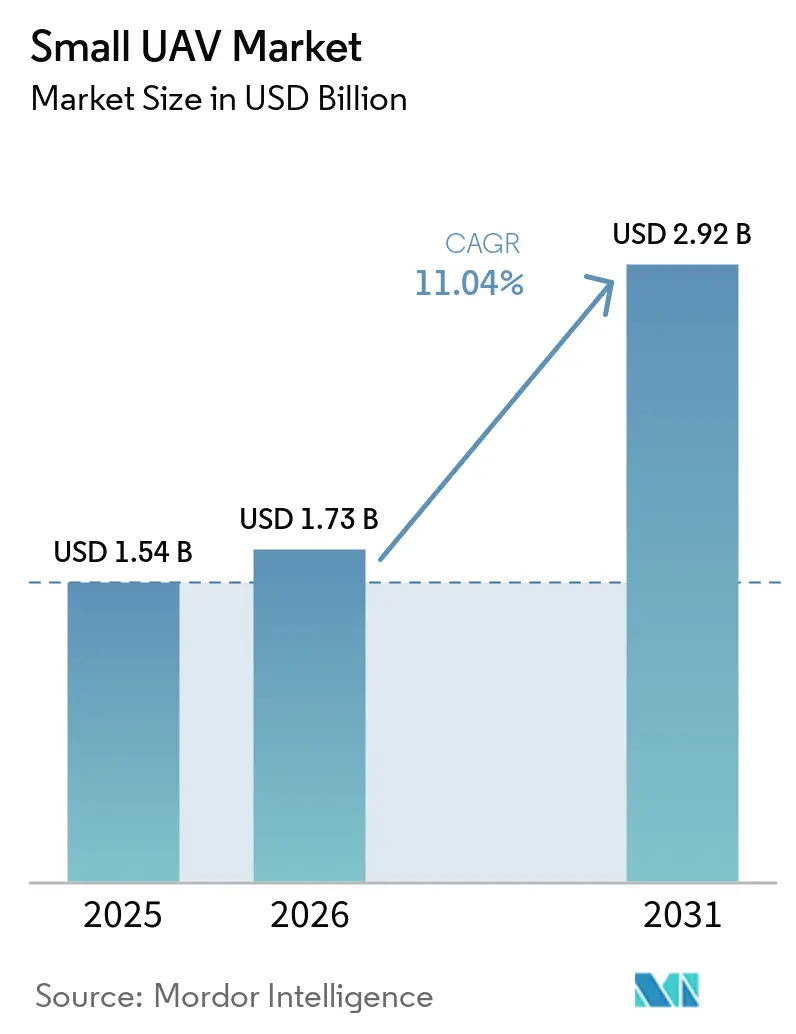
The small UAV market size was valued at USD 1.54 billion in 2025, and is forecast to grow from USD 1.73 billion in 2026 to reach USD 2.92 billion by 2031, advancing at an 11.04% CAGR over 2026-2031. Growth stems from the rapid transition away from crewed reconnaissance aircraft toward compact, expendable platforms that deliver real-time intelligence at far lower operating costs. Fixed-wing airframes currently hold the largest revenue share, yet demand is steadily shifting toward hybrid vertical-takeoff designs that eliminate runway dependence and reduce launch cycles. Weight-class preferences are also shifting: mini drones, weighing between 2 kilograms and 20 kilograms, dominate shipments, while nano and micro variants, weighing below 2 kilograms, are gaining traction within infantry squads for pocket-launched scouting. Mission sets continue to diversify; intelligence, surveillance, and reconnaissance (ISR) still lead in volumes, but combat roles using loitering munitions are outpacing all other applications following battlefield validation in Eastern Europe. North America anchors demand on the back of rising Pentagon budgets, whereas the Asia-Pacific emerges as the fastest-growing region, as China, India, and South Korea accelerate indigenous production.
Key Report Takeaways
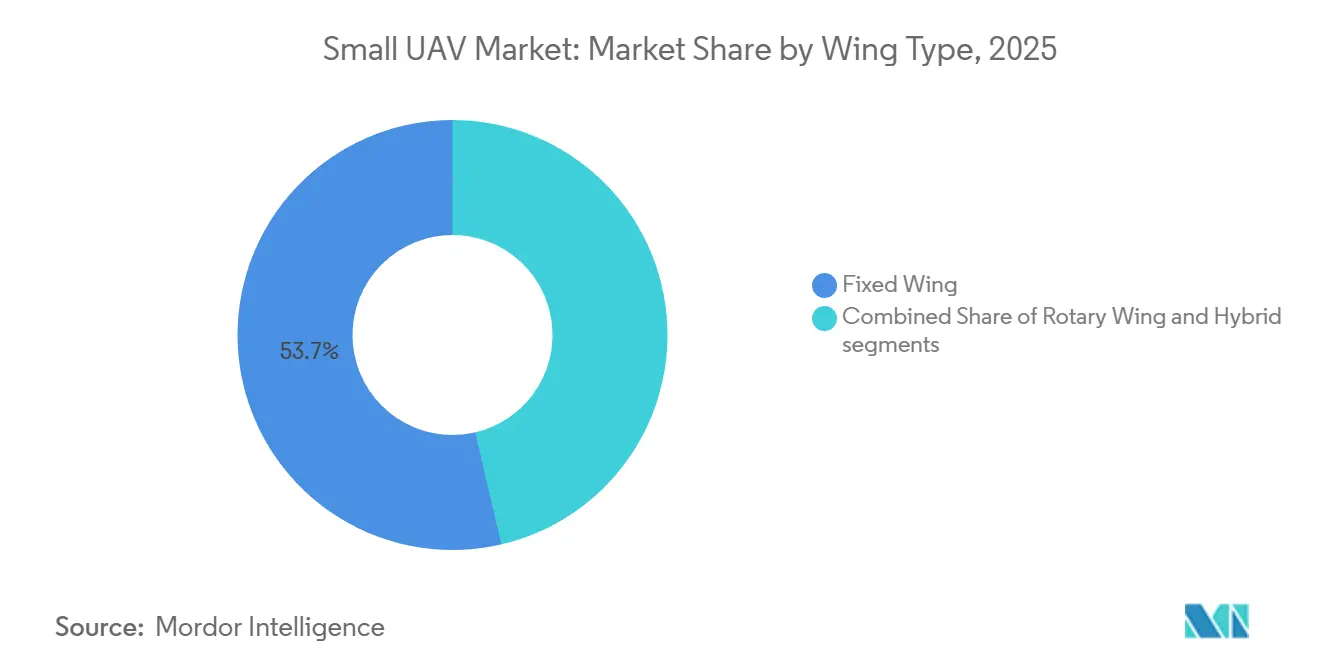
- By wing type, fixed-wing platforms held 53.65% of the small UAV market share in 2025, while hybrid vertical-takeoff designs are forecast to expand at a 13.92% CAGR through 2031.
- By size class, the mini category accounted for 56.76% of the small UAV market in 2025, whereas nano and micro drones are projected to grow at a 12.45% CAGR through 2031.
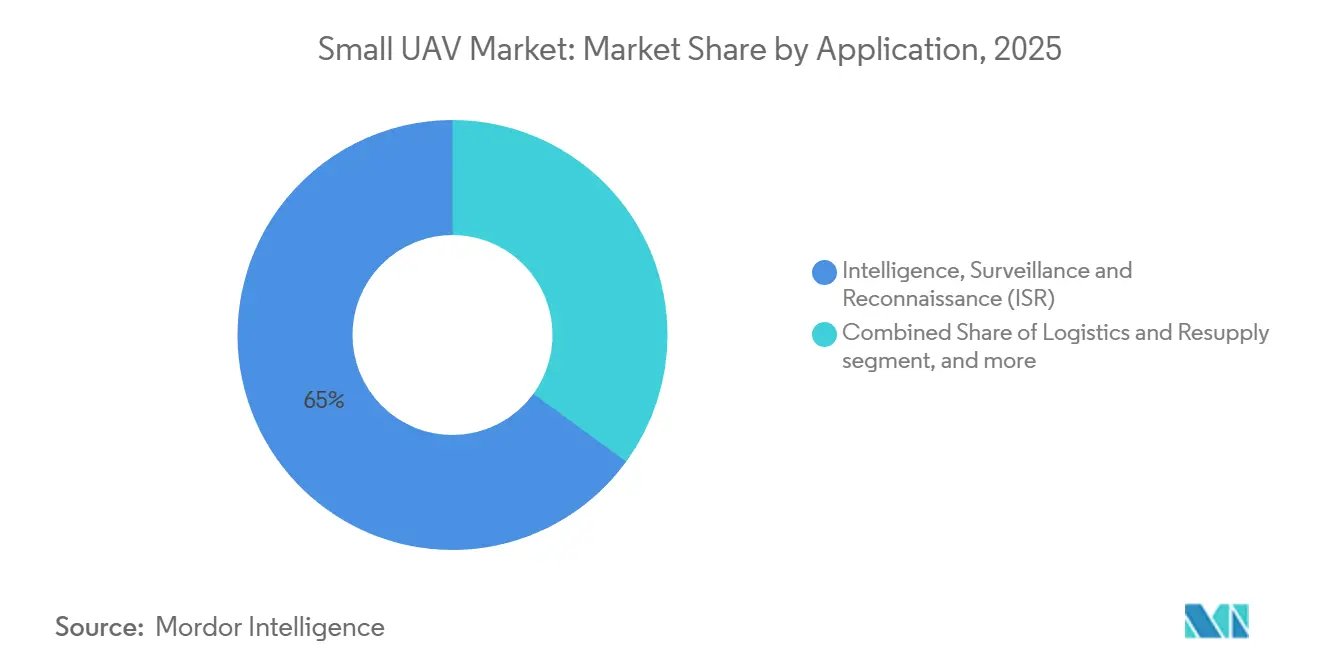
- By application, ISR dominated with a 64.98% revenue share in 2025; however, combat missions deploying loitering munitions are projected to grow at a 12.85% CAGR through 2031.
- By propulsion, battery systems captured 61.89% of the small UAV market size in 2025, while fuel-cell platforms are forecast to grow at a 13.83% CAGR through 2031.
- By geography, North America led with a 46.91% revenue share in 2025, and the Asia-Pacific is forecast to grow at a 12.45% CAGR through 2031.
Note: Market size and forecast figures in this report are generated using Mordor Intelligence’s proprietary estimation framework, updated with the latest available data and insights as of January 2026.
Global Small UAV Market Trends and Insights
Drivers Impact Analysis*
| Driver | (~) % Impact on CAGR Forecast | Geographic Relevance | Impact Timeline |
|---|---|---|---|
| Demand for real-time ISR in contested environments | +3.2% | Global, concentrated in North America, Europe, Asia-Pacific | Medium term (2-4 years) |
| Force-multiplier value vs. crewed aircraft | +2.8% | Global, especially North America and Middle East | Long term (≥ 4 years) |
| DoD-funded soldier-borne and squad-level drone programs | +2.1% | North America, spillover to NATO allies | Short term (≤ 2 years) |
| AI-enabled autonomous swarming capability | +1.9% | North America, Asia-Pacific | Medium term (2-4 years) |
| DARPA projects for GPS-denied navigation | +1.5% | North America with allied tech transfer | Long term (≥ 4 years) |
| Rapid fielding of expendable loitering munitions | +2.3% | Global, early uptake in Europe and Middle East | Short term (≤ 2 years) |
| Source: Mordor Intelligence | |||
Demand for Real-Time ISR in Contested Environments
Peer air-defense networks pose an unacceptable risk to crewed reconnaissance, so brigade commanders now rely on small UAV market platforms that cost one-tenth as much per flight hour as manned aircraft.[1] The US Army earmarked USD 487 million for the Future Tactical UAS program in FY 2025, specifying a six-hour endurance and automatic target recognition capability to replace the legacy Shadow aircraft. Operational data from Ukraine indicated that small drones executed 78% of artillery-targeting missions in 2024, confirming their centrality to kill-chain closure. Consequently, procurement officers favor expendable systems fitted with sub-1 kilogram multi-spectral payloads such as the Puma 3 AE, which delivers targeting-quality imagery from 5 kilometers. The resulting budget reallocation from exquisite, crewed platforms to mass-produced drones is restructuring the ISR value chain.
Force-Multiplier Value vs Crewed Aircraft
Lifecycle analyses show a 10-to-1 operating-cost advantage for small UAV market fleets over helicopters, a ratio that is reshaping force designs.[2] A four-ship detachment of RQ-11 Ravens costs approximately USD 1.2 million per year to operate, compared to USD 12 million for a single reconnaissance helicopter of similar coverage. Reflecting this calculus, the US Marine Corps began retiring light-attack helicopter squadrons in 2025 in favor of infantry-organic drone companies. Japan plans to equip all 13 rapid-deployment brigades with mini-UAV platoons by 2027 without expanding pilot schools. The widened sensor envelope allows junior officers to call precision fires within seconds, further increasing combat efficiency.
DoD-Funded Soldier-Borne and Squad-Level Drone Programs
The FY 2025 US budget allocates USD 874.30 million to soldier-borne reconnaissance and lethal miniature aerial missile systems, pushing capability to the nine-soldier squad. AeroVironment won a five-year indefinite-delivery contract in March 2024 to provide Switchblade drones, ensuring every squad carries two organic loitering munitions. Separate DARPA field trials reduced operator cognitive load by 40%, enabling one soldier to control four drones simultaneously.[3] NATO interoperability standards issued in 2025 require member states to integrate squad-level drone datalinks with battlefield-management software, harmonizing procurement specifications. These requirements fuel demand for nano-class airframes, such as the 33-gram Black Hornet 4, which provides thermal imaging for 25 minutes.
AI-Enabled Autonomous Swarming Capability
The US Air Force Collaborative Combat Aircraft program demonstrated 20-drone autonomous swarms that routed threat radars with distributed jamming in 2025, validating edge-AI processors that allow on-board decision-making. DARPA’s Offensive Swarm-Enabled Tactics tests in 2024 showed 30 quadcopters clearing a 12-building complex in 18 minutes, proving collaborative autonomy in dense urban terrain. Anduril’s Ghost-X utilized Lattice software to assign ten drones to seven targets in a single salvo, reducing engagement time by 60% compared to human control.[4] China’s People’s Liberation Army revealed similar launches during 2024 coastal exercises, indicating rapid technology diffusion. Defense agencies now prize software-defined platforms that can receive algorithm updates, tilting competitive advantage toward AI-centric vendors.
Restraints Impact Analysis*
| Restraint | (~) % Impact on CAGR Forecast | Geographic Relevance | Impact Timeline |
|---|---|---|---|
| Cyber/EW vulnerability and counter-UAS proliferation | -2.1% | Global, acute in Europe and Middle East | Short term (≤ 2 years) |
| Short endurance and limited lethal payload | -1.4% | Global, affects extended-range Asia-Pacific missions | Medium term (2-4 years) |
| Export-control (ITAR/MTCR) hurdles | -0.9% | Exporting nations in North America/Europe; importing nations in Middle East/Africa | Long term (≥ 4 years) |
| Semiconductor and Li-ion cell supply-chain risk | -1.2% | Global, concentrated in Asia-Pacific manufacturing hubs | Medium term (2-4 years) |
| Source: Mordor Intelligence | |||
Cyber/EW Vulnerability and Counter-UAS Proliferation
Adversaries employ jammers, lasers, and cyber exploits that compromise the effectiveness of the small UAV market, forcing manufacturers to invest in encrypted, frequency-hopping radios, which add USD 8,000-12,000 to each unit. Russian Pole-21 systems degraded GPS to 50 m CEP and severed quadcopter links along the Ukrainian front in 2024, triggering NATO anti-jam mandates. The US Naval Postgraduate School demonstrated that machine-learning (ML) jammers autonomously denied 92% of drone control links in trials, foreshadowing AI-driven counter-UAS networks. Directed-energy weapons are also maturing; Israel’s Drone Dome laser achieved 1,000 intercepts at a marginal USD 2 per shot in 2025. A higher attrition risk compels buyers either to pay for survivability upgrades or treat drones as disposable, thereby compressing margins.
Short Endurance and Limited Lethal Payload
Battery-powered craft rarely exceed 90 minutes aloft, limiting deep-strike or persistent ISR missions unless launch teams operate within 20 kilometers of targets, exposing them to enemy fire. The Army’s 2024 RQ-11 assessment led to the cancellation of 40% of sorties due to a lack of loiter time, thereby accelerating fuel-cell R&D efforts aimed at achieving six-hour endurance. Intelligent Energy’s 800-watt module hit 5.2 hours in 2025 tests but added 1.8 kilograms, reducing payload headroom. Warhead mass also constrains lethality; a 0.5-kilogram Switchblade 300 charge is effective only on soft targets, while the 18-kilogram Switchblade 600 requires vehicle transport, limiting infantry portability. The market bifurcates between ultra-light nano craft and heavier mini-UAVs, neither of which fully satisfies operational requirements, tempering adoption.
*Our forecasts treat driver/restraint impacts as directional, not additive. The impact forecasts reflect baseline growth, mix effects, and variable interactions.
Segment Analysis
By Wing Type: Hybrid Designs Accelerate Runway-Free Missions
Hybrid VTOL platforms are expanding at a 13.92% CAGR, the fastest pace among airframe architectures, as armies and navies seek drones that can launch without catapults or recovery nets, a decisive benefit in austere bases and ship decks. Fixed-wing craft still generated 53.65% of 2025 revenue on the strength of long-endurance ISR, cementing the segment’s lead in the small UAV market. Yet tiltrotors, such as Textron’s Aerosonde HQ, now win maritime contracts precisely because they can land back on small vessels despite the sea state, a feat that fixed-wing UAVs cannot match.
Hybrid configurations also dominate next-generation loitering munitions because vertical launch enables immediate response to fleeting targets. Anduril’s Roadrunner lifts off vertically, then sprints at Mach 0.6 for 100 minutes, pairing VTOL launch flexibility with jet endurance. Compliance with NATO STANAG 4703 airworthiness rules, which require controlled recovery, further favors platforms that can descend vertically into tight landing zones.[5] As a result, analysts expect hybrid models to command 25% of new procurement spending by 2028, steadily eroding the fixed-wing lead in the small UAV market.

By Size Class: Nano and Micro Variants Proliferate at Squad Level
Nano and micro drones weighing under 2 kilograms are projected to grow at a 12.45% CAGR through 2031, reflecting doctrinal moves to embed organic surveillance within every infantry squad. The mini segment retained a 56.76% revenue share in 2025, demonstrating the slight market-size advantage that larger airframes hold in multi-sensor payloads and three-hour endurance.
Teledyne FLIR shipped its 12,000th 33-gram Black Hornet 4 in September 2025, marking a 40% annual production increase that reflects steep battlefield demand for pocket-launched ISR. Meanwhile, India’s ideaForge posted a 60% revenue growth in FY2025, driven by a surge in Switch UAV orders, illustrating how emerging-market armies are leapfrogging to indigenous nano solutions. Regulatory relief accelerates adoption: The US FAA’s 2024 rule exempts craft weighing less than 250 grams from remote ID, thereby trimming compliance costs and shortening fielding timelines. Together, these trends are expected to lift nano and micro drones to roughly one-third of the small UAV market revenue by the end of the decade.
By Application: Loitering Munitions Redefine Combat Missions
ISR dominated 64.98% of 2025 demand; however, combat applications using loitering munitions are expanding at a 12.85% CAGR, as defense planners emphasize kill-chain compression. Ukraine’s reliance on one-way attack drones demonstrated low-cost lethality against armor and fortified positions, prompting many NATO members to re-allocate budgets toward strike-capable airframes.
The DoD’s Replicator initiative aims to field thousands of autonomous loitering munitions by 2027, underscoring how the small UAV market share associated with combat roles is expected to rise rapidly. AeroVironment’s Switchblade 600 secured USD 75 million in foreign military sales in 2024, as it offers precision strike capabilities at half the cost of anti-tank missiles. Electronic attack, logistics resupply, and training targets remain niche today but attract rising R&D as miniaturized gallium-nitride transmitters and modular payload bays unlock new mission sets.
By Propulsion Type: Fuel Cells Pursue Multi-Hour Endurance
Battery packs accounted for 61.89% of 2025 revenue, as lithium-polymer (LiPo) chemistry delivers 250 Wh/kg at a low cost and fits unit logistics, thereby anchoring their lead in the small UAV market. Yet, hydrogen fuel cells are advancing at a 13.83% CAGR, which is triple the growth rate of batteries, because special operations units require six-hour endurance to penetrate denied airspace.
Intelligent Energy’s 2.4 kW stack achieved a 7.5-hour flight time on a 25-kilogram prototype in 2025, but it carried a USD 18,000 price premium and complex hydrogen cartridges. The US Special Operations Command purchased 200 Protonex modules in 2024 to test that trade-off, suggesting fuel cells will gain share in high-value, long-range missions. Developers aim to target sub-USD 10,000 per kilowatt and solid-state storage by 2027, milestones that could shift a portion of the small UAV market size toward fuel cells.
Geography Analysis
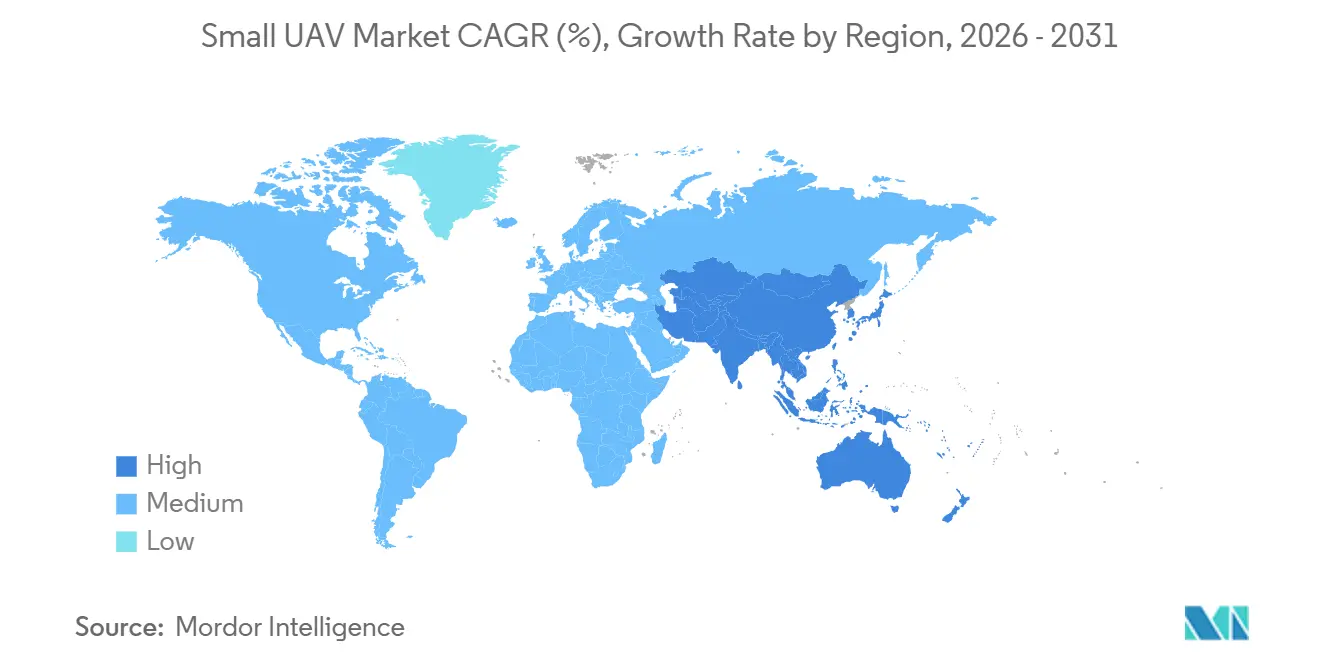
North America generated 46.91% of 2025 revenue, buoyed by USD 1.1 billion in DoD small-UAS appropriations spanning Future Tactical UAS, Short-Range Reconnaissance, and Lethal Miniature Aerial Missile System lines. The US Army’s March 2024 indefinite-delivery award to AeroVironment for Switchblade variants typifies bulk procurement that anchors regional dominance. Canada devoted CAD 320 million (USD 166.81 million) in 2024 to mini-UAVs for Arctic patrol, employing drones instead of patrol aircraft for cost-effective polar coverage. Mexico followed in 2025 with a USD 45 million purchase of quadcopters for counter-narcotics missions, signaling growing homeland security demand.
The Asia-Pacific region is projected to post the highest growth at a 12.45% CAGR through 2031, led by indigenous programs in China, India, and South Korea that aim for strategic autonomy while reducing their exposure to Western export controls. China’s Aviation Industry Corporation introduced the Blowfish A3 loitering munition in 2024 for potential deployment in Taiwan-strait scenarios. South Korea signed a KRW 85 billion (approximately USD 57.68 million) quadcopter contract with Firstec in 2024 to enhance border surveillance and reduce overseas dependence. Australia chose Textron’s Aerosonde HQ VTOL drones for shipboard ISR in 2025, signaling maritime-focused demand.
Europe accounted for 28% of 2025 sales, inflated by wartime Ukrainian orders yet hampered by ITAR constraints that complicate US technology transfer. The UK Ministry of Defence funded GBP 75 million of domestic QinetiQ drones in 2024, emphasizing sovereignty over supply chains. In the Middle East, Israel Aerospace Industries, Turkey’s Baykar, and the UAE’s EDGE Group exploit permissive export rules to win contracts that Western firms cannot pursue under the ITAR, thereby enlarging their regional share to 12% of the small UAV market. South America and Africa remain nascent at 6%, but Brazil’s 2024 rainforest-surveillance program indicates wider internal-security adoption is imminent.
Regulatory Landscape
Regulation continues to split between civil airspace integration and defense-specific procurement and supply-chain rules. In the United States, FAA Remote ID requirements under 14 CFR Part 89 apply to drones that must be registered, requiring broadcast Remote ID or operation within an FAA-Recognized Identification Area (FRIA), which increases compliance and equipment considerations for many commercial and dual-use small UAV fleets. In Europe, EASA rules for UAS operations continue to mature around risk-based approval pathways, and in June 2026 EASA updated its Easy Access Rules for UAS to incorporate the JARUS SORA 2.5 package, reinforcing standardized safety cases for more complex operations.
On the defense side, policy is increasingly geared toward rapid fielding and compliance-driven sourcing. The US Department of Defense issued the July 2025 Unleashing U.S. Military Drone Dominance memorandum, reframing Group 1 and Group 2 drones as consumable commodities rather than durable property to reduce procurement and training friction, and the US Marine Corps followed with MARADMIN 537/25 to implement the Secretary of Defense policy changes for small UAS procurement and training. NATO interoperability and airworthiness requirements referenced in the report (such as STANAG 4703), alongside US supply-chain restrictions including NDAA-related constraints on certain Chinese-origin electronics, raise the emphasis on documentation, traceability, and secure communications as factors in vendor eligibility.
Value Chain Analysis
The small UAV value chain spans upstream electronics and energy storage inputs (semiconductors, GNSS/IMU navigation components, radios, cameras, Li-ion cells, and in emerging cases fuel-cell stacks) through airframe and propulsion integration, mission payloads, and software stacks that enable autonomy and resilient command-and-control. Assembly and test are increasingly organized around modular open architectures so airframes can accept multiple payload types (EO/IR, EW, communications relay), while software updates and mission apps provide differentiation. Downstream, the chain extends to training, spares, repair and overhaul, encryption key management, and data exploitation workflows that connect squad-level drones to battlefield management systems.
Supply-chain risk is concentrated in components rather than basic airframes, especially batteries, motors, magnets/rare earths, and specialized compute and secure networking, which can become chokepoints during rapid scale-up. The report context highlights active moves toward vertical integration and domestic sourcing (for example, Teledyne's battery acquisition in 2024), reflecting buyer preference for traceable, compliant electronics and assured replenishment. Industry coordination and policy engagement also shape the chain: AUVSI held its 2026 Hill Day on June 24 in Washington, D.C., convening over 100 industry leaders around autonomy policy, underscoring how standards, security requirements, and procurement rules increasingly influence supplier selection and the build-versus-buy balance across tiers.
Competitive Landscape
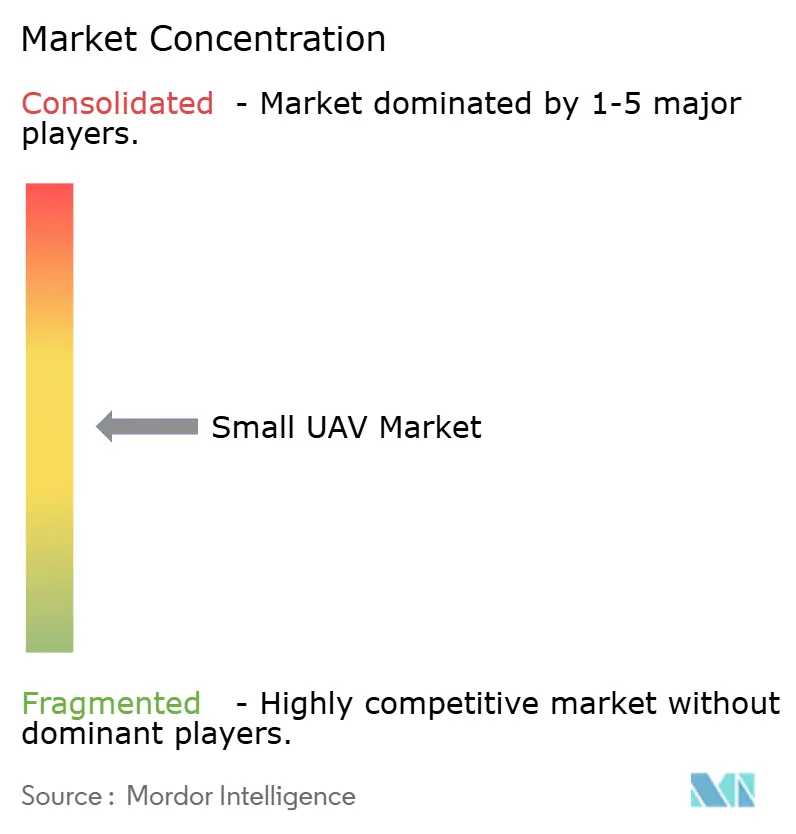
The small UAV market features moderate fragmentation: the top five vendors, Northrop Grumman Corporation, AeroVironment, Inc., Teledyne Technologies Incorporated, Elbit Systems Ltd., and Lockheed Martin Corporation, captured a significant share of the 2025 defense revenue. Incumbents leverage installed fleets and sustainment contracts but confront margin pressure as buyers demand open-architecture systems that commoditize airframes. Venture-backed Anduril and Skydio erode share by bundling edge-AI software that bypasses GPS jamming, a differentiator that legacy suppliers retrofit at a higher cost.
Strategic moves center on vertical integration and software mergers and acquisitions. Teledyne’s 2024 USD 180 million battery acquisition secures cell supply amid 12-month lead times for Li-ion cells. Northrop Grumman invested USD 200 million to triple its Mississippi production space by 2025, indicating rising demand for autonomous strike platforms. Meanwhile, Baykar and the EDGE Group leverage export policy flexibility to serve African and Middle Eastern buyers who are restricted from US supply, reshaping geographic competition.
Patent activity corroborates the shift toward autonomy: the US Patent and Trademark Office granted 340 small-UAV autonomy patents in 2024, a 25% increase year-over-year, with Anduril, Shield AI, and Skydio accounting for 40% of the awards. Compliance barriers also rise; NATO STANAG 4703 airworthiness rules and the US National Defense Authorization Act’s Section 848 ban on Chinese electronics require transparent supply chains that favor established defense primes. Start-ups that combine AI software with compliant hardware stand to capture incremental share in the small UAV market.
Small UAV Industry Leaders
-
Northrop Grumman Corporation
-
AeroVironment, Inc.
-
Teledyne Technologies Incorporated
-
Lockheed Martin Corporation
-
Elbit Systems Ltd.
- *Disclaimer: Major Players sorted in no particular order
Market Opportunities and Future Outlook
A large, actionable opportunity sits at the intersection of mass fielding and survivability upgrades, where buyers are purchasing attritable airframes while also paying for counter-EW features (encrypted, frequency-hopping radios and onboard autonomy) that preserve utility in jammed environments. The US Department of Defense has already moved policy in this direction with the July 2025 Unleashing U.S. Military Drone Dominance memorandum, and it has articulated squad-level drone fielding goals by the end of 2026, pushing vendors to productize low-cost configurations with faster training and replenishment cycles. This procurement posture expands whitespace for vendors that can pair compliant hardware with frequent software releases (autonomy, navigation in GPS-degraded environments, and targeting aids) and deliver sustainment packages that keep unit-level fleets mission-ready at high attrition rates.
Another opportunity is emerging in base and homeland defense, where demand is moving beyond the drone itself toward integrated detect-track-identify-defeat systems and the sensors that cue them. In April 2026, JIATF-401 committed over USD 600 million to expand counter-uncrewed aircraft capabilities for Operation Epic Fury and related initiatives, and in July 2026 AeroVironment received a USD 500 million IDIQ for the JIATF-401 Domestic Shield Program with an USD 80.5 million task order for Titan-MS deployments for U.S. Air Force Global Strike Command base defense. These programs create follow-on requirements for interoperable command-and-control, multi-sensor payload integration, hardened communications, and rapid manufacturing throughput, while also reinforcing demand for NDAA-compliant and traceable electronics across the small UAV stack.
Recent Industry Developments
- July 2026: AeroVironment was awarded a USD 500 million, three-year IDIQ for the JIATF-401 Domestic Shield Program focused on counter-UAS capabilities. The award broadens AeroVironment's position beyond small UAV platforms into installation protection and layered sensing/defeat architectures, aligning with expanding homeland and base-defense procurement.
- October 2025: The US Army awarded Skydio a USD 7.9 million contract under the Short-Range Reconnaissance (SRR) Tranche 2 program to supply domestically manufactured X10D small UAS, including support and training. The contract reinforces demand for NDAA-aligned, U.S.-manufactured tactical drones and highlights how training and sustainment are being bundled to speed unit adoption.
- March 2024: AeroVironment won a five-year indefinite-delivery contract to provide Switchblade drones. The award institutionalized squad-level loitering munition procurement and strengthened a replenishment-driven demand pattern that favors vendors with scalable production and reliable supply chains.
Research Methodology Framework and Report Scope
Market Definition and Coverage
For this study, the small UAV market covers sales of remotely piloted or autonomous unmanned aircraft up to 25 kg maximum takeoff weight, typically operated below 400 ft, along with the related onboard power and control needed for flight.
Scope exclusions: We exclude tethered drones and unmanned aircraft above 25 kg MTOW.
Segmentation Overview
- By Wing Type
- Fixed Wing
- Rotary Wing
- Hybrid
- By Size Class
- Nano/Micro (Less than 2 kg)
- Mini (2 to 20 kg)
- Small (20 to 150 kg)
- By Application
- Intelligence, Surveillance, and Reconnaissance (ISR)
- Combat – Loitering Munition
- Logistics and Resupply
- Electronic Warfare (EW)
- Training and Simulation
- By Propulsion Type
- Internal Combustion Engine
- Batteries
- Fuel Cells
- By Geography
- North America
- United States
- Canada
- Mexico
- Europe
- United Kingdom
- France
- Germany
- Russia
- Rest of Europe
- Asia-Pacific
- China
- Japan
- India
- South Korea
- Australia
- Rest of Asia-Pacific
- South America
- Brazil
- Rest of South America
- Middle East and Africa
- Middle East
- Saudi Arabia
- United Arab Emirates
- Israel
- Turkey
- Rest of Middle East
- Africa
- South Africa
- Rest of Africa
- Middle East
- North America
Data Sources, Market Sizing, and Validation
Desk Research
Desk research helped us set the market boundaries and build the initial demand and pricing assumptions that were later tested in interviews. We used public sources such as civil aviation authority guidance and safety advisories, defense budget documents and procurement notices, official import and export trade statistics, and standards and airworthiness references that address unmanned aircraft operations.
To round out the view, we also reviewed peer-reviewed journals on UAV technology and performance limits, patent databases to track focus areas like autonomy and batteries, and government or agency publications on airspace rules and enforcement. Company filings, investor presentations, association websites, and reputable press were used to confirm program timing, product positioning, and regional activity. Where relevant, a paid subscription for company financials and news intelligence was used selectively to cross-check revenue splits and major contract signals. The sources listed here are not exhaustive, and other public references were also used for collection, validation, and clarification.
Primary Interviews and Surveys
Primary interviews and surveys were used to validate unit demand, price bands, and adoption constraints across defense operators and civil and commercial users. We spoke with a mix of manufacturers, subsystem suppliers, integrators, and operations stakeholders across APAC, EMEA, and the Americas, so desk assumptions could be checked, corrected, and then applied consistently in the model.
Distribution of primary research fieldwork respondents
| Company type | Respondent position | Region |
|---|---|---|
| Top tier: 28% | CXOs: 15% | APAC: 41% |
| Mid tier: 52% | Functional/Unit leaders: 38% | EMEA: 32% |
| Smaller Players: 20% | Managers: 47% | Americas: 27% |
Market-Sizing & Forecasting
Sizing starts with a top-down build where defense and civil UAV demand is reconstructed from procurement signals, platform weight thresholds, and observable adoption rates by application. That demand is then converted into value using typical system pricing bands. To keep the result grounded, selective bottom-up checks are applied, such as sampled average selling price times estimated unit volumes for common small UAV classes, and supplier and channel checks where usable information exists.
Key model inputs include (illustrative) the number of active UAV programs and planned procurements, adoption in inspection and mapping use cases, typical payload and endurance needs that shift platform mix, average selling price movement by class, and regulatory operating constraints that shape how systems get deployed. Where direct unit information is incomplete, gaps are handled using proxy ratios from comparable programs and then re-tested through expert feedback.
For forecasts, we mainly use scenario analysis because procurement timing and civil adoption can move in steps rather than smoothly. The scenarios are tied to variables like budget direction, regulatory easing or tightening, and the pace of commercial scaling, and then aligned with interview consensus before the final growth path is finalized.
Data Validation & Update Cycle
Outputs are compared with independent signals like procurement announcements, trade flow direction, and reported production capacity changes, and then large variances are investigated before sign-off. A second analyst review is performed to re-check core inputs, currency conversions, and year alignment, followed by a final pass for internal consistency across regions and applications.
The report is refreshed annually, and interim updates are triggered when a material event occurs, such as a major regulatory change or a large procurement shift. Before delivery, we do a last update sweep so the client receives the most current view that can be supported by visible data and expert confirmation.
Mordor Intelligence's Small Uav Market Estimate Compared With Other Published Estimates
Published market sizes for small UAVs often vary because studies do not always count the same weight classes, operating modes, and end uses, and they also use different base years. Differences also show up when one estimate leans more on shipment-style assumptions, while another relies more on spending programs and adoption indicators.
Key gap drivers in this market are usually the weight cutoff used for small UAVs, whether micro and nano drones are counted, and whether the value is treated as an airframe-only view or a broader system view. Currency timing and refresh cadence can also shift the total, especially when procurement schedules move between years and pricing bands are updated at different points in time.
Benchmark comparison
| Source | Market Size | Gaps in Research Methodology |
|---|---|---|
| Mordor Intelligence | USD 1.73 B (2026) | |
| Global Consultancy A | USD 5.81 B (2024) | Uses a different base year and appears to use a broader small UAV framing (for example, compact drones under 55 lb across many civil uses), which can expand the counted unit pool beyond a 25 kg cutoff. |
| Industry Research Group B | USD 5.90 B (2024) | Positions the market as small drones including micro, mini, and nano classes, which likely brings in additional consumer and light commercial volumes and lifts value totals versus a tighter aircraft-weight definition. |
The table shows that the biggest spread is driven by base-year choice and by how wide the counted drone set is. Under Mordor Intelligence's scope, only small UAV airframes up to 25 kg are counted and tethered drones are excluded, which keeps totals tied to a narrower demand pool. With inputs that can be traced to procurement signals, adoption indicators, and realistic price bands, the result is easier to repeat and reconcile during each annual refresh.
Key Questions Answered in the Report
What is the current value of the small UAV market?
The small UAV market is valued at USD 1.73 billion in 2026 and is projected to reach USD 2.92 billion by 2031 at a CAGR of 11.04%.
Which size class leads procurement today?
Mini UAVs weighing 2 to 20 kilograms held 56.76% of 2025 revenue due to their balance of endurance and payload capacity.
Why are hybrid VTOL designs gaining popularity?
They remove the need for runways or launch gear, enabling reconnaissance and strike missions from ships and austere bases.
What propulsion trend is most disruptive?
Hydrogen fuel-cell systems, growing 13.83% annually, promise six-hour endurance for deep ISR despite higher cost and logistics complexity.
Which region is growing fastest?
Asia-Pacific is expanding at a 12.45% CAGR to 2031, driven by indigenous programs in China, India and South Korea.
What technology is helping small UAVs stay operational when GPS signals are jammed?
Defense buyers are fitting drones with AES-256 encrypted, frequency-hopping radios and onboard AI navigation, upgrades that add USD 8,000–12,000 per unit but keep control links intact in electronic-warfare environments.