
Market Overview
| Study Period | 2020 - 2031 |
|---|---|
| Forecast Data Period | 2026 - 2031 |
| Base Year Market Size (2025) | USD 265.43 Million |
| Market Size (2026) | USD 294.04 Million |
| Market Size (2031) | USD 490.58 Million |
| Growth Rate (2026 - 2031) | 10.78 % |
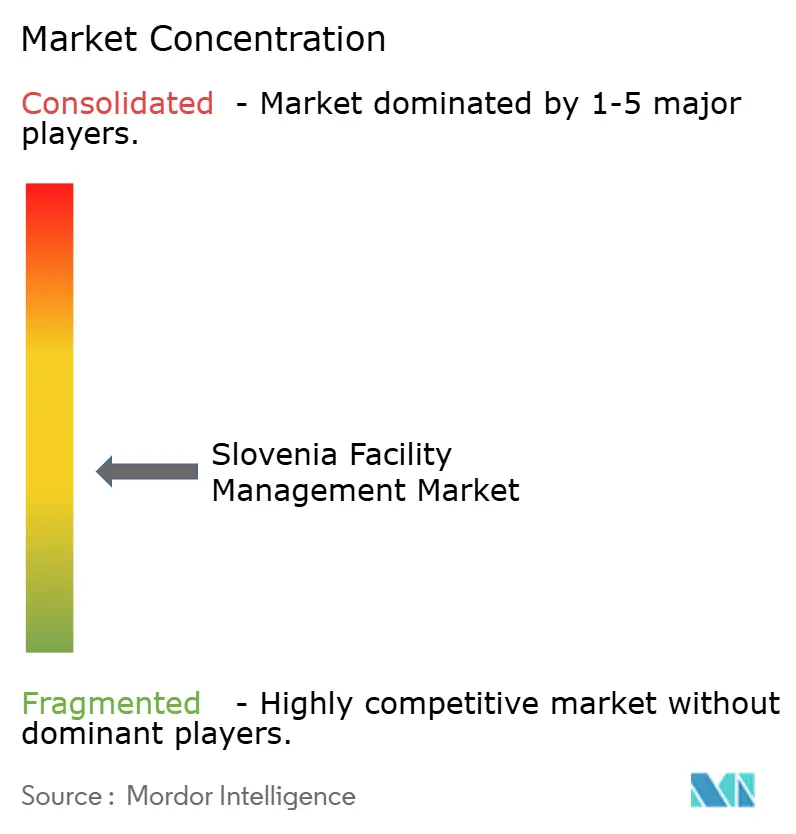
| Market Concentration | Medium |
Major Players *Disclaimer: Major Players sorted in no particular order Image © Mordor Intelligence. Reuse requires attribution under CC BY 4.0. | |
Slovenia Facility Management Market Analysis by Mordor Intelligence
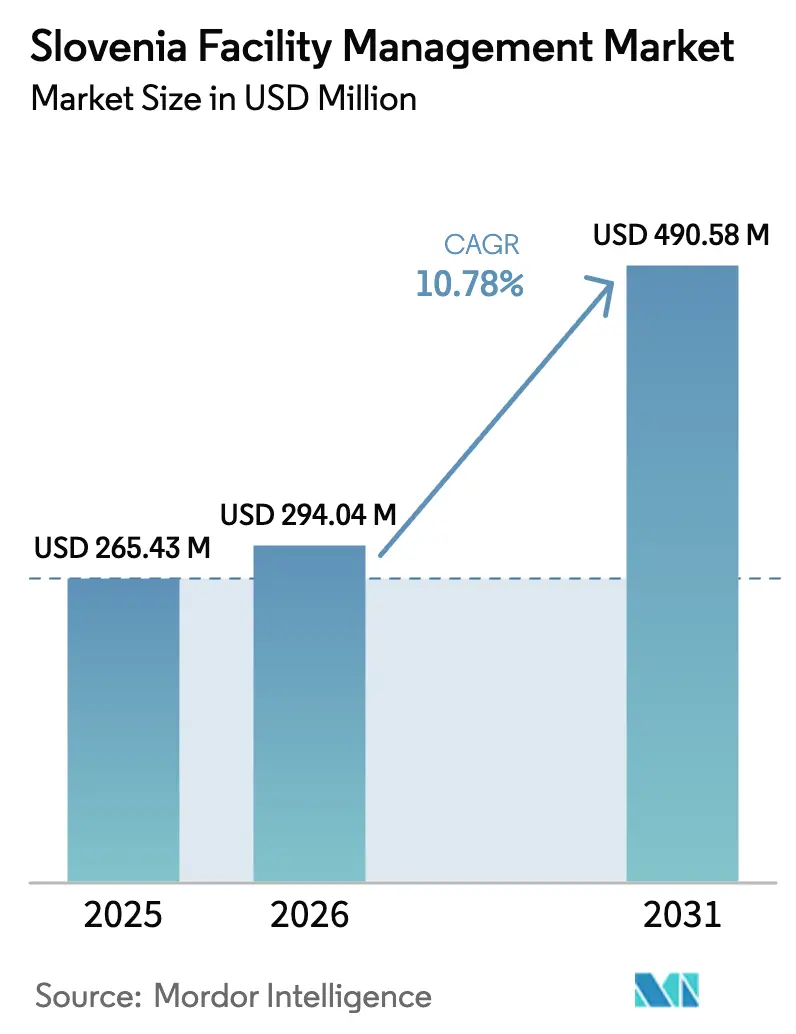
The Slovenia Facility Management Market size was valued at USD 265.43 million in 2025 and estimated to grow from USD 294.04 million in 2026 to reach USD 490.58 million by 2031, at a CAGR of 10.78% during the forecast period (2026-2031). Robust public investment under the EUR 2.7 billion Recovery and Resilience Plan, rising wage pressure in a 4.4% unemployment environment, and growing recognition of facility services as productivity enablers rather than cost centers are driving this expansion. [1] The Slovenia facility management market benefits from EU-aligned sustainability rules that push clients toward outsourced technical expertise for compliance. Demand is further catalyzed by digitalization incentives that encourage data-driven maintenance, while tight labor supply and inflationary construction costs make outsourcing a hedge against unpredictable in-house expense. [2] Competitive intensity is increasing as both international majors and local specialists invest in IoT-enabled building management systems and predictive analytics.
Key Report Takeaways
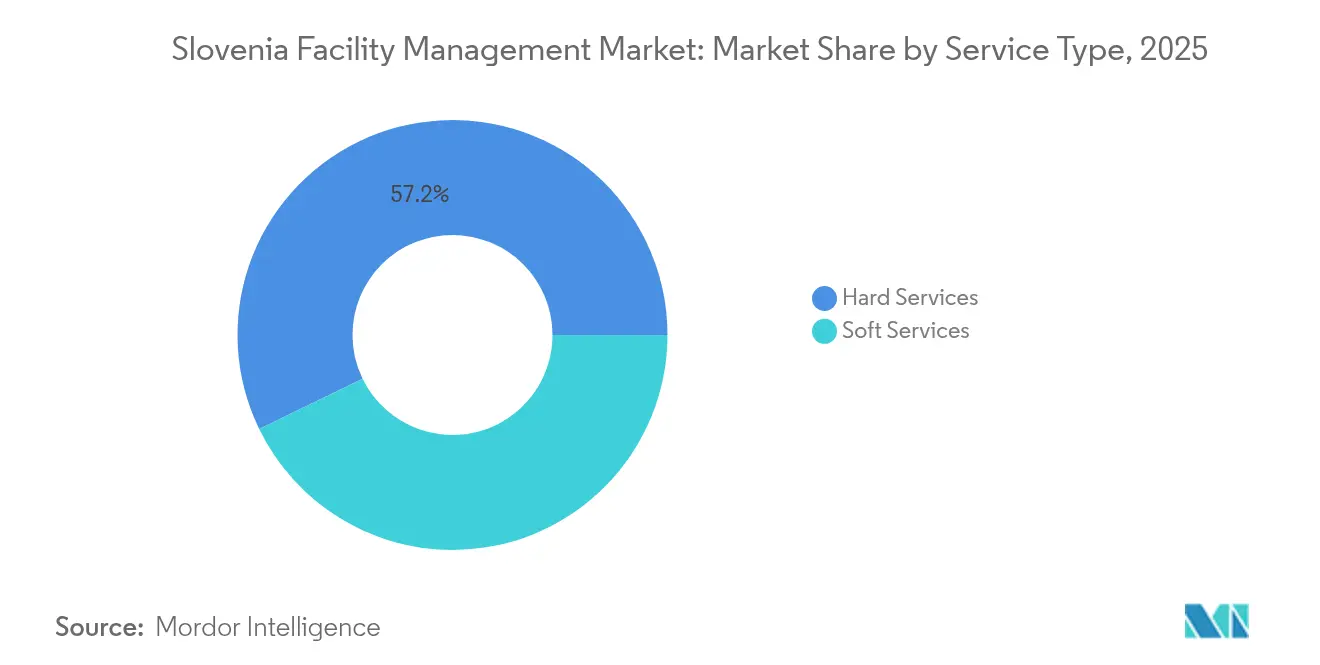
- By service type, hard services led with a 57.21% Slovenia facility management market share in 2025, while soft services are projected to advance at a 13.78% CAGR through 2031.
- By offering type, the outsourced delivery models accounted for 65.85% of the Slovenia facility management market share in 2025, with integrated outsourcing forecast to grow at 12.88% CAGR to 2031.
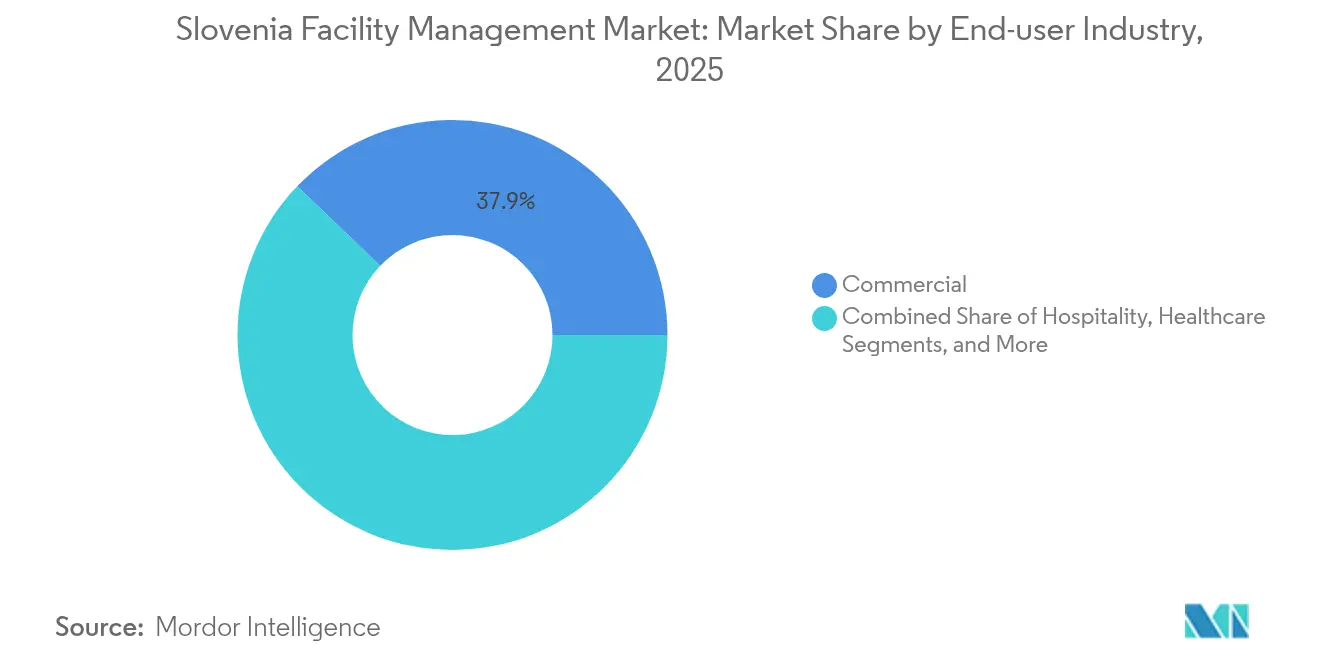
- By end-user industry, the commercial segment captured 37.85% of the Slovenia facility management market in 2025; institutional and public infrastructure is on track for a 13.45% CAGR through 2031.
Note: Market size and forecast figures in this report are generated using Mordor Intelligence’s proprietary estimation framework, updated with the latest available data and insights as of 2026.
Slovenia Facility Management Market Trends and Insights
Drivers Impact Analysis*
| Driver | (~) % Impact on CAGR Forecast | Geographic Relevance | Impact Timeline |
|---|---|---|---|
| Increasing outsourcing of non-core business functions | +2.1% | Slovenia, with spillover to Central Europe | Medium term (2-4 years) |
| Growing demand for integrated facility management solutions | +1.8% | National, with early gains in Ljubljana, Maribor, Celje | Medium term (2-4 years) |
| Rising focus on workplace experience and employee productivity | +1.5% | Commercial hubs in Ljubljana and coastal regions | Short term (≤ 2 years) |
| Technological advancements in building management systems | +1.3% | Urban centers and industrial zones | Long term (≥ 4 years) |
| Growing emphasis on green building certifications and sustainability compliance | +1.7% | EU-aligned markets with regulatory pressure | Long term (≥ 4 years) |
| Expansion of public-private partnerships in infrastructure and facilities maintenance | +1.4% | National infrastructure projects | Medium term (2-4 years) |
| Source: Mordor Intelligence | |||
Increasing Outsourcing of Non-Core Business Functions
Organizations are reallocating resources toward strategic priorities as GDP growth rebounds to a 2.5% outlook for 2025. Outsourcing addresses talent shortages, evidenced by seven successive quarterly declines in job vacancies to 17,900 in Q4 2024, and gives companies access to specialized digital and ESG skills absent internally. [3] The Slovenia facility management market, therefore, records rising multi-year service contracts within ICT and construction, where 3,200 open roles underscore capacity gaps. Preferred-partner models prevail, mirroring broader European trends in which a single vendor assumes R&D-like responsibilities. Clients cite predictable cost structures and compliance assurance as primary motivations. This momentum lifts the Slovenia facility management market toward greater consolidation as large providers leverage economies of scale.
Growing Demand for Integrated Facility Management Solutions
Clients seek one-stop accountability that merges technical maintenance with hospitality-style services. Healthcare exemplifies this shift: AI-driven building platforms cut HVAC energy use by up to 37%, supporting patient comfort and sustainability mandates. Slovenia dedicates 20% of its EU recovery funds to digital transition, fostering environments where physical asset care and digital infrastructure monitoring coexist. New spatial-planning laws in 2025 make integrated compliance management essential. Commercial landlords echo this need, aligning facility services with workplace-experience goals to attract tenants in competitive urban markets.
Rising Focus on Workplace Experience and Employee Productivity
Inflation at 2.2% in June 2025 shrinks discretionary income and places pressure on employers to deliver engaging work environments. With 40% of new residences embedding smart-home features, employees expect comparable office amenities. Facility providers deploy indoor-air sensors, ergonomic layouts, and wellness programs that boost retention. Hybrid work increases the complexity of space planning; IoT analytics now guide real-time desk and climate optimization. Immigration-screening simplification for EU investors intensifies competition for knowledge workers, reinforcing the link between facility quality and talent attraction.
Technological Advancements in Building Management Systems
Cloud expenditure rose 35% in 2021, underpinning rapid adoption of IoT sensors and edge computing for energy and security oversight. Global smart-building stock is set to exceed 115 million by 2026, and Slovenia aligns with this trajectory through state-funded pilots. AI analytics enable predictive maintenance that halves unplanned downtime and yields double-digit energy savings. Demonstrations in Ireland and Greece recorded 61% commercial-building energy reductions via IoT retrofits, reinforcing ROI arguments. Carbon-neutrality goals further encourage the rollout of such platforms.
Restraints Impact Analysis*
| Restraint | (~) % Impact on CAGR Forecast | Geographic Relevance | Impact Timeline |
|---|---|---|---|
| Shortage of skilled facility management professionals | -1.9% | National, with acute impact in Ljubljana and industrial regions | Short term (≤ 2 years) |
| Regulatory complexities and compliance challenges | -1.2% | EU-aligned markets with evolving legislation | Medium term (2-4 years) |
| Price sensitivity amid economic uncertainty and cost-cutting pressures | -0.8% | SME-dominated sectors and budget-constrained organizations | Short term (≤ 2 years) |
| Fragmented supplier landscape leading to inconsistent service quality | -0.6% | Regional markets with limited provider consolidation | Medium term (2-4 years) |
| Source: Mordor Intelligence | |||
Shortage of Skilled Facility Management Professionals
The vacancy rate dipped to 2.2% in Q4 2024, yet construction and manufacturing each carried more than 3,000 unfilled roles. Digital fluency and ESG reporting skills remain scarce, and 60% of facility leaders cite talent as a top strategic risk. Immigration reforms cut permit wait times, but sector attractiveness still lags, especially among younger cohorts. Providers respond with upskilling programs and technology tools that reduce manual tasks, but short-term wage pressure persists. Labor constraints, therefore, cap the growth ceiling for the Slovenia facility management market.
Regulatory Complexities and Compliance Challenges
Overlapping amendments to environmental, spatial-planning, and construction laws in 2025 force providers to navigate more documentation and audits. EU climate disclosures add building-level emissions and energy-use reporting to lease contracts. Smaller suppliers struggle with the cost of specialized legal and technical staff, nudging clients toward larger, integrated vendors. New tax rules affecting small firms (normiranci) alter margin structures from January 2025, introducing additional uncertainty. These factors combine to slow procurement cycles and raise compliance costs.
*Our forecasts treat driver/restraint impacts as directional, not additive. The impact forecasts reflect baseline growth, mix effects, and variable interactions.
Segment Analysis
By Service Type: Hard Services Form the Operational Core
Hard services contributed 57.21% of Slovenia's facility management market share in 2025, buoyed by aging hospitals where 70% exceed optimal lifespan. Mechanical, electrical, and plumbing upkeep anchors predictable revenue streams, while IoT-enabled asset monitoring now reduces equipment downtime by 30%. The Slovenia facility management market size for hard services is forecast to scale alongside public-sector retrofits aimed at cutting energy use. Soft services, however, post the quickest trajectory with a 13.78% CAGR as employers link workplace ambience to productivity. Cleaning, security, catering, and concierge offerings increasingly integrate wellness and sustainability metrics to meet tenant expectations.
Soft-service providers deploy sensor-based occupancy analytics to right-size staffing, yielding cost reductions that offset wage inflation. Technology convergence is blurring service lines: in hospitals, integrated hard- and soft-service contracts tie HVAC optimization to patient-experience indicators. The ensuing performance-based models encourage providers to invest in AI and robotics, elevating differentiation within the Slovenia facility management market.

By Offering Type: Outsourcing Dominates Strategic Choices
Outsourced arrangements commanded 65.85% Slovenia facility management market share in 2025 and are poised for a 12.88% CAGR to 2031. Clients view external partners as a hedge against wage volatility and regulatory risk, intensifying demand for single-invoice integrated solutions. The Slovenia facility management market size for outsourced delivery should expand as ICT firms prioritize core R&D over property logistics. Integrated contracts that bundle technical, workplace, and digital services now outpace single-service deals, supported by performance-linked KPIs.
In-house models remain in defense and heavy industry, where security protocols require tighter control; nevertheless, these organizations experiment with hybrid setups such as externally managed predictive maintenance overlays. Wage pressure from a 4.4% unemployment rate keeps the cost advantage firmly on the side of outsourcing. Vendor consolidation continues as clients trim supplier rosters to improve accountability and leverage data insights.
By End-user Industry: Commercial Leads, Institutional Accelerates
Commercial accounts—covering IT, telecom, retail, and warehousing—held 37.85% share of the Slovenia facility management market in 2025, reflecting the country’s 3,000-strong ICT company base and 35% annual cloud-adoption growth. Retail and logistics tenants demand energy-efficient warehouses and omnichannel fulfillment hubs, prompting widespread installation of smart lighting and automated cleaning solutions. The Slovenia facility management market size within institutional and public infrastructure is expanding at a 13.45% CAGR due to PPP-funded hospitals, schools, and transport projects.
Healthcare facilities present intense opportunities, as utility charges represent 77.45% of total management costs, encouraging investment in building analytics that yield rapid payback. Industrial users implement ESG-aligned retrofits to satisfy supply-chain audits, integrating real-time carbon monitoring into facility dashboards. Hospitality rebounds alongside tourism, and multi-housing developments with smart-home features push providers to deliver 24/7 remote monitoring services.
Geography Analysis
Urban hubs drive the Slovenia facility management market, with Ljubljana, Maribor, and Celje capturing the bulk of service contracts as commercial tenancy rates climb. The western coastal corridor, anchored by Koper port, records rising demand tied to tourism and logistics. Institutional spending under EU recovery funds is evenly spread, fostering facility modernization in secondary towns and rural municipalities.
Infrastructure upgrades such as the Divaca–Koper railway expand opportunity corridors, requiring technical maintenance for stations, signaling systems, and ancillary real estate. Residential building permits rose 18% since 2023, supporting geographic dispersion of soft-service requirements for new multi-housing complexes. Border regions hosting logistics depots benefit from Slovenia’s favorable trading-across-borders ranking, stimulating integrated facility contracts that blend security, warehousing, MEP upkeep, and ESG monitoring.
Demographic shifts add nuance: aging populations cluster in eastern regions, prompting specialized healthcare and senior-housing facility needs. Conversely, tech start-ups congregate in Ljubljana’s innovation districts, demanding high-spec smart-office services. These patterns ensure that the Slovenia facility management market maintains balanced growth across the country.
Regulatory Landscape
Slovenia's facility management regulatory environment is increasingly shaped by EU-aligned digital, cyber, and building-energy compliance, which affects how providers deploy smart building technologies and manage operational data. In April 2024, Slovenia adopted its Law on Implementation of the EU Digital Services Act, designating AKOS as the Digital Services Coordinator, setting governance expectations for digital platforms and online services used in workplace and building ecosystems.
On the built-environment side, a Regulation on minimum requirements for Building Automation and Control Systems (BACS) for non-residential buildings over 290 kW entered into force in January 2025, increasing the need for documented monitoring, control, and performance reporting in larger facilities. In June 2025, the Information Security Act (ZInfV-1) implemented NIS2-style requirements, raising the bar for cybersecurity in connected building systems and contractor ecosystems. In November 2025, legislation implementing the EU AI Act formalized supervision roles for the Information Commissioner and sectoral bodies. In March 2026, the government adopted the National AI Strategy to 2030, reinforcing policy direction around trustworthy AI that influences procurement and governance for AI-enabled FM workflows, including predictive maintenance and automated work-order prioritization.
Value Chain Analysis
The Slovenia facility management value chain starts with asset owners and occupiers (commercial real estate, institutional and public infrastructure, healthcare, and industrial sites) defining service outcomes, compliance needs, and performance KPIs. Planning and onboarding then rely increasingly on digitized asset information.
A key upstream shift is BIM. From January 2025, BIM became a mandatory requirement for construction projects classified as of national importance, improving handover data quality and pushing FM providers to connect construction-phase models to operations-phase maintenance planning. Core execution is delivered by integrated and specialist FM providers covering hard and soft services, supported by OEMs and technical subcontractors such as MEP, HVAC, and fire and safety. A growing layer of CAFM/IWMS and building-technology vendors enables IoT-enabled monitoring and analytics, while software developers such as Imagine d.o.o. (iFacility and iNep platforms) translate asset and service data into maintenance scheduling, KPI dashboards, and reporting that support multi-site outsourcing models. Downstream, service assurance and compliance reporting loops back to clients and public programs, and Slovenia's public funding for digital transformation and EU-aligned rules around cybersecurity and digital governance accelerate partnerships between traditional FM operators and ICT and software firms to deliver integrated, audit-ready services.
Competitive Landscape
Slovenia’s facility management arena remains fragmented, with international groups such as Sodexo, CBRE, and JLL competing alongside domestic specialists MG Facility Management, First Facility, and Iskra Facility Management. No single vendor dominates across all service lines, though global players leverage standardized processes to secure large multisite deals. Local firms sustain an advantage through regulatory fluency and agile service customization, particularly for smaller municipalities and niche industries.
Technology is the principal battleground. Providers integrate AI-powered work-order platforms, digital twins, and occupancy analytics to deliver outcome-based contracts. Case studies show energy cost cuts of up to 36.8 kW after implementing predictive maintenance protocols. Partnerships between facility managers and ICT firms accelerate solution rollouts; alliances such as JLL–Microsoft indoor mapping exemplify this convergence.
Consolidation intensifies as firms seek regional scale. Allied Universal’s multicountry acquisitions and Johnson Controls’ building-automation buys signal a pivot toward portfolio extension into adjacent security and energy domains. White-space remains in ESG compliance consulting and data-driven healthcare facilities, where demand outstrips current capacity within the Slovenia facility management market.
Slovenia Facility Management Industry Leaders
-
Sodexo Slovenia
-
CBRE GWS
-
MG Facility Management d.o.o.
-
First Facility d.o.o.
-
Diversey Slovenia
- *Disclaimer: Major Players sorted in no particular order
Market Opportunities and Future Outlook
Public-sector digitalization programs create immediate whitespace for integrated FM that bundles building operations with data, cybersecurity hygiene, and automated reporting. As part of Digital Slovenia 2030 and Recovery and Resilience actions, the government highlighted in February 2026 that 23 consortia involving more than 100 companies completed digital strategy development and initial implementation work, expanding the pool of organizations moving from planning to operational rollouts that touch facilities, assets, and service processes.
A named opportunity area sits in public administration modernization. Under the Digital Transformation of Public Administration program, a pilot focuses on automated and sustainable management of public buildings, aligning with FM offerings that combine BMS integration, maintenance optimization, and ESG-aligned performance measurement. Technology-led FM adoption is also supported by public capability-building and policy coordination that reduces implementation friction. In March 2026, the Ministry of Digital Transformation released a proposal for the 2026 update to the Digital Public Services Strategy 2030 for consultation, pointing to continued emphasis on digital service delivery that increases the relevance of resilient building operations and connected infrastructure. The OECD's June 2026 scan reported that the Slovenian Public Administration Academy reached 85% of its target to train 40,000 civil servants in digital skills by end-2026, supporting procurement, oversight, and day-to-day use of digital tools in facilities operations. For FM providers, this underpins packaged offerings that combine CAFM/IWMS deployment, BIM-to-operations integration on national-importance projects, and security-by-design controls aligned with the Information Security Act (ZInfV-1) for connected buildings.
Recent Industry Developments
- March 2026: The Government of Slovenia adopted the National AI Strategy to 2030 (NsUI 2030), setting governance and ethical direction for trustworthy AI across public and private systems. For facility managers deploying AI in predictive maintenance, energy optimization, or service-desk automation, this increases the need for transparent data handling, model governance, and auditable workflows in client contracts.
- April 2025: JLL and Microsoft announced the integration of indoor mapping capabilities to support workplace digitalization initiatives. The change strengthens support for location-aware workplace services, helping integrated FM teams improve space utilization, wayfinding, and service dispatch in multi-site environments.
- November 2024: Sodexo secured a five-year integrated workplace services contract with HMRC across 24 sites. The win reinforces the competitiveness of bundled and outcome-based service models among global FM leaders and shapes expectations in smaller markets such as Slovenia, where large occupiers want standardized governance and service performance.
Research Methodology Framework and Report Scope
Market Definition and Coverage
This market measures the value of facility management services delivered for buildings and sites in Slovenia, covering day-to-day operations and maintenance activities that keep facilities safe, compliant, and functional.
Scope exclusions: construction, one-time renovation projects, and standalone equipment manufacturing or sales are not counted unless they are part of an FM service contract.
Segmentation Overview
- By Service Type
- Hard Services
- Asset Management
- MEP and HVAC Services
- Fire Systems and Safety
- Other Hard FM Services
- Soft Services
- Office Support and Security
- Cleaning Services
- Catering Services
- Other Soft FM Services
- Hard Services
- By Offering Type
- In-house
- Outsourced
- Single FM
- Bundled FM
- Integrated FM
- By End-user Industry
- Commercial (IT and Telecom, Retail and Warehouses, etc.)
- Hospitality (Hotels, Eateries, Large-scale Restaurants)
- Institutional and Public Infrastructure (Govt, Education, Transportation)
- Healthcare (Public and Private Facilities)
- Industrial and Process (Manufacturing, Energy, Mining)
- Other End-user Industries (Multi-housing, Entertainment, Sports and Leisure)
Data Sources, Market Sizing, and Validation
Desk Research
Desk work started with mapping the Slovenia building and services backdrop so our assumptions sit on a real operating base. We referenced public sources such as the Statistical Office of the Republic of Slovenia (SURS), Eurostat structural business statistics, and public procurement portals for signals on outsourced service demand.
To keep the model tied to actual activity, we also reviewed materials from sources such as the European Commission, the International Labour Organization, and relevant EU energy and building policy pages that indicate compliance and maintenance intensity. Alongside these, we used company annual reports, investor decks, and reputable business press to understand contract styles, price movements, and service-mix shifts. Where needed, we used paid databases for company financials, contract and tender tracking, and patent and technology cues to support cross-checks on market direction. The examples listed here are not exhaustive, and many other sources were used for data collection, validation, and clarification.
Primary Interviews and Surveys
We use interviews and surveys with facility directors, service buyers, providers, functional leaders, and managers working in Slovenia. Respondents help clarify outsourcing rates, contract values, renewal timing, labor cost changes, and the mix of hard and soft services. Unclear answers trigger follow-up checks against the desk evidence.
Distribution of primary research fieldwork respondents
| Company type | Respondent position |
|---|---|
| Top tier: 27% | CXOs: 15% |
| Mid tier: 48% | Functional/Unit leaders: 35% |
| Smaller Players: 25% | Managers: 50% |
Market-Sizing & Forecasting
Market size was built using a top-down and bottom-up mix, where the main spine was a top-down reconstruction from Slovenia's addressable facility base and typical outsourcing behavior. In practice, the demand pool was derived by linking building stock and activity levels to service intensity, and then applying outsourcing shares and average contract pricing for common FM bundles.
A few inputs that mattered in this market included the split between hard services and soft services, the share of integrated versus single-service contracting, observed wage and labor availability trends that influence service pricing, energy- and compliance-driven maintenance needs, and the pipeline of commercial and public infrastructure usage that changes cleaning, security, and MEP workloads. These variables were pressure tested through interviews, and where data was missing for smaller categories, proxy ratios from similar service lines were applied before being adjusted back using interview feedback and tender signals.
For forecasting, we used scenario analysis supported by simple trend smoothing on key price and volume drivers, then the scenarios were narrowed based on what respondents expected for outsourcing adoption and contract repricing. The final trajectory was checked with selective bottom-up approximations, such as sampled contract values, service provider revenue splits, and ASP times estimated serviced area, which helped keep totals realistic without forcing an overly granular roll-up.
Data Validation & Update Cycle
Outputs were validated by comparing the model totals against independent signals like tender activity, reported services revenue movement, and visible changes in outsourcing penetration by end user. When a segment showed a jump that did not align with these signals, the assumptions were revisited, and follow-up calls were triggered to recheck pricing steps and service-scope interpretation.
Before sign-off, the work goes through multiple analyst reviews so unit logic, currency handling, and year alignment are consistent across the full time series. The report is refreshed annually, and interim updates are made when there are material changes, such as major contract shifts or policy moves that affect compliance-driven service demand. Right before delivery, a final update pass is performed so clients receive the latest view available at that time.
Mordor Intelligence's Slovenia Facility Management Market Estimate Compared With Other Published Estimates
Published market values for Slovenia facility management can differ even when they sound like they are talking about the same services, because service boundaries and pricing treatment are not consistent across studies. Differences usually come from what is counted as FM versus adjacent services, how in-house activity is handled, and whether contract pricing is treated as flat or indexed over time.
In this study, the refresh cadence and the timing of currency conversion were aligned to the latest annual data points, and contract ASPs were revalidated using recent tender and interview checks before the final totals were locked in. This is one reason the 2026 figure differs across sources, a modeling choice applied by Mordor Intelligence.
Benchmark comparison
| Source | Market Size | Gaps in Research Methodology |
|---|---|---|
| Mordor Intelligence | USD 294.04 M (2026) | |
| Industry Association A | USD 310.00 M (2026) | This figure typically leans on member reported revenue and may treat bundled services broadly, which can pull in adjacent property or project services and apply simpler price escalation assumptions. |
| Regional Consultancy B | USD 255.00 M (2026) | This estimate appears to focus mainly on outsourced contracts and can undercount in-house delivered FM activity, and it may use older FX timing or conservative ASP updates that lag current contract repricing. |
Overall, the spread in values is mostly explained by how in-house activity is treated, how wide the service boundary is drawn, and whether pricing is refreshed with recent contract evidence. Our approach stays traceable because each step is tied to clear demand drivers, outsourcing shares, and practical pricing checks that can be repeated when new data becomes available.
Key Questions Answered in the Report
What is the current size of the Slovenia facility management market?
The Slovenia facility management market size is USD 294.04 million in 2026 and is projected to reach USD 490.58 million by 2031.
Which service type leads the market?
Hard services lead with 57.21% market share in 2025, driven by demand for technical maintenance of aging infrastructure.
How fast is outsourced facility management growing?
Outsourced models are forecast to expand at a 12.88% CAGR between 2026 and 2031 as organizations seek specialized expertise and cost predictability.
What end-user segment is expanding the quickest?
Institutional and public infrastructure facilities are expected to grow at a 13.45% CAGR, buoyed by EU-funded modernization projects.
Why is technology investment critical for providers?
IoT and AI platforms enable predictive maintenance and energy savings that improve contract performance and differentiate service offerings.
How does Slovenia’s regulatory environment affect facility management?
New environmental and construction laws effective 2025 increase compliance complexity, favoring providers with integrated ESG and legal expertise.