
Single-Arm Medical Pendant Market Size and Share
Market Overview
| Study Period | 2020 - 2031 |
|---|---|
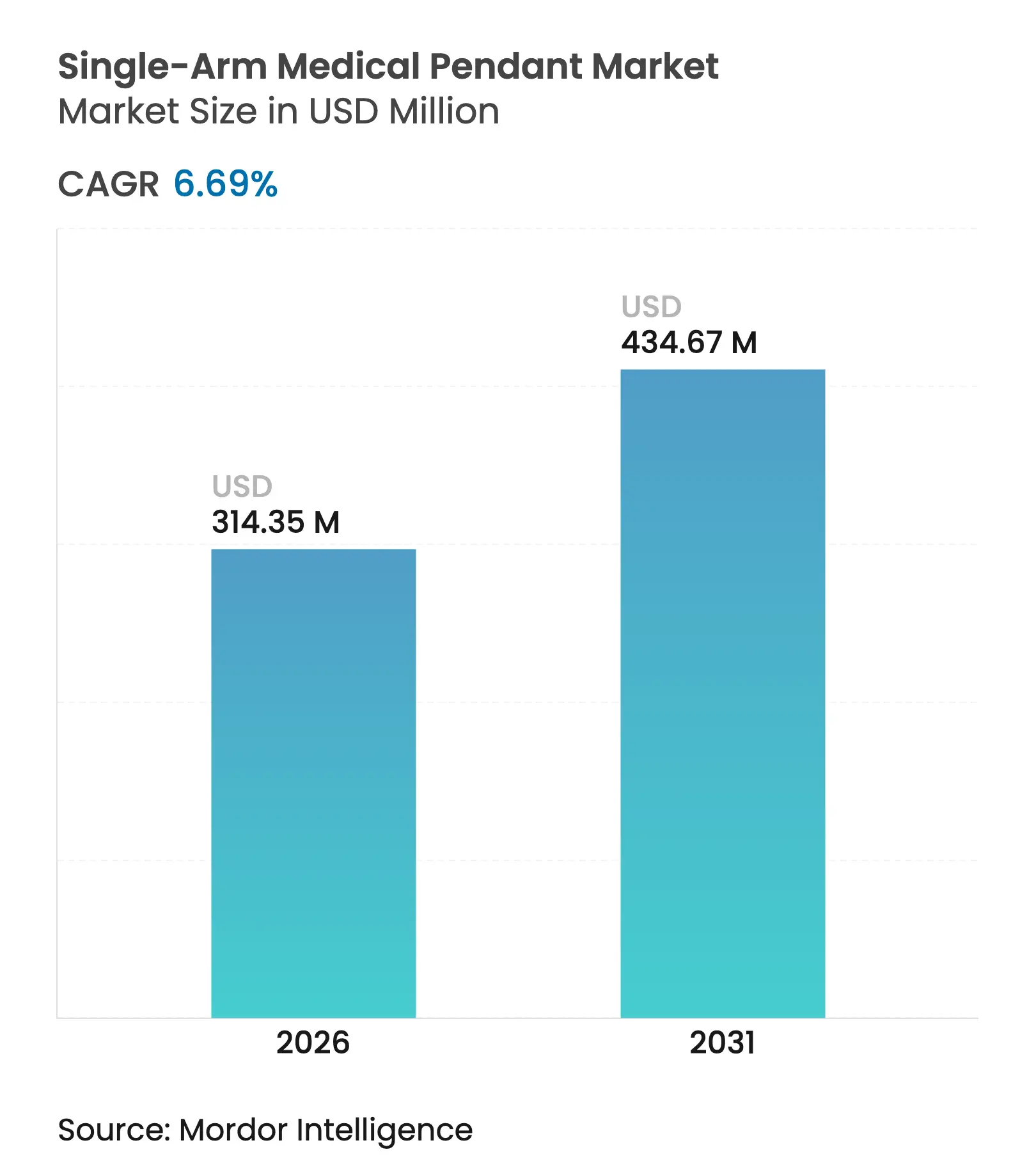
| Market Size (2026) | USD 314.35 Million |
| Market Size (2031) | USD 434.67 Million |
| Growth Rate (2026 - 2031) | 6.69 % CAGR |
| Fastest Growing Market | Asia-Pacific |
| Largest Market | North America |
| Market Concentration | Medium |
Major Players *Disclaimer: Major Players sorted in no particular order. Image © Mordor Intelligence. Reuse requires attribution under CC BY 4.0. |

Single-Arm Medical Pendant Market Analysis by Mordor Intelligence
This steady rise mirrors the rapid modernization of surgical suites, the push for infection-controlled workspaces, and an upturn in capital budgets, US hospitals alone expect capital equipment spending to advance 9% in 2025. Health-system planners increasingly specify pendant systems that host heavier imaging platforms, robotic arms, and IoT sensors while freeing floor space for faster patient turnover. Ceiling-mounted designs lead adoption because they preserve critical circulation zones, permit easy cleaning, and align with hybrid operating-room layouts. Demand is strongest in surgery and endoscopy theatres where minimally invasive techniques dictate precise instrument positioning and multiple high-definition displays. Hospitals remain the anchor customer group, yet ambulatory surgical centers (ASCs) are scaling purchases as payers reward outpatient procedures. Geographically, North American installations expand as hospitals retrofit to stricter infection-control codes, while Asia’s hospital-building boom propels the fastest regional growth.
Key Report Takeaways
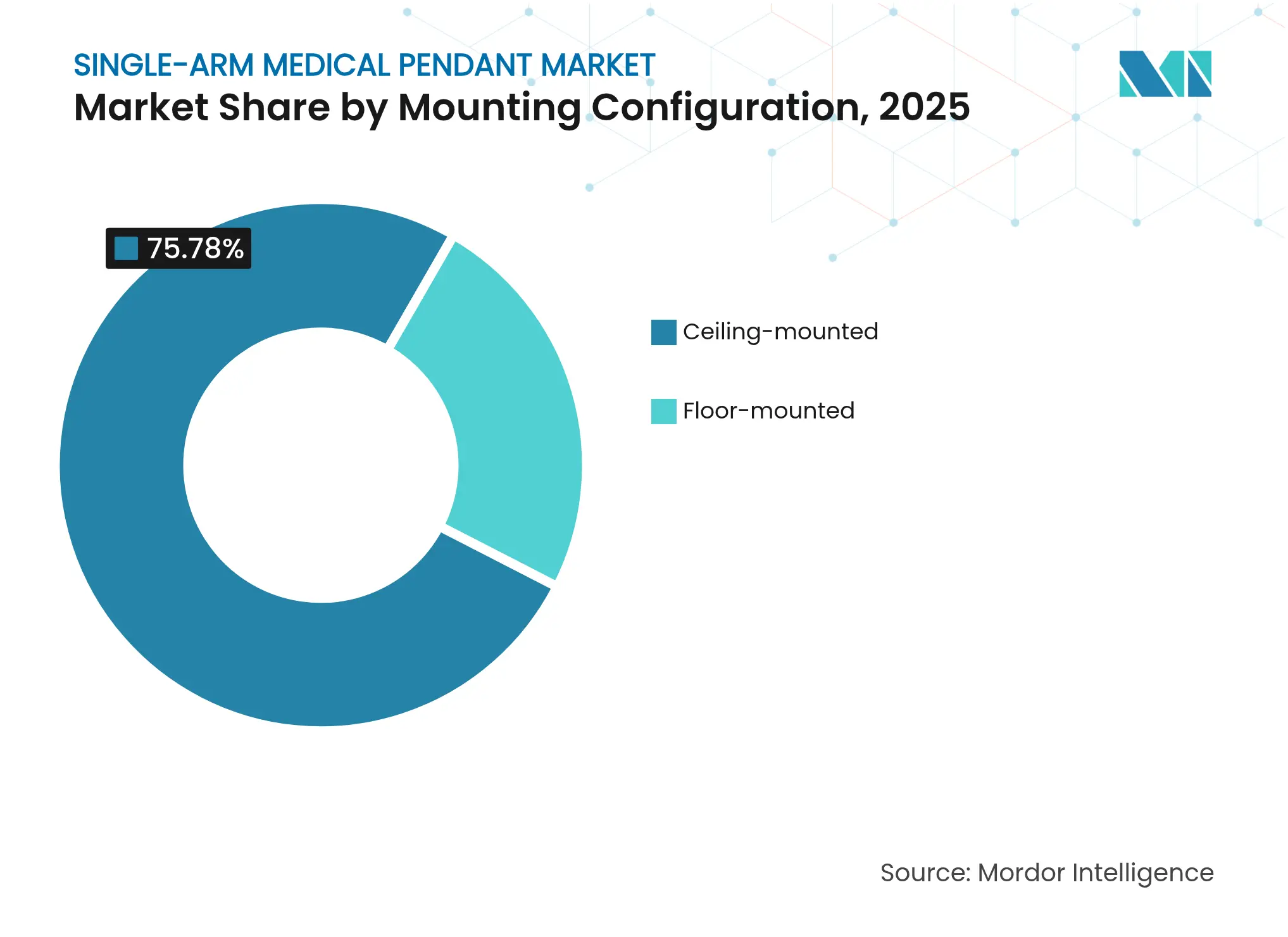
- By mounting configuration, ceiling-mounted systems held 75.78% of the single arm medical pendant market share in 2025, whereas modular ceiling lines are set to post the fastest 7.05% CAGR through 2031.
- By application, surgery suites led with 42.10% revenue in 2025; endoscopy suites are projected to grow at an 8.35% CAGR to 2031.
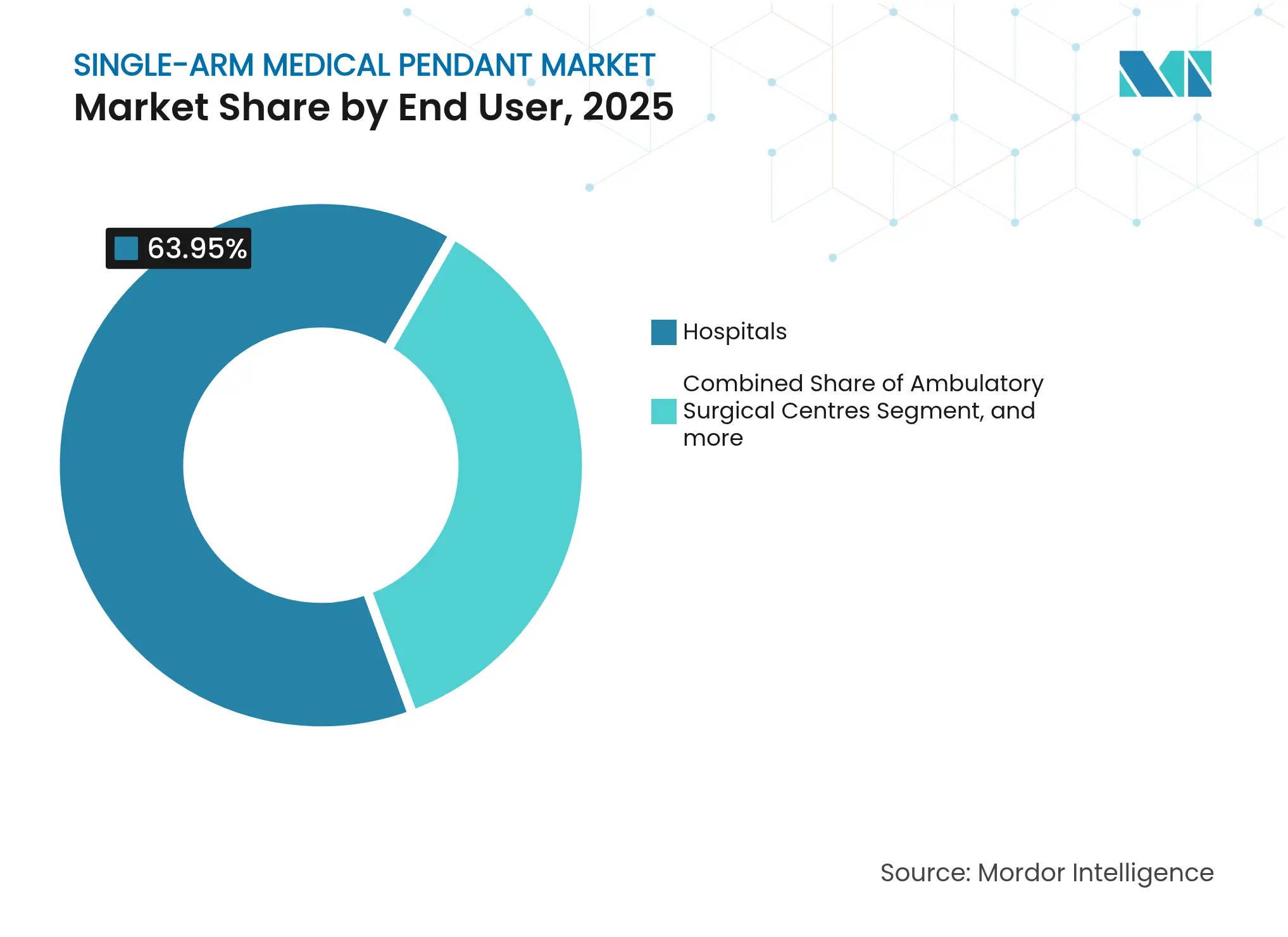
- By end user, hospitals accounted for 63.95% of the single arm medical pendant market size in 2025, while ASCs record the highest projected 5.34% CAGR for 2026-2031.
- By geography, North America captured 35.30% of 2025 revenue; Asia-Pacific is forecast to advance at a 4.76% CAGR through 2031.
Note: Market size and forecast figures in this report are generated using Mordor Intelligence's proprietary estimation framework, updated with the latest available data and insights as of 2026.
Global Single-Arm Medical Pendant Market Trends and Insights
Drivers Impact Analysis
| Driver | (~) % Impact on CAGR Forecast | Geographic Relevance | Impact Timeline |
|---|---|---|---|
Surging
Demand for Minimally Invasive and Hybrid Surgical Procedures
|
+1.2%
|
Global, with
concentration in North America & Europe
|
Medium term
(2-4 years)
|
Robust
Investments in Hospital Infrastructure Modernization
| +1.0% | APAC core, spill-over to MEA and South America | Long term (≥ 4 years) |
Accelerating
Replacement Cycle of Legacy Pendants in Emerging Markets
| +0.8% | APAC, MEA, South America | Short term (≤ 2 years) |
Growth in
Digitally Integrated Operating Rooms
| +0.7% | North America & EU, expanding to APAC | Medium term (2-4 years) |
Increased
Retrofit Activity due to Decarbonization
| +0.5% | Global, led by EU and North America | Long term (≥ 4 years) |
Focus on
Surgical Workspace Optimization and Infection Control
| +0.4% | Global | Short term (≤ 2 years) |
| Source: Mordor Intelligence | |||
Surging Demand for Minimally Invasive and Hybrid Surgical Procedures
Endoscopy installations are expanding at an 8.72% CAGR as surgeons migrate to camera-guided techniques that shorten recovery and reduce infection risk. Hybrid operating rooms now blend catheter-based imaging with open-surgery capabilities, forcing pendant lines to support heavier monitors, articulated lights, and robot docking stations. Intuitive Surgical placed 147 da Vinci V robots in Q1 2025, intensifying hospital upgrades to load-bearing ceiling pendants that integrate robotic arm cabling. Modular pendant frames that accept add-on rails and boom joints are increasingly specified so hospitals can future-proof against evolving instrument arrays. This driver lifts overall adoption across the single arm medical pendant market, particularly in academic and specialty centers.
Robust Investments in Hospital Infrastructure Modernization
Mega-projects such as MD Anderson’s USD 2.5 billion expansion specify pendant systems with integrated data hubs to meet digital-operating-room standards. Builders now view pendants as critical utilities akin to HVAC and nurse-call, embedding them in early design phases. Governments also link funding to energy-efficiency targets, boosting orders for motor-assisted pendants that lower idle-power draw and help hospitals meet decarbonization pledges. Together, these investments fortify long-run demand in the single arm medical pendant market.
Accelerating Replacement Cycle of Legacy Pendants in Emerging Markets
IEC 60601-1 enforcement is pushing facilities to retire pendant models lacking updated electrical-safety protections. TÜV Rheinland notes a jump in recertification failures, propelling hospitals to replace boom arms rather than attempt costly retrofits.[1] Foreign direct investment of USD 1.5 billion flowed into Indian healthcare equipment in 2024, targeting digital-ready pendants with antimicrobial surfaces. Because many emerging-market theatres were fitted a decade ago, this renewal window is compressed into the 2025-2027 horizon, amplifying annual order volumes. Vendors offering scaled-down, code-compliant models at mid-tier prices are capturing share quickly.
Growth in Digitally Integrated Operating Rooms
Japan’s SCOT program links more than 20 devices over the OPeLiNK platform and treats the pendant as a central node for power, data, and ergonomic positioning.[2] 6G research demonstrates latency under one millisecond for in-room device communication, opening avenues for AI-assisted imaging and augmented-reality overlays.[3] KARL STORZ and Zimmer Biomet embed pendant booms inside turnkey operating-room integration suites so surgeons can route images to any display with a voice command. Hospitals procuring these suites prefer pendants with native network switches and predictive-maintenance dashboards, a trend that accelerates premium-tier revenue across the single arm medical pendant market.
Restraints Impact Analysis
| Restraint | (~) % Impact on CAGR Forecast | Geographic Relevance | Impact Timeline |
|---|---|---|---|
Significant
Upfront Capital and Installation Costs
|
-0.8%
|
Global,
particularly acute in emerging markets
|
Short term (≤
2 years)
|
Structural
Incompatibility in Legacy Facilities
| -0.6% | North America & Europe, with aging infrastructure | Medium term (2-4 years) |
Short Supply
of Certified Operating Theatre Planners and Installation Specialists
| -0.4% | Global, most acute in APAC and emerging markets | Medium term (2-4 years) |
Raw Material
Cost Volatility
| -0.3% | Global | Short term (≤ 2 years) |
| Source: Mordor Intelligence | |||
Significant Upfront Capital and Installation Costs
A turnkey ceiling-mounted pendant bay, including booms, rails, med-gas feeds, and structural supports, often exceeds USD 90,000. Hospital construction costs now average USD 700-730 per sq ft, putting intense pressure on capital committees. The 2024 Hospital Construction Survey found 76%-plus of projects faced cost overruns or delays, prompting executives to defer elective OR upgrades. Facilities therefore stretch replacement timelines or choose basic pendant models without digital extras, dampening immediate gains in the single-arm medical pendant market size.
Structural Incompatibility in Legacy Facilities
Pre-2000 theatres often lack reinforced ceiling grids or sufficient floor-to-soffit clearance for four-axis pendants. Retrofitting requires downtime, asbestos abatement, and possible HVAC rebalancing, which can halt surgical schedules. Operators increasingly opt for phased renovations or micro-hospitals, but pendant retrofits still require invasive roof-deck work. As a result, some hospitals restrict pendant upgrades to new wings only, constraining penetration in older campuses throughout North America and parts of Europe.
Segment Analysis
By Mounting Configuration: Ceiling Dominance Drives Innovation
Ceiling-mounted pendants generated 75.78% revenue in 2025, establishing them as the anchor of the single arm medical pendant market. Modularity, infection-control superiority, and unobstructed floor access remain decisive purchase criteria. This configuration is projected to log a 7.05% CAGR through 2031, outpacing floor-mounted and mobile variants. Load ratings now exceed 500 kg, enabling attachment of C-arms, 4K monitors, and robotic docking cradles. Integrated antimicrobial coatings and sealed bearing housings help providers meet post-pandemic sterilization protocols.
Floor-mounted booms retain value in ORs with low slab-to-slab height or heritage-building restrictions. These models advance through quick-release column adaptors and plug-and-play utility panels, easing relocation when theatres switch specialty. Nonetheless, ceiling systems continue to dominate spending because hospitals want future-ready rooms capable of hybrid surgery and immersive imaging. As architects adopt standardized ceiling grids, vendors offering drop-in pendants with universal rail interfaces command premium pricing. This trend reinforces ceiling leadership inside the single arm medical pendant market while opening segments for retrofit-friendly designs.
Note: Segment shares of all individual segments available upon report purchase
By Application: Endoscopy Surge Reshapes Market Dynamics
Surgical theatres held 42.10% revenue in 2025, reflecting the core role of pendants in general surgery, orthopedics, and cardiovascular suites. Yet endoscopy theatres are scaling fastest at an 8.35% CAGR. Complex minimally invasive procedures such as single-incision cholecystectomies and advanced ERCP demand pendants that anchor multiple insufflators, pumps, and dual 4K monitors without clutter. Stryker’s 2024 launch of an upgraded arthroscopy platform underlined the need for pendants with higher cable-management capacity
Anesthesia worksurfaces, ICU booms, and cath-lab pendants remain steady contributors, fueled by critical-care expansions post-COVID-19. AI-guided visualization is arriving in GI suites, prompting hospitals to future-proof with pendants featuring data ports and on-board switches. Hybrid procedures combining open and endoscopic steps further amplify demand for flexible booms that swivel to distinct “zones” within the same theatre. Collectively, these shifts expand the share of endoscopy within the single arm medical pendant market size, even as surgical theatres remain the revenue backbone.
By End User: ASC Growth Challenges Hospital Dominance
Hospitals commanded 63.95% revenue in 2025 owing to multi-service lines and higher case acuity. However, ASCs register the fastest 5.34% CAGR thanks to insurer incentives for outpatient care. Compact pendants with integrated med-gas and power cut installation time, meeting ASC needs for rapid project turnover. Infection-control officers also favor sealed-surface booms that reduce bioburden between back-to-back spinal or ophthalmic cases.
Specialty clinics for example, stand-alone cardio or fertility centers choose customized pendant kits pre-assembled off-site to curtail disruption. Vendors compete on lifecycle cost: motor-driven lift columns that report via IoT platforms can reduce unplanned downtime, a strong selling point in high-volume ASCs. As value-based care expands, outpatient operators invest in pendants that enable efficient, high-quality care, eroding the hospital share but enlarging overall revenue across the single arm medical pendant market.
Note: Segment shares of all individual segments available upon report purchase
Geography Analysis
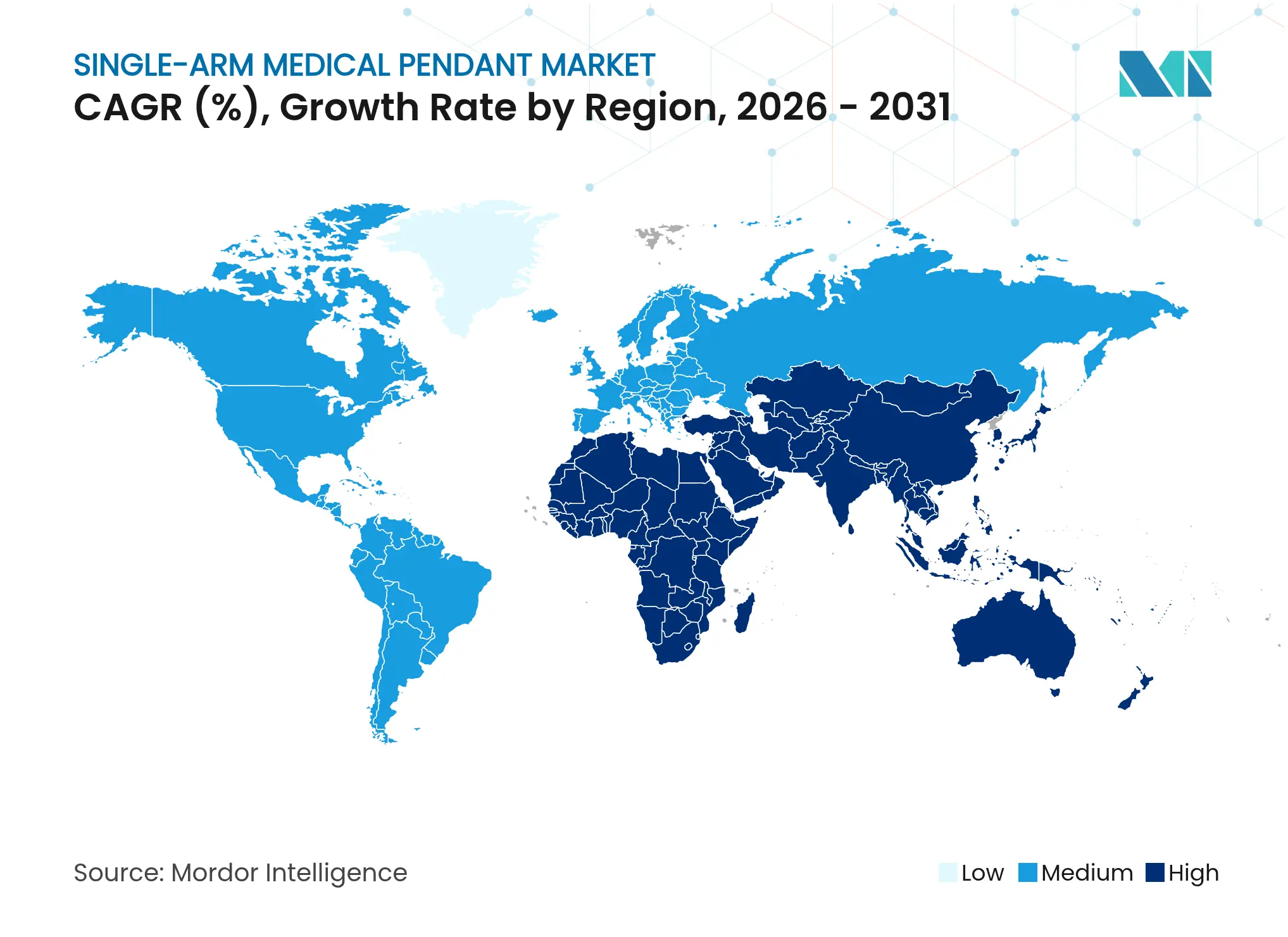
North America generated 35.30% of 2025 revenue, buoyed by federal reimbursement updates favoring robotic procedures and by hospital retrofit programs tied to stricter infection-control codes. Numerous US health systems now integrate pendant procurement into energy-efficiency mandates, opting for motorized units with low-standby consumption. Ceiling retrofits also benefit from tax incentives under the Inflation Reduction Act for carbon-reducing equipment, indirectly stimulating the single arm medical pendant market.
Asia-Pacific is the fastest mover with a 4.76% CAGR through 2031, underwritten by record hospital construction. Malaysia’s 2024 budget raised healthcare spending to USD 8.7 billion, while Singapore allocated USD 13.8 billion to sustain its advanced-medicine hub. Indonesia green-lit USD 1 billion for its Bali International Hospital project, specifying digital-ready pendant lines that meet Joint Commission International standards. Japan projects healthcare outlays to rise, compelling upgrades to accommodate an aging population requiring complex surgeries. Combined, these projects anchor future revenue streams, elevating Asia’s contribution to the single-arm medical pendant market size.
Europe continues to experience moderate growth. Hospitals leverage European Union green-building directives to justify replacing 15-year-old pendants with lighter, energy-efficient models. Germany, France, and the Nordics prioritize decarbonizing ORs, contributing steady unit demand. Meanwhile, Middle East and Africa investments accelerate in medical-tourism corridors; UAE and Saudi Arabia projects specify high-spec pendants to attract international patients. South American upgrades follow incremental macroeconomic improvements, with private-hospital chains forming bulk-purchase pools to negotiate better pricing. In every region, vendors that can demonstrate compliance with local seismic, electrical, and infection-control codes build trust and capture share in the single-arm medical pendant market.

Competitive Landscape
Market Concentration
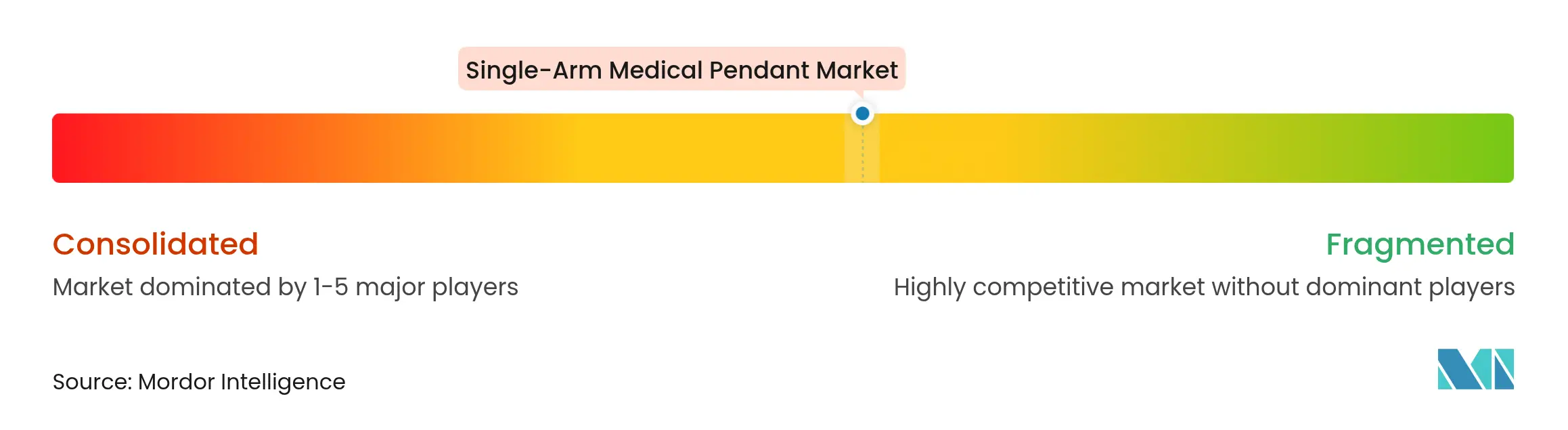
The single arm medical pendant market remains moderately fragmented. Top multinationals—Drägerwerk, STERIS, and Ondal Medical Systems—offer broad portfolios, global service teams, and deep relationships with design-build firms. Drägerwerk highlights predictive-maintenance dashboards that integrate into hospital CMMS platforms, cutting unscheduled downtime. Ondal deploys universal rail cartridges, letting theatres swap accessory shelves without tools.
Acquisition activity continues. STERIS recently bought assets from Becton, Dickinson to broaden capital-equipment exposure, and it targets 2025 synergies in sales channels. Regional players in China and India capitalize on cost advantages, meeting domestic value-segment demand while gradually adding IoT functions. North American engineering groups partner with ceiling-track specialists to co-design pendants embedding cable trays that streamline robotic-system hookups.
Digital integration is the new battleground. Vendors embed Wi-Fi 6 or private-5G repeaters inside pendant arms, enabling low-latency data for OR integration systems. Those with proven cybersecurity credentials win preference in hospital RFPs. Sustainability credentials also influence awards; manufacturers tout recycled-aluminum housings and energy-efficient motors to align with net-zero procurement rules.
Single-Arm Medical Pendant Industry Leaders

*Disclaimer: Major Players sorted in no particular order
Recent Industry Developments
- June 2025: Cleveland Clinic has announced a major expansion of Avon Hospital and the Richard E. Jacobs Family Health Center to meet the rising healthcare needs of west side communities. The project emphasizes greater access to inpatient, specialty, and primary care services. This expansion is expected to significantly drive demand for ceiling-mounted single-arm medical pendants, particularly in newly constructed operating rooms and critical care environments prioritizing flexibility, infection control, and efficient utility management.
- June 2025: Skanska’s Completion of HSS Sports Medicine Institute Renovation, NYC Skanska has completed an USD 8 million renovation of the Hospital for Special Surgery (HSS) Sports Medicine Institute on Manhattan’s West Side. The project introduced advanced surgical and rehabilitation facilities with a focus on technical upgrades for functional optimization. As part of operating room modernization, this development reflects a broader trend toward digitally integrated surgical suites, reinforcing market uptake of motorized single-arm pendant systems tailored for high-performance clinical workflows.
- May 2025: Medline completed the acquisition of Ecolab's surgical solutions business for USD 950 million, significantly enhancing its portfolio in healthcare infrastructure and medical equipment sectors
Table of Contents for Single-Arm Medical Pendant Industry Report
1. Introduction
- 1.1 Study Assumptions & Market Definition
- 1.2 Scope of the Study
2. Research Methodology
3. Executive Summary
4. Market Landscape
- 4.1 Market Overview
- 4.2 Market Drivers
- 4.2.1 Surging Demand for Minimally Invasive and Hybrid Surgical Procedures
- 4.2.2 Robust Investments in Hospital Infrastructure Modernization
- 4.2.3 Accelerating Replacement Cycle of Legacy Pendants in Emerging Markets
- 4.2.4 Growth In Digitally Integrated Operating Rooms
- 4.2.5 Increased Retrofit Activity due to Decarbonization
- 4.2.6 Focus on Surgical Workspace Optimization and Infection Control
- 4.3 Market Restraints
- 4.3.1 Significant Upfront Capital and Installation Costs
- 4.3.2 Structural Incompatibility in Legacy Facilities
- 4.3.3 Short Supply of Certified Operating Theatre Planners and Installation Specialists
- 4.3.4 Raw Material Cost Volatility
- 4.4 Porter’s Five Forces Analysis
- 4.4.1 Bargaining Power of Suppliers
- 4.4.2 Bargaining Power of Buyers
- 4.4.3 Threat of New Entrants
- 4.4.4 Threat of Substitutes
- 4.4.5 Intensity of Competitive Rivalry
5. Market Size & Growth Forecasts (Value in USD)
- 5.1 By Mounting Configuration
- 5.1.1 Ceiling-mounted
- 5.1.2 Floor-mounted
- 5.2 By Application
- 5.2.1 Surgery
- 5.2.2 Anesthesia
- 5.2.3 Endoscopy
- 5.2.4 ICU/Critical Care
- 5.3 By End User
- 5.3.1 Hospitals
- 5.3.2 Ambulatory Surgical Centres
- 5.3.3 Specialty Clinics
- 5.4 By Geography
- 5.4.1 North America
- 5.4.1.1 United States
- 5.4.1.2 Canada
- 5.4.1.3 Mexico
- 5.4.2 Europe
- 5.4.2.1 Germany
- 5.4.2.2 United Kingdom
- 5.4.2.3 France
- 5.4.2.4 Italy
- 5.4.2.5 Spain
- 5.4.2.6 Rest of Europe
- 5.4.3 Asia-Pacific
- 5.4.3.1 China
- 5.4.3.2 Japan
- 5.4.3.3 India
- 5.4.3.4 Australia
- 5.4.3.5 South Korea
- 5.4.3.6 Rest of Asia-Pacific
- 5.4.4 Middle East & Africa
- 5.4.4.1 GCC
- 5.4.4.2 South Africa
- 5.4.4.3 Rest of Middle East & Africa
- 5.4.5 South America
- 5.4.5.1 Brazil
- 5.4.5.2 Argentina
- 5.4.5.3 Rest of South America
6. Competitive Landscape
- 6.1 Market Concentration
- 6.2 Market Share Analysis
- 6.3 Company Profiles (includes Global level Overview, Market level overview, Core Segments, Financials as available, Strategic Information, Market Rank/Share for key companies, Products & Services, and Recent Developments)
- 6.3.1 Drägerwerk AG & Co. KGaA
- 6.3.2 STERIS plc
- 6.3.3 Ondal Medical Systems GmbH
- 6.3.4 Skytron LLC
- 6.3.5 Brandon Medical Co. Ltd
- 6.3.6 BeaconMedaes (Atlas Copco)
- 6.3.7 Tedisel Medical
- 6.3.8 Starkstrom Ltd
- 6.3.9 Novair Medical
- 6.3.10 Medimaxkorea Co. Ltd
- 6.3.11 Beijing Aeonmed Co. Ltd
- 6.3.12 Elektra Hellas SA
- 6.3.13 Hipac Healthcare Pty Ltd
- 6.3.14 Pneumatech MGS
- 6.3.15 Surgiris SAS
- 6.3.16 Trumpf Medizin Systeme
- 6.3.17 Shanghai Pinxing Medical
- 6.3.18 Modular Services Company
- 6.3.19 Amico Corporation
- 6.3.20 Medical Holdings Ltd
7. Market Opportunities & Future Outlook
- 7.1 White-space & unmet-need assessment
Scope and Methodology
As per the scope, the single-arm medical pendant is a rotary medical pendant, which is an indispensable gas supply medical device in the modern operating room of the hospital. It is mainly used for the terminal transfer of oxygen, suction, compressed air, nitrogen, and other medical gases in the operating room. The medical pendant is mainly controlled by the motor to lift the platform, which is safe and reliable. It is also used for placing monitors, electric knives, equipment, etc., which are required for general surgery. The Single-arm Medical Pendant Market is segmented by Application (Surgery, Anesthesia, Endoscopy, and Others), End User (Hospitals, Clinics, and Other End Users), and Geography (North America, Europe, Asia-Pacific, and Rest of the World). The report offers the value (in USD million) for the above segments.
| By Mounting Configuration | Ceiling-mounted | |
| Floor-mounted | ||
| By Application | Surgery | |
| Anesthesia | ||
| Endoscopy | ||
| ICU/Critical Care | ||
| By End User | Hospitals | |
| Ambulatory Surgical Centres | ||
| Specialty Clinics | ||
| By Geography | North America | United States |
| Canada | ||
| Mexico | ||
| Europe | Germany | |
| United Kingdom | ||
| France | ||
| Italy | ||
| Spain | ||
| Rest of Europe | ||
| Asia-Pacific | China | |
| Japan | ||
| India | ||
| Australia | ||
| South Korea | ||
| Rest of Asia-Pacific | ||
| Middle East & Africa | GCC | |
| South Africa | ||
| Rest of Middle East & Africa | ||
| South America | Brazil | |
| Argentina | ||
| Rest of South America | ||
