
Market Overview
| Study Period | 2021 - 2031 |
|---|---|
| Forecast Data Period | 2025 - 2031 |
| Base Year Market Size (2025) | USD 264.08 Million |
| Market Size (2026) | USD 288.20 Million |
| Market Size (2031) | USD 446.10 Million |
| Growth Rate (2025 - 2031) | 9.13 % |
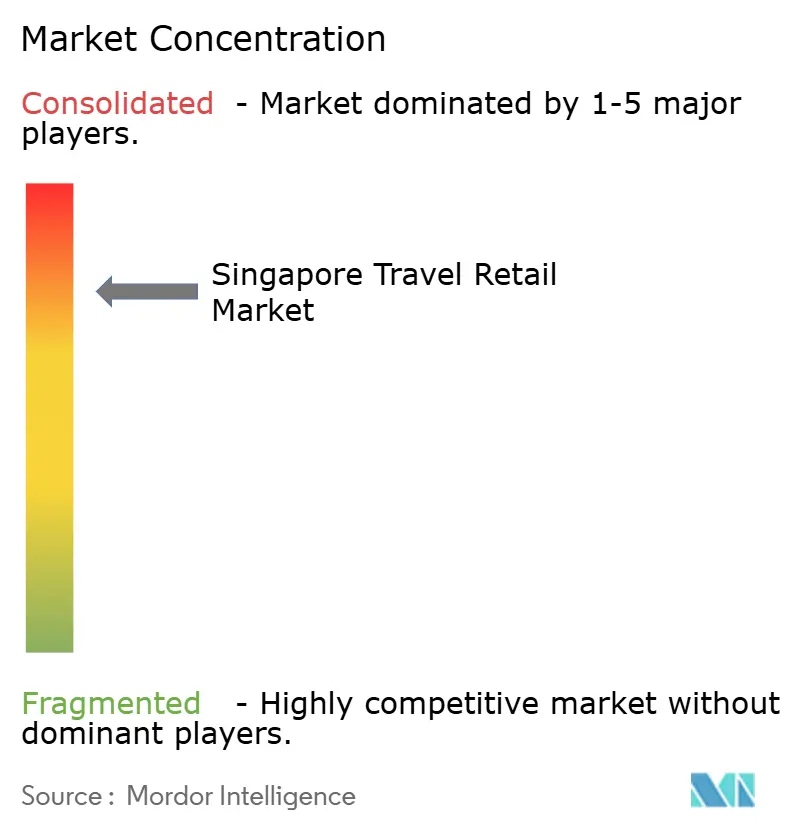
| Market Concentration | High |
Major Players *Disclaimer: Major Players sorted in no particular order Image © Mordor Intelligence. Reuse requires attribution under CC BY 4.0. | |
Singapore Travel Retail Market Analysis by Mordor Intelligence
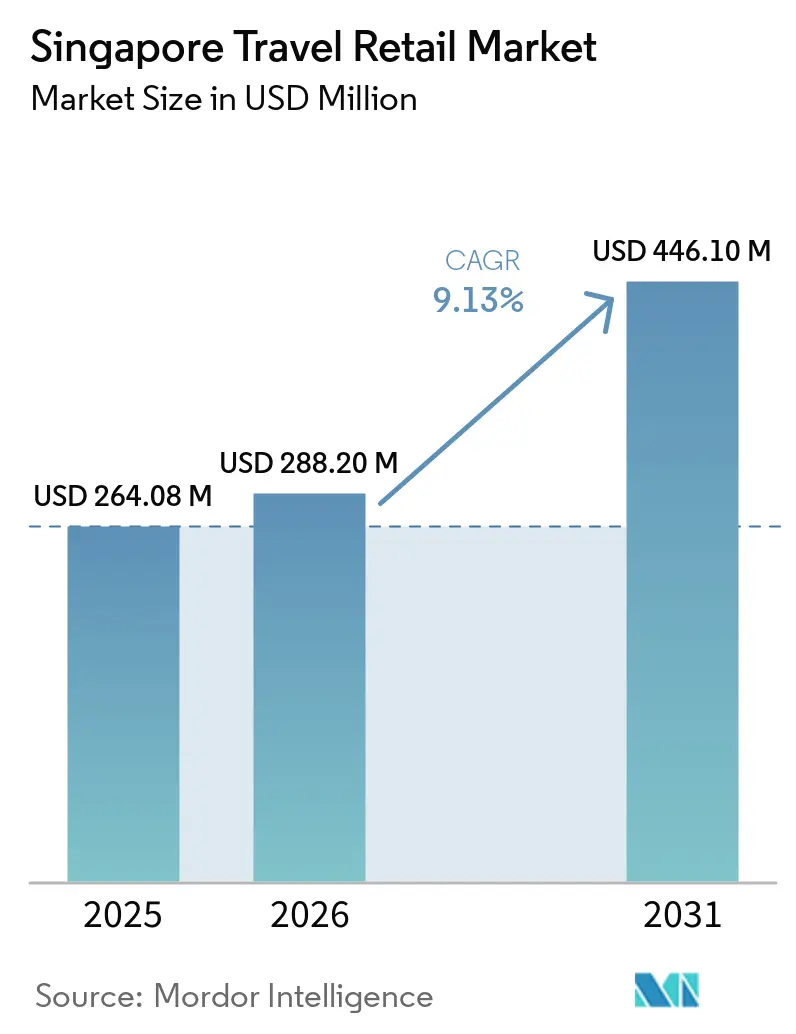
The Singapore Travel Retail Market size was valued at USD 264.08 million in 2025 and is estimated to grow from USD 288.20 million in 2026 to reach USD 446.10 million by 2031, at a CAGR of 9.13% during the forecast period (2026-2031).
The Singapore travel retail market is expanding as growth shifts from pure visitor volumes toward higher spending intensity per traveler, which supports premium and high-margin retail categories. Even with visitor numbers still normalizing, travelers are spending more on luxury, beauty, and premium alcohol, reinforcing the resilience of duty-free sales. This trend particularly benefits airport and cruise retail channels, where impulse and premium purchases remain strongest. Changi Airport’s recovery as a major global hub continues to anchor the market, providing consistently high passenger throughput that sustains retail demand. Market growth is further supported by Singapore’s positioning as a regional launchpad for luxury and global brands, which encourages experiential and discovery-led shopping. While shopping’s share of total tourism spending has moderated, the absolute value of high-quality duty-free transactions continues to rise due to premiumization. Retailers and brands are increasingly leveraging omnichannel strategies, digital engagement, and pre-travel targeting to stimulate demand before passengers arrive at the airport.
Key Report Takeaways
- By product type, Cosmetics & Fragrances led with 42.24% of the Singapore travel retail market share in 2025; Wines & Spirits is forecast to expand at an 8.11% CAGR through 2031.
- By distribution channel, Airports held 67.90% of the Singapore travel retail market share in 2025, while the same channel is projected to grow at a 7.88% CAGR through 2031.
- By geography, the East Region accounted for 82.25% of the Singapore travel retail market share in 2025 and is set to grow at an 8.32% CAGR through 2031.
Note: Market size and forecast figures in this report are generated using Mordor Intelligence’s proprietary estimation framework, updated with the latest available data and insights as of January 2026.
Market Trends and Insights
Drivers Impact Analysis of Singapore Travel Retail Market*
| Driver | (~) % Impact on CAGR Forecast | Geographic Relevance | Impact Timeline |
|---|---|---|---|
| Experiential retail-tainment boosting spend-per-passenger | +1.2% | Global, peak impact East Region (Changi Airport) | Medium term (2-4 years) |
| Omni-channel pre-order and click-and-collect at Changi | +0.9% | East Region (Changi ecosystem), expanding to Central/West via iShopChangi | Short term (≤ 2 years) |
| Surge in premium beauty and niche perfumes from Gen-Z tourists | +1.5% | Global, over-indexed by India, Southeast Asia, South Korea | Medium term (2-4 years) |
| Cruise-terminal expansion unlocking non-airport duty-free traffic | +0.7% | Central/South (Marina Bay), East (Tanah Merah) | Long term (≥ 4 years) |
| GST hike pulls forward high-ticket purchases | +0.4% | National, with early gains in the Central Region and East | Short term (≤ 2 years) |
| Pentarchy data-sharing lifting conversions | +1.1% | East Region (Changi partnerships), roll-out to Marina Bay cruise hub | Medium term (2-4 years) |
| Source: Mordor Intelligence | |||
Experiential "Retail-tainment" Strategies Boosting Spend-Per-Passenger
Immersive activations across Changi and Jewel focus on turning dwell time into high-value purchases with multi-sensory formats and exclusive premieres. L’Oréal Travel Retail Asia Pacific’s “Beauty Shopper-tainment of the Future” and wide-scale, multi-terminal brand experiences illustrated how activation breadth increases reach and strengthens conversion among international travelers moving through multiple terminals[1]. SkinCeuticals’ first global travel retail presence at Terminal 3 introduces professional-grade skincare diagnostics into the airport setting, aligning premium skincare with unhurried transit moments that encourage consultation-led purchasing. Stronger spending intensity per traveler supports these high-end, experiential concepts even as overall visitor volumes continue to normalize. The East Region’s integrated retail ecosystem, led by Jewel, reinforces this dynamic through rising footfall and improving sales productivity. The Singapore travel retail market benefits from a flywheel where each high-profile activation reinforces brand discovery, compounding returns as passengers circulate across terminals and the Jewel precinct.
Omni-Channel Pre-Order & Click-and-Collect Adoption at Changi
Omnichannel pre-order and click-and-collect capabilities at Changi are a structural growth driver for the Singapore travel retail market, as they redefine when and how consumers engage with duty-free shopping. By shifting purchase decisions upstream to the planning phase of a journey, retailers capture intent earlier and reduce reliance on in-terminal impulse alone. The ability to serve both travelers and non-travelers through digital storefronts keeps assortments visible year-round rather than limited to airport dwell time. A fully integrated digital ecosystem aligns inventory, pricing, promotions, and content across physical and online channels, improving execution efficiency and minimizing lost sales from stockouts. Loyalty programs and data-enabled partnerships allow targeted engagement based on travel behavior, increasing conversion and basket size. Convenience, certainty of availability, and frictionless fulfillment strengthen consumer trust, particularly in premium beauty and liquor categories. Together, these omnichannel mechanics expand the effective selling window around each trip and create a more stable, scalable demand engine for travel retail[2].
Cruise-Terminal Expansion Unlocking Non-Airport Duty-Free Traffic
Marina Bay and Singapore Cruise Centre together create a second growth leg by opening access to ferry and cruise passengers whose dwell times are typically longer than airport flows. The award of a long-term master duty-free and general merchandise concession at Singapore Cruise Centre to Lagardère Travel Retail in May 2025 established a broader footprint across HarbourFront Passenger Terminal and Tanah Merah Ferry Terminal, with operations slated to begin from July 2025 after phased upgrades. The Singapore travel retail market stands to gain as this concession brings consistent brand standards and category depth to sea terminals that connect directly to regional leisure corridors. Operator investments in refreshed layouts and convenience-led merchandising at ferry and cruise touchpoints work in tandem with airport activations to boost total traveler reach across gateways. As sea- and air-side programs align, the addressable audience expands to travelers who do not pass through air-side retail, lifting the ecosystem’s resiliency to seasonal air traffic swings. This structural expansion reduces concentration risk by adding non-airport duty-free nodes that are coordinated with airport promotions through shared loyalty and digital campaigns where feasible[3].
GST Hike Pull-Forward of High-Ticket Purchases
The January 1, 2024, GST rate increase from 8% to 9% influenced pre-hike buying patterns for luxury goods and electronics, a common pull-forward dynamic when net payable tax rises year-on-year[4]. Retailers prepared tactical promotions to smooth demand around the transition, while duty-free channels maintained category-specific concessions that preserved some price advantages relative to downtown retail. At the airport, this was complemented by omnichannel initiatives on iShopChangi that emphasize pre-order certainty and bundled offers to encourage conversion despite the rate change. Changi Airport’s FY2024/25 results signalled improved operating momentum supported by traffic recovery, even as global economic conditions tempered concession revenue growth in the period. The Singapore travel retail market has adapted to a higher GST baseline by leaning into differentiated experiences and duty-free allowances where permitted, keeping conversion strong for high-ticket categories where shoppers still value the combined benefits of convenience, authenticity, and curated exclusivity.
Restraints Impact Analysis of Singapore Travel Retail Market*
| Restraint | (~) % Impact on CAGR Forecast | Geographic Relevance | Impact Timeline |
|---|---|---|---|
| China's price convergence is eroding Singapore’s duty-free advantage | -1.3% | Global, acute for the East Region on beauty and spirits | Medium term (2-4 years) |
| Anti-daigou enforcement limiting bulk buys | -0.6% | National, disproportionate at Changi and Marina Bay checkpoints | Short term (≤ 2 years) |
| Rising concession and workforce costs | -0.8% | National, particularly the East and Central regions | Long term (≥ 4 years) |
| Health-driven curbs on tobacco and alcohol allowances | -0.4% | National, with periodic tightening by health authorities | Long term (≥ 4 years) |
| Source: Mordor Intelligence | |||
China Price Convergence Eroding Singapore’s Duty-Free Advantage
Regional price differentials have narrowed as offshore duty-free zones in China and upgraded airport retail offer competitive pricing and expanded allowances, reducing pure price-led arbitrage for mass prestige SKUs. This shift drives Singapore operators to emphasize exclusive products, early launches, and experiential formats that preserve differentiation when baseline prices converge. The Singapore travel retail market’s response is to focus on scarcity value and curated assortments that are difficult to replicate elsewhere, while amplifying the omnichannel pre-order model to lock in intent earlier in the journey. Singapore’s diversified source market mix, which includes China as a top visitation source in 2024, helps sustain category traffic even as relative price advantages ease. The net effect is a compositional shift from volume-driven cosmetics toward niche beauty, prestige spirits, and exclusive editions that better withstand price-based competition.
Anti-Daigou Enforcement Limiting Bulk Buys
Stricter enforcement against daigou and bulk-buy activities acts as a restraint on the Singapore travel retail market by limiting high-volume, repeat purchases intended for resale. Enhanced customs controls and clearer digital declaration processes have reduced opportunities for tax and duty arbitrage, discouraging purchases that previously inflated category volumes. As compliance becomes more rigorous, opportunistic bulk buying declines, particularly in categories prone to gray-market leakage. While this shift supports long-term brand equity and protects retail margins, it also reduces transaction throughput from high-frequency buyers. Retailers are therefore compelled to rebalance assortments toward premium products with higher single-item values and to focus on loyalty-driven, legitimate consumer demand rather than resale-oriented purchases.
*Our forecasts treat driver/restraint impacts as directional, not additive. The impact forecasts reflect baseline growth, mix effects, and variable interactions.
Singapore Travel Retail Market Segment Analysis
By Product Type:
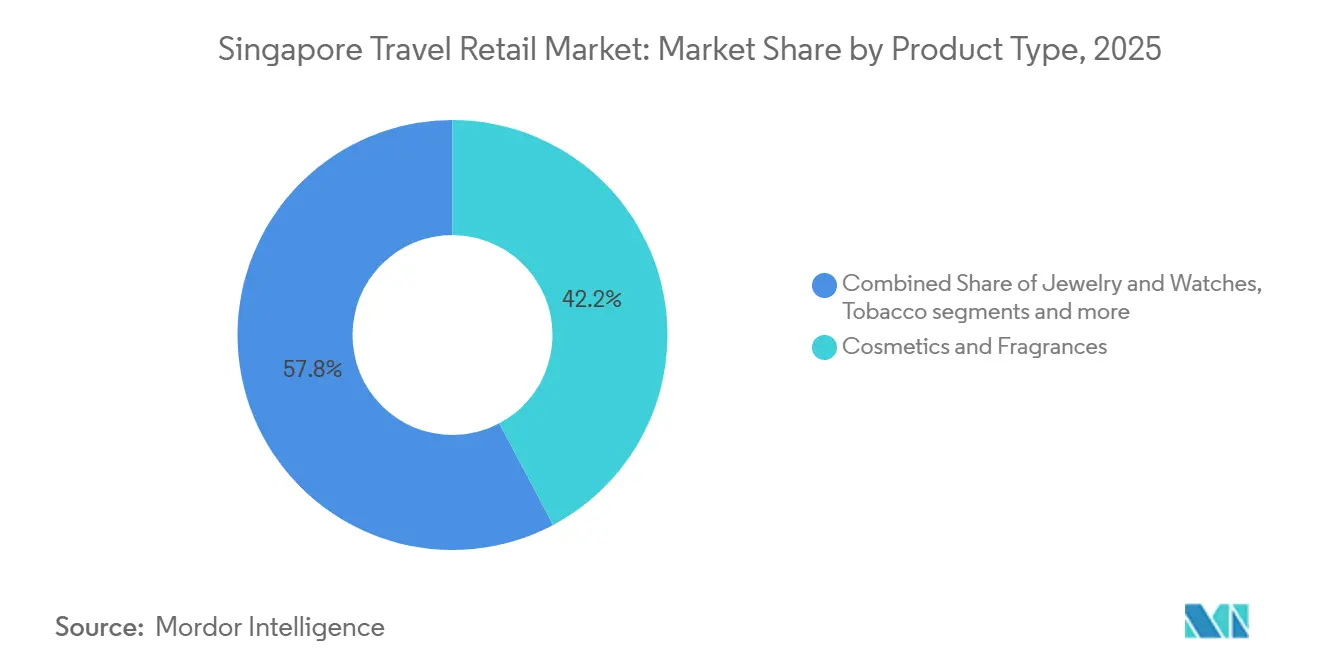
Beauty Premiumization and Spirits Diversification Reshape Category EconomicsCosmetics & Fragrances commands 42.24% of the Singapore travel retail market share in 2025, while Wines & Spirits is projected as the fastest-growing category at an 8.11% CAGR through 2031. This divergence is driven by rising interest in niche fragrances and advanced skincare concepts that thrive on airport-led discovery and consultation, lifting spend per passenger even as visitor volumes continue to normalize. Changi Airport and Jewel reinforce beauty’s role as a first-look channel through exclusive launches and immersive counters, including professional-grade skincare formats that translate engagement into higher-value baskets.
The strong outlook for wines and spirits is underpinned by premiumization, curated assortments, and limited-edition offerings that appeal to travelers seeking rarity and storytelling rather than price arbitrage. Omnichannel previews and pre-travel engagement further support intent-building ahead of departure, enhancing conversion at the airport. Food and confectionery operators are increasingly emphasizing quality, provenance, and trusted labeling to appeal to discerning international travelers, while tobacco faces structural constraints from strict regulatory policies. As a result, space and investment continue to shift toward high-margin beauty and prestige spirits, with slower categories refined to protect overall profitability.

By Distribution Channel:
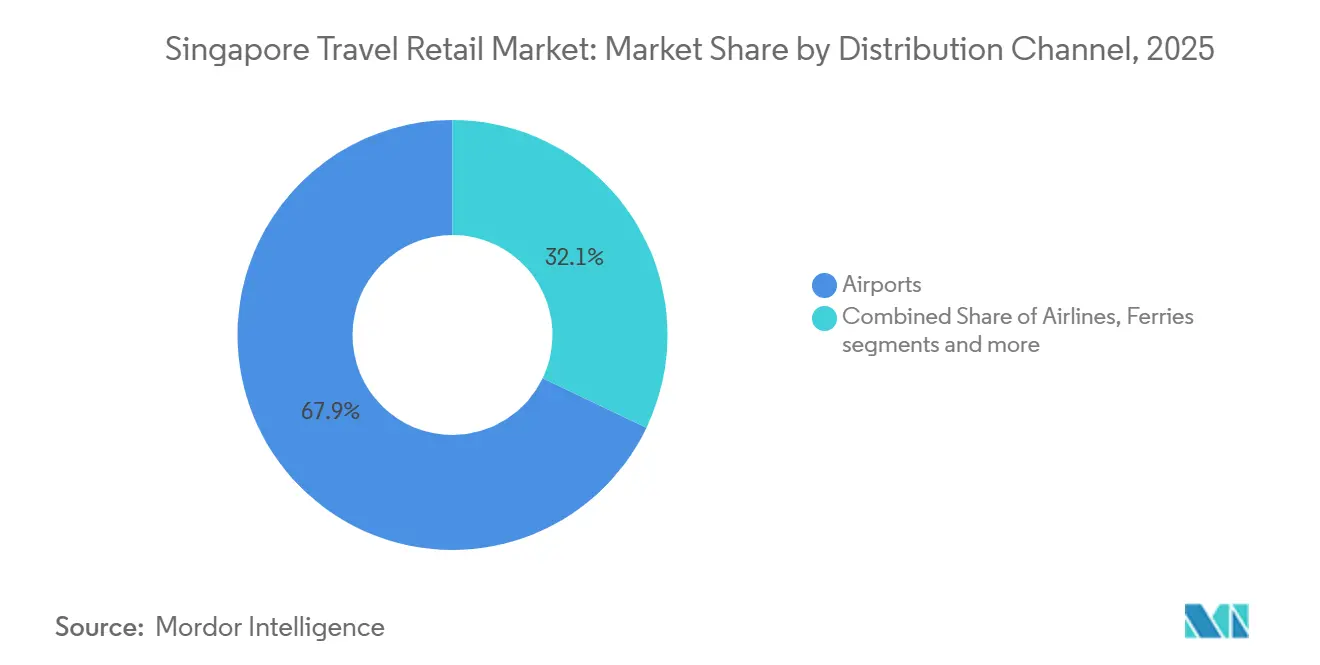
Airports Consolidate Dominance Through Omnichannel Integration and Infrastructure ExpansionAirports held a 67.90% share in 2025 and are projected to grow fastest at a 7.88% CAGR, with the channel benefiting from traffic normalization and the reach of iShopChangi as a digital extension of airport retail. Changi Airport continues to function as the primary sales engine, supported by ongoing terminal enhancements that sustain strong category breadth and premium shopping experiences. The integration of iShopChangi extends airport retail beyond physical dwell time, allowing travelers to engage with assortments before departure and outside peak travel windows. This omnichannel model shifts purchasing decisions earlier in the journey and improves conversion efficiency. As digital and physical activations become more synchronized, the airport channel’s influence on overall market growth continues to strengthen.
Beyond airports, complementary channels add depth to Singapore’s travel retail distribution ecosystem. Airlines play an important role in product discovery and impulse purchasing, particularly on long-haul routes where browsing time is longer and fulfillment can be seamlessly linked to airport collection. Ferry and cruise terminals are emerging as meaningful growth nodes as duty-free operations expand and store formats are refreshed to capture rising passenger flows. Downtown and border retail remain more limited in scale, but virtual downtown concepts anchored by airport marketplaces extend duty-free access to residents under defined conditions.
Geography Analysis
The East Region holds 82.25% share in 2025 and is forecast to grow at 8.32% CAGR through 2031, driven by the synergy between Changi Airport and Jewel, which together attract both travelers and residents. Jewel has become a destination in its own right, with strong footfall and increasing international visitor engagement validating its role as a hub for retail-led experiences. Changi’s traffic recovery further reinforces the region’s retail base, supporting anchor categories and a robust calendar of activations. The concentration of shoppers in the East enables sustained spend per passenger and strengthens the overall market ecosystem. Retail growth in this region is expected to continue as long as Changi remains the primary gateway and Jewel expands its attractions and experiences.
Long-term capacity growth is anchored by Terminal 5, which will significantly increase passenger throughput and strengthen the East Region’s retail potential. The “T5 In the Making” exhibition highlights design innovations and engages the public while linking visitors to on-terminal promotions, demonstrating how infrastructure development and retail programming are integrated. Planned expansions, including seamless transfers and multimodal access, reinforce the retail campus effect, encouraging repeat visits across multiple terminals. Retailers are aligning activation roadmaps with T5’s phased development to maximize engagement ahead of the terminal’s opening. This coordinated approach ensures shopper interest and market momentum are sustained even during the construction phase.
Other regions provide complementary opportunities but remain secondary to the East. The Central Region benefits from luxury shopping corridors, business hubs, and MICE-driven downtown retail, while cruise terminals create additional duty-free touchpoints for leisure travelers. North-East, North, and West regions see limited travel retail penetration due to fewer international gateways and smaller air- or seaside retail presence. Nationwide digital channels, including airport marketplace delivery services, help extend reach to residents and off-peak travelers. Across all regions, category depth, activation quality, and omnichannel convenience continue to shape how and where shoppers engage with the travel retail ecosystem.
Regulatory Landscape
Singapore travel retail is shaped by a mix of customs, tax, and airport economic regulation. Singapore Customs administers the Duty-Free Shop (DFS) Scheme, licensing duty-free operators for dutiable goods and tying eligibility to compliance requirements such as TradeFIRST assessment. This licensing framework influences who can operate bonded duty-free formats and how stock is managed within controlled premises.
On the tax side, GST rules affect traveler-facing price advantages and refund mechanics. The Electronic Tourist Refund Scheme (eTRS) allows eligible tourists to claim GST refunds at self-help kiosks at Changi and Seletar airports, with retailers participating either as independent retailers or through central refund agencies, including Global Blue Singapore Pte Ltd and Global Tax Free Pte Ltd. At the airport level, the Civil Aviation Authority of Singapore (CAAS) oversees airport economic regulation through its Code of Practice for Changi Airport Service Standards, with determinations covering the Fourth Regulatory Period (FY2025/2026 to FY2036/2037) and setting service and operating conditions for the airport retail environment.
Value Chain Analysis
Value creation in Singapore travel retail begins with brand owners and distributors supplying travel-exclusive and core SKUs, which then move through bonded logistics and warehousing for controlled inventory handling under Singapore Customs duty-free requirements. The midstream is led by concessionaires and operators that run duty-free and travel retail stores across major gateways. Changi Airport Group (CAG) is the primary landlord at the airport, while Singapore Cruise Centre (SCC) anchors sea-terminal retail, and the consolidation of sea-terminal operations under Lagardere Travel Retail at SCC shows how long-tenure concessions affect assortments, merchandising standards, and supplier negotiations.
Downstream, omnichannel and on-site fulfillment are increasingly built into the value chain rather than treated as add-ons. iShopChangi acts as a central digital front end for pre-order and collection, connecting merchants to customers earlier in the journey and requiring tighter coordination across operators, platform tools, and inventory visibility. The extension and commencement of major airport concessions, including Lotte Duty Free for liquor and tobacco across multiple terminals, also reinforces how long-term airport-partner relationships influence store network coverage, brand activation calendars, and the operational interfaces between platforms, stores, and fulfillment points.
Competitive Landscape
The Singapore travel retail market is highly concentrated, with a few leading players controlling most of the sector. Despite this, competitive intensity remains strong as experiential retail, premium activations, and omnichannel strategies raise the bar for conversion and loyalty. Airport-owned digital marketplaces, such as iShopChangi, extend retailers’ reach beyond terminal shoppers, engaging non-travelers through eligibility-based promotions and partnerships with airlines and banks. Brand-led campaigns and early product launches leverage the airport’s role as a showcase for international travelers, driving high-velocity sales and reinforcing premium positioning. While scale provides advantages, the gap in performance is increasingly determined by the ability to connect pre-trip intent with in-terminal engagement through data-driven strategies.
Strategic collaborations linking airlines, airports, payment networks, retailers, and brands are shaping integrated customer journeys, layering incentives without overburdening any single partner. Partnerships like Jewel Changi Airport and Mastercard illustrate the commercial power of coordinated campaigns that boost card transactions and cross-border spend among international visitors. Large-scale brand activations, such as those by L’Oréal Travel Retail Asia Pacific, demonstrate how multi-brand and single-brand experiences at terminal scale can drive visibility, engagement, and conversion across diverse traveler segments. The market increasingly rewards operators who can harness audience data to retarget travelers with timely, relevant offers. This partnership-driven approach strengthens incumbents’ competitive moat while allowing challenger brands to grow through targeted, event-led initiatives.
Expansion beyond airports into ferry and cruise terminals is diversifying traffic sources and complementing air-side retail flows. Programs such as Lagardère Travel Retail’s initiatives at HarbourFront and Tanah Merah Ferry Terminals bring unified brand standards, improving category depth and reducing fragmentation in non-airport nodes. Integration with airport promotions and loyalty mechanisms helps extend reach to travelers who bypass airside stores, enhancing overall market coverage. The competitive playbook now combines airport category leadership, omnichannel engagement via iShopChangi, and selective expansion into sea terminals to maximize retail team and inventory utilization. In this environment, innovation in activation, personalization, and experience delivery has become a key lever for sustaining growth and differentiation.
Singapore Travel Retail Industry Leaders
-
The Shilla Duty Free
-
Lotte Duty Free
-
Lotte Duty Free
-
Changi Airport Group
-
Lagardère Travel Retail
- *Disclaimer: Major Players sorted in no particular order
Singapore Travel Retail Market Companies Covered in this Report
- The Shilla Duty Free
- Ever Rich Duty Free
- Heinemann Asia Pacific
- Moët Hennessy Travel Retail
- L'Oréal Travel Retail APAC
- 3Sixty Duty Free
- Aer Rianta International (ARI Singapore)
- The Nuance Group Singapore
- Watsons Personal Care Stores
- Guardian Health & Beauty Singapore
- SMI Retail
- Lotte Duty Free
- DFASS (Singapore)
- DFS Group / DFS Venture Singapore
- Changi Airport Group (iShopChangi)
- Lagardère Travel Retail
- Gebr. Heinemann SE & Co. KG
- Dufry AG / Dufry Singapore
- King Power International
- Duty Free Americas Inc.
Market Opportunities and Future Outlook
Changi-focused retail innovation and infrastructure programs create concrete whitespace for higher-yield retail concepts that combine experiences with operational productivity. Changi Airport Group has disclosed Terminal 3 as a test bed for new retail concepts and technologies ahead of Terminal 5 readiness, and it has announced a major Terminal 3 upgrade with a tender planned in the second half of 2026. This timing gives retailers and brands an active pathway to redesign formats, improve conversion, and trial automation in high-traffic spaces.
Demand-side opportunity is supported by brand-led experiential rollouts and government-backed tourism development funding that can be integrated into retail activation pipelines. In 2026, Clarins launched a Beauty Concierge concept in Changi Terminal 1 with Changi-exclusive travel retail sets, showing how premium beauty brands use Singapore as a showcase for differentiated services and exclusive assortments. Separately, the Ministry of Trade and Industry announced an SGD 740 million injection into the Tourism Development Fund over the next five years (under Tourism 2040 ambitions), expanding support for digital transformation and visitor-experience initiatives that can feed into airport, Jewel, and sea-terminal retail.
Recent Industry Developments in Singapore Travel Retail Market
- June 2026: Lotte Duty Free commenced a three-year extension for duty-free liquor and tobacco concessions at Changi Airport Group, spanning 18 outlets and more than 8,600 sqm across all four terminals. The renewal secures continuity for a key category cluster while giving runway for store upgrades and experiential concepts aligned to Changi's broader terminal enhancement plans.
- May 2025: Changi Airport Group announced the extension of Lotte Duty Free's liquor and tobacco concession to run from 9 June 2026 to 8 June 2029. The multi-year term reinforces Changi's partnership-led concession model and supports longer-horizon investments in assortment depth, activation programming, and operational capabilities.
- June 2024: Changi Airport Group launched the TREX marketplace solution on iShopChangi to help merchants manage product, order, and sales data. The platform upgrade improves omnichannel execution by strengthening data flow and operational coordination between digital storefronts and physical fulfillment, which is central to pre-order and click-and-collect growth.
Singapore Travel Retail Market Report Scope and Research Methodology
Market Definition and Coverage
This market covers retail sales made to travelers in Singapore across travel-linked locations and channels, where purchases are driven by passenger movement and travel occasions rather than local everyday shopping.
Scope exclusions: Sales from regular domestic retail stores that are not targeted to traveling shoppers are not counted in this market value.
Segments Covered in This Report
- By Product Type
- Fashion & Accessories
- Jewelry & Watches
- Wines & Spirits
- Food & Confectionery
- Cosmetics & Fragrances
- Tobacco
- Other Product Types (Stationery, Electronics, etc.)
- By Distribution Channel
- Airports
- Airlines
- Ferries
- Other Channels (Railway Stations, Border Shops, Downtown)
- By Geography
- Central Region
- East Region
- North Region
- North-East Region
- West Region
Data Sources, Market Sizing, and Validation
Desk Research
Desk research was used to build the fact base on travel demand, retail activity around air and sea gateways, and how duty-free rules shape what can be sold. We typically start with public passenger and tourism indicators and then align them with retail-relevant markers like concession activity and major terminal capacity additions.
For Singapore, sources used for foundational inputs include public statistics and operational releases such as those from Singapore Tourism Board, Changi Airport Group, Singapore Department of Statistics, and Singapore Customs, along with international reference series from organizations such as UN Comtrade and ICAO. We also review annual reports, investor presentations, reputable press coverage, and a paid subscription that helps with company financials and news screening so assumptions can be cross-checked. These are illustrative examples, and many other public and paid sources were also referred to for data collection, validation, and clarification during the study.
Primary Interviews and Surveys
Primary work focused on interviews and structured checks with travel retail operators, brand and distributor representatives, and channel stakeholders tied to airport, airline, and ferry sales in Singapore. Inputs from these discussions helped us confirm category mix shifts, pricing and promotion behavior, and how passenger recovery translates into sales, with follow ups used when a desk-data signal and a field view did not line up.
Distribution of primary research fieldwork respondents
| Company type | Respondent position |
|---|---|
| Top tier: 38% | CXOs: 20% |
| Mid tier: 42% | Functional/Unit leaders: 33% |
| Smaller Players: 20% | Managers: 47% |
Market-Sizing & Forecasting
Sizing starts with a top-down build where passenger movement and visitor flows are used to reconstruct the addressable spend pool for travel-linked retail in Singapore, which is then allocated across the main channels and major product groupings. To keep totals realistic, we corroborate this with selective bottom-up approximations, such as sampled store productivity checks and a sampled price times volume logic for a few high-rotation categories, before adjusting the final totals.
Key inputs in the model include passenger throughput at air and sea gateways, tourism arrivals and purpose-of-visit mix, spend per passenger trends, category mix shifts (for example, beauty, wines and spirits, tobacco, and fashion-related purchases), and channel split changes tied to airports, airlines, and ferries. Where a bottom-up check is incomplete due to limited disclosed data, gaps are handled using conservative productivity ranges and then re-tested with interview feedback so no single assumption drives the outcome.
Forecasting is run using scenario analysis around travel volumes and spend intensity, with assumptions for recovery pace, pricing, and promotional intensity reviewed with primary respondents and then applied consistently across the forecast window.
Data Validation & Update Cycle
Model outputs are checked against independent demand signals, including public passenger statistics, tourism trends, and any available retail or concession indicators, so large jumps are questioned early. Variance checks are performed at multiple levels, including year-over-year movement, channel splits, and category mix, and then reviewed by another analyst before sign-off.
When a variance cannot be explained by a clear demand driver, we re-contact relevant interviewees and refresh the assumptions that created the mismatch. Reports are refreshed annually, with interim updates when a material event changes travel flows or retail operating conditions, and a final pre-delivery review is done so clients receive the latest updated view.
Mordor Intelligence's Singapore Travel Retail Market Estimate Compared With Other Published Estimates
Published market sizes for Singapore travel retail can look different because each estimate makes its own calls on what counts as travel-linked sales and how demand is tied back to passenger activity. Differences also show up when one model leans heavily on a single proxy, or when the price and mix assumptions are not refreshed with recent operating signals.
By tracking passenger throughput, channel splits, and spend-per-passenger checks, Mordor Intelligence keeps the 2025 value tied to a traveler-demand pool and avoids inflating totals with adjacent domestic retail or non-travel shopper spend.
Benchmark comparison
| Source | Market Size | Gaps in Research Methodology |
|---|---|---|
| Mordor Intelligence | USD 264.08 M (2025) | |
| Trade Journal A | USD 283.21 M (2025) | This estimate appears to treat duty-free shopping as the full market and may lean on a narrower channel view with less explicit adjustment for category mix and airport versus non-airport travel channels, which can shift the total. |
| Regional Consultancy B | USD 53.00 M (2022) | This figure is anchored in an earlier year and looks closer to a constrained demand period, which can understate normalized passenger volumes and recovery-linked spend, thereby producing a smaller market size. |
The spread mainly comes from scope boundaries, year selection, and how travel volumes are translated into retail spend across channels. When the demand pool is rebuilt from clear travel indicators and then tested with practical store and pricing checks, the resulting market size is easier to trace and repeat.
Key Questions Answered in the Report
What is the current size and growth outlook for the Singapore travel retail market?
The Singapore travel retail market is worth USD 288.20 million in 2026 and is projected to reach USD 446.10 million by 2031 at a 9.13% CAGR, supported by higher spend-per-passenger and the expansion of omnichannel models.
Which product categories are performing best within Singapore travel retail?
Cosmetics & Fragrances led in 2025 with 42.24% share, while Wines & Spirits is set to grow fastest at an 8.11% CAGR through 2031, reflecting premiumization and exclusive launches that raise basket values.
How critical are airports to Singapore’s travel retail performance?
Airports held a 67.90% share in 2025 and are projected to grow at a 7.88% CAGR, with Changi’s traffic recovery and iShopChangi’s pre-order and non-traveler services extending the effective selling window across the trip.
Why does the East Region dominate Singapore travel retail?
The East Region accounted for 82.25% in 2025 and is forecast at an 8.32% CAGR through 2031 due to the Changi-Jewel ecosystem’s combined footfall, destination retail, and strong activation pipeline supported by capacity expansion.
What role does data-sharing play in improving conversion in Singapore travel retail?
Ecosystem partnerships linking airlines, airports, brands, retailers, and payment networks enable targeted promotions, loyalty linkages, and live commerce pilots that increase pre-trip intent and in-terminal conversion.