
Market Overview
| Study Period | 2021 - 2031 |
|---|---|
| Forecast Data Period | 2026 - 2031 |
| Base Year Market Size (2025) | USD 10.45 Billion |
| Market Size (2026) | USD 11.08 Billion |
| Market Size (2031) | USD 14.82 Billion |
| Growth Rate (2026 - 2031) | 6.03 % |
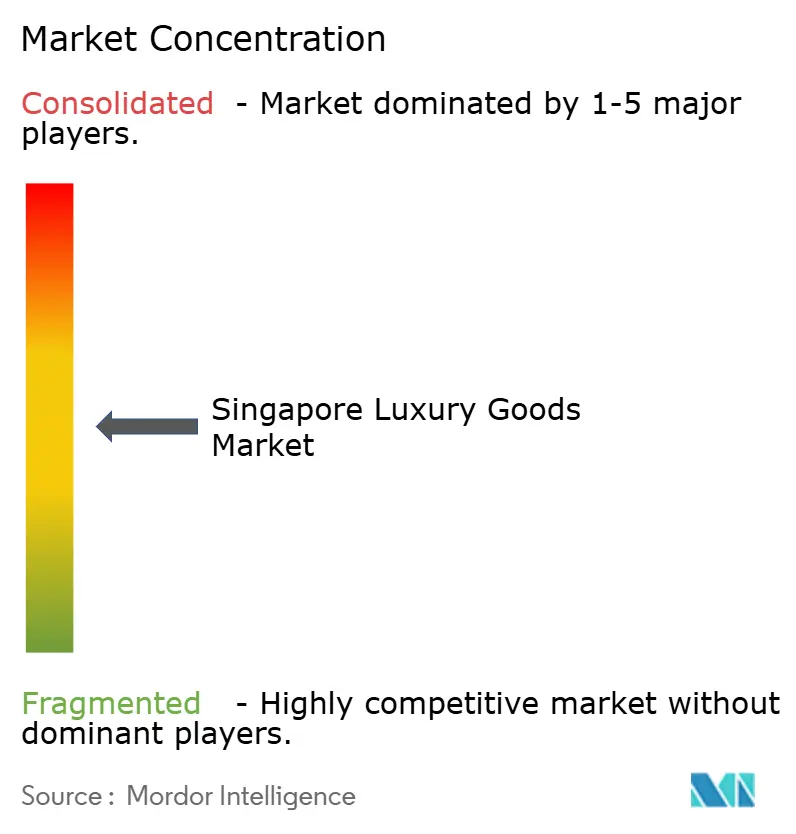
| Market Concentration | Medium |
Major Players *Disclaimer: Major Players sorted in no particular order Image © Mordor Intelligence. Reuse requires attribution under CC BY 4.0. | |
Singapore Luxury Goods Market Analysis by Mordor Intelligence
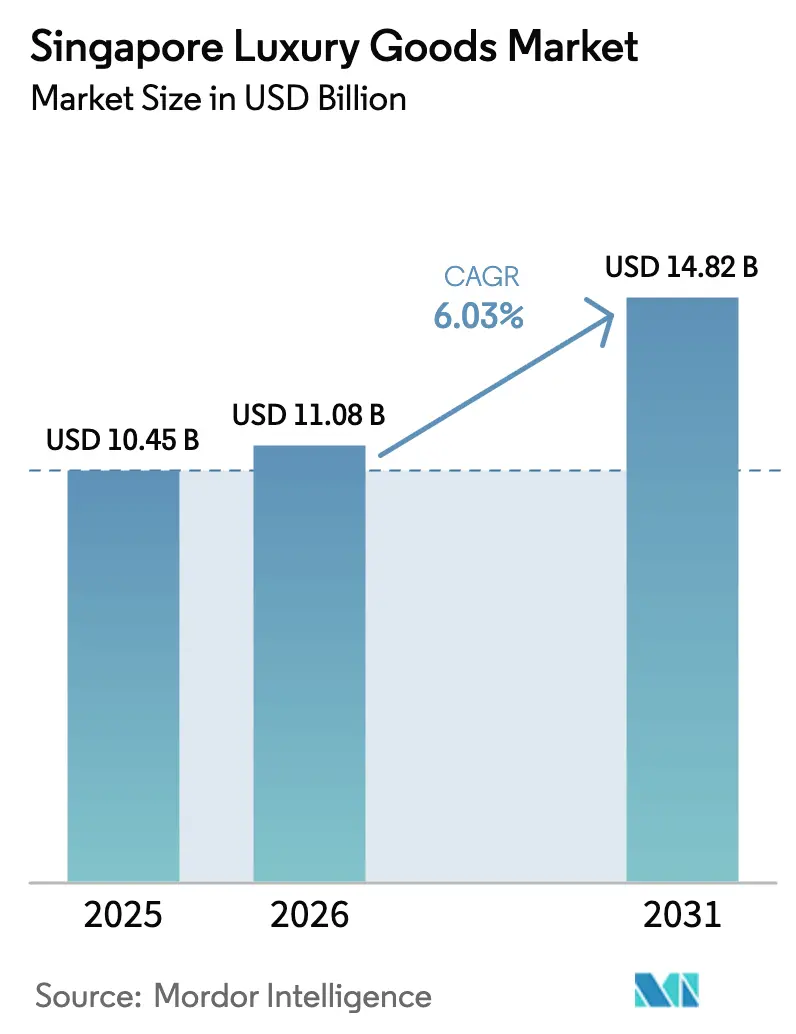
The Singapore luxury goods market size is expected to grow from USD 10.45 billion in 2025 to USD 11.08 billion in 2026 and is forecast to reach USD 14.82 billion by 2031 at 6.03% CAGR over 2026-2031. It is projected to grow significantly, reaching USD 14.26 billion by 2030, with a robust CAGR of 6.42% during the forecast period of 2025-2030. This growth is driven by several key factors, including rising disposable incomes, an increasing inclination toward premium and high-quality products, and the strong presence of global luxury brands in the country. Singapore's strategic position as a global financial hub and a premier tourist destination further bolsters the market, attracting affluent consumers from both domestic and international markets. The market is also witnessing a shift in consumer behavior, with a growing emphasis on personalized shopping experiences and sustainable luxury. The younger demographic, particularly millennials and Gen Z, is emerging as a significant consumer base, driving demand for innovative and exclusive luxury products. Furthermore, the rapid adoption of digital platforms and e-commerce has revolutionized the way luxury goods are purchased, offering greater accessibility and convenience to consumers.
Key Report Takeaways
- By product type, jewelry captured 26.05% of Singapore luxury goods market share in 2025; watches are projected to post the fastest 6.92% CAGR through 2031.
- By end user, women accounted for 55.74% of the Singapore luxury goods market in 2025, whereas men represent the quickest-growing cohort with a 7.55% CAGR to 2031.
- By distribution channel, single-brand stores held 36.62% of 2025 revenue; online stores are forecast to record a 7.31% CAGR during 2026-2031.
Note: Market size and forecast figures in this report are generated using Mordor Intelligence’s proprietary estimation framework, updated with the latest available data and insights as of 2026.
Market Trends and Insights
Drivers Impact Analysis of Singapore Luxury Goods Market*
| Driver | (~) % Impact on CAGR Forecast | Geographic Relevance | Impact Timeline |
|---|---|---|---|
| Rising wealth and HNWIs population | +1.8% | Singapore core, spillover to Southeast Asia | Medium term (2-4 years) |
| Influence of social media and celebrity endorsements | +1.2% | Singapore urban centers | Short term (≤ 2 years) |
| Expansion of luxury e-commerce platforms | +1.5% | Singapore national, regional hub effect | Medium term (2-4 years) |
| Affluent younger demographic | +0.9% | Singapore urban centers, regional influence | Long term (≥ 4 years) |
| Consumer inclination towards limited edition products | +0.6% | Singapore premium districts, tourist zones | Short term (≤ 2 years) |
| Globalization of luxury brands | +0.7% | Singapore as regional gateway to Southeast Asia | Long term (≥ 4 years) |
| Source: Mordor Intelligence | |||
Rising wealth and HNWIs population
Growing affluence and an increasing population of high-net-worth individuals (HNWIs) are significant drivers of the Singapore luxury goods market. The rise in disposable income and wealth accumulation among individuals has led to a higher demand for premium and luxury products. According to the Credit Suisse Research Institute, in 2024, Singapore is home to 330,752 high-net-worth (HNW) individuals and 1,739 ultra-high-net-worth (UHNW) individuals [1]. This substantial concentration of wealth not only boosts the consumption of luxury goods but also encourages the entry of global luxury brands into the market to cater to this affluent demographic. Singapore, being a global financial hub, attracts a significant number of HNWIs and UHNWIs, further fueling the market's growth. Additionally, the country's stable economy, favorable tax policies, and robust retail infrastructure create an ideal environment for the luxury goods market to thrive. The presence of high-end shopping districts, luxury boutiques, and exclusive retail experiences further enhances the appeal of luxury goods among affluent consumers, solidifying Singapore's position as a key market for luxury products in the Asia-Pacific region.
Influence of social media and celebrity endorsements
Social media and celebrity endorsements significantly drive the Singapore luxury goods market. The widespread use of social media platforms has transformed how consumers discover and engage with luxury brands. Platforms like Instagram, Facebook, and TikTok serve as key channels for showcasing luxury products, enabling brands to reach a broader audience and create aspirational value. Celebrity endorsements further amplify this influence by leveraging the credibility and appeal of well-known personalities. Celebrities often act as trendsetters, and their association with luxury brands enhances brand perception and desirability among consumers. In Singapore, where social media penetration is high, and consumers are highly brand-conscious, these endorsements play a pivotal role in shaping purchasing decisions. According to the Department of Singapore Statistics, the mobile penetration rate in Singapore was observed to be 165% in 2024 [2], highlighting the extensive reach of digital platforms. Additionally, the integration of influencer marketing, where social media influencers promote luxury goods, has become a critical strategy for brands. Influencers with a strong following and niche appeal can effectively target specific consumer segments, driving engagement and sales.
Expansion of luxury e-commerce platforms
The expansion of luxury e-commerce platforms is a significant driver of the Singapore luxury goods market. These platforms are increasingly catering to the growing demand for premium products by offering a seamless online shopping experience. Enhanced digital infrastructure, coupled with the rising penetration of smartphones and internet connectivity, has enabled luxury brands to reach a broader audience. Additionally, features such as personalized recommendations, virtual try-ons, and exclusive online collections are attracting affluent consumers. The convenience of shopping from home, combined with secure payment options and efficient delivery services, further fuels the growth of luxury e-commerce in Singapore. This trend is reshaping consumer behavior and driving the market forward. Furthermore, collaborations between luxury brands and e-commerce platforms are creating exclusive partnerships, offering limited-edition products and unique experiences to online shoppers. The growing influence of social media and digital marketing strategies also plays a crucial role in promoting luxury goods through these platforms.
Affluent younger demographic
The wealthy youth demographic serves as a significant driver for the Singapore luxury goods market. In 2024, over 40% of Singaporeans are aged between 15 and 39, as reported by the Singapore Department of Statistics [3]. This substantial proportion of the population represents a key consumer base for luxury goods, as individuals in this age group are often characterized by higher disposable incomes and a strong inclination toward premium products. Younger consumers in Singapore are increasingly drawn to luxury brands due to their desire for exclusivity, status, and superior quality. Their tech-savviness and active engagement on digital platforms and social media further amplify their exposure to luxury trends, making them more likely to adopt and invest in high-end products. Moreover, this demographic's preference for personalized and unique experiences has prompted luxury brands to innovate and tailor their offerings to meet these evolving demands. As a result, the spending habits and preferences of this influential group are shaping the strategies of luxury brands, driving growth and competition within the market.
Restraints Impact Analysis of Singapore Luxury Goods Market*
| Restraint | (~) % Impact on CAGR Forecast | Geographic Relevance | Impact Timeline |
|---|---|---|---|
| Escalating prime-retail rents | -0.8% | Singapore Orchard Road, Marina Bay premium districts | Short term (≤ 2 years) |
| Intense market competition | -0.6% | Singapore national, regional competitive spillover | Medium term (2-4 years) |
| Availability of counterfeit products | -0.4% | Singapore borders, regional supply chains | Medium term (2-4 years) |
| Sustainability-driven shift from new goods to resale | -0.7% | Singapore urban centers, environmentally conscious segments | Long term (≥ 4 years) |
| Source: Mordor Intelligence | |||
Intense market competition
Fierce competition dominates the market landscape, acting as a significant restraint in the Singapore Luxury Goods Market. The presence of numerous established players and new entrants intensifies the rivalry, making it challenging for companies to differentiate their offerings. This competitive environment often leads to aggressive pricing strategies, promotional activities, and innovation races, which can strain profit margins. Additionally, the high level of competition compels businesses to invest heavily in marketing and branding efforts to maintain their market position, further increasing operational costs. Such dynamics create a challenging environment for market players, impacting their growth potential and overall market performance. Furthermore, the market's saturation with luxury brands and products makes it difficult for new entrants to establish a foothold, while existing players face the constant pressure of retaining customer loyalty. The evolving preferences of consumers, who increasingly seek personalized and unique experiences, further complicate the competitive landscape.
Availability of counterfeit products
The availability of counterfeit products poses a significant restraint in the Singapore Luxury Goods Market. Counterfeit goods, often sold at a fraction of the price of genuine luxury items, undermine the exclusivity and perceived value of luxury brands. This issue not only impacts the revenue of legitimate manufacturers and retailers but also erodes consumer trust in the market. The proliferation of counterfeit products is facilitated by advancements in technology, which make it easier to produce high-quality replicas, and by the rise of online platforms, which provide a convenient channel for their distribution. Additionally, the presence of counterfeit goods can dilute brand equity and create challenges for companies in maintaining their premium positioning. Counterfeit products also create a highly competitive environment for legitimate players, as consumers seeking lower-priced alternatives may opt for fake goods, further affecting the sales of authentic luxury items. The issue is compounded by the difficulty in distinguishing counterfeit products from genuine ones, especially for consumers who lack the expertise to identify subtle differences. Addressing this issue requires stringent regulatory measures, increased consumer awareness, and robust anti-counterfeiting strategies by market players.
*Our forecasts treat driver/restraint impacts as directional, not additive. The impact forecasts reflect baseline growth, mix effects, and variable interactions.
Singapore Luxury Goods Market Segment Analysis
By Product Type:
Jewelry Dominance Meets Watch InnovationIn 2025, jewelry maintained its dominance in the Singapore luxury goods market, securing a commanding 26.05% share of the overall industry. This leadership position underscores Singapore’s role as a regional hub for luxury trade, drawing both local consumers and international buyers. The city-state’s strategic location and strong financial infrastructure make it an ideal gateway for precious metals and high-value products. Beyond trade dynamics, jewelry also carries deep cultural importance across Asia, where gold and other precious metals symbolize security, prosperity, and long-term wealth preservation. For many affluent consumers in Singapore and the surrounding region, jewelry purchases are not only seen as lifestyle choices but also as investments that hold intrinsic financial value.
The watches category is projected to be the fastest-growing segment, expanding at a CAGR of 6.92% through 2031. This growth trajectory reflects shifting consumer preferences, as high-net-worth individuals increasingly view luxury timepieces as both status symbols and collectible assets. Global demand for rare and limited-edition watches has surged, and Singapore’s luxury retail ecosystem positions it well to capture this momentum. The city’s reputation for authenticity, transparency, and access to leading Swiss and European brands enhances consumer trust in high-value purchases. Additionally, younger affluent buyers are showing keen interest in luxury watches, reflecting expanding aspirational consumption alongside traditional investment-driven purchases.


By End User:
Women Lead While Men AccelerateIn 2025, women accounted for the largest share of the Singapore luxury goods market, commanding 55.74% of total sales. This dominance is closely tied to traditional consumption patterns in the luxury sector, where women have historically represented the primary consumer base for categories such as jewelry, apparel, handbags, and personal accessories. Cultural norms, coupled with long-established marketing practices, reinforce the centrality of female consumers in luxury retail strategies. Furthermore, women in Singapore and the broader Asian region often view luxury goods as both lifestyle enhancements and expressions of social identity, contributing to sustained demand across categories. Influenced by generational wealth transfers and rising female affluence, women continue to drive premium purchases in both established and emerging luxury segments.
In contrast, the men’s luxury segment is emerging as the fastest-growing category, projected to grow at a 7.55% CAGR through 2031. This rapid growth signals a fundamental shift in gender-based purchasing behavior, reflecting how male consumers are embracing luxury through new avenues beyond traditional categories. While watches and automobiles remain cornerstone purchases, today’s male consumers in Singapore are increasingly drawn to self-care products, high-end fashion, and accessories that emphasize individuality and personal expression. The evolving perception of masculinity among affluent men has paved the way for broader luxury participation, driven by aspirational consumption and investment-minded purchasing. Younger generations, in particular, are seeking out luxury as a statement of identity, lifestyle sophistication, and financial discernment.
By Distribution Channel:
Single Brand Stores Anchor Digital GrowthIn 2025, single-brand stores held the largest share of the Singapore luxury goods market, commanding 36.62% of overall sales. This dominance highlights the continued importance of exclusive and controlled retail environments within the luxury sector. Luxury brands rely heavily on curated physical spaces to deliver immersive experiences, build strong emotional connections, and maintain brand prestige among affluent consumers. For many buyers, the in-store journey from personalized service to sensory engagement is as critical as the product itself. Singapore’s position as a global shopping destination reinforces the relevance of single-brand boutiques, which are often strategically placed in high-end retail districts to cater to both local and international clientele. This enduring strength demonstrates that even in an era of rapid digitalization, physical stores remain the cornerstone of luxury retail strategies and consumer trust.
In contrast, online luxury retail is emerging as the fastest-growing distribution channel, projected to expand at a CAGR of 7.31% through 2031. This acceleration is driven by the digital transformation of consumer engagement models and the growing comfort of high-net-worth individuals with e-commerce transactions. Advancements in secure payment systems, virtual try-on technologies, and curated online experiences are reshaping how luxury brands connect with their audiences. Younger consumers, in particular, are spearheading this digital adoption, valuing convenience, exclusivity, and personalized recommendations in their online shopping journeys. Moreover, brands are strategically investing in direct-to-consumer platforms to retain control over pricing, authenticity, and customer relationships while scaling global reach. As a result, online stores are not only expanding rapidly but are also redefining the balance between traditional luxury retail environments and digital-first strategies in Singapore.

Geography Analysis
The Singapore luxury goods market stands out in Southeast Asia for its unique combination of strong local demand, significant tourist spending, and its status as a wealth management and retail hub. Singapore’s affluent resident base—bolstered by one of the highest concentrations of millionaires in Asia—drives consistent domestic consumption of high-end products, from designer apparel and luxury watches to jewelry and fine leather goods. The city’s reputation for safety, stability, and cosmopolitan lifestyle further cultivates a tendency towards discretionary luxury purchases, making it an attractive market for both global brands and local distributors looking to launch flagship stores or exclusive offerings.
Tourism plays a pivotal role in amplifying Singapore’s luxury market performance. As a renowned destination for international travelers, especially from China, Indonesia, and Malaysia, Singapore benefits from high tourist footfall in luxury retail districts like Orchard Road, Marina Bay Sands, and Changi Airport’s Jewel. Tourism-driven sales experienced a robust rebound following travel recovery in the post-pandemic era, contributing a substantial share to overall market revenues. The presence of luxury hotels and world-class shopping malls creates a seamless integration of premium experiences, further stimulating sales across categories such as fashion, watches, jewelry, and high-end beauty products.
Geographically, Singapore’s compact urban landscape allows for highly concentrated and dynamic retail zones, enabling luxury brands to maximize visibility and operational efficiency. Areas such as Orchard Road and Marina Bay act as flagship corridors for leading global luxury houses, providing immersive retail experiences and frequent opportunities for exclusive launches and pop-up events. Meanwhile, expanding e-commerce penetration and omnichannel strategies allow luxury brands to reach affluent consumers island-wide, including repeat customers and younger luxury buyers in residential neighborhoods. This unique geography—urban, accessible, and intensely commercial—solidifies Singapore’s role as a benchmark luxury goods market, not just in ASEAN but globally.
Regulatory Landscape
Singapore luxury goods players operate within a pro-trade regulatory framework that emphasizes fair trading, accurate product claims, and compliant import processes. The Competition and Consumer Commission of Singapore (CCCS) enforces consumer-facing rules through the Consumer Protection (Fair Trading) Act, alongside related requirements under the Weights and Measures Act and the Consumer Protection (Trade Descriptions and Safety Requirements) Act. Together, these shape pricing transparency, product descriptions, and promotion mechanics in premium retail.
For cross-border flows, Singapore Customs manages import and export administration via TradeNet, including permit workflows where items fall under controlled categories and require approvals from competent authorities. Category-specific rules also affect luxury beauty and fragrance adjacencies, as the Health Sciences Authority (HSA) regulates cosmetics under the ASEAN Cosmetic Directive framework, including product notification requirements prior to sale, plus labeling and safety obligations. Store operators typically handle these obligations alongside business setup and retail licensing processes routed through the GoBusiness platform.
Competitive Landscape
In Singapore's luxury goods market, a score of 5 indicates a moderate concentration. This score reflects a competitive landscape where global giants, regional players, and local luxury brands actively compete for market share. The market's competitive nature is driven by the presence of well-established global conglomerates such as LVMH, Kering, and Richemont, which dominate through their extensive portfolios, strong brand equity, and significant financial resources. These companies leverage their scale advantages to maintain a robust presence in the market, offering a wide range of luxury products that cater to diverse consumer preferences. Their ability to invest heavily in marketing, innovation, and distribution networks further strengthens their competitive positioning, allowing them to consistently attract high-net-worth individuals and affluent consumers in Singapore.
At the same time, the market structure creates ample opportunities for emerging regional players and local luxury brands to carve out their niche. These smaller players often focus on specialized offerings, such as bespoke services, unique craftsmanship, or culturally resonant designs, which appeal to specific customer segments. By targeting these distinct niches, they can differentiate themselves from larger competitors and build a loyal customer base. Additionally, the growing demand for personalized and exclusive luxury experiences in Singapore further supports the growth of these niche brands and specialized retailers. Local brands, in particular, are leveraging Singapore's rich cultural heritage and blending it with modern luxury trends to create products that resonate deeply with both domestic and international consumers.
The competitive environment in Singapore's luxury goods market is also shaped by evolving consumer preferences and trends. Increasingly, consumers are seeking sustainable and ethically produced luxury goods, prompting both global and local players to adapt their strategies. This shift has led to the introduction of eco-friendly product lines, transparent supply chains, and initiatives aimed at reducing environmental impact. As a result, the market not only fosters competition among established and emerging players but also drives innovation and sustainability within the luxury goods sector. Furthermore, the rise of digitalization and e-commerce platforms has intensified competition, as brands now compete not only in physical retail spaces but also in the online domain.
Singapore Luxury Goods Industry Leaders
-
The Swatch Group Ltd
-
Rolex SA
-
Richemont SA
-
Kering SA
-
LVMH Moët Hennessy Louis Vuitton
- *Disclaimer: Major Players sorted in no particular order
Singapore Luxury Goods Market Companies Covered in this Report
- LVMH Moët Hennessy Louis Vuitton
- Kering SA
- Richemont SA
- The Swatch Group Ltd
- Rolex SA
- Chanel SA
- PVH Corp
- The Estée Lauder Companies
- Ralph Lauren Corporation
- Prada SpA
- Hermès International S.A.
- Burberry Group plc
- Audemars Piguet Holding SA
- Patek Philippe SA
- Tapestry Inc
- Tiffany & Co
- Bottega Veneta
- Chow Tai Fook Jewellery Group
- Balenciaga SA
- Capri Holdings Limited
Market Opportunities and Future Outlook
Luxury demand in Singapore continues to be supported by watch and jewellery momentum and high-spending customer pools, leaving room for brands to pair authenticity assurance with elevated experiences across channels. A recent check on demand is retail performance: in May 2026, Singapore retail sales data showed watches and jewellery up 11.7% year on year, alongside overall retail sales growth of 3.0% year on year (fourth straight month of growth). That data reinforces the market weight of hero categories such as jewelry (26.05% share in 2025) and the continued shift toward high-value purchasing.
Opportunities cluster around (i) deepening VIC-led retail models and experiential concepts in prime districts and travel-linked nodes, (ii) accelerating trusted omnichannel journeys that preserve pricing integrity and product provenance, and (iii) strengthening anti-counterfeit and traceability capabilities as a commercial differentiator. Named ecosystem bodies and platforms such as the French Chamber of Commerce in Singapore (Retail and Luxury committee) and the Singapore Fashion Council provide engagement points for capability-building and partnership-led activations, while Singapore Customs TradeNet processes and HSA cosmetic notification rules create compliance-led openings for distributors and brands looking to scale cleanly across product lines.
Recent Industry Developments in Singapore Luxury Goods Market
- July 2026: Richemont reports strong Q1 2026 sales growth of 20 percent at constant rates, with Singapore identified as a key market supporting APAC performance. The update points to continued premium brand traction in Singapore and across the Asia-Pacific region, helping underpin player expectations for the year.
- July 2026: LVMH (Tiffany & Co.) expanded Tiffany and Co. boutique at ION Orchard into a three-storey space, including first Blue Box Cafe in Southeast Asia. The move adds retail density and a more experiential customer journey in Singapore, reinforcing the city as a luxury retail and experiential destination for both tourists and locals.
- July 2026: Richemont reports strong Q1 2026 sales growth of 20 percent at constant rates, with Singapore identified as a key market supporting sales performance in the Asia-Pacific region. The update reiterates the role of Singapore in APAC momentum and sustains the premium outlook for luxury goods players tracking regional demand.
Singapore Luxury Goods Market Report Scope and Research Methodology
Market Definition and Coverage
This market covers spending on luxury goods sold in Singapore through physical and digital retail, captured as revenue at the point of sale and reported in USD for consistent comparison.
Scope exclusions: We exclude luxury services and experiences (such as hotels, fine dining, and travel), along with resale-only transactions that do not represent new product sales.
Segments Covered in This Report
- By Product Type
- Clothing and Apparel
- Footwear
- Eyewear
- Jewelry
- Leather Goods
- Watches
- Other Types
- By End User
- Men
- Women
- Unisex
- By Distribution Channel
- Single Brand Stores
- Multi Brand Stores
- Online Stores
- Other Distribution Channels
Data Sources, Market Sizing, and Validation
Desk Research
Desk research was used to build the basic demand and supply context for luxury goods in Singapore, and to set guardrails around what counts as retail goods revenue. We referred to public and official sources such as Singapore Department of Statistics releases, Monetary Authority of Singapore publications, Singapore Customs trade statistics, and Enterprise Singapore and related trade body updates that discuss retail and consumer activity.
To anchor the demand side, we also reviewed non-paywalled signals such as tourism and arrivals indicators (for example from the Singapore Tourism Board), inflation and exchange-rate series, and broader consumer indicators published by government agencies. Company annual reports, investor presentations, and reputable press were reviewed to understand distribution shifts, pricing behavior, and the timing of product launches. Paid subscriptions were used selectively for company financials and patent databases when cross-checking innovation and product cadence. This list is illustrative, and many other sources were also used for data collection, validation, and clarification during the research process.
Primary Interviews and Surveys
Primary work was used to pressure-test assumptions that are hard to read from public data, such as the share of tourist-led purchases, channel mix between boutiques and online, and how price increases translate into realized retail sales. We spoke with a mix of brand-side executives, retailers and distributors, mall leasing and retail specialists, and industry experts across the main customer cohorts in Singapore so that desk findings could be checked, gaps could be filled, and final assumptions could be triangulated.
Distribution of primary research fieldwork respondents
| Company type | Respondent position |
|---|---|
| Top tier: 39% | CXOs: 14% |
| Mid tier: 46% | Functional/Unit leaders: 41% |
| Smaller Players: 15% | Managers: 45% |
Market-Sizing & Forecasting
Sizing starts with a top-down build where Singapore retail consumption is reconstructed using category demand signals and trade and tourism indicators, and then converted into luxury-only revenue using validated share assumptions. To keep the totals realistic, we also do selective bottom-up checks by sampling typical price points and volumes in key product areas and by sense-checking the implied sales productivity of major retail formats.
In the model, inbound visitor volumes and shopping intensity are refreshed carefully alongside luxury price inflation and mix shifts toward higher ticket products. We also track store network changes in key retail corridors, and online penetration within premium retail. Because some data points are not published at the exact category level, gaps are handled through proxy series and interview-backed ratios that are reviewed each time the model is updated.
Forecasting is done using scenario analysis supported by trend-based smoothing, with key variables projected in a base case and then adjusted for faster or slower tourism normalization, changes in consumer sentiment, and pricing cycles. The final forecast is signed off after the implied per-visitor spend and per-capita spend move within a plausible range for Singapore.
Data Validation & Update Cycle
Validation is done through repeated cross-checks so that one data series does not drive the full result. Outputs are compared against independent signals such as import patterns for high-value goods, tourism spending direction, and retail category momentum, and then outliers are investigated before the dataset is finalized.
A multi-step analyst review is followed, where assumptions are challenged, units and currency conversions are rechecked, and unusual year-on-year movements are traced back to a clear driver. If a new event materially changes demand, pricing, or channel availability, the team re-contacts relevant experts and reruns the sensitive parts of the model. Reports are refreshed annually, and before delivery a fresh pass is completed so clients receive the latest updated view.
Mordor Intelligence's Singapore Luxuary Goods Market Size Compared Against Other Published Estimates
Published market numbers for luxury goods in Singapore can look far apart because each publisher makes different choices on what counts as luxury, how retail value is recorded, and which years are treated as the base for normalization.
Tourism arrival and spend direction, luxury price inflation patterns, and the observed shift in store-based versus online mix are used to keep Mordor Intelligence tied to a retail goods revenue pool that is repeatable to update, rather than a broader lifestyle spend figure.
Benchmark comparison
| Source | Market Size | Gaps in Research Methodology |
|---|---|---|
| Mordor Intelligence | USD 11.08 B (2026) | |
| Trade Journal A | USD 10.30 B (2026) | Uses a narrower retail scope that appears to undercount premium watches and jewelry sold through selected multi-brand and travel-linked outlets, and it applies conservative ASP progression without rechecking tourist mix shifts. |
| Industry Association B | USD 12.60 B (2026) | Blends luxury goods with adjacent premium categories and may include parts of luxury experiences and services, and it relies on older currency timing and less frequent refresh of tourism-led demand assumptions. |
The spread in the table mainly comes down to scope boundaries and how tourist demand and pricing are translated into realized retail revenue. By keeping inputs tied to observable demand signals and by revalidating the key shares during primary discussions, our estimate stays easier to replicate and less sensitive to one-off assumptions.
Key Questions Answered in the Report
What is the value of luxury goods sales in Singapore in 2026?
Sales total USD 11.08 billion, and they are projected to reach USD 14.82 billion by 2031.
Which product category currently generates the highest revenue?
Jewelry leads with 26.05% share of 2025 sales.
How fast is the watches segment expected to expand?
Watches are forecast to advance at a 6.92% CAGR during 2026-2031.
What rental trend affects Orchard Road boutiques?
Prime-retail rents climbed 4.1% in 2023 while vacancies fell to a decade-low 6.6%, pushing brands to optimize store productivity.