
Market Overview
| Study Period | 2020 - 2031 |
|---|---|
| Forecast Data Period | 2026 - 2031 |
| Base Year Market Size (2025) | USD 69.77 Billion |
| Market Size (2026) | USD 79.24 Billion |
| Market Size (2031) | USD 149.68 Billion |
| Growth Rate (2026 - 2031) | 13.57% CAGR |
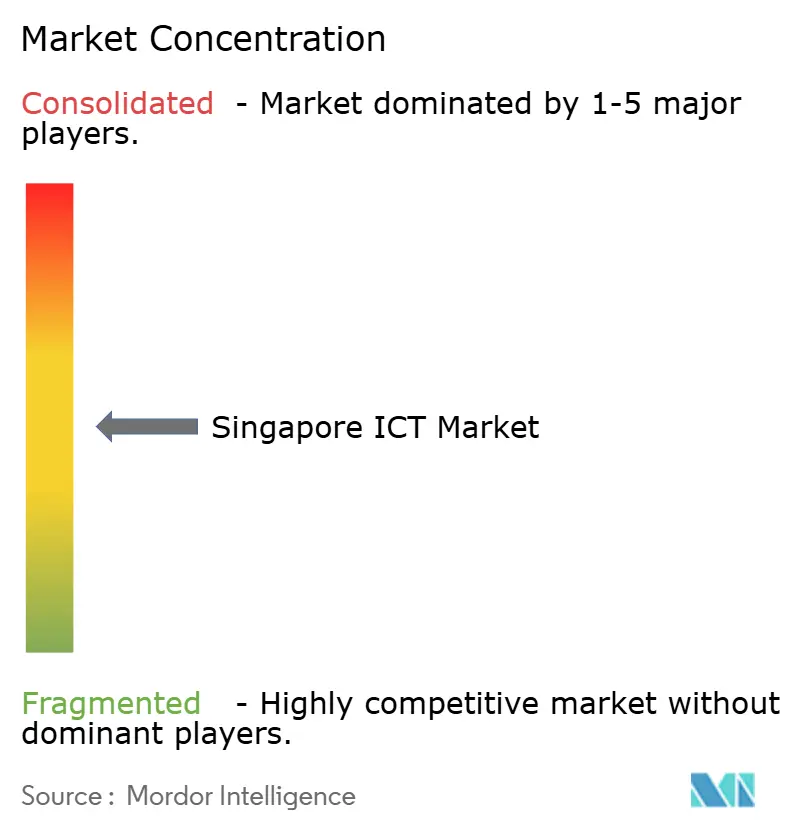
| Market Concentration | Medium |
Major Players *Disclaimer: Major Players sorted in no particular order Image © Mordor Intelligence. Reuse requires attribution under CC BY 4.0. | |
Singapore ICT Market Analysis by Mordor Intelligence
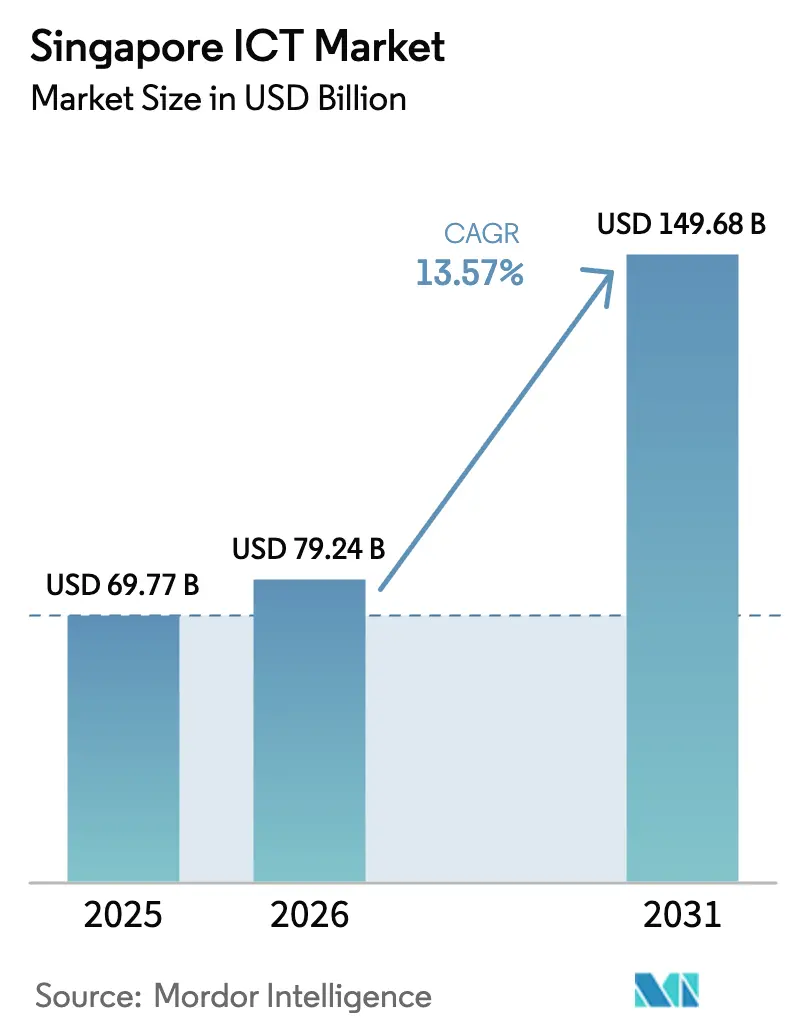
The Singapore ICT market size is expected to grow from USD 69.77 billion in 2025 to USD 79.24 billion in 2026 and is forecast to reach USD 149.68 billion by 2031 at 13.57% CAGR over 2026-2031. Singapore’s surge pivots on Smart Nation 2.0 funding, hyperscale data-center investments, and accelerated enterprise migration to cloud and AI platforms. Multinational cloud providers are racing to expand local capacity, while small and medium enterprises (SMEs) leverage software-as-a-service to close capability gaps with larger rivals. Sector momentum is also reinforced by healthcare digitalization, digital-only banking licenses, and the National AI Compute Resource (NACR) that lowers barriers to advanced analytics. Heightened spending, however, collides with power-grid limits and a widening cybersecurity talent gap that lifts operating costs and elongate project lead times.
Key Report Takeaways
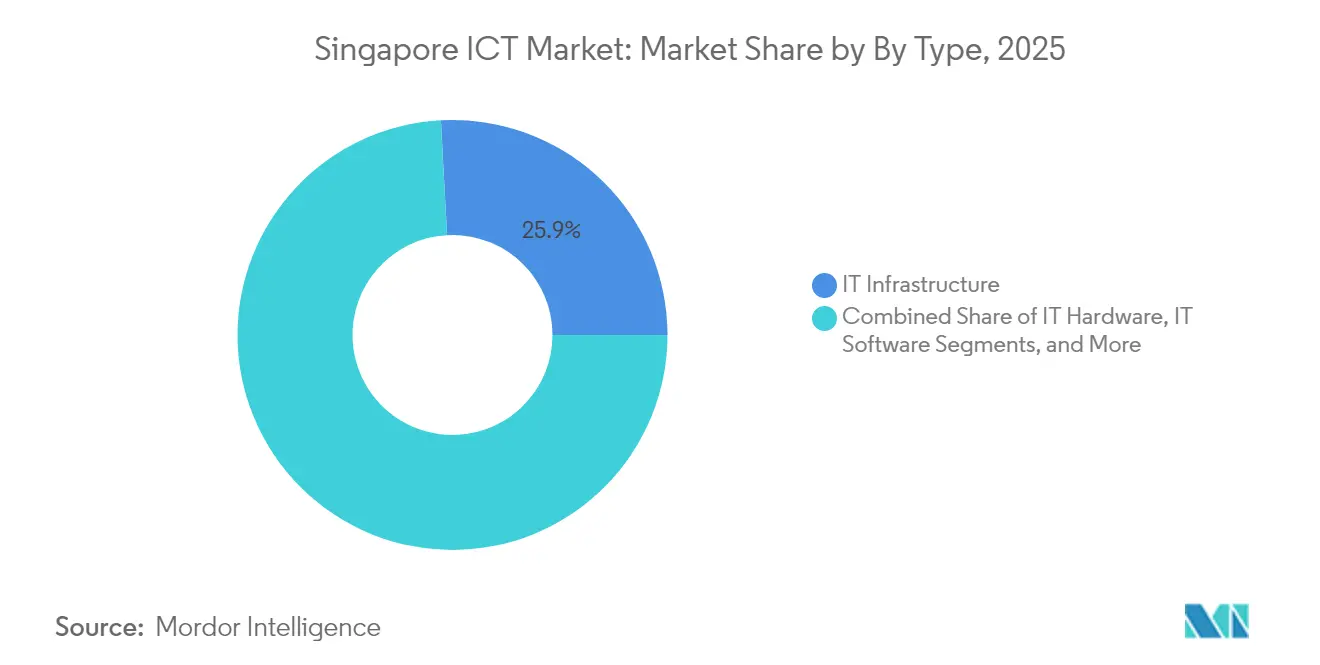
- By type, IT infrastructure captured 25.86% of Singapore ICT market share in 2025, while IT software is forecast to grow at a 16.35% CAGR through 2031.
- By enterprise size, large enterprises held 66.78% of the Singapore ICT market size in 2025; SMEs are advancing at a 14.88% CAGR to 2031.
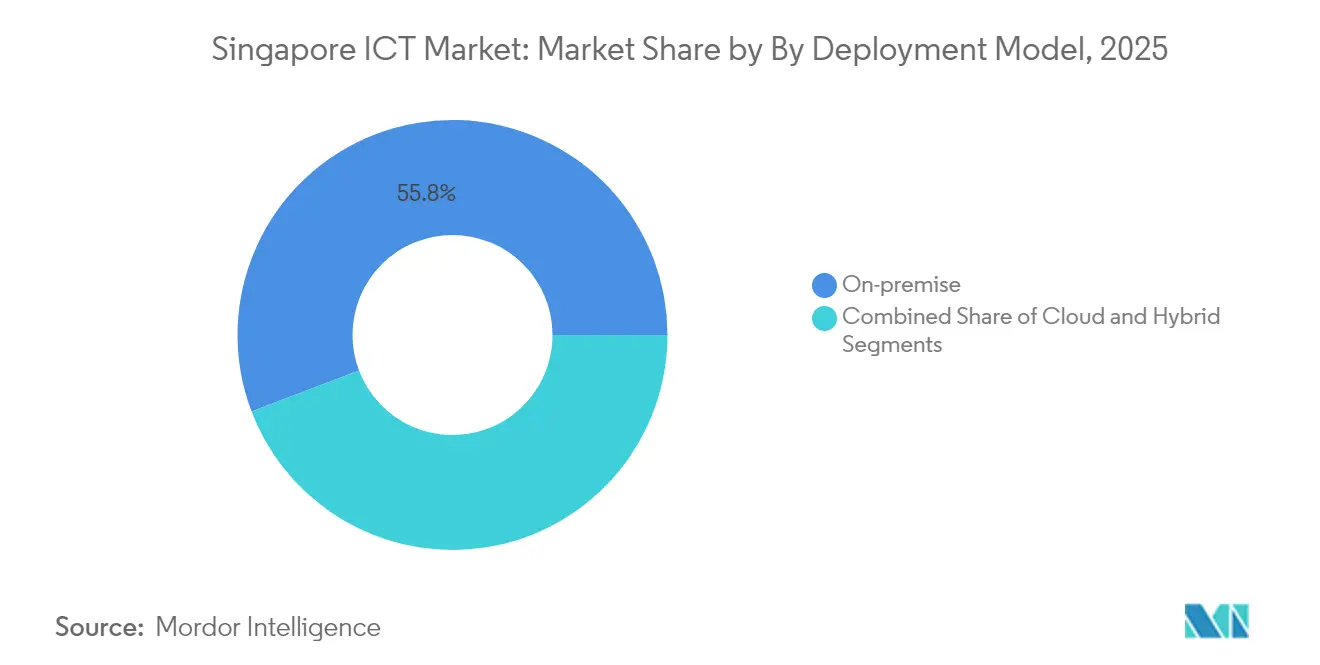
- By deployment model, on-premise solutions led with 55.78% of the Singapore ICT market size in 2025, yet cloud deployments are expanding at a 17.15% CAGR.
- By vertical, BFSI accounted for 21.78% of the Singapore ICT market share in 2025, whereas healthcare and life sciences are poised for an 17.93% CAGR through 2031.
Note: Market size and forecast figures in this report are generated using Mordor Intelligence’s proprietary estimation framework, updated with the latest available data and insights as of 2026.
Singapore ICT Market Trends and Insights
Drivers Impact Analysis*
| Driver | ( ~ ) % Impact on CAGR Forecast | Geographic Relevance | Impact Timeline |
|---|---|---|---|
| Government Smart-Nation Expenditure Surge | +2.1% | National, urban hubs | Medium term (2–4 years) |
| Rapid 5G Roll-out and Adoption | +1.8% | National, enterprise focus | Short term (≤ 2 years) |
| Enterprise Cloud-first Mandates | +2.3% | National, SME-driven growth | Medium term (2–4 years) |
| Digital Bank Licenses Boost BFSI Tech Spend | +1.4% | National, financial district | Short term (≤ 2 years) |
| National AI Compute Resource Roll-out | +1.9% | National, research nodes | Long term (≥ 4 years) |
| Green-Powered Hyperscale Data-center Incentives | +1.6% | National, industrial zones | Long term (≥ 4 years) |
| Source: Mordor Intelligence | |||
Government Smart-Nation Expenditure Surge
Smart Nation 2.0 moves Singapore from digital adoption toward digital-first governance, channeling USD 3.3 billion in fiscal 2024 into cybersecurity, data platforms, and modernized infrastructure. The outlay accelerates procurement of analytics engines, edge devices, and real-time processing tools, catalyzing demand far beyond the public sector. Regulatory requirements that mirror these standards push private organizations, especially in finance and healthcare, to upgrade legacy systems. Vendors specializing in API orchestration and cross-platform security gain direct access to large multi-year contracts, while interoperable frameworks reduce integration friction across verticals.
Enterprise Cloud-first Mandates
Cloud-first policies have flipped infrastructure planning, with cloud workloads growing 17.7% against 11.2% for on-premise deployments. Multi-cloud strategies lessen vendor lock-in and satisfy data-sovereignty rules, prompting a USD 3.5 billion domestic cloud market. SMEs drive the fastest uptake, using subscription-based AI, analytics, and automation to match big-company capabilities. Secondary demand is emerging for unified observability dashboards, hybrid connectivity fabrics, and automated policy governance that keep distributed environments in regulatory compliance.
Digital Bank Licenses Boost BFSI Tech Spend
New digital banking licenses have carved out cloud-native players that skip expensive core conversions, channeling fresh spending into API-first architectures, real-time fraud analytics, and conversational interfaces [1]Economic Development Board, “SAP invests S$12 million in its Digital Innovation Accelerator to boost adoption of Business AI in Singapore,” edb.gov.sg. Incumbents respond with accelerated modernization budgets, raising total BFSI technology outlays even as overall vertical growth slows. Compliance automation, blockchain integration, and zero-trust security become must-have modules, opening niches for SaaS vendors with proven fintech credentials.
National AI Compute Resource Roll-out
The NACR allocates USD 270 million to local supercomputing clusters, positioning Singapore as Southeast Asia’s AI proving ground. Accessible capacity lowers experimentation barriers for startups and researchers, while joint programs with universities expand the skilled-talent pipeline. Corporate adopters benefit from proximity to high-density compute, trimming latency for inference workloads in healthcare diagnostics and industrial simulation. Complementary investments, such as SAP’s USD 8.9 million Digital Innovation Accelerator, signal a multiplier effect across the software stack.
Restraints Impact Analysis*
| Restraint | (~) % Impact on CAGR Forecast | Geographic Relevance | Impact Timeline |
|---|---|---|---|
| Scarcity of Skilled Digital Talent | -1.7% | Nationwide, AI/ML roles | Long term (≥ 4 years) |
| Escalating Cyber-attack Surface | -1.2% | Enterprise networks | Short term (≤ 2 years) |
| Power-grid Capacity Caps on New DC Builds | -0.9% | Industrial zones | Medium term (2–4 years) |
| Wage Inflation from Foreign-Labor Curbs | -1.1% | Technology clusters | Medium term (2–4 years) |
| Source: Mordor Intelligence | |||
Scarcity of Skilled Digital Talent
A shortage of 2,800 to 4,400 cybersecurity professionals shackles rollout schedules and elevates salary costs, even as security demand is set to hit USD 4.82 billion by 2029. The gap extends to AI engineers and cloud architects, forcing SMEs to compete with multinationals on compensation. Government-backed upskilling programs, including IBM’s SkillsBuild, which targets 4,500 learners, will narrow deficits only gradually. Firms therefore pivot to low-code platforms, AI-assisted development, and managed services that reduce reliance on scarce specialists.
Escalating Cyber-attack Surface
Rapid digitalization widens exposure, with 5G, IoT, and cloud APIs multiplying entry points for threat actors. The attack surface expansion drives near-term adoption of zero-trust architectures, secure access service edge (SASE) frameworks, and AI-enabled anomaly detection. Yet implementation is slowed by fragmented legacy systems and overlapping regulatory mandates. Insurers are also tightening underwriting criteria, raising premiums on firms lacking mature cybersecurity postures.
*Our forecasts treat driver/restraint impacts as directional, not additive. The impact forecasts reflect baseline growth, mix effects, and variable interactions.
Segment Analysis
By Type: Software Innovation Drives Infrastructure Modernization
IT infrastructure owned 25.86% of Singapore ICT market size in 2025, underlining continued investment in data centers, networking gear, and server capacity . The segment benefits from hyperscale expansion commitments such as AWS’s USD 12 billion plan, but year-on-year growth is moderating as virtualization densifies server racks. IT software outpaces all other categories with a 16.35% CAGR, propelled by cloud-native platforms, AI toolchains, and workflow automation suites. This software pivot lifts demand for container orchestration, micro-services security, and agile integration services. Parallel expansion of infrastructure and applications underpins a balanced growth profile. Companies increasingly adopt subscription pricing for enterprise software, flattening capex spikes and smoothing cash flows. Hardware margins tighten amid commoditization, though specialized AI accelerators and edge devices command premiums. Major vendors such as SAP anchor R&D in Singapore, exemplified by its Digital Innovation Accelerator that aligns industry-specific AI models with local use cases . The interplay of high-capacity infrastructure with advanced software creates a virtuous cycle that keeps the Singapore ICT market on its upward trajectory.


By End-User Enterprise Size: SME Digital Democratization Accelerates
Large enterprises held 66.78% of Singapore ICT market share in 2025, leveraging budgets and in-house talent to execute complex, multi-domain digitization. Growth, however, is slowing to 12.84% as many have already completed first-wave transformations. SMEs, in contrast, are posting a 14.88% CAGR, driven by government grants and cloud subscriptions that compress deployment cycles. The widening availability of turnkey AI services empowers small firms to integrate chatbots, analytics, and robotic process automation without owning expensive hardware. Training initiatives keep the pipeline of digital talent flowing to smaller companies. IBM’s SkillsBuild is one example that provides free certification tracks for data analytics and cybersecurity . Financial incentives such as the Productivity Solutions Grant reimburse up to 70% of qualifying tech investments, further equalizing adoption conditions. As SMEs scale, they form a sizeable customer base for managed-service providers and value-added resellers, reinforcing a diversified vendor ecosystem that underpins the Singapore ICT market.
By Deployment Model: Hybrid Architectures Bridge Legacy and Cloud
On-premise systems still command 55.78% of Singapore ICT market size in 2025, reflecting strict data-sovereignty rules and sunk investment in proprietary hardware . Yet cloud deployments are advancing at a 17.15% CAGR, supported by local availability zones from AWS, Google, and Microsoft. Hybrid patterns are fast becoming standard operating models, allowing enterprises to address latency-sensitive workloads on-premise while exploiting elastic compute for peak demand. Enterprise maturity in cloud governance is improving. Organizations are building centralized FinOps teams and deploying automated policy engines to optimize resource usage across multi-cloud estates. Compliance frameworks issued by the Infocomm Media Development Authority (IMDA) now certify sovereign cloud configurations, lowering risk perceptions. Edge computing is gaining traction as a complement to hyperscale, balancing workloads across micro-data centers that relieve pressure on the national power grid.
By End-User Industry Vertical: Healthcare Digitalization Outpaces Financial Services
BFSI retained the largest slice of Singapore ICT market size at 21.78% in 2025, buoyed by digital banking, reg-tech, and cybersecurity programs . Spending intensity remains high as incumbent banks fortify core systems against new digital upstarts. Still, healthcare and life sciences post the fastest 17.93% CAGR through 2031. Precision medicine, AI-driven diagnostics, and tele-consult platforms are scaling rapidly within public and private hospitals, supported by NACR resources and strict data-privacy enforcement. Manufacturing is also lifting ICT demand via Industry 4.0 retrofits, including IoT sensors and predictive maintenance. Government and public services prioritize citizen-centric portals and backend modernization that aligns with Smart Nation KPIs. Meanwhile, retail and logistics firms revise omnichannel roadmaps to account for same-day delivery expectations. Although gaming and esports attract attention, the vertical remains nascent relative to high-value enterprise segments and therefore contributes a smaller revenue share.
Geography Analysis
Singapore’s single-city geography concentrates ICT investment within a compact yet high-density market. Smart Nation 2.0 earmarked USD 3.3 billion for nationwide cybersecurity, data analytics, and digital infrastructure, stimulating first-tier demand across public and private sectors. Pairing this with a USD 760 million slate of new subsea cables reinforces the city-state’s status as a Southeast Asian data gateway. Domestic broadband upgrades to 10 Gbps and extensive 5G coverage raise the baseline for digital service quality.
The regulatory environment remains one of the most transparent in Asia. IMDA mandates clear data-protection requirements and issues licenses that foster competition without compromising security. Local talent initiatives, backed by public–private partnerships, aim to produce job-ready graduates in AI and cloud technologies to sustain expansion. Such predictability has drawn multi-billion-dollar data-center pledges from AWS, Google, and Equinix, anchoring the Singapore ICT market.
Regional connectivity plans extend influence beyond national borders. The Bifrost and upcoming Vietnam-Singapore cables will enlarge subsea capacity and shorten latency to North America and neighboring economies. This makes Singapore the preferred hosting location for regional SaaS vendors and fintech platforms. High-capacity links also encourage edge deployments in nearby markets, with Singapore acting as the command center for multi-country digital operations.
Regulatory Landscape
Singapore ICT regulation is anchored by the Info-communications Media Development Authority (IMDA), which administers licensing and market conduct oversight under the IMDA Act and supports telecom rules such as spectrum allocation, numbering plans, and Quality of Service requirements. In April 2026, the Info-communications Media Development Authority (Amendment) Act 2026 was introduced to strengthen IMDA market conduct powers and align elements of the IMDA Act with the Telecommunications Act 1999, tightening oversight as networks and cloud platforms become more converged.
Digital infrastructure governance also moved up the agenda in 2026. On 1 July 2026, the Ministry of Digital Development and Information (MDDI) and IMDA issued a draft Digital Infrastructure Bill for public consultation (through 22 July 2026), covering major Foundational Digital Infrastructure service providers and data center operators at or above 3 MW, with emphasis on operational resilience and sustainability. This complements the Cybersecurity Act framework by extending requirements beyond cyber threats to include physical hazards and technical failures, shaping compliance roadmaps for operators of data centers, network backbones, and critical digital platforms.
Value Chain Analysis
The Singapore ICT value chain starts with core digital infrastructure inputs (subsea cables, fixed broadband, 5G mobile networks, and data centers), extends into platform and integration layers, and then culminates in cloud, software, and managed services delivered to government, BFSI, healthcare, manufacturing, and other enterprise buyers. IMDA programs and planning, including the Digital Connectivity Blueprint, influence upstream infrastructure investment decisions, while green data center roadmap requirements and selective capacity allocations shape how colocation and hyperscale build-outs are executed.
Local ecosystem orchestration is led by telcos and infrastructure owners that aggregate network assets, compute, and edge capabilities into service platforms. For example, Singtel Digital InfraCo operates a portfolio that includes Nxera (data centers), RE:AI (AI cloud), Paragon (5G/AI platform), and subsea cable interests, connecting connectivity with higher-value digital services. In mobile infrastructure, network-sharing models such as Antina (the StarHub and M1 joint venture) pool 5G standalone capacity and improve coverage economics, while hyperscalers (AWS, Google, and Microsoft) and system integrators extend the chain into multi-cloud migration, cybersecurity, and application modernization for enterprises and SMEs.
Competitive Landscape
The Singapore ICT market displays moderate fragmentation with pockets of high concentration. Hyperscale cloud infrastructure is dominated by AWS, Microsoft Azure, and Google Cloud, whose combined footprints exceed 70% of available hyperscale capacity. In contrast, software and managed-services segments are populated by regional specialists, system integrators, and startups that address niche requirements such as reg-tech, automation, and vertical AI applications.
Strategic partnerships are the preferred path to scale. IBM and the National University of Singapore launched an AI research center focused on green computing and safety, aligning public research with enterprise demand. SAP tripled its local R&D headcount to accelerate business-AI projects tailored for Southeast Asian clients. These moves reflect an ecosystem anchored on co-innovation rather than pure vendor lock-in, giving enterprises a broad menu of interoperable solutions.
Barriers to entry are rising. Power-grid caps limit new data-center licenses, favoring incumbents that hold existing allocations. Talent shortages inflate wages and push vendors to adopt automation, raising the capital intensity of service-delivery models. Regulatory compliance remains stringent but predictable, rewarding providers that can certify sovereign-cloud architectures and zero-trust postures. Overall, supplier rivalry is shaped by differentiation in domain expertise and the ability to deliver quantifiable ROI to discerning enterprise buyers.
Singapore ICT Industry Leaders
Singapore Telecommunications Ltd. (Singtel)
StarHub Ltd.
M1 Ltd.
Amazon Web Services (AWS) Singapore
Google Asia Pacific Pte. Ltd.
- *Disclaimer: Major Players sorted in no particular order

Market Opportunities and Future Outlook
Regulated digital infrastructure and resilience compliance is creating whitespace for software and services that operationalize governance across networks, cloud, and data center operations. The July 2026 draft Digital Infrastructure Bill, alongside existing cybersecurity obligations, lifts demand for continuous controls monitoring, incident readiness, asset observability, and vendor-risk tooling that can be deployed across Foundational Digital Infrastructure providers, data center operators (>=3 MW), and large enterprise users relying on these services. This pulls through opportunities in managed security, policy automation, and compliance-by-design architectures for regulated verticals such as BFSI and healthcare.
Sovereign AI, edge computing, and GPU-as-a-Service are also developing as commercial lanes, supported by identifiable infrastructure moves and programs. Singtel initiatives such as RE:AI and its applied AI collaboration with Nvidia, together with the National AI Compute Resource referenced in the market context, lower barriers for enterprises and startups to trial and deploy compute-heavy workloads in Singapore. At the same time, connectivity upgrades expand the addressable market for latency-sensitive services: all four major operators achieved nationwide 5G standalone networks in 2026, and the Digital Connectivity Blueprint targets 10 Gbps domestic connectivity within five years plus a step-up in submarine cable landings over a decade. Regional interconnection investments, including the I-2SEA undersea cable linking India, Malaysia, and Singapore (targeting operation in Q4 2029), reinforce Singapore's role as a control plane for regional SaaS and digital operations, supporting cloud interconnect, data center networking, and cross-border managed services.
Recent Industry Developments
- July 2026: Singtel considers forming a data center real estate investment trust to fund data center and AI related capex, targeted at about S$3 billion in FY2027. The proposal would enable large-scale capital deployment for Singapore's data-center and AI infrastructure expansion. It would also support AI infrastructure growth through additional capacity in Singapore's data center market.
- July 2026: Singtel confirms full nationwide 5G standalone network coverage as NSA is retired. This milestone supports higher-value, low-latency enterprise AI and IoT services. It also strengthens enterprise digitalization capabilities across Singapore.
- June 2026: Singtel partners with Digital Industry Singapore to accelerate AI transformation and strengthen AI-enabled operations and digital infrastructure. The collaboration links public-sector AI initiatives with enterprise telecom and digital services. It expands the addressable market for Singtel's digital services.


Research Methodology Framework and Report Scope
Market Definition and Coverage
For this study, the market is defined as total spending in Singapore on information and communications technology products and services that enable compute, connectivity, software use, and related delivery and support across public and private organizations.
Scope exclusions: We exclude consumer electronics spending that is not primarily bought for ICT use in organizations, as well as non-ICT construction work even when it is linked to digital infrastructure projects.
Segmentation Overview
- By Type
- IT Hardware
- Computer Hardware
- Networking Equipment
- Peripherals
- IT Software
- IT Services
- Managed Services
- Business Process Services
- Business Consulting Services
- Cloud Services
- IT Infrastructure
- Communication Services
- IT Hardware
- By End-User Enterprise Size
- Small and Medium Enterprises
- Large Enterprises
- By Deployment Model
- On-premise
- Cloud
- Hybrid
- By End-user Industry Vertical
- Government and Public Administration
- BFSI
- Energy and Utilities
- Retail, E-commerce and Logistics
- Manufacturing and Industry 4.0
- Healthcare and Life Sciences
- Oil and Gas (Up-, Mid-, Down-stream)
- Gaming and Esports
- Other Verticals
Data Sources, Market Sizing, and Validation
Desk Research
Desk research helped structure the market boundary and anchor the model to Singapore demand signals before any forecasting was done. Public and official sources were used for fundamentals, such as IMDA publications on the digital economy and sector programs, SingStat national accounts and industry statistics, and MAS macro releases that influence business investment cycles. We also reviewed GovTech and ministry budget disclosures to understand public sector ICT priorities. Where relevant, we checked Infocomm Media Development Authority spectrum and connectivity updates, as well as public procurement portals and tender notices, to understand typical contract sizes and refresh cycles.
To translate those signals into sizing inputs, we referred to company annual reports, filings, investor presentations, and reputable press coverage to confirm product presence and delivery footprint in Singapore. Select paid subscriptions that support company financials and news screening were used to speed up cross-checks, and a patent database was reviewed selectively to understand product direction in cloud, cybersecurity, and data infrastructure. The sources mentioned here are illustrative, and many other public and subscription sources were also checked for data collection, validation, and clarification.
Primary Interviews and Surveys
Primary work was used to confirm what is actually purchased in Singapore, how pricing is moving, and how spending splits across hardware, software, telecom, and services in day to day procurement. We spoke with a mix of suppliers, channel partners, enterprise buyers, and public sector facing delivery teams, and then rechecked unclear points across industries such as government, BFSI, healthcare, and manufacturing. Since this is a single-country market, the conversations were also used to validate local currency effects, contract renewal timing, and the practical split between on-premise and cloud delivery.
Distribution of primary research fieldwork respondents
| Company type | Respondent position | Region |
|---|---|---|
| Top tier: 31% | CXOs: 19% | |
| Mid tier: 50% | Functional/Unit leaders: 36% | |
| Smaller Players: 19% | Managers: 45% |
Market-Sizing & Forecasting
The core model starts with a top-down build where Singapore ICT spending is reconstructed from the addressable enterprise and public sector demand pool, and then split across major ICT buckets using adoption and intensity indicators. Inputs were treated as practical sizing levers, including ICT budget growth expectations by industry, cloud migration pace, 5G and fixed connectivity expansion, cybersecurity compliance driven spend, and data center capacity and utilization signals that influence infrastructure and services pull through. When a number looked too smooth, it was broken down further by typical contract length, renewal cycles, and project-based services patterns, then re-aggregated.
Those totals were then checked with selective bottom-up approximations, mainly using sampled price and volume logic and channel checks for common categories, for example seats or subscriptions for business software, and line or bandwidth counts for telecom services. When company reported revenue lines did not isolate Singapore, exposure proxies from local headcount, delivery center presence, and customer mix were used, and the contribution was capped to avoid over-attribution. For forecasting, scenario analysis was used, with a base case shaped by primary inputs on expected budget releases, pricing changes, and delivery constraints. The scenarios were mainly linked to macro growth, policy driven digital funding, and major capacity additions.
Data Validation & Update Cycle
Before sign-off, outputs were triangulated against independent signals such as Singapore digital economy growth markers, public sector ICT program pacing, and supplier commentary on bookings and renewals. Variance checks were run at multiple levels, so unusual jumps in any year had to be explained by a clear driver, such as a policy change, a large infrastructure buildout, or a pricing step-up. If an assumption moved the total meaningfully, analysts re-contacted experts to confirm whether the shift was real or only a timing effect.
The report is refreshed annually, and interim updates are made when major events occur that can move ICT budgets or pricing quickly. Before delivery, a final analyst pass is completed so newly released public data and recent deal signals are reflected in the final tables and narrative.
Mordor Intelligence's Singapore Ict Market Size Measured Against Other Published Estimates
Different published numbers for Singapore ICT usually come from timing and definition differences, even when the country is the same. The spread is often explained by which ICT items are counted, whether values are reported in current USD or converted from SGD using a different exchange rate window, and whether the estimate is updated after major budget announcements.
Because pricing for subscriptions, managed services, and connectivity can change within a year, the refresh cadence and the USD conversion window become material. These checks are applied consistently before publication by Mordor Intelligence.
Benchmark comparison
| Source | Market Size | Gaps in Research Methodology |
|---|---|---|
| Mordor Intelligence | USD 69.77 B (2025) | |
| Industry Intelligence Publisher A | USD 66.00 B (2023) | This figure is for an earlier year and is described as enterprise ICT, which can undercount public sector led ICT programs and some telecom services, and it may use a different USD conversion window. |
| Trade Media B | USD 66.70 B (2024) | This estimate is presented as enterprise ICT budgets, which can treat multi-year contracts differently, and it can miss price progression effects when subscription and managed services pricing is not refreshed annually. |
Taken together, the differences line up with two repeatable causes, the year being referenced and how currency conversion and pricing updates are handled. When scope is kept consistent and assumptions are refreshed on a clear schedule, the market value becomes easier to track year to year and easier to reconcile with observed spending signals in Singapore.


Key Questions Answered in the Report
How large is the Singapore ICT market in 2026?
The Singapore ICT market size reached USD 79.24 billion in 2026.
What is the predicted growth rate for Singapore’s ICT sector through 2031?
The market is forecast to expand at a 13.57% CAGR to USD 149.68 billion by 2031.
Which enterprise segment is growing faster, SMEs or large corporations?
SMEs are expanding at a 14.88% CAGR, outpacing large enterprises’ 12.84% growth.
Which deployment model is advancing the quickest?
Cloud deployments are rising at a 17.15% CAGR, driven by multi-cloud and hybrid strategies.
Page last updated on:


