
Singapore Data Center Storage Market Size and Share
Market Overview
| Study Period | 2020 - 2031 |
|---|---|
| Forecast Data Period | 2026 - 2031 |
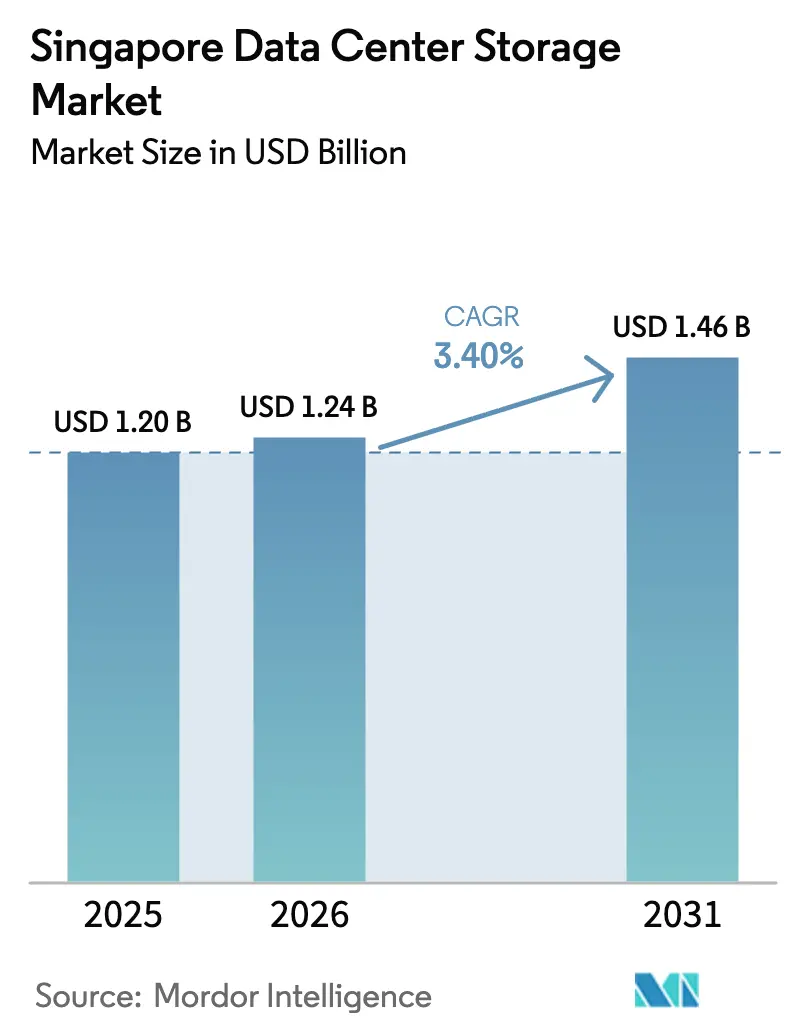
| Base Year Market Size (2025) | USD 1.20 Billion |
| Market Size (2026) | USD 1.24 Billion |
| Market Size (2031) | USD 1.46 Billion |
| Growth Rate (2026 - 2031) | 3.40 % |
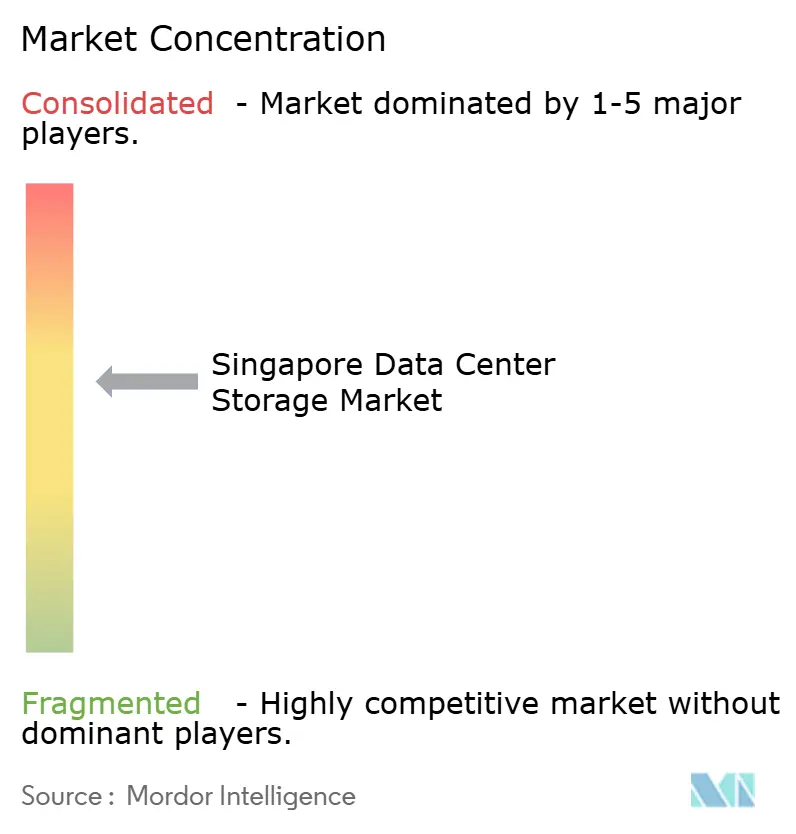
| Market Concentration | Medium |
Major Players *Disclaimer: Major Players sorted in no particular order Image © Mordor Intelligence. Reuse requires attribution under CC BY 4.0. | |
Singapore Data Center Storage Market Analysis by Mordor Intelligence
Singapore data center storage market size in 2026 is estimated at USD 1.24 billion, growing from 2025 value of USD 1.20 billion with 2031 projections showing USD 1.46 billion, growing at 3.40% CAGR over 2026-2031. The measured pace stems from a policy shift that rewards energy-efficient capacity rather than sheer floor space, tying new power allocations to strict sustainability metrics [1]. Heightened AI adoption is accelerating demand for low-latency flash arrays, while recent data-sovereignty rules push enterprises toward storage architectures with granular governance controls. [2] Cross-border expansion into the Johor-Singapore Special Economic Zone eases land constraints yet adds complexity in compliance and operations. Meanwhile, the rising carbon tax, set to hit SGD 50-80 per tonne by 2030, is fast-tracking the move from HDD to all-flash storage that can cut power draw by as much as 85%
Key Report Takeaways
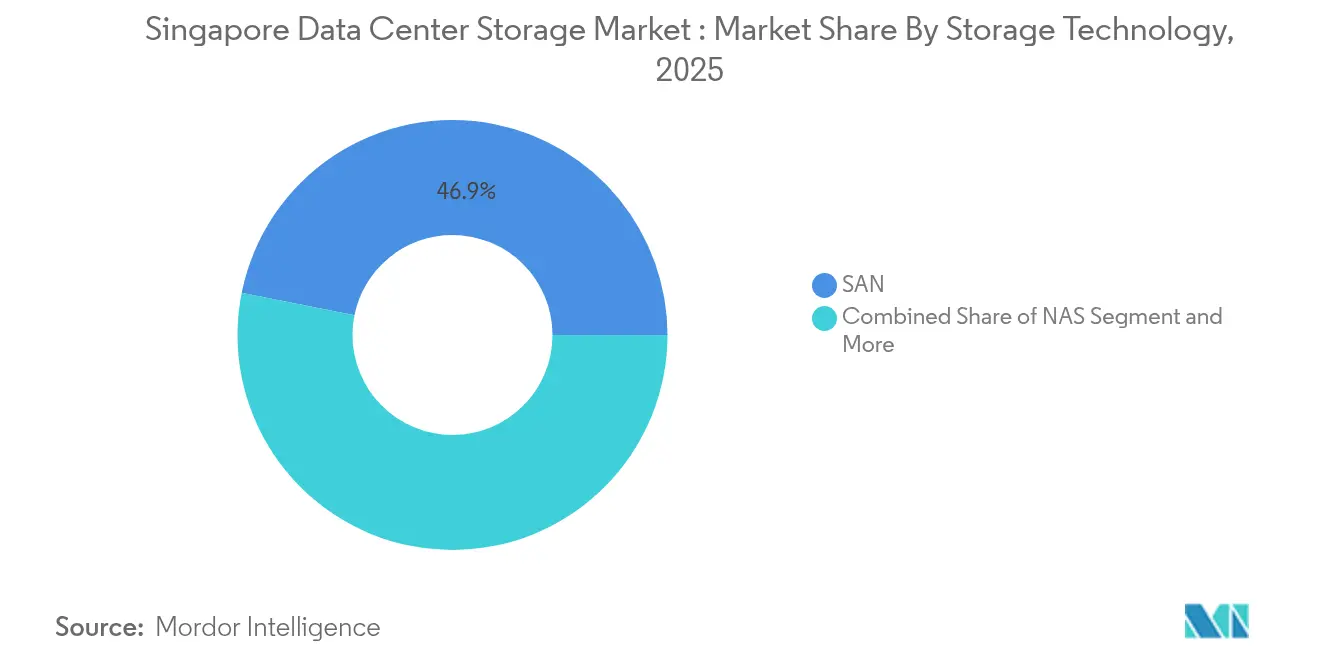
- By storage technology, the SAN segment held 46.85% of the Singapore data center storage market share in 2025, while NAS is projected to expand at a 5.12% CAGR to 2031.
- By storage type, traditional HDD arrays accounted for 39.55% share of the Singapore data center storage market size in 2025 and all-flash arrays are advancing at a 6.54% CAGR through 2031.
- By data-center type, hyperscalers and cloud service providers led with 62.95% revenue share in 2025; the segment records the highest forecast CAGR at 8.05% to 2031.
- By end user, IT & telecommunications captured 38.76% share of the Singapore data center storage market size in 2025, while healthcare and life sciences show the fastest growth at 6.18% CAGR through 2031.
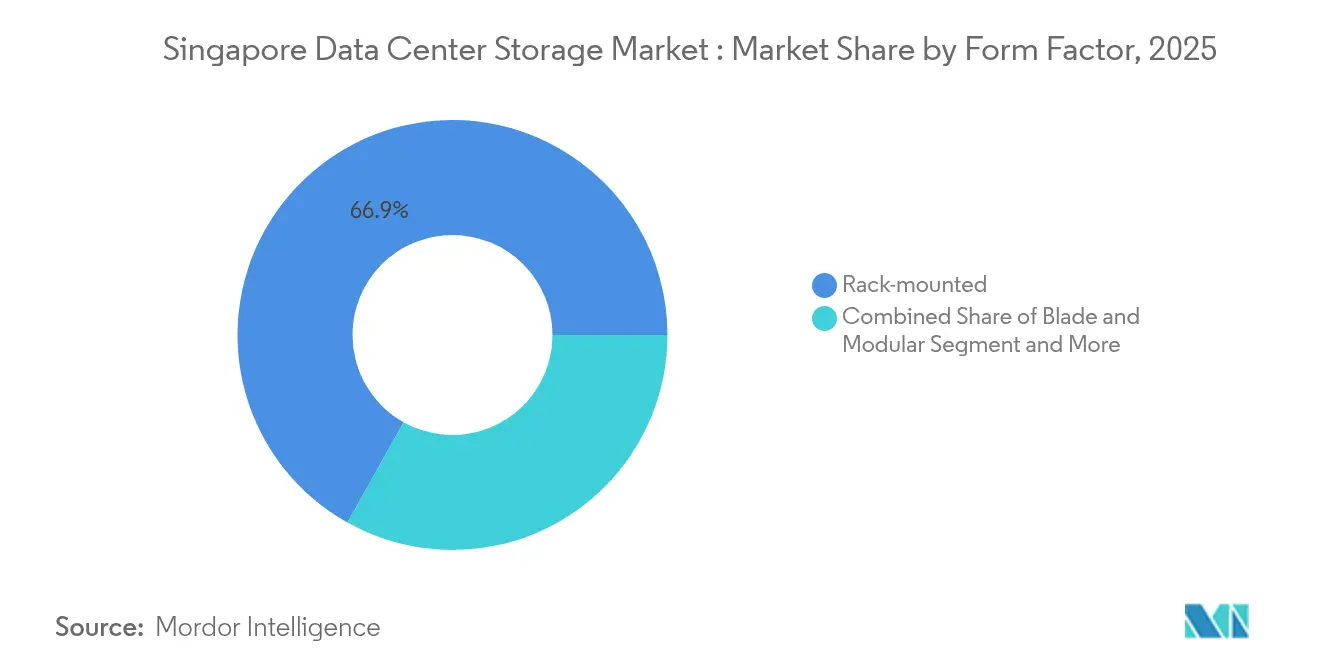
- By form factor, rack-mounted systems commanded 66.88% of the Singapore data center storage market share in 2025; blade and modular systems are set to grow at 5.08% CAGR between 2026 and 2031.
- By interface, SAS/SATA retained 51.60% share in 2025, whereas NVMe is forecast to grow at 8.88% CAGR to 2031.
Note: Market size and forecast figures in this report are generated using Mordor Intelligence’s proprietary estimation framework, updated with the latest available data and insights as of 2026.
Singapore Data Center Storage Market Trends and Insights
Drivers Impact Analysis*
| Driver | (+) % Impact on CAGR Forecast | Geographic Relevance | Impact Timeline |
|---|---|---|---|
| Green DC power allocation unlocks flash-storage capex | +0.7% | Singapore, spillover to Johor | Medium term (2-4 years) |
| AI build-outs demand ultra-low-latency NVMe arrays | +0.5% | Global, focus on Singapore | Short term (≤ 2 years) |
| Data-sovereignty rules under PDPA | +0.4% | Singapore | Medium term (2-4 years) |
| Expansion of cloud on-ramps | +0.6% | Singapore, Southeast Asia | Medium term (2-4 years) |
| Hyperscale investment pipeline | +0.4% | Singapore | Short term (≤ 2 years) |
| Johor-Singapore SEZ modular pods | +0.4% | Border region | Long term (≥ 4 years) |
| Source: Mordor Intelligence | |||
Government “Green DC” Power-Allocation Drives Flash Storage Adoption
Singapore earmarked 300 MW of new capacity, with 200 MW ring-fenced for operators using renewable energy, nudging buyers toward low-power all-flash arrays that fit within a strict 1.3 PUE threshold. Operators report up to an 85% power reduction versus HDD and significantly smaller rack footprints. A recent ministry refresh trimmed floor area by 94% after deploying Pure Storage systems, underscoring how policy catalyzes technology. The same policy grants early adopters preferential power allocation, creating a competitive edge that accelerates flash demand across the Singapore data center storage market.
AI Workloads Demand NVMe Performance Capabilities
Generative-AI models strain classical storage designs; NVMe’s parallel queues eliminate latency bottlenecks vital for high-volume GPU clusters. Kioxia’s 122.88 TB enterprise SSD and Micron’s 6500 ION series each raise throughput while curbing rack power use. These performance gains shorten AI training cycles, prompting cloud providers to specify NVMe as a standard for new capacity in the Singapore data center storage market.
Data Sovereignty Rules Reshape Storage Architectures
March 2024 amendments to the PDPA lay out explicit pathways—consent, business improvement, research, and anonymization—for AI use of personal data. Enterprises now invest in multi-tier encryption, audit trails, and region-pinning features that prove compliance in audits. Google Cloud’s MTCS-certified regions and similar offerings illustrate how sovereign controls now influence vendor selection in the Singapore data center storage market.
Expansion of IT Infrastructure and Cloud On-ramps
Fresh on-ramps from AWS, Microsoft, and Google extend low-latency connections across Southeast Asia, making Singapore the default hub for cross-border traffic. This traffic consolidation lifts demand for shared storage pools with dynamic scaling, deepening the value proposition of SAN and NAS systems with automated tiering.
Restraints Impact Analysis*
| Restraint | (≈) % Impact on CAGR Forecast | Geographic Relevance | Impact Timeline |
|---|---|---|---|
| High upfront capex of enterprise-grade storage | −0.8% | Singapore | Short term (≤ 2 years) |
| Land-and-power scarcity | −0.3% | Singapore | Long term (≥ 4 years) |
| SSD controller supply-chain volatility | −0.4% | Global, affects Singapore | Medium term (2-4 years) |
| Rising carbon-tax / ESG compliance costs | −0.3% | Singapore | Long term (≥ 4 years) |
| Source: Mordor Intelligence | |||
High Upfront Capex Creates Adoption Barriers
All-flash arrays still cost 2-3x more at purchase than HDD systems, straining budgets for mid-market firms Additional costs arise from power upgrades and cooling retrofits, extending payback periods. Storage-as-a-service models partly offset capex but can introduce sovereignty concerns for regulated workloads, tempering growth in the Singapore data center storage market.
Land and Power Constraints Persist Despite Policy Changes
Island land scarcity and premium real-estate prices cap large-footprint builds even after the moratorium lift. AI racks also require higher power density, pushing total demand beyond the 300 MW allocation. This constraint nudges operators toward Johor builds but adds cross-border governance overhead, moderating expansion of the Singapore data center storage market.
*Our forecasts treat driver/restraint impacts as directional, not additive. The impact forecasts reflect baseline growth, mix effects, and variable interactions.
Segment Analysis
By Storage Technology: SAN Retains Core Workloads
Storage Area Networks captured 46.85% share in 2025, reflecting their position as the performance backbone for financial and telco applications that demand low-latency block storage. NAS, scaling at 5.12% CAGR, is taking on collaborative workloads and edge ingestion use cases where flexible file protocols matter. The Singapore data center storage market continues to blend both technologies in hybrid estates that add object storage tiers for long-term archives. Vendor roadmaps increasingly offer unified management layers, allowing operators to shift datasets between SAN and NAS without downtime.
At the same time, disaggregated memory architectures outlined in US Patent US10917321B2 create an emerging option that separates compute from storage to optimize resource use patents.google.com. Early proofs suggest improved utilization rates that reduce stranded capacity, a compelling benefit as carbon-based cost pressures intensify across the Singapore data center storage market.

By Storage Type: Flash Gains at the Expense of HDD
Traditional HDD arrays still hold 39.55% share in 2025, yet all-flash arrays rise the fastest at 6.54% CAGR. The switch is driven by tangible performance gains—sub-millisecond latency and higher IOPS—that directly improve AI and analytics workloads. The Singapore data center storage market size for all-flash arrays is projected to reach USD xx million (undisclosed) by 2031, reflecting both falling media costs and rising energy prices that favor flash’s lower watt-per-IO profile.
Public-sector projects illustrate flash economics vividly: a ministerial deployment reduced rack space by 94% and cut energy bills in half. Flash density roadmaps that promise 150 TB and 300 TB drives by 2026 will only hasten HDD retirement, though hybrid systems remain in play for tier-2 workloads through the mid-term horizon of the Singapore data center storage market.
By Data Center Type: Hyperscalers Lead Build-Outs
Hyperscalers and cloud service providers controlled 62.95% of capacity in 2025 and are expanding at an 8.05% CAGR to 2031. Investments such as Equinix SG6 and Digital Realty’s upcoming campuses showcase purpose-built halls with liquid cooling and AI-optimized power trunks. Colocation operators cater to hybrid enterprise requirements, while edge micro-sites emerge around transport hubs to shave latency for real-time apps. The Singapore data center storage market benefits from the hyperscaler ecosystem by absorbing procurement volume, which drives down flash pricing for smaller buyers.
Edge and enterprise facilities still matter for data sovereignty. Banks and healthcare providers routinely split workloads across on-premises hardware and colocation racks to satisfy residency mandates, reinforcing a multi-tier structure that underpins the broader Singapore data center storage market.
By End User: Healthcare Accelerates Digital Uptake
IT and telecommunications held 38.76% revenue in 2025 on the back of 5G and SaaS growth. Healthcare and life sciences, the fastest mover at 6.18% CAGR, require high-throughput storage for imaging and genomics processing. Compliance-ready colocation sites like Iron Mountain SIN-1 attract hospitals that need audited environments . Government agencies continue to modernize infrastructure guided by the Green Data Centre Roadmap, often setting sustainability benchmarks later adopted by private firms participating in the Singapore data center storage market.
Media, entertainment, and manufacturing add further diversity with bursty content workloads and factory-floor analytics respectively. Vendors now position software-defined storage bundles tuned to vertical needs, a sign of maturing segmentation within the Singapore data center storage industry.
By Form Factor: Blades Pack More Terabytes per Rack
Rack systems own 66.88% share owing to their plug-and-play nature. Blades and modular designs, climbing at 5.08% CAGR, shrink overhead cabling and share power supplies, making them attractive where floor space is scarce. The Singapore data center storage market size for blade systems is projected to rise in tandem with liquid-cooling adoption that allows denser compute nodes per enclosure.
Composable architectures let operators spin up storage pools on demand, aligning with AI bursts without locking capital into static racks. As carbon taxation tightens, form factors that maximize watts-to-IO ratios gain preference across the Singapore data center storage market.
By Interface: NVMe Becomes the De-Facto Default
SAS/SATA still connect over half of installed drives, yet NVMe races ahead at 8.88% CAGR thanks to its direct PCIe pathway and rich parallelism. Micron’s 200-layer SSD line proves performance gains of 34% lower read latency, translating into faster model convergence for AI workloads. NVMe-over-Fabrics extends these benefits across Ethernet fabrics, cutting latency penalties associated with network hops.
Enterprises in the Singapore data center storage market increasingly specify NVMe for new deployments, planning phased migrations that retire SAS/SATA shelves as warranties expire. Fibre Channel retains a niche in mission-critical banking systems where deterministic throughput matters, preserving interface diversity through this forecast window.
Geography Analysis
Singapore hosts 87 active data centers with 1,026 MW of installed power, the largest cluster in Southeast Asia. A national roadmap adds 300 MW yet ties allocations to efficiency metrics, spurring innovations in liquid cooling and renewables, including Keppel’s hydrogen-powered floating data-center concept. These innovations ripple through the Singapore data center storage market by prioritizing low-power flash arrays and advanced management software able to throttle idle disks.
The Johor-Singapore Special Economic Zone supplements land and energy supply without diluting Singapore’s connectivity advantage. NTT DATA’s 290 MW Johor campus will feed Singapore workloads via mesh fiber routes, effectively expanding the Singapore data center storage market size beyond national borders. Tax incentives—5% corporate rate for strategic sectors—further encourage operators to adopt a dual-site topology where compliance-sensitive data resides in Singapore and overflow or test environments sit across the border.
Across Asia-Pacific, demand for AI-ready racks is outstripping supply by an estimated 15-25 GW through 2028. Malaysia expects 72% growth in its data-center sector by 2028 with MYR 17 billion in Johor investments. This regional surge positions Singapore as command center and compliance anchor for multinationals, sustaining throughput to the Singapore data center storage market even when some compute shifts overseas.
Regulatory Landscape
Singapore’s data center storage buying environment is shaped by energy-efficiency gating and data governance obligations. IMDA’s Green Data Centre Roadmap and related frameworks such as the Green Data Centre Standard, together with the BCA-IMDA Green Mark for Data Centres (GMDC) certification tiers (Gold, GoldPLUS, Platinum), support procurement moves toward lower-power storage architectures that help operators meet sustainability targets. Capacity release mechanisms such as the Data Centre Call for Application (DC-CFA) link new development approvals to efficiency and economic-value criteria, raising the weight of storage density, automated tiering, and power-aware data management in tender specifications.
On the resilience and compliance side, the Ministry of Digital Development and Information (MDDI) and IMDA opened a public consultation for a draft Digital Infrastructure Bill that sets baseline environmental sustainability requirements for data center operators meeting a Critical IT Load threshold (3 MW or greater). In parallel, PDPA-driven expectations for responsible data use (including AI-related guidance referenced in the report context) continue to steer enterprises toward storage platforms with encryption, audit trails, and workload-level governance, which increases demand for enterprise arrays and software layers that can evidence controls during audits.
Value Chain Analysis
The Singapore data center storage value chain starts with global storage OEMs and component ecosystems (controllers, NAND media, NICs, HBAs, and software stacks) and moves through local distribution, systems integrators, and colocation and hyperscale operators that place recurring orders for arrays, servers, and networking. Demand-side influence comes from hyperscalers and cloud service providers, colocation providers, and regulated enterprises (BFSI, healthcare, government), which shape solution design around high-availability architectures, multi-site replication, and governance features aligned with PDPA and critical infrastructure requirements.
Execution and operations are supported by services that include engineering, build, and modularization specialists, plus logistics providers. Examples visible across the ecosystem include Pro-Matrix and ASTI for M&E and facility engineering, EPG Modular Data Center for prefabricated and modular infrastructure approaches that shorten deployment cycles, and DHL for end-to-end data center logistics and supply-chain handling. Energy and sustainability partnerships are increasingly embedded in delivery models, illustrated by DayOne’s 10-year power purchase agreement with Sembcorp Power for renewable supply at its 20 MW facility. R&D collaboration such as DayOne with the National University of Singapore on the Sustainable Tropical Data Center Testbed (STDCT 2.0) is also feeding cooling and operating-condition learnings back into storage density and thermal envelope decisions.
Competitive Landscape
Established vendors Dell Technologies, HPE, and NetApp maintain deep channel presence, yet flash-first specialists and cloud-native services are reshaping buyer preferences. Pure Storage, through its NCS alliance, won a landmark public-sector deal that cut floor space by 94% while boosting AI performance . That reference account spurred private-sector interest and intensified competition in the Singapore data center storage market.
Traditional players respond by expanding all-flash portfolios and embedding software layers that unify block, file, and object services. NetApp’s 2025 roadmap stresses data fabric capabilities that move datasets seamlessly between SAN, NAS, and public-cloud bucket. Cloud operators leverage in-house silicon and global scale, bundling storage with AI accelerators and managed services that sidestep on-premises capex.
White-space opportunities exist in disaggregated memory architectures and cross-border data-replication tools optimized for the Johor-Singapore corridor. Patent activity around compute-memory separation underscores a shift toward resource-pooling that aligns with sustainability objectives in the Singapore data center storage market.
Regulation acts as both hurdle and differentiator. The Digital Infrastructure Act designates data centers critical infrastructure, requiring advanced resilience layers, multi-site failover, and audited supply chains. Vendors able to embed encryption, automated recovery, and power-efficiency reporting at platform level win mindshare, tightening the link between compliance and product design.
Singapore Data Center Storage Industry Leaders
-
Dell Technologies
-
Hewlett Packard Enterprise
-
NetApp
-
Huawei Technologies
-
Pure Storage
- *Disclaimer: Major Players sorted in no particular order
Market Opportunities and Future Outlook
Singapore’s allocation of new, efficiency-qualified data center capacity creates whitespace for storage platforms that deliver higher performance per watt and verifiable governance. National programs and standards, including IMDA’s Green Data Centre Roadmap, the Green Data Centre Standard, and BCA-IMDA GMDC certification, push operators to treat storage refresh cycles as an energy optimization lever. This emphasis favors all-flash arrays, NVMe, and policy-driven tiering that can reduce rack footprint and cooling load while maintaining enterprise-grade resilience.
Near-term opportunity is reinforced by expansion and investment activity that increases the installed base of facilities requiring primary and secondary storage. A 700 MW data center park planned for Jurong Island is positioned as a large low-carbon project, while Digital Realty has publicly committed S$7 billion in investment to Singapore, including S$4.3 billion earmarked for new data center developments. DayOne also broke ground on a 20 MW Singapore data center in 2025, with service scheduled for 2026, adding another demand node for high-density arrays, backup and replication software, and operational tooling that maps storage utilization to sustainability and compliance reporting needs.
Recent Industry Developments
- June 2026: Hewlett Packard Enterprise (HPE) integrated Alletra Storage MP X10000 with Private Cloud AI to apply automated policies for governance and metadata. The upgrade strengthens HPE's position in AI-ready storage for Singapore deployments.
- May 2026: Hewlett Packard Enterprise (HPE) updated Alletra Storage MP X10000 platform to 16 nodes and 23PB with RDMA-accelerated file workloads. The scale expansion targets AI data pipelines in Singapore data centers.
- May 2026: Hewlett Packard Enterprise (HPE) expanded Alletra Storage MP B10000 to six controller nodes achieving approximately 50 percent performance uplift. The performance boost supports enterprise storage demand in Singapore data centers.
Research Methodology Framework and Report Scope
Market Definition and Coverage
For this report, the market covers revenue generated from storage hardware and related systems deployed inside Singapore-based data centers to store, protect, and retrieve digital workloads, including enterprise and cloud-driven environments.
Scope exclusions: We exclude general data center construction and fit-out spending, pure networking equipment, and software-only services that are not directly tied to data center storage systems.
Segmentation Overview
- By Storage Technology
- Network Attached Storage (NAS)
- Storage Area Network (SAN)
- Direct Attached Storage (DAS)
- Object and Tape Storage
- By Storage Type
- Traditional HDD Arrays
- All-Flash Arrays (AFA)
- Hybrid Storage
- By Data Center Type
- Hyperscalers/Cloud Service Provider
- Colocation Facilities
- Enterprise and Edge
- By End User
- IT and Telecommunication
- BFSI
- Government and Public Sector
- Media and Entertainment
- Healthcare and Life Sciences
- Manufacturing
- By Form Factor
- Rack-mounted
- Blade and Modular
- Disaggregated / Composable
- By Interface
- SAS / SATA
- NVMe
- Fibre Channel and iSCSI
Data Sources, Market Sizing, and Validation
Desk Research
Desk research was used to set a realistic demand backdrop for Singapore data centers, and then connect that demand to storage adoption. We reviewed public datasets and official releases such as IMDA publications, MAS macro indicators, Energy Market Authority electricity statistics, the Personal Data Protection Commission guidance, and Infocomm Media Development Authority related updates where relevant to data localization and governance.
We also used company filings, investor presentations, reputable press coverage, and data center operator updates to cross-check deployment timelines and the pace of capacity additions. Where gaps existed on revenue mix and product pricing direction, we supplemented with paid subscriptions that consolidate company financials and news, plus patent databases to sanity-check technology shifts over time. This desk-research list is illustrative only, and many other sources were used for data collection, validation, and clarification.
Primary Interviews and Surveys
Primary work was used to pressure-test the desk view and convert it into usable sizing inputs such as storage refresh cycles, typical configurations by workload, and realistic pricing erosion assumptions. We spoke with a spread of stakeholders including data center operators, storage and integration partners, and enterprise buyers across regulated and digital-native sectors, and then used follow-ups to resolve mismatches that showed up in the model.
Distribution of primary research fieldwork respondents
| Company type | Respondent position |
|---|---|
| Top tier: 36% | CXOs: 12% |
| Mid tier: 47% | Functional/Unit leaders: 41% |
| Smaller Players: 17% | Managers: 47% |
Market-Sizing & Forecasting
Sizing started from a top-down demand reconstruction that links Singapore data center capacity additions and utilization patterns to storage intensity by workload, and then translates that into annual spending using observed pricing direction. To keep the output grounded, we backed it with selective bottom-up checks like sampled configuration builds (ASP multiplied by estimated units), channel feedback on mix shifts, and cross-checks against supplier and integrator revenue exposure.
Key inputs that were used, as examples, include the pace of capacity commissioning in Singapore, workload mix changes (including AI and latency-sensitive use cases), storage technology shifts between flash and HDD, refresh and warranty cycles, and typical interface and form-factor preferences inside data centers. Forecasting relied on scenario analysis supported by expert consensus, since policy and power-allocation choices can move timing, and then the scenarios were narrowed using what buyers and operators said they can realistically deploy. Where direct bottom-up detail was thin, gaps were handled through range-based assumptions that were later tightened through primary callbacks and consistency checks across the full time series.
Data Validation & Update Cycle
Model outputs were triangulated against independent signals, and variances were investigated before finalization, especially when the implied spend per installed capacity moved outside expected bands. Checks were also run for year-on-year jumps that did not match known commissioning schedules, pricing trends, or refresh-cycle logic, and then the inputs were adjusted only when corroborated by multiple sources.
Each estimate went through multi-step analyst review, followed by targeted re-contacts when a key assumption moved or when new disclosures created a mismatch. Reports are refreshed annually, with interim updates for material events that can affect demand, pricing, or deployment timing. Before delivery, a final analyst pass is completed so the numbers reflect the latest validated view.
Mordor Intelligence's Singapore Data Center Storage Market Size Compared With Other Published Estimates
Published market sizes for Singapore data center storage can differ even when they appear to talk about the same topic, because the scope lines and the conversion from capacity signals into revenue can be handled differently. Differences usually come from what is counted as storage spend, how pricing erosion is applied, and how quickly new data center capacity is assumed to turn into shipped and installed storage.
The main gap comes from whether adjacent categories like cloud storage services and software-defined layers are bundled into the total, and how aggressively growth is projected during policy-driven supply constraints, and then Mordor Intelligence counts only data center storage systems revenue inside Singapore and applies refresh-cycle and technology-mix checks before locking ASP paths.
Benchmark comparison
| Source | Market Size | Gaps in Research Methodology |
|---|---|---|
| Mordor Intelligence | USD 1.20 B (2025) | |
| Trade Publisher A | USD 1.16 B (2025) | Uses a different base year treatment and can undercount enterprise-owned deployments by leaning more on reported colocation capacity, which can lag actual storage refresh activity. |
| Industry Portal B | USD 1.28 B (2026) | Often blends storage systems with broader data center infrastructure spend and applies a more optimistic adoption curve for flash and AI-driven upgrades, which lifts near-term revenue. |
The table highlights that a large portion of the spread comes from scope choices and the timing assumptions behind capacity-to-spend conversion. By anchoring the inputs to commissioning pace, refresh cycles, and realistic pricing movement, the final number remains traceable and can be repeated with the same steps when new data points emerge.
Key Questions Answered in the Report
What is the forecast growth rate for the Singapore data center storage market?
The market is projected to grow at a 3.40% CAGR from USD 1.24 billion in 2026 to USD 1.46 billion in 2031.
Which segment holds the largest share in the Singapore data center storage market?
Hyperscalers and cloud service providers lead with 62.95% revenue share in 2025, reflecting strong investment pipelines.
Why are all-flash arrays gaining momentum in Singapore?
Flash delivers lower latency and higher IOPS while consuming up to 85% less power than HDD, aligning with carbon-tax pressures and Green DC mandates.
How do new PDPA rules affect storage buying decisions?
Stricter data-sovereignty requirements drive adoption of architectures with encryption, audit trails, and regional data-residency controls.
- Data Center Power Market Power systems across all regions, split by component, tier and facility size.
- Data Center Server Market Servers across the global market, covering tier, facility size and facility type.
- Data Center Construction Market Global construction demand, split by tier, facility size and facility type.
- South America Data Center SSD Market SSDs in South America, split by form factor, interface and nand technology.
- Middle East Data Center Server Market The Middle East's servers, split by facility size and tier.
- APAC Green Data Center Market Energy efficiency demand across Asia-Pacific, covering component, facility type and tier.
- United States Data Center SSD Market The US's SSDs, split by form factor, interface and nand technology.
- Africa Data Center SSD Market SSDs in Africa, split by form factor, interface and nand technology.
- China Data Center SSD Market SSDs demand across China, covering form factor, interface and nand technology.
- Europe Data Center SSD Market SSDs in Europe, split by form factor, interface and nand technology.