
Market Overview
| Study Period | 2020 - 2031 |
|---|---|
| Forecast Data Period | 2026 - 2031 |
| Base Year Market Size (2025) | USD 2.65 Billion |
| Market Size (2026) | USD 3.07 Billion |
| Market Size (2031) | USD 6.41 Billion |
| Growth Rate (2026 - 2031) | 15.86 % |
| Market Concentration | Medium |
Major Players *Disclaimer: Major Players sorted in no particular order Image © Mordor Intelligence. Reuse requires attribution under CC BY 4.0. | |
Singapore Cybersecurity Market Analysis by Mordor Intelligence
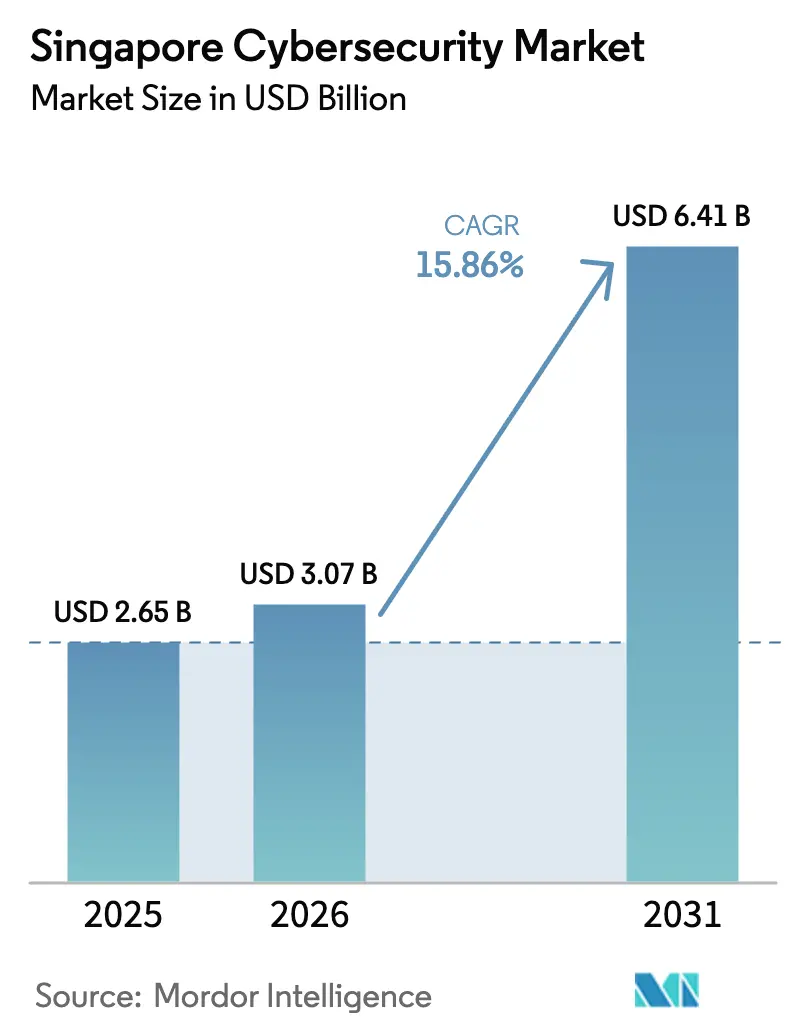
Singapore Cybersecurity market size in 2026 is estimated at USD 3.07 billion, growing from 2025 value of USD 2.65 billion with 2031 projections showing USD 6.41 billion, growing at 15.86% CAGR over 2026-2031 and confirming the city-state’s status as Southeast Asia’s digital command center[1]. Corporate boards attribute the growth to elevated threat volumes—cybercrime already formed 49.2% of all offences logged in 2023—and to the rising density of hyperscale data-center investments that surpassed 1.4 GW of active or committed IT load by mid-2024. Procurement teams now judge offerings on delivered risk reduction rather than feature counts, with 67% of large enterprises insisting on key-risk indicators in 2024 contracts. A pronounced shift toward converged IT-OT defence reflects automated port terminals and smart factories that prefer one security control plane over siloed stacks. Zero-trust policies, mandated across critical infrastructure, have already trimmed unauthorized-privilege cases at banks by 42% since mid-2023.
Key Report Takeaways
- By offering, Services held a 59.60% Singapore Cybersecurity market share in 2025, while cloud security solutions are poised to deliver a 15.52% CAGR to 2031.
- By deployment mode, On-premises retained 54.30% share of the Singapore Cybersecurity market size in 2025; cloud deployments are forecast to expand at a 16.93% CAGR through 2031.
- By end-user enterprise size, large enterprises commanded 77.60% of spending in 2025; SME demand is set for an 18.09% CAGR over the forecast horizon.
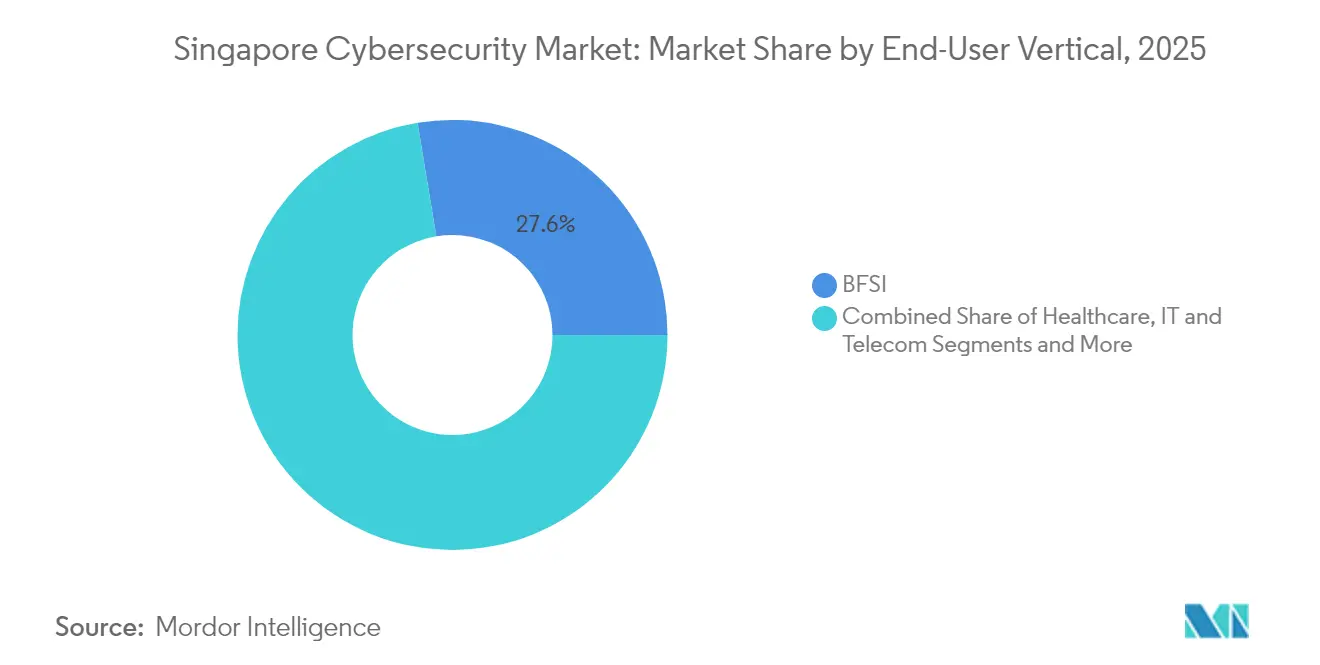
- By end-user vertical, BFSI led with 27.60% revenue share of the Singapore Cybersecurity market size in 2025, whereas healthcare spending is projected to grow at 18.74% CAGR.
Note: Market size and forecast figures in this report are generated using Mordor Intelligence’s proprietary estimation framework, updated with the latest available data and insights as of 2026.
Singapore Cybersecurity Market Trends and Insights
Drivers Impact Analysis*
| Driver | (~) % Impact on CAGR Forecast | Geographic Relevance | Impact Timeline |
|---|---|---|---|
| Nationwide zero-trust architecture mandates | +3.2% | National, finance and government | Medium term (2-4 years) |
| Accelerated digital-bank licenses | +2.8% | Financial district | Short term (≤ 2 years) |
| SGX-listed firms’ disclosure rules | +1.5% | CBD | Short term (≤ 2 years) |
| Heightened OT-security demand | +2.5% | Western Singapore | Medium term (2-4 years) |
| Roll-out of 5G standalone networks | +1.8% | National | Medium term (2-4 years) |
| R&D tax-incentives | +1.2% | Innovation hubs | Long term (≥ 4 years) |
| Source: Mordor Intelligence | |||
Nationwide Zero-Trust Architecture Mandates from Government
Regulators now compel every critical information-infrastructure owner to file a zero-trust roadmap, and 96% had submitted plans by November 2024. Financial institutions responded by micro-segmenting traffic, cutting unauthorized-privilege cases by 42% within one year of go-live. Budget cycles allocate up to 28% of security outlays to identity analytics, underscoring demand for context-aware access controls. Streamlined multi-agency design reviews compressed policy-approval windows to 34 days, halving historical delays and allowing vendors to accelerate revenue recognition. Together, these moves place zero-trust enforcement at the heart of every major tender, giving suppliers that support adaptive trust scoring a decisive edge.
Accelerated Digital-Bank Licences Driving Next-Gen BFSI Security Spend
Digital full-bank licensees accumulated SGD 1.8 billion in deposits by end-2024, equal to 4% of Singapore’s retail savings pool. Each new entrant channelled roughly 22% of operating expenditure into cybersecurity during its first year, an intensity mirrored by incumbents whose resilience investments grew 36% to SGD 491 million in 2024. Pilot deployments of post-quantum cryptography already protect 12% of domestic interbank traffic. Competitive parity now hinges on rapid threat-intelligence ingestion and automated compliance evidence, redirecting budgets toward managed detection and response platforms rather than standalone appliances. The banking cluster’s early adoption curves ripple through payments, wealth management and capital-markets systems, magnifying total addressable demand for the Singapore Cybersecurity market.
SGX-Listed Firms’ Mandatory Cyber-Incident Disclosure Rules
The Singapore Exchange oversees 714 issuers worth SGD 776 billion and plans to enforce four-business-day cyber-incident notification, a pilot regime that surfaced 14 reportable events in 2024. Listed firms lifted spending on automated breach-impact assessment tools by 31% after the trial, shrinking board-notification lag to 20 hours. Faster, transparent disclosure reduces rumor-driven price swings and places quantitative integrity metrics on investor dashboards. Vendors offering validated forensic data pipelines and template-driven regulatory reports find accelerated decision cycles. Over time the rules institutionalize cybersecurity as an ESG checkpoint, anchoring recurring demand across 714 corporate budgets and reinforcing the Singapore Cybersecurity market.
Heightened OT-Security Demand from Tuas Mega-Port and Jurong Island Revamp
Phase 1 of Tuas Mega-Port processed 3 million TEUs in 2024, each crane and automated guided vehicle streaming up to 2 GB of telemetry per hour that requires round-the-clock OT-SOC coverage. Jurong Island hosts more than 100 petrochemical plants that contributed SGD 81 billion in manufacturing output during 2023, and 87% of new OT devices were certified to IEC 62443 by mid-2024. Operators prefer unified IT-OT control planes to handle both process safety and cyber threats, elevating demand for deep-packet inspection sensors tuned to proprietary protocols. Capital-project consortia now embed security clauses worth 2%–3% of total build cost, locking in multiyear run-rate for managed OT-incident response. These industrial deployments, clustered in western Singapore, materially boost service hours sold into the Singapore Cybersecurity market.
Restraints Impact Analysis*
| Restraint | (~) % Impact on CAGR Forecast | Geographic Relevance | Impact Timeline |
|---|---|---|---|
| Scarce CREST-certified talent | –2.5% | National | Medium term (2-4 years) |
| Fragmented SME market | –1.5% | Suburban parks | Short term (≤ 2 years) |
| Data-sovereignty clauses | –1.2% | National | Medium term (2-4 years) |
| High compliance overlap | –0.8% | Regulated industries | Short term (≤ 2 years) |
| Source: Mordor Intelligence | |||
Scarce Pool of CREST-Certified Talent Inflates Service Costs
Only 530 CREST-certified professionals operated locally in 2024 against demand for 1,200, equating to a 56% gap. Median senior-analyst pay climbed 14% to SGD 117,000, compressing margins for managed security service providers. MSSPs used automation to trim Tier-1 ticket volumes by 35%, yet many still absorb wage inflation by passing through higher seat-licence prices. Persistent scarcity delays large rollouts, elongating go-live timelines and dampening short-term revenue conversion. Unless training pipelines expand materially, talent supply will continue to limit the Singapore Cybersecurity market’s ability to scale at the forecast rate.
Fragmented SME Market Still Anchored on Legacy Antivirus
SMEs represent 99% of Singapore firms but 58% remain dependent on standalone antivirus, with only 21% adopting multi-factor authentication. Average security budgets seldom exceed SGD 10,000, making price the dominant buying criterion. Government subsidies such as the CISO-as-a-Service grant averaged SGD 18,500 yet reached only 350 projects in the first year. Low cyber-insurance penetration—12% of eligible policies in 2024—further blunts incentives to modernise. The volume of small, non-recurring deals raises customer-acquisition costs and constrains vendor margins, moderating growth of the Singapore Cybersecurity market among micro-enterprises.
*Our forecasts treat driver/restraint impacts as directional, not additive. The impact forecasts reflect baseline growth, mix effects, and variable interactions.
Segment Analysis
By Offering: Services Dominate While Cloud Security Accelerates
Services contributed 59.60% to the Singapore Cybersecurity market share in 2025, helped by managed security service revenues of SGD 2.3 billion. Average mean-time-to-detect dropped from eight hours in 2022 to two hours in 2024, proving the return on 24/7 monitoring investments. Providers that integrate cross-border threat-intelligence achieved 92% renewal, outpacing the sector median of 84%. Clients increasingly bundle insurance broking and incident-response retainers with monitoring, creating annuity-like revenue for MSSPs. These factors sustain robust double-digit expansion for the Singapore Cybersecurity market.
Cloud security is on track for a 15.52% CAGR through 2031, riding on 84% enterprise cloud-workload penetration. Updated MAS rules expanded mandatory control objectives from eight to 11, intensifying due-diligence cycles yet enlarging addressable spend. Vendors that pair posture management with auto-remediation now execute 37 policy updates per client each month, triple 2022 volumes. Consumption-based pricing fits well with rapid scale-out during peak e-commerce seasons. As a result, cloud-native solutions will continue to outpace appliance refreshes inside the Singapore Cybersecurity market.


By Deployment Mode: Cloud Momentum Gathers Even as On-Premise Leads
On-premise installations still held 54.30% of the Singapore Cybersecurity market share in 2025, with 71% of financial-sector databases co-located in trusted facilities. Tier-4 floor space reached 660,000 m², providing large banks and payment networks with latency-controlled environments. Hybrid forensics workflows lowered evidence-processing time by 27%, validating a staged migration path for regulated workloads. Accordingly, most incumbents continue to refresh perimeter hardware even while piloting cloud-first applications.
Cloud deployments promise a 16.93% CAGR, buoyed by an extra 300 MW of hyperscale IT load planned for 2025-2027. Operators meeting the Green Data Centre standard report PUE below 1.3, releasing energy budgets for in-rack security accelerators. New bulk-licence tariffs priced per CPU-second reduced monthly invoice volatility by 18%, easing CFO concerns. Faster provisioning times allow startups to activate SOC infrastructure in hours rather than weeks. These advantages will keep cloud adoption at the forefront of the Singapore Cybersecurity market.
By End-User Vertical: Healthcare Emerges as High-Growth Challenger to BFSI
BFSI retained the largest Singapore Cybersecurity market share at 27.60% in 2025, having executed 4,712 cyber drill scenarios during the year . Synthetic-transaction monitoring sliced fraud losses by SGD 14 million, breaking a multi-year surge. Immutable backups now cover 82% of banks, insuring rapid recovery under adverse conditions. Vendor selection criteria prioritize zero-downtime upgrades and audited crypto-modules, prolonging refresh cycles yet enlarging per-node spend. BFSI therefore remains an anchor tenant for the Singapore Cybersecurity market.
Healthcare exhibits a 18.74% CAGR outlook, having logged 4.3 million digital hospital visits in 2024 —double 2022 volume. Farrer Park Hospital’s AI-powered SOC cut mean-time-to-respond to 12 minutes compared with a national average of 46 minutes. Medical-device vulnerability disclosures grew 28%, signaling proactive risk management as tele-ICUs proliferate. Cloud-native data-loss-prevention suites and secure-API gateways rise in priority as hospitals unify electronic medical records. Consequently, healthcare is set to be the fastest-growing vertical inside the Singapore Cybersecurity market.
By End-User Enterprise Size: Enterprise Dominance Persists While SME Uptake Quickens
Large enterprises commanded 77.60% of the Singapore Cybersecurity market size in 2025, with SGX-listed issuers alone investing SGD 1.96 billion in security capital and operating expenditure. Board reports now integrate cyber resilience into ESG dashboards for 63% of issuers, up from 38% three years earlier. Secure-by-design hardware purchases shrank end-of-life e-waste by 12%, an ancillary sustainability gain that resonates with investors. With regulators tightening benchmarks annually, large-cap spending shows little elasticity, undergirding baseline growth for the Singapore Cybersecurity market.
SME budgets are still modest but are expanding at an 18.09% CAGR thanks to IMDA’s CTO-as-a-Service programme that enrolled 1,600 subscribers by Q4 2024. Browser-based dashboards now cut initial configuration to 3.5 hours, replacing appliance rollouts that once took 18 hours. Cyber-insurance holders deploying multi-factor authentication filed 27% fewer ransomware claims, encouraging insurers to offer premium rebates. Together, simplified user experiences and risk-transfer incentives make SMEs the next frontier of the Singapore Cybersecurity market.
Geography Analysis
Singapore’s central business district continues to anchor the Singapore Cybersecurity market, housing headquarters of more than 200 regional banks and insurers that together spend over SGD 1.2 billion on security each year. Mandatory four-day breach-disclosure rules at SGX-listed firms compressed remediation lead times, pushing managed detection demand higher in the CBD. High-density office towers also host distributed SOC centres that offer 24/7 coverage for ASEAN clients, concentrating skilled labour and premium colocation facilities.
Western Singapore, stretching from Tuas Port to Jurong Island, represents the fastest-expanding subregion. The port’s automated container terminals generate terabytes of OT telemetry that require protocol-aware intrusion detection, while petrochemical complexes on Jurong Island integrate IEC 62443-certified controllers. These projects favour suppliers that can certify both marine and process-safety environments, creating niche opportunities for OT-specialist MSSPs. Supporting infrastructure such as the JL-NTU Maritime AI lab further boosts pilot activity, deepening regional share of the Singapore Cybersecurity market.
Northern and eastern districts benefit from near-total 5G standalone coverage that attained 95% population reach in 2024. Edge-compute nodes collocated at suburban exchanges host low-latency security analytics for telemedicine, smart-transport and drone-delivery pilots. Community hospitals and polyclinics in the east now process fully digital EMR traffic, prompting incremental licensing of API-security gateways. Meanwhile, suburban innovation parks house many SMEs targeted by CTO-as-a-Service grants, raising micro-segmentation and email-security orders. Collectively these zones ensure balanced geographic demand across the Singapore Cybersecurity market.
Regulatory Landscape
Singapore’s cybersecurity regulatory backbone is led by the Cyber Security Agency of Singapore (CSA) under the Ministry of Digital Development and Information, and is anchored by the Cybersecurity Act (CA2018) and its subsequent updates. The Cybersecurity (Amendment) Act 2024 (passed May 2024) broadened the Commissioner of Cybersecurity’s oversight beyond traditional Critical Information Infrastructure (CII) to include new regulated categories such as Foundational Digital Infrastructure (FDI) service providers, Entities of Special Cybersecurity Interest (ESCI), and Systems of Temporary Cybersecurity Concern (STCCs), tightening supervisory reach across digital infrastructure and critical services.
On the standards and compliance side, CSA’s Cyber Trust Mark (CTM) is being institutionalized via SS 712 (Cyber Trust (2025)), creating a tiered certification framework that buyers can reference in tenders and use during supplier due diligence. CII owners face a CTM certification requirement by end-2027, and government procurement for vendors handling critical systems or sensitive government data increasingly anchors on meeting CTM-aligned requirements. This is reinforcing demand for auditability, risk assessment, and assurance-ready reporting in enterprise security programs.
Value Chain Analysis
The Singapore cybersecurity value chain is coordinated around CSA as the central regulator and ecosystem orchestrator, which shapes demand through legislation, codes of practice, and national programs that influence both public-sector procurement and regulated private-sector requirements. Upstream inputs include security software and platforms, network and endpoint hardware, OT and IoT device supply chains, and cloud service providers supporting regulated workloads, with assurance requirements increasingly tied to CSA-led schemes such as Cyber Trust Mark (SS 712).
Midstream, local and global vendors deliver solutions through direct sales and channel partners, then rely heavily on systems integrators, managed security service providers (MSSPs), and incident-response specialists to deploy, operate, and continuously improve controls for enterprises and critical sectors. Independent certification bodies appointed under CSA programs provide audits and assessments that translate technical controls into compliance artifacts for buyers. Downstream, end users in BFSI, government-linked entities, healthcare, and industrial clusters (including port and petrochemical operations) drive recurring spend on monitoring, identity, cloud posture management, and OT security, while government-backed ecosystem initiatives link academia (such as NUS and NTU) with industry to move applied research into commercialization and export pathways for Singapore-anchored cybersecurity offerings.
Competitive Landscape
Ensign InfoSecurity recorded SGD 281 million revenue in 2024, a 20% jump that lifted its customer-retention rate to 94%, well above the 86% industry median. Palo Alto Networks booked Asia-Pacific orders worth USD 1.36 billion, citing “high-double-digit millions” from Singapore as zero-trust deals closed ahead of regulatory deadlines. Local analytics start-up Seconize secured 68 paid government pilots through the Open Innovation Platform, spotlighting appetite for AI-native vulnerability scoring.
Strategic alliances shape the mid-tier: StarHub’s Cybersecurity Services arm reported SGD 104 million revenue, with 40% stemming from bundled 5G edge-security packages. The Singapore Manufacturing Federation recorded an 18% reduction in procurement lead-time for Industry 4.0 adopters using these telecom-plus-security bundles. Identity provider Okta enlarged its active local customer base by 47% to 310, driven by stricter MAS authentication guidance.
Price pressure remains intense in the SME segment where Check Point’s average bundle fell to USD 6,400 in 2024, 5% lower year on year. To defend margins MSSPs automated 62% of Tier-1 tasks, reallocating analysts toward consultancy upsells[3]. API-first security platforms report 33% integration-cost savings versus appliance models, a gap highlighted in Cisco’s 2024 Singapore Partner Economics paper. The combined moves underscore a healthy but competitive Singapore Cybersecurity market.
Singapore Cybersecurity Industry Leaders
-
Horangi Cyber Security
-
wizlynx Pte Ltd
-
Attila Cybertech Pte Ltd
-
Tech Security
-
Tenable Singapore
- *Disclaimer: Major Players sorted in no particular order

Market Opportunities and Future Outlook
Compliance-led assurance and measurable resilience create whitespace for vendors that package security outcomes into audit-ready artifacts and map to certification pathways. CSA’s Cyber Trust Mark (SS 712, Cyber Trust (2025)) provides a concrete alignment point for product and service providers, and the end-2027 CTM certification requirement for CII owners is expanding demand for assessment, remediation, continuous controls monitoring, and managed compliance evidence generation across regulated environments.
Capability building and new threat surfaces are also opening defined solution areas. The CyberSG TIG Collaboration Centre at LaunchPad at one-north and the CyberSG R&D Programme Office hosted by NTU provide infrastructure for talent development and commercialization of R&D, supporting locally built tools that can be deployed first in government and critical sectors before scaling into enterprise programs. In parallel, quantum-safe migration work such as the National Quantum Safe Network Plus (NQSN+) and adoption of post-quantum cryptography based on NIST standards elevate opportunities in crypto-agility, key management, and hybrid cryptographic migration services for banks and digital infrastructure operators. AI adoption programs, including the National AI Impact Programme targeting 10,000 local enterprises, further expand the need for AI-enabled security operations, model and data protection controls, and practitioner training tailored to AI-driven threat scenarios in CII sectors.
Recent Industry Developments
- July 2026: NSFOCUS appointed SiS Technologies Pte Ltd as a new distributor in Singapore to distribute its cybersecurity portfolio. The appointment expands NSFOCUS reach in Singapore and increases local go-to-market and channel coverage for its offerings in the country.
- June 2026: Gambit Cyber and BitCyber appointed BitCyber Pte Ltd as regional distributor for its KnightGuard platform across Singapore, ASEAN, and Hong Kong, with Gambit Cyber establishing a Singapore-based tenancy. The partnership sets up a Singapore-based hub that broadens access to KnightGuard across the region and deepens channel depth.
- February 2026: Acronis appointed Insightz Technology as its first certified managed security service provider partner in Singapore for Managed Detection and Response services. The designation expands local MDR delivery capabilities and customer coverage through a Singapore-based partner.
Research Methodology Framework and Report Scope
Market Definition and Coverage
This market covers spending in Singapore on cybersecurity solutions and services that prevent, detect, and respond to cyber threats across cloud and on-premise environments, as purchased by enterprises and public sector entities for their IT and connected operational assets.
Scope exclusions: We exclude standalone cyber insurance premiums, pure hardware-only networking refresh that is not security-led, and general IT consulting that does not have a defined cybersecurity deliverable.
Segmentation Overview
- By Offering
- Solutions
- Application Security
- Cloud Security
- Data Security
- Identity and Access Management
- Infrastructure Protection
- Integrated Risk Management
- Network Security Equipment
- Endpoint Security
- Other Services
- Services
- Professional Services
- Managed Services
- Solutions
- By Deployment Mode
- On-Premise
- Cloud
- By End-User Vertical
- BFSI
- Healthcare
- IT and Telecom
- Industrial and Defense
- Manufacturing
- Retail and E-commerce
- Energy and Utilities
- Others
- By End-User Enterprise Size
- Small and Medium Enterprises (SMEs)
- Large Enterprises
Data Sources, Market Sizing, and Validation
Desk Research
Desk research was used to set the boundaries of what counts as cybersecurity spending in Singapore and to build the first layer of demand signals we can cross-check later. We relied on public sources such as the Cyber Security Agency of Singapore advisories and landscape reports, the Infocomm Media Development Authority publications, and Department of Statistics Singapore releases for macro and sector baselines. We also referenced Monetary Authority of Singapore guidelines and notices where they drive security-related compliance spending, and we kept control categories consistent using global standards and threat references from ISO and NIST.
Once the scope was stable, we added corporate disclosures and market signals like annual reports, investor presentations, and reputable press coverage to identify budget drivers and buying cycles. In a few places, we used paid subscriptions for company financials and intelligence, news and financials, and patent databases to speed up verification of revenue exposure and technology focus, especially when local disclosure was limited. The sources named here are illustrative only, and many other references were also checked for data collection, validation, and clarification.
Primary Interviews and Surveys
Primary work focused on validating what Singapore buyers actually purchase, and how pricing and adoption are changing across regulated and non-regulated sectors. We spoke with a mix of solution and service providers, channel partners, and enterprise security leaders, then used those inputs to confirm adoption levels, typical contract structures, and the split between cloud and on-premise deployments. Because this is a country-level market, the fieldwork centered on Singapore, while also covering multinational operating models that influence local budgets.
Distribution of primary research fieldwork respondents
| Company type | Respondent position |
|---|---|
| Top tier: 39% | CXOs: 18% |
| Mid tier: 43% | Functional/Unit leaders: 39% |
| Smaller Players: 18% | Managers: 43% |
Market-Sizing & Forecasting
Sizing starts with a top-down build that reconstructs Singapore cybersecurity demand from the addressable enterprise and public sector spend pool, then allocates it using security intensity by vertical. We corroborate totals with selective bottom-up checks, such as sampling provider revenue exposure to Singapore, channel partner run-rate ranges, and simple volume-by-ASP sanity checks for common service bundles.
The model is shaped using market-specific inputs that can be tracked consistently year to year, including compliance-led spend in BFSI and critical infrastructure, the cloud workload shift that changes security architecture, managed security service penetration driven by talent constraints, incident and vulnerability reporting intensity that influences response budgets, and the timing of large enterprise refresh cycles for identity, endpoint, and network security. When a data point is missing, we use conservative ranges informed by interviews and narrow them through cross-checks against procurement patterns and public disclosures.
For forecasting, we use scenario analysis because cybersecurity budgets in Singapore can shift quickly after major incidents or policy changes. We then translate scenarios into annual values using trend smoothing aligned to buyer guidance from interviews. Assumptions on price progression and service attach rates are reviewed with practitioners so the growth profile does not depend on a single variable.
Data Validation & Update Cycle
Outputs are validated through triangulation across demand indicators, supplier-side signals, and the practical constraints buyers describe, with exceptions flagged for review. We run variance checks by vertical and by offering type to test any sudden step changes against known procurement cycles and policy timelines. Where the model deviates from multiple independent signals, analysts revisit inputs and, if needed, re-contact relevant respondents to confirm what changed.
The report is refreshed annually, and interim updates are triggered when material events occur, such as major regulatory actions, large breaches affecting spending, or step changes in cloud adoption. Before delivery, a final analyst pass is completed so clients receive the latest updated view.
Mordor Intelligence's Singapore Cybersecurity Market Estimate Compared With Other Published Estimates
Published cybersecurity market numbers for Singapore often look different because firms count different spending buckets and do not always align on the same base year and currency timing. Differences also come from how services are treated, especially managed security and incident response, which can be booked as recurring contracts or as one-time projects.
The benchmark table shows a spread that is largely explained by scope and booking assumptions. In Mordor Intelligence's model, only cybersecurity-specific solutions and services delivered into Singapore are counted, while adjacent IT outsourcing and broad digital transformation services are kept outside the total.
Benchmark comparison
| Source | Market Size | Gaps in Research Methodology |
|---|---|---|
| Mordor Intelligence | USD 2.65 B (2025) | |
| Industry Association A | USD 2.20 B (2025) | Often anchored to member-reported security spend, which can undercount smaller buyers and may exclude parts of managed security services delivered through partners. |
| Global Consultancy B | USD 3.40 B (2025) | May include broader risk, compliance, and IT resilience programs alongside security tools, and can apply higher assumed cloud security attach rates when converting from total IT spend. |
Taken together, the comparison suggests the lower figure is driven by narrower capture of services, while the higher figure is pushed up by folding in adjacent IT and risk programs. By keeping the scope tied to clearly defined cybersecurity purchases and then validating assumptions through repeatable demand signals and interview checks, the final estimate stays transparent and easier to reproduce.
Key Questions Answered in the Report
What is the current Singapore Cybersecurity market size and growth rate?
The Singapore Cybersecurity market size is USD 3.07 billion in 2026 and is forecast to reach USD 6.41 billion by 2031, reflecting a 15.86% CAGR.
Which industry segment spends the most on cybersecurity?
Banking, financial services and insurance accounts for 27.60% of total spending, driven by stringent MAS regulations and new digital-bank licences.
How extensive is 5G coverage in Singapore and why does it matter for security?
5G standalone networks cover 95% of the population, enabling low-latency services that require cloud-native security functions to protect micro-service cores.
How large is the local cybersecurity talent shortfall?
Singapore had 17,100 practitioners for 18,000 roles in 2024, with only 530 CREST-certified experts, leaving a 900-position gap.
Why are SMEs a rising opportunity in the Singapore Cybersecurity market?
Government grants and cyber-insurance incentives are lifting SME adoption, supporting an 18.09% CAGR in SME cybersecurity spending through 2031.