
Silicone Surfactant Market Size and Share
Market Overview
| Study Period | 2020 - 2031 |
|---|---|
| Market Size (2026) | USD 2.65 Billion |
| Market Size (2031) | USD 3.18 Billion |
| Growth Rate (2026 - 2031) | 3.76 % |
| Fastest Growing Market | Asia Pacific |
| Largest Market | Asia Pacific |
| Market Concentration | Medium |
Major Players *Disclaimer: Major Players sorted in no particular order Image © Mordor Intelligence. Reuse requires attribution under CC BY 4.0. | |
Silicone Surfactant Market Analysis by Mordor Intelligence
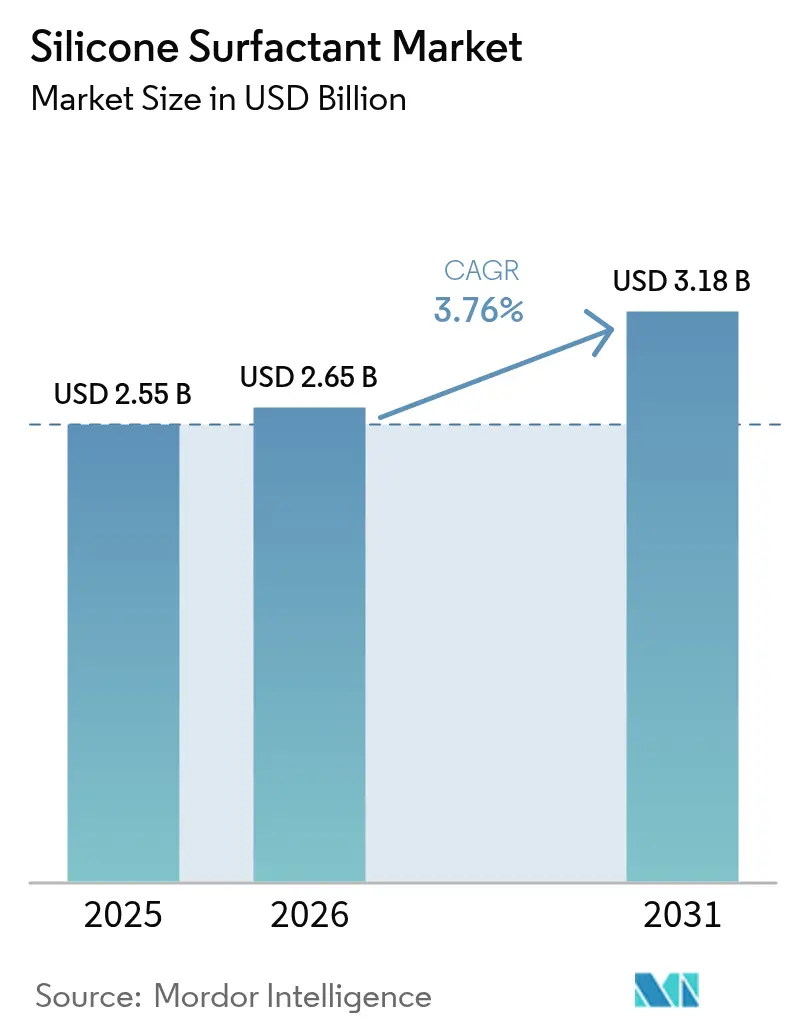
The Silicone Surfactant Market size was valued at USD 2.55 billion in 2025 and estimated to grow from USD 2.65 billion in 2026 to reach USD 3.18 billion by 2031, at a CAGR of 3.76% during the forecast period (2026-2031). Measured growth reflects a maturing landscape in which sustainable formulations, precision agriculture and advanced polyurethane foams become primary demand engines. End-user focus is shifting toward high-value, biodegradable chemistries that satisfy tightening global regulations on cyclosiloxanes and PFAS. Consolidation among vertically integrated producers is accelerating investment in renewable electricity and circular feedstocks, while medium-sized specialty suppliers target drone-ready agricultural adjuvants and PFAS-free textile finishes. Asia-Pacific remains the largest consumption hub thanks to expanding middle-class personal-care spending, growing polyurethane demand in construction and rapid textile wet-processing build-outs. North America and Europe influence the innovation agenda through strict chemical policies that reward bio-based silicone chemistries.
Key Report Takeaways
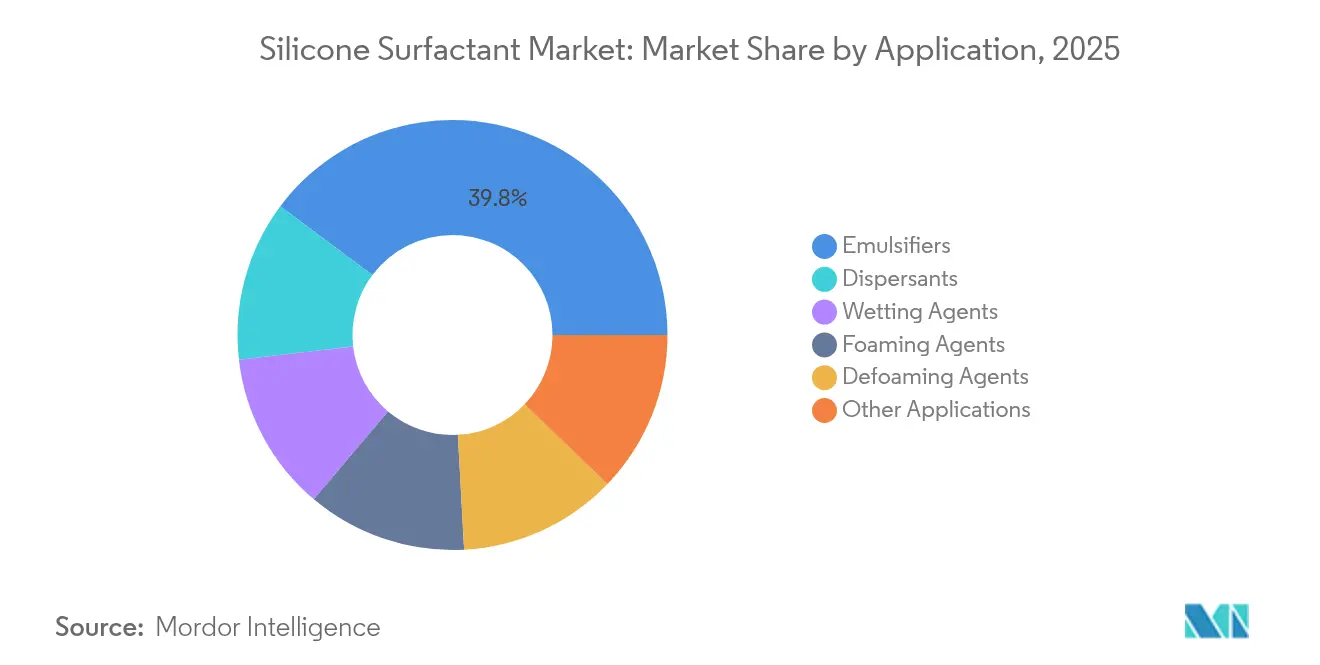
- By application, emulsifiers led with 39.78% of silicone surfactants market share in 2025, while the other-applications cluster is projected to post the fastest 4.55% CAGR through 2031.
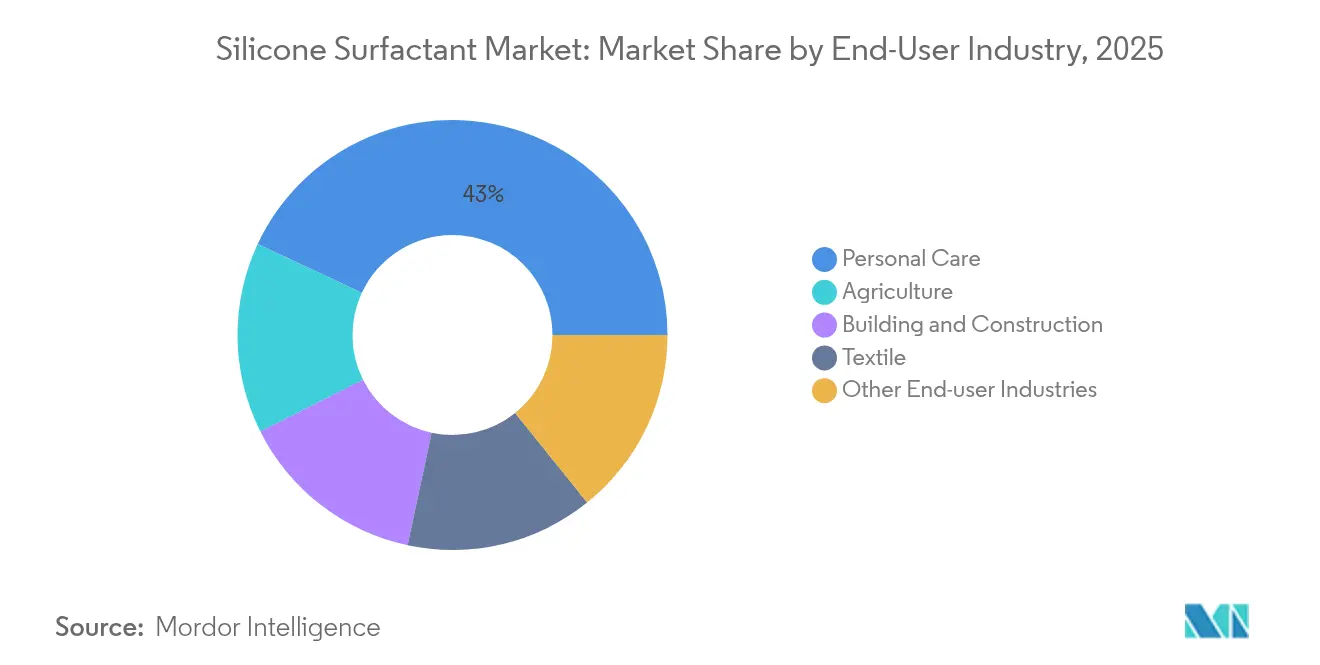
- By end-user industry, personal care accounted for 43.05% share of the silicone surfactants market size in 2025; agriculture is advancing at a 4.35% CAGR to 2031.
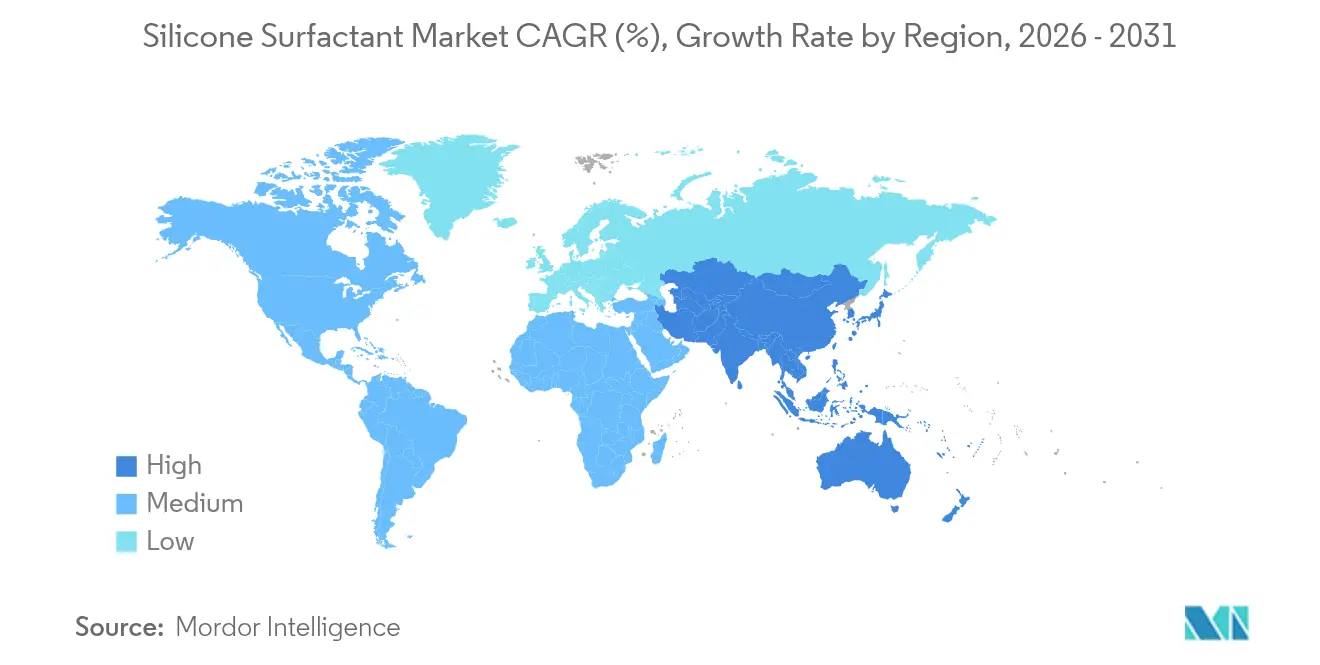
- By geography, Asia-Pacific contributed 45.86% revenue share in 2025, and the region is forecast to register a 4.18% CAGR through 2031.
Note: Market size and forecast figures in this report are generated using Mordor Intelligence’s proprietary estimation framework, updated with the latest available data and insights as of 2026.
Market Trends and Insights
Drivers Impact Analysis of Silicone Surfactant Market*
| Driver | (~) % Impact on CAGR Forecast | Geographic Relevance | Impact Timeline |
|---|---|---|---|
| Rising demand for sensorial silicone‐based personal-care formulations | +1.20% | Global, with concentration in North America & Europe | Medium term (2-4 years) |
| Rapid growth of polyurethane foam industry in construction and automotive | +0.80% | APAC core, spill-over to North America | Long term (≥ 4 years) |
| Increasing use of super-spreader adjuvants in precision agriculture | +0.60% | Global, with early gains in North America & APAC | Medium term (2-4 years) |
| Expansion of textile wet-processing in emerging economies | +0.40% | APAC emerging markets, particularly Southeast Asia | Long term (≥ 4 years) |
| Sugar-modified, biodegradable silicone surfactants gaining traction | +0.30% | Europe & North America, expanding to APAC | Short term (≤ 2 years) |
| Source: Mordor Intelligence | |||
Sensorial Silicone Formulations in Personal Care
Demand for multisensory skin-care and hair-care products is fueling complex emulsion systems that rely on silicone surfactants to deliver light textures, quick absorption and adaptive moisturization. BASF showcased climate-responsive skin-care prototypes at Cosmet’Agora 2025, highlighting silicone-enabled water-in-oil emulsions that adjust to humidity and temperature shifts[1]. CHT Group introduced recycled-content silicone surfactants with 94% reclaimed monomers, merging sensorial performance with circular sourcing. Market migration toward sulfate-free cleansing intensifies the need for gentle yet high-foaming agents that silicone chemistry provides. Premium product positioning and regulatory acceptance of low-cyclic silicone grades underpin stable volume growth in this driver segment.
Polyurethane Foam Growth in Construction and Automotive
Polyurethane foam producers depend on silicone surfactants as cell regulators that stabilize froth and control thermal insulation values. Mexico's polyurethane market is experiencing consistent capacity growth. This growth is driven by nearshoring investments in the automotive sector, which significantly contribute to the nation's GDP. Bio-based polyols from vegetable oils have entered pilot scale, prompting silicone suppliers to tailor surfactants for renewable feedstock compatibility. Wacker’s 2025 expansion of silicone capacity and Dow’s rollout of bio-sourced NORDEL REN EPDM affirm industry commitment to sustainable foam chemistry. Long term, high-performance building codes and electric-vehicle battery insulation requirements underpin robust demand for silicone stabilizers.
Super-Spreader Adjuvants for Precision Agriculture
Drone-based crop protection requires surfactants that lower surface tension to improve canopy penetration while minimizing off-target drift. Evonik launched BREAK-THRU MSO MAX 522 and TEGO XP 11134, polyether-trisiloxane blends engineered for drone delivery that enhance droplet adhesion and pesticide efficacy. Momentive’s Silwet Power combines super-spreading with microbial-compatible chemistry, supporting biological pesticide uptake and soil health. Early field trials in cotton report higher pest-control outcomes with lower spray volumes, driving adoption in Southeast Asia’s rapidly mechanizing farms. These performance gains position agricultural adjuvants as the fastest incremental contributor to the silicone surfactants market through 2030.
Textile Wet-Processing Expansion in Emerging Economies
Foreign direct investment is shifting garment supply chains toward Vietnam and Bangladesh, prompting new wet-processing capacity that relies on silicone surfactants for durable softness, water repellency and color fastness. Shin-Etsu markets antimicrobial finishes that combine polydimethylsiloxane backbones with quaternary ammonium groups to meet performance and hygiene targets. Research into PFAS-free silicone water repellents on polyester blends has confirmed comparable oil repellency without fluorine chemistry[2]. Adoption is strongest in Southeast Asia, elevating specialty surfactant imports. Long-term infrastructure for effluent treatment and circular dyeing processes will reinforce silicone demand in textile finishing.
Restraints Impact Analysis of Silicone Surfactant Market*
| Restraint | (~) % Impact on CAGR Forecast | Geographic Relevance | Impact Timeline |
|---|---|---|---|
| Volatile siloxane monomer prices | -0.70% | Global, with particular impact on integrated producers | Short term (≤ 2 years) |
| Trisiloxane intermediate supply-chain concentration risks | -0.50% | Global, with highest risk in APAC-dependent supply chains | Medium term (2-4 years) |
| PFAS-style disclosure rules for persistent organosilicons | -0.40% | Europe & North America, expanding to APAC | Medium term (2-4 years) |
| Source: Mordor Intelligence | |||
Volatile Siloxane Monomer Prices
Silicon metal and methyl chloride price swings propagate directly into siloxane costs, compressing margins for downstream formulators. Wacker still lifted EBITDA by 47% in 2024 through vertical integration, demonstrating the buffer that captive monomer units provide. Independent blenders, by contrast, face quarterly price passthrough delays that erode competitiveness. Energy-intensive direct synthesis routes expose producers to gas and electricity volatility, an issue most acute in Europe and North America during winter demand peaks. Inventory hedging and long-term offtake contracts partially mitigate risk, yet sustained volatility could shave 0.7 percentage points off the market CAGR until energy markets stabilize.
Trisiloxane Intermediate Supply-Chain Concentration
Global output of critical trisiloxane intermediates resides in a handful of large facilities, many clustered in East Asia. Any operational outage risks constraining specialty surfactant availability worldwide. The European Chemicals Agency will enforce leave-on cosmetic restrictions for D4, D5 and D6 cyclosiloxanes from June 2026, compelling formulators to re-engineer supply chains around alternative intermediates[3].EU. Additional regulatory scrutiny on broader siloxane classes could deter capital investment in new capacity. Dow’s collaboration with Circusil on closed-loop silicone recycling aims to cut PDMS carbon footprints by more than 50% and diversify feedstock sources, though commercial scale-up is slated for post-2027. Persistent concentration therefore presents a medium-term drag on the silicone surfactants market.
*Our forecasts treat driver/restraint impacts as directional, not additive. The impact forecasts reflect baseline growth, mix effects, and variable interactions.
Silicone Surfactant Market Segment Analysis
By Application:
Emulsifiers Sustain Leadership as Specialty Uses AccelerateEmulsifiers retained the largest revenue slice in 2025 with 39.78% of silicone surfactants market share, buoyed by personal-care and industrial formulations that depend on stable oil-in-water systems. The segment’s staying power derives from the ability of silicone chains to orient at interfaces with minimal dosage, thereby enhancing sensory feel and freeze-thaw stability.
Other applications such as electronics cooling fluids, photovoltaic sealants and advanced coatings are forecast to grow at a 4.55% CAGR through 2031, faster than the broader silicone surfactants market. Wetting agents that achieve surface tensions below 20 mN/m enable thinner photoresist layers and efficient agricultural sprays, while novel sulfonate-based defoamers suppress entrapped air in high-shear resin systems. Foaming agents drive density control in polyurethane insulation boards that meet near-zero energy building codes. Collectively, these specialty end-uses diversify revenue streams and reduce dependence on commoditized emulsifier demand.

By End-User Industry:
Personal Care Dominates yet Agriculture AdvancesPersonal care, at 43.05% of 2025 revenue, anchors the silicone surfactants market size through high consumption of shampoos, sunscreens and color cosmetics that rely on mild cleaning, slip and shine performance. Growth within this cohort stems from the migration to sulfate-free and waterless formats in which silicone surfactants maintain foam and tactile cues without harsh detergents.
Agriculture is projected to record the fastest 4.35% CAGR as precision spraying and biological crop-protection agents spread across large farming regions. Super-spreader adjuvants cut water usage and pesticide volumes, satisfying regulatory demands for sustainable intensification. Building and construction consume silicone surfactants through sealants, elastomeric coatings and foamed insulation, leveraging thermal stability for long-lived building envelopes. Textile mills adopt silicone softeners, defoamers and water repellents to achieve premium hand feel and PFAS-free liquid repellency, particularly in Southeast Asia. Electronics and automotive applications complete the portfolio, where silicone surfactants improve dielectric cooling and paint wetting for advanced manufacturing lines.
Geography Analysis
APAC Silicone Surfactant Market
Asia-Pacific’s leadership stems from synchronized growth in consumer spending, industrialization and inward chemical investment. The region’s 4.18% CAGR to 2031 is supported by rising middle-class personal-care demand in India, expanding polyurethane production in China and accelerating drone-assisted agriculture in Southeast Asia. Government incentives for sustainable building materials further reinforce polyurethane foam and sealant uptake. Regional producers leverage economies of scale while global suppliers establish local formulation centers to shorten innovation cycles.
North America Silicone Surfactant Market
North America commands steady demand driven by automotive and construction applications that incorporate high-specification silicone surfactants. Mexico’s polyurethane boom catalyzed by electric-vehicle production sustains multiyear volume growth. United States regulations phasing out legacy fluorochemicals accelerate adoption of silicone-based water repellents and surface treatments. Canada’s advanced manufacturing and resource sectors maintain baseline consumption, with federal funding promoting bio-based chemical initiatives that intersect with sugar-modified silicone development.
Europe Silicone Surfactant Market
Europe shapes global innovation through forward-leaning regulations that restrict cyclic siloxanes and incentivize renewable electricity in chemical production. Leaders such as Germany and France channel investment toward biodegradable silicone surfactants that comply with the European Green Deal. Northern European countries set procurement specifications that require PFAS-free water repellents in textiles and construction, stimulating market demand. Regional R&D clusters cooperate with multinational suppliers to pilot closed-loop silicone recycling and carbon-negative siloxane production pathways.
Value Chain Analysis
The silicone surfactant value chain starts with upstream inputs such as silicon metal-derived chlorosilanes and siloxane intermediates (including trisiloxane building blocks), alongside polyether raw materials. Producers then convert these into polysiloxanes and carry out block copolymerization (commonly via Si-O-C or Si-C linkages) to tune emulsifying, wetting, defoaming, and foam-stabilizing performance for end uses in personal care, polyurethane foams, agriculture, textiles, and industrial coatings. Integrated silicone manufacturers, including Dow, Wacker, Momentive/KCC, Elkem, and Shin-Etsu, compete alongside a larger set of small-to-mid-sized Chinese producers that focus on standard grades and provide regional redundancy.
Midstream, specialty silicone surfactants are formulated into application-specific packages (for example, super-spreaders for crop protection or cell regulators for polyurethane) and then qualified by brand owners and industrial users through performance, odor/VOC, and regulatory compliance testing. Downstream distribution is typically handled through direct sales for key accounts and via global chemical distributors for smaller buyers, with localized technical service increasingly important for reformulation work tied to cyclosiloxane limits and PFAS-free substitution. The main bottlenecks are volatility in siloxane and polyether feedstocks and concentration risk in trisiloxane supply, which can constrain availability and extend qualification cycles for higher-spec applications.
Competitive Landscape
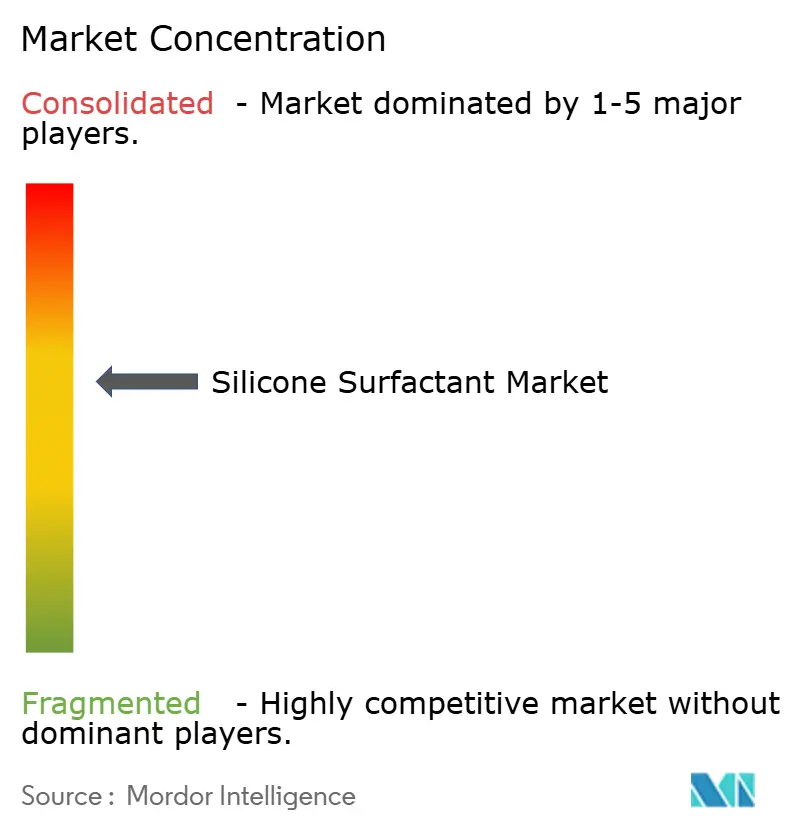
Global supply is moderately consolidated, with integrated majors controlling monomer production and downstream specialty lines while niche formulators serve regional or application-specific needs. KCC’s full acquisition of Momentive in 2024 enlarged its silicone toolkit, creating one of the five largest players by revenue. Dow restructured its Dow Corning assets to streamline specialty silicones and accelerate bio-based innovation timelines.
Strategic priorities pivot around sustainability and regional growth. Wacker commissioned a Czech formulation plant capable of 20,000 tpa to satisfy European demand for high-value fluids, elastomer gels and emulsions. Elkem, celebrating 120 years in silicon, accelerates sugar-modified silicone launches to capture natural-origin personal-care demand.
Innovation efforts concentrate on PFAS-free coatings, drone-grade agricultural adjuvants and recyclable silicone networks. Companies expand joint ventures for closed-loop silicone recycling, targeting 50% lifecycle CO₂ cuts. Early movers secure long-term supply agreements with electronics and solar manufacturers that value low-carbon content, providing competitive insulation against raw-material price volatility. Consequently, the silicone surfactants market favors firms with deep R&D budgets, integrated monomer assets and demonstrated ESG performance.
Silicone Surfactant Industry Leaders
-
Dow
-
Elkem ASA
-
Evonik Industries AG
-
Momentive
-
Wacker Chemie AG
- *Disclaimer: Major Players sorted in no particular order
Silicone Surfactant Market Companies Covered in this Report
- AB Specialty Silicones
- BASF SE
- CHT
- Dow
- Elé Corporation
- Elkay Chemicals Pvt. Ltd.
- Elkem ASA
- Evonik Industries AG
- Hangzhou Topwin Technology Development Co.,ltd.
- Harcros Chemicals Inc.
- Innospec
- JIAHUA CHEMICALS INC.
- Maysta
- Momentive
- Resil
- Shin-Etsu Chemical Co., Ltd
- SILIBASE SILICONE
- Siltech Corporation
- Supreme Silicones India Pvt. Ltd.
- Wacker Chemie AG
Market Opportunities and Future Outlook
Product reformulation tied to tighter cyclosiloxane and broader persistent-chemistry scrutiny is opening room for low-cyclic, low-SVHC silicone surfactant portfolios that reduce customer compliance burden in Europe and other regions that follow similar disclosure norms. Evonik’s 2026 refresh of its TEGOSIL range to meet stricter cyclosiloxane limits (D4, D5, D6 thresholds) shows how suppliers are using upgraded purity and tighter specification control as a commercial lever in personal care and industrial formulations, where emulsification, wetting, and slip still need to be maintained while meeting new limits.
On the supply side, capacity and innovation investments are concentrating in specialty silicones manufacturing hubs serving Asia-Pacific demand and export markets. Dow’s June 2026 announcement of approximately USD 100 million in projects through end-2027 across sites in China, Japan, and the United States supports opportunities in engineered silicone materials that overlap with silicone-surfactant adjacencies (specialty fluids, emulsions, and performance additives), while improving lead times for formulators supplying polyurethane, mobility, and electronics-related customers. In parallel, application-led opportunities continue to emerge in low-VOC polyurethane foams (including low-fogging formulations for automotive interiors) and drone-compatible agricultural adjuvants, where validation and field use-cases tend to favor suppliers that can offer both surfactant performance tuning and robust regulatory documentation.
Recent Industry Developments in Silicone Surfactant Market
- June 2026: Wacker Chemie AG opened a new production site for specialty silicones in Karlovy Vary, Czech Republic. The facility strengthens regional supply for silicone specialties used across automotive and energy-related value chains, helping European formulators shorten lead times and engage technical service closer to end markets.
- May 2026: Evonik Industries AG introduced an updated TEGOSIL product range aligned with stricter European regulatory limits for cyclosiloxanes (including tighter D4, D5, and D6 specifications). The update supports customer reformulation programs in personal care and industrial uses where maintaining sensorial performance and wetting behavior needs to be balanced against compliance.
- March 2024: KCC Corporation finalized an agreement to fully acquire Momentive Performance Materials Group. The transaction expanded KCC’s silicone platform and downstream specialty portfolio, reshaping competitive positioning in silicone surfactants through broader product breadth and integrated innovation capabilities.
Silicone Surfactant Market Report Scope and Research Methodology
Market Definition and Coverage
This market covers the value of silicone surfactants sold for industrial and consumer-use formulations, where a silicone-based molecule is used to improve spreading, wetting, foaming control, or emulsification in a finished product.
Scope exclusions: Silicones used only as elastomers, sealants, resins, fluids, or non-surfactant additives are excluded even if they are used in similar end uses.
Segments Covered in This Report
- By Application
- Emulsifiers
- Foaming Agents
- Defoaming Agents
- Wetting Agents
- Dispersants
- Other Applications
- By End-user Industry
- Personal Care
- Building and Construction
- Textile
- Agriculture
- Other End-user Industries
- By Geography
- Asia-Pacific
- China
- Japan
- India
- South Korea
- ASEAN Countries
- Rest of Asia-Pacific
- North America
- United States
- Canada
- Mexico
- Europe
- Germany
- United Kingdom
- France
- Italy
- Spain
- Russia
- NORDIC Countries
- Rest of Europe
- South America
- Brazil
- Argentina
- Rest of South America
- Middle East and Africa
- Saudi Arabia
- South Africa
- Rest of Middle East and Africa
- Asia-Pacific
Data Sources, Market Sizing, and Validation
Desk Research
Desk research was used to build the base structure of the market and to anchor major demand signals to public data series. We reviewed official and non-paywalled sources such as US Census Bureau manufacturing and trade tables, Eurostat external trade statistics, UN Comtrade import and export data, and OECD indicators that help explain industrial output and consumer spending patterns.
On the supply side, we also checked supporting evidence from sources such as SEC filings and annual reports of listed producers, investor presentations, industry association publications (such as chemistry and surfactant groups), and peer-reviewed journals covering silicone chemistry and formulation performance. Select paid subscriptions for company financials and intelligence, patent databases, and shipment-level import and export records were used to cross-check company exposure, pricing signals, and trade flows where public detail is limited. These sources are illustrative only, and many additional public references were reviewed for data collection, validation, and clarification during the study.
Primary Interviews and Surveys
Primary work focused on interviews and structured surveys with formulators, distributors, procurement managers, and product specialists across personal care, construction chemicals, textiles, and agriculture uses. We used these discussions to confirm application split logic, typical dosage and reformulation trends, and regional pricing direction, and then we rechecked assumptions when a respondent flagged a mismatch with observed demand in their geography.
Distribution of primary research fieldwork respondents
| Company type | Respondent position | Region |
|---|---|---|
| Top tier: 38% | CXOs: 15% | APAC: 42% |
| Mid tier: 45% | Functional/Unit leaders: 26% | EMEA: 36% |
| Smaller Players: 17% | Managers: 59% | Americas: 22% |
Market-Sizing & Forecasting
Sizing starts with a top-down build where end-use demand pools are reconstructed using regional activity indicators and then filtered by silicone surfactant penetration by application. The total is corroborated with selective bottom-up approximations, such as sampled price per kilogram times estimated consumption volumes in key applications and a roll-up of supplier exposure where public revenue hints are available.
Inputs that were treated as the practical fingerprints for this market include personal care and home care formulation activity, construction output and admixture usage intensity, textile finishing and processing volumes, agricultural adjuvant demand, and observed price movement for silicone intermediates that influences surfactant pricing. Where direct volume signals were missing, gaps were handled by using comparable application dosage ranges and by applying region-specific adoption rates that were tested in interviews.
For forecasting, scenario analysis was used so the model can reflect different paths for construction cycles, personal care premiumization, and regulatory push toward lower-VOC and higher performance additives. The final forecast path is the one that best matches the consensus ranges heard from primary respondents on adoption, pricing progression, and near-term destocking or restocking behavior.
Data Validation & Update Cycle
Model outputs are checked against independent signals, including regional trade direction, downstream production trends, and any visible shifts in end-use mix that would realistically change demand. When a variance looks too large, we revisit the assumption drivers, rerun sensitivity checks on adoption and pricing, and re-contact selected experts to confirm what changed and why.
Before sign-off, the analysis goes through multi-step internal review so unusual jumps in growth, share, or pricing are explained with a clear trail back to inputs. The report is refreshed annually, and interim updates are made when major events materially affect supply, pricing, or downstream consumption. Before delivery, a final pass is completed so clients receive the most recently validated view.
Mordor Intelligence's Silicone Surfactant Market Size Measured Against Other Published Estimates
Published market sizes for silicone surfactants can differ even when the topic name looks identical, because the included chemistries, the year chosen as the anchor, and the way pricing is averaged can shift the final number.
Paint and coating additives that are not functioning as surfactants often get mixed into some estimates, and that item sits outside Mordor Intelligence's scope, which keeps the value tied to surfactant use cases across emulsifiers, defoamers, wetting agents, dispersants, and foaming agents. Differences also come from base-year timing, where some sources anchor in 2024 and others in 2026, and from whether a single global price is used or regional price curves are applied with currency conversion at the period average.
Benchmark comparison
| Source | Market Size | Gaps in Research Methodology |
|---|---|---|
| Mordor Intelligence | USD 2.65 B (2026) | |
| Global Consultancy A | USD 1.98 B (2024) | Anchored to a 2024 base year and a 2025-2030 forecast window, so the level differs from a 2026-based view, and the pricing build appears to lean on broad regional averages that can understate higher-value formulation grades. |
| Industry Publisher B | USD 2.75 B (2024) | Uses a 2024 starting point and also reports both revenue and volume, which can inflate value if volume-to-value conversion relies on generalized prices and includes adjacent silicone-based additives used in similar applications. |
The spread across sources is mostly explained by what gets counted as a silicone surfactant, the base-year selection, and the price and currency assumptions used to convert demand into revenue. By keeping the inputs traceable to application demand signals and by rechecking adoption and pricing with primary respondents, the estimate stays easier to reproduce and to update when end-use cycles shift.
Key Questions Answered in the Report
What is the current value of the silicone surfactants market?
The silicone surfactants market size reached USD 2.65 billion in 2026 and is projected to hit USD 3.18 billion by 2031.
Which application segment leads revenue generation?
Emulsifiers hold the top position with 39.78% silicone surfactants market share due to their central role in personal-care and industrial emulsions.
Which end-user industry is expanding the fastest?
Agriculture is set to post a 4.35% CAGR through 2031 as precision spraying and biological crop-protection products scale.
Why is Asia-Pacific the largest regional market?
Asia-Pacific accounts for 45.86% of global demand thanks to robust manufacturing, expanding middle-class consumption and strong investment in textiles, polyurethane foams and agriculture.
What are the main growth drivers for silicone surfactants?
Key drivers include sensorial personal-care innovations, rising polyurethane foam usage in energy-efficient buildings, drone-enabled agriculture and the launch of biodegradable sugar-modified surfactants.
How are regulations shaping product development?
Restrictions on cyclic siloxanes and PFAS push manufacturers toward biodegradable and bio-based silicone chemistries, driving R&D investment and market differentiation.