
Silicone Coating Market Size and Share
Market Overview
| Study Period | 2020 - 2031 |
|---|---|
| Market Size (2026) | USD 7.43 Billion |
| Market Size (2031) | USD 9.27 Billion |
| Growth Rate (2026 - 2031) | 4.52 % |
| Fastest Growing Market | Asia Pacific |
| Largest Market | Asia Pacific |
| Market Concentration | Medium |
Major Players *Disclaimer: Major Players sorted in no particular order Image © Mordor Intelligence. Reuse requires attribution under CC BY 4.0. | |
Silicone Coating Market Analysis by Mordor Intelligence
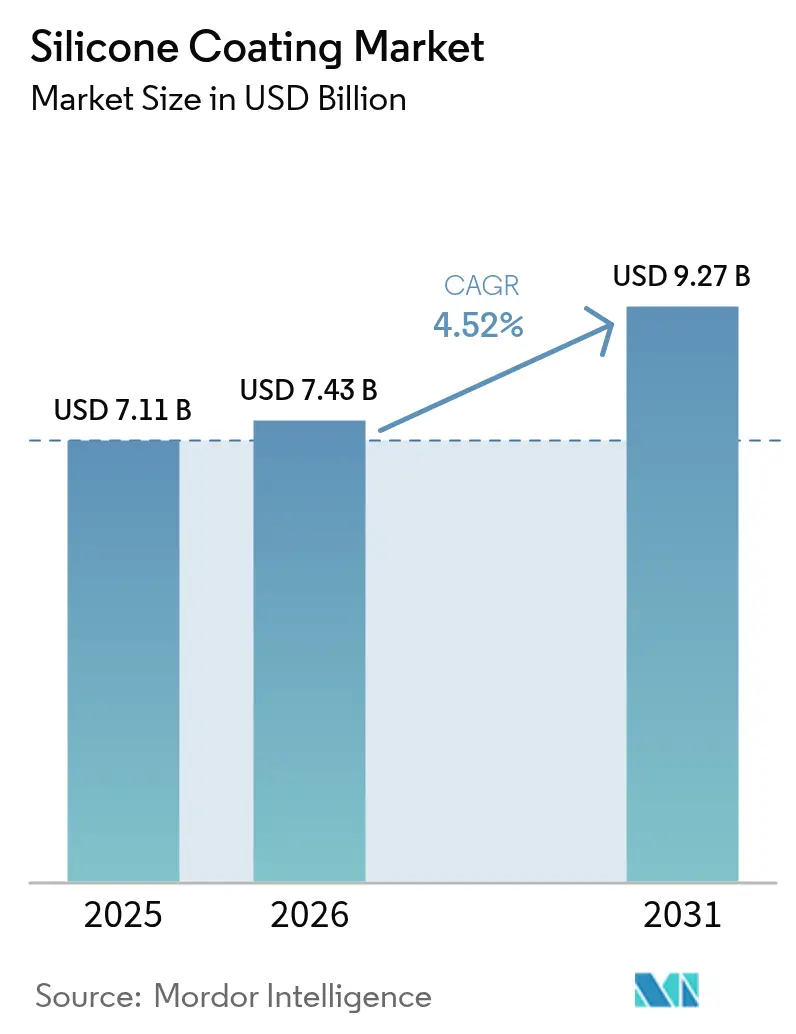
The Silicone Coating Market size was valued at USD 7.11 billion in 2025 and estimated to grow from USD 7.43 billion in 2026 to reach USD 9.27 billion by 2031, at a CAGR of 4.52% during the forecast period (2026-2031). Ongoing energy-efficiency mandates in commercial roofing, accelerating electronics miniaturization, and the proven thermal stability of silicone polymers continue to move the Silicone coatings market from niche status toward a broadly adopted protective-materials segment. Structural durability, UV resistance, and moisture impermeability position silicone coatings as preferred solutions in climates that impose high thermal shock and solar exposure. Asia-Pacific’s construction boom and its electronics manufacturing dominance anchor global demand, while policy shifts that phase out PFAS-based chemistries further tilt customer selection toward silicone systems. On the supply side, producers with vertically integrated siloxane chains and strong application-engineering support capture higher margins even when feedstock prices fluctuate.
Key Report Takeaways
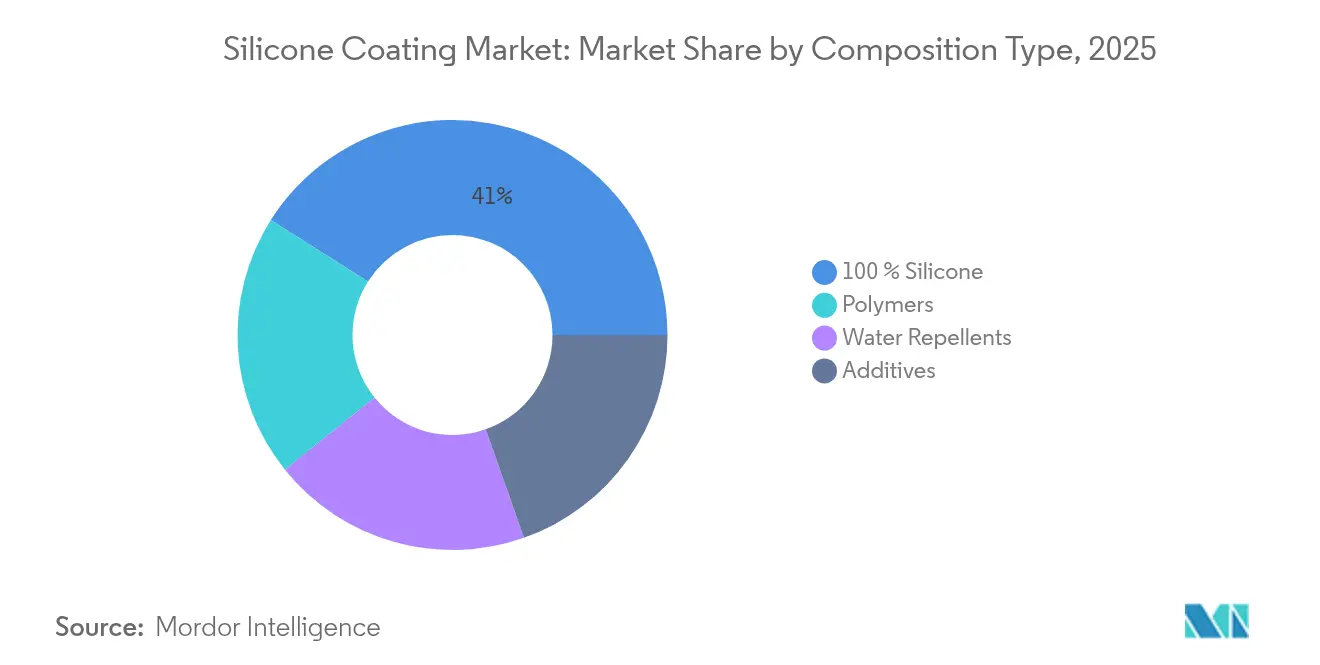
- By composition type, 100% silicone elastomeric coatings held 41.02% of the Silicone coatings market share in 2025; water-repellent systems are forecast to deliver a 5.28% CAGR to 2031.
- By technology, solvent-less platforms led with a 37.85% revenue share in 2025, while UV-cured chemistries are poised for the fastest 5.33% CAGR between 2026 and 2031.
- By substrate, metal surfaces commanded 54.62% of the overall revenue in 2025; concrete and masonry applications are projected to expand at 5.25% CAGR through 2031.
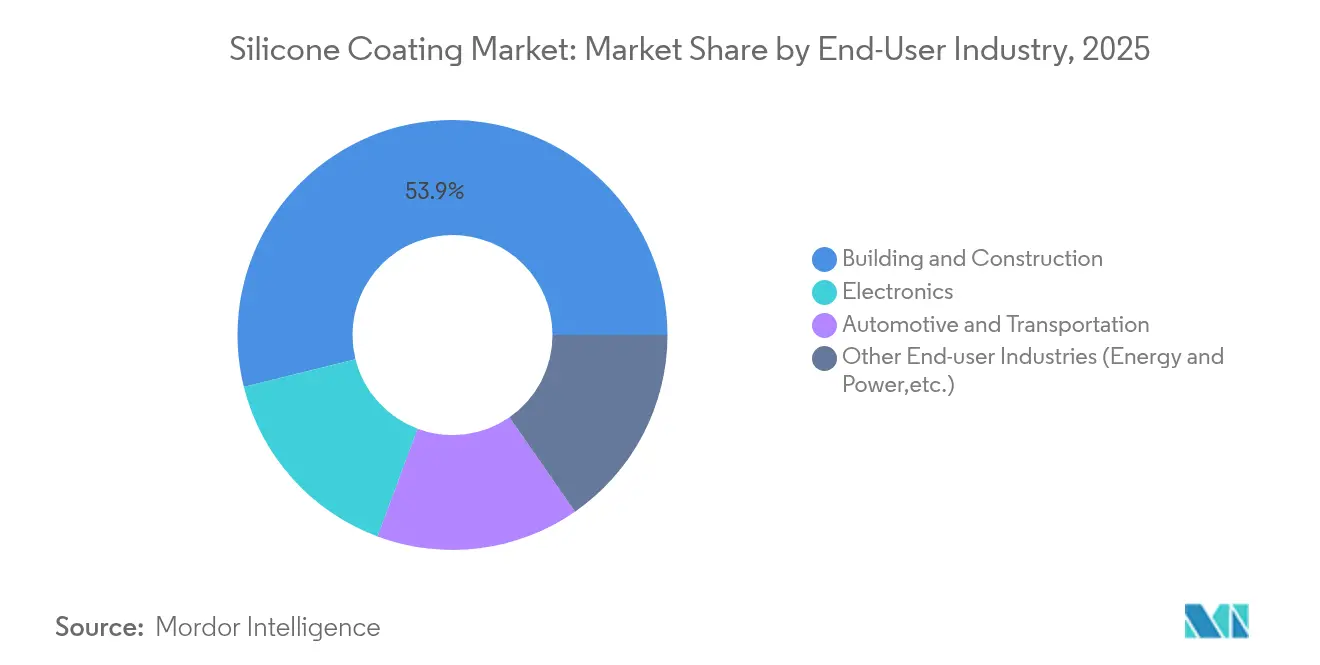
- By end-user industry, building and construction dominated with a 53.88% revenue share in 2025, whereas electronics is expected to register the highest 5.55% CAGR to 2031.
Note: Market size and forecast figures in this report are generated using Mordor Intelligence’s proprietary estimation framework, updated with the latest available data and insights as of 2026.
Global Silicone Coating Market Trends and Insights
Drivers Impact Analysis*
| Driver | (~) % Impact on CAGR Forecast | Geographic Relevance | Impact Timeline |
|---|---|---|---|
| Surge in cool-roof refurbishments for energy-efficient buildings | +1.2% | Global, with concentration in North America & EU | Medium term (2-4 years) |
| Growing demand from building and construction industry | +1.0% | APAC core, spill-over to MEA | Long term (≥ 4 years) |
| Rapid adoption in consumer and industrial electronics conformal coatings | +0.8% | Global, led by APAC electronics hubs | Short term (≤ 2 years) |
| Increasing demand for silicone coatings from the automotive industry | +0.7% | Global, with EV concentration in China, EU, North America | Medium term (2-4 years) |
| Urban-heat-island mitigation programs driving reflective silicone roofs | +0.5% | Urban centers globally, priority in Asia-Pacific megacities | Long term (≥ 4 years) |
| Source: Mordor Intelligence | |||
Surge in Cool-Roof Refurbishments for Energy-Efficient Buildings
California’s Title 24 code enforces a minimum aged solar reflectance of 0.63 and thermal emittance of 0.75 on low-slope commercial roofs, converting regulatory language into immediate demand for high-reflectance silicone membranes[1]. Building owners frequently choose silicone restoration rather than full reroofing, trimming capital expenditure by as much as 40% while extending service life. Field studies from the California Energy Commission indicate that cool roofs cut annual energy use by up to 15% in hot climates[2]. Similar performance-based codes now appear across Europe and fast-growing Asian megacities, embedding silicone solutions in long-range retrofit budgets. As electricity tariffs continue to rise, the payback period for silicone cool-roof systems shortens, reinforcing a durable demand driver in the Silicone coatings market.
Growing Demand from the Building and Construction Industry
The construction sector is shifting from reactive repairs toward proactive envelope protection, and silicone chemistry sits at that strategic pivot point. Moisture ingress remains the dominant degradation mechanism in concrete, yet vapor-permeable silicone barriers extend structural life by two to three decades while allowing substrates to breathe. Nanotitanium-modified silane coatings tested on long-span bridges have demonstrated potential lifetimes exceeding 70 years. Warranty frameworks in public-infrastructure procurement increasingly specify minimum service intervals that silicone technology uniquely satisfies, anchoring the long-term influence of this driver. Emerging government incentives for “whole-life-carbon” accounting further lift specification rates for high-durability silicone membranes, amplifying growth momentum in the Silicone coatings market.
Rapid Adoption in Consumer and Industrial Electronics Conformal Coatings
Component miniaturization raises power densities and moisture-sensitivity, prompting electronics suppliers to migrate toward PFAS-free silicone conformal coatings with superior dielectric performance. Momentive’s thermally conductive encapsulants operate reliably from −50 °C to +200 °C, meeting the envelope required for 5G base-station modules. Atomic-layer-deposition research now proves uniform silicone coverage inside 60:1 aspect-ratio vias without impairing signal integrity. Global roll-outs of IoT sensors add billions of boards that demand corrosion-resistant, low-modulus coatings. Consequently, electronics OEMs view silicone coatings less as optional insurance and more as an enabling design element, reinforcing a robust short-term pull on the Silicone coatings market.
Increasing Demand from the Automotive Industry
The shift from internal-combustion engines to battery-electric platforms multiplies thermal-management challenges, elevating silicone interface materials from ancillary to critical components. Dow’s DOWSIL TC-3080 gel delivers uniform heat spread at pack level while allowing automated dispensing speeds required for gigafactory scale. Parker’s CoolTherm systems combine moisture sealing with 2 W/m·K conductivity, protecting control boards from dust and vibration. Original equipment manufacturers increasingly bake coating specifications into advanced product quality planning, pushing silicone suppliers toward IATF 16949 accreditation for process rigor. Advanced driver-assistance and high-voltage inverters further widen the scope of silicone use, translating automotive electrification trends into medium-term growth for the Silicone coatings market.
Restraints Impact Analysis*
| Restraint | (~) % Impact on CAGR Forecast | Geographic Relevance | Impact Timeline |
|---|---|---|---|
| Volatile raw-material prices (siloxanes, fumed silica) | -0.9% | Global, with concentration in silicone manufacturing regions | Short term (≤ 2 years) |
| Supply-chain concentration of silane monomer feedstocks | -0.6% | Global, with vulnerability in APAC supply chains | Medium term (2-4 years) |
| Stricter indoor-air fire-safety codes limiting interior silicone use | -0.4% | North America & EU regulatory jurisdictions | Long term (≥ 4 years) |
| Source: Mordor Intelligence | |||
Volatile Raw-Material Prices for Siloxanes and Fumed Silica
Silicon-metal price swings cascade through to siloxane and fumed-silica intermediates, undermining cost predictability for coating formulators. Concentrated smelting capacity in energy-intensive provinces means that local power curtailments or environmental shutdowns in China can spike global raw-material indices within weeks. Coating producers respond through supply-contract hedging and greater recycle content, with emerging depolymerization technologies converting post-consumer silicone back into monomeric feedstock. Capital-intensive backward integration shelters margins yet favors only a handful of multinational players. Short-term volatility therefore translates into cautious inventory strategies among downstream users, mildly dampening expansion in the Silicone coatings market.
Supply-Chain Concentration of Silane Monomer Feedstocks
High-purity silane plants operate in fewer than ten global locations, leaving the value chain exposed to single-point disruptions. Specialty silanes tune adhesion and water repellency, and qualification cycles for replacements can exceed one year, discouraging rapid supplier substitution. Capacity expansions underway in the United States and the Middle East will not come online before 2026, prolonging supply-tight conditions. Construction firms with liquidated-damages clauses incur cost overruns when key silanes are delayed, eroding confidence in just-in-time procurement. The resulting risk premium tempers otherwise robust growth in the Silicone coatings market during the medium term.
*Our forecasts treat driver/restraint impacts as directional, not additive. The impact forecasts reflect baseline growth, mix effects, and variable interactions.
Segment Analysis
By Composition Type: Elastomeric Dominance Faces Water-Repellent Innovation
In 2025, 100% silicone grades generated 41.02% of total revenue, reflecting their unrivaled durability under severe UV and thermal cycling. These products anchor industrial-maintenance budgets in petrochemical, marine, and roofing markets where downtime costs exceed material premiums. Water-repellent chemistries, although smaller in volume, post the highest 5.28% CAGR to 2031 as architects increasingly specify breathable yet moisture-blocking façades for net-zero buildings. Advancements in super-hydrophobic silicone resins have achieved static contact angles above 160°, opening façade panels, monuments, and even solar modules to new protective paradigms.
Research pipelines now blend bio-based alkyl-polysiloxanes that retain high contact angles while cutting carbon intensity, answering sustainability tenders in public infrastructure. Concurrently, additive packages containing silsesquioxanes and nano-zirconia enable abrasion resistance without raising VOC levels, a benefit in emission-regulated spray booths. Competitive differentiation therefore migrates from basic polymer conversion to proprietary surface-energy control, locking in customer loyalty and supporting pricing power across the Silicone coatings market.

By Technology: Solvent-less Leadership Challenged by UV-Cured Innovation
Solvent-less systems captured 37.85% revenue in 2025, propelled by environmental regulations that cap VOC content in architectural and OEM facilities. Absence of flammable carrier solvents also simplifies plant-safety audits, lowering insurance premiums for applicators. Yet UV-cured platforms, forecast to grow at 5.33% CAGR, are rapidly closing the gap as production lines chase sub-minute tack-free times and lower energy footprints. Breakthroughs in near-infrared photoinitiators achieve cure depths exceeding 25 mm, unlocking structural adhesives and thick-section potting that previously defaulted to thermal bakeouts.
Water-borne hybrids edge into schools and hospitals where indoor-air regulations restrict solvent exposure, while radiation-cured epoxies protect mini-LED backplanes against flux-solder processing. Collectively, these technology options expand the addressable footprint of the Silicone coatings market, supplying specifiers with an increasingly granular toolkit aligned to both throughput and sustainability metrics.
By Substrate: Metal Applications Drive Volume while Concrete Gains Momentum
Metal substrates ruled 2025 sales with 54.62%, anchored by process-plant piping, offshore structures, and locomotive exhaust systems that demand thermal shock tolerance and corrosion inhibition. Electrical utilities also coat aluminum bus-bars to damp corona discharge in humid climates. Concrete-and-masonry coatings, however, will post a 5.25% CAGR as megacity transit tunnels, bridges, and parking decks seek breathable waterproofing. Bifunctional siloxane primers now couple chemically to calcium silicate hydrate, raising freeze-thaw durability and slashing algae colonization by over 70%.
Plastics and composites represent niche but strategic deployments in aerospace fairings and wind-turbine blades, where low surface energy combats ice accretion. For glass façades, one-component silicone clear coats deliver self-cleaning performance and curb particulate adhesion—attributes valued in dense urban corridors. The diversified substrate landscape demonstrates that formulation science, rather than raw volume, underpins value creation in the Silicone coatings market.
By End-User Industry: Construction Stability Meets Electronics Acceleration
Building and construction retained a stalwart 53.88% revenue share in 2025, its dominance secured by roof restoration, façade hydrophobization, and joint sealing. Government retrofit subsidies funnel expenditure into reflective coatings that both curb peak-load energy demand and stretch maintenance cycles beyond 20 years. Electronics, benefiting from a 5.55% CAGR through 2031, embraces silicone’s dual role as dielectric barrier and thermal spreader. Conformal coatings featuring low-modulus organosilicon networks protect high-density boards against capillary condensation without inducing solder-joint stress.
In automotive, lightweight battery enclosures now integrate silicone potting to offset vibration and prevent thermal runaway propagation. Power-grid assets, meanwhile, employ high-creepage-distance silicone housings that repel pollution flashovers, illustrating ecosystem cross-pollination. Collectively, these trends underscore how end-user innovation continues to re-shape opportunity contours inside the Silicone coatings market.
Geography Analysis
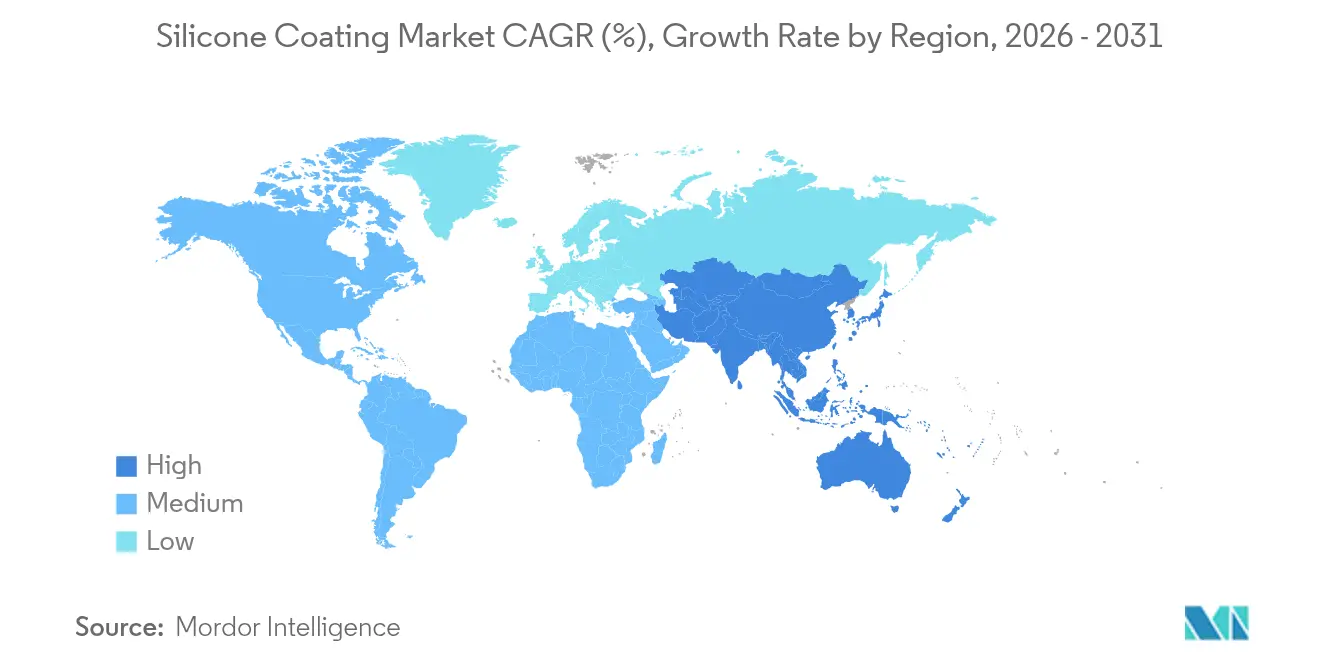
Asia-Pacific accounted for 45.70% of global revenue in 2025 and is projected to register a 4.92% CAGR to 2031, reflecting concerted infrastructure investment in China, India, and Vietnam alongside electronics manufacturing saturation in South Korea and Taiwan. Local firms increasingly channel R&D into EV thermal-management and semiconductor encapsulation, broadening regional value capture beyond basic volume. Multinational producers deepen joint ventures to secure proximity to end-users and buffer logistics exposure, thereby sustaining leadership within the Silicone coatings market.
North America remains a technologically mature arena where energy codes, such as California’s Title 24, institutionalize cool-roof demand. Roofing contractors leverage silicone restoration systems to sidestep landfill disposal fees, boosting adoption in sun-belt states. In Canada, federal green-building standards elevate vapor-permeable façade coatings, while Mexico’s automotive clusters generate steady pull for thermal-interface silicones. These dynamics anchor steady value growth, even as overall unit volumes plateau.
Europe’s market pursues circular-economy goals that reward long-life, low-maintenance chemistries, positioning silicone as the default for bridge refurbishment and offshore wind monopiles. Germany and the Nordics pioneer in-process recycling of silicone liner waste, reinforcing local supply resilience. Elsewhere, Southern Europe’s renovation wave channels stimulus funds toward roof-reflective coatings to mitigate urban heat islands. Emerging economies in South America and the Middle East & Africa add incremental demand through port expansions and energy projects, though currency volatility and limited applicator expertise moderate uptake in these regions.
Value Chain Analysis
The silicone coating value chain begins upstream with silicon metal production and conversion into chlorosilanes and monomers. These inputs are then polymerized into siloxanes and formulated into fluids, resins, elastomers, and additive packages, including fillers such as fumed silica, pigments, photoinitiators for UV-cure, and other performance modifiers. Integrated producers such as Dow, Wacker, Momentive, and Elkem participate across multiple steps, which supports feedstock continuity and technical consistency for high-spec end uses like electronics conformal coatings, cool-roof membranes, and corrosion protection on metal assets.
In the midstream, formulators and compounders tailor systems by technology, including solvent-less, water-borne hybrids, and UV-cured platforms, then certify them to end-use requirements. Sales typically move through direct technical channels to OEMs and through distribution networks serving contractors and maintenance in roofing and infrastructure refurbishment. Key bottlenecks center on high-purity silanes and cyclic siloxanes compliance, where qualification cycles can exceed a year and regulatory tightening increases testing and documentation burdens for exporters. Examples include South Korea MFDS Notice No. 2026-11, which lowers the combined D4/D5 limit in silicone sealants to 350 ppm effective October 1, 2026, and China issuing GB 4806.10-2025 (food-contact coatings) and GB 4806.16-2025 (food-contact silicone rubber), scheduled to take effect September 2, 2026. These requirements can drive reformulation and re-approval work for coatings intended for food-contact environments.
Competitive Landscape
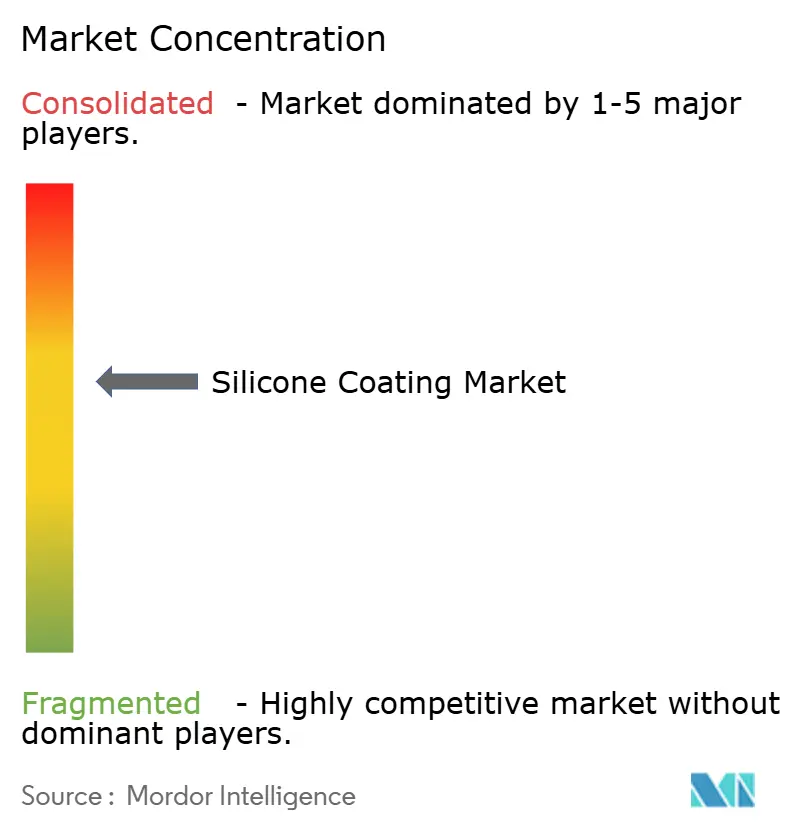
The Silicone coatings market reflects moderate consolidation. Dow, WACKER, and Momentive headline the tier-one roster, each operating integrated siloxane chains, global technical-service footprints, and application labs that shorten customer adoption cycles. KCC Corporation’s 2024 acquisition of Momentive consolidates R&D assets and grants the Korean conglomerate greater access to premium automotive and semiconductor accounts.
Evonik’s 2025 reorganization of its Silica and Silanes businesses under the “Smart Effects” banner illustrates portfolio streamlining designed to focus capital on high-growth EV and medical-device coatings. Meanwhile, Siltech stakes out sustainability leadership through bio-alkyl polysiloxane additives that cut fossil-carbon input yet maintain hydrophobic performance, appealing to European eco-label schemes. Smaller regional formulators thrive in regulated niches—such as low-smoke cloister coatings specified by Japanese rail operators—by tailoring chemistries to local codes and offering rapid field-service response.
Silicone Coating Industry Leaders
-
Shin-Etsu Chemical Co., Ltd
-
Momentive
-
Wacker Chemie AG
-
Dow
-
Elkem ASA
- *Disclaimer: Major Players sorted in no particular order
Market Opportunities and Future Outlook
White space is emerging where compliance, purity, and localized supply overlap, particularly in electronics, medical-adjacent applications, and food-contact environments that increasingly rely on substance lists and standalone silicone requirements. As regulatory frameworks formalize in key markets, suppliers get a clearer route to compliant silicone chemistries. MERCOSUR countries were required to transpose Resolution GMC No. 34/2025 into national rules by June 16, 2026, while China set September 2, 2026 as the effective date for GB 4806.10-2025 and GB 4806.16-2025, encouraging differentiation through documentation-ready, low-VOC, and low-cyclic-siloxane portfolios.
Investment and capacity expansions are also creating room for higher-value specialty grades and faster qualification support close to demand centers. In June 2026, Dow announced a USD 100 million investment program through 2027 to expand specialty silicones manufacturing and innovation across the United States, China, and Japan, including engineered-materials capacity work in Songjiang and Fukui (2026) and liquid silicone rubber capacity additions in Carrollton and Zhangjiagang (2027). In the same month, Wacker inaugurated a new specialty silicones production site in Karlovy Vary, Czech Republic, strengthening European supply for specialty silicones used across industrial applications and helping enable quicker collaboration with regional OEMs and formulators as solventless and UV-curable silicone coating technologies gain share under tightening VOC and labeling requirements.
Recent Industry Developments
- June 2026: Wacker Chemie AG opened a new production site for specialty silicones in Karlovy Vary, Czech Republic. The facility expands regional availability of specialty silicone materials used across performance-driven applications, supporting shorter lead times and faster technical iteration for European customers.
- November 2025: Shin-Etsu Chemical Co., Ltd. announced the development of a recyclable thermoplastic silicone positioned for surface-coating uses. The material direction addresses growing customer requirements around end-of-life and circularity without abandoning silicone performance attributes that are hard to replicate with conventional coatings.
- March 2024: Shin-Etsu Chemical Co., Ltd. announced the KRW-6000 Series, an emulsifier-free, water-based, fast-curing silicone resin for weather-resistant paint and additive applications. The development supports a shift toward lower-VOC and water-based platforms while retaining cure speed and durability demanded in exterior protection.
Research Methodology Framework and Report Scope
Market Definition and Coverage
For this methodology, the silicone coating market covers revenue generated from silicone-based coating materials applied to protect or improve the surface performance of substrates across industrial and commercial uses.
Scope exclusions: This sizing excludes upstream silicone base polymer manufacturing and non-coating silicone products that are sold mainly as sealants, adhesives, or elastomers.
Segmentation Overview
- By Composition Type
- Polymers
- 100 % Silicone
- Water Repellents
- Additives
- By Technology
- Solvent-less
- Solvent-based
- Water-borne
- Radiation/UV-cured
- By Substrate
- Metal
- Concrete and Masonry
- Plastics and Composites
- Glass and Ceramics
- By End-user Industry
- Building and Construction
- Electronics
- Automotive and Transportation
- Other End-user Industries (Energy and Power,etc.)
- By Geography
- Asia-Pacific
- China
- Japan
- India
- South Korea
- ASEAN Countries
- Rest of Asia-Pacific
- North America
- United States
- Canada
- Mexico
- Europe
- Germany
- United Kingdom
- France
- Italy
- Spain
- Russia
- NORDIC Countries
- Rest of Europe
- South America
- Brazil
- Argentina
- Rest of South America
- Middle East and Africa
- Saudi Arabia
- South Africa
- Rest of Middle East and Africa
- Asia-Pacific
Data Sources, Market Sizing, and Validation
Desk Research
Desk research started by mapping where silicone coatings are consumed and how they are typically sold, and then linking this to demand signals that can be checked publicly. We relied on non-paywalled sources such as the US International Trade Commission trade data, UN Comtrade, the US Bureau of Labor Statistics for relevant producer price indexes, and US Census manufacturing and construction indicators, along with peer-reviewed papers on silicone coating performance and use cases.
Next, we used company annual reports, investor presentations, and technical datasheets to understand application spread, pricing direction, and the pace of substitution between solvent-based, solvent-less, and water-based systems. Patent databases were also used to identify where innovation is focusing in release, heat-resistant, and water-repellent coatings, which helped validate which end uses are expanding. For some countries, we used paid subscription sources for company financials and shipment-level import and export databases to cross-check supplier presence and trade flow direction. The sources named here are illustrative only, and many other public documents and datasets were also consulted for collection, clarification, and validation.
Primary Interviews and Surveys
Primary work focused on interviews and short surveys with manufacturers, formulators, distributors, and large end users that specify silicone coatings for construction, industrial equipment, and electronics-related protection. We used these discussions to confirm buying criteria (film thickness, durability needs, and compliance requirements), to pressure-test average selling price movement, and to validate regional demand patterns across APAC, EMEA, and the Americas.
Distribution of primary research fieldwork respondents
| Company type | Respondent position | Region |
|---|---|---|
| Top tier: 37% | CXOs: 12% | APAC: 46% |
| Mid tier: 49% | Functional/Unit leaders: 42% | EMEA: 30% |
| Smaller Players: 14% | Managers: 46% | Americas: 24% |
Market-Sizing & Forecasting
Sizing was built using a top-down approach where coatings demand pools were reconstructed from end-use activity indicators and then translated into silicone coating value using penetration and pricing assumptions. For example, construction refurbishment intensity, industrial maintenance cycles, electronics and appliance output, and packaging and label release needs were used as demand anchors, which were then converted into coating consumption and value by applying typical application rates and regional price ranges.
Selective bottom-up checks were then used to keep totals realistic, including sanity checks from supplier revenue exposure to silicone coatings, distributor channel feedback, and sampled average selling price multiplied by estimated volume for major application clusters. Key model inputs included regional construction spending and starts, manufacturing output trends for industrial goods, solvent-less adoption and related regulatory pressure, substrate mix shifts (metal, plastics, paper and film), and the observed spread between specialty release coatings and more commoditized water-repellent uses. Forecasts were produced using scenario analysis, where we stress-tested high and low cases for construction activity, industrial output, and pricing pass-through, and then converged on a central case supported by what interviewees described as the most likely planning view.
Data Validation & Update Cycle
Outputs were validated by checking whether the implied regional splits match independent signals such as trade flow direction, manufacturing intensity, and construction activity, followed by a review of price assumptions against public index movement and interview feedback. When a region or end-use total looked unusually high or low, assumptions were rechecked, and targeted follow-ups were done with respondents to confirm whether a real shift was occurring or a scope item was being mixed in by mistake.
Before sign-off, the model and assumptions are reviewed in steps, including an internal peer review that focuses on scope alignment, unit consistency, and year-over-year logic. The report is refreshed annually, and interim updates are made when material events occur, such as sudden feedstock price swings or major changes in construction and manufacturing outlook. Before delivery, a fresh analyst pass is completed so clients receive an updated view tied to the latest available indicators.
Mordor Intelligence's Silicone Coating Market Size Versus Other Published Estimates
Published market values for silicone coatings can differ because firms draw the market coverage differently and also pick different base years, price paths, and demand indicators. In our checks, the spread usually comes from how broadly coatings are defined and how much of the construction and industrial maintenance demand pool is attributed to silicone-based systems.
Trade-flow direction, construction activity trends, and adoption signals for solvent-less systems are the evidence points that keep Mordor Intelligence's 2026 estimate tied to coating consumption rather than adjacent silicone materials sold into similar end uses.
Benchmark comparison
| Source | Market Size | Gaps in Research Methodology |
|---|---|---|
| Mordor Intelligence | USD 7.43 B (2026) | |
| Global Research Publisher A | USD 9.07 B (2025) | Uses a different base year and a broader silicone coating definition that can pull in additional coating-like silicone materials, and it may also apply a different currency timing that lifts the reported value. |
| Industry Publisher B | USD 7.00 B (2025) | Anchors the market in 2025 and can compress value if specialty release and high-performance grades are blended into one average price without enough adjustment for application mix. |
Looking at the table, the gap is mainly explained by base-year choice and what is counted as a silicone coating versus a nearby silicone material used for surface performance. A model that is anchored to observable demand indicators and then checked with pricing and penetration feedback tends to reduce over-counting and under-counting when the application mix shifts year to year.
Key Questions Answered in the Report
What is the current Silicone Coating Market size?
The Silicone coatings market size stands at USD 7.43 billion in 2026 and is forecast to reach USD 9.27 billion by 2031.
Which end-user sector holds the largest revenue share?
Building and construction applications account for 53.88% of 2025 revenues, making them the dominant sector.
Which segment is expanding fastest by technology?
UV-cured silicone coatings lead growth with a projected 5.33% CAGR between 2026 and 2031.
Why are silicone coatings increasingly used in electronics?
Miniaturization, PFAS phase-outs, and high thermal-management requirements make silicone materials the preferred conformal-coating choice.