
Short Bowel Syndrome Market Size and Share
Market Overview
| Study Period | 2020 - 2031 |
|---|---|
| Market Size (2026) | USD 1.64 Billion |
| Market Size (2031) | USD 2.34 Billion |
| Growth Rate (2026 - 2031) | 7.32 % |
| Fastest Growing Market | Asia Pacific |
| Largest Market | North America |
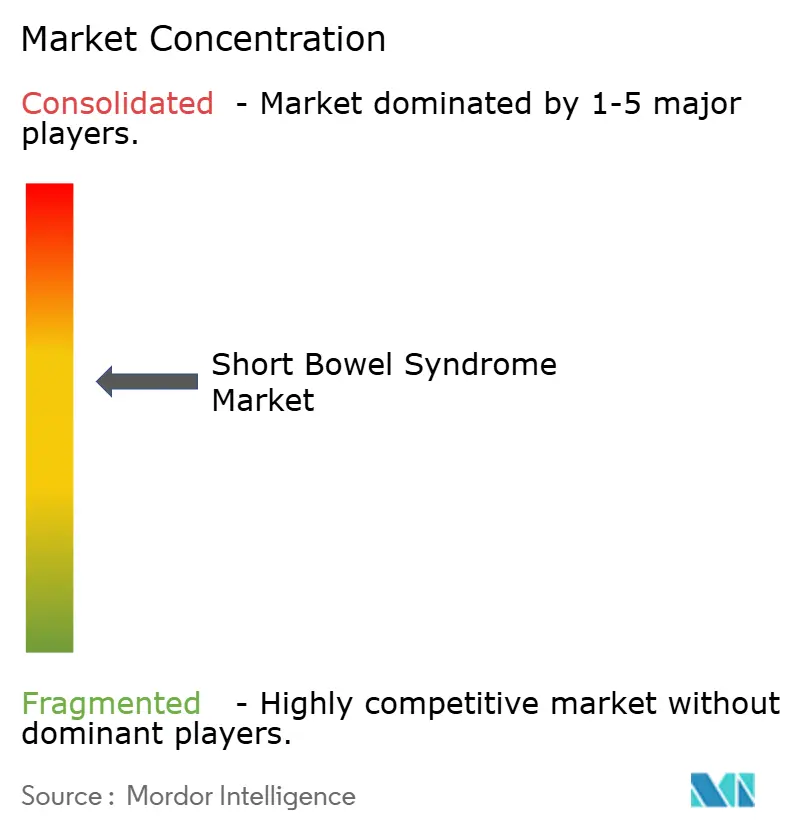
| Market Concentration | Medium |
Major Players *Disclaimer: Major Players sorted in no particular order Image © Mordor Intelligence. Reuse requires attribution under CC BY 4.0. | |
Short Bowel Syndrome Market Analysis by Mordor Intelligence
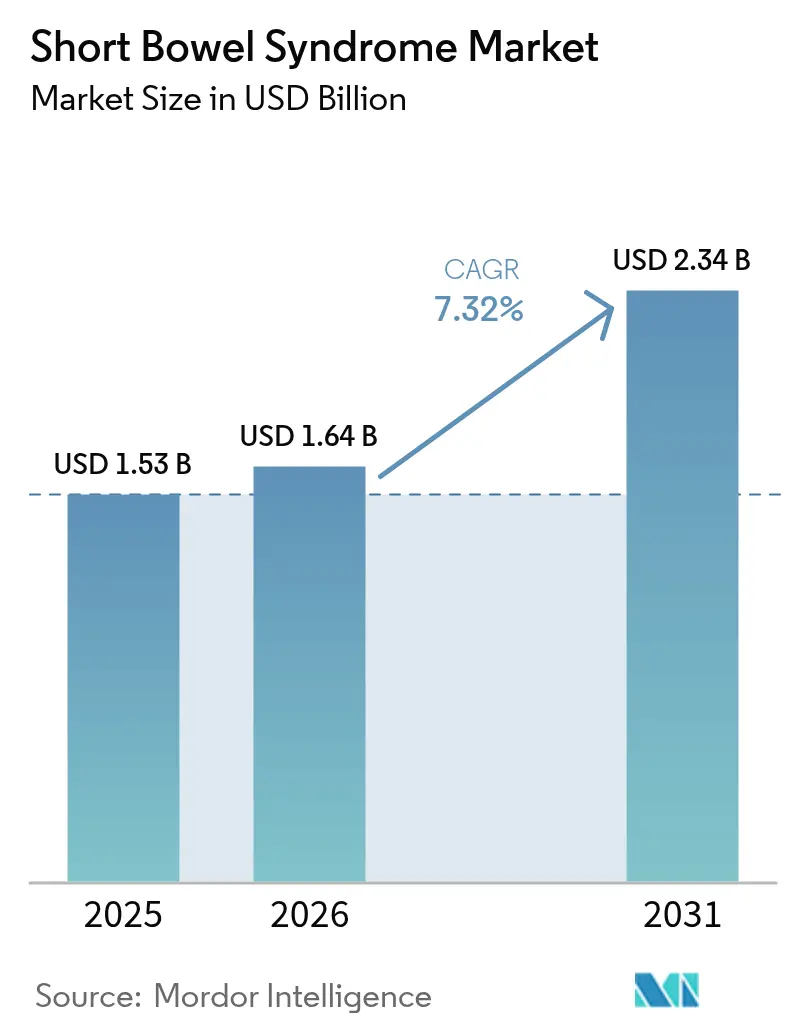
The short bowel syndrome market size is expected to grow from USD 1.53 billion in 2025 to USD 1.64 billion in 2026 and is forecast to reach USD 2.34 billion by 2031 at 7.32% CAGR over 2026-2031. Current expansion is propelled by earlier disease recognition, faster orphan-drug approvals, and tissue-engineering breakthroughs that promise anatomical restoration rather than symptomatic relief. New ICD-10 codes introduced by the Centers for Medicare & Medicaid Services (CMS) in October 2023 are uncovering previously unreported cases and widening the treated population. At the same time, digital health platforms are making home parenteral nutrition (PN) feasible for a larger share of patients, lowering inpatient costs and improving adherence. Competitive intensity is moderate because GLP-2 analogs dominate therapy choices, yet manufacturing bottlenecks, long-term safety monitoring, and rising reimbursement scrutiny create palpable risks. Still, regulatory incentives for rare diseases and converging tissue-engineering research are reshaping the Short Bowel Syndrome market outlook over the next five years.
Key Report Takeaways
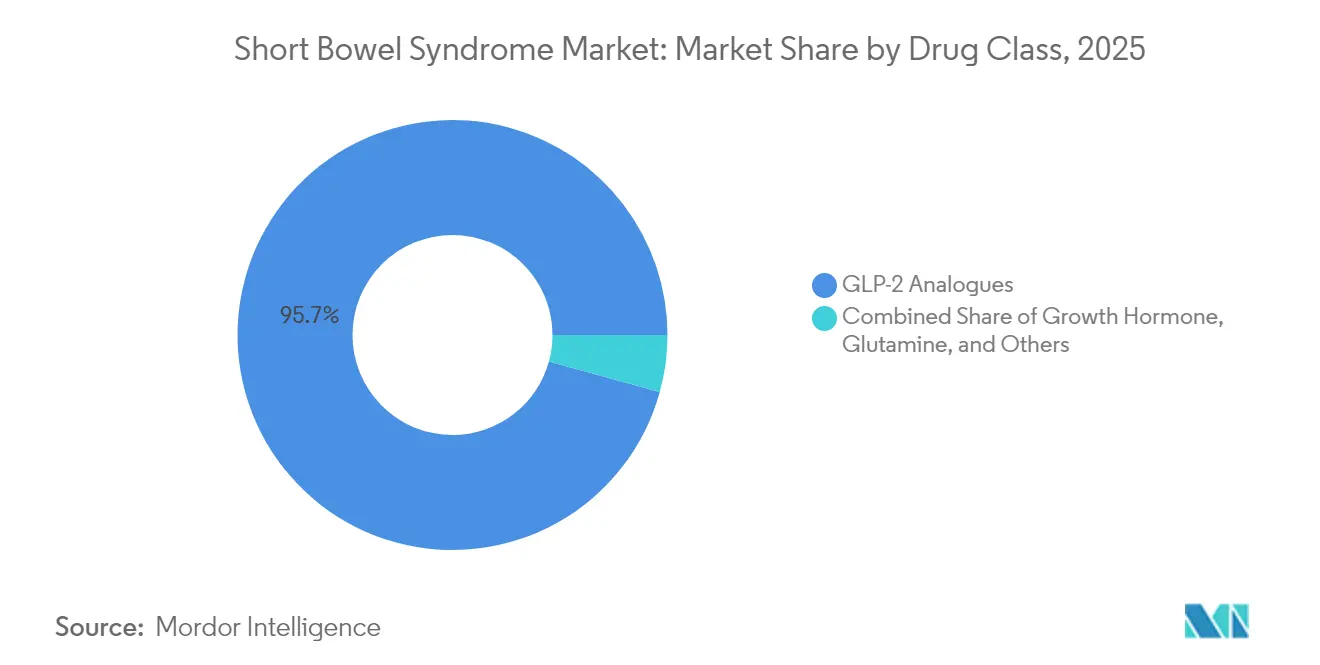
- By drug class, GLP-2 analogs led with 95.72% of Short Bowel Syndrome market share in 2025, while growth hormone therapies are projected to expand at an 7.94% CAGR through 2031.
- By distribution channel, hospital pharmacies controlled 55.93% revenue in 2025; online & others are poised for an 8.51% CAGR to 2031.
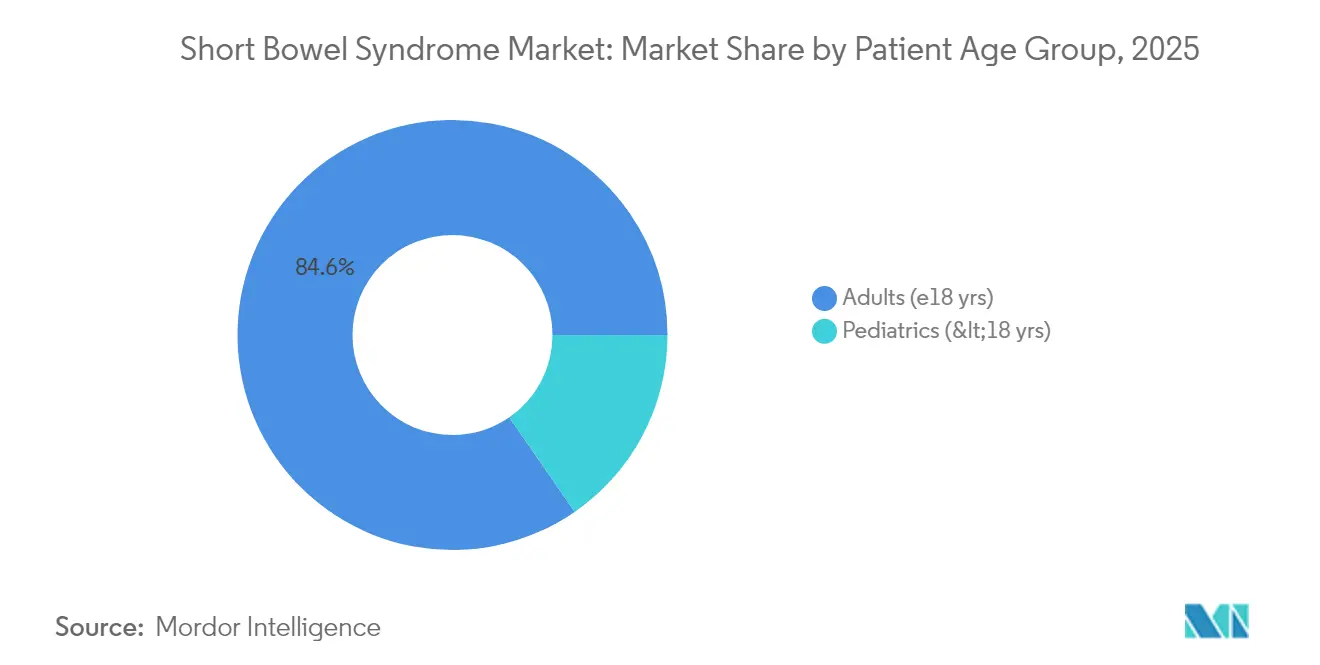
- By patient age, adults accounted for 84.62% of the Short Bowel Syndrome market size in 2025, whereas pediatrics is expected to grow at 8.72% CAGR through 2031.
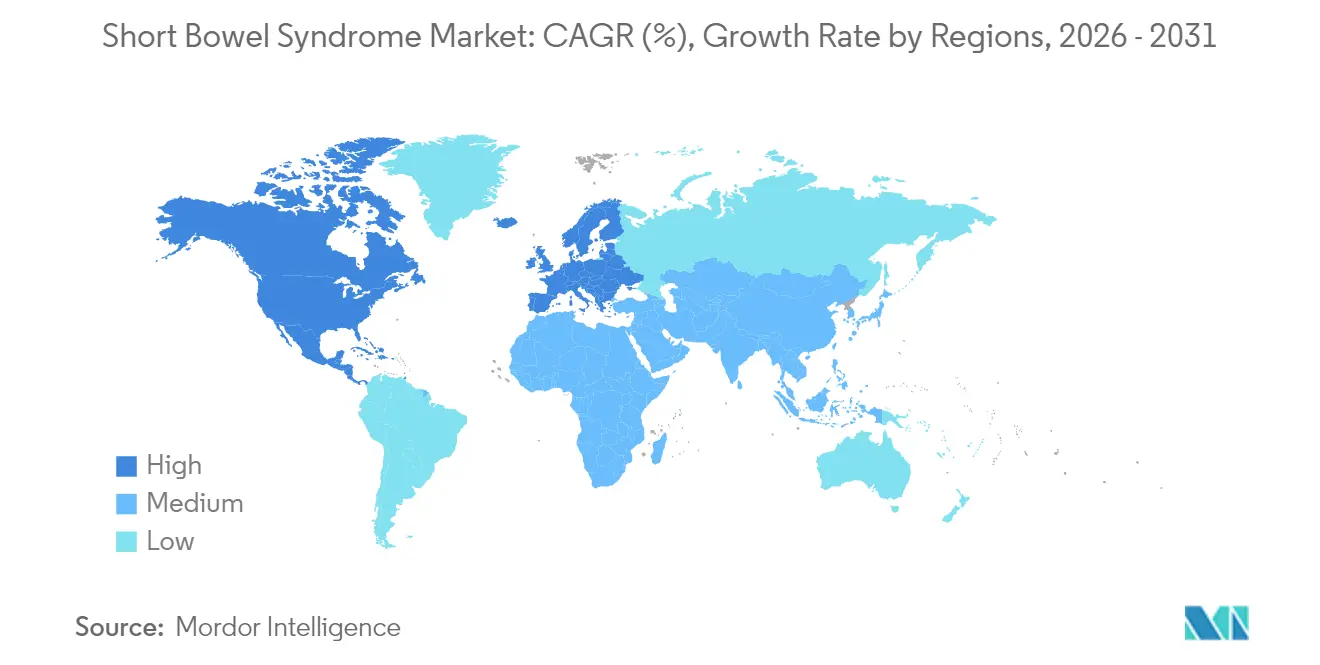
- By geography, North America commanded 42.05% revenue in 2025; Asia-Pacific is set to accelerate at a 8.96% CAGR to 2031.
Note: Market size and forecast figures in this report are generated using Mordor Intelligence’s proprietary estimation framework, updated with the latest available data and insights as of 2026.
Market Trends and Insights
Drivers Impact Analysis of Short Bowel Syndrome Market*
| Driver | (~) % Impact on CAGR Forecast | Geographic Relevance | Impact Timeline |
|---|---|---|---|
| Rising prevalence of SBS & complex GI surgeries | +1.8% | North America & Europe | Medium term (2-4 years) |
| Accelerated approvals & uptake of GLP-2 analogs | +2.1% | North America & EU, APAC | Short term (≤ 2 years) |
| Orphan-drug incentives & favorable reimbursement | +1.4% | North America & Europe | Long term (≥ 4 years) |
| Global patient-registry & NGO awareness initiatives | +0.9% | Global | Medium term (2-4 years) |
| Tissue-engineered intestine R&D breakthroughs | +1.2% | North America & Europe | Long term (≥ 4 years) |
| Remote PN-monitoring digital platforms | +0.6% | Developed markets | Short term (≤ 2 years) |
| Source: Mordor Intelligence | |||
Rising Prevalence of SBS & Complex GI Surgeries
Neonatal surgical advances have lifted survival in very low birth-weight infants, yet they have also pushed neonatal SBS incidence to 22.1 per 1,000 NICU admissions in recent cohorts [1] Journal of Pediatric Surgery Editorial Board, “Short Bowel Syndrome Epidemiology,” sciencedirect.com. Adult incidence is rising for similar reasons: oncologic and inflammatory bowel resections are now more radical, preserving life but shortening bowel length. CMS coding changes in 2023 created visibility for these additional cases, encouraging earlier referrals and stimulating demand for novel therapeutics.
Accelerated Approvals & Uptake of GLP-2 Analogs
The FDA expanded teduglutide to children aged ≥1 year and granted fast-track status to newer molecules such as apraglutide and sonefpeglutide, creating a virtuous cycle of innovation and access. Takeda’s Gattex/Revestive posted JPY 119.3 billion sales in fiscal 2024, up 28.1% year over year [2]Takeda Pharmaceutical Company Limited, “FY 2024 Full-Year Results,” takeda.com. Conversely, Zealand Pharma’s glepaglutide received a Complete Response Letter in December 2024, highlighting the market’s regulatory volatility.
Orphan-Drug Incentives & Favorable Reimbursement
U.S. Medicare covers home PN under Part B when strict criteria are met, and advocacy groups are working to update the three-decade-old policy to widen access [3]Oley Foundation Advocacy Team, “Medicare Home PN Coverage,” oley.org. In Europe, NICE endorsed teduglutide under managed-entry agreements, balancing cost effectiveness with patient need. These incentives enable premium pricing and attract continued investment even as payers demand real-world evidence of PN reduction.
Global Patient-Registry & NGO Awareness Initiatives
Registries coordinated by ESPEN and foundations such as IFFGD generate longitudinal data on safety and quality of life, expediting regulatory filings and reimbursement reviews. Awareness initiatives in emerging markets are crucial, as clinicians historically under-diagnosed SBS because they lacked dedicated codes or training.
Tissue-Engineered Intestine R&D Breakthroughs
Tissue-engineered small intestine constructs restored 98% weight recovery in animal models versus 76% for controls. Colonic SATB2 gene knock-out reprogrammed colon tissue toward small-intestinal function, improving nutrient uptake in preclinical studies. Stem-cell organoids now achieve 17% engraftment after 10 weeks, supporting first-in-human trials.
Restraints Impact Analysis of Short Bowel Syndrome Market*
| Restraint | (~) % Impact on CAGR Forecast | Geographic Relevance | Impact Timeline |
|---|---|---|---|
| High therapy cost & limited access in LMICs | -1.3% | Primarily LMIC regions, some impact in developed markets | Long term (≥ 4 years) |
| Serious long-term safety concerns (e.g., neoplasia) | -0.8% | Global, with regulatory focus in North America & Europe | Medium term (2-4 years) |
| Peptide-manufacturing supply-chain bottlenecks | -1.1% | Global, concentrated in major manufacturing hubs | Short term (≤ 2 years) |
| Disruptive competition from microbiome & surgical innovations | -0.6% | North America & Europe leading innovation, global adoption | Long term (≥ 4 years) |
| Source: Mordor Intelligence | |||
High Therapy Cost & Limited Access in LMICs
Total annual therapy costs exceed USD 43,000 per patient when factoring PN, monitoring, and complication management. Many LMIC health systems lack reimbursement frameworks or the cold-chain logistics for GLP-2 analogs. Manufacturers are experimenting with tiered pricing, but infrastructure constraints persist, motivating interest in low-cost peptides or simplified PN regimens.
Serious Long-Term Safety Concerns (e.g., Neoplasia)
GLP-2 analogs mandate baseline and regular colonoscopies because long-term exposure may elevate polyp risk. Hyperamylasemia and hyperlipasemia have also been reported, particularly in pediatric cohorts. Regulators now require extended post-marketing surveillance, raising trial costs and deterring smaller entrants.
*Our forecasts treat driver/restraint impacts as directional, not additive. The impact forecasts reflect baseline growth, mix effects, and variable interactions.
Short Bowel Syndrome Market Segment Analysis
By Drug Class:
GLP-2 Dominance Faces Innovation PressureGLP-2 analogs accounted for 95.72% of the Short Bowel Syndrome market in 2025, propelled by teduglutide’s robust evidence base. Growth hormone therapies, though smaller in absolute sales, are set for 7.94% CAGR through 2031 as pediatric specialists employ them to spur mucosal adaptation. Weekly and monthly GLP-2 candidates like apraglutide and sonefpeglutide seek to reduce injection burden, whereas OPKO Health and Entera Bio are developing the first oral GLP-2 peptide, a shift that could reposition the Short Bowel Syndrome market size for maintenance therapy. Competitive differentiation now centers on dosing convenience, safety, and incremental PN-reduction data to secure payer acceptance and justify premium prices.
Future uptake will hinge on real-world evidence showing durable PN reduction and manageable colonoscopic surveillance. If next-generation molecules confirm similar efficacy with fewer polyps, the Short Bowel Syndrome market could migrate quickly, fragmenting the current GLP-2 oligopoly. Conversely, any class-wide safety signal could redirect investment toward regenerative or gene-editing modalities.


By Distribution Channel:
Hospital Dominance Challenged by Digital ShiftHospital pharmacies held 55.93% revenue in 2025 because SBS management demands multidisciplinary oversight and sterile compounding. Yet online & others channels are scaling at an 8.51% CAGR as home infusion firms integrate telehealth, IoT-connected pumps, and proactive electrolyte monitoring. Studies show 86% of home PN patients own a connected device, and 63% already engage with health apps. If payers continue rewarding hospital-at-home models, the Short Bowel Syndrome market will distribute more prescriptions through specialty mail-order and digital clinics, shrinking hospital share even as volumes grow.
Retail pharmacies focus on ancillary needs such as antidiarrheals and micronutrient supplements. Their participation could expand if oral GLP-2 formulations succeed, yet stringent cold-chain and counseling requirements still favor specialty or infusion channels today.
By Patient Age Group:
Adult Stability Contrasts Pediatric DynamismAdult patients made up 84.62% of 2025 revenue because oncologic resections and Crohn-related surgeries are more common in later life. This segment has well-defined protocols and centers of excellence, ensuring predictable penetration for every incremental therapy. However, pediatric cases are climbing fastest, with an 8.72% CAGR, due to improved neonatal survival of premature infants with necrotizing enterocolitis. A systematic review reported 36 children achieving enteral autonomy on teduglutide after 24 weeks, while 149 showed reduced PN needs. Pediatric formulations, weight-based dosing, and family-centric digital support platforms are poised to capture new value pools and diversify the Short Bowel Syndrome market share currently anchored in adult care.
Long-term safety monitoring is more stringent in children, so sponsors must generate lifetime exposure data and collaborate with registries. High efficacy in growth metrics and neurodevelopmental outcomes will be decisive for caregiver adoption and payer endorsement.
Geography Analysis
North America Short Bowel Syndrome Market
North America generated 42.05% of the Short Bowel Syndrome market in 2025, supported by specialized intestinal-failure centers, Medicare PN reimbursement, and early access to GLP-2 analogs. CMS coding updates and commercial coverage expansions ensure treatment visibility and financial viability, yet payer criteria remain stringent and require documentation of 12-month PN dependence in some plans.
Europe Short Bowel Syndrome Market
Europe retains critical mass through centralized care networks and harmonized guidelines. NICE’s commercial arrangement for teduglutide and ESPEN’s multidisciplinary standards provide structure and reduce therapeutic variability. EU clinical consortia also drive first-in-human tissue-engineering trials, strengthening the region’s innovation footprint.
APAC Short Bowel Syndrome Market
Asia-Pacific is the fastest-growing territory at 8.96% CAGR through 2031, driven by regulatory modernization in China and increased resection volumes tied to rising colorectal cancer incidence. China’s 2023 regulations on special-medical-purpose formula expand access to nutritionally balanced enteral feeds, complementing PN and pharmacotherapy. Japan’s inclusion in global apraglutide trials exemplifies the region’s integration into pivotal studies, accelerating time-to-approval for novel agents.

Regulatory Landscape
Regulation for short bowel syndrome (SBS) therapeutics is shaped by rare-disease pathways, biologics quality requirements, and payer-linked evidence expectations, with GLP-2 analogs as the anchor class. In the United States, teduglutide (GATTEX, Takeda) remains the established GLP-2 option for SBS, and FDA labeling updates (revised prescribing information in September 2025) plus ongoing long-term safety monitoring requirements continue to affect utilization protocols.
In Europe, the European Medicines Agency (EMA) frames access through centralized approvals and post-authorization oversight. In January 2026, EMA marketing authorization for Teduglutide Viatris (positioned as a generic equivalent to Revestive) marked an important regulatory milestone that can affect tender dynamics and price corridors in EU markets, while keeping the same core pharmacovigilance expectations for teduglutide-class products. For pipeline entrants, regulator feedback continues to raise the evidence bar: in April 2025, Ironwood reported FDA feedback requiring a confirmatory Phase 3 trial for apraglutide in SBS with intestinal failure dependent on parenteral support, indicating a tightening standard for new GLP-2 approvals.
Value Chain Analysis
The SBS therapeutics value chain is built around peptide drug development (GLP-2 analogs and adjunct agents), specialized manufacturing, and distribution models tied to intestinal-failure care pathways. Upstream work starts with discovery and clinical development at biopharma sponsors, followed by scale-up and sterile fill-finish for injectable peptides under GMP controls. Manufacturing continuity depends on specialized inputs, including single-use components and peptide production media, as well as qualified sterile filling capacity. Regulatory gating at the manufacturing step, including USP 797 aligned sterile compounding expectations and EMA GMP certification, limits how quickly capacity can shift and reinforces the role of established, quality-accredited facilities.
Downstream, demand generation concentrates around intestinal-failure centers and multidisciplinary prescribers, with procurement routed through hospital pharmacies and specialty infusion networks that support home parenteral nutrition coordination. Specialty distribution and cold-chain logistics remain critical for GLP-2 analogs, and homecare procurement consolidation in major markets has increased negotiating leverage and compressed service margins, pushing manufacturers to bundle patient-support services and real-world evidence generation. Partnerships are a key scaling mechanism across the chain: in June 2026, Eli Lilly signed a USD 1.26 billion licensing agreement with Hanmi to develop, manufacture, and commercialize the long-acting GLP-2 analogue sonefpeglutide for SBS, showing how large-cap entrants use licensing to secure late-stage assets and manufacturing know-how while expanding global commercialization reach.
Competitive Landscape
Takeda leads with Gattex/Revestive, in fiscal 2024, affirming its entrenched GLP-2 franchise. Ironwood pivoted its portfolio in 2025 to concentrate on apraglutide, filing an NDA and downsizing non-core projects to streamline capital toward commercialization. Zealand Pharma, recovering from a CRL, is conducting additional histology studies aimed at re-filing in 2026, while Hanmi targets monthly dosing to leapfrog convenience.
Strategic moves emphasize dosing interval, safety reassurance, and integrated care platforms that track PN volume, weight, and electrolyte metrics. VectivBio (now a CSL Behring subsidiary) merged to secure global commercial muscle for its pipeline, signaling potential for further consolidation. OPKO Health and Entera Bio are collaborating on an oral GLP-2 tablet, betting that ease of administration will unlock retail channels and broaden adherence. Digital alliances are equally active: Takeda partners with remote-monitoring firms to embed catheter surveillance and infusion-pump analytics, aiming at fewer catheter-related infections.
If future data validate tissue-engineered constructs, incumbents may license or acquire regenerative start-ups to hedge against GLP-2 exposure. Manufacturing scale-up of complex biologics remains a barrier; hence, companies with peptide production capacity are well placed to capture incremental share as demand climbs.
Short Bowel Syndrome Industry Leaders
TAKEDA Inc
OxThera
VectivBio AG
Ardelyx
Nutricia
- *Disclaimer: Major Players sorted in no particular order
Short Bowel Syndrome Market Companies Covered in this Report
- Takeda Pharmaceuticals
- Zealand Pharma
- VectivBio
- Ironwood Pharmaceuticals
- OxThera AB
- Nutrinia Ltd.
- Merck
- Ardelyx Inc.
- Nestlé Health Science
- Hanmi Pharmaceutical
- 9 Meters Biopharma
- Opko Health
- Jaguar Health
- Pfizer
- Abbvie
- Kyowa Kirin
- Johnson & Johnson

Market Opportunities and Future Outlook
Opportunities are forming where stakeholders can reduce treatment burden, widen reimbursed access, and improve continuity of care for patients dependent on parenteral support. Long-acting GLP-2 programs create whitespace around dosing convenience and adherence support versus daily injectables, and regulatory engagement is already moving forward for new entrants: Ironwood initiated a rolling NDA submission for apraglutide in February 2026 for adult SBS patients dependent on parenteral support, which signals progress toward additional branded options alongside teduglutide.
Access expansion is also creating near-term commercial headroom through payer and formulary levers rather than new indications alone. In May 2026, Takeda Canada announced that BC PharmaCare added Revestive (teduglutide) to its provincial formulary for eligible pediatric and adult SBS patients, demonstrating how provincial reimbursement decisions can translate into uptake in treated populations. Larger biopharma licensing adds another opportunity vector by combining capital and operational scale: in June 2026, Eli Lilly licensed Hanmi’s sonefpeglutide with global rights outside Korea, which can accelerate global clinical execution and strengthen market education and distribution readiness in territories where SBS diagnosis and specialty infusion infrastructure are still developing.
Recent Industry Developments in Short Bowel Syndrome Market
- June 2026: Eli Lilly signed a USD 1.26 billion global licensing agreement with Hanmi Pharmaceuticals for sonefpeglutide, a long-acting GLP-2 analogue being developed for short bowel syndrome. The deal transferred development, manufacturing, and commercialization responsibilities to Lilly in most markets, bringing large-cap capabilities to clinical execution and future supply planning for peptide-based SBS therapy.
- May 2026: Takeda Canada announced that BC PharmaCare added Revestive (teduglutide for injection) to its provincial formulary for eligible pediatric and adult SBS patients dependent on parenteral support. The listing strengthens reimbursed access in a major Canadian province and supports broader adoption through government-funded coverage pathways.
- December 2024: Zealand Pharma reported that the FDA issued a Complete Response Letter for the glepaglutide New Drug Application for short bowel syndrome. The response required additional confirmatory clinical work, extending timelines for a competing long-acting GLP-2 option and reinforcing the higher evidentiary threshold for SBS approvals.


Short Bowel Syndrome Market Report Scope and Research Methodology
Market Definition and Coverage
For this methodology, the short bowel syndrome market is measured as the global revenue generated from prescription therapeutics used to manage SBS and reduce dependence on parenteral nutrition, across major regions and key countries.
Scope exclusions: We exclude parenteral nutrition equipment, intestinal transplant services, and compounded nutritional supplements from the market value.
Segments Covered in This Report
- By Drug Class
- GLP-2 Analogues
- Growth Hormone
- Glutamine
- Others
- By Distribution Channel
- Hospital Pharmacies
- Retail Pharmacies
- Online & Others
- By Patient Age Group
- Adults (≥18 yrs)
- Pediatrics (<18 yrs)
- By Geography
- North America
- United States
- Canada
- Mexico
- Europe
- Germany
- United Kingdom
- France
- Italy
- Spain
- Rest of Europe
- Asia-Pacific
- China
- Japan
- India
- Australia
- South Korea
- Rest of Asia-Pacific
- Middle East & Africa
- GCC
- South Africa
- Rest of Middle East & Africa
- South America
- Brazil
- Argentina
- Rest of South America
- North America
Data Sources, Market Sizing, and Validation
Desk Research
Desk work starts with mapping the SBS patient pool and typical treatment pathways, then linking that to drug utilization and pricing direction. We refer to public health statistics and disease burden outputs, including World Health Organization resources, national health agency publications such as CDC pages, and peer-reviewed gastroenterology journals for prevalence context and care patterns. For market access and care delivery signals, we also review US FDA labels and approvals, EMA assessment documents, and national reimbursement notes where available.
To keep country and region splits grounded, we use public hospital and pharmacy channel information, customs and trade publications when relevant to specialty products, and company filings plus investor presentations that discuss therapy uptake and regional mix. A paid subscription database is also used selectively for company financials and news checks, while a separate patent database is used to validate lifecycle and the likely timing of new therapy options. These desk sources are not exhaustive, and we use other public references for ongoing data collection, validation, and follow-up clarification during the work.
Primary Interviews and Surveys
Primary work is used to stress-test the modeled treated patient pool, typical duration on therapy, and realistic switching and discontinuation behavior across adult and pediatric care settings. We also use clinician, payer, and hospital pharmacist input to check how GLP-2 analog adoption and persistence differ across APAC, EMEA, and the Americas, so gaps from public data can be filled and assumptions can be confirmed before finalizing the sizing.
Distribution of primary research fieldwork respondents
| Company type | Respondent position | Region |
|---|---|---|
| Top tier: 35% | CXOs: 14% | APAC: 41% |
| Mid tier: 43% | Functional/Unit leaders: 40% | EMEA: 32% |
| Smaller Players: 22% | Managers: 46% | Americas: 27% |
Market-Sizing & Forecasting
Market sizing is built by first reconstructing demand from a treated cohort view, where prevalence and diagnosis patterns are filtered into an addressable group that is eligible for drug therapy, and then converted into annual revenue using typical dosing, therapy duration, and an average selling price by country. To keep the totals practical, we use a top-down and bottom-up blend, where the epidemiology-led demand pool is the main structure and it is cross-checked with selective supplier and channel approximations.
Key inputs used in the model include the share of SBS patients on parenteral nutrition, adoption of GLP-2 analog therapies versus other drug classes, average treatment duration and persistence, list price direction and expected net price adjustments, and regional access and reimbursement timing that affects uptake. Where country-level data is thin, gaps are handled using proxy indicators from similar health systems, followed by expert review and adjustment so the final mix still matches observed regional treatment realities.
For forecasting, scenario analysis is used to reflect different adoption speeds for newer therapies and different price paths as products mature, and the selected scenario is aligned with the consensus that emerged from primary discussions. Forecast outputs are also sanity-checked against expected diagnosis and referral trends, and against known launch and access milestones that shift treated volume over time.
Data Validation & Update Cycle
Validation is handled through repeated cross-checks between the demand pool build, implied treated volumes, and the revenue totals by region, then through variance checks against independent signals such as regional access timing and expected therapy share. When a country result looks unusually high or low, the assumptions behind eligibility, dosing, duration, or price are reviewed, and follow-up outreach is triggered if the driver cannot be explained by desk evidence.
Before sign-off, the work is reviewed in steps so the logic, inputs, and calculations remain consistent across countries and years. Reports are refreshed annually, and interim updates are done when material events occur such as a major approval, label change, or reimbursement shift. Right before delivery, a fresh analyst pass is completed so clients receive the most current view available at that time.
Mordor Intelligence's Short Bowel Syndrome Market Size Versus Other Published Estimates
Different published values for the SBS market can look far apart because the counting rules are not always the same, even when the topic name sounds identical. In practice, differences usually come from geography coverage, what is treated as in-scope revenue, and how treated patient counts and pricing are carried forward year to year.
In SBS specifically, one common gap is whether estimates are truly global or only cover the top therapy markets, and another is whether supportive nutrition items and procedure related revenues get mixed into what is presented as a drug market. The spread also grows when uptake is modeled as a straight line without checking real access timing, and when currency conversion and price changes are not updated near the publication date, which is a scope and refresh choice applied by Mordor Intelligence.
Benchmark comparison
| Source | Market Size | Gaps in Research Methodology |
|---|---|---|
| Mordor Intelligence | USD 1.53 B (2025) | |
| Global Consultancy A | USD 1.65 B (2025) | Uses a broader treatment framing and does not clearly separate prescription therapeutics from adjacent supportive care spend, which can lift the counted revenue in the base year. |
| Industry Association B | USD 2.58 B (2025) | Covers only the top 7 markets and includes a wider set of in-market and pipeline product discussions, so it is not directly comparable to a global therapeutic revenue total. |
Looking at the table, the largest gap is explained by geography and what gets counted as market revenue, rather than by small differences in growth rates. By keeping the treated cohort logic and product scope consistent across countries, the final number stays traceable to clear inputs that can be reviewed and repeated.


Key Questions Answered in the Report
What is the current Short Bowel Syndrome Market size?
The Short Bowel Syndrome Market is projected to register a CAGR of 7.32% during the forecast period (2026-2031)
Who are the key players in Short Bowel Syndrome Market?
TAKEDA Inc, OxThera, VectivBio AG, Ardelyx and Nutricia are the major companies operating in the Short Bowel Syndrome Market.
Which is the fastest growing region in Short Bowel Syndrome Market?
Asia Pacific is estimated to grow at the highest CAGR over the forecast period (2026-2031).
Which region has the biggest share in Short Bowel Syndrome Market?
In 2025, the North America accounts for the largest market share in Short Bowel Syndrome Market.
What years does this Short Bowel Syndrome Market cover?
The report covers the Short Bowel Syndrome Market historical market size for years: 2019, 2020, 2021, 2022, 2023 and 2024. The report also forecasts the Short Bowel Syndrome Market size for years: 2026, 2027, 2028, 2029, 2030 and 2031.
Page last updated on:


 Your data is secure and never sold or shared.


