
Self-injection Device Market Size and Share
Market Overview
| Study Period | 2020 - 2031 |
|---|---|
| Market Size (2026) | USD 27.87 Billion |
| Market Size (2031) | USD 45.88 Billion |
| Growth Rate (2026 - 2031) | 10.49 % |
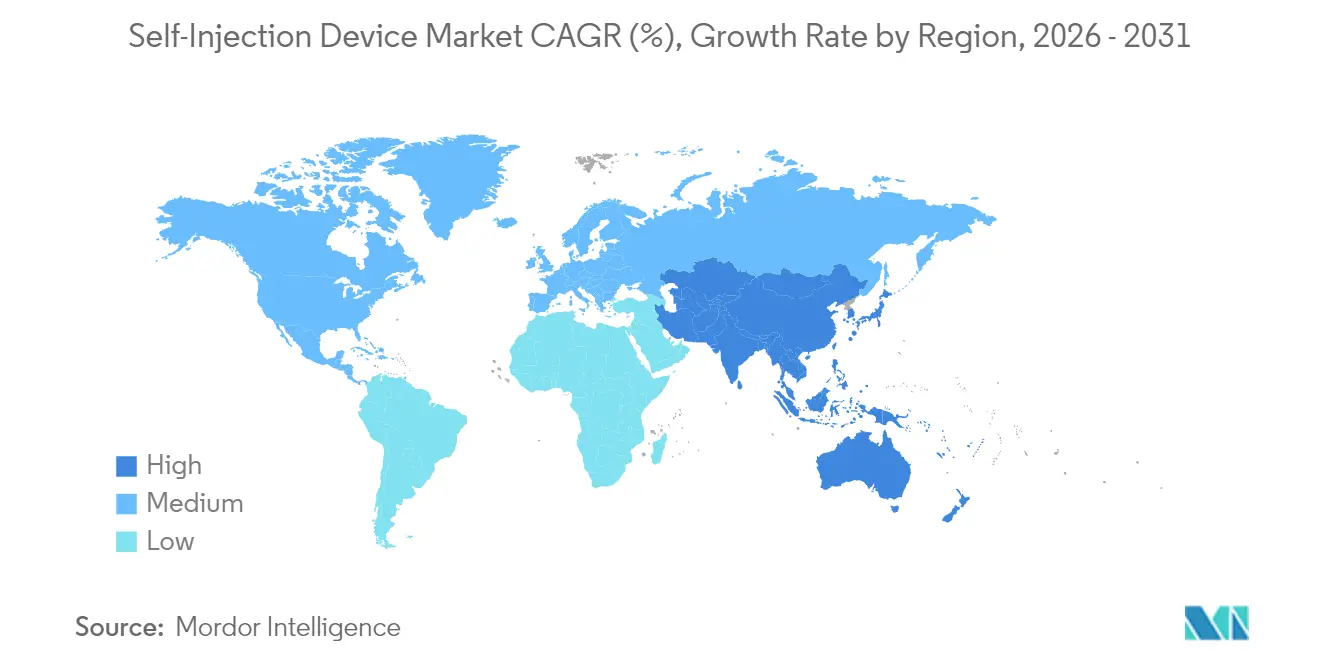
| Fastest Growing Market | Asia Pacific |
| Largest Market | North America |
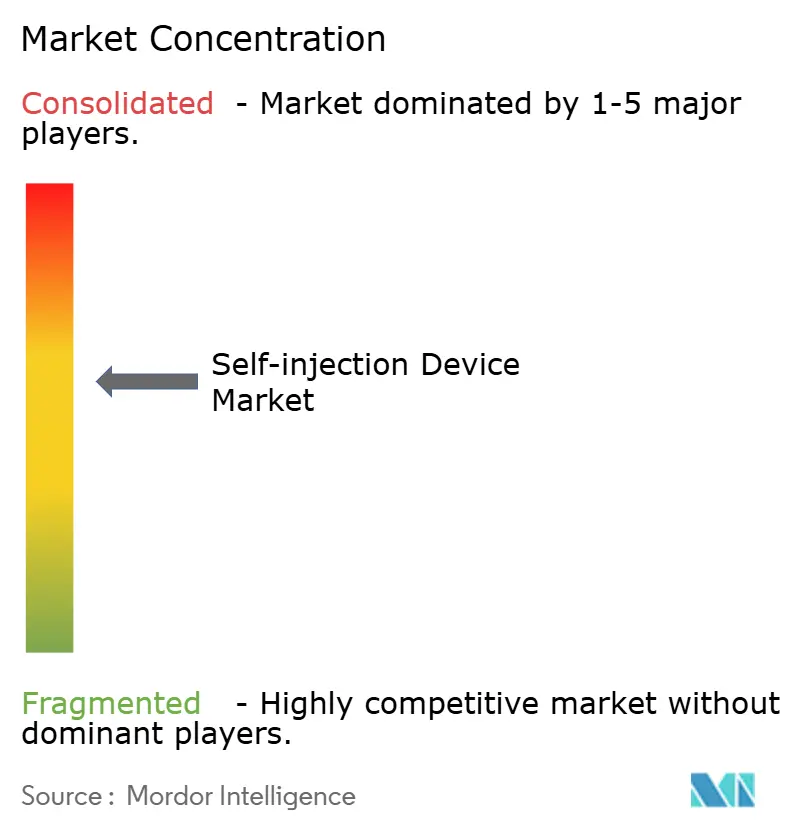
| Market Concentration | Medium |
Major Players *Disclaimer: Major Players sorted in no particular order Image © Mordor Intelligence. Reuse requires attribution under CC BY 4.0. | |
Self-injection Device Market Analysis by Mordor Intelligence
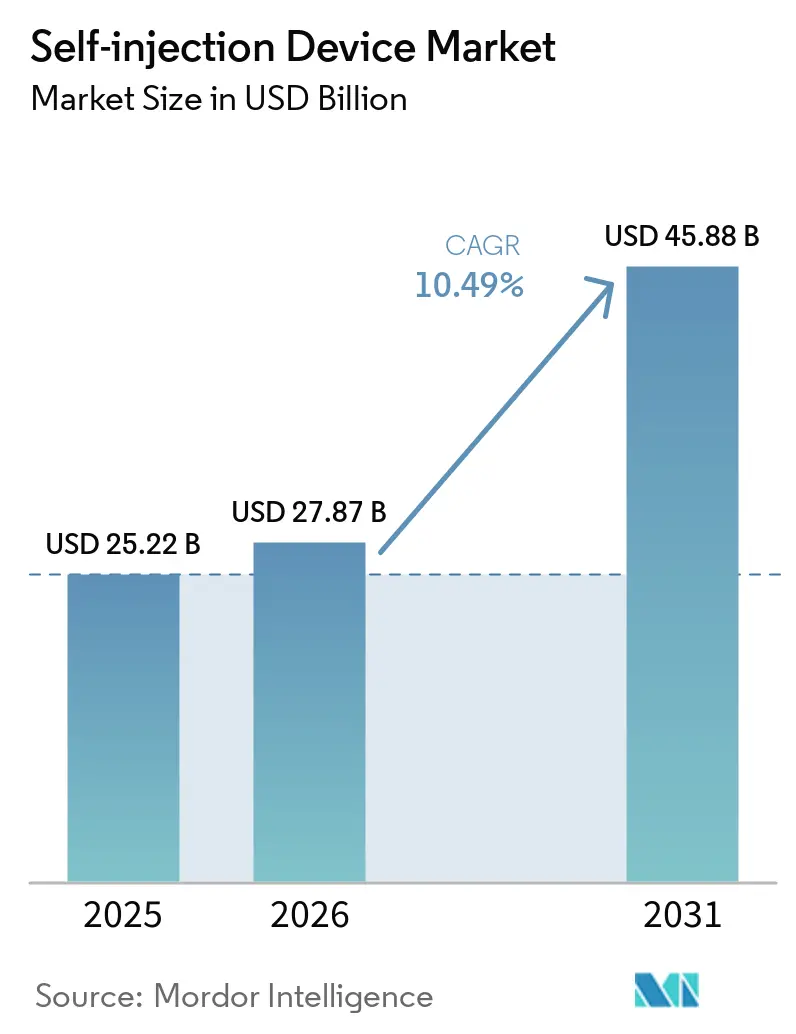
The self-injection devices market size was valued at USD 25.22 billion in 2025 and estimated to grow from USD 27.87 billion in 2026 to reach USD 45.88 billion by 2031, at a CAGR of 10.49% during the forecast period (2026-2031). Growth rests on three pillars: population aging that drives chronic disease prevalence, the biopharmaceutical shift toward patient-centric delivery formats, and payer pressure to keep treatment in lower-cost settings. Pharmaceutical producers, device specialists, and contract manufacturers are expanding capacity for glucagon-like peptide-1 (GLP-1) therapies, oncology drugs, and other biologics formulated for at-home administration, signalling durable demand for advanced injection platforms. Regulatory harmonisation—in particular the United States Food and Drug Administration’s streamlined pathways for combination products and the European Union’s evolving Medical Device Regulation (MDR)—shortens approval cycles and spurs device iteration. Meanwhile, biosimilar launches are widening access to molecules once confined to infusion centres, further shifting the point of care to the patient’s home. Novo Nordisk’s USD 4.1 billion factory programme in North Carolina and the FDA clearance of Hikma’s liraglutide biosimilar in December 2024 encapsulate the dual forces of large-scale capacity build-out and affordable alternatives that underpin the current expansion[1].
Key Report Takeaways
- By product category, pen injectors retained 47.12% of self-injection devices market share in 2025; wearable injectors are projected to expand at a 14.06% CAGR to 2031.
- By usage, disposable formats held 60.58% of the self-injection devices market size in 2025, while re-usable systems record the highest projected CAGR at 12.01% through 2031.
- By application, diabetes and hormonal disorders led with 46.02% of self-injection devices market size in 2025, whereas oncology registers the fastest 13.09% CAGR to 2031.
- By geography, North America commanded 38.12% revenue share in 2025; Asia-Pacific is the fastest-growing region, advancing at an 11.21% CAGR through 2031.
Note: Market size and forecast figures in this report are generated using Mordor Intelligence’s proprietary estimation framework, updated with the latest available data and insights as of 2026.
Market Trends and Insights
Drivers Impact Analysis of Self-injection Device Market*
| Driver | (~) % Impact on CAGR Forecast | Geographic Relevance | Impact Timeline |
|---|---|---|---|
| Rising prevalence of chronic diseases | +2.1% | Global with North America & Europe concentration | Long term (≥ 4 years) |
| Increasing patient preference for home healthcare | +1.8% | Global, led by North America & Asia-Pacific cities | Medium term (2–4 years) |
| Expansion of biologic & biosimilar therapeutics | +2.3% | North America & EU; emerging in Asia-Pacific | Medium term (2–4 years) |
| Advancements in drug-device combination technologies | +1.6% | Global, R&D centred in North America & EU | Long term (≥ 4 years) |
| Supportive reimbursement & cost-containment policies | +1.4% | North America & EU; developing in Asia-Pacific | Short term (≤ 2 years) |
| Growing pharma–medtech partnerships | +1.2% | Global, investment hubs in North America & EU | Medium term (2–4 years) |
| Source: Mordor Intelligence | |||
Rising Prevalence of Chronic Diseases
More than 537 million adults live with diabetes and cancer incidence has climbed 47% since 2000; these figures create a sustained pull for at-home injection therapies. Insulet’s SmartAdjust clearance in August 2024 illustrates regulators’ support for automated insulin delivery platforms that lower facility pressure while enabling multidisease care. Pharmaceutical pipelines now bundle agents addressing comorbidities into single high-viscosity formulations deliverable via connected autoinjectors, improving adherence and containing costs borne by payers. Ageing demographics in Europe, North America, and parts of Asia amplify the long-run influence of this driver.
Increasing Patient Preference For Home Healthcare
Pandemic-era exposure to telehealth strengthened demand for self-administration tools that offer privacy and flexibility. Coherus BioSciences’ UDENYCA ONBODY came to market in February 2024, letting neutropenia patients avoid a second clinic visit for pegfilgrastim. Real-time adherence monitoring and dosing feedback delivered through Bluetooth-enabled pen injectors lessen safety concerns and align with payers’ desire to shift care outside hospitals. Younger cohorts comfortable with digital interfaces now expect connected devices as standard rather than premium features, supporting mid-term growth.
Expansion of Biologic & Biosimilar Therapeutics
A recent screen identified 182 large-volume subcutaneous biologics—15% of all injectable biologics—highlighting the demand for platforms accommodating 2–10 mL doses while maintaining viscosity tolerances beyond 15 cP. BD’s collaboration with Ypsomed on the Neopak XtraFlow syringe for YpsoMate 2.25 underscores the tooling and glass-barrel innovations necessary to capture this opportunity. Patent cliffs for adalimumab, trastuzumab, and other blockbusters hasten biosimilar entry, expanding patient pools and pushing device volumes up across mature and emerging markets alike.
Advancements in drug-device combination technologies
R&D teams are embedding micro-controllers, pressure sensors, and cellular chips into autoinjectors to transform them into data-rich therapeutic managers. SHL Medical holds 227 active patent families covering disposable autoinjector layouts, drive mechanisms, and connectivity stacks, illustrating the intellectual property intensity of the segment. The FDA’s interoperability designation for diabetes ecosystems accelerates acceptance of modular, app-integrated devices that personalise dosing on the fly. Over the long term, these developments position self-injection devices as nodes within broader digital-health networks.
Restraints Impact Analysis of Self-injection Device Market*
| Restraints Impact Analysis | (~) % Impact on CAGR Forecast | Geographic Relevance | Impact Timeline |
|---|---|---|---|
| Stringent regulatory & quality compliance requirements | -1.7% | Global, highest in North America & EU | Long term (≥ 4 years) |
| Availability of alternative drug-delivery modalities | -1.2% | Global, concentration in developed markets | Medium term (2–4 years) |
| High upfront device development & manufacturing costs | -1.5% | Global, most acute for small and mid-size manufacturers in the EU & US | Medium term (2–4 years) |
| Concerns over safety, needle anxiety & user errors | -1.3% | Global, with heightened sensitivity in pediatric and geriatric cohorts | Short term (≤ 2 years) |
| Source: Mordor Intelligence | |||
Stringent Regulatory & Quality Compliance Requirements
The European Parliament’s October 2024 vote to revise MDR deadlines showed how certification backlogs can stall product introductions and inflate compliance costs, which can top USD 50 million for a globally launched combination product[2]. The FDA treats on-body injectors as Class II devices subject to special performance controls, adding design-verification layers that can lengthen timelines by 18 months. Smaller innovators often lack the capital for parallel submissions across regions, consolidating power among larger companies with dedicated regulatory teams.
Availability of Alternative Drug-Delivery Modalities
Rani Therapeutics’ capsule-based delivery platform attracted obesity-drug collaborators in 2024, spotlighting oral biologic options that bypass injections entirely. Transdermal microneedle patches, a USD 768.9 million segment in 2024, are on a path to double within a decade, creating substitution risk in dermatology and vaccine indications[3]. Long-acting depot injections lower dosing frequency and therefore device utilisation, while needle-free jet injectors challenge the conventional needle-and-syringe paradigm, forcing incumbents to invest in alternative formats or risk share erosion.
*Our forecasts treat driver/restraint impacts as directional, not additive. The impact forecasts reflect baseline growth, mix effects, and variable interactions.
Self-injection Device Market Segment Analysis
By Product:
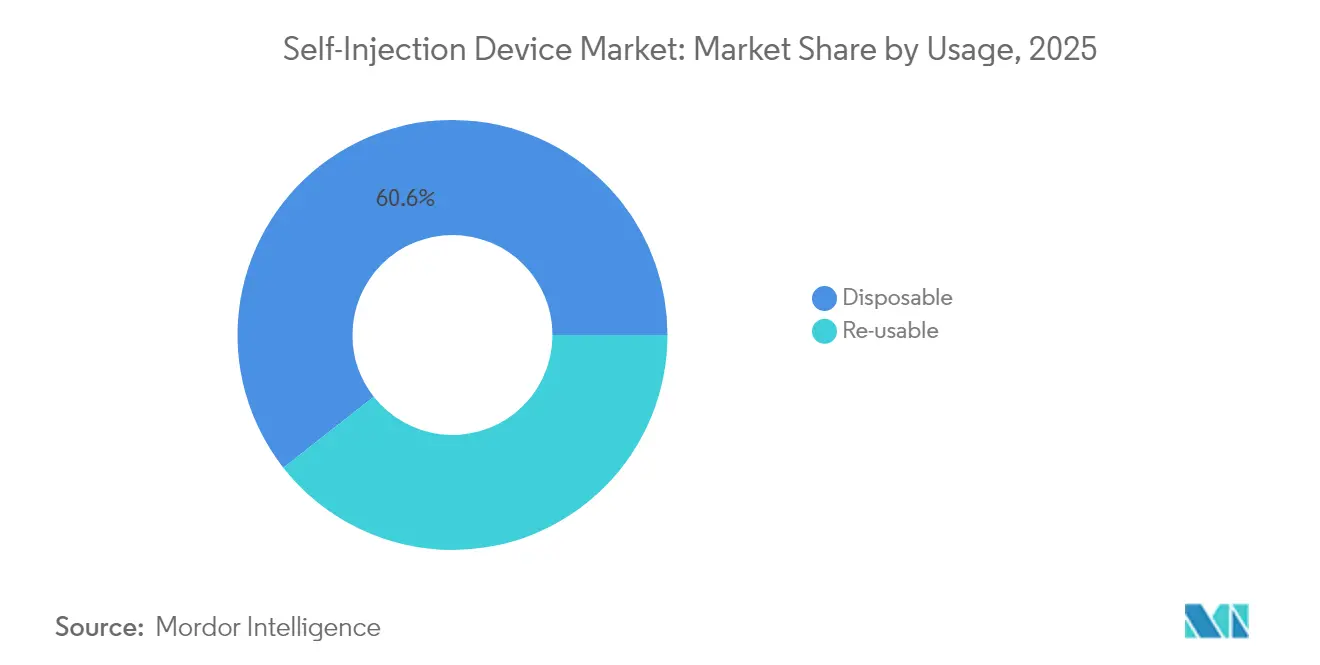
Wearable Injectors Accelerate Innovation Despite Pen DominancePen injectors generated the highest revenue, holding 47.12% self-injection devices market share in 2025, supported by mature manufacturing infrastructure and clinician familiarity. The self-injection devices market size for pens is projected to reach USD 19.13 billion by 2031 at a steady 8.27% CAGR. Wearable injectors, however, outpace every other product class at a 12.21% rate as biologic concentrations and volumes rise. Stevanato Group’s Vertiva on-body system dispenses up to 10 mL over several minutes, lending itself to oncology and rare-disease regimens once limited to intravenous infusion. Auto-injectors remain a resilient sub-segment, buoyed by biosimilar filtration of adalimumab and etanercept into primary care. Needle-free devices, although technologically compelling, still confront price and regulatory hurdles that curb immediate impact.
A second wave of innovation focuses on device connectivity. Bluetooth modules in wearable pumps transmit dosing logs to cloud dashboards, giving physicians granular adherence visibility. Pharmaceutical firms now bundle apps with devices to differentiate therapy packages and gather real-world evidence for health-technology assessments. As data architecture becomes integral, device makers are forced to build cybersecurity competencies alongside mechanical engineering capabilities, raising entry barriers for new entrants and intensifying collaboration needs between software and hardware teams.

By Usage:
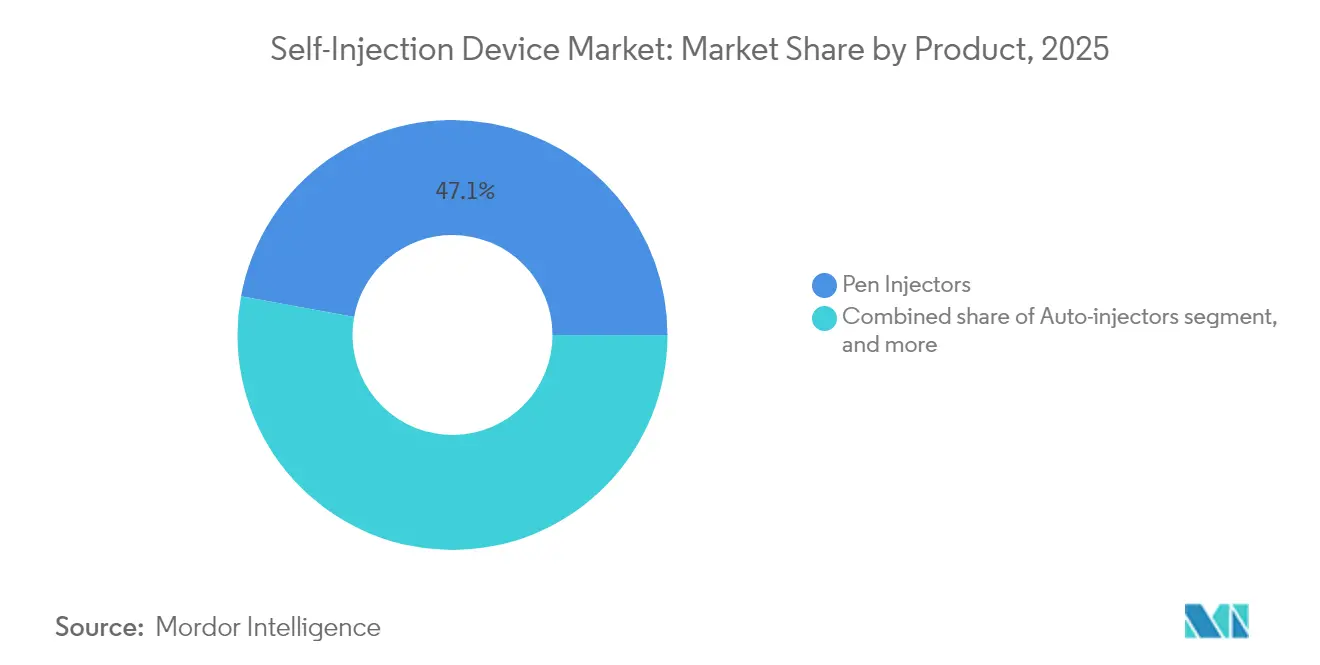
Sustainability Concerns Lift Re-Usable FormatsDisposable units retained 60.58% revenue in 2025 because infection-control guidelines and patient convenience favour single-use simplicity. Yet pressure from European regulators and hospital sustainability mandates is nudging buyers toward re-usables, which are expanding at 12.01% annually through 2031. The self-injection devices market size for re-usable formats is forecast to climb from USD 9.94 billion in 2025 to USD 19.59 billion by 2031. SHL Medical’s electromechanical Elexy platform, compatible with cartridges and prefilled syringes from 1–5 mL, addresses both environmental and cost objectives by spreading electronics across hundreds of injections.
Healthcare providers in France and Sweden have begun pilot tenders requiring carbon-footprint disclosures, accelerating adoption curves for re-usable hardware. Meanwhile, the economics of embedding radios, batteries, and displays favour re-usables because fixed electronics costs are amortised over greater dose counts. Manufacturers respond with modular designs where drug-contact components remain disposable while drive units are retained, balancing sterility with sustainability.
By Application:
Oncology Leads Growth While Diabetes Maintains ScaleDiabetes and hormonal disorders accounted for 46.02% revenue in 2025, underpinned by the entrenched insulin-pen ecosystem and growing prevalence of GLP-1 obesity treatments. However, oncology indications register the fastest 13.09% CAGR through 2031 because immuno-oncology agents migrate from infusion chairs to subcutaneous auto-injectors. The FDA’s July 2024 approval of Tecentriq Hybreza, cutting administration time to 7 minutes, accelerates oncologist embrace of in-home dosing protocols. Together, oncology and supportive-care injectors are set to represent USD 7.65 billion self-injection devices market size by 2031.
Autoimmune-disease treatments continue to benefit from 1 mL autoinjectors, but pipeline analysis shows upcoming agents trending toward higher concentrations, which may shift volume to wearable devices. Pain management lags because opioid stewardship dampens injections, although neurology biologics for migraine and multiple sclerosis add incrementally. Niche growth appears in rare diseases where high-cost therapies demand precision delivery to justify payer reimbursement.
Geography Analysis
North America Self-injection Device Market
North America contributed 38.12% of global revenue in 2025 thanks to robust reimbursement, high biologic penetration, and early connected-device adoption. The region’s self-injection devices market size is on track to grow 9.05% per year through 2031, supported by BD’s expanded syringe-barrel capacity and the FDA’s clear guidance on digital-health add-ons. Canada’s health-technology assessments increasingly endorse connected autoinjectors for adherence improvement, while Mexico’s maquiladora site expansions create a cost-efficient production corridor for export into the United States.
APAC Self-injection Device Market
Asia-Pacific, expanding at an 11.21% CAGR, is propelled by China’s National Medical Products Administration, which approved 12,213 devices in 2024, a gateway for local manufacturers scaling into global supply chains. India’s contract-development organisations are pairing with European pharma to build fill-finish lines dedicated to GLP-1 pens, compressing lead times and costs. Japan, South Korea, and Australia combine mature reimbursement systems with ageing populations, creating immediate demand for high-end connected devices.
Europe Self-injection Device Market
Europe sustains mid-single-digit growth as MDR compliance costs restrain smaller players even while harmonised rules simplify multi-country launches. Germany’s sickness funds reimburse electromechanical pens when paired with outcomes-based contracts that cap payer risk. The UK’s National Institute for Health and Care Excellence (NICE) has invited real-world evidence generated by connected autoinjectors into cost-effectiveness files, a move expected to encourage broader digital uptake across the bloc. Eastern European markets remain cost-sensitive but are adopting disposable pens for biosimilar adalimumab at faster clips than Western peers.
South America and MEA Self-injection Device Market
South America and the Middle East & Africa are at earlier stages, yet rising chronic-disease incidence and public-sector procurement reforms point to higher volumes over the decade. Brazil’s national immunisation plan has already earmarked budget for 3 mL prefilled devices to support oncology biosimilars, while Saudi Arabia’s Vision 2030 healthcare push fast-tracks registration of patient-centric devices.
Regulatory Landscape
Self-injection devices are regulated primarily as drug-device combination products, so approvals and lifecycle changes must meet both medicinal-product requirements and device controls. In the United States, the FDA oversees combination products through coordinated review, and the agency finalized amendments to 21 CFR Part 820 in February 2024 to align the Quality System Regulation with ISO 13485, with the updated framework taking effect on February 2, 2026. Manufacturers of pens, autoinjectors, and on-body systems will need to refresh quality documentation, design controls, and supplier management to match these ISO-aligned expectations.
In Europe, the EU Medical Device Regulation (MDR) and the EMA guidance on medical devices used with medicinal products frame how device constituents are assessed within marketing applications, with notified-body capacity and the depth of documentation remaining practical gating items for launches. Industry technical conformity is also anchored by injection-system standards: ISO published ISO 11608-1:2022/Amd 1:2026 (April 23, 2026) and ISO 11608-3:2022/Amd 1:2026 (April 16, 2026), tightening expectations for needle-based injection systems and integrated fluid paths, including particulate-related verification. Taken together, FDA quality-system alignment and updated ISO performance standards lift the compliance bar for high-viscosity and large-volume self-injection platforms, where human factors, container-closure, and device reliability are central to approvals.
Competitive Landscape
BD, SHL Medical, and Insulet anchor a market that remains moderately consolidated; the top five firms jointly hold roughly 60% share. BD surpassed USD 1 billion in biologics-delivery sales and deepened its moat with a French plant that will lift prefillable syringe output sevenfold by 2030. SHL Medical safeguards its lead through a patent wall and, in March 2025, inaugurated a United States facility to shorten customer supply chains and capture rising biologic volumes. Insulet exemplifies therapeutic-area specialisation: with more than 500,000 active global users of the Omnipod system, it booked 22% revenue growth in 2024 and plans a product family extension into multi-hormone delivery.
Competitive strategy now centres on three vectors. First, capacity scalability—Gerresheimer’s USD 180 million Georgia expansion and Gerresheimer–Eli Lilly supply deals underscore the premium on secure, high-volume output. Second, technology platforms—BD–Ypsomed’s collaboration illustrates demand for flexible systems that can accept highly viscous formulations without altering patient technique. Third, therapeutic alignment—Aktiv Medical Systems’ partnership with a global pharma company on 4 mL autoinjectors positions it as a go-to platform for obesity agents with higher dose volumes.
Mergers and acquisitions remain an expedient route to pipeline access; Teleflex’s EUR 760 million acquisition of BIOTRONIK’s vascular-intervention unit broadens its drug-coated device portfolio, hinting at further convergence between interventional and subcutaneous delivery technologies. At the fringes, needle-free specialists and oral-delivery startups present disruption risks, although regulatory and clinical validation hurdles remain high. Overall, capital intensity, regulatory expertise, and integrated digital capabilities act as key competitive buffers.
Self-injection Device Industry Leaders
-
Becton, Dickinson and Company
-
Insulet Corporation
-
Ypsomed AG
-
Gerresheimer AG
-
Halozyme (Antares Pharma Inc)
- *Disclaimer: Major Players sorted in no particular order
Self-injection Device Market Companies Covered in this Report
- Beckton Dickinson
- Gerresheimer
- Insulet Corp.
- Ypsomed
- West Pharmaceutical Services
- SHL Medical
- Owen Mumford
- Recipharm
- Halozyme
- Novo Nordisk
- Eli Lilly and Company
- Sanofi
- Roche
- Amgen
- Teva Pharmaceutical Industries
- Bespak by Recipharm
- Nemera
- Phillips-Medisize (Molex)
- Haselmeier GmbH
- Medtronic
Market Opportunities and Future Outlook
The clearest opportunity lies where more therapies shift from IV to subcutaneous delivery and device architectures can handle higher volumes, higher viscosities, and more complex formulations. FDA approval in July 2026 of Sanofi's subcutaneous Sarclisa Escena, administered via Enable Injections' on-body platform, provides a concrete reference point that oncology and other complex biologics can move into on-body administration. This expands the addressable space for wearable injectors beyond traditional endocrine and supportive-care use cases. At the same time, platform co-development is accelerating around larger prefilled formats, with BD and Ypsomed expanding their collaboration in January 2026 to develop a 5.5 mL version of the BD Neopak XtraFlow glass prefillable syringe for the YpsoMate 5.5 autoinjector platform, targeting large-volume subcutaneous delivery needs.
Whitespace is also emerging for device designs that support co-formulation and point-of-use mixing as multi-peptide regimens grow, particularly dual-chamber and monodose formats that help protect stability until injection. Ypsomed's February 2026 introduction of the LyoTwist dual-chamber monodose device reflects commercial momentum behind architectures designed for reconstitution and multi-component delivery in a patient-friendly workflow. Connectivity and interoperability are increasingly treated as baseline requirements in diabetes-related self-administration ecosystems, and Insulet's June 2026 U.S. rollout of an enhanced Omnipod 5 algorithm with additional CGM compatibility shows how software iteration and sensor partnerships translate into differentiated home-care experiences. This, in turn, creates demand for connected, data-generating self-injection platforms across therapeutic areas where adherence evidence supports reimbursement and contracting discussions.
Recent Industry Developments in Self-injection Device Market
- July 2026: Sanofi received FDA approval for subcutaneous Sarclisa Escena, administered via an on-body injector using Enable Injections' platform. The approval showed regulator acceptance of on-body delivery for an anticancer therapy, widening the reference set for wearable injection approaches beyond traditional high-volume biologics use cases.
- March 2025: Ypsomed began construction on a second production facility in Schwerin to expand manufacturing capacity. The project strengthens supply availability for autoinjector and related self-injection platforms and supports shorter lead times for pharma customers scaling biologics programs.
- October 2024: BD and Ypsomed announced a collaboration to advance self-injection systems for high-viscosity biologics. By aligning container and autoinjector development, the partnership addressed a technical constraint in self-administration, enabling device platforms that better handle viscous formulations without changing patient technique.
Self-injection Device Market Report Scope and Research Methodology
Market Definition and Coverage
This market covers hardware devices that let patients self-administer injectable medicines in non-clinical settings, including pen injectors, auto-injectors, wearable injectors, and needle-free injector systems. Values are tracked in USD at the point of sale for the device (including reusable and disposable formats).
Scope exclusions: We exclude hospital-only infusion pumps, standard safety syringes without a self-injection mechanism, and standalone software apps that do not include an injector device.
Segments Covered in This Report
- By Product
- Pen Injectors
- Disposable Pens
- Re-usable Pens
- Auto-injectors
- Prefilled Disposable
- Prefilled Re-usable
- Wearable Injectors
- Large-volume Patch Pumps
- Bolus-on-demand Devices
- Needle-Free Injectors
- Spring-powered Jet
- Gas-powered Jet
- Pen Injectors
- By Usage
- Disposable
- Re-usable
- By Application
- Diabetes & Other Hormonal Disorders
- Auto-immune Diseases
- Oncology
- Pain Management
- Other Applications
- Geography
- North America
- United States
- Canada
- Mexico
- Europe
- Germany
- United Kingdom
- France
- Italy
- Spain
- Rest of Europe
- Asia-Pacific
- China
- Japan
- India
- Australia
- South Korea
- Rest of Asia-Pacific
- Middle East & Africa
- GCC
- South Africa
- Rest of Middle East & Africa
- South America
- Brazil
- Argentina
- Rest of South America
- North America
Data Sources, Market Sizing, and Validation
Desk Research
Desk work starts with aligning the disease and therapy pools that most often use self-injection, and then mapping which device formats are typically prescribed for those therapies. We rely on public health statistics such as CDC and NIH publications, WHO disease and treatment indicators, and OECD health data to anchor patient volumes and care settings over time.
For the device and manufacturing side, we review regulatory and product signals from sources such as the US FDA device databases, the European Commission medical device pages, and clinical literature indexed in PubMed to understand approvals, recalls, and technology shifts. Trade association releases, company annual reports, and investor presentations are used to confirm product portfolios, geographic exposure, and mix changes. Where helpful, we also use paid subscriptions for company financials and intelligence, patent databases, and shipment-level import and export data to cross-check directionality. These source examples are illustrative, and many other public references were also used for data collection, validation, and clarification.
Primary Interviews and Surveys
Primary work is used to confirm what portion of injector demand is tied to at-home administration, how reusable versus disposable preferences are shifting, and how pricing moves by channel and geography. We speak with device makers, contract manufacturers, distributors, healthcare providers, and therapy-area specialists across major regions so the assumptions that were built from desk work can be stress-tested and adjusted.
Distribution of primary research fieldwork respondents
| Company type | Respondent position | Region |
|---|---|---|
| Top tier: 33% | CXOs: 12% | APAC: 49% |
| Mid tier: 47% | Functional/Unit leaders: 41% | EMEA: 33% |
| Smaller Players: 20% | Managers: 47% | Americas: 18% |
Market-Sizing & Forecasting
Sizing is built using a top-down approach where treatment prevalence and diagnosed patient pools are translated into likely self-injection volumes by therapy setting, followed by device-type splits that reflect common prescribing and delivery patterns. Once this demand pool is shaped, value is derived using typical device replacement cycles and average selling price bands by format and region, which are then aligned to currency timing for the year being estimated.
To keep the model practical, we use a short list of market fingerprints as core inputs, such as growth in biologics and biosimilars administered outside hospitals, adoption of homecare and self-care pathways, auto-injector and pen penetration in chronic therapies, reusable versus disposable mix, and observed list-price and tender-price movement where it is visible. Forecasting is run using scenario analysis, since reimbursement shifts, product launches, and supply constraints can change mix faster than underlying patient growth. The forward view is then checked with selective bottom-up approximations like sampled supplier revenue splits, channel checks on pricing, and volume to value sanity tests, and where data is missing for smaller countries, we interpolate using therapy prevalence and healthcare access indicators before final totals are locked.
Data Validation & Update Cycle
Model outputs are validated through triangulation across independent signals, including therapy-level patient counts, device adoption rates, and revenue direction observed in public filings and trade flows. If a result looks out of line, we re-check unit assumptions, replacement cycles, and price logic, and then revisit interview inputs to confirm whether a real market shift occurred.
Before publication, the work goes through multiple analyst reviews where variances by region and device format are questioned and reconciled, and any large step changes are documented with the underlying driver. Reports are refreshed annually, and interim updates are triggered when material events occur such as major approvals, recalls, reimbursement changes, or large supply moves. Right before delivery, a final pass is completed so clients receive the latest updated view.
Mordor Intelligence's Self Injection Device Market Size Measured Against Other Published Estimates
Published market values for self-injection devices can differ widely, even when they look like they cover the same topic. The most common reasons are differences in what device types get counted, whether accessories are included, what year is treated as the base, and how prices are converted and trended across regions.
The main gap comes from whether add-on consumables and non-device components are rolled into the total, where Mordor Intelligence counts only the injector hardware categories used for patient self-administration and keeps syringes and other general supplies outside the value build. Another driver is how studies handle at-home versus clinic use, since some estimates blend hospital-only delivery equipment into the same bucket. Differences also show up when one model assumes faster ASP progression from premium formats, or when the estimate has not been refreshed after major product launches, recalls, or reimbursement updates.
Benchmark comparison
| Source | Market Size | Gaps in Research Methodology |
|---|---|---|
| Mordor Intelligence | USD 25.22 B (2025) | |
| Global Research Publisher A | USD 22.79 B (2024) | Uses an earlier base year and a 2025-2030 framing, which can understate the effect of newer device launches and mix shift toward higher-value wearable and auto-injector formats in later years. |
| Market Tracker B | USD 9.11 B (2024) | Appears to apply a narrower value scope with a much smaller market base, likely limiting the counted device set or applying conservative pricing and coverage assumptions that exclude parts of the mainstream self-injection device universe. |
The spread in the table is mostly explained by scope and timing choices, rather than a single math difference. When the counted device basket is clearly stated and the adoption and pricing assumptions are tied back to observable therapy and homecare signals, the resulting number becomes easier to replicate and track over time.
Key Questions Answered in the Report
What is the current size of the self-injection devices market?
The self-injection devices market is valued at USD 27.87 billion in 2026 and is projected to reach USD 45.88 billion by 2031.
Which product type is growing fastest within self-injection devices?
Wearable injectors are advancing at a 14.06% CAGR through 2031, outpacing pen and auto-injectors because they can deliver large-volume biologics.
Why is Asia-Pacific the fastest-growing region for self-injection devices?
Regulatory streamlining, domestic manufacturing build-out, and rising chronic-disease prevalence are pushing Asia-Pacific market revenue at an 11.21% CAGR through 2031.
How are sustainability goals shaping device design?
Regulators and hospital systems, especially in Europe, favour re-usable or hybrid platforms that cut single-use plastics, driving 12.01% annual growth in re-usable formats.
Which therapeutic area will contribute most to future market acceleration?
Oncology is forecast to expand at 13.09% through 2031 as immuno-oncology agents transition from infusion to subcutaneous autoinjector delivery.
What major hurdle could slow market growth?
Stringent regulatory and quality-system requirements, particularly under the EU MDR and FDA combination-product rules, can extend development timelines and inflate compliance costs.