
Self-Cleaning Glass Market Size and Share
Market Overview
| Study Period | 2020 - 2031 |
|---|---|
| Market Size (2026) | USD 128.91 Million |
| Market Size (2031) | USD 160.06 Million |
| Growth Rate (2026 - 2031) | 4.42 % |
| Fastest Growing Market | Asia Pacific |
| Largest Market | Europe |
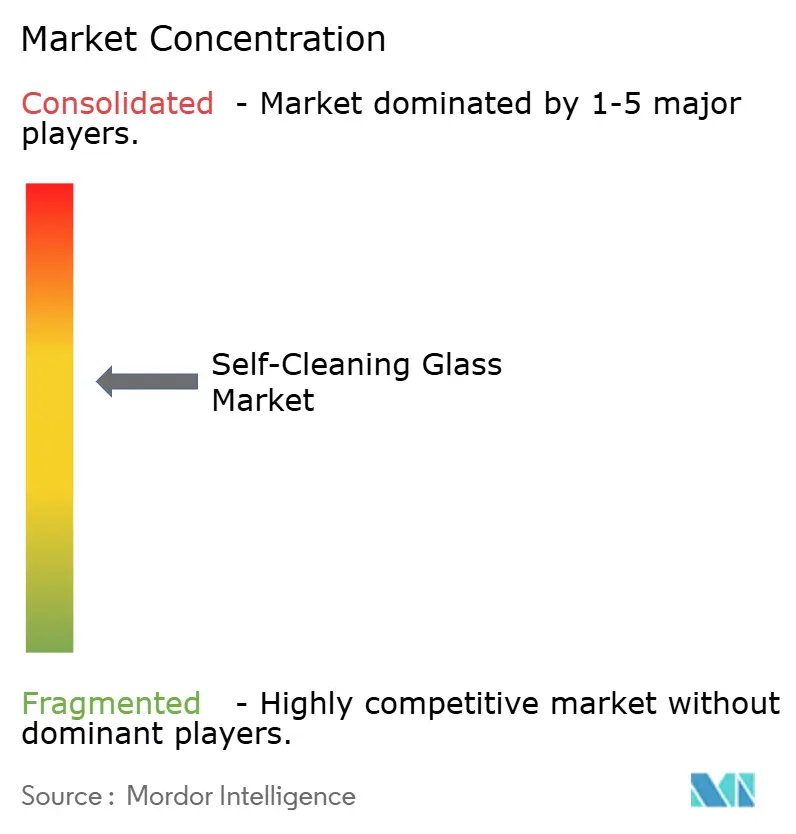
| Market Concentration | Medium |
Major Players *Disclaimer: Major Players sorted in no particular order Image © Mordor Intelligence. Reuse requires attribution under CC BY 4.0. | |
Self-Cleaning Glass Market Analysis by Mordor Intelligence
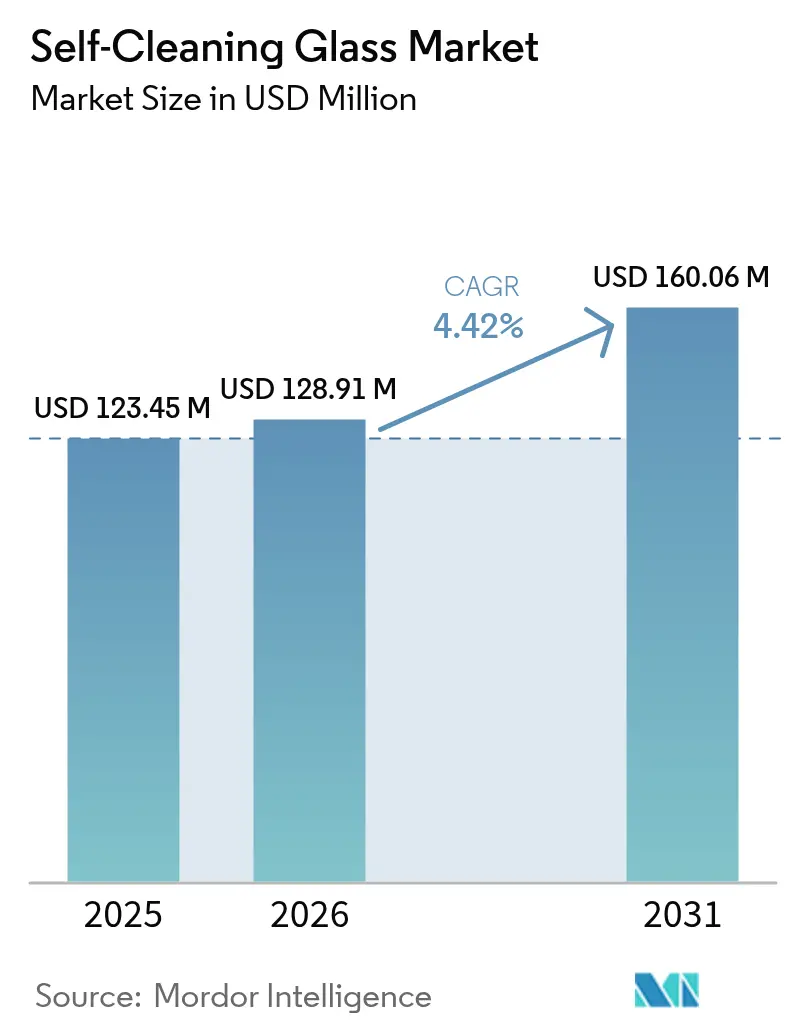
Self-Cleaning Glass Market size in 2026 is estimated at USD 128.91 million, growing from 2025 value of USD 123.45 million with 2031 projections showing USD 160.06 million, growing at 4.42% CAGR over 2026-2031. The expansion shows how self-cleaning glazing is moving from specialist to mainstream use in construction, automotive, and solar energy projects. Regulatory pressure for green buildings in Europe, widening solar capacity in Asia Pacific, and the operational savings linked to reduced manual washing are the primary growth catalysts. Product innovation now centers on multifunctional units that combine self-cleaning, solar control, and smart-building compatibility, allowing vendors to command premium pricing. Supply chains remain fairly resilient because large float-glass makers have expanded coaters and automated lines, yet the market still faces cost barriers in highly price-sensitive residential work. Manufacturing complexity and uneven code adoption in emerging countries temper the pace of roll-outs, but technology upgrades and financing models that capture lifecycle value continue to narrow the cost gap with standard glazing.
Key Report Takeaways
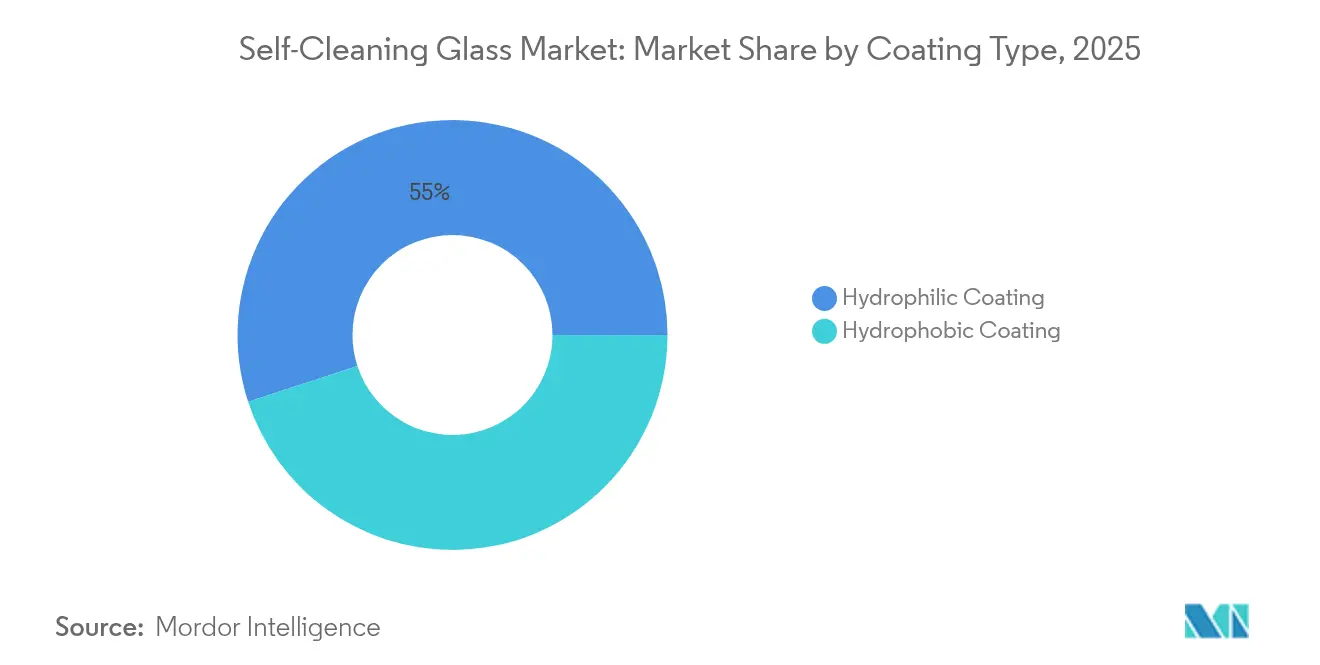
- By coating type, hydrophilic technology led with 55.02% of the self-cleaning glass market share in 2025, while hydrophobic coatings are forecast to post a 5.32% CAGR to 2031.
- By application, facades and windows held 37.85% revenue share in the self-cleaning glass market in 2025; solar panels and BIPV are expected to grow at a 6.95% CAGR to 2031.
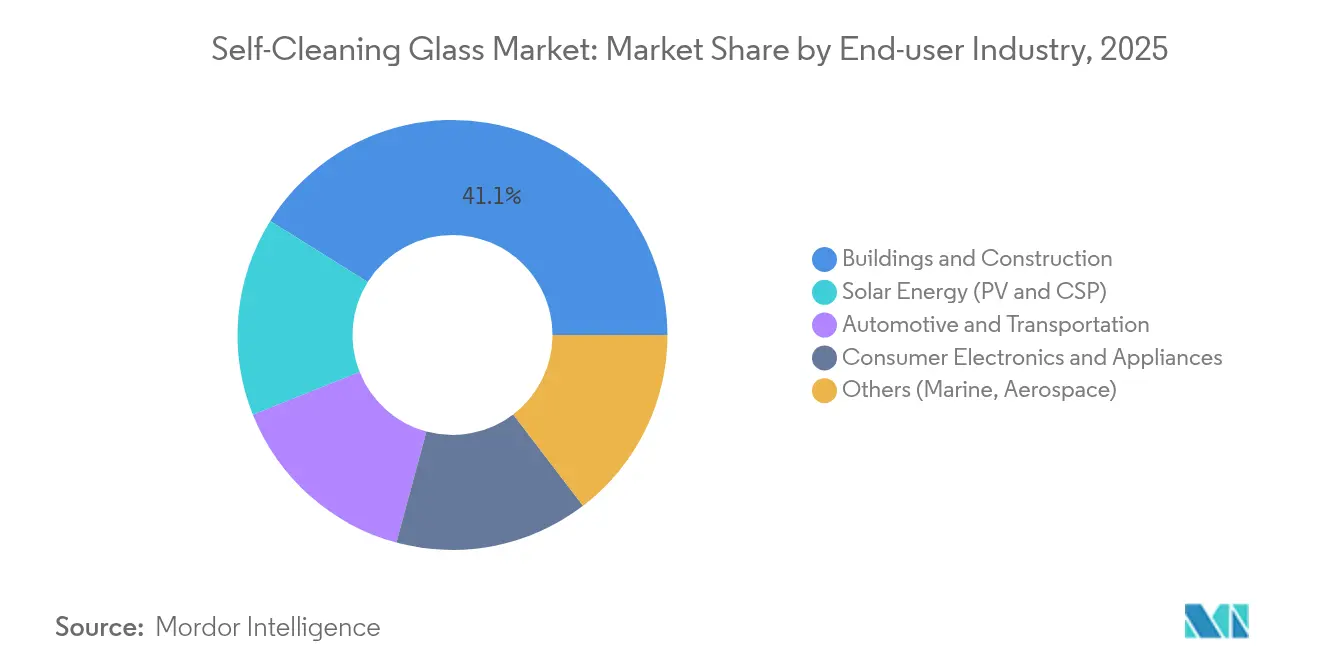
- By end-user industry, the buildings and construction segment accounted for 41.10% share of the self-cleaning glass market size in 2025, whereas solar energy is projected to expand at 6.21% CAGR through 2031.
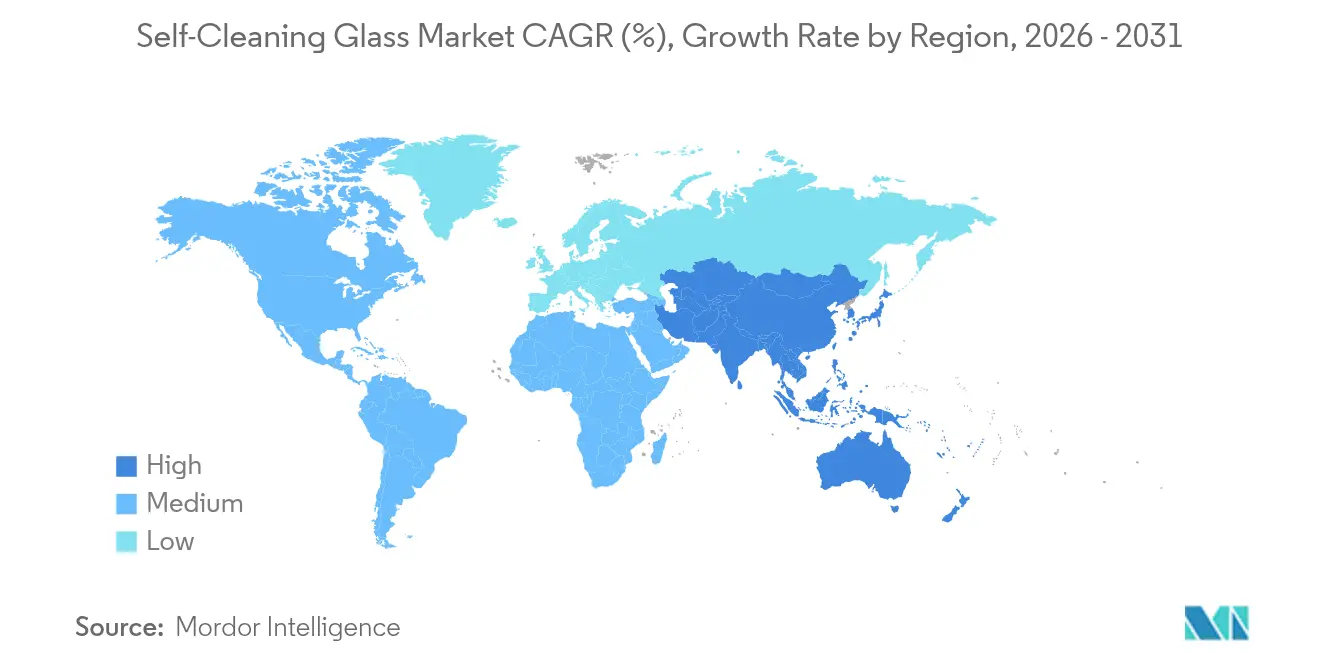
- By geography, Europe commanded 36.10% of the self-cleaning glass market in 2025, but Asia Pacific is advancing at a 6.05% CAGR through 2031.
Note: Market size and forecast figures in this report are generated using Mordor Intelligence’s proprietary estimation framework, updated with the latest available data and insights as of 2026.
Global Self-Cleaning Glass Market Trends and Insights
Drivers Impact Analysis*
| Drivers | (~) % Impact on CAGR Forecast | Geographic Relevance | Impact Timeline |
|---|---|---|---|
| Growing green-building mandates | +1.2% | Europe and North America, expanding to Asia Pacific | Medium term (2-4 years) |
| Rapid façade replacement in high-rise retrofits | +0.8% | Global urban centers, concentrated in Europe and North America | Short term (≤ 2 years) |
| Increasing demand from the energy sector | +1.1% | Global, with Asia Pacific leading installations | Long term (≥ 4 years) |
| Hygiene-driven use in institutional and healthcare buildings | +0.6% | Global, accelerated after the pandemic | Medium term (2-4 years) |
| Growth of solar panel installations | +1.3% | Global, with Asia Pacific and the Middle East and Africa leading | Long term (≥ 4 years) |
| Source: Mordor Intelligence | |||
Growing Green-Building Mandates
Regulations are resetting glazing specifications as authorities tighten energy codes to reach carbon targets. The European Union’s Energy Performance of Buildings Directive 2024/1275 requires that all member states deliver zero-emission building stock by 2050, which directly boosts demand for advanced glazing that lowers operational loads[1]. Similar rules now appear in the United States and major Asia Pacific economies. Certification programs such as LEED and BREEAM award points for self-cleaning systems because lower maintenance cuts resource use. This incentive framework helps the self-cleaning glass market gain traction among developers chasing premium building ratings. Government data showing buildings account for 40% of carbon emissions strengthens the policy drive toward high-performance facades.
Rapid Façade Replacement in High-Rise Retrofits
A large cohort of towers built during the 1980s and 1990s is entering the replacement window for curtain-wall systems. For buildings above 20 stories, the economics favor self-cleaning glass because rope-access washing is expensive and risky. AGC has upgraded continuous coaters to serve the retrofit boom and reports rising orders linked to urban renewal projects. Insurers in Europe and North America offer premium discounts for properties that reduce façade maintenance accidents, increasing owner interest. The combined safety and operating-cost rationale is accelerating the penetration of the self-cleaning glass market in central business districts.
Increasing Demand from the Energy Sector
Dust can cut solar output by up to 30%, so utility-scale farms now specify self-cleaning covers to safeguard revenue streams. Field studies demonstrate superhydrophilic coatings remove 92% of particulates and raise spectral transmittance by 26.5%. In remote deserts and offshore arrays, robotic or manual cleaning is costly or impossible, giving self-cleaning technology a rapid payback. Concentrated solar power mirrors also adopt similar coatings because reflectance declines quickly when soiled. As global renewable quotas tighten, operators prioritize solutions that secure lifetime performance, reinforcing the upward trajectory of the self-cleaning glass market.
Widespread Adoption in Institutional and Healthcare Buildings for Hygiene Control
Titanium dioxide coatings exhibit over 80% bactericidal efficacy under common hospital UV exposure, providing a passive antimicrobial layer that complements cleaning protocols. Healthcare design guidelines from the American Society for Health Care Engineering now list self-disinfecting surfaces, prompting greater specification of self-cleaning glazing. Schools, airports, and government buildings have mirrored this trend because fewer touchpoints lower maintenance budgets and public health risks. Post-pandemic awareness ensures that hygiene will continue to influence glazing choices, sustaining long-term demand across the self-cleaning glass industry.
Restraints Impact Analysis*
| Restraints | (~) % Impact on CAGR Forecast | Geographic Relevance | Impact Timeline |
|---|---|---|---|
| Slow adoption in cost-sensitive sectors | −0.9% | Global, especially emerging markets | Short term (≤ 2 years) |
| Complex manufacturing process adds cost | −0.7% | Global manufacturing hubs | Medium term (2-4 years) |
| Regulatory inconsistencies across countries affecting adoption. | -0.5% | Global, cross-border manufacturers | Medium term (2-4 years) |
| Source: Mordor Intelligence | |||
Slow Adoption in Cost-Sensitive Sectors
Self-cleaning panes carry a 20–40% premium over standard float glass, which deters residential and public procurement projects where upfront budgets dominate decision-making. In emerging economies, labor rates for window washing remain low, blunting lifecycle savings arguments. These constraints slow the penetration of the self-cleaning glass market in low-rise housing, student dormitories, and public facilities. Wider adoption hinges on scaled production that trims coating costs and on financing structures that let owners monetize operating savings.
Complex Manufacturing Process Increases Production Time and Cost
Hydrophilic layers are deposited through chemical vapor or sol-gel processes at temperatures above 450 °C. Tight thickness tolerances near 50 nm require sophisticated monitoring, while any defect triggers costly scrap. These steps add energy, labor, and capital requirements compared with uncoated float lines. Smaller regional manufacturers, therefore, struggle to enter the self-cleaning glass market, limiting price competition. Ongoing research into atmospheric-pressure plasma treatment and wire-bar coating aims to improve yields and cut cycle times, yet large-scale commercialization is still two to four years away.
*Our forecasts treat driver/restraint impacts as directional, not additive. The impact forecasts reflect baseline growth, mix effects, and variable interactions.
Segment Analysis
By Coating Type: Hydrophilic Dominance Faces Hydrophobic Innovation
Hydrophilic technology held 55.02% of the self-cleaning glass market in 2025. NSG Group’s Pilkington Activ and similar products use titanium dioxide to break down organic matter and promote water sheeting that rinses façades during rain events. Despite that dominance, hydrophobic coatings are the fastest-growing option with a 5.32% CAGR through 2031. Ultrasonic surface modification from Curtin University forms a covalent organic layer that permanently repels water and removes the need for chemical coatings. Superhydrophobic nanocomposite films now exceed 160° water contact angles and survive long UV exposure, widening the scope in automotive windscreens and outdoor displays. As these breakthroughs prove durable at scale, hydrophobic solutions may chip away at the self-cleaning glass market share of hydrophilic incumbents.

By Application: Solar Panels Drive Innovation Beyond Traditional Façades
Facades and windows dominated with 37.85% of applications in 2025. Retrofitting towers and new high-rise projects will keep this slice sizable, yet solar panels and BIPV are advancing at a 6.95% CAGR. Energy yields degrade quickly when glass is dirty, so photovoltaic owners standardize on superhydrophilic covers to maintain throughput. This directly links cleanliness and cash flow, lifting demand within the self-cleaning glass market. Roofs and skylights also benefit because cleaning access is challenging, and occupants value daylighting without spotty panes.
Vehicle windscreens, sunroofs, and mirrors capture share as auto OEMs move toward higher-strength laminated glass with coatings that endure thermal cycling and wiper abrasion. Researchers have reported niobia nanosheet films that remain transparent and self-cleaning after 100,000 wiper passes.
By End-User Industry: Solar Energy Outpaces Traditional Construction
Buildings and construction contributed 41.10% of the self-cleaning glass market size in 2025. Green-building codes, façade replacement cycles, and tenant demand for pristine views sustain baseline volume. Growth is steadier than spectacular because commercial cycles and residential affordability create adoption caps. Despite a smaller base, the solar energy segment is set to post the strongest 6.21% CAGR. Dust-prone solar parks in Asia Pacific and the Middle East deploy self-cleaning covers to maximize kWh output, turning performance gains into immediate revenue. Payback periods below three years encourage project developers to specify coated glass as a default. Automotive and transportation is another promising area, buoyed by electric vehicles that depend on lightweight, panoramic glazing as part of design language and weight reduction programs.
Geography Analysis
Europe remained the largest regional contributor with 36.10% of the self-cleaning glass market in 2025. Regulations such as the Energy Performance of Buildings Directive set binding efficiency targets that favor advanced glazing. AGC Glass Europe’s plan to recycle photovoltaic cover glass into flat production aligns with circular-economy policies and adds supply stability.
Asia Pacific delivered the fastest 6.05% CAGR and will likely narrow the volume gap by 2030. China dominates solar panel output and integrates self-cleaning covers to preserve export competitiveness and domestic generation. Smart-city roll-outs and the 14th Five-Year Plan’s green targets spur adoption in both public and private real-estate projects.
North America, South America, and Middle-East, and Africa together hold a smaller but expanding slice of the self-cleaning glass market. United States federal incentives and LEED certification credits lift commercial installations, especially in coastal regions where salt spray accelerates pane fouling.
Regulatory Landscape
Regulation affecting self-cleaning glass is increasingly linked to broader building-energy and product-performance frameworks, with technical standards used to qualify coated-glass self-cleaning behavior. In Europe, EN 1096-5:2016 provides a recognized test and classification method for self-cleaning performance of coated glass surfaces, supporting more consistent specification for architectural use. Safety glazing references such as ANSI Z97.1-2015 in North America also shape how coated products are evaluated.
Trade and country standards are further shaping substrate availability and compliance requirements for coated products. In the United States, the Department of Commerce published a countervailing duty order on float glass products from China and Malaysia in April 2026 following affirmative injury findings. Colombia enacted Decree 636 in June 2026 establishing a 35% tariff on colorless float glass imports from non-FTA countries. In China, application-specific standardization advanced with GB/T 43083-2023 (effective April 2024) for self-cleaning coated glass used in solar power generation and JC/T 2168-2023 (effective July 2024) for self-cleaning coated glass, pushing suppliers to document durability and performance across both building and PV use cases.
Value Chain Analysis
The value chain starts with upstream minerals and chemicals for float glass (silica sand, soda ash, limestone, dolomite and metal oxides), then moves into energy-intensive melting and forming through the float process before the downstream coating step. Self-cleaning functionality is typically added through thin-film deposition, commonly titanium dioxide-based, using approaches such as sputtering, CVD, or sol-gel. Finished products then go through cutting, tempering or lamination, and insulating glass unit (IGU) assembly, with process windows governed by coating handling guidelines, including requirements around edge deletion, sealing compatibility, and post-processing limitations for coated lites.
Midstream activity is carried out by integrated glass majors and regional float-glass producers that run coating lines and supply fabricators, facade contractors and OEM channels across construction, automotive glazing systems and PV cover glass. Key bottlenecks remain coating durability under abrasion, UV and humidity, along with yield loss tied to tight thickness tolerances during deposition. These constraints reinforce the advantage of vertically integrated players such as AGC, Saint-Gobain, NSG Group and Guardian Industries, which can control substrate supply, coating quality and certification or EPD documentation. Downstream demand is ultimately driven by specification and project economics, so partnerships with facade contractors, PV module supply chains and retrofit programs help convert performance benefits into installed solutions.
Competitive Landscape
The self-cleaning glass market features a moderately fragmented group of global float-glass majors supplemented by niche coating innovators. AGC, Saint-Gobain, NSG Group, and Guardian Industries rely on scale economies and vertically integrated float lines to control raw glass supply, coating chambers, and distribution. Technology partnerships shape differentiation. Regional challengers in China, India, and Turkey invest in atmospheric-pressure plasma coaters that avoid vacuum infrastructure and lower energy loads. These firms aim to serve domestic mid-tier construction, where price remains decisive.
Self-Cleaning Glass Industry Leaders
-
Saint-Gobain
-
AGC Inc.
-
Guardian Industries
-
Nippon Sheet Glass Co., Ltd
-
CARDINAL GLASS INDUSTRIES, INC
- *Disclaimer: Major Players sorted in no particular order
Market Opportunities and Future Outlook
White space is emerging where owners can monetize avoided cleaning labor, safety risk and water use, especially in high-rise retrofit facades and in soiling-prone solar installations where output loss is material, with dust-related PV losses cited at up to 30% in the report context. Differentiation is also shifting from single-feature self-cleaning to multifunctional glazing that bundles self-cleaning with solar control, anti-fogging, anti-reflective and hygiene benefits, matching the market move toward premium, performance-documented building envelopes and PV cover glass.
Near-term opportunity is focused on improving durability and manufacturability of hydrophobic and hybrid systems while preserving optical clarity. Published 2026 research in the report context highlights practical performance targets that address these needs, including semi-transparent superhydrophobic coatings with 75% optical transmittance and 153.2 degree water contact angle, and PV-oriented nanostructured surfaces showing 95% transmittance with water contact angles above 155 degrees. On the supply side, capacity and product moves by established glassmakers also support wider adoption. For example, NSG Group reporting completion and start-up of a US solar energy glass facility converted from an existing float line (2025) supports more localized supply for PV-related self-cleaning cover glass and related coated-glass offerings.
Recent Industry Developments
- July 2026: Guardian Glass launched Guardian NEXA, a lower-carbon float glass range offered in two performance levels (NEXA 9 and NEXA 6) supported by third-party verified Environmental Product Declarations. The launch supports decarbonization-led specifications in facade and glazing projects and creates a clearer pathway to pair coated/self-cleaning products with documented embodied-carbon credentials.
- February 2025: Curtin University researchers unveiled an ultrasonic technique that permanently bonds a hydrophobic layer to glass without traditional chemicals. The approach targets longer-life self-cleaning performance for construction and automotive glazing and supports scaling by reducing reliance on conventional coating chemistries.
- September 2024: Nippon Sheet Glass Co., Ltd introduced the HomeComfort range at Glasstec 2024, including HeatComfort heated insulating glass and LuxComfort integrated blinds that merge comfort features with self-cleaning functionality. The release reflects the market shift toward multifunctional insulating glass units where self-cleaning is packaged alongside occupant-comfort and building-systems integration benefits.
Research Methodology Framework and Report Scope
Market Definition and Coverage
This market covers the value of self-cleaning glass sold for end uses where the glass surface is designed to reduce manual cleaning through coating behavior, and it is counted on a revenue basis across key end-user industries.
Scope exclusions: Excludes standard uncoated glazing and generic facade glass without a self-cleaning function, even if it is marketed as low-maintenance.
Segmentation Overview
- By Coating Type
- Hydrophilic Coating
- Hydrophobic Coating
- By Application
- Facades and Windows
- Roofs and Skylights
- Solar Panels and BIPV
- Mirrors and Glass Partitions
- Vehicle Windscreens and Sunroofs
- By End-user Industry
- Buildings and Construction
- Automotive and Transportation
- Solar Energy (PV and CSP)
- Consumer Electronics and Appliances
- Others (Marine, Aerospace)
- By Geography
- Asia-Pacific
- China
- India
- Japan
- South Korea
- Rest of Asia-Pacific
- North America
- United States
- Canada
- Mexico
- Europe
- Germany
- United Kingdom
- France
- Italy
- Rest of Europe
- South America
- Brazil
- Argentina
- Rest of South America
- Middle-East and Africa
- Saudi Arabia
- South Africa
- Rest of Middle-East and Africa
- Asia-Pacific
Data Sources, Market Sizing, and Validation
Desk Research
Desk research was used to set the market context and build a clean fact base around construction activity, glass demand signals, and adoption triggers for coated glazing. We referred to public sources such as the International Energy Agency for building energy trends, US DOE materials and building programs, and standards and guidance published by ISO and ASTM that help frame product requirements and test approaches.
To ground the demand side, we also reviewed trade and macro indicators from sources such as UN Comtrade and national statistics portals, along with public customs releases where available. Company annual reports, investor presentations, and reputable industry press were used to track capacity additions, coating technology direction, and price movement narratives, and then these were cross-checked using paid subscriptions for company financials and intelligence, patent databases, and an import export shipment-level database where it was relevant for coated glass flows. These desk sources are illustrative only, and many other public references were used during data collection, validation, and clarification.
Primary Interviews and Surveys
Primary work focused on interviews and short surveys with coating and glass value chain participants, fabricators, installers, and downstream specifiers who influence adoption in buildings, automotive glazing, and solar applications. For a global market like this, inputs were balanced across APAC, EMEA, and the Americas so that regional differences in building codes, project pipelines, and buyer willingness to pay could be reflected in the final assumptions.
Distribution of primary research fieldwork respondents
| Company type | Respondent position | Region |
|---|---|---|
| Top tier: 31% | CXOs: 15% | APAC: 43% |
| Mid tier: 52% | Functional/Unit leaders: 42% | EMEA: 32% |
| Smaller Players: 17% | Managers: 43% | Americas: 25% |
Market-Sizing & Forecasting
Sizing starts with a top-down build where construction and renovation activity, glass intensity in facades and windows, and the penetration of coated and specialty glazing are used to reconstruct the addressable revenue pool. Once that demand pool is framed, the model is adjusted using selective bottom-up checks, such as sampled supplier revenues, channel conversations on project mix, and ASP times volume sanity checks for major use areas.
A few practical inputs keep the model tied to real market behavior, including commercial and residential glazing demand trends, green building and energy efficiency policy pull, solar capacity additions that use glass surfaces, and automotive glazing feature uptake where it makes sense. Coating mix assumptions (hydrophilic versus hydrophobic) and typical replacement cycles are also considered, because they affect repeat demand and the average value captured per square meter. Where country level data is incomplete, nearby markets with similar building and climate patterns are used as proxies, and then they are corrected through interview feedback.
For forecasting, scenario analysis is used with a central case that blends construction spending outlook, expected penetration changes, and achievable ASP progression based on coating cost and adoption friction. The forward view is then checked against what interviewees described as realistic adoption timelines by end use, and we only widen the range when a regulatory or input-cost shock is seen as likely.
Data Validation & Update Cycle
Validation is done through multiple checks, where modeled totals are compared with independent signals such as specialty glass trade movement, public capacity announcements, and the pace of green building adoption in key regions. If a region shows an unexpected jump, the drivers are re-tested, assumptions are reworked, and experts are re-contacted when the variance cannot be explained through visible demand indicators.
Before sign-off, the numbers move through multi-step analyst reviews so that unit logic, currency conversions, and growth assumptions remain consistent across years. The report is refreshed annually, and interim updates are made when material events happen, after which a final pre-delivery review is completed so clients receive the latest updated view.
Mordor Intelligence's Self Cleaning Glass Market Size Compared With Other Published Estimates
Published market sizes for self-cleaning glass can vary quite a bit, even when everyone is discussing the same end uses. The gaps usually come from how each publisher defines what counts as self-cleaning glass, which years are treated as the current baseline, and what assumptions are used for adoption and price movement.
The main gap comes from scope expansion into adjacent specialty glazing, where Mordor Intelligence counts revenue only when a self-cleaning function is explicitly present in the coating or surface treatment, instead of blending in broader coated glass categories. Differences are also driven by base year choice (some sources anchor on 2024 or 2025), how fast penetration is assumed to rise in building facades and skylights, and whether ASPs are kept flat or stepped up quickly without checking supplier and installer feedback.
Benchmark comparison
| Source | Market Size | Gaps in Research Methodology |
|---|---|---|
| Mordor Intelligence | USD 128.91 M (2026) | |
| Global Consultancy A | USD 127.80 M (2024) | Uses an earlier base year and may blend broader coated glass applications into the self-cleaning definition, which can shift the starting value and dampen like-for-like comparison. |
| Industry Publisher B | USD 145.24 M (2024) | Starts from a higher 2024 base and appears to apply faster early adoption and ASP progression assumptions, which can lift the market size without the same level of cross-checking to project mix. |
Overall, the spread mainly reflects definition choices, base year timing, and how penetration and pricing are treated across buildings, solar, and automotive use cases. By keeping the scope tied to a clear self-cleaning feature and re-checking key inputs with field feedback, the estimate stays traceable to practical variables that can be revisited each refresh cycle.
Key Questions Answered in the Report
Why is the self-cleaning glass market gaining momentum in solar energy projects?
Dust can reduce photovoltaic output by up to 30%, so self-cleaning covers that shed dirt help maintain generation and deliver payback periods below three years.
Which coating technology currently dominates the self-cleaning glass market?
Hydrophilic titanium dioxide coatings hold a 55.02% share because of mature manufacturing and proven performance in façade use.
What CAGR is forecast for the self-cleaning glass market from 2026 to 2031?
The market is projected to grow at 4.42% per year over the forecast window, rising from USD 128.91 million to USD 160.06 million.
Which region is the fastest growing in the self-cleaning glass market?
Asia Pacific leads with a forecast 6.05% CAGR through 2031, driven by urbanization and rapid solar installations in China, India, and Japan.
What are the key restraints limiting wider adoption of self-cleaning glass?
Higher upfront cost versus standard glazing and complex manufacturing processes continue to slow uptake in cost-sensitive residential and public projects.