
Security Paper Market Size and Share
Market Overview
| Study Period | 2020 - 2031 |
|---|---|
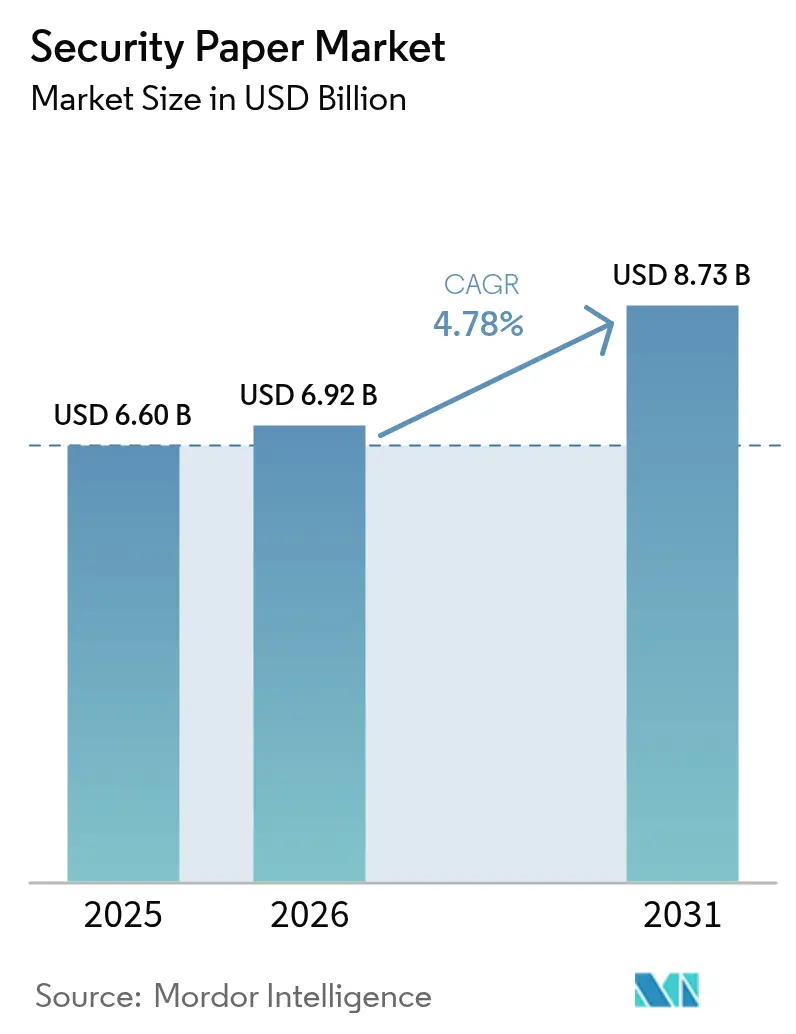
| Market Size (2026) | USD 6.92 Billion |
| Market Size (2031) | USD 8.73 Billion |
| Growth Rate (2026 - 2031) | 4.78 % |
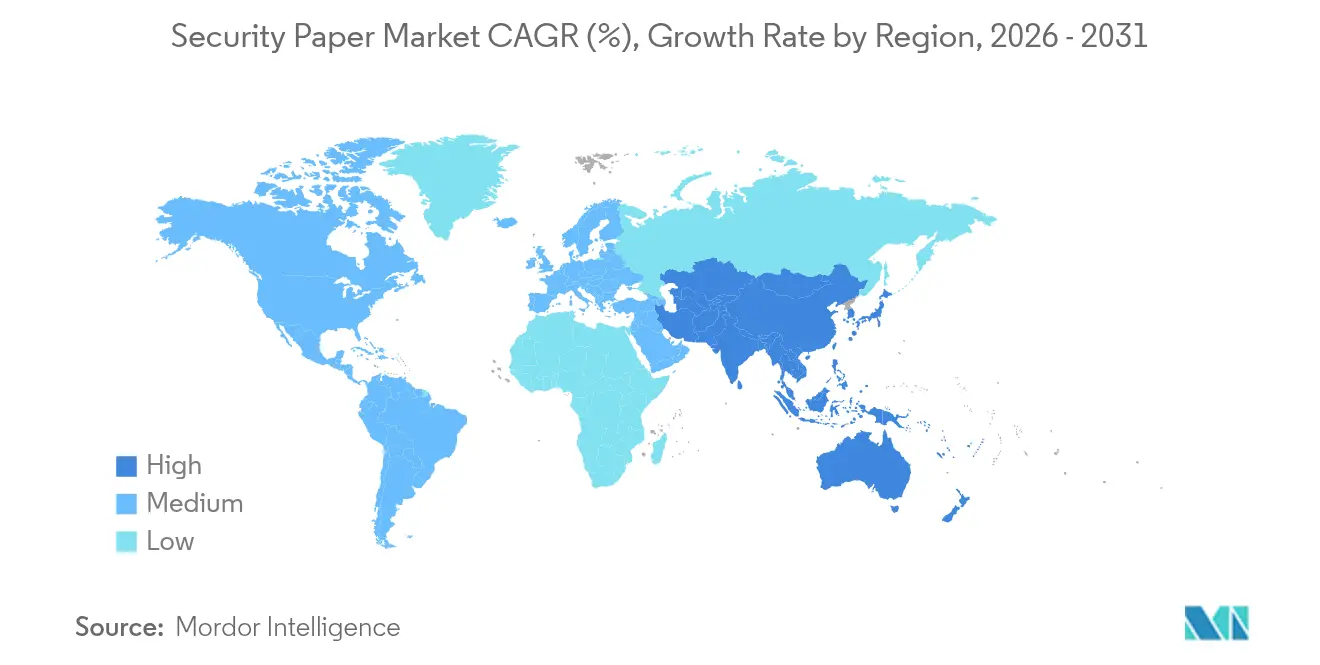
| Fastest Growing Market | Asia Pacific |
| Largest Market | Asia Pacific |
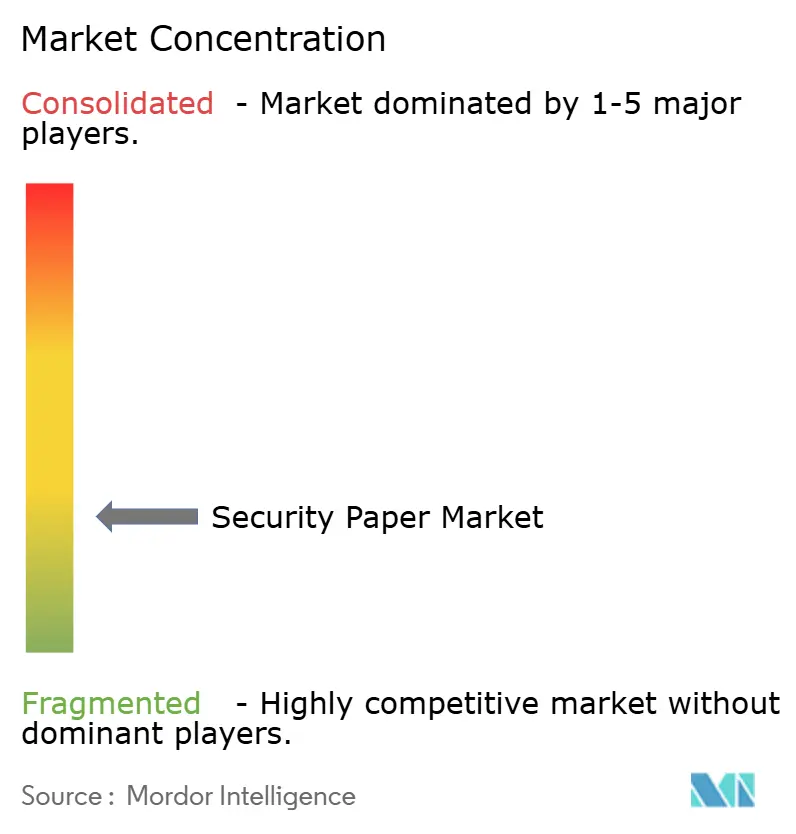
| Market Concentration | Low |
Major Players *Disclaimer: Major Players sorted in no particular order Image © Mordor Intelligence. Reuse requires attribution under CC BY 4.0. | |
Security Paper Market Analysis by Mordor Intelligence
The security paper market size is expected to grow from USD 6.60 billion in 2025 to USD 6.92 billion in 2026 and is forecast to reach USD 8.73 billion by 2031 at 4.78% CAGR over 2026-2031. The momentum comes from a steady rise in sophisticated counterfeiting attempts, renewed banknote redesign programmes, and growing demand for tamper-evident packaging in pharmaceutical and luxury value chains. India’s April 2025 alert on high-quality counterfeit ₹500 notes highlights the advanced techniques now confronting central banks. Simultaneously, polymer and hybrid substrates are gaining favour because they enable complex optical features and extend note life, giving issuers a lower total cost of ownership. Supply-chain resilience is emerging as a strategic theme, with manufacturers exploring recycled and region-specific fibres to offset cotton volatility and align with sustainability mandates.
Key Report Takeaways
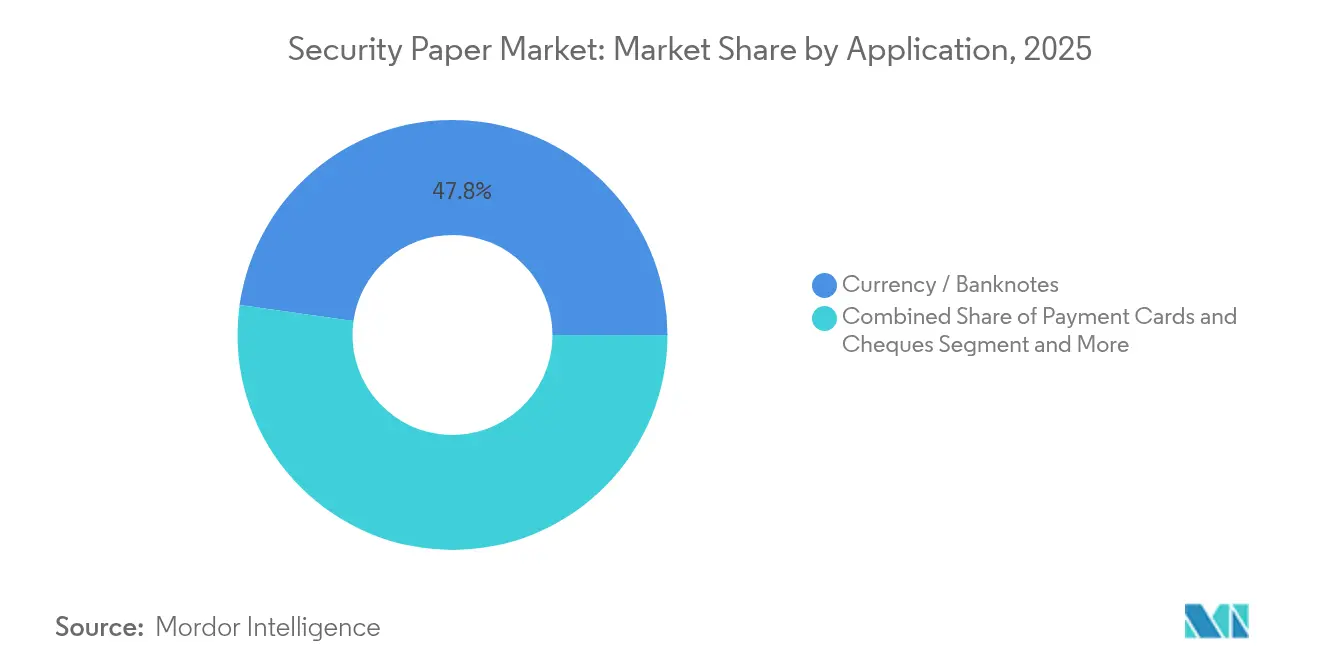
- By application, currency and banknotes led with 47.78% of security paper market share in 2025, while secure packaging and labels are projected to expand at an 8.22% CAGR to 2031.
- By substrate type, cotton-fibre paper accounted for 56.10% of the security paper market size in 2025; recycled-fibre papers hold the fastest outlook at a 9.05% CAGR through 2031.
- By security feature, security threads captured 33.21% of security paper market share in 2025, whereas RFID/NFC-embedded formats are advancing at a 6.29% CAGR.
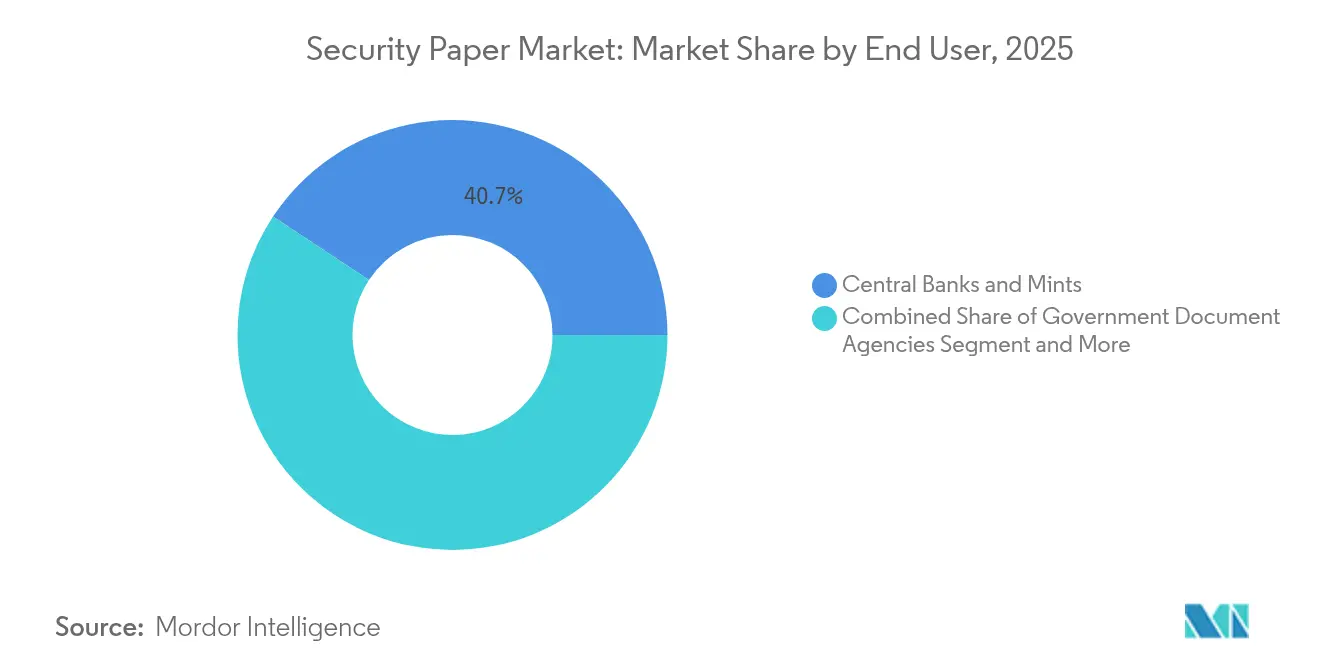
- By end user, central banks and mints held 40.72% revenue share in 2025; secure printing houses post the highest projected CAGR at 6.88% to 2031.
- By geography, Asia-Pacific contributed 32.10% of 2025 revenue and is forecast to grow at 6.74% CAGR, maintaining regional primacy.
Note: Market size and forecast figures in this report are generated using Mordor Intelligence’s proprietary estimation framework, updated with the latest available data and insights as of 2026.
Market Trends and Insights
Drivers Impact Analysis of Security Paper Market*
| Driver | (~) % Impact on CAGR Forecast | Geographic Relevance | Impact Timeline |
|---|---|---|---|
| Rising fraud and counterfeiting incidents | +1.2% | Global, with acute impact in APAC and emerging markets | Short term (≤ 2 years) |
| Expansion of secure-document programmes (e-passports, ID) | +0.8% | Global, led by North America & EU regulatory frameworks | Medium term (2-4 years) |
| Polymer and hybrid substrate migration | +0.6% | APAC core, spill-over to MEA and Latin America | Long term (≥ 4 years) |
| Excise-stamp mandates for sin-tax goods | +0.4% | Global, with early adoption in EU and North America | Medium term (2-4 years) |
| RFID/NFC-integrated "smart paper" adoption | +0.3% | North America & EU, expanding to APAC | Long term (≥ 4 years) |
| Tamper-evident packaging for high-value goods | +0.2% | Global, concentrated in pharmaceutical and luxury sectors | Short term (≤ 2 years) |
| Source: Mordor Intelligence | |||
Rising Fraud and Counterfeiting Incidents
Escalating fraud has become a structural growth pillar for the security paper market. India’s 2025 seizure of near-perfect counterfeit INR 500(USD 5.58) notes illustrates how spelling micro-errors are now among the few visible detection clues. The U.S. Department of Homeland Security warns that generative AI will heighten document forgery sophistication, forcing issuers to adopt multi-layer substrates that combine tactile, optical and digital elements.[1]U.S. Department of Homeland Security, “Impacts of Adversarial Use of Generative AI on Homeland Security,” dhs.gov Central banks respond by shortening redesign cycles, which keeps the security paper market in a perpetual upgrade mode. Across Asia-Pacific, polymer trials show counterfeit rejection rates improving by double digits once transparent windows and micro-perforations are introduced, reinforcing confidence in substrate migration. For producers, the arms race translates into steady R&D spend and a premium pricing corridor that buffers margins even when commodity fibres face inflationary spikes.
Expansion of Secure-Document Programmes
Governments are modernising identity infrastructures, intertwining physical credentials with digital verification rails. TOPPAN’s 2024 acquisition of HID Citizen Identity Solutions fused traditional security printing with biometric enrolment platforms, offering agencies a single procurement lane. Patent filings exceed 6,000 for blockchain-anchored identity solutions, signalling industry commitment to privacy-preserving, user-centric ID architectures.[2]Matthew Comb & Andrew Martin, “Mining Digital Identity Insights: Patent Analysis Using NLP,” SpringerOpen, eurasip.org National projects such as the Philippines’ abaca-infused polymer passports demonstrate localisation strategies that embed regional fibres into global-grade substrates. Demand therefore tilts toward hybrid papers that can store encrypted chips while still displaying visible watermarks, cementing a multi-dimensional revenue stream for the security paper market.
Polymer and Hybrid Substrate Migration
Durability, lifecycle economics and feature density are propelling polymer adoption. Romania’s 100-leu commemorative polymer note showcased transparent windows and laser micro-perforations, elevating counterfeit deterrence without compromising throughput on high-speed sorters. Libya joined the cohort in 2025, switching to De La Rue’s SAFEGUARD substrate that integrates SPARK Live optical ink. Field data from the Philippines indicate polymer notes last up to 7.5 years—roughly 2.5 times longer than cotton—delivering lifecycle savings that outweigh higher initial procurement costs. Hybrid compositions that sandwich cotton layers between polymer film are gaining traction, easing transition pains by retaining tactile familiarity while boosting strength. Such shifts sustain premium substrate volumes, helping the security paper market offset incremental digital-payment erosion.
Excise-Stamp Mandates for Sin-Tax Goods
Governments are tightening excise controls on tobacco, alcohol and other high-levy items, with U.S. Code Title 26 prescribing explicit stamp standards that only specialised security papers can meet. European Union directives similarly require holographic or UV-tagged stamps, generating niche but recurring orders for security printers. Mandates serve dual objectives—securing tax receipts and curbing illicit trade—which together ensure that stamp volumes remain resilient even when broader print markets decline. Suppliers that can blend overt holograms with covert RFID chips gain competitive advantage, positioning the security paper market for adjacent growth in track-and-trace solutions for pharmaceuticals and beverages.
Restraints Impact Analysis of Security Paper Market*
| Restraint | (~) % Impact on CAGR Forecast | Geographic Relevance | Impact Timeline |
|---|---|---|---|
| Digital-payment substitution | -0.8% | Global, accelerated in developed markets | Medium term (2-4 years) |
| High cost of advanced security features | -0.4% | Global, particularly impacting emerging markets | Short term (≤ 2 years) |
| Sustainability pressure on cotton fibre sourcing | -0.3% | Global, with acute impact in North America and EU | Long term (≥ 4 years) |
| Climate-driven fibre supply disruptions | -0.2% | Regional, concentrated in major cotton-producing areas | Short term (≤ 2 years) |
| Source: Mordor Intelligence | |||
Digital-Payment Substitution
Central-bank research shows consumer preference shifting toward digital wallets, casting a structural shadow on cash volumes.[3]European Central Bank, “Consumer Demand for Central Bank Digital Currency as a Means of Payment,” ecb.europa.eu Trials of a digital pound with offline functionality by the Bank of England illustrate that central-bank digital currencies could replicate many cash roles without physical notes. While migration will be gradual—Japan still issued 280 million high-tech notes in 2024—the trajectory is downward in mature economies. For the security paper market, that means defensive strategies of portfolio diversification toward passports, tax stamps and smart packaging.
High Cost of Advanced Security Features
Cutting-edge inks infused with TiO₂ and ZnO nanoparticles or AI-driven watermark algorithms raise unit costs, especially for budget-constrained issuers. Patent applications covering diffractive pigments and composite label films underscore the R&D intensity required to stay ahead of counterfeiters. Emerging markets often opt for stripped-down features, exposing them to higher fraud risk and slowing premium adoption within the security paper industry. Suppliers must therefore balance feature depth with cost efficiency, offering tiered solutions that keep the security paper market accessible across income brackets.
*Our forecasts treat driver/restraint impacts as directional, not additive. The impact forecasts reflect baseline growth, mix effects, and variable interactions.
Security Paper Market Segment Analysis
By Application:
Currency Dominance Amid Packaging GrowthCurrency and banknotes retained a commanding 47.78% slice of the security paper market in 2025, underpinned by Japan’s roll-out of 3D-hologram notes and frequent redesigns across Asia-Pacific. Despite an uptick in digital wallets, cash remains crucial for unbanked populations, giving the security paper market resilient base volumes. Cheques and payment cards hang on as secondary use cases, especially in regions where bank penetration is climbing. Identity and travel documents occupy a growing middle ground because e-passport issuance cycles are accelerating in Europe and North America. Secure packaging and labels, although only a mid-single-digit share today, are projected to rise at an 8.22% CAGR to 2031 as pharmaceutical serialisation laws widen coverage. That trajectory signals a gradual re-balancing of the security paper market away from pure currency dependency.
The segment mix also reflects risk-management strategies. Central banks favour polymer for high-denomination notes yet still specify cotton for lower tiers, spreading sourcing risk. Packaging converters, by contrast, gravitate towards synthetic and recycled fibres that pair security with sustainability. Ticketing and certificate applications retain niche demand in academic and events sectors, providing long-tail revenue. Collectively, these dynamics underline why application diversification is the foremost hedge against structural cash decline for companies active in the security paper market.


By Substrate Type:
Cotton Leadership Faces Sustainability PressureCotton-fibre sheets secured 56.10% of the security paper market share in 2025, a position earned through centuries-old manufacturing ecosystems and user familiarity. Yet consecutive droughts in Texas and a 10% output dip in India forced imports to double, inflating input costs and exposing supply vulnerability. Polymer substrates now enjoy clear durability and cost-in-use advantages, encouraging central banks in Libya, Romania and the Philippines to transition core denominations. Hybrid papers marry cotton’s tactile feel with polymer film strength, easing psychological barriers among cash users and enabling gradual equipment retrofits.
Recycled-fibre variants register a 9.05% CAGR, the fastest pace in the segment, driven by environmental scorecard pressures from both regulators and corporate sustainability officers. Abaca and linen offer region-specific opportunities, giving issuers a chance to localise supply and cut transport emissions. Looking ahead, lifecycle assessments will dictate substrate selection as much as counterfeit resistance, elevating the strategic value of in-house fibre R&D within the security paper industry.
By Security Feature Integration:
Traditional Features EvolveSecurity threads dominated 2025 with 33.21% use across issued papers, thanks to their proven track record and compatibility with existing printing lines. Watermarks continue as a foundational layer, but the rise of optically variable devices makes each new series visibly distinct, complicating counterfeiter learning curves. UV and IR fibres add covert layers that require specialist scanners, a popular choice for passports and excise stamps. Holographic imagery has moved from flat foils to dynamic portrait elements, as showcased in Japan’s 2024 notes. The fusion of multiple features is standard practice, with seven or more separate elements common on high-value denominations, reinforcing the multi-pronged defence strategy that sustains premium ASPs in the security paper market.
Second-generation innovations integrate machine-readable pixels within threads, letting bank-sorting machines authenticate notes at 40 notes per second. Colour-shifting inks provide a quick public check, while micro-text adds forensic back-office verification. The arms race creates a virtuous cycle of vendor-issuer collaboration, with each redesign feeding back into R&D pipelines for subsequent improvement. As a result, the security paper industry enjoys a built-in cadence of feature refreshes that cushions revenue against macro-economic swings.
By End User:
Central Banks Lead DiversificationCentral banks and mints consumed 40.72% of global volume in 2025, leveraging long-term supply contracts that grant them pricing power yet provide suppliers with predictable cash flows. Government document agencies form the next tier, hungry for chip-enabled passports that dovetail with e-gate infrastructure upgrades at borders. Commercial banks still commission cheques, bank drafts and high-value certificates, but their share is plateauing as online channels gain traction. Secure printing houses emerge as the fastest-expanding end user, clocking a 6.88% CAGR, since outsourcing allows smaller governments to bypass capital-intensive internal print works.
Brand-protection specialists and packaging converters round out the user matrix, positioning the security paper market to capture demand from industries outside its traditional lane. This widening spectrum compels suppliers to develop modular platforms that can serve both currency and consumer-goods clients without compromising risk segregation or regulatory compliance.
By Smart Paper Integration:
RFID/NFC Adoption AcceleratesRFID-enabled formats are projected to outpace all conventional feature sets at a 6.29% CAGR, propelled by falling chip costs and rising demand for interactive authentication. Early pilots in luxury handbags allow customers to tap labels with smartphones for provenance checks, an experience that is migrating to high-value drugs and electronics. On the governmental side, e-passports already pair RFID with laser-engraved portraits, and next-generation ID cards are expected to embed multi-frequency antennas compatible with national database readers. These capabilities transform security paper from a static barrier to a dynamic data conduit, creating ancillary revenue in software analytics and lifecycle services. Suppliers capable of horizontal integration across paper, chip and middleware layers hold a strategic edge as the security paper market pivots toward cyber-physical convergence.
Geography Analysis
APAC Security Paper Market
Asia-Pacific held 32.10% of 2025 revenue, and the region’s security paper market size is forecast to expand at 6.74% CAGR as polymer adoption widens and national ID projects scale. Japan’s July 2024 banknote launch proved the commercial viability of 3D hologram portraits, likely setting a new benchmark for neighbours planning redesigns. The Philippines rolled out its first polymer series in January 2025, anchoring its monetary modernisation programme. India’s twin dynamics of counterfeit threats and cotton-supply worries are spurring interest in blended substrates that reduce dependence on imported lint.
North America and Europe Security Paper Market
North America and Europe sit in maturity phase yet still command premium ASPs because issuers demand layered security that meets ISO and ICAO passport stipulations. The European Central Bank’s exploration of a digital euro introduces strategic uncertainty, but Romania’s 2024 polymer commemorative note confirms that Euro-linked markets remain committed to high-security physical cash for the foreseeable future.
MEA and South America Security Paper Market
The Middle East and Africa show leap-frog potential; Libya’s 2025 polymer switch is a bellwether for neighbouring states. Gulf issuers such as the UAE embrace durable polymer substrates to cope with harsh climates. South America, led by Brazil and Argentina, is expected to prioritise tax-stamp revamps to stem illicit alcohol flows, giving the security paper market a fresh revenue pipeline in excise applications.

Regulatory Landscape
The security paper market operates under a layered compliance environment spanning document security, identity standards, and packaging rules that influence substrate and feature choices. For identity and travel documents, ICAO-aligned e-passport requirements and best-practice guidance from bodies such as the Secure Identity Alliance are pushing issuers toward multi-layer protection that combines overt and covert physical security with digital verification. Standards frameworks such as ISO 22388:2023 (security design and risk assessment for physical documents and value transactions) and ISO/IEC 27000:2026 (ISMS overview and principles) also shape procurement and audit expectations when security paper is integrated with data-bearing elements, including RFID/NFC-enabled formats.
On the packaging side, Regulation (EU) 2025/40 on packaging and packaging waste tightens conformity and circularity requirements that affect secure packaging and labels. That shift raises the importance of recycled-fibre and traceable input materials in qualified supply chains. Trade remedies add additional sourcing complexity for paper-based categories used in adjacent applications: in February 2026, the European Commission adopted Implementing Regulation (EU) 2026/313 to register certain lightweight thermal paper imports from China for potential retroactive duties, and in March 2026 the United States issued a countervailing duty order on corrugated boxes from China. While these actions do not target banknote paper directly, they increase risk and compliance workloads for converters and printers buying specialized paper inputs across borders.
Competitive Landscape
Sector consolidation is reshaping market structure as players chase scale and technology breadth. TOPPAN Security’s June 2025 purchase of dzcard Group doubled its banking-card capacity and extended its personalisation network across Thailand, the Philippines and India. Crane NXT followed by acquiring De La Rue’s Authentication arm for GBP 300 million, signalling investor appetite for high-margin ID and brand-protection assets.
Patent analytics show Chinese firms leading RFID and smart-paper filings, challenging Western incumbents on innovation turf. Incumbents maintain advantage through entrenched central-bank relationships that create switching costs. Yet greenfield opportunities exist in recycled fibres and AI-enhanced watermarks, fields where newcomers can differentiate. While price competition remains limited due to strict qualification cycles, technological race intensity is high, compelling top players to earmark 6-8% of revenue for R&D. Overall, the competitive equilibrium implies mid-level consolidation but ample room for specialist disruptors that focus on adjacent verticals, thereby sustaining a vibrant security paper market.
Security Paper Industry Leaders
Giesecke+Devrient Currency Technology GmbH
Fedrigoni Group
Infinity Security Papers Limited
Ceprohart SA
Drewsen Specialty Papers GmbH & Co. KG
- *Disclaimer: Major Players sorted in no particular order
Security Paper Market Companies Covered in this Report
- Giesecke+Devrient Currency Technology GmbH
- De La Rue plc
- Fedrigoni Group
- Crane Currency
- Oberthur Fiduciaire SAS
- Papierfabrik Louisenthal GmbH
- Drewsen Spezialpapiere GmbH & Co. KG
- Domtar Corporation
- Thomas Greg & Sons Ltd
- Infinity Security Papers Ltd
- Simpson Security Papers
- Ceprohart SA
- Ciotola SRL
- A1 Security Print Ltd
- HUECK FOLIEN GmbH
- Security Papers Ltd (Pakistan)
- Portals Paper Ltd
- Sequana (Arjowiggins Security assets)
- Security Fibres Ltd
- Euro-Banknote Production GmbH

Market Opportunities and Future Outlook
Security paper demand is broadening beyond currency into regulated packaging and next-generation credentials, creating room for suppliers that can evidence both security performance and sustainability attributes. Regulation (EU) 2025/40 increases the compliance burden for packaging placed on the EU market, including conformity documentation and recyclability-linked requirements, which supports adoption of secure paper-based labels, tamper-evident formats, and recycled-fibre security papers in pharmaceutical and luxury value chains. In China, implementation of GB/T 18706-2025 for paper-based laminated packaging for liquid food and GB/T 38278.2-2025 for anti-counterfeiting holographic paper points to continued standardization of paper-based packaging and anti-counterfeiting specifications, opening space for feature suppliers (threads, OVDs, UV/IR markers) to integrate into compliant paper structures.
In currency and official documents, issuer and technology moves are reshaping opportunity areas around higher feature density and hybrid physical-digital authentication. In May 2026, the Reserve Bank of India announced a phased introduction of upgraded banknotes with enhanced security features, including anti-microbial and anti-bacterial treatments integrated into currency paper, reinforcing a commercial pathway for functional coatings and advanced substrates. Also in May 2026, Bundesdruckerei presented the STELLA concept banknote focused on sustainable production and integrated security features, pointing to continued design emphasis on durable, resource-efficient formats. As smart paper gains adoption in IDs and brand protection, vendors that can qualify RFID/NFC-embedded formats alongside traditional watermark and thread systems, and show information-security governance aligned with ISO/IEC 27000-series expectations, can strengthen their position in higher-value tenders and multi-year programs.
Recent Industry Developments in Security Paper Market
- June 2026: Giesecke+Devrient launched an AI Hub at Mila in Montreal to develop security-critical solutions for areas including financial technology and digital identity. The initiative builds capabilities that connect physical security elements with automated decisioning and fraud detection, supporting modernization of secure document and credential ecosystems.
- February 2025: Infinity Security Papers Limited was awarded a contract by Security Printing Press (Hyderabad), SPMCIL, to supply 50 MT of sensitized cream wove cheque paper for IPO. The award indicates continued institutional procurement for financial-instrument security papers and provides visibility into domestic sourcing pipelines for specialized grades.
- July 2024: Infinity Security Papers Limited was awarded a contract by India Security Press (Nasik), SPMCIL, to supply re-inforced tear and water-resistant paper (150 GSM). This tender supports demand for durable security-grade paper used in official applications where physical robustness and controlled supply are central qualification criteria.


Security Paper Market Report Scope and Research Methodology
Market Definition and Coverage
This market covers the value of security paper used to make documents harder to copy, alter, or counterfeit. It includes paper and substrate grades made with built-in security features that are used for items like banknotes, IDs, and other official or high-trust documents.
Scope exclusions: we exclude general commercial printing paper, standard packaging paper without security function, and purely digital identity or authentication services that do not use a physical security substrate.
Segments Covered in This Report
- By Application
- Currency / Banknotes
- Payment Cards and Cheques
- ID and Travel Documents
- Certificates and Ticketing
- Secure Packaging and Labels
- Other Application
- By Substrate Type
- Cotton-fibre Paper
- Polymer Substrate
- Hybrid Cotton-Polymer
- Synthetic Fibres (Abaca, Linen)
- Recycled-fibre Paper
- By Security Feature Integration
- Watermarks
- Security Threads
- Holograms and OVD
- UV/IR Fibres and Dyes
- RFID/NFC Embedded
- Micro-printing and Nanotext
- Colour-shifting Inks
- By End User
- Central Banks and Mints
- Government Document Agencies
- Secure Printing Houses
- Commercial Banks
- Brand-Protection and Packaging Firms
- By Geography
- North America
- United States
- Canada
- Mexico
- Europe
- Germany
- United Kingdom
- France
- Italy
- Russia
- Rest of Europe
- Asia-Pacific
- China
- India
- Japan
- South Korea
- Rest of Asia-Pacific
- Middle East and Africa
- Middle East
- Saudi Arabia
- United Arab Emirates
- Turkey
- Rest of Middle East
- Africa
- South Africa
- Nigeria
- Rest of Africa
- Middle East
- South America
- Brazil
- Argentina
- Rest of South America
- North America
Data Sources, Market Sizing, and Validation
Desk Research
Desk work started with mapping where security paper demand comes from and how it moves across borders, since many buyers are public institutions and regulated printers. We used public sources such as central bank currency reports, national statistics offices, customs trade statistics portals, and pulp and paper industry bodies to understand production trends and consumption signals.
To avoid building the model on one data stream, we also reviewed sources such as annual reports and investor presentations of listed paper and specialty materials companies, government procurement portals for security document tenders, and patent databases to track adoption of features like threads, watermarks, and embedded elements. Where available, we also leaned on paid subscriptions for company financials and intelligence, shipment-level import and export records, and patent analytics to validate timelines and price-movement assumptions. The desk sources listed here are illustrative only, and we used many other public references for cross-checks and clarification.
Primary Interviews and Surveys
Primary inputs came from interviews and structured surveys with paper converters, security printers, raw material suppliers, and downstream buyers tied to banknote and identity-document programs. These discussions were used to confirm pricing logic, procurement cycles, substitution between cotton and polymer substrates, and realistic adoption rates of specific security features across major regions.
Distribution of primary research fieldwork respondents
| Company type | Respondent position | Region |
|---|---|---|
| Top tier: 38% | CXOs: 14% | APAC: 50% |
| Mid tier: 44% | Functional/Unit leaders: 26% | EMEA: 31% |
| Smaller Players: 18% | Managers: 60% | Americas: 19% |
Market-Sizing & Forecasting
Sizing was built using a top-down approach where demand pools were reconstructed from currency-in-circulation direction, banknote and secure-document issuance plans, and trade and production indicators for specialty paper and substrates, then translated into value using application-led pricing bands. To keep totals realistic, we corroborated them with selective bottom-up checks such as sampled supplier revenue splits, channel checks with security printers, and volume times average selling price calculations for a few high-visibility applications.
Key inputs that shaped the model included trends in banknote circulation and replacement rates, issuance volumes for passports and national IDs, tender and contract renewal cycles, substrate shifts between cotton-fiber paper and polymer, and security feature intensity (for example, watermark and thread complexity) that tends to lift average selling prices. When country-level volumes were not available, gaps were handled by using proxy indicators such as population cohorts, travel-document penetration, and known program refresh timing, followed by expert review. Forecasts were produced using scenario analysis supported by trend smoothing on core drivers, since policy shifts and procurement timing can create step-changes that a straight-line projection would miss.
Data Validation & Update Cycle
Validation was done through multiple passes where model outputs were checked against independent signals like currency printing activity, import and export movements for relevant paper grades, and the pace of identity document program renewals. When a data point created an unusual jump, the assumption was revisited, and follow-up calls were triggered to confirm whether it was a one-time contract or a real demand shift.
Before sign-off, the work goes through peer review so the logic, units, and conversions align across regions and years. Reports are refreshed annually, and interim updates are made when material events occur such as major currency redesign cycles, policy changes impacting passports and visas, or sharp price swings in key inputs. Right before delivery, the latest public releases are rechecked so clients receive an up-to-date view.
Mordor Intelligence's Security Paper Market Sizing Compared With Other Published Estimates
Published market sizes for security paper often vary because groups do not refresh their models at the same time, and they do not always align on the exact year of currency conversion, pricing basis, or which applications count as in-scope.
In practice, the biggest gaps usually come from how fast average selling prices are updated during inflationary cycles, whether polymer substrates and feature add-ons are priced as separate uplift factors, and whether older base years are carried forward without re-validating issuance and tender timing. In this study, the refresh cadence and currency timing were kept consistent with the stated base year, and price bands were rechecked through recent program and procurement signals before totals were finalized, which explains the lower 2026 value shown by Mordor Intelligence.
Benchmark comparison
| Source | Market Size | Gaps in Research Methodology |
|---|---|---|
| Mordor Intelligence | USD 6.92 B (2026) | |
| Global Consultancy A | USD 15.26 B (2018) | Uses an older base year and a broad historical growth frame, which can embed past price levels and older document-issuance patterns that are not fully re-validated against newer tenders and substrate shifts. |
| Industry Publisher B | USD 20.94 B (2026) | Likely applies wider application coverage and higher ASP progression, where security features and adjacent secure-print inputs may be priced in more aggressively, and the currency conversion timing can lift totals versus a tighter security-substrate-only view. |
The table shows that timing and scope choices can easily move the outcome by a wide range, even when multiple publishers are describing the same anti-counterfeiting demand theme. By tying assumptions to observable issuance cycles, tender renewals, and realistic price bands by application, the final number stays traceable and repeatable when the model is refreshed.


Key Questions Answered in the Report
What is the current value of the security paper market?
The security paper market size is USD 6.92 billion in 2026, with a forecast to reach USD 8.73 billion by 2031.
Which application segment leads global demand?
Currency and banknotes remain dominant, accounting for 47.78% of 2025 revenue.
Why are polymer substrates gaining ground?
Polymer notes last up to 7.5 years and support advanced security features like transparent windows, reducing lifecycle costs.
How fast is the recycled-fibre segment growing?
Recycled-fibre papers exhibit a 9.05% CAGR through 2031, the fastest rate among substrates.
Page last updated on:


 Your data is secure and never sold or shared.


